

Habitual use of GPS negatively impacts spatial memory during self-guided navigation
Open accessThe DOI matches its Crossref record; 46 of the 46 references it cites were found in a registry or an index.
Abstract
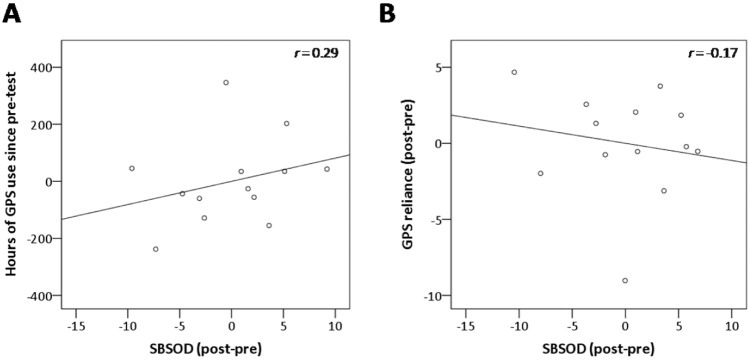
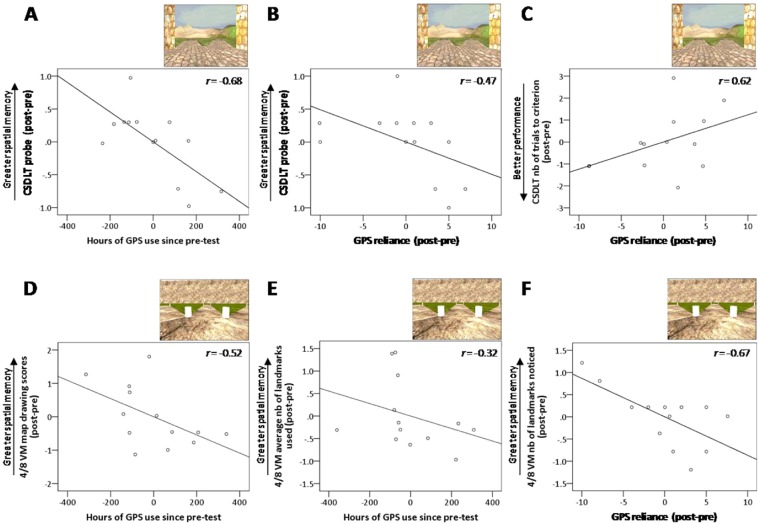
Global Positioning System (GPS) navigation devices and applications have become ubiquitous over the last decade. However, it is unclear whether using GPS affects our own internal navigation system, or spatial memory, which critically relies on the hippocampus. We assessed the lifetime GPS experience of 50 regular drivers as well as various facets of spatial memory, including spatial memory strategy use, cognitive mapping, and landmark encoding using virtual navigation tasks. We first present cross-sectional results that show that people with greater lifetime GPS experience have worse spatial memory during self-guided navigation, i.e. when they are required to navigate without GPS. In a follow-up session, 13 participants were retested three years after initial testing. Although the longitudinal sample was small, we observed an important effect of GPS use over time, whereby greater GPS use since initial testing was associated with a steeper decline in hippocampal-dependent spatial memory. Importantly, we found that those who used GPS more did not do so because they felt they had a poor sense of direction, suggesting that extensive GPS use led to a decline in spatial memory rather than the other way around. These findings are significant in the context of society's increasing reliance on GPS.
Overview
The claims and statistics of this paper haven’t been checked yet.
Free: it reads the open-access text and checks the first 5 claims that cite a source we can check. Create a free account to check every claim.
Integrity signals
Registry
Cites
Statistics
Figures
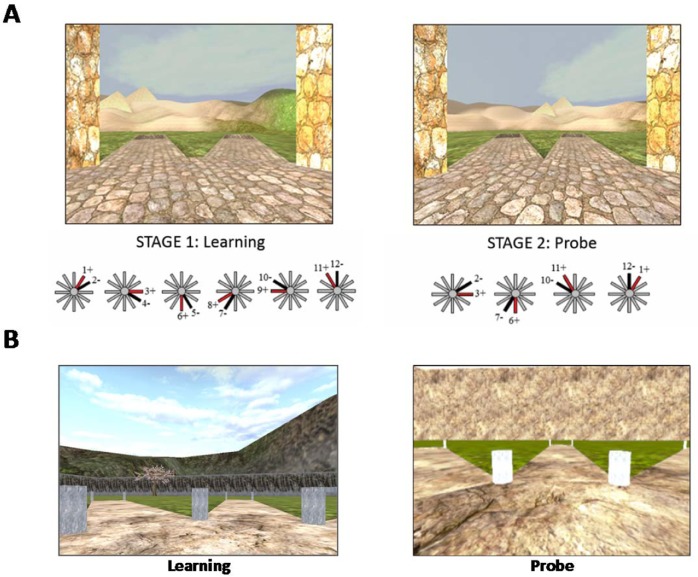
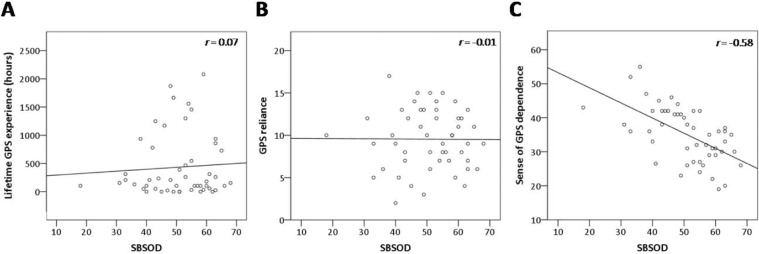
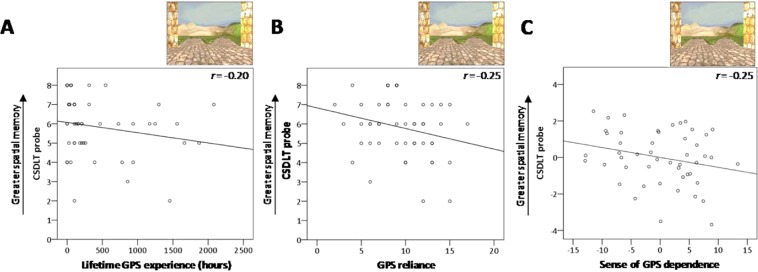
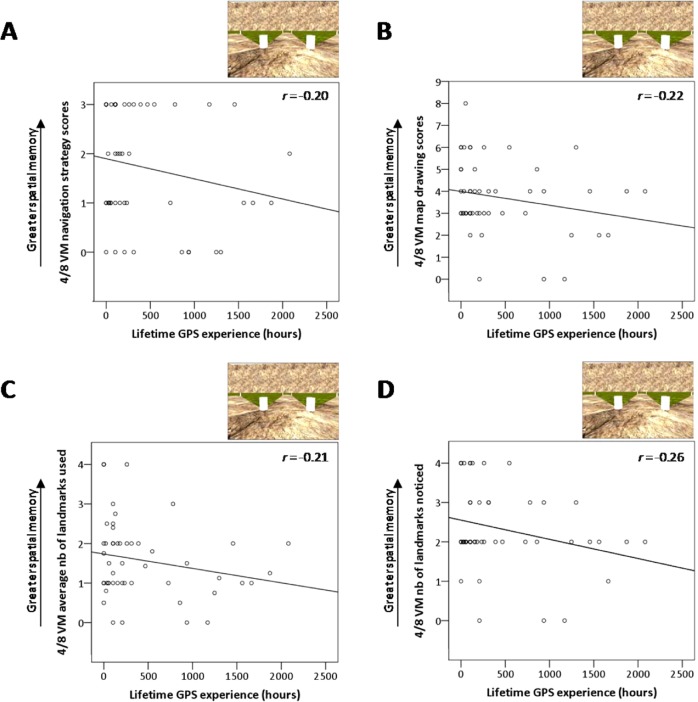
Verification
Claims the paper makes
The claims and statistics of this paper haven’t been checked yet.
Free: it reads the open-access text and checks the first 5 claims that cite a source we can check. Create a free account to check every claim.
Claims other papers make about this one
Each is checked against this paper’s own text: does it say what the citing paper says it does?
The cited source doesn’t support the claim as written.
In the citing paper
“and thus are more likely to be prone to negative effects on spatial learning, such as passive reliance on navigation aids and thus lesser engagement with the environment (Dahmani & Bohbot, 2020; Ishikawa, 2019; Ruginski et al., 2019).”
From The influence of landmark visualization style on task performance, visual attention, and spatial learning in a real-world navigation task (2024) · cites this paper as Dahmani & Bohbot, 2020
Checked by a reasoning model — may be wrong.
Experimental — accuracy not yet measuredThe source backs part of the claim, not all of it — or backs it for a different population, condition or comparison.
In the citing paper
“In these experiments, navigational aids, by replacing internal computations with external cues, remove the requirement that the spatial layout is learned by the navigator at all; and thus, when they are asked to remember it later, show poorer spatial memory.”
From This is not the way: global directional cues do not improve spatial learning in an immersive virtual environment (2025) · cites this paper as Dahmani & Bohbot, 2020
Experimental — accuracy not yet measuredThe source backs part of the claim, not all of it — or backs it for a different population, condition or comparison.
In the citing paper
“Indeed, people with lower spatial abilities rely more on mobile maps – which was also the case in our study, regardless of the landmark visualization style – and thus are more likely to be prone to negative effects on spatial learning, such as passive reliance on navigation aids and thus lesser engagement with the environment (Dahmani & Bohbot, 2020; Ishikawa, 2019; Ruginski et al., 2019).”
From The influence of landmark visualization style on task performance, visual attention, and spatial learning in a real-world navigation task (2024) · cites this paper as Dahmani & Bohbot, 2020
Experimental — accuracy not yet measuredThe source backs part of the claim, not all of it — or backs it for a different population, condition or comparison.
In the citing paper
“AI already pervasively interacts with our nervous systems by influencing, reinforcing, and changing our behaviors and cognitive processes.”
From AI and Neurotechnology (2023) · cites this paper as [10]
Experimental — accuracy not yet measuredThe cited source says what the claim attributes to it.
In the citing paper
“Past empirical research has demonstrated that over-reliance on mobile maps negatively influences wayfinders’ spatial knowledge acquisition of the traversed environment in the short term and further contributes to the long-term deterioration of their spatial abilities (Dahmani & Bohbot, 2020; Ishikawa, 2019; Ruginski et al., 2019).”
From The influence of landmark visualization style on task performance, visual attention, and spatial learning in a real-world navigation task (2024) · cites this paper as Dahmani & Bohbot, 2020
4 more claims about this paper
Create a free account to see every claim other papers make about this one.
Self-check
Percentages, sums and reported differences re-computed from the paper’s own numbers.
The self-check needs the paper’s full text.
Citations
Cites
(1978) · UA Campus Repository (The University of Arizona) · Cited by 8,010
LOSS OF RECENT MEMORY AFTER BILATERAL HIPPOCAMPAL LESIONS
Scoville, W. B., & Milner, B. (1957) · Journal of Neurology, Neurosurgery & Psychiatry · doi:10.1136/jnnp.20.1.11 · Cited by 7,322
Cognitive maps in rats and men
Tolman, E. C. (1948) · Psychological Review · doi:10.1037/h0061626 · Cited by 6,641
Place navigation impaired in rats with hippocampal lesions
Morris, R. G. M., Garrud, P., Rawlins, J. N. P., & O'Keefe, J. (1982) · Nature · doi:10.1038/297681a0 · Cited by 6,340
Navigation-related structural change in the hippocampi of taxi drivers
Maguire, E. A., Gadian, D. G., Johnsrude, I. S., Good, C. D., Ashburner, J., Frackowiak, R. S. J., & Frith, C. D. (2000) · Proceedings of the National Academy of Sciences · doi:10.1073/pnas.070039597 · Cited by 3,225
Statistical tests, P values, confidence intervals, and power: a guide to misinterpretations
Greenland, S., Senn, S. J., Rothman, K. J., Carlin, J. B., Poole, C., Goodman, S. N., & Altman, D. G. (2016) · European Journal of Epidemiology · doi:10.1007/s10654-016-0149-3 · Cited by 3,200
Psychological Assessment Resources
Abidin, R. R. (1995) · Medical Entomology and Zoology · Cited by 3,147
Squire, L. R. (1984) · The Biology of Learning · doi:10.1007/978-3-642-70094-1_32 · Cited by 2,107
Remembrance of places passed: Spatial memory in rats.
Olton, D. S., & Samuelson, R. J. (1976) · Journal of Experimental Psychology: Animal Behavior Processes · doi:10.1037//0097-7403.2.2.97 · Cited by 1,998
Resampling-Based Multiple Testing: Examples and Methods for p-Value Adjustment.
Martin, M. A., Westfall, P. H., & Young, S. S. (1994) · Biometrics · doi:10.2307/2533464 · Cited by 1,699
Research works printed but not linked: 3
- Burnett, G. E. & Lee, K. In International conference of traffic and transport psychology (2005).
- Wessel, G., Ziemkiewicz, C., Chang, R. & Sauda, E. In Proceedings of the International Conference on Advanced Visual Interfaces. 207–214 (ACM) (2010).
- Mishkin, M. & Petri, H. L. In Neuropsychology of memory (eds. L. R. Squire & N. Butters) 287–296 (Guilford Press, 1984).
Cited by
Items 201–285 of 285
Agency Modulation of Hippocampal Activity During Spatial NavigationPreprint
Goh, J. O. S., Lin, Y.-Y., Chang, Y.-T., Maschke, C., Lin, W.-R., & Su, Y.-S. (2025) · Research Square · doi:10.21203/rs.3.rs-6493656/v1
Berry, T.-A., Burgess, J., Mendoza‐Espinosa, L. G., & Oswald, F. (2025) · Frontiers in Sustainability · doi:10.3389/frsus.2025.1575658
Requarth, T. (2025) · The Transmitter · doi:10.53053/tqxi1702
Sosyal Bilgiler Öğretmen Adaylarının Mekânsal Düşünme Becerilerine Dair Algıları
ARIKAN, A. (2025) · Ege coğrafya dergisi :/Ege coğrafya dergisi · doi:10.51800/ecd.1616895
Textgenerierende KI: Ein kritisches Essay
Cap, C. H. (2025) · Ars digitalis · doi:10.1007/978-3-658-45839-3_1
Comment l’IA influence nos façons d’apprendre – et pourquoi se méfier de la facilité
Stone, B. (2025) · The Conversation · doi:10.64628/aak.pwak3sgjy
Cai, Y., Wang, J., Qiu, Y., & Huang, R. (2026) · Journal of Cognitive Neuroscience · doi:10.1162/jocn.a.101
(2025) · Frontiers research topics · doi:10.3389/978-2-8325-6452-3
Joshi, N. V., Ratley, S., Selvakumar, P., Manjunath, T. C., Anute, N., & Arun, M. R. (2025) · Advances in computational intelligence and robotics book series · doi:10.4018/979-8-3373-5606-8.ch004
Epilogue: Sedentary Minds in a Digital Age: The Hidden Costs of Modern Comfort
Biesalski, H. K. (2025) · Springer eBooks · doi:10.1007/978-3-031-99121-9_16
Mandal, R., Prabhakaran, G. S., Kowsik, A. V., Balaji, B. M., & Balaji, J. (2025) · bioRxiv (Cold Spring Harbor Laboratory) · doi:10.1101/2025.11.27.690628
Janowski, J. M., & Mazurek, A. (2025) · Studia z Teorii Wychowania · doi:10.5604/01.3001.0055.5082
Hybrid Team Tetris: A New Platform For Hybrid Multi-Agent, Multi-Human TeamingPreprint
McDowell, K., Waytowich, N., Garcia, J., Gordon, S., Bartlett, B., & Gaston, J. R. (2025) · arXiv (Cornell University) · doi:10.48550/arxiv.2502.21300
“The creation of consumer Global Positioning System (GPS) navigation devices pioneered by Garmin in the 1990s exemplifies how complex problem-solving tool use can reduce, but not eliminate, human cognitive demand associated with specifics aspects of navigation (see 4).”
Emergent spatial representations in reinforcement learning
Vijayabakaran, S. (2025) · Dokumentenrepositorium der RUB (Ruhr University Bochum) · doi:10.13154/294-13203
Topete, A., He, C., Protzko, J., Schooler, J., & Hegarty, M. (2024) · Figshare · doi:10.6084/m9.figshare.26695578
Qiu, C. (2024) · eCommons (Cornell University) · doi:10.7298/1764-z655
B., A. N. (2025) · Iconic Research and Engineering Journals · doi:10.64388/irev9i5-1712224
Walkstein, R. (2025) · Qucosa (Saxon State and University Library Dresden)
AI Competency Erosion: Understanding Expertise Decay
Yadav, P. S. (2026) · Future of business and finance · doi:10.1007/978-3-032-11748-9_5
Zhao, J., Wang, M., & Li, R. (2026) · Frontiers in Virtual Reality · doi:10.3389/frvir.2026.1908953
The neurobiology of addiction and artificial intelligence dependency
Saba, L. (2026) · Elsevier eBooks · doi:10.1016/b978-0-443-44728-0.00015-9
Ishikawa, T. (2025) · Springer eBooks · doi:10.1007/978-3-031-92524-5_117
A Comprehensive Multidisciplinary Research on Sustainable Development
Arthi, R., Roy, T. S., Rubert, E. J., & Bagalari, N. (2026) · doi:10.65647/msp/106/2026
Din, A. M. G. E. (2026) · Advances in computational intelligence and robotics book series · doi:10.4018/979-8-3373-4908-4.ch001
The Hegemonic Function of AI: Cognitive Sovereignty in the Age of Algorithmic MediationPreprint
Calloway, D. (2026) · SSRN Electronic Journal · doi:10.2139/ssrn.6256058
Environmental Contexts and the Neural Basis of Memory and Spatial Navigation
Subramanian, D., Sri, D., Jayakumar, F. A., & Varman, D. R. (2026) · European Journal of Clinical and Biomedical Sciences · doi:10.11648/j.ejcbs.20261201.12
Yadav, R., Chaudhary, A., Mishra, R., & Kumar, S. (2026) · World Academy of Sciences Journal · doi:10.3892/wasj.2026.455
“The initial results indicated that those who had used GPS more often in their lives tended to have a worse spatial memory (138).”
InfluentialGet the unbalance right: asymmetric transfer effects in cognitive offloading
Florean, I., Stragà, M., Mäntylä, T., & Missier, F. D. (2026) · Cognitive Research Principles and Implications · doi:10.1186/s41235-026-00722-0 · Cited by 1
“According to Dahmani and Bohbot (2020), the intensive use of GPS technology may even impair spatial memory in the long term, but navigation technologies that promote learning of a cognitive map seem able to improve navigation while preserving spatial knowledge and memory (Liu et al., 2022, see also…”
Meaning Representation Frameworks and Reasoning in the Era of Large Language Models
Sadeddine, Z. (2025) · theses.fr (ABES) · doi:10.70675/7f1c15a9z3c9bz4a61z8bf8z8bc5790ee4ed
Self++: Co-determined agency for human–AI symbiosis in extended reality
Piumsomboon, T. (2026) · Empathic Computing · doi:10.70401/ec.2026.0021
Ughachukwu, O. M., Garcia, K., DeVerter, M., Salas, K., Anguiano, M., Hernandez, A. P., O’Riordan, A., & He, Q. (2026) · Journal of Environmental Psychology · doi:10.1016/j.jenvp.2026.103067
Odakura, H., & Nakajima, T. (2026) · Augmented Humans International Conference (AHs) · doi:10.1145/3795011.3797400
“When navigation assistance substitutes for exploration and inference, environmental learning and cognitive map formation may be weakened [9, 10].”
Computational complexity improves recognition memory for reward-relevant attributes
Kapounek, A., de‐Wit, L., & Bossaerts, P. L. (2026) · Cognition · doi:10.1016/j.cognition.2026.106772
H-AGO: Human-Centric Agentic Governance with Creative Capacity Preservation
Shabista, S., & Gupta, R. (2026) · Proceedings of the AAAI Symposium Series · doi:10.1609/aaaiss.v8i1.42615
Gupta, R., & Shabista, S. (2026) · Proceedings of the AAAI Symposium Series · doi:10.1609/aaaiss.v8i1.42603
“Just as the widespread adoption of GPS navigation has been associated with degraded spatial cognition (Dahmani and Bohbot 2020), and search engine availability with reduced memory encoding (Sparrow, Liu, and Wegner 2011), sustained reliance on AI creative assistance may systematically weaken the…”
InfluentialA Systems Model of Gifted Underachievement and Overachievement
Sternberg, R. J. (2026) · Springer eBooks · doi:10.1007/978-3-032-21277-1_1
Predictive Assistance and the Temporal Dynamics of Exploratory CompressionPreprint
Battu, B. (2026) · arXiv (Cornell University) · doi:10.48550/arxiv.2606.10094
“Long-term reliance on turn-by-turn GPS systems has been associated with weaker cognitive map formation, reduced landmark encoding, and increased dependence on rigid route-following strategies, including during later navigation without GPS assistance [14].”
InfluentialBefore You Think: System 0, AI-Mediated Cognition and Cognitive ColonizationPreprint
Ganapini, M. B., Chiriatti, M., Panai, E., & Riva, G. (2026) · arXiv (Cornell University) · doi:10.48550/arxiv.2606.13658
Alam, F. (2026) · HARVEST (University of Saskatchewan)
Margondai, A., Rader, J., Rader, E., Willox, S., & Mouloua, M. (2026) · arXiv
“GPS users with greater lifetime reliance on automated routing show measurably poorer spatial memory when later required to navigate unaided, an effect observed cross-sectionally and, in a three-year follow-up, longitudinally (Dahmani & Bohbot, 2020).”
InfluentialMercer, T. (2026) · Springer eBooks · doi:10.1007/978-3-031-52643-5_291-1
Oviedo-Trespalacios, Ó., Laksanadjaja, F., & Torkamaan, H. (2026) · AHFE international · doi:10.54941/ahfe1007458
Agents That Teach: Towards Designing Incidental Learning Back into AI-Assisted Software Development
Mehra, R., Suri, S., Tagadinamani, P. K., Singi, K., Kaulgud, V., & Burden, A. P. (2026) · IEEE/ACM International Conference on Automated Software Engineering (ASE) · doi:10.1145/3832783.3834557
“For example, sustained reliance on GPS has been linked to decline in spatial memory and navigation ability, spell check and autocorrect to weakened spelling ability, and smartphones to reduced memory recall ability [2, 9, 13].”
Crompton, H., & Burke, D. (2026) · Oxford University Press eBooks · doi:10.1093/9780198945215.003.0220
Abdallah, N., Katmah, R., Khalaf, K. A., & Jelinek, H. F. (2026) · Computers in Human Behavior Reports · doi:10.1016/j.chbr.2026.101208
Margondai, A., Rader, J., Rader, E., Willox, S., & Mouloua, M. (2026) · arXiv (Cornell University) · doi:10.48550/arxiv.2607.12125
Doing Without Knowing: Generative AI and the Reorganization of Competence in SolopreneurshipPreprint
da Fonseca, A. L. A., & Chimenti, P. C. P. D. S. (2026) · SSRN Electronic Journal · doi:10.2139/ssrn.7155520
́Meara, D. O., Keil, J., Oster, C., Edler, D., Korte, A., & Dickmann, F. (2026) · ISPRS International Journal of Geo-Information · doi:10.3390/ijgi15080339
Schade, E. E. S. (2026) · Journal on Multimodal User Interfaces · doi:10.1007/s12193-026-00479-2
“Participants slightly underestimated the ride’s duration, implying an engaging experience, which coincides with prior studies linking engagement to improved spatial memory [14, 25].”
InfluentialJanzantti, P. H. F. (2026) · Revista Signos Geográficos · doi:10.5216/signos.v8.84885
Charaan, R. M. D., Ganapathy, S., Nalini, T., Machap, K., Nishapriya, R., & Santhoshkumar, S. P. (2026) · Advances in computational intelligence and robotics book series · doi:10.4018/979-8-3373-9484-8.ch004
AI-Induced Cognitive Atrophy: Experimental, Neuroplastic, and Evolutionary Perspectives
Sridhar, V., Chinnasamy, A., & Vijayalakshmi, K. (2026) · Advances in computational intelligence and robotics book series · doi:10.4018/979-8-3373-9484-8.ch002
Yang, Y., Sun, G., & Zhou, J. (2026) · Spatial Cognition and Computation · doi:10.1080/13875868.2026.2745006
“When people can simply follow navigation instructions without the need to explore or remember routes on their own, their capacity to build and maintain an understanding of the environment may gradually decline (Dahmani & Bohbot, 2020).”
Britel, I., Moummou, H., Aghdou, Z., Bouzidi, H. E., & El‐Mansoury, B. (2026) · Advances in computational intelligence and robotics book series · doi:10.4018/979-8-3373-9484-8.ch011
The Epistemic Fiduciary of Human Understanding: A Phenomenology of Epistemic Debt
Cflc, V. (n.d.) · PhilPapers (PhilPapers Foundation)
Zingaro, D., Reichenbacher, T., & Fabrikant, S. I. (2026) · ACM Transactions on Spatial Algorithms and Systems · doi:10.1145/3844502
Synthetic Rationality: The Behavioral Macroeconomics of Cognitive Offloading to Generative AIPreprint
Gorlick, R. A. (2026) · SSRN Electronic Journal · doi:10.2139/ssrn.7399060
The Impact of Everyday Technology Use on Cognitive Health
Mis, R. E., Zúñiga, C., Amon, K. K., Anthos, Z. R., Kiselica, A. M., Scullin, M. K., & Benge, J. F. (2026) · Oxford University Press eBooks · doi:10.1093/9780197814116.003.0013
Ying, Q., Hilton, C. W., & Fabrikant, S. I. (2026) · DROPS (Schloss Dagstuhl – Leibniz Center for Informatics) · doi:10.4230/lipics.cosit.2026.22
Kwiek, M. (2026) · Folia Turistica / Akademia Wychowania Fizycznego im. B. Czecha w Krakowie · doi:10.5604/01.3001.0055.9091
Anthony, A. (2026) · SSRN Electronic Journal · doi:10.2139/ssrn.7459500
Liu, Q., Zhao, X., Liu, X., Huang, J., & Wu, C. (2026) · Traffic Injury Prevention · doi:10.1080/15389588.2026.2727649
Exploring Generation Z Instructor Pilots’ Perception of Automation: A Preliminary Interview Study
Bender, M., Makkar, P., Beaulieu, N., Hayden, A., & Blickensderfer, E. (2026) · Proceedings of the Human Factors and Ergonomics Society Annual Meeting · doi:10.1177/10711813261493605
The dual-edged sword impact of generative AI product usage on consumer memory efficacy and behavior
Xuefeng, W. A. N. G., & Ma, Z. (2026) · Advances in Psychological Science · doi:10.3724/sp.j.1042.2026.2219
Suppressed inquiry: The hidden toll of working with satisfaction-optimized AI
Carmon, Z., Linzen, I., Sela, A., & Steinhart, Y. (2026) · Current Opinion in Psychology · doi:10.1016/j.copsyc.2026.102453
Factors Of University Student Belongingness On Campus
Aliperti, A., & Sutton, J. (2025) · Western Undergraduate Psychology Journal
Too Much Mind Extension? Towards a Virtue Ethics of the Extended Mind
Chlebowski, S., Ratajczyk, D., & Wyrwa, M. (2026) · Roczniki Filozoficzne · doi:10.18290/rf26743.6
Mental Health: Ethics and the Role and Limits of Artificial Intelligence
Castellví, P. (2026) · Springer eBooks · doi:10.1007/978-3-032-22853-6_2
Shoaib, S., Haq, F. U., Maaitah, N., Dhahbi, A., Badawy, M., Sheikh, A. A., & Masood, A. (2026) · Social Sciences & Humanities Open · doi:10.1016/j.ssaho.2026.103799
Stages of Accessible Reality: A Model of Cognitive-Technological TransitionsPreprint
Seitov, A. (2026) · SSRN Electronic Journal · doi:10.2139/ssrn.7594218
Vuelta al curso con IA: ¿cómo evitar que la tecnología sustituya el aprendizaje?
Feridouni, A. (2026) · Fundación Muy Interesante · doi:10.66806/fundacion_muyinteresante.624643
Struggles for Recognition in the Digitalizing Workplace
Anderson, J. H. (2026) · Springer eBooks · doi:10.1007/978-3-032-34028-3_3
Artificial Intelligence and Behavioural Risk: The Danger and the Saving Power
Smith, P. M. R. (2026) · Routledge eBooks · doi:10.4324/9781003785811
Riedl, R., & Krüeger, F. (2026) · Applied Sciences · doi:10.3390/app162110872
From Autonomous Agents to Cognitive Symbionts: Toward AI-Augmented Human IntelligencePreprint
Fei, H. (2026) · arXiv (Cornell University) · doi:10.48550/arxiv.2611.05376
Rethinking neuroscience graduate education in the age of AI
Goldman, M. (2026) · The Transmitter · doi:10.53053/pics1951
Paradigm and Paradox of Mobility: A Jet in Perpetual Lag
Gascon, V.-F. (2026) · Springer eBooks · doi:10.1007/978-3-031-70581-6_268-1
Expertise by Design: Why Modern Training Requires Deliberate Cultivation
Nizamuddin, J., Baker, K. H., Ambardekar, A. P., & Saddawi‐Konefka, D. (2026) · Anesthesia & Analgesia · doi:10.1213/ane.0000000000008191
Kareli, F. (2026) · Advances in Mobile Learning Educational Research · doi:10.25082/amler.2026.02.007
Munns, M. E., Nelson, M., He, C., Topete, A., Rashidi, M., Chrastil, E. R., & Hegarty, M. (2026) · Journal of Environmental Psychology · doi:10.1016/j.jenvp.2026.103286
PreView: Rehearsing Real Routes in VR to Support Independent Navigation with Low-Vision
Sechayk, Y., Cao, X., Jain, D., & Igarashi, T. (2026) · ACM Symposium on User Interface Software and Technology (UIST) · doi:10.1145/3830397.3842475
Li, X., Yang, Y., & Zhou, J. (2026) · International Journal of Human-Computer Interaction · doi:10.1080/10447318.2026.2759395
Ahmed, S. A., & Shehata, M. H. (2026) · Frontiers in Education · doi:10.3389/feduc.2026.1939042
Rose, M., Borhani, Z., Schreiber, D., Azuka-Onwuka, N. O., Machuca, M. D. B., & Ortega, F. R. (2026) · ACM Symposium on Virtual Reality Software and Technology (VRST) · doi:10.1145/3822517.3848729
Metadata
- Authors
- Dahmani, L., & Bohbot, V. D.
- Affiliations
- McGill University (CA)
- Douglas Mental Health University Institute (CA)
- Corresponding author
- Bohbot, Véronique D.
- Venue
- Scientific Reports
- Published
- 2020-04-14
- Volume
- 10
- Issue
- 1
- Pages
- 6310-6310
- ISSN
- 2045-2322 (ISSN-L)
- PMC
- PMC7156656
- OpenAlex
- W3015865106
- Cited by
- 212
- References
- 46
- Citations by year
- 2026: 50 · 2025: 49 · 2024: 49 · 2023: 28 · 2022: 22 · 2021: 9 · 2020: 5
- FWCI
- 5.92
- Type
- journal article
- Language
- en
- Open access
- gold
- doi.org
- Licence
- cc-by
- creativecommons.org/licenses/by/4.0 (tdm)
- creativecommons.org/licenses/by/4.0 (vor)
- Locations
- Scientific Reports (publishedVersion, cc-by)
- PubMed Central (publishedVersion, cc-by)
- PubMed (publishedVersion)
- Topics
- Social Sciences › Psychology › Experimental and Cognitive Psychology › Spatial Cognition and Navigation
- Life Sciences › Neuroscience › Cognitive Neuroscience › Memory and Neural Mechanisms
- Social Sciences › Geography, Planning and Development › Geography Education and Pedagogy
- Keywords
- GPS navigation, spatial memory, hippocampus, cognitive mapping, sense of direction, cognitive decline, virtual navigation
- MeSH terms
- Adult, Cross-Sectional Studies, Female, Follow-Up Studies, Hippocampus, Humans, Longitudinal Studies, Male, Memory Disorders, Geographic Information Systems, Young Adult, Spatial Memory, Spatial Navigation
About these checks
Registry, retraction, Cites and statistics results are computed, not judged, with one exception: a printed reference that no index lists is read once by a model before it counts as a citation error. Claims are extracted by a model and kept only when their quote appears verbatim in the text; each cited source is then checked, with a model’s help, for whether it says what the claim relies on. Those verdicts can be wrong — read the claim’s quote and the cited source before relying on one.
Statistics and arithmetic are recomputed, not judged.
Confidence bands are shown only for fields calibrated on our annotated test set. None is calibrated yet, so no band is shown.
What counts as a claim ›How we measure confidence ›How we check this ›
Are you an author, or do you see a problem with this page? Request a review
Data sources
Bibliographic data: Semantic Scholar, OpenAlex, Crossref.
Contains information from the Semantic Scholar Academic Graph Datasets, made available under the ODC Attribution License (ODC-BY 1.0).
Semantic Scholar’s data is described in: Kinney, R., et al. (2023). The Semantic Scholar Open Data Platform. arXiv:2301.10140.
