

Habitual use of GPS negatively impacts spatial memory during self-guided navigation
Open accessThe DOI matches its Crossref record; 46 of the 46 references it cites were found in a registry or an index.
Abstract
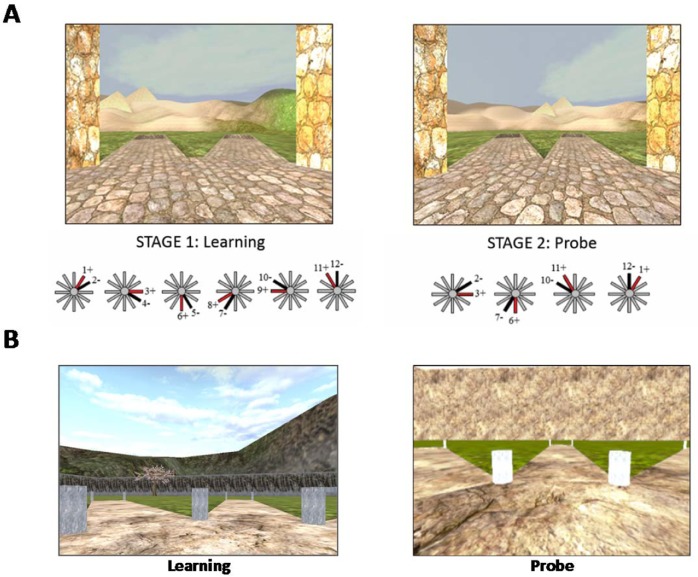
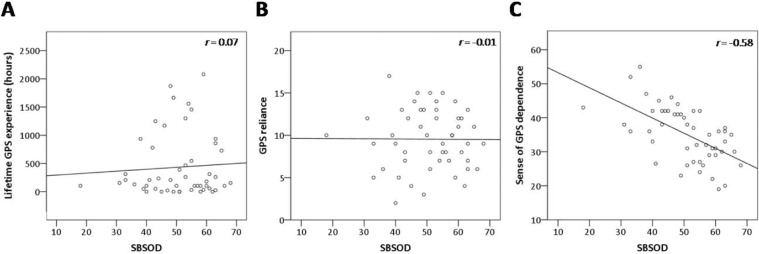
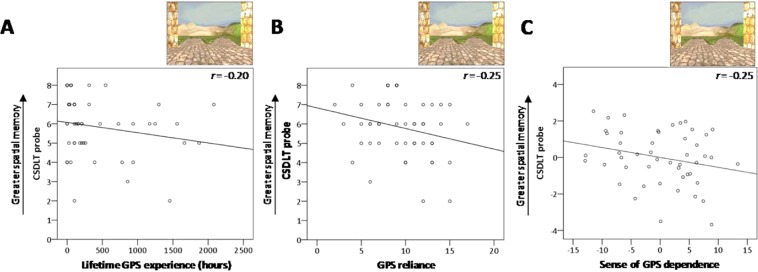
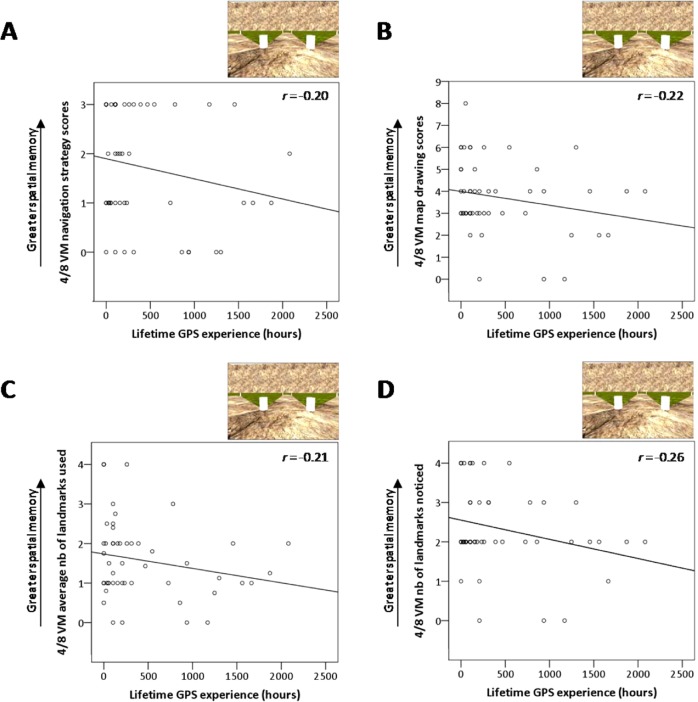
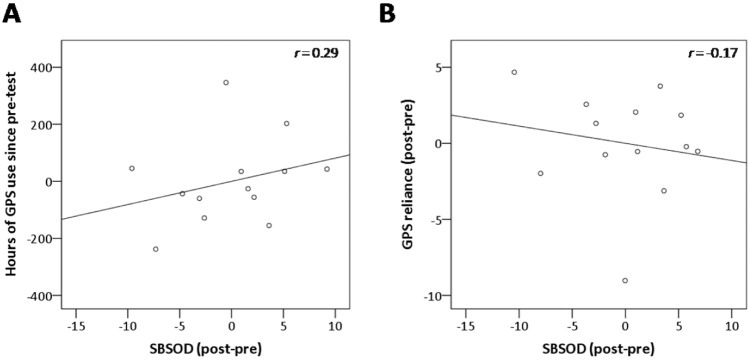
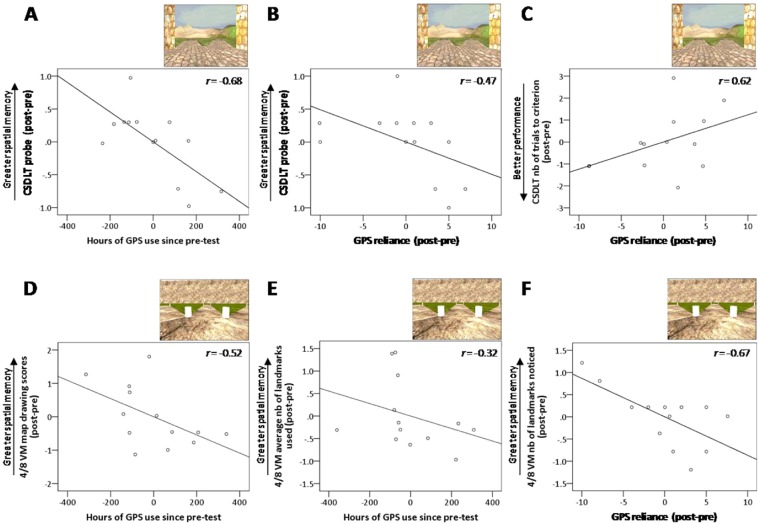
Global Positioning System (GPS) navigation devices and applications have become ubiquitous over the last decade. However, it is unclear whether using GPS affects our own internal navigation system, or spatial memory, which critically relies on the hippocampus. We assessed the lifetime GPS experience of 50 regular drivers as well as various facets of spatial memory, including spatial memory strategy use, cognitive mapping, and landmark encoding using virtual navigation tasks. We first present cross-sectional results that show that people with greater lifetime GPS experience have worse spatial memory during self-guided navigation, i.e. when they are required to navigate without GPS. In a follow-up session, 13 participants were retested three years after initial testing. Although the longitudinal sample was small, we observed an important effect of GPS use over time, whereby greater GPS use since initial testing was associated with a steeper decline in hippocampal-dependent spatial memory. Importantly, we found that those who used GPS more did not do so because they felt they had a poor sense of direction, suggesting that extensive GPS use led to a decline in spatial memory rather than the other way around. These findings are significant in the context of society's increasing reliance on GPS.
Overview
The claims and statistics of this paper haven’t been checked yet.
Free: it reads the open-access text and checks the first 5 claims that cite a source we can check. Create a free account to check every claim.
Integrity signals
Registry
Cites
Statistics
Figures
Verification
Claims the paper makes
The claims and statistics of this paper haven’t been checked yet.
Free: it reads the open-access text and checks the first 5 claims that cite a source we can check. Create a free account to check every claim.
Claims other papers make about this one
Each is checked against this paper’s own text: does it say what the citing paper says it does?
The cited source doesn’t support the claim as written.
In the citing paper
“and thus are more likely to be prone to negative effects on spatial learning, such as passive reliance on navigation aids and thus lesser engagement with the environment (Dahmani & Bohbot, 2020; Ishikawa, 2019; Ruginski et al., 2019).”
From The influence of landmark visualization style on task performance, visual attention, and spatial learning in a real-world navigation task (2024) · cites this paper as Dahmani & Bohbot, 2020
Checked by a reasoning model — may be wrong.
Experimental — accuracy not yet measuredThe source backs part of the claim, not all of it — or backs it for a different population, condition or comparison.
In the citing paper
“In these experiments, navigational aids, by replacing internal computations with external cues, remove the requirement that the spatial layout is learned by the navigator at all; and thus, when they are asked to remember it later, show poorer spatial memory.”
From This is not the way: global directional cues do not improve spatial learning in an immersive virtual environment (2025) · cites this paper as Dahmani & Bohbot, 2020
Experimental — accuracy not yet measuredThe source backs part of the claim, not all of it — or backs it for a different population, condition or comparison.
In the citing paper
“Indeed, people with lower spatial abilities rely more on mobile maps – which was also the case in our study, regardless of the landmark visualization style – and thus are more likely to be prone to negative effects on spatial learning, such as passive reliance on navigation aids and thus lesser engagement with the environment (Dahmani & Bohbot, 2020; Ishikawa, 2019; Ruginski et al., 2019).”
From The influence of landmark visualization style on task performance, visual attention, and spatial learning in a real-world navigation task (2024) · cites this paper as Dahmani & Bohbot, 2020
Experimental — accuracy not yet measuredThe source backs part of the claim, not all of it — or backs it for a different population, condition or comparison.
In the citing paper
“AI already pervasively interacts with our nervous systems by influencing, reinforcing, and changing our behaviors and cognitive processes.”
From AI and Neurotechnology (2023) · cites this paper as [10]
Experimental — accuracy not yet measuredThe cited source says what the claim attributes to it.
In the citing paper
“Past empirical research has demonstrated that over-reliance on mobile maps negatively influences wayfinders’ spatial knowledge acquisition of the traversed environment in the short term and further contributes to the long-term deterioration of their spatial abilities (Dahmani & Bohbot, 2020; Ishikawa, 2019; Ruginski et al., 2019).”
From The influence of landmark visualization style on task performance, visual attention, and spatial learning in a real-world navigation task (2024) · cites this paper as Dahmani & Bohbot, 2020
4 more claims about this paper
Create a free account to see every claim other papers make about this one.
Self-check
Percentages, sums and reported differences re-computed from the paper’s own numbers.
The self-check needs the paper’s full text.
Citations
Cites
(1978) · UA Campus Repository (The University of Arizona) · Cited by 8,010
LOSS OF RECENT MEMORY AFTER BILATERAL HIPPOCAMPAL LESIONS
Scoville, W. B., & Milner, B. (1957) · Journal of Neurology, Neurosurgery & Psychiatry · doi:10.1136/jnnp.20.1.11 · Cited by 7,322
Cognitive maps in rats and men
Tolman, E. C. (1948) · Psychological Review · doi:10.1037/h0061626 · Cited by 6,641
Place navigation impaired in rats with hippocampal lesions
Morris, R. G. M., Garrud, P., Rawlins, J. N. P., & O'Keefe, J. (1982) · Nature · doi:10.1038/297681a0 · Cited by 6,340
Navigation-related structural change in the hippocampi of taxi drivers
Maguire, E. A., Gadian, D. G., Johnsrude, I. S., Good, C. D., Ashburner, J., Frackowiak, R. S. J., & Frith, C. D. (2000) · Proceedings of the National Academy of Sciences · doi:10.1073/pnas.070039597 · Cited by 3,225
Statistical tests, P values, confidence intervals, and power: a guide to misinterpretations
Greenland, S., Senn, S. J., Rothman, K. J., Carlin, J. B., Poole, C., Goodman, S. N., & Altman, D. G. (2016) · European Journal of Epidemiology · doi:10.1007/s10654-016-0149-3 · Cited by 3,200
Psychological Assessment Resources
Abidin, R. R. (1995) · Medical Entomology and Zoology · Cited by 3,147
Squire, L. R. (1984) · The Biology of Learning · doi:10.1007/978-3-642-70094-1_32 · Cited by 2,107
Remembrance of places passed: Spatial memory in rats.
Olton, D. S., & Samuelson, R. J. (1976) · Journal of Experimental Psychology: Animal Behavior Processes · doi:10.1037//0097-7403.2.2.97 · Cited by 1,998
Resampling-Based Multiple Testing: Examples and Methods for p-Value Adjustment.
Martin, M. A., Westfall, P. H., & Young, S. S. (1994) · Biometrics · doi:10.2307/2533464 · Cited by 1,699
Packard, M. G., & McGaugh, J. L. (1996) · Neurobiology of Learning and Memory · doi:10.1006/nlme.1996.0007 · Cited by 1,492
Structure and function of declarative and nondeclarative memory systems
Squire, L. R., & Zola, S. M. (1996) · Proceedings of the National Academy of Sciences · doi:10.1073/pnas.93.24.13515 · Cited by 1,327
On the role of the hippocampus in learning and memory in the rat.
Jarrard, L. E. (1993) · Behavioral and Neural Biology · doi:10.1016/0163-1047(93)90664-4 · Cited by 1,125
A triple dissociation of memory systems: Hippocampus, amygdala, and dorsal striatum.
McDonald, R. J., & White, N. M. (2013) · Behavioral Neuroscience · doi:10.1037/a0034883 · Cited by 1,044
Development of a self-report measure of environmental spatial ability
Hegarty, M. (2002) · Intelligence · doi:10.1016/s0160-2896(02)00116-2 · Cited by 1,023
Packard, M., Hirsh, R., & White, N. (1989) · The Journal of Neuroscience · doi:10.1523/jneurosci.09-05-01465.1989 · Cited by 971
Spatial memory and hippocampal function
Olton, D. S., & Paras, B. C. (1979) · Neuropsychologia · doi:10.1016/0028-3932(79)90042-3 · Cited by 936
London taxi drivers and bus drivers: A structural MRI and neuropsychological analysis
Maguire, E. A., Woollett, K., & Spiers, H. J. (2006) · Hippocampus · doi:10.1002/hipo.20233 · Cited by 918
A triple dissociation of memory systems: Hippocampus, amygdala, and dorsal striatum.
McDonald, R. J., & White, N. M. (1993) · Behavioral Neuroscience · doi:10.1037/0735-7044.107.1.3 · Cited by 885
Iaria, G., Petrides, M., Dagher, A., Pike, B., & Bohbot, V. D. (2003) · The Journal of Neuroscience · doi:10.1523/jneurosci.23-13-05945.2003 · Cited by 799
Self-citationPackard, M. G., & McGaugh, J. L. (1992) · Behavioral Neuroscience · doi:10.1037//0735-7044.106.3.439 · Cited by 641
Older Drivers and Cataract: Driving Habits and Crash Risk
Owsley, C., Stalvey, B., Wells, J., & Sloane, M. E. (1999) · The Journals of Gerontology Series A: Biological Sciences and Medical Sciences · doi:10.1093/gerona/54.4.m203 · Cited by 564
Haukoos, J. S., & Lewis, R. J. (2005) · Academic Emergency Medicine · doi:10.1111/j.1553-2712.2005.tb01958.x · Cited by 540
Wayfinding with a GPS-based mobile navigation system: A comparison with maps and direct experience
Ishikawa, T., Fujiwara, H., Imai, O., & Okabe, A. (2008) · Journal of Environmental Psychology · doi:10.1016/j.jenvp.2007.09.002 · Cited by 445
Konishi, K., & Bohbot, V. D. (2013) · Frontiers in Aging Neuroscience · doi:10.3389/fnagi.2013.00001 · Cited by 404
Self-citationLow P-Values or Narrow Confidence Intervals: Which Are More Durable?
Poole, C. (2001) · Epidemiology · doi:10.1097/00001648-200105000-00005 · Cited by 350
Gray matter differences correlate with spontaneous strategies in a human virtual navigation task
Bohbot, V. D., Lerch, J., Thorndycraft, B., Iaria, G., & Zijdenbos, A. P. (2007) · The Journal of Neuroscience · doi:10.1523/jneurosci.1763-07.2007 · Cited by 347
Self-citationBohbot, V. D., Iaria, G., & Petrides, M. (2004) · Neuropsychology · doi:10.1037/0894-4105.18.3.418 · Cited by 275
Self-citationAporta, C., & Higgs, E. (2005) · Current Anthropology · doi:10.1086/432651 · Cited by 230
Is the rodent hippocampus just for ‘place’?
Eichenbaum, H. (1996) · Current Opinion in Neurobiology · doi:10.1016/s0959-4388(96)80072-9 · Cited by 210
Hippocampal and prefrontal processing of network topology to simulate the future
Javadi, A.-H., Emo, B., Howard, L. R., Zisch, F. E., Yu, Y., Knight, R., Pinelo Silva, J., & Spiers, H. J. (2017) · Nature Communications · doi:10.1038/ncomms14652 · Cited by 207
Delatour, B., & Gisquet-Verrier, P. (2000) · Behavioural Brain Research · doi:10.1016/s0166-4328(99)00168-0 · Cited by 169
Chang, Q., & Gold, P. E. (2003) · Behavioural Brain Research · doi:10.1016/s0166-4328(03)00063-9 · Cited by 155
How Navigational Aids Impair Spatial Memory: Evidence for Divided Attention
Gardony, A. L., Brunyé, T. T., Mahoney, C. R., & Taylor, H. A. (2013) · Spatial Cognition & Computation · doi:10.1080/13875868.2013.792821 · Cited by 145
de Bruin, J. P. C., Moita, M. A. P., de Brabander, H. M., & Joosten, R. N. J. M. A. (2001) · Neurobiology of Learning and Memory · doi:10.1006/nlme.2000.3962 · Cited by 145
Konishi, K., Etchamendy, N., Roy, S., Marighetto, A., Rajah, N., & Bohbot, V. D. (2013) · Hippocampus · doi:10.1002/hipo.22181 · Cited by 118
Self-citationAn intrinsic association between olfactory identification and spatial memory in humans
Dahmani, L., Patel, R., Yang, Y., Chakravarty, M. M., Fellows, L. K., & Bohbot, V. D. (2018) · Nature Communications · doi:10.1038/s41467-018-06569-4 · Cited by 114
Self-citationEtchamendy, N., Konishi, K., Pike, G. B., Marighetto, A., & Bohbot, V. D. (2012) · Hippocampus · doi:10.1002/hipo.20948 · Cited by 113
Self-citationNavigation assistance: A trade-off between wayfinding support and configural learning support.
Münzer, S., Zimmer, H. D., & Baus, J. (2012) · Journal of Experimental Psychology: Applied · doi:10.1037/a0026553 · Cited by 97
Response learning of rats in a Morris water maze: Involvement of the medial prefrontal cortex
de Bruin, J. P. C., Swinkels, W. A. M., & de Brabander, J. M. (1997) · Behavioural Brain Research · doi:10.1016/s0166-4328(96)00163-5 · Cited by 93
Almey, A., Cannell, E., Bertram, K., Filardo, E., Milner, T. A., & Brake, W. G. (2014) · Endocrinology · doi:10.1210/en.2014-1463 · Cited by 91
Prenatal stress changes learning strategies in adulthood
Schwabe, L., Bohbot, V. D., & Wolf, O. T. (2012) · Hippocampus · doi:10.1002/hipo.22034 · Cited by 70
Self-citationMarighetto, A., Etchamendy, N., Touzani, K., Torrea, C. C., Yee, B. K., Rawlins, J. N. P., & Jaffard, R. (1999) · European Journal of Neuroscience · doi:10.1046/j.1460-9568.1999.00741.x · Cited by 64
Dahmani, L., & Bohbot, V. D. (2015) · Neurobiology of Learning and Memory · doi:10.1016/j.nlm.2014.07.002 · Cited by 63
Self-citationTest of Nonverbal Intelligence–Third Edition
Dumont, R., & Willis, J. O. (2008) · Wiley eBooks · doi:10.1002/9780470373699.speced2074 · Cited by 60
McDonald, R. J., Jones, J., Richards, B., & Hong, N. S. (2006) · European Journal of Neuroscience · doi:10.1111/j.1460-9568.2006.05064.x · Cited by 45
Research works printed but not linked: 3
- Burnett, G. E. & Lee, K. In International conference of traffic and transport psychology (2005).
- Wessel, G., Ziemkiewicz, C., Chang, R. & Sauda, E. In Proceedings of the International Conference on Advanced Visual Interfaces. 207–214 (ACM) (2010).
- Mishkin, M. & Petri, H. L. In Neuropsychology of memory (eds. L. R. Squire & N. Butters) 287–296 (Guilford Press, 1984).
Cited by
State of the art and practice in AI in education
Holmes, W., & Tuomi, I. (2022) · European Journal of Education · doi:10.1111/ejed.12533 · Cited by 1,093
Shanmugasundaram, M., & Tamilarasu, A. (2023) · Frontiers in Cognition · doi:10.3389/fcogn.2023.1203077 · Cited by 291
Extending Minds with Generative AI
Clark, A. (2025) · Nature Communications · doi:10.1038/s41467-025-59906-9 · Cited by 174
Ubal, M., Tambasco, P., Martínez, S. L., & Correa, M. G. (2023) · Revista Interuniversitaria de Investigación en Tecnología Educativa · doi:10.6018/riite.584501 · Cited by 113
Macnamara, B. N., Berber, I., Çavuşoğlu, M. C., Krupinski, E. A., Nallapareddy, N., Nelson, N. E., Smith, P. J., Wilson-Delfosse, A. L., & Ray, S. (2024) · Cognitive Research: Principles and Implications · doi:10.1186/s41235-024-00572-8 · Cited by 97
Metadata
- Authors
- Dahmani, L., & Bohbot, V. D.
- Affiliations
- McGill University (CA)
- Douglas Mental Health University Institute (CA)
- Corresponding author
- Bohbot, Véronique D.
- Venue
- Scientific Reports
- Published
- 2020-04-14
- Volume
- 10
- Issue
- 1
- Pages
- 6310-6310
- ISSN
- 2045-2322 (ISSN-L)
- PMC
- PMC7156656
- OpenAlex
- W3015865106
- Cited by
- 212
- References
- 46
- Citations by year
- 2026: 50 · 2025: 49 · 2024: 49 · 2023: 28 · 2022: 22 · 2021: 9 · 2020: 5
- FWCI
- 5.92
- Type
- journal article
- Language
- en
- Open access
- gold
- doi.org
- Licence
- cc-by
- creativecommons.org/licenses/by/4.0 (tdm)
- creativecommons.org/licenses/by/4.0 (vor)
- Locations
- Scientific Reports (publishedVersion, cc-by)
- PubMed Central (publishedVersion, cc-by)
- PubMed (publishedVersion)
- Topics
- Social Sciences › Psychology › Experimental and Cognitive Psychology › Spatial Cognition and Navigation
- Life Sciences › Neuroscience › Cognitive Neuroscience › Memory and Neural Mechanisms
- Social Sciences › Geography, Planning and Development › Geography Education and Pedagogy
- Keywords
- GPS navigation, spatial memory, hippocampus, cognitive mapping, sense of direction, cognitive decline, virtual navigation
- MeSH terms
- Adult, Cross-Sectional Studies, Female, Follow-Up Studies, Hippocampus, Humans, Longitudinal Studies, Male, Memory Disorders, Geographic Information Systems, Young Adult, Spatial Memory, Spatial Navigation
About these checks
Registry, retraction, Cites and statistics results are computed, not judged, with one exception: a printed reference that no index lists is read once by a model before it counts as a citation error. Claims are extracted by a model and kept only when their quote appears verbatim in the text; each cited source is then checked, with a model’s help, for whether it says what the claim relies on. Those verdicts can be wrong — read the claim’s quote and the cited source before relying on one.
Statistics and arithmetic are recomputed, not judged.
Confidence bands are shown only for fields calibrated on our annotated test set. None is calibrated yet, so no band is shown.
What counts as a claim ›How we measure confidence ›How we check this ›
Are you an author, or do you see a problem with this page? Request a review
Data sources
Bibliographic data: Semantic Scholar, OpenAlex, Crossref.
Contains information from the Semantic Scholar Academic Graph Datasets, made available under the ODC Attribution License (ODC-BY 1.0).
Semantic Scholar’s data is described in: Kinney, R., et al. (2023). The Semantic Scholar Open Data Platform. arXiv:2301.10140.
