

MDMA-assisted psychotherapy for treatment of anxiety and other psychological distress related to life-threatening illnesses: a randomized pilot study
Open accessThe DOI matches its Crossref record; 54 of the 54 references it cites were found in a registry or an index.
Abstract
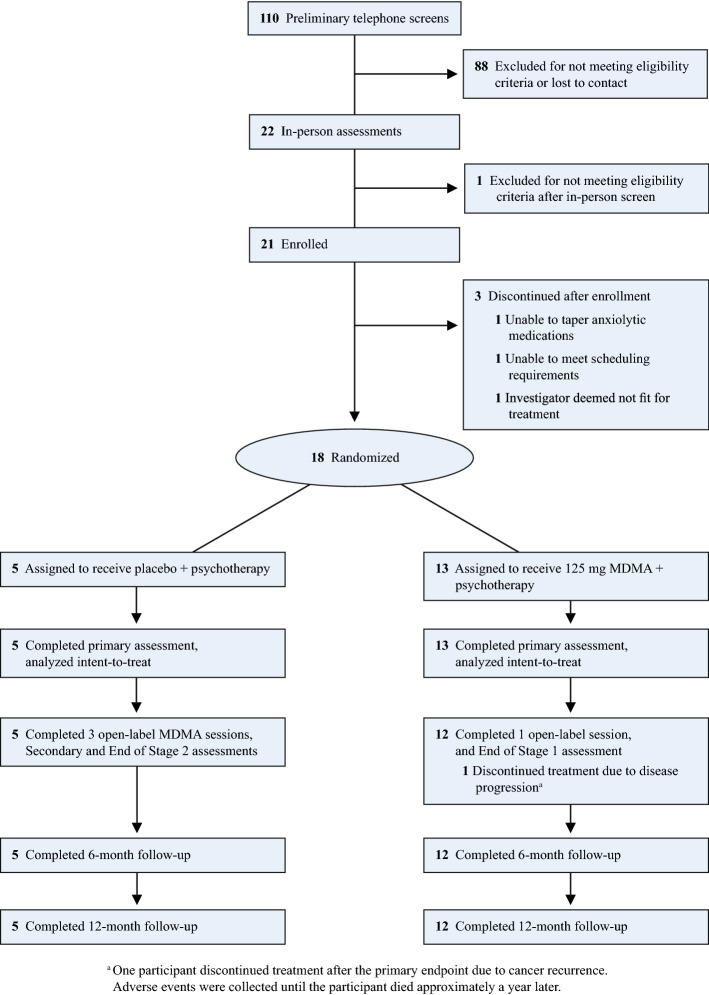
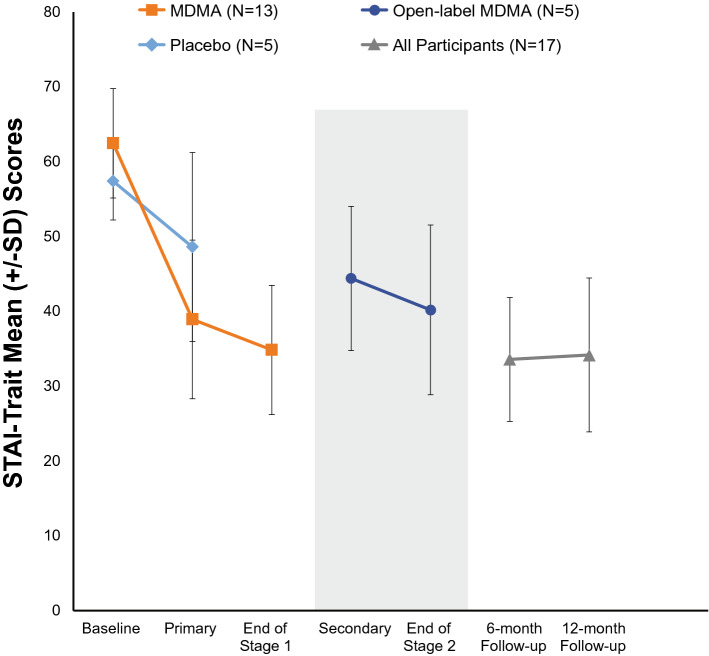
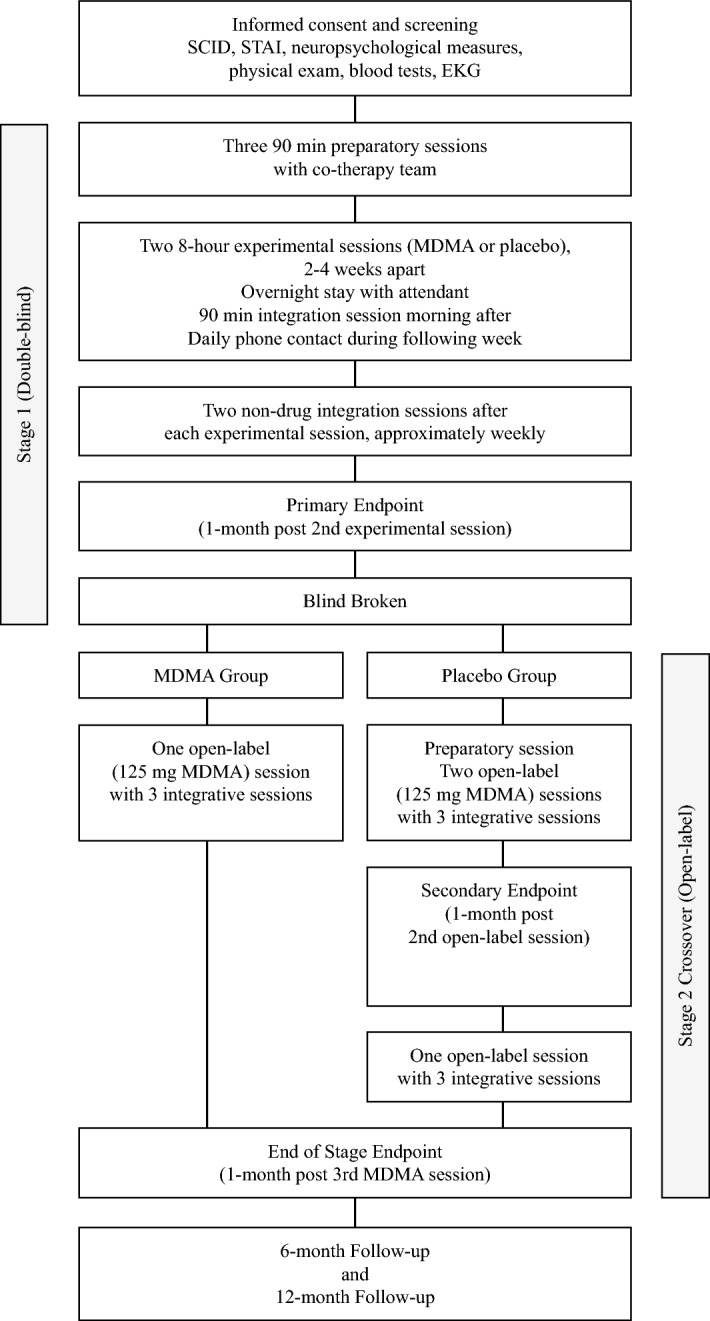
The success of modern medicine creates a growing population of those suffering from life-threatening illnesses (LTI) who often experience anxiety, depression, and existential distress. We present a novel approach; investigating MDMA-assisted psychotherapy for the treatment of anxiety in people with an LTI. Participants with anxiety from an LTI were randomized in a double-blind study to receive MDMA (125 mg, n = 13) or placebo (n = 5) in combination with two 8-h psychotherapy sessions. The primary outcome was change in State-Trait Anxiety Inventory (STAI) Trait scores from baseline to one month post the second experimental session. After unblinding, participants in the MDMA group had one open-label MDMA session and placebo participants crossed over to receive three open-label MDMA sessions. Additional follow-up assessments occurred six and twelve months after a participant’s last experimental session. At the primary endpoint, the MDMA group had a greater mean (SD) reduction in STAI-Trait scores, − 23.5 (13.2), indicating less anxiety, compared to placebo group, − 8.8 (14.7); results did not reach a significant group difference ( p = .056). Hedges’ g between-group effect size was 1.03 (95% CI: − 5.25, 7.31). Overall, MDMA was well-tolerated in this sample. These preliminary findings can inform development of larger clinical trials to further examine MDMA-assisted psychotherapy as a novel approach to treat individuals with LTI-related anxiety. Trial Registration : clinicaltrials.gov Identifier: NCT02427568, first registered April 28, 2015.
Overview
The claims and statistics of this paper haven’t been checked yet.
Free: it reads the open-access text and checks the first 5 claims that cite a source we can check. Create a free account to check every claim.
Integrity signals
Registry
Cites
Statistics
Figures
Verification
Claims the paper makes
The claims and statistics of this paper haven’t been checked yet.
Free: it reads the open-access text and checks the first 5 claims that cite a source we can check. Create a free account to check every claim.
Claims other papers make about this one
Each is checked against this paper’s own text: does it say what the citing paper says it does?
The source backs part of the claim, not all of it — or backs it for a different population, condition or comparison.
In the citing paper
“Statistically significant improvements were found in anxiety, depression, sleep, global functioning, well-being, self-compassion, mindfulness, and attitudes regarding death, compared to baseline.”
From Psychedelics for the treatment of depression, anxiety, and existential distress in patients with a terminal illness: a systematic review (2022) · cites this paper as Wolfson et al., 2020
Experimental — accuracy not yet measuredThe cited source says what the claim attributes to it.
In the citing paper
“Improvements remained stable after 6 months and 1 year.”
From Psychedelics for the treatment of depression, anxiety, and existential distress in patients with a terminal illness: a systematic review (2022) · cites this paper as Wolfson et al., 2020
The cited source says what the claim attributes to it.
In the citing paper
“One month after the second session, the MDMA group had a borderline significant larger reduction in trait anxiety compared to the placebo group.”
From Psychedelics for the treatment of depression, anxiety, and existential distress in patients with a terminal illness: a systematic review (2022) · cites this paper as Wolfson et al., 2020
The cited source says what the claim attributes to it.
In the citing paper
“Finally, a recent exploratory pilot study that used MDMA-assisted psychotherapy to treat existential distress in patients with a life-threatening illness found lasting positive change on anxiety, depression, and attitudes towards death (Wolfson et al., 2020).”
From Psychedelics for the treatment of depression, anxiety, and existential distress in patients with a terminal illness: a systematic review (2022) · cites this paper as Wolfson et al., 2020
The cited source says what the claim attributes to it.
In the citing paper
“Results of this study should be interpreted with caution due to study limitations such as a small sample size and lack of a control group after crossover.”
From Psychedelics for the treatment of depression, anxiety, and existential distress in patients with a terminal illness: a systematic review (2022) · cites this paper as Wolfson et al., 2020
Self-check
Percentages, sums and reported differences re-computed from the paper’s own numbers.
The self-check needs the paper’s full text.
Citations
Cites
1 retracted
Mithoefer, M. C., Feduccia, A. A., Jerome, L., Mithoefer, A., Wagner, M., Walsh, Z., Hamilton, S., Yazar-Klosinski, B., Emerson, A., & Doblin, R. (2019) · Psychopharmacology · doi:10.1007/s00213-019-05249-5 · Cited by 359
Self-citationRetractedThe Pittsburgh Sleep Quality Index: a new instrument for psychiatric practice and research
Buysse, D. J., Reynolds, C. F., Monk, T. H., Berman, S. R., & Kupfer, D. J. (1989) · Psychiatry Research · doi:10.1016/0165-1781(89)90047-4 · Cited by 35,234
(1970) · Cited by 24,983
A new depression scale designed to be sensitive to change
Montgomery, S. A., & Åsberg, M. (1979) · British Journal of Psychiatry · doi:10.1192/bjp.134.4.382 · Cited by 13,962
Using Self-Report Assessment Methods to Explore Facets of Mindfulness
Baer, R. A., Smith, G. T., Hopkins, J., Krietemeyer, J., & Toney, L. (2006) · Assessment · doi:10.1177/1073191105283504 · Cited by 7,511
The posttraumatic growth inventory: measuring the positive legacy of trauma
Tedeschi, R. G., & Calhoun, L. G. (1996) · Journal of Traumatic Stress · doi:10.1002/jts.2490090305 · Cited by 7,061
The Development and Validation of a Scale to Measure Self-Compassion
NEFF, K. D. (2003) · Self and Identity · doi:10.1080/15298860309027 · Cited by 6,436
Comparison of Beck Depression Inventories -IA and -II in psychiatric outpatients
Beck, A. T., Steer, R. A., Ball, R., & Ranieri, W. F. (1996) · Journal of Personality Assessment · doi:10.1207/s15327752jpa6703_13 · Cited by 5,965
Baer, R. A., Smith, G. T., Lykins, E., Button, D., Krietemeyer, J., Sauer, S., Walsh, E., Duggan, D., & Williams, J. M. G. (2008) · Assessment · doi:10.1177/1073191107313003 · Cited by 2,930
Griffiths, R. R., Johnson, M. W., Carducci, M. A., Umbricht, A., Richards, W. A., Richards, B. D., Cosimano, M. P., & Klinedinst, M. A. (2016) · Journal of Psychopharmacology · doi:10.1177/0269881116675513 · Cited by 2,201
Ross, S., Bossis, A., Guss, J., Agin-Liebes, G., Malone, T., Cohen, B., Mennenga, S. E., Belser, A., Kalliontzi, K., Babb, J., et al. (2016) · Journal of Psychopharmacology · doi:10.1177/0269881116675512 · Cited by 1,698
Pilot Study of Psilocybin Treatment for Anxiety in Patients With Advanced-Stage Cancer
Grob, C. S., Danforth, A. L., Chopra, G. S., Hagerty, M., McKay, C. R., Halberstadt, A. L., & Greer, G. R. (2011) · Archives of General Psychiatry · doi:10.1001/archgenpsychiatry.2010.116 · Cited by 1,206
Internal consistencies of the original and revised beck depression inventory
Beck, A. T., & Steer, R. A. (1984) · Journal of Clinical Psychology · doi:10.1002/1097-4679(198411)40:6<1365::aid-jclp2270400615>3.0.co;2-d · Cited by 1,146
Posner, K., Oquendo, M. A., Gould, M., Stanley, B., & Davies, M. (2007) · American Journal of Psychiatry · doi:10.1176/ajp.2007.164.7.1035 · Cited by 1,025
Grunfeld, E. (2004) · Canadian Medical Association Journal · doi:10.1503/cmaj.1031205 · Cited by 963
Griffiths, R., Richards, W., Johnson, M., McCann, U., & Jesse, R. (2008) · Journal of Psychopharmacology · doi:10.1177/0269881108094300 · Cited by 905
Cella, D., Eton, D. T., Lai, J.-S., Peterman, A. H., & Merkel, D. E. (2002) · Journal of Pain and Symptom Management · doi:10.1016/s0885-3924(02)00529-8 · Cited by 808
Gasser, P., Holstein, D., Michel, Y., Doblin, R., Yazar-Klosinski, B., Passie, T., & Brenneisen, R. (2014) · Journal of Nervous & Mental Disease · doi:10.1097/nmd.0000000000000113 · Cited by 750
Self-citationMithoefer, M. C., Wagner, M. T., Mithoefer, A. T., Jerome, L., & Doblin, R. (2011) · Journal of Psychopharmacology · doi:10.1177/0269881110378371 · Cited by 674
Self-citationCordova, M. J., Andrykowski, M. A., Kenady, D. E., McGrath, P. C., Sloan, D. A., & Redd, W. H. (1995) · Journal of Consulting and Clinical Psychology · doi:10.1037/0022-006x.63.6.981 · Cited by 466
Andrykowski, M. A., Cordova, M. J., Studts, J. L., & Miller, T. W. (1998) · Journal of Consulting and Clinical Psychology · doi:10.1037/0022-006x.66.3.586 · Cited by 454
Mithoefer, M. C., Mithoefer, A. T., Feduccia, A. A., Jerome, L., Wagner, M., Wymer, J., Holland, J., Hamilton, S., Yazar-Klosinski, B., Emerson, A., et al. (2018) · The Lancet Psychiatry · doi:10.1016/s2215-0366(18)30135-4 · Cited by 439
Self-citationSubjective Reports of the Effects of MDMA in a Clinical Setting
Greer, G., & Tolbert, R. (1986) · Journal of Psychoactive Drugs · doi:10.1080/02791072.1986.10472364 · Cited by 413
Oehen, P., Traber, R., Widmer, V., & Schnyder, U. (2013) · Journal of Psychopharmacology · doi:10.1177/0269881112464827 · Cited by 400
Mithoefer, M. C., Wagner, M. T., Mithoefer, A. T., Jerome, L., Martin, S. F., Yazar-Klosinski, B., Michel, Y., Brewerton, T. D., & Doblin, R. (2013) · Journal of Psychopharmacology · doi:10.1177/0269881112456611 · Cited by 376
Self-citationMDMA enhances emotional empathy and prosocial behavior
Hysek, C. M., Schmid, Y., Simmler, L. D., Domes, G., Heinrichs, M., Eisenegger, C., Preller, K. H., Quednow, B. B., & Liechti, M. E. (2014) · Social Cognitive and Affective Neuroscience · doi:10.1093/scan/nst161 · Cited by 356
Danforth, A. L., Grob, C. S., Struble, C., Feduccia, A. A., Walker, N., Jerome, L., Yazar-Klosinski, B., & Emerson, A. (2018) · Psychopharmacology · doi:10.1007/s00213-018-5010-9 · Cited by 280
Self-citationCella, D., & Nowinski, C. J. (2002) · Archives of Physical Medicine and Rehabilitation · doi:10.1053/apmr.2002.36959 · Cited by 275
Gesser, G., Wong, P. T. P., & Reker, G. T. (1988) · OMEGA - Journal of Death and Dying · doi:10.2190/0dqb-7q1e-2ber-h6yc · Cited by 269
Novel psychopharmacological therapies for psychiatric disorders: psilocybin and MDMA
Mithoefer, M. C., Grob, C. S., & Brewerton, T. D. (2016) · The Lancet Psychiatry · doi:10.1016/s2215-0366(15)00576-3 · Cited by 239
Self-citationDumont, G. J. H., Sweep, F. C. G. J., van der Steen, R., Hermsen, R., Donders, A. R. T., Touw, D. J., van Gerven, J. M. A., Buitelaar, J. K., & Verkes, R. J. (2009) · Social Neuroscience · doi:10.1080/17470910802649470 · Cited by 238
Ot’alora G, M., Grigsby, J., Poulter, B., Van Derveer, J. W., Giron, S. G., Jerome, L., Feduccia, A. A., Hamilton, S., Yazar-Klosinski, B., Emerson, A., et al. (2018) · Journal of Psychopharmacology · doi:10.1177/0269881118806297 · Cited by 226
Self-citationFeduccia, A. A., & Mithoefer, M. C. (2018) · Progress in Neuro-Psychopharmacology and Biological Psychiatry · doi:10.1016/j.pnpbp.2018.03.003 · Cited by 217
Self-citationEffects of MDMA on sociability and neural response to social threat and social reward
Bedi, G., Phan, K. L., Angstadt, M., & de Wit, H. (2009) · Psychopharmacology · doi:10.1007/s00213-009-1635-z · Cited by 206
Carhart-Harris, R. L., Murphy, K., Leech, R., Erritzoe, D., Wall, M. B., Ferguson, B., Williams, L. T. J., Roseman, L., Brugger, S., De Meer, I., et al. (2015) · Biological Psychiatry · doi:10.1016/j.biopsych.2013.12.015 · Cited by 178
Kamilar-Britt, P., & Bedi, G. (2015) · Neuroscience & Biobehavioral Reviews · doi:10.1016/j.neubiorev.2015.08.016 · Cited by 163
Posttraumatic Stress Disorder Symptoms After Bone Marrow Transplantation for Breast Cancer
Jacobsen, P. B., Widows, M. R., Hann, D. M., Andrykowski, M. A., Kronish, L. E., & Fields, K. K. (1998) · Psychosomatic Medicine · doi:10.1097/00006842-199805000-00026 · Cited by 158
Safety pharmacology of acute MDMA administration in healthy subjects
Vizeli, P., & Liechti, M. E. (2017) · Journal of Psychopharmacology · doi:10.1177/0269881117691569 · Cited by 145
Study of Lysergic Acid Diethylamide as an Analgesic Agent
KAST, E. C., & COLLINS, V. J. (1964) · Anesthesia & Analgesia · doi:10.1213/00000539-196405000-00013 · Cited by 142
3,4-Methylenedioxymethamphetamine facilitates fear extinction learning
Young, M. B., Andero, R., Ressler, K. J., & Howell, L. L. (2015) · Translational Psychiatry · doi:10.1038/tp.2015.138 · Cited by 141
Effects of Acute MDMA Intoxication on Mood and Impulsivity: Role of the 5-HT2 and 5-HT1 Receptors
van Wel, J. H. P., Kuypers, K. P. C., Theunissen, E. L., Bosker, W. M., Bakker, K., & Ramaekers, J. G. (2012) · PLoS ONE · doi:10.1371/journal.pone.0040187 · Cited by 122
Carhart-Harris, R. L., Wall, M. B., Erritzoe, D., Kaelen, M., Ferguson, B., De Meer, I., Tanner, M., Bloomfield, M., Williams, T. M., Bolstridge, M., et al. (2014) · The International Journal of Neuropsychopharmacology · doi:10.1017/s1461145713001405 · Cited by 108
Young, M. B., Norrholm, S. D., Khoury, L. M., Jovanovic, T., Rauch, S. A. M., Reiff, C. M., Dunlop, B. W., Rothbaum, B. O., & Howell, L. L. (2017) · Psychopharmacology · doi:10.1007/s00213-017-4684-8 · Cited by 108
Progress and promise for the MDMA drug development program
Feduccia, A. A., Holland, J. A., & Mithoefer, M. C. (2017) · Psychopharmacology · doi:10.1007/s00213-017-4779-2 · Cited by 86
Self-citationPsychosocial Factors Related to Posttraumatic Growth in Breast Cancer Survivors: A Review
Kolokotroni, P., Anagnostopoulos, F., & Tsikkinis, A. (2014) · Women & Health · doi:10.1080/03630242.2014.899543 · Cited by 85
Correlates of Post-traumatic Stress Disorder in Stroke Survivors
Goldfinger, J. Z., Edmondson, D. E., Kronish, I. M., Fei, K., Balakrishnan, R., Tuhrim, S., & Horowitz, C. R. (2013) · Journal of Stroke and Cerebrovascular Diseases · doi:10.1016/j.jstrokecerebrovasdis.2013.09.019 · Cited by 82
Grob, C. S., Bossis, A. P., & Griffiths, R. R. (2013) · Psychological Aspects of Cancer · doi:10.1007/978-1-4614-4866-2_17 · Cited by 53
Altered Insula Connectivity under MDMA
Walpola, I. C., Nest, T., Roseman, L., Erritzøe, D., Feilding, A., Nutt, D. J., & Carhart-Harris, R. L. (2017) · Neuropsychopharmacology · doi:10.1038/npp.2017.35 · Cited by 53
Oflaz, S., Yüksel, Ş., Şen, F., Özdemiroğlu, F., Kurt, R., Oflaz, H., & Kaşıkçıoğlu, E. (2014) · Nöro Psikiyatri Arşivi · doi:10.4274/npa.y6394 · Cited by 31
Posttraumatic stress-related psychological functioning in adult survivors of childhood cancer
Allen, J. M., Willard, V. W., Klosky, J. L., Li, C., Srivastava, D. K., Robison, L. L., Hudson, M. M., & Phipps, S. (2017) · Journal of Cancer Survivorship · doi:10.1007/s11764-017-0660-x · Cited by 28
Kamboj, S. K., Walldén, Y. S. E., Falconer, C. J., Alotaibi, M. R., Blagbrough, I. S., Husbands, S. M., & Freeman, T. P. (2018) · Mindfulness · doi:10.1007/s12671-017-0849-0 · Cited by 28
Iconomou, G., Iconomou, G., Argyriou, A. A., Nikolopoulos, A., Ifanti, A. Α., & Kalofonos, H. P. (2008) · PubMed · Cited by 25
Psycho-existential distress in cancer patients: A return to “entheogens”
Blinderman, C. D. (2016) · Journal of Psychopharmacology · doi:10.1177/0269881116675761 · Cited by 17
Psychosocial needs and well-being issues of long-term survivors and cured cancer patients.
Grassi, L. G., & Costantini, A. (2014) · PubMed · Cited by 1
Research works printed but not linked: 3
- Kurland, A. A., Grof, S., Pahnke, W. N. & Goodman, L. E. In Psychotheramacological Agents for the Terminally Ill and Bereaved. (eds Goldberger, I. K. et al.) 86–133 (Columbia University Press, 1973).
- First, M. B., Spitzer, R. L., Gibbon. M. & Williams, J. B. W. Structured Clinical Interview for DSM-IV Axis I Disorders - Patient Edition (SCID-I/P, Version 2.0, 4/97 Revision). (Biometrics Research Department, New York State Psychiatric Institute, 1997).
- Wolfson, P. in MAPS Bulletin Winter Vol. 25 28–29 (MAPS, 2015).
Cited by
Aday, J. S., Heifets, B. D., Pratscher, S. D., Bradley, E., Rosen, R., & Woolley, J. D. (2022) · Psychopharmacology · doi:10.1007/s00213-022-06123-7 · Cited by 237
Breeksema, J. J., Kuin, B. W., Kamphuis, J., van den Brink, W., Vermetten, E., & Schoevers, R. A. (2022) · Journal of Psychopharmacology · doi:10.1177/02698811221116926 · Cited by 178
“(2014) EOLA: End-of-life anxiety; LSD: lysergic acid diethylamide; PTSD: post-traumatic stress disorder; TRD: treatment-resistant depression. occurred more often in the MDMA than in the placebo groups, with some exceptions (e.g., one RCT found a slightly higher prevalence of anxiety and fatigue in the placebo group) (…”
BackgroundInfluentialYao, Y., Guo, D., Lu, T., Liu, F.-L., Huang, S., Diao, M.-Q., Li, S., Zhang, X.-J., Kosten, T. R., Shi, J., et al. (2024) · Psychiatry Research · doi:10.1016/j.psychres.2024.115886 · Cited by 175
Psychedelic-Assisted Psychotherapy—A Systematic Review of Associated Psychological Interventions
Cavarra, M., Falzone, A., Ramaekers, J. G., Kuypers, K. P. C., & Mento, C. (2022) · Frontiers in Psychology · doi:10.3389/fpsyg.2022.887255 · Cited by 171
“MDMA-AP (Mithoefer, 2016) is a structured approach to PAT that was developed by the Multidisciplinary Association for Psychedelic Studies (MAPS).”
BackgroundMethodInfluentialSchimmers, N., Breeksema, J. J., Smith-Apeldoorn, S. Y., Veraart, J., van den Brink, W., & Schoevers, R. A. (2022) · Psychopharmacology · doi:10.1007/s00213-021-06027-y · Cited by 162
Metadata
- Authors
- Wolfson, P. E., Andries, J., Feduccia, A. A., Jerome, L., Wang, J. B., Williams, E., Carlin, S. C., Sola, E., Hamilton, S., Yazar-Klosinski, B., Emerson, A., Mithoefer, M. C., & Doblin, R.
- Affiliations
- University of California, San Francisco (US)
- Stanford Medicine (US)
- Medical University of South Carolina (US)
- Multidisciplinary Association for Psychedelic Studies (US)
- Corresponding author
- Wang, Julie B.
- ORCID
- Venue
- Scientific Reports
- Published
- 2020-11-24
- Volume
- 10
- Issue
- 1
- Pages
- 20442-20442
- ISSN
- 2045-2322 (ISSN-L)
- PMC
- PMC7686344
- OpenAlex
- W3107917596
- Cited by
- 169
- References
- 54
- Citations by year
- 2026: 12 · 2025: 26 · 2024: 72 · 2023: 29 · 2022: 21 · 2021: 7
- FWCI
- 5.69
- Type
- journal article
- Language
- en
- Open access
- gold
- doi.org
- Licence
- cc-by
- creativecommons.org/licenses/by/4.0 (tdm)
- creativecommons.org/licenses/by/4.0 (vor)
- Locations
- Scientific Reports (publishedVersion, cc-by)
- PubMed Central (publishedVersion, cc-by)
- PubMed (publishedVersion)
- DOAJ (DOAJ: Directory of Open Access Journals) (submittedVersion, cc-by-sa)
- Funders
- Multidisciplinary Association for Psychedelic Studies
- Topics
- Social Sciences › Psychology › Clinical Psychology › Psychedelics and Drug Studies
- Social Sciences › Psychology › Social Psychology › Music Therapy and Health
- Social Sciences › Health › Religion, Spirituality, and Psychology
- Keywords
- MDMA-assisted psychotherapy, MDMA, ecstasy, anxiety, life-threatening illness, terminal illness, existential suffering, depression, psychological distress, state-trait anxiety
- MeSH terms
- Adult, Anxiety, Combined Modality Therapy, Double-Blind Method, Female, Humans, Male, Middle Aged, Neoplasms, Nervous System Diseases, Pilot Projects, Psychiatric Status Rating Scales, Psychotherapy, Treatment Outcome, Cross-Over Studies, N-Methyl-3,4-methylenedioxyamphetamine
About these checks
Registry, retraction, Cites and statistics results are computed, not judged, with one exception: a printed reference that no index lists is read once by a model before it counts as a citation error. Claims are extracted by a model and kept only when their quote appears verbatim in the text; each cited source is then checked, with a model’s help, for whether it says what the claim relies on. Those verdicts can be wrong — read the claim’s quote and the cited source before relying on one.
Statistics and arithmetic are recomputed, not judged.
Confidence bands are shown only for fields calibrated on our annotated test set. None is calibrated yet, so no band is shown.
What counts as a claim ›How we measure confidence ›How we check this ›
Are you an author, or do you see a problem with this page? Request a review
Data sources
Bibliographic data: Semantic Scholar, OpenAlex, Crossref.
Contains information from the Semantic Scholar Academic Graph Datasets, made available under the ODC Attribution License (ODC-BY 1.0).
Semantic Scholar’s data is described in: Kinney, R., et al. (2023). The Semantic Scholar Open Data Platform. arXiv:2301.10140.
