

Energetic and health effects of protein overconsumption constrain dietary adaptation in an apex predator
Open accessThe DOI matches its Crossref record; 65 of the 65 references it cites were found in a registry or an index.
Abstract
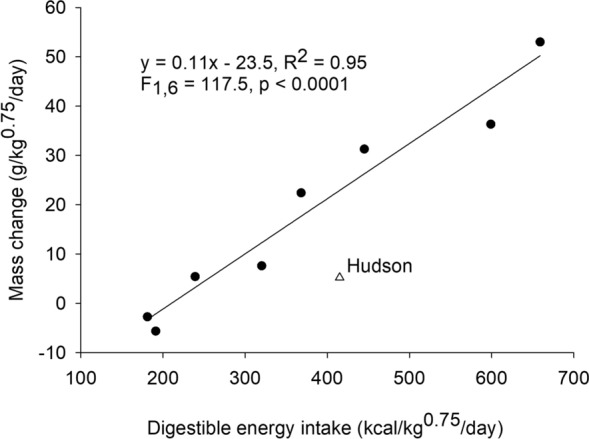
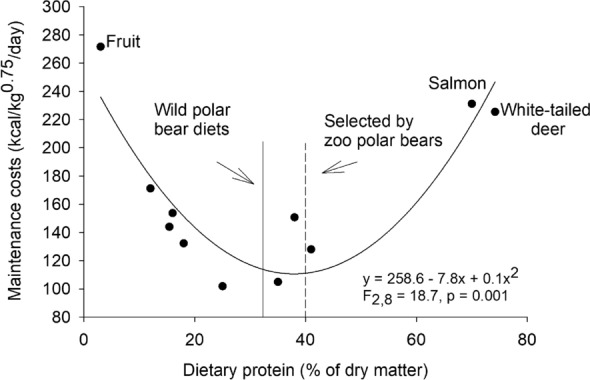
Studies of predator feeding ecology commonly focus on energy intake. However, captive predators have been documented to selectively feed to optimize macronutrient intake. As many apex predators experience environmental changes that affect prey availability, limitations on selective feeding can affect energetics and health. We estimated the protein:fat ratio of diets consumed by wild polar bears using a novel isotope-based approach, measured protein:fat ratios selected by zoo polar bears offered dietary choice and examined potential energetic and health consequences of overconsuming protein. Dietary protein levels selected by wild and zoo polar bears were low and similar to selection observed in omnivorous brown bears, which reduced energy intake requirements by 70% compared with lean meat diets. Higher-protein diets fed to zoo polar bears during normal care were concurrent with high rates of mortality from kidney disease and liver cancer. Our results suggest that polar bears have low protein requirements and that limitations on selective consumption of marine mammal blubber consequent to climate change could meaningfully increase their energetic costs. Although bear protein requirements appear lower than those of other carnivores, the energetic and health consequences of protein overconsumption identified in this study have the potential to affect a wide range of taxa.
Overview
The claims and statistics of this paper haven’t been checked yet.
Free: it reads the open-access text and checks the first 5 claims that cite a source we can check. Create a free account to check every claim.
Integrity signals
Registry
Cites
Statistics
Figures
Verification
Claims the paper makes
The claims and statistics of this paper haven’t been checked yet.
Free: it reads the open-access text and checks the first 5 claims that cite a source we can check. Create a free account to check every claim.
Claims other papers make about this one
Each is checked against this paper’s own text: does it say what the citing paper says it does?
The cited source says what the claim attributes to it.
In the citing paper
“The few available studies16 suggest that, based on their tolerance towards carbohydrates, mammalian predators can be aligned along a carnivore–omnivore continuum, ranging from obligate carnivores, such as wolves (Canis lupus)17 to poorly specialized ursids18.”
From Nutritional ecology of a prototypical generalist predator, the red fox (Vulpes vulpes) (2024) · cites this paper as [18]
Self-check
Percentages, sums and reported differences re-computed from the paper’s own numbers.
The self-check needs the paper’s full text.
Citations
Cites
Hofmann, R. R. (1989) · Oecologia · doi:10.1007/bf00378733 · Cited by 1,812
Analyzing mixing systems using a new generation of Bayesian tracer mixing models
Stock, B. C., Jackson, A. L., Ward, E. J., Parnell, A. C., Phillips, D. L., & Semmens, B. X. (2018) · PeerJ · doi:10.7717/peerj.5096 · Cited by 1,524
Nutrition integrates environmental responses of ungulates.
Parker, K. L., Barboza, P. S., & Gillingham, M. P. (2009) · Functional Ecology · doi:10.1111/j.1365-2435.2009.01528.x · Cited by 686
BININDA-EMONDS, O. R. P., GITTLEMAN, J. L., & PURVIS, A. (1999) · Biological Reviews of the Cambridge Philosophical Society · doi:10.1017/s0006323199005307 · Cited by 589
Population genomics reveal recent speciation and rapid evolutionary adaptation in polar bears
Liu, S., Lorenzen, E. D., Fumagalli, M., Li, B., Harris, K., Xiong, Z., Zhou, L., Korneliussen, T. S., Somel, M., Babbitt, C., et al. (2014) · Cell · doi:10.1016/j.cell.2014.03.054 · Cited by 411
POLAR BEAR DIETS AND ARCTIC MARINE FOOD WEBS: INSIGHTS FROM FATTY ACID ANALYSIS
Thiemann, G. W., Iverson, S. J., & Stirling, I. (2008) · Ecological Monographs · doi:10.1890/07-1050.1 · Cited by 351
The Effects of High-Protein Diets on Kidney Health and Longevity
Ko, G.-J., Rhee, C. M., Kalantar-Zadeh, K., & Joshi, S. (2020) · Journal of the American Society of Nephrology · doi:10.1681/asn.2020010028 · Cited by 345
TRITES, A. W., & DONNELLY, C. P. (2003) · Mammal Review · doi:10.1046/j.1365-2907.2003.00009.x · Cited by 332
Digestive and metabolic efficiencies of grizzly and black bears
Pritchard, G. T., & Robbins, C. T. (1990) · Canadian Journal of Zoology · doi:10.1139/z90-244 · Cited by 249
Self-citationStirling, I., & McEwan, E. H. (1975) · Canadian Journal of Zoology · doi:10.1139/z75-117 · Cited by 238
Rode, K. D., Regehr, E. V., Douglas, D. C., Durner, G., Derocher, A. E., Thiemann, G. W., & Budge, S. M. (2014) · Global Change Biology · doi:10.1111/gcb.12339 · Cited by 219
Self-citationEnergy utilization of low-protein diets in growing pigs.
Le Bellego, L., van Milgen, J., Dubois, S., & Noblet, J. (2001) · Journal of Animal Science · doi:10.2527/2001.7951259x · Cited by 203
Newsome, S. D., Koch, P. L., Etnier, M. A., & Aurioles‐Gamboa, D. (2006) · Marine Mammal Science · doi:10.1111/j.1748-7692.2006.00043.x · Cited by 200
Effect of high temperature and low-protein diets on the performance of growing-finishing pigs1
Le Bellego, L., van Milgen, J., & Noblet, J. (2002) · Journal of Animal Science · doi:10.2527/2002.803691x · Cited by 194
Optimizing protein intake as a foraging strategy to maximize mass gain in an omnivore
Robbins, C. T., Fortin, J. K., Rode, K. D., Farley, S. D., Shipley, L. A., & Felicetti, L. A. (2007) · Oikos · doi:10.1111/j.0030-1299.2007.16140.x · Cited by 179
Self-citationCan polar bears use terrestrial foods to offset lost ice‐based hunting opportunities?
Rode, K. D., Robbins, C. T., Nelson, L., & Amstrup, S. C. (2015) · Frontiers in Ecology and the Environment · doi:10.1890/140202 · Cited by 179
Self-citationNutritional physiology and ecology of wildlife in a changing world
Birnie-Gauvin, K., Peiman, K. S., Raubenheimer, D., & Cooke, S. J. (2017) · Conservation Physiology · doi:10.1093/conphys/cox030 · Cited by 179
Idiosyncratic nutrient requirements of cats appear to be diet-induced evolutionary adaptations
Morris, J. G. (2002) · Nutrition Research Reviews · doi:10.1079/nrr200238 · Cited by 175
Raubenheimer, D., Simpson, S. J., & Tait, A. H. (2012) · Philosophical Transactions of the Royal Society B: Biological Sciences · doi:10.1098/rstb.2012.0007 · Cited by 174
Physiological Mechanisms in Coping with Climate Change
Fuller, A., Dawson, T., Helmuth, B., Hetem, R. S., Mitchell, D., & Maloney, S. K. (2010) · Physiological and Biochemical Zoology · doi:10.1086/652242 · Cited by 173
Rapid Environmental Change Drives Increased Land Use by an Arctic Marine Predator
Atwood, T. C., Peacock, E., McKinney, M. A., Lillie, K., Wilson, R. H., Douglas, D. C., Miller, S., & Terletzky, P. A. (2016) · PLoS ONE · doi:10.1371/journal.pone.0155932 · Cited by 172
McArt, S. H., Spalinger, D. E., Collins, W., Schoen, E. R., Stevenson, T. J., & Bucho, M. (2009) · Ecology · doi:10.1890/08-1435.1 · Cited by 169
Ioannou, G. N., Morrow, O. B., Connole, M. L., & Lee, S. P. (2009) · Hepatology · doi:10.1002/hep.22941 · Cited by 168
Plantinga, E. A., Bosch, G., & Hendriks, W. H. (2011) · British Journal of Nutrition · doi:10.1017/s0007114511002285 · Cited by 166
Kirsch, P. E., Iverson, S. J., & Bowen, W. D. (2000) · Physiological and Biochemical Zoology · doi:10.1086/316723 · Cited by 162
Aspects of survival in juvenile polar bears
Derocher, A. E., & Stirling, I. (1996) · Canadian Journal of Zoology · doi:10.1139/z96-138 · Cited by 161
Hilderbrand, G. V., Jenkins, S. G., Schwartz, C. C., Hanley, T. A., & Robbins, C. T. (1999) · Canadian Journal of Zoology · doi:10.1139/z99-133 · Cited by 158
Self-citationRode, K. D., Chapman, C. A., McDowell, L. R., & Stickler, C. M. (2006) · Biotropica · doi:10.1111/j.1744-7429.2006.00183.x · Cited by 155
Self-citationWhy bears consume mixed diets during fruit abundance
Rode, K. D., & Robbins, C. T. (2000) · Canadian Journal of Zoology · doi:10.1139/cjz-78-9-1640 · Cited by 152
Self-citationHilderbrand, G. V., Jenkins, S. G., Schwartz, C. C., Hanley, T. A., & Robbins, C. T. (1999) · Canadian Journal of Zoology · doi:10.1139/cjz-77-10-1623 · Cited by 146
Self-citationMacronutrient optimization and energy maximization determine diets of brown bears
Erlenbach, J. A., Rode, K. D., Raubenheimer, D., & Robbins, C. T. (2014) · Journal of Mammalogy · doi:10.1644/13-mamm-a-161 · Cited by 142
Self-citationFerguson, S. H., Young, B. G., Yurkowski, D. J., Anderson, R., Willing, C., & Nielsen, O. (2017) · PeerJ · doi:10.7717/peerj.2957 · Cited by 133
Fasting season length sets temporal limits for global polar bear persistence
Molnár, P. K., Bitz, C. M., Holland, M. M., Kay, J. E., Penk, S. R., & Amstrup, S. C. (2020) · Nature Climate Change · doi:10.1038/s41558-020-0818-9 · Cited by 131
Geometric analysis of macronutrient selection in breeds of the domestic dog, Canis lupus familiaris
Hewson-Hughes, A. K., Hewson-Hughes, V. L., Colyer, A., Miller, A. T., McGrane, S. J., Hall, S. R., Butterwick, R. F., Simpson, S. J., & Raubenheimer, D. (2013) · Behavioral Ecology · doi:10.1093/beheco/ars168 · Cited by 126
Kohl, K. D., Coogan, S. C. P., & Raubenheimer, D. (2015) · BioEssays · doi:10.1002/bies.201400171 · Cited by 125
Anton, S., Hida, A., Heekin, K., Sowalsky, K., Karabetian, C., Mutchie, H., Leeuwenburgh, C., Manini, T., & Barnett, T. (2017) · Nutrients · doi:10.3390/nu9080822 · Cited by 125
Seasonal changes in body mass and body composition of ringed seals (Phoca hispida) on Svalbard
Ryg, M. S., Smith, T. G., & Øritsland, N. A. (1990) · Canadian Journal of Zoology · doi:10.1139/z90-069 · Cited by 122
Historical and potential future importance of large whales as food for polar bears
Laidre, K. L., Stirling, I., Estes, J. A., Kochnev, A. A., & Roberts, J. (2018) · Frontiers in Ecology and the Environment · doi:10.1002/fee.1963 · Cited by 117
Crawford, J. A., Quakenbush, L. T., & Citta, J. J. (2015) · Progress In Oceanography · doi:10.1016/j.pocean.2015.05.011 · Cited by 116
Regehr, E. V., Hostetter, N. J., Wilson, R. R., Rode, K. D., Martin, M. S., & Converse, S. J. (2018) · Scientific Reports · doi:10.1038/s41598-018-34824-7 · Cited by 115
Self-citationThe importance of physiological ecology in conservation biology
Tracy, C. R., Nussear, K. E., Esque, T. C., Dean-Bradley, K., Tracy, C. R., DeFalco, L. A., Castle, K. T., Zimmerman, L. C., Espinoza, R. E., & Barber, A. M. (2006) · Integrative and Comparative Biology · doi:10.1093/icb/icl054 · Cited by 109
Spring fasting behavior in a marine apex predator provides an index of ecosystem productivity
Rode, K. D., Wilson, R. R., Douglas, D. C., Muhlenbruch, V., Atwood, T. C., Regehr, E. V., Richardson, E. S., Pilfold, N. W., Derocher, A. E., Durner, G. M., et al. (2017) · Global Change Biology · doi:10.1111/gcb.13933 · Cited by 100
Self-citationRode, K. D., Stricker, C. A., Erlenbach, J. A., Robbins, C. T., Cherry, S. G., Newsome, S. D., Cutting, A., Jensen, S., Stenhouse, G. B., Brooks, M., et al. (2016) · Physiological and Biochemical Zoology · doi:10.1086/686490 · Cited by 95
Self-citationGiant Pandas Are Macronutritional Carnivores
Nie, Y., Wei, F., Zhou, W., Hu, Y., Senior, A. M., Wu, Q., Li, Y., & Raubenheimer, D. (2019) · Current Biology · doi:10.1016/j.cub.2019.03.067 · Cited by 84
Yurkowski, D. J., Hussey, N. E., Semeniuk, C. A. D., Ferguson, S. H., & Fisk, A. T. (2014) · Polar Biology · doi:10.1007/s00300-014-1571-1 · Cited by 77
Hauser, D. D. W., Allen, C. S., Rich, H. B., & Quinn, T. P. (2008) · Aquatic Mammals · doi:10.1578/am.34.3.2008.303 · Cited by 63
The Nutritional Ecology of Marine Apex Predators
Machovsky‐Capuska, G. E., & Raubenheimer, D. (2019) · Annual Review of Marine Science · doi:10.1146/annurev-marine-010318-095411 · Cited by 63
Long-Term High Intake of Whole Proteins Results in Renal Damage in Pigs
Jia, Y. H., Hwang, S. Y., House, J. D., Ogborn, M. R., Weiler, H. A., Karmin, O., & Aukema, H. M. (2010) · Journal of Nutrition · doi:10.3945/jn.110.123034 · Cited by 62
Rosen, D. A. S., & Trites, A. W. (2005) · Journal of Comparative Physiology B · doi:10.1007/s00360-005-0481-5 · Cited by 57
McKinney, M. A., Atwood, T. C., Iverson, S. J., & Peacock, E. (2017) · Ecosphere · doi:10.1002/ecs2.1633 · Cited by 54
Proximate Mineral and Gross Energy Composition of White-Tailed Deer
McCullough, D. R., & Ullrey, D. E. (1983) · Journal of Wildlife Management · doi:10.2307/3808516 · Cited by 52
PLASMA BIOCHEMICAL VALUES FROM APPARENTLY HEALTHY FREE-RANGING POLAR BEARS FROM SVALBARD
Tryland, M., Brun, E., Derocher, A. E., Arnemo, J. M., Kierulf, P., Ølberg, R., & Wiig, Ø. (2002) · Journal of Wildlife Diseases · doi:10.7589/0090-3558-38.3.566 · Cited by 50
Rode, K. D., Regehr, E. V., Bromaghin, J. F., Wilson, R. R., Martin, M. S., Crawford, J. A., & Quakenbush, L. T. (2021) · Global Change Biology · doi:10.1111/gcb.15572 · Cited by 47
Self-citationBöswald, L. F., Kienzle, E., & Dobenecker, B. (2018) · Journal of Animal Physiology and Animal Nutrition · doi:10.1111/jpn.12886 · Cited by 44
A diet with 35 % of energy from protein leads to kidney damage in female Sprague–Dawley rats
Wakefield, A. P., House, J. D., Ogborn, M. R., Weiler, H. A., & Aukema, H. M. (2011) · British Journal of Nutrition · doi:10.1017/s0007114511000730 · Cited by 38
Excess protein enabled dog domestication during severe Ice Age winters
Lahtinen, M., Clinnick, D., Mannermaa, K., Salonen, J. S., & Viranta, S. (2021) · Scientific Reports · doi:10.1038/s41598-020-78214-4 · Cited by 36
Hewson, A. K., Colyer, A., Simpson, S. J., & Raubenheimer, D. (2016) · Royal Society Open Science · doi:10.1098/rsos.160081 · Cited by 35
Zhao, L., Schell, D. M., & Castellini, M. A. (2006) · Comparative Biochemistry and Physiology Part A Molecular & Integrative Physiology · doi:10.1016/j.cbpa.2005.12.032 · Cited by 34
Hedberg, G. E., Derocher, A. E., Andersen, M., Rogers, Q. R., DePeters, E. J., Lönnerdal, B. L., Mazzaro, L. M., Chesney, R. W., & Hollis, B. (2011) · Zoo Biology · doi:10.1002/zoo.20375 · Cited by 31
Germain, L. R., McCarthy, M. D., Koch, P. L., & Harvey, J. T. (2011) · Marine Mammal Science · doi:10.1111/j.1748-7692.2011.00516.x · Cited by 23
Nutrient-specific compensatory feeding in a mammalian carnivore, the mink, Neovison vison
Jensen, K., Simpson, S. J., Nielsen, V. H., Hunt, J., Raubenheimer, D., & Mayntz, D. (2014) · British Journal of Nutrition · doi:10.1017/s0007114514001664 · Cited by 20
A RETROSPECTIVE STUDY OF END-STAGE RENAL DISEASE IN CAPTIVE POLAR BEARS (URSUS MARITIMUS)
LaDouceur, E. E. B., Garner, M. M., Davis, B. J., & Tseng, F. (2014) · Journal of Zoo and Wildlife Medicine · doi:10.1638/2013-0071r.1 · Cited by 18
Gomez, M. D., Rosen, D. A. S., & Trites, A. W. (2015) · Canadian Journal of Zoology · doi:10.1139/cjz-2015-0143 · Cited by 18
Dyck, M. G., & Morin, P. (2011) · Pakistan Journal of Zoology · Cited by 10
Dietary Evolution: The Panda Paradox
Sponheimer, M., Clauß, M., & Codron, D. (2019) · Current Biology · doi:10.1016/j.cub.2019.04.045 · Cited by 7
Research works printed but not linked: 1
- Erlenbach, J. A. Nutritional and landscape ecology of brown bears (Ursus arctos). PhD dissertation. Washington State University, Pullman, WA, USA (2020).
Cited by
Anthropogenic food: an emerging threat to polar bears
Smith, T. S., Derocher, A. E., Mazur, R., York, G. W., Owen, M. A., Obbard, M. E., Richardson, E. S., & Amstrup, S. C. (2022) · Oryx · doi:10.1017/s0030605322000278 · Cited by 26
Rode, K. D., Taras, B. D., Stricker, C. A., Atwood, T. C., Boucher, N. P., Durner, G. M., Derocher, A. E., Richardson, E. S., Cherry, S. G., Quakenbush, L. T., et al. (2022) · Ecological Applications · doi:10.1002/eap.2751 · Cited by 19
Self-citationNew insights into dietary management of polar bears (Ursus maritimus) and brown bears (U. arctos)
Robbins, C. T., Tollefson, T. N., Rode, K. D., Erlenbach, J. A., & Ardente, A. J. (2021) · Zoo Biology · doi:10.1002/zoo.21658 · Cited by 18
Self-citationMikkelsen, A. J., Hobson, K. A., Sergiel, A., Hertel, A. G., Selva, N., & Zedrosser, A. (2023) · Ecology · doi:10.1002/ecy.4228 · Cited by 13
Ursids evolved early and continuously to be low-protein macronutrient omnivores
Robbins, C. T., Christian, A. L., Vineyard, T. G., Thompson, D., Knott, K. K., Tollefson, T. N., Fidgett, A., & Wickersham, T. A. (2022) · Scientific Reports · doi:10.1038/s41598-022-19742-z · Cited by 15
Self-citation
Metadata
- Authors
- Rode, K. D., Robbins, C. T., Stricker, C. A., Taras, B. D., & Tollefson, T. N.
- Affiliations
- U.S. Geological Survey, Alaska Science Center (US)
- Washington State University (US)
- Fort Collins Science Center (US)
- Alaska Department of Fish and Game (US)
- Corresponding author
- Rode, Karyn D.
- Venue
- Scientific Reports
- Published
- 2021-07-28
- Volume
- 11
- Issue
- 1
- Pages
- 15309-15309
- ISSN
- 2045-2322 (ISSN-L)
- PMC
- PMC8319126
- OpenAlex
- W3186561967
- Cited by
- 21
- References
- 65
- Citations by year
- 2026: 1 · 2025: 6 · 2024: 5 · 2023: 3 · 2022: 5 · 2021: 1
- FWCI
- 1.89
- Type
- journal article
- Language
- en
- Open access
- gold
- doi.org
- Licence
- cc-by
- creativecommons.org/licenses/by/4.0 (tdm)
- creativecommons.org/licenses/by/4.0 (vor)
- Locations
- Scientific Reports (publishedVersion, cc-by)
- PubMed Central (publishedVersion, cc-by)
- PubMed (publishedVersion)
- DOAJ (DOAJ: Directory of Open Access Journals) (submittedVersion, cc-by-sa)
- Funders
- US Geological Survey
- Detroit Zoological Society
- Topics
- Physical Sciences › Environmental Science › Ecology › Isotope Analysis in Ecology
- Physical Sciences › Environmental Science › Ecology › Marine animal studies overview
- Physical Sciences › Environmental Science › Ecology › Wildlife Ecology and Conservation
- Keywords
- polar bear, protein requirements, fat-to-protein ratio, selective feeding, zoo animals, captive diet, kidney disease, liver cancer, energy intake, brown bear, climate change
- MeSH terms
- Adipose Tissue, Animals, Animal Feed, Animals, Wild, Animals, Zoo, Ursidae, Carbon Isotopes, Cause of Death, Dietary Fats, Dietary Proteins, Energy Metabolism, Female, Food Preferences, Hair, Heart Diseases, Hyperphagia, Kidney Diseases, Liver Neoplasms, Male, Muscles, Nitrogen Isotopes, Predatory Behavior, Salmon, Whales, Seals, Earless, Climate Change
About these checks
Registry, retraction, Cites and statistics results are computed, not judged, with one exception: a printed reference that no index lists is read once by a model before it counts as a citation error. Claims are extracted by a model and kept only when their quote appears verbatim in the text; each cited source is then checked, with a model’s help, for whether it says what the claim relies on. Those verdicts can be wrong — read the claim’s quote and the cited source before relying on one.
Statistics and arithmetic are recomputed, not judged.
Confidence bands are shown only for fields calibrated on our annotated test set. None is calibrated yet, so no band is shown.
What counts as a claim ›How we measure confidence ›How we check this ›
Are you an author, or do you see a problem with this page? Request a review
Data sources
Bibliographic data: Semantic Scholar, OpenAlex, Crossref.
Contains information from the Semantic Scholar Academic Graph Datasets, made available under the ODC Attribution License (ODC-BY 1.0).
Semantic Scholar’s data is described in: Kinney, R., et al. (2023). The Semantic Scholar Open Data Platform. arXiv:2301.10140.
