

The DOI matches its Crossref record; 49 of the 49 references it cites were found in a registry or an index.
Effect of particle size on phytochemical composition and antioxidant properties of Sargassum cristaefolium ethanol extract
Open accessAbstract
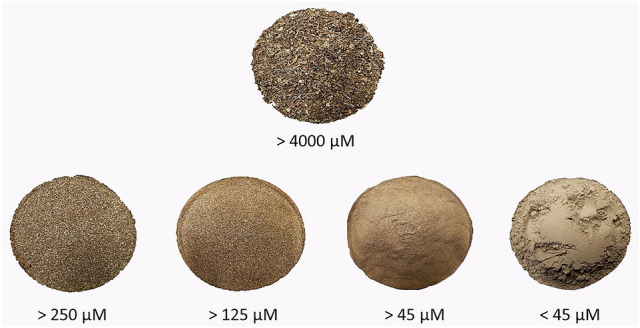
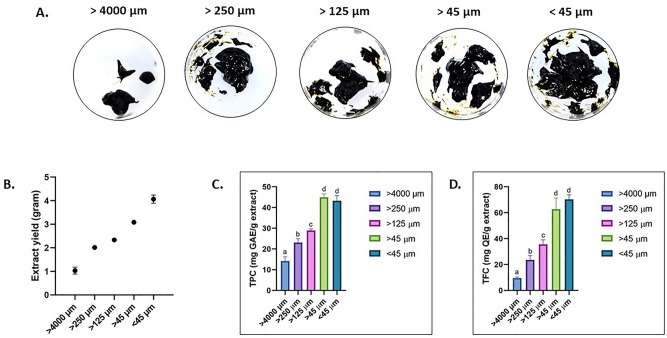
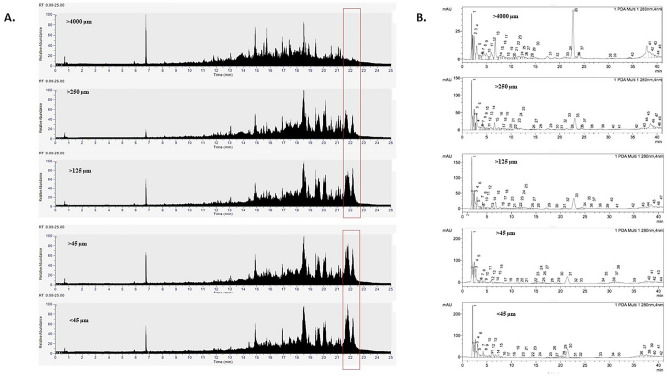
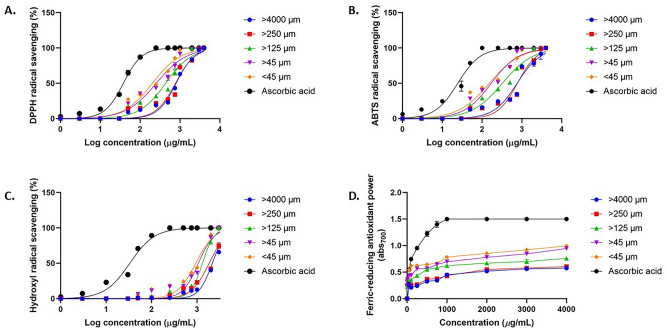
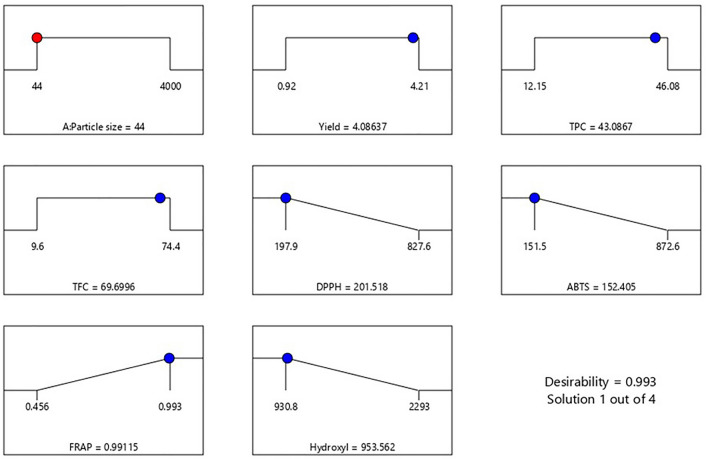
Sample particle size is an important parameter in the solid–liquid extraction system of natural products for obtaining their bioactive compounds. This study evaluates the effect of sample particle size on the phytochemical composition and antioxidant activity of brown macroalgae Sargassum cristaefolium . The crude ethanol extract was extracted from dried powders of S.cristeafolium with various particle sizes (> 4000 µm, > 250 µm, > 125 µm, > 45 µm, and < 45 µm). The ethanolic extracts of S.cristaefolium were analysed for Total Phenolic Content (TPC), Total Flavonoid Content (TFC), phenolic compound concentration and antioxidant activities. The extract yield and phytochemical composition were more abundant in smaller particle sizes. Furthermore, the TPC (14.19 ± 2.08 mg GAE/g extract to 43.27 ± 2.56 mg GAE/g extract) and TFC (9.6 ± 1.8 mg QE/g extract to 70.27 ± 3.59 mg QE/g extract) values also significantly increased as particle sizes decreased. In addition, phenolic compounds epicatechin (EC), epicatechin gallate (ECG), epigallocatechin (EGC), and Epigallocatechin gallate (EGCG) concentration were frequently increased in samples of smaller particle sizes based on two-way ANOVA and Tukey’s multiple comparison analysis. These results correlate with the significantly stronger antioxidant activity in samples with smaller particle sizes. The smallest particle size (< 45 µm) demonstrated the strongest antioxidant activity based on DPPH, ABTS, hydroxyl assay and FRAP. In addition, ramp function graph evaluates the desired particle size for maximum phytochemical composition and antioxidant activity is 44 µm. In conclusion, current results show the importance of particle size reduction of macroalgae samples to increase the effectivity of its biological activity.
Overview
The claims and statistics of this paper haven’t been checked yet.
Run the check — free, no account needed. It reads the open-access text and checks the sources it cites.
Integrity signals
Registry
Cites
Statistics
Figures
Verification
Claims the paper makes
The claims and statistics of this paper haven’t been checked yet.
Run the check — free, no account needed. It reads the open-access text and checks the sources it cites.
Claims other papers make about this one
Each is checked against this paper’s own text: does it say what the citing paper says it does?
The cited source says what the claim attributes to it.
In the citing paper
“This variability in particle size may influence the interaction between the plant material and solvents, potentially affecting the extraction efficiency [66].”
From Comparative Analysis of Infusions and Ethanolic Extracts of Annona muricata Leaves from Colima, Mexico: Phytochemical Profile and Antioxidant Activity (2024) · cites this paper as [66]
Self-check
Percentages, sums and reported differences re-computed from the paper’s own numbers.
The self-check needs the paper’s full text.
Citations
Cites
Ainsworth, E. A., & Gillespie, K. M. (2007) · Nature Protocols · doi:10.1038/nprot.2007.102 · Cited by 3,375
Phytochemicals: extraction, isolation, and identification of bioactive compounds from plant extracts
Altemimi, A., Lakhssassi, N., Baharlouei, A., Watson, D., & Lightfoot, D. (2017) · Plants · doi:10.3390/plants6040042 · Cited by 1,965
Extraction, Isolation And Characterization Of Bioactive Compounds From Plants’ Extracts
Sasidharan, S., Chen, Y., Saravanan, D., Sundram, K., & Latha, L. (2010) · African Journal of Traditional Complementary and Alternative Medicines · doi:10.4314/ajtcam.v8i1.60483 · Cited by 1,463
Estimation of Scavenging Activity of Phenolic Compounds Using the ABTS•+ Assay
Nenadis, N., Wang, L., Tsimidou, M. Z., & Zhang, H. (2004) · Journal of Agricultural and Food Chemistry · doi:10.1021/jf0400056 · Cited by 496
Marine macroalgae as sources of protein and bioactive compounds in feed for monogastric animals
Øverland, M., Mydland, L. T., & Skrede, A. (2018) · Journal of the Science of Food and Agriculture · doi:10.1002/jsfa.9143 · Cited by 456
Phenolic content and antioxidant capacity in algal food products
Machu, L., Misurcova, L., Vavra Ambrozova, J., Orsavova, J., Mlcek, J., Sochor, J., & Jurikova, T. (2015) · Molecules · doi:10.3390/molecules20011118 · Cited by 437
Piluzza, G., & Bullitta, S. (2011) · Pharmaceutical Biology · doi:10.3109/13880209.2010.501083 · Cited by 335
Maran, J. P., Manikandan, S., Nivetha, C. V., & Dinesh, R. (2013) · Arabian Journal of Chemistry · doi:10.1016/j.arabjc.2013.02.007 · Cited by 291
The Potential of Seaweeds as a Source of Functional Ingredients of Prebiotic and Antioxidant Value
Gomez-Zavaglia, A., Prieto Lage, M. A., Jimenez-Lopez, C., Mejuto, J. C., & Simal-Gandara, J. (2019) · Antioxidants · doi:10.3390/antiox8090406 · Cited by 280
Lee, K. J., Oh, Y. C., Cho, W. K., & Yeul, J. (2015) · Evidence-based Complementary and Alternative Medicine · doi:10.1155/2015/165457 · Cited by 246
Esmaeili, A. K., Taha, R. M., Mohajer, S., & Banisalam, B. (2015) · BioMed Research International · doi:10.1155/2015/643285 · Cited by 226
Optimizing conditions for the extraction of catechins from green tea using hot water
Vuong, Q. V., Golding, J. B., Stathopoulos, C. E., Nguyen, M. H., & Roach, P. D. (2011) · Journal of Separation Science · doi:10.1002/jssc.201000863 · Cited by 223
Sanjeewa, K. K. A., Kim, E.-A. L., Son, K.-T., & Jeon, Y. (2016) · Journal of Photochemistry and Photobiology B Biology · doi:10.1016/j.jphotobiol.2016.06.027 · Cited by 206
Barbosa, M., Valentão, P., & Andrade, P. (2014) · Marine Drugs · doi:10.3390/md12094934 · Cited by 181
Yang, B., Liu, X., & Gao, Y. (2009) · Innovative Food Science & Emerging Technologies · doi:10.1016/j.ifset.2009.03.003 · Cited by 167
Effect of superfine grinding on quality and antioxidant property of fine green tea powders
Hu, J., Chen, Y., & Ni, D. (2011) · LWT · doi:10.1016/j.lwt.2011.08.002 · Cited by 166
Wheat bran particle size influence on phytochemical extractability and antioxidant properties
Brewer, L. R., Kubola, J., Siriamornpun, S., Herald, T. J., & Shi, Y. (2013) · Food Chemistry · doi:10.1016/j.foodchem.2013.11.128 · Cited by 152
Supercritical Carbon Dioxide Extraction of Molecules of Interest from Microalgae and Seaweeds
Crampon, C., Boutin, O., & Badens, E. (2011) · Industrial & Engineering Chemistry Research · doi:10.1021/ie102297d · Cited by 146
Lim, S.-J., Choi, A.-H., Kwon, M., Joung, E., Shin, T., Lee, S. G., Kim, N.-G., & Kim, H. (2018) · Food Chemistry · doi:10.1016/j.foodchem.2018.11.058 · Cited by 146
Moubayed, N. M. S., Al Houri, H. J., Al Khulaifi, M. M., & Al Farraj, D. A. (2017) · Saudi Journal of Biological Sciences · doi:10.1016/j.sjbs.2016.05.018 · Cited by 145
Tanna, B., & Mishra, A. (2018) · Comprehensive Reviews in Food Science and Food Safety · doi:10.1111/1541-4337.12396 · Cited by 136
Mansoori, A., Singh, N. K., Dubey, S. K., Thakur, T. K., Alkan, N., Das, S. N., & Kumar, A. (2020) · Frontiers in Agronomy · doi:10.3389/fagro.2020.582268 · Cited by 135
Amdoun, R., Khelifi, L., Khelifi-Slaoui, M., Amroune, S., Asch, M., Ducrocq, C., & Gontier, É. (2018) · Iranian Journal of Biotechnology · doi:10.21859/ijb.1339 · Cited by 126
Polyphenolic and basic chemical composition of black chokeberry industrial by-products
Sójka, M., Kołodziejczyk, K., & Milala, J. (2013) · Industrial Crops and Products · doi:10.1016/j.indcrop.2013.08.051 · Cited by 125
Pretreatment of macroalgal biomass for biogas production
Montingelli, M. E., Benyounis, K. Y., Stokes, J. T., & Olabi, A. G. (2015) · Energy Conversion and Management · doi:10.1016/j.enconman.2015.11.008 · Cited by 119
Savlak, N., Türker, B., & Yeşilkanat, N. (2016) · Food Chemistry · doi:10.1016/j.foodchem.2016.06.064 · Cited by 119
Therapeutic Uses of Red Macroalgae
Ismail, M. M., Alotaibi, B. S., & EL-Sheekh, M. M. (2020) · Molecules · doi:10.3390/molecules25194411 · Cited by 118
Makanjuola, S. A. (2017) · Food Science & Nutrition · doi:10.1002/fsn3.509 · Cited by 116
Distribution of catechins in Japanese seaweeds
Yoshie, Y., Wang, W., Petillo, D., & Suzuki, T. (2000) · Fisheries Science · doi:10.1046/j.1444-2906.2000.00160.x · Cited by 114
Tierney, M. S., Smyth, T. J., Rai, D. K., Soler‐Vila, A., Croft, A. K., & Brunton, N. P. (2013) · Food Chemistry · doi:10.1016/j.foodchem.2013.01.019 · Cited by 106
Determination of phenolic compounds in macroalgae for human consumption
de Quirós, A. R. B., Lage-Yusty, M. A., & López-Hernández, J. (2010) · Food Chemistry · doi:10.1016/j.foodchem.2009.12.078 · Cited by 104
Olasehinde, T. A., Olaniran, A. O., & Okoh, A. I. (2019) · Marine Drugs · doi:10.3390/md17110609 · Cited by 93
Chan, C. X., Ho, C., & Phang, S. (2006) · Trends in Plant Science · doi:10.1016/j.tplants.2006.02.003 · Cited by 84
Tchabo, W., Ma, Y., Kwaw, E., Xiao, L., Wu, M., & Apaliya, M. T. (2018) · International Journal of Food Properties · doi:10.1080/10942912.2018.1446025 · Cited by 62
Sheng, Z., Zhao, J., Ishfaq, M., & Zhang, Y. (2018) · PLoS ONE · doi:10.1371/journal.pone.0202368 · Cited by 59
Maneesh, A., Chakraborty, K., & Makkar, F. (2016) · International Journal of Food Properties · doi:10.1080/10942912.2016.1189434 · Cited by 58
Turumtay, E. A., İslamoğlu, F., Çavuş, D., Şahin, H., Turumtay, H., & Vanholme, B. (2013) · Industrial Crops and Products · doi:10.1016/j.indcrop.2013.11.042 · Cited by 57
Baek, S. H., Cao, L., Jeong, S. J., Kim, H., Jeung, N. T., & Lee, S. G. (2021) · Journal of Food Quality · doi:10.1155/2021/6640789 · Cited by 56
Alsaud, N., & Farid, M. M. (2020) · Applied Sciences · doi:10.3390/app10186362 · Cited by 48
Belščak‐Cvitanović, A., Benković, M., Komes, D., Bauman, I., Horžić, D., Dujmić, F., & Matijašec, M. (2010) · Journal of Agricultural and Food Chemistry · doi:10.1021/jf1005484 · Cited by 44
Lucas‐González, R., Fernández‐López, J., Pérez‐Álvarez, J. Á., & Viuda‐Martos, M. (2017) · Journal of the Science of Food and Agriculture · doi:10.1002/jsfa.8487 · Cited by 36
Growth-inhibitory Effects of the Red Alga Gelidium amansii on Cultured Cells
Chen, Y., Tu, C.-J., & Wu, H. (2004) · Biological and Pharmaceutical Bulletin · doi:10.1248/bpb.27.180 · Cited by 35
Mansour, R. B., Megdiche-Ksouri, W., Cluzet, S., Krisa, S., Richard, T., & Ksouri, R. (2016) · Evidence-based Complementary and Alternative Medicine · doi:10.1155/2016/2843463 · Cited by 35
Effects of processing parameters in the sonic assisted water extraction (SAWE) of 6-gingerol
Jaapar, S. Z. S., Morad, N. A., Iwai, Y., & Nordin, M. F. M. (2017) · Ultrasonics Sonochemistry · doi:10.1016/j.ultsonch.2017.02.034 · Cited by 23
Sansone, C., & Brunet, C. (2020) · Antioxidants · doi:10.3390/antiox9030206 · Cited by 22
Augusto-Obara, T. R., de Oliveira, J., da Glória, E. M., Spoto, M. H. F., Godoy, K., Vieira, T. M. F. D. S., & Scheuermann, E. (2019) · Scientia Agricola · doi:10.1590/1678-992x-2018-0056 · Cited by 20
Cellulose-rich secondary walls in wave-swept red macroalgae fortify flexible tissues
Martone, P. T., Janot, K., Fujita, M., Wasteneys, G. O., Ruel, K., Joseleau, J. P., & Estevez, J. M. (2019) · Planta · doi:10.1007/s00425-019-03269-1 · Cited by 15
Fahrurrozi, Juanssilfero, A. B., Perwitasari, U., Stepanie, Purwanto, A. P., Nugroho, I. B., Ratnakomala, S., Dewi, R. T., Ajijah, N., & Lisdiyanti, P. (2021) · International Journal on Advanced Science Engineering and Information Technology · doi:10.18517/ijaseit.11.3.14846 · Cited by 9
Self-citationAntioxidant activity of brown macroalgae Sargassum ethanol extract from Lombok coast, Indonesia
Prasedya, E. S., Martyasari, N. W. R., Abidin, A. S., Ilhami, B. T. K., Padmi, H., Widyastuti, S. H., Sunarwidhi, A. L., & Sunarpi, H. (2021) · IOP Conference Series Earth and Environmental Science · doi:10.1088/1755-1315/712/1/012038 · Cited by 8
Self-citation
Cited by
Sorted by citations
Tomasi, I. T., Santos, S. C. R., Boaventura, R. A. R., & Botelho, C. M. S. (2023) · Journal of Cleaner Production · doi:10.1016/j.jclepro.2023.136452 · Cited by 118
Jacob, S., Rao, R., Gorain, B., Boddu, S. H. S., & Nair, A. B. (2025) · Pharmaceutics · doi:10.3390/pharmaceutics17081079 · Cited by 99
Pogorzelska-Nowicka, E., Hanula, M., & Pogorzelski, G. (2024) · Food Chemistry · doi:10.1016/j.foodchem.2024.140456 · Cited by 72
Vidaarth, T. M. N., Surendhiran, S., Jagan, K. S. G., Savitha, S., Shanmugam, B. K., Karthik, A., & Kalpana, B. (2023) · Journal of Photochemistry and Photobiology A Chemistry · doi:10.1016/j.jphotochem.2023.115349 · Cited by 53
Macroalgae Bioactive Compounds for the Potential Antiviral of SARS-CoV-2: An In Silico Study
Padmi, H., Kharisma, V. D., Ansori, A. N. M., Sibero, M. T., Widyananda, M. H., Ullah, M. E., Гуменюк, О., Chylichcova, S., Bratishko, N., Prasedya, E. S., et al. (2022) · Journal of Pure and Applied Microbiology · doi:10.22207/jpam.16.2.26 · Cited by 46
Self-citation
Metadata
- Authors
- Prasedya, E. S., Frediansyah, A., Martyasari, N. W. R., Ilhami, B. K., Abidin, A. S., Padmi, H., Fahrurrozi, Juanssilfero, A. B., Widyastuti, S., & Sunarwidhi, A. L.
- Affiliations
- University of Mataram (ID)
- Indonesian Institute of Sciences (ID)
- Corresponding author
- Sunarwidhi, A. L.
- Venue
- Scientific Reports
- Published
- 2021-09-09
- Volume
- 11
- Issue
- 1
- Pages
- 17876-17876
- ISSN
- 2045-2322 (ISSN-L)
- PMC
- PMC8429668
- OpenAlex
- W3198301646
- Cited by
- 118
- References
- 49
- Citations by year
- 2026: 11 · 2025: 41 · 2024: 25 · 2023: 21 · 2022: 14 · 2021: 6
- FWCI
- 12.04
- Type
- journal article
- Language
- en
- Open access
- gold
- doi.org
- Locations
- Scientific Reports (publishedVersion, cc-by)
- PubMed Central (publishedVersion, cc-by)
- PubMed (publishedVersion)
- DOAJ (DOAJ: Directory of Open Access Journals) (submittedVersion, cc-by-sa)
- Funders
- Kementerian Riset, Teknologi dan Pendidikan Tinggi (PD 2021)
- Topics
- Life Sciences › Agricultural and Biological Sciences › Aquatic Science › Seaweed-derived Bioactive Compounds
- Health Sciences › Medicine › Biochemistry (medical) › Phytochemicals and Antioxidant Activities
- Life Sciences › Agricultural and Biological Sciences › Food Science › Food Quality and Safety Studies
- Keywords
- Sargassum cristaefolium, particle size, brown macroalgae, phytochemical composition, antioxidant activity, total phenolic content, total flavonoid content, phenolic compounds, epigallocatechin gallate, epicatechin, ethanol extract, solid-liquid extraction, extraction yield
- MeSH terms
- Ethanol, Antioxidants, Catechin, Flavonoids, Particle Size, Phenols, Plant Extracts
About these checks
Registry, retraction, Cites and statistics results are computed, not judged, with one exception: a printed reference that no index lists is read once by a model before it counts as a citation error. Claims are extracted by a model and kept only when their quote appears verbatim in the text; each cited source is then checked, with a model’s help, for whether it says what the claim relies on. Those verdicts can be wrong — read the claim’s quote and the cited source before relying on one.
Statistics and arithmetic are recomputed, not judged.
Confidence bands are shown only for fields calibrated on our annotated test set. None is calibrated yet, so no band is shown.
What counts as a claim ›How we measure confidence ›How we check this ›
Are you an author, or do you see a problem with this page? Request a review
