

Cyber-physical defense in the quantum Era
Open accessThe DOI matches its Crossref record; 49 of the 53 references it cites were found in a registry or an index.
Abstract
Networked-Control Systems (NCSs), a type of cyber-physical systems, consist of tightly integrated computing, communication and control technologies. While being very flexible environments, they are vulnerable to computing and networking attacks. Recent NCSs hacking incidents had major impact. They call for more research on cyber-physical security. Fears about the use of quantum computing to break current cryptosystems make matters worse. While the quantum threat motivated the creation of new disciplines to handle the issue, such as post-quantum cryptography, other fields have overlooked the existence of quantum-enabled adversaries. This is the case of cyber-physical defense research, a distinct but complementary discipline to cyber-physical protection. Cyber-physical defense refers to the capability to detect and react in response to cyber-physical attacks. Concretely, it involves the integration of mechanisms to identify adverse events and prepare response plans, during and after incidents occur. In this paper, we assume that the eventually available quantum computer will provide an advantage to adversaries against defenders, unless they also adopt this technology. We envision the necessity for a paradigm shift, where an increase of adversarial resources because of quantum supremacy does not translate into a higher likelihood of disruptions. Consistently with current system design practices in other areas, such as the use of artificial intelligence for the reinforcement of attack detection tools, we outline a vision for next generation cyber-physical defense layers leveraging ideas from quantum computing and machine learning. Through an example, we show that defenders of NCSs can learn and improve their strategies to anticipate and recover from attacks.
Overview
The claims and statistics of this paper haven’t been checked yet.
Free: it reads the open-access text and checks the first 5 claims that cite a source we can check. Create a free account to check every claim.
Integrity signals
Registry
Cites
Statistics
Figures

Verification
Claims the paper makes
The claims and statistics of this paper haven’t been checked yet.
Free: it reads the open-access text and checks the first 5 claims that cite a source we can check. Create a free account to check every claim.
Claims other papers make about this one
Each is checked against this paper’s own text: does it say what the citing paper says it does?
The source backs part of the claim, not all of it — or backs it for a different population, condition or comparison.
In the citing paper
“Contemporary surveys and threat assessments consistently warn that quantum decryption transforms confidentiality into a temporal vulnerability, demanding immediate cryptographic agility and migration toward quantum-resilient standards [17-19].”
From Harvest-Now, Decrypt-Later: A Temporal Cybersecurity Risk in the Quantum Transition (2025) · cites this paper as [18]
Experimental — accuracy not yet measuredThe source backs part of the claim, not all of it — or backs it for a different population, condition or comparison.
In the citing paper
“By combining multiple layers such as PQC primitives, hybrid modes, agile key management, and forward-secure lifecycles, recent research delineates a viable pathway for maintaining communications confidentiality against the HNDL threat [18,28].”
From Harvest-Now, Decrypt-Later: A Temporal Cybersecurity Risk in the Quantum Transition (2025) · cites this paper as [18]
Experimental — accuracy not yet measuredThe check wasn’t confident either way, so it gives no verdict — never disputed.
In the citing paper
“Recent work instead frames confidentiality as an explicitly temporal requirement, where an encryption scheme must remain secure for the full lifetime of the data it protects [18].”
From Harvest-Now, Decrypt-Later: A Temporal Cybersecurity Risk in the Quantum Transition (2025) · cites this paper as [18]
Experimental — accuracy not yet measuredThe check wasn’t confident either way, so it gives no verdict — never disputed.
In the citing paper
“Similarly, Mosca et al. [18] propose a systems-level temporal security framework but treat HNDL as one among several emerging risks rather than as a definable cryptographic adversary.”
From Harvest-Now, Decrypt-Later: A Temporal Cybersecurity Risk in the Quantum Transition (2025) · cites this paper as [18]
Experimental — accuracy not yet measured
Self-check
Percentages, sums and reported differences re-computed from the paper’s own numbers.
The self-check needs the paper’s full text.
Citations
Cites
LeCun, Y., Bengio, Y., & Hinton, G. (2015) · Nature · doi:10.1038/nature14539 · Cited by 84,126
Human-level control through deep reinforcement learning
Mnih, V., Kavukcuoglu, K., Silver, D., Rusu, A. A., Veness, J., Bellemare, M. G., Graves, A., Riedmiller, M., Fidjeland, A. K., Ostrovski, G., et al. (2015) · Nature · doi:10.1038/nature14236 · Cited by 30,357
Quantum Computation and Quantum Information
Nielsen, M. A., Chuang, I., & Grover, L. K. (2002) · American Journal of Physics · doi:10.1119/1.1463744 · Cited by 21,895
Quantum computation and quantum information
Law, J. (2001) · ACM SIGSOFT Software Engineering Notes · doi:10.1145/505482.505499 · Cited by 18,842
Watkins, C. J. C. H., & Dayan, P. (1992) · Machine Learning · doi:10.1007/bf00992698 · Cited by 9,083
Polynomial-time algorithms for prime factorization and discrete logarithms on a quantum computer
Shor, P. W. (1997) · SIAM Journal on Computing · doi:10.1137/s0097539795293172 · Cited by 8,472
Asynchronous Methods for Deep Reinforcement Learning
Mnih, V., Badia, A. P., Mirza, M., Graves, A., Lillicrap, T. P., Harley, T., Silver, D., & Kavukcuoglu, K. (2016) · arXiv · doi:10.48550/arxiv.1602.01783 · Cited by 7,132 · cited 1×
“Note that deep learning 45–47 and quantum RL can be used to approximate the Q-value function, with respectively, a neural network or a variational quantum circuit.”
MethodWatkins, C. (1989) · OpenGrey (Institut de l'Information Scientifique et Technique) · doi:10.17863/cam.132164 · Cited by 5,297
Biamonte, J., Wittek, P., Pancotti, N., Rebentrost, P., Wiebe, N., & Lloyd, S. (2017) · Nature · doi:10.1038/nature23474 · Cited by 4,779
Degen, C. L., Reinhard, F., & Cappellaro, P. (2017) · Reviews of Modern Physics · doi:10.1103/revmodphys.89.035002 · Cited by 4,045
Simple Proof of Security of the BB84 Quantum Key Distribution Protocol
Shor, P. W., & Preskill, J. (2000) · Physical Review Letters · doi:10.1103/physrevlett.85.441 · Cited by 3,047
Supervised learning with quantum-enhanced feature spaces
Havlíček, V., Córcoles, A. D., Temme, K., Harrow, A. W., Kandala, A., Chow, J. M., & Gambetta, J. M. (2019) · Nature · doi:10.1038/s41586-019-0980-2 · Cited by 2,572 · cited 1×
“A similar approach has been proposed by Havlíček et al. 30 .”
MethodThe rician distribution of noisy mri data
Gudbjartsson, H., & Patz, S. (1995) · Magnetic Resonance in Medicine · doi:10.1002/mrm.1910340618 · Cited by 2,494 · cited 1×
“Distribution functions such as Rayleigh 24 and Rician 25 are commonly used in the intrusion detection literature for this purpose.”
MethodMarkov Decision Processes: Discrete Stochastic Dynamic Programming
Baxter, L. A. (1995) · Technometrics · doi:10.1080/00401706.1995.10484354 · Cited by 2,415
Bellman, R. (1957) · Indiana University Mathematics Journal · doi:10.1512/iumj.1957.6.56038 · Cited by 2,408 · cited 1×
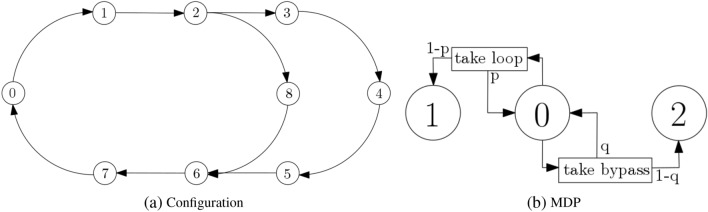
“To capture these three key assumptions, we use the Markov Decision Process (MDP) model 37,38 .”
MethodOn lattices, learning with errors, random linear codes, and cryptography
Regev, O. (2009) · Journal of the ACM · doi:10.1145/1568318.1568324 · Cited by 2,315 · cited 1×
“Candidate PQC families include code-based 9 , hash-based 10 , multivariate 11 , lattice-based 12,13 and supersingular isogeny-based 14 cryptosystems.”
NTRU: A ring-based public key cryptosystem
Hoffstein, J., Pipher, J., & Silverman, J. H. (1998) · Lecture Notes in Computer Science · doi:10.1007/bfb0054868 · Cited by 1,947 · cited 1×
“Candidate PQC families include code-based 9 , hash-based 10 , multivariate 11 , lattice-based 12,13 and supersingular isogeny-based 14 cryptosystems.”
Quantum Machine Learning in Feature Hilbert Spaces
Schuld, M., & Killoran, N. (2019) · Physical Review Letters · doi:10.1103/physrevlett.122.040504 · Cited by 1,840 · cited 2×
“Schuld and Killoran investigated the use of kernel methods 29 , employed for system identification, for quantum ML. Encoding of classical data into a quantum format is involved.”
MethodA secure control framework for resource-limited adversaries
Teixeira, A., Shames, I., Sandberg, H., & Johansson, K. H. (2015) · Automatica · doi:10.1016/j.automatica.2014.10.067 · Cited by 1,187
A survey on security control and attack detection for industrial cyber-physical systems
Ding, D., Han, Q.-L., Xiang, Y., Ge, X., & Zhang, X.-M. (2018) · Neurocomputing · doi:10.1016/j.neucom.2017.10.009 · Cited by 944
PennyLane: Automatic differentiation of hybrid quantum-classical computations
Bergholm, V., Izaac, J., Schuld, M., Gogolin, C., Ahmed, S., Ajith, V., Alam, M. S., Alonso-Linaje, G., AkashNarayanan, B., Asadi, A., et al. (2018) · arXiv · doi:10.48550/arxiv.1811.04968 · Cited by 732 · cited 4×
“Variational circuit optimization experts 41 highlight the need for more research to determine what works best, among the available variational circuit designs, versus the type of problem considered.”
BackgroundMethodInfluentialSupervised Learning with Quantum Computers
Schuld, M., & Petruccione, F. (2018) · Quantum Science and Technology · doi:10.1007/978-3-319-96424-9 · Cited by 730 · cited 3×
“Next, we develop an example that illustrates the potential and current limitations of quantum ML, using variational quantum circuits 31,34,35 , for solving cyber-physical defense issues.”
BackgroundMethodPatarin, J. (1996) · Lecture Notes in Computer Science · doi:10.1007/3-540-68339-9_4 · Cited by 662
Towards Quantum-Resistant Cryptosystems from Supersingular Elliptic Curve Isogenies
Jao, D., & De Feo, L. (2011) · Lecture Notes in Computer Science · doi:10.1007/978-3-642-25405-5_2 · Cited by 634
Classification with Quantum Neural Networks on Near Term Processors
Farhi, E., & Neven, H. (2018) · arXiv · doi:10.48550/arxiv.1802.06002 · Cited by 598 · cited 1×
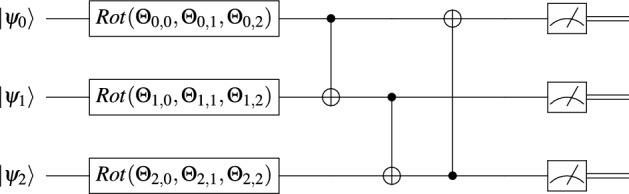
“As an example, an instance of the variational circuit design of Farhi and Neven 42 is pictured in Fig.”
MethodSecure State Estimation and Control of Cyber-Physical Systems: A Survey
Ding, D., Han, Q.-L., Ge, X., & Wang, J. (2021) · IEEE Transactions on Systems, Man, and Cybernetics: Systems · doi:10.1109/tsmc.2020.3041121 · Cited by 591 · cited 2×
“A classical bit can only be one of two points on the sphere, the north pole (0) or the south pole (1).”
BackgroundVariational Quantum Circuits for Deep Reinforcement Learning
Chen, S. Y.-C., Yang, C.-H. H., Qi, J., Chen, P.-Y., Ma, X., & Goan, H.-S. (2020) · IEEE Access · doi:10.1109/access.2020.3010470 · Cited by 452 · cited 2×
“Next, we develop an example that illustrates the potential and current limitations of quantum ML, using variational quantum circuits 31,34,35 , for solving cyber-physical defense issues.”
BackgroundMethodQuantum Reinforcement Learning
Dong, D., Chen, C., Li, H., & Tarn, T.-J. (2008) · IEEE Transactions on Systems, Man, and Cybernetics, Part B (Cybernetics) · doi:10.1109/tsmcb.2008.925743 · Cited by 410
Towards quantum machine learning with tensor networks
Huggins, W., Patil, P., Mitchell, B., Whaley, K. B., & Stoudenmire, E. M. (2019) · Quantum Science and Technology · doi:10.1088/2058-9565/aaea94 · Cited by 366 · cited 1×
“Use of tensor networks 32 , a general graph model, is one of them 33 .”
MethodClassification with Quantum Neural Networks on Near Term Processors
Farhi, E., & Neven, H. (2020) · doi:10.37686/qrl.v1i2.80 · Cited by 332 · cited 1×
“As an example, an instance of the variational circuit design of Farhi and Neven 42 is pictured in Fig.”
MethodZhu, Y., & Zheng, W. X. (2020) · IEEE Transactions on Automatic Control · doi:10.1109/tac.2019.2953210 · Cited by 303 · cited 1×
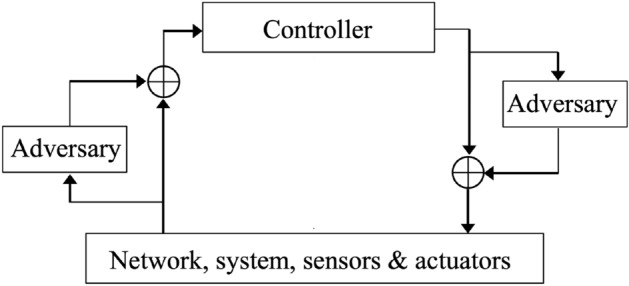
“For instance, let us consider switching control strategies used to mitigate DoS attacks 6 or input and output signal manipulation attacks 44 .”
BackgroundSecurity and privacy in cyber-physical systems: A survey of surveys
Giraldo, J., Sarkar, E., Cardenas, A. A., Maniatakos, M., & Kantarcioglu, M. (2017) · IEEE Design & Test · doi:10.1109/mdat.2017.2709310 · Cited by 289 · cited 1×
“Cybersecurity researchers emphasized the need for more works on approaches mitigating the impact of such attacks 18 .”
BackgroundReinforcement Learning with Quantum Variational Circuit
Lockwood, O., & Si, M. (2020) · Proceedings of the AAAI Conference on Artificial Intelligence and Interactive Digital Entertainment · doi:10.1609/aiide.v16i1.7437 · Cited by 240
A review of attack graph and attack tree visual syntax in cyber security
Lallie, H. S., Debattista, K., & Bal, J. (2020) · Computer Science Review · doi:10.1016/j.cosrev.2019.100219 · Cited by 218 · cited 1×
“The detection and reaction paradigm uses adversarial risk analysis methodologies, such as attack trees 20 and graphs 21 .”
MethodMontangero, S. (2018) · Springer eBooks · doi:10.1007/978-3-030-01409-4 · Cited by 179
Heule, M. J. H., & Kullmann, O. (2017) · Communications of the ACM · doi:10.1145/3107239 · Cited by 145 · cited 1×
“For instance, infinite resources can mean usage of brute-force 22 .”
BackgroundOn the Rician distribution of noisy MRI data
Andersen, A. H. (1996) · Magnetic Resonance in Medicine · doi:10.1002/mrm.1910360222 · Cited by 96
Time-Dependent Analysis of Attacks
Arnold, F., Hermanns, H., Pulungan, R., & Stoelinga, M. I. A. (2014) · Lecture notes in computer science · doi:10.1007/978-3-642-54792-8_16 · Cited by 87 · cited 1×
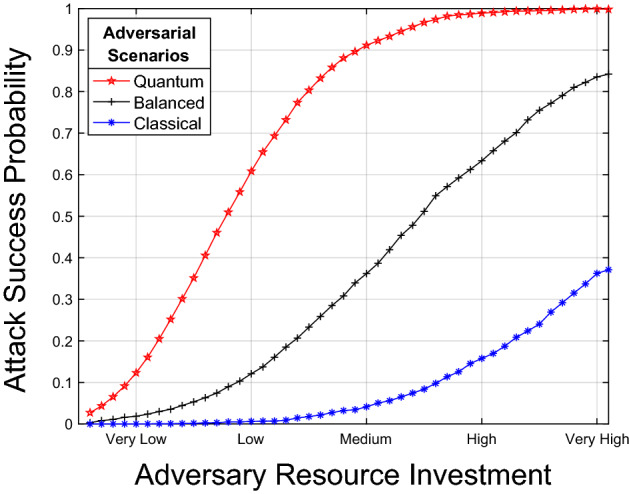
“Analysis tools may help to explore the relation between adversary investment and attack success probability 23 .”
BackgroundResilient and secure remote monitoring for a class of cyber-physical systems against attacks
Ge, X., Han, Q., Zhang, X., Ding, D., & Yang, F. (2019) · Information Sciences · doi:10.1016/j.ins.2019.10.057 · Cited by 81 · cited 1×
“(2) pt,s,a = Qt(s, a) ∑ i∈A Qt(s, i) .”
Schuld, M., & Petruccione, F. (2017) · Encyclopedia of Machine Learning and Data Mining · doi:10.1007/978-1-4899-7687-1_913 · Cited by 79
Attacking the Quantum Internet
Satoh, T., Nagayama, S., Suzuki, S., Matsuo, T., Hajdušek, M., & Meter, R. V. (2021) · IEEE Transactions on Quantum Engineering · doi:10.1109/tqe.2021.3094983 · Cited by 78 · cited 2×
“For instance, quantum-resistant routing aims at achieving a secure and sustainable quantum-safe Internet 16 .”
BackgroundResilient Control in Cyber-Physical Systems
Weerakkody, S., Ozel, O., Mo, Y., & Sinopoli, B. (2019) · Foundations and Trends® in Systems and Control · doi:10.1561/2600000018 · Cited by 44 · cited 1×
“While an attack is being perpetrated, the state of the system must be recoverable 43 , i.e., the velocities and compromised actuators or sensors can be determined using redundant sensing resources.”
BackgroundThe Theory of the Rayleigh Distribution and Some of Its Applications
Hoffman, D., & Karst, O. J. (1975) · Journal of Ship Research · doi:10.5957/jsr.1975.19.3.172 · Cited by 37
Resilience Estimation of Cyber-Physical Systems via Quantitative Metrics
Barbeau, M., Cuppens, F., Cuppens-Boulahia, N., Dagnas, R., & García-Alfaro, J. (2021) · IEEE Access · doi:10.1109/access.2021.3066108 · Cited by 27 · cited 1×
“This topic has been addressed in related work 36 .”
BackgroundSelf-citationSwitched-Based Resilient Control of Cyber-Physical Systems
Segovia, M., Hernan, J. M. R., Cavalli, A. R., & García-Alfaro, J. (2020) · IEEE Access · doi:10.1109/access.2020.3039879 · Cited by 14 · cited 1×
“For instance, let us consider switching control strategies used to mitigate DoS attacks 6 or input and output signal manipulation attacks 44 .”
BackgroundIwakoshi, T. (2021) · IEEE Access · doi:10.1109/access.2021.3056494 · Cited by 13 · cited 1×
“They involve the combination of quantum and classical security tools 17 .”
BackgroundQuantitative penetration testing with item response theory
Arnold, F., Pieters, W., & Stoelinga, M. I. A. (2013) · International Conference on Information Assurance and Security (IAS) · doi:10.1109/isias.2013.6947732 · Cited by 12 · cited 1×
“Their parameters can be estimated via empirical penetration testing tools 26 .”
BackgroundRecognizing Drone Swarm Activities: Classical versus Quantum Machine Learning
Barbeau, M. (2019) · Digitale Welt · doi:10.1007/s42354-019-0212-9 · Cited by 8
Self-citation1. Quantum Applications - Fachbeitrag: The Quantum What? Advantage, Utopia or Threat?
Barbeau, M., Beurier, E., García-Alfaro, J., Kuang, R., Pahl, M., & Pastor, D. (2021) · Digitale Welt · doi:10.1007/s42354-021-0402-0 · Cited by 2
Self-citation
Research works printed but not linked: 5
- McEliece RJ A public-key cryptosystem based on algebraic Codin. Thv. 1978 4244 114 116
- Merkle, R. Secrecy, Authentication, and Public Key Systems. Computer Science Series (UMI Research Press, 1982).
- Barbeau, M. & Garcia-Alfaro, J. Supplementary material to: Cyber-physical defense in the quantum Era. https://github.com/jgalfaro/DL-PoC (2021). PMC8814167 35115576
- Schneier, B. Modelling security threats. Dr. Dobb’s Journal (1999).
- Chio C Freeman D Machine Learning and Security: Protecting Systems with Data and Algorithms 2018 O’Reilly Media
Cited by
Hoang, V.-T., Ergu, Y. A., Nguyen, V.-L., & Chang, R. (2024) · Journal of Network and Computer Applications · doi:10.1016/j.jnca.2024.104031 · Cited by 94
A quantum-based approach for offensive security against cyber attacks in electrical infrastructure
Lakshmi, D., Nagpal, N., Chandrasekaran, S., & Hemanth, D. J. (2023) · Applied Soft Computing · doi:10.1016/j.asoc.2023.110071 · Cited by 39
Harvest-Now, Decrypt-Later: A Temporal Cybersecurity Risk in the Quantum Transition
Kagai, F., Branch, P., But, J., & Allen, R. (2025) · Telecom · doi:10.3390/telecom6040100 · Cited by 15
“This reframing aligns cryptographic assurance with realistic temporal threat models, ensuring that confidentiality guarantees remain credible for decades to come [18,23].”
InfluentialEzeogu, A. O. (2025) · Research Corridor Journal of Engineering Science · doi:10.66320/s0k5vw19 · Cited by 14
“…to target critical data repositories (30), but also future-proof sensitive healthcare data against the inevitable rise of quantum computing, building resilience into its digital infrastructure and thereby ensuring the long-term integrity and confidentiality of sensitive health information (16).”
A Hybrid Framework Integrating QML, AI, and Quantum-Safe Cryptography for Cybersecurity
Gunasridharan, R., Altalbe, A. A., Gurusamy, B. M., Pallavi, G., & Kumar, R. P. (2025) · Journal of Computational and Cognitive Engineering · doi:10.47852/bonviewjcce52025121 · Cited by 9
Metadata
- Authors
- Barbeau, M., & Garcia-Alfaro, J.
- Affiliations
- Carleton University (CA)
- Corresponding author
- Barbeau, Michel
- ORCID
- Barbeau, Michel
- Venue
- Scientific Reports
- Published
- 2022-02-03
- Volume
- 12
- Issue
- 1
- Pages
- 1905-1905
- ISSN
- 2045-2322 (ISSN-L)
- PMC
- PMC8814167
- OpenAlex
- W4210315416
- Semantic Scholar
- e5dd7b3f517f57ebdc89e550cba8c218280ccd97
- Cited by
- 22
- References
- 53
- Citations by year
- 2026: 5 · 2025: 8 · 2024: 5 · 2023: 3 · 2022: 1
- FWCI
- 1.71
- Type
- journal article
- Language
- en
- Open access
- gold
- doi.org
- Licence
- cc-by
- creativecommons.org/licenses/by/4.0 (tdm)
- creativecommons.org/licenses/by/4.0 (vor)
- Locations
- Scientific Reports (publishedVersion, cc-by)
- PubMed Central (publishedVersion, cc-by)
- PubMed (publishedVersion)
- arXiv (Cornell University) (submittedVersion)
- HAL (submittedVersion, cc-by)
- DOAJ (DOAJ: Directory of Open Access Journals) (submittedVersion, cc-by-sa)
- arXiv (Cornell University) (cc-by)
- Funders
- European Commission (830892, H2020)
- Horizon 2020 Framework Programme (830892)
- Natural Sciences and Engineering Research Council of Canada
- Topics
- Physical Sciences › Engineering › Control and Systems Engineering › Smart Grid Security and Resilience
- Physical Sciences › Computer Science › Information Systems › Information and Cyber Security
- Physical Sciences › Computer Science › Computer Networks and Communications › Network Security and Intrusion Detection
- Keywords
- networked control systems, cyber-physical security, quantum computing threats, quantum advantage, attack detection, incident response, post-quantum cryptography, machine learning for intrusion detection
About these checks
Registry, retraction, Cites and statistics results are computed, not judged, with one exception: a printed reference that no index lists is read once by a model before it counts as a citation error. Claims are extracted by a model and kept only when their quote appears verbatim in the text; each cited source is then checked, with a model’s help, for whether it says what the claim relies on. Those verdicts can be wrong — read the claim’s quote and the cited source before relying on one.
Statistics and arithmetic are recomputed, not judged.
Confidence bands are shown only for fields calibrated on our annotated test set. None is calibrated yet, so no band is shown.
What counts as a claim ›How we measure confidence ›How we check this ›
Are you an author, or do you see a problem with this page? Request a review
Data sources
Bibliographic data: Semantic Scholar, OpenAlex, Crossref.
Contains information from the Semantic Scholar Academic Graph Datasets, made available under the ODC Attribution License (ODC-BY 1.0).
Semantic Scholar’s data is described in: Kinney, R., et al. (2023). The Semantic Scholar Open Data Platform. arXiv:2301.10140.
