

Predictive classification of Alzheimer’s disease using brain imaging and genetic data
Open accessThe DOI matches its Crossref record; 37 of the 42 references it cites were found in a registry or an index.
Abstract
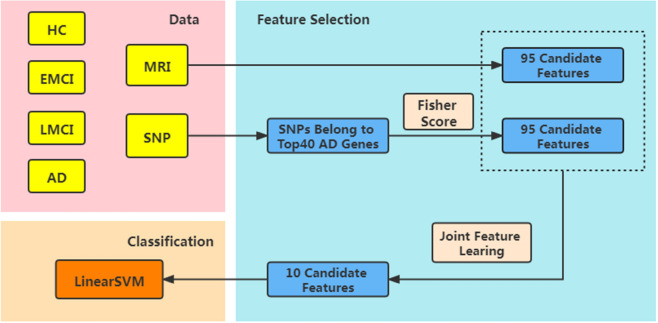
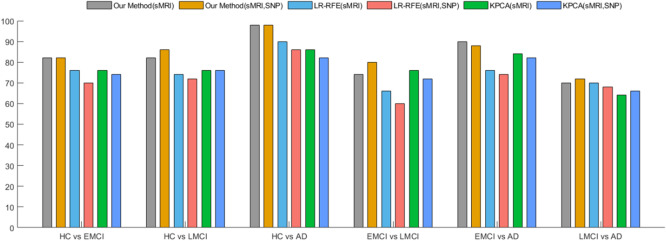
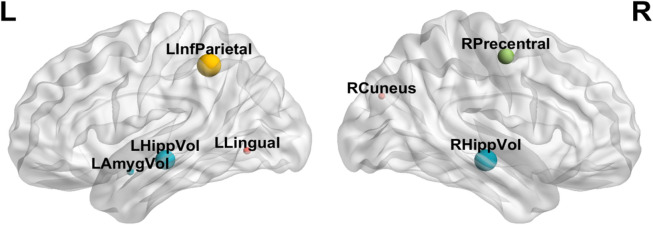
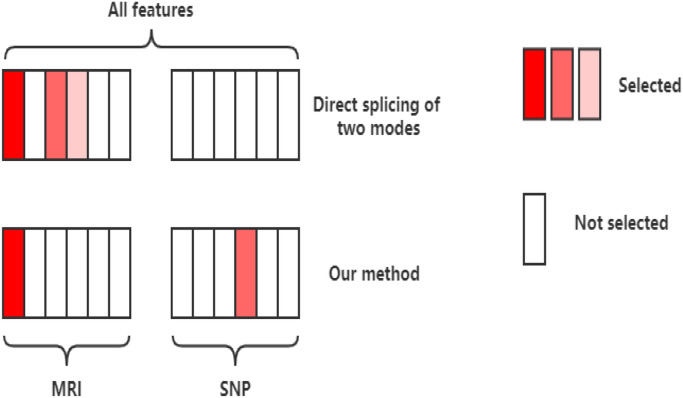
For now, Alzheimer’s disease (AD) is incurable. But if it can be diagnosed early, the correct treatment can be used to delay the disease. Most of the existing research methods use single or multi-modal imaging features for prediction, relatively few studies combine brain imaging with genetic features for disease diagnosis. In order to accurately identify AD, healthy control (HC) and the two stages of mild cognitive impairment (MCI: early MCI, late MCI) combined with brain imaging and genetic characteristics, we proposed an integrated Fisher score and multi-modal multi-task feature selection research method. We learned first genetic features with Fisher score to perform dimensionality reduction in order to solve the problem of the large difference between the feature scales of genetic and brain imaging. Then we learned the potential related features of brain imaging and genetic data, and multiplied the selected features with the learned weight coefficients. Through the feature selection program, five imaging and five genetic features were selected to achieve an average classification accuracy of 98% for HC and AD, 82% for HC and EMCI, 86% for HC and LMCI, 80% for EMCI and LMCI, 88% for EMCI and AD, and 72% for LMCI and AD. Compared with only using imaging features, the classification accuracy has been improved to a certain extent, and a set of interrelated features of brain imaging phenotypes and genetic factors were selected.
Overview
The claims and statistics of this paper haven’t been checked yet.
Free: it reads the open-access text and checks the first 5 claims that cite a source we can check. Create a free account to check every claim.
Integrity signals
Registry
Cites
Statistics
Figures
Verification
Claims the paper makes
The claims and statistics of this paper haven’t been checked yet.
Free: it reads the open-access text and checks the first 5 claims that cite a source we can check. Create a free account to check every claim.
Claims other papers make about this one
Each is checked against this paper’s own text: does it say what the citing paper says it does?
The cited source says what the claim attributes to it.
In the citing paper
“Beyond model comparison at the level of performance, XAI techniques could enhance comparison regarding pathophysiological plausibility by providing influential features, for example, the volume of the hippocampus and amygdala as biomarkers of cognitive impairment33.”
From Orchestrating explainable artificial intelligence for multimodal and longitudinal data in medical imaging (2024) · cites this paper as [33]
Self-check
Percentages, sums and reported differences re-computed from the paper’s own numbers.
The self-check needs the paper’s full text.
Citations
Cites
Fischl, B. (2012) · NeuroImage · doi:10.1016/j.neuroimage.2012.01.021 · Cited by 9,526 · cited 1×
“FreeSurfer is suite of tools that provide extensive and automated analysis of cerebrum region 36 .”
MethodRe-epithelialization and immune cell behaviour in an ex vivo human skin model
Rakita, A., Nikolić, N., Mildner, M., Matiasek, J., & Elbe-Bürger, A. (2020) · Scientific Reports · doi:10.1038/s41598-019-56847-4 · Cited by 8,228
Caruana, R. (1997) · Machine Learning · doi:10.1023/a:1007379606734 · Cited by 6,636
A survey on feature selection methods
Chandrashekar, G., & Sahin, F. (2014) · Computers & Electrical Engineering · doi:10.1016/j.compeleceng.2013.11.024 · Cited by 5,189 · cited 1×
“Feature selection can be divided into three types: filtering, wrapping and embedded 37 .”
BackgroundThe neuropathological diagnosis of Alzheimer's disease
DeTure, M. A., & Dickson, D. W. (2019) · Molecular Neurodegeneration · doi:10.1186/s13024-019-0333-5 · Cited by 3,329 · cited 9×
“The three morphological data tested were: (1) SNP, (2) sMRI, (3) sMRI and SNP.”
BackgroundMethodInfluentialBarker, L. (2002) · Technometrics · doi:10.1198/tech.2002.s659 · Cited by 2,477
2019 Alzheimer’s disease facts and figures.
Alzheimer's Association (2019) · Alzheimer's & Dementia · doi:10.1016/j.jalz.2019.01.010 · Cited by 2,461
Jansen, I. E., Savage, J. E., Watanabe, K., Bryois, J., Williams, D. M., Steinberg, S., Sealock, J., Karlsson, I. K., Hägg, S., Athanasiu, L., et al. (2019) · Nature Genetics · doi:10.1038/s41588-018-0311-9 · Cited by 2,277 · cited 1×
“Researchers used GWAS to analyze SNP data and found that genetic factors play a significant role in the development of AD 12,13 .”
MethodBrookmeyer, R., Gray, S., & Kawas, C. (1998) · American Journal of Public Health · doi:10.2105/ajph.88.9.1337 · Cited by 1,787 · cited 2×
“If the disease can be detected early and measures can be taken timely, the onset of AD can be effectively delayed 5 .”
BackgroundMethodChapter 11: Genome-wide association studies
Bush, W. S., & Moore, J. H. (2012) · PLoS Computational Biology · doi:10.1371/journal.pcbi.1002822 · Cited by 1,171
Research works printed but not linked: 2
- Kohavi R A study of cross-validation and bootstrap for accuracy estimation and model selection Ijcai 1995 14 2 1137 1145
- Thrun, S. Is learning the n-th thing any easier than learning the first? Adv. Neural Inf. Process. Syst. 640–646 (1996).
Cited by
Odusami, M., Maskeliūnas, R., Damaševičius, R., & Misra, S. (2023) · Journal of Medical and Biological Engineering · doi:10.1007/s40846-023-00801-3 · Cited by 120
“Sheng et al. combined sMRI features and genetic features for six binary classifications (HC vs. AD, HC vs. EMCI, HC vs. LMCI, EMCI vs. LMCI, EMCI vs. AD, and LMCI vs. AD) [32].”
BackgroundElazab, A., Wang, C., Abdel-Aziz, M. H., Zhang, J., Gu, J. J., Górriz, J. M., Zhang, Y., & Chang, C. (2024) · Expert Systems with Applications · doi:10.1016/j.eswa.2024.124780 · Cited by 126
Pahud de Mortanges, A., Luo, H., Shu, S. Z., Kamath, A., Suter, Y., Shelan, M., Pöllinger, A., & Reyes, M. (2024) · npj Digital Medicine · doi:10.1038/s41746-024-01190-w · Cited by 93
Yu, W.-Y., Sun, T.-H., Hsu, K.-C., Wang, C., Chien, S.-Y., Tsai, C., & Yang, Y. (2024) · Computers in Biology and Medicine · doi:10.1016/j.compbiomed.2024.108621 · Cited by 51
Huang, G., Li, R., Bai, Q., & Alty, J. (2023) · Health Information Science and Systems · doi:10.1007/s13755-023-00231-0 · Cited by 46
“For discriminating MCI, AD and HC, the accuracy was generally lower with accuracies ranging from about 72–86% [52, 55].”
BackgroundHazarika, R. A., Kandar, D., & Maji, A. K. (2023) · Multimedia Tools and Applications · doi:10.1007/s11042-023-16379-6 · Cited by 34
Deep joint learning diagnosis of Alzheimer’s disease based on multimodal feature fusion
Wang, J., Wen, S., Liu, W., Meng, X., & Jiao, Z. (2024) · BioData Mining · doi:10.1186/s13040-024-00395-9 · Cited by 28
RACF: A Multimodal Deep Learning Framework for Parkinson’s Disease Diagnosis Using SNP and MRI Data
Cao, J., & Long, X. (2025) · Applied Sciences · doi:10.3390/app15084513 · Cited by 22
Abbasian, P., & Hammond, T. (2024) · Information · doi:10.3390/info15120746 · Cited by 20
“Sheng et al. [22] analyzed brain imaging and genetic data from 100 individuals (25 from each group) to diagnose various cognitive conditions: (1) NC vs. EMCI, (2) NC vs. LMCI, (3) NC vs. AD, (4) EMCI vs. LMCI, (5) EMCI vs. AD, and (6) LMCI vs. AD.”
Shah, S., & Shah, M. (2024) · Advances in Biomarker Sciences and Technology · doi:10.1016/j.abst.2024.08.004 · Cited by 22
Abbas, Q., Hussain, A., & Baig, A. R. (2023) · Diagnostics · doi:10.3390/diagnostics13010167 · Cited by 18
“Mental deterioration (MD) or Alzheimer’s (ALZ) disease is the most prevalent neurodegenerative [1] illness among elderly people, and it causes 60% to 80% of cases of dementia.”
BackgroundSadegh‐Zadeh, S., Nazari, M.-J., Aljamaeen, M., Yazdani, F. S., Mousavi, S. Y., & Vahabi, Z. (2024) · NPG. Neurologie, psychiatrie, gériatrie/NPG · doi:10.1016/j.npg.2024.04.004 · Cited by 18
Sakthimohan, M., Rani, G. E., Amuthaguka, D., & Sornalakshmi, M. (2025) · Waves in Random and Complex Media · doi:10.1080/17455030.2025.2535959 · Cited by 13
“When this condition worsens, patients face symptoms like cognitive and mental disorders, behavior changes, and memory decline, which also affect their everyday lives [2,3].”
Rajayyan, S., & Mustafa, S. M. M. (2023) · International Journal of Power Electronics and Drive Systems/International Journal of Electrical and Computer Engineering · doi:10.11591/ijece.v13i4.pp4623-4632 · Cited by 11
Fan, X., Initiative, A. D. N., Li, H., Liu, L., Zhang, K., Zhang, Z., Chen, Y., Wang, Z., He, X., Xu, J., et al. (2023) · Journal of Alzheimer s Disease · doi:10.3233/jad-230705 · Cited by 12
Shen, Y., Qian, L., Zhang, T., Yan, H., Mansouri, N., Osipowicz, K. Z., Tanglay, O., Young, I. M., Doyen, S., Lu, X., et al. (2022) · Frontiers in Aging Neuroscience · doi:10.3389/fnagi.2022.962319 · Cited by 9
“Several studies have proposed machine learning approaches for the classification of MCI and AD (Gray et al., 2012; Wee et al., 2012; Nozadi et al., 2018; Billeci et al., 2020; Shi and Liu, 2020; Syaifullah et al., 2020; Sheng et al., 2022).”
BackgroundMou, F. S., Ahmed, T., Huda, M. N., & Nandi, A. K. (2026) · Artificial Intelligence Review · doi:10.1007/s10462-025-11484-4 · Cited by 9
Udayakumar, P., & Subhashini, R. (2025) · Results in Engineering · doi:10.1016/j.rineng.2025.105200 · Cited by 11
Wang, L., Sheng, J., Zhang, Q., Song, Y., Zhang, Q., Wang, B., & Zhang, R. (2025) · Cerebral Cortex · doi:10.1093/cercor/bhae498 · Cited by 7
Self-citationPrediction of Alzheimer Disease using LeNet-CNN model with Optimal Adaptive Bilateral Filtering
Krishnan, V. G., Rao, P. V., Saradhi, M. V. V., Sathyamoorthy, K., & Vijayaraja, V. (2023) · International Journal of Communication Networks and Information Security (IJCNIS) · doi:10.17762/ijcnis.v15i1.5706 · Cited by 4
The future of Alzheimer’s disease risk prediction: a systematic review
Nazir, S. (2025) · Neurological Sciences · doi:10.1007/s10072-025-08167-x · Cited by 7
Neuroimaging feature extraction using a neural network classifier for imaging genetics
Beaulac, C., Wu, S., Gibson, E., Miranda, M. F., Cao, J., Rocha, L. S., Beg, M. F., & Nathoo, F. S. (2023) · BMC Bioinformatics · doi:10.1186/s12859-023-05394-x · Cited by 4
Evidence-Aware Multi-Modal Data Fusion and its Application to Total Knee Replacement Prediction
Liu, X., Wang, J., Zhou, S. K., ENGSTROM, C. M., & Chandra, S. S. (2024) · International Conference on Digital Image Computing: Techniques and Applications (DICTA) · doi:10.1109/dicta63115.2024.00042 · Cited by 5
A novel diagnosis method utilizing MDBO-SVM and imaging genetics for Alzheimer's disease
Yu, X., Sheng, J., Zhang, Q., Song, Y., Wang, L., & Yang, Z. X. (2025) · Computerized Medical Imaging and Graphics · doi:10.1016/j.compmedimag.2025.102542 · Cited by 4
Self-citationCognitive prediction using regional connectivities and network biomarkers in Alzheimer’s disease
Sheng, J., Wang, J., Zhang, Q., Huang, R., Lu, Y., & Li, T. (2025) · Neuroscience · doi:10.1016/j.neuroscience.2025.08.059 · Cited by 4
Self-citationAn Optimal Framework for Alzheimer’s Disease Diagnosis
Alsaraira, A., Alabed, S., Hamad, E. M., & Saraereh, O. A. (2023) · Intelligent Automation & Soft Computing · doi:10.32604/iasc.2023.036950 · Cited by 3
Role of Imaging Genetics in Alzheimer’s Disease: A Systematic Review and Current Update
Chhetri, A., Goel, K., Ludhiadch, A., Singh, P., & Munshi, A. (2024) · CNS & Neurological Disorders - Drug Targets · doi:10.2174/0118715273264879231027070642 · Cited by 4
Tensor-based Multi-Modality Feature Selection and Regression for Alzheimer’s Disease Diagnosis
Yu, J. Y., Kong, Z., Zhan, L., Shen, L., & He, L. (2022) · doi:10.5121/csit.2022.121812 · Cited by 3
Genetics Information with Functional Brain Networks for Dementia Classification
Khatri, U., Kim, J., & Kwon, G. (2023) · Mathematics · doi:10.3390/math11061529 · Cited by 3
Prediction of mild cognitive impairment using blood multi-omics data
Zhang, D. F., Bayrak, Ç. S., Zeng, Q., Wang, M., & Zhang, B. (2025) · Frontiers in Genetics · doi:10.3389/fgene.2025.1552063 · Cited by 2
Qasim, M. A., Al-Hatab, M. M. M., & Albak, L. H. (2026) · IAES International Journal of Artificial Intelligence · doi:10.11591/ijai.v15.i1.pp695-706 · Cited by 2
“Therefore, MCI is considered a significant indicator for early diagnosis of the AD [4].”
Deep learning models for diagnosing mood disorders using integrated MRI and genetic data
Aziz, A., Oh, S., Ji, Y., Nam, Y., Ham, B., & Cho, Y. (2026) · PeerJ Computer Science · doi:10.7717/peerj-cs.3562 · Cited by 2
Gad, E., Gamal, A., Elattar, M., & Selim, S. (2022) · Lecture notes in computer science · doi:10.1007/978-3-031-21595-7_3 · Cited by 2
Alzoubi, R., Turky, A. M., Hussain, A. J., & Foufou, S. (2024) · IEEE/ACM International Conference on Big Data Computing, Applications and Technologies (BDCAT) · doi:10.1109/bdcat63179.2024.00019 · Cited by 2
Artificial Intelligence and Applications
(2022) · doi:10.5121/csit.2022.1218 · Cited by 2
A novel restrainer device for acquistion of brain images in awake rats
Tiefenbach, J., Shannon, L., Lobosky, M. S., Johnson, S., Chan, H. H. N., Byram, N. A., Machado, A. G., Androjna, C., & Baker, K. B. (2024) · NeuroImage · doi:10.1016/j.neuroimage.2024.120556 · Cited by 1
“…in advancing many fundamental areas of neuroscience, including the study of multiple sclerosis (Wood, 2021), Parkinson ’ s disease (Lin et al., 2022), Alzheimer ’ s disease (Sheng et al., 2022), traumatic brain injury (Simchick et al., 2021) and other neurological conditions (Yen et al., 2023).”
BackgroundGene-to-Image: Decoding Brain Images from Genetics via Latent Diffusion Models
Jeon, S., Song, Y., & Kim, W. H. (2024) · Lecture notes in computer science · doi:10.1007/978-3-031-74561-4_5 · Cited by 1
Unsupervised Dimensionality Reduction Techniques for the Assessment of ASD BiomarkersPreprint
Jacokes, Z., Adoremos, I., Hussain, A. R., Newman, B. T., Pelphrey, K. A., & Horn, J. D. V. (2024) · medRxiv · doi:10.1101/2024.08.12.24311682 · Cited by 3
Early detection of Alzheimer’s via machine learning with multi-modal data
Gupta, D. (2022) · SPIE Applications of Machine Learning · doi:10.1117/12.2641481
“12,13 Interest in longitudinal studies can be seen in, 14 which explored options for forecasting shift from mild cognitive impairment to dementia, using 3D whole brain MRIs and various deep learning techniques, achieving accuracy values of nearly 90%.”
BackgroundDifferent Machine Learning Approch's for Diagnosis of Alzheimer's Disease and Vascular Dementia
Pentela, V., Vendra, B. R. N., Putluri, D. T. R., Bodapati, V. K., & Nimmagadda, S. M. (2023) · International Conference on Integrated Circuits and Communication Systems (ICICACS) · doi:10.1109/icicacs57338.2023.10100185 · Cited by 1
“Academics have recently performed research on the application of machine learning in the treatment of (AD) [2].”
BackgroundImproved deep canonical correlation fusion approach for detection of early mild cognitive impairment
Shaji, S., Palanisamy, R., & Swaminathan, R. (2025) · Medical & Biological Engineering & Computing · doi:10.1007/s11517-024-03282-x
Alzheimer's Disease Detection from Brain MRI Scans Using Convolutional Neural Networks
Chauhan, A. S., Kancharla, M., Pathak, C., & Devapatla, B. (2025) · International Conference on Cognitive Computing in Engineering, Communications, Sciences and Biomedical Health Informatics (IC3ECSBHI) · doi:10.1109/ic3ecsbhi63591.2025.10991227
“L I TERATURE SURVEY The research [3] developed a study of data integration in classifier for AD patients and healthy control, including controls, early mild cognitive impairment, late mild cognitive impairment with Data from Brain images.”
Marcadores de envelhecimento em adultos e idosos com síndrome de Down
Cordeiro, A. M. T. (2024) · Digital Library of Theses and Dissertations (Universidade de São Paulo) · doi:10.11606/t.5.2024.tde-02092025-161756
Deep Mediation Analysis for Multimodal Genotype-Imaging Associations with Disease PhenotypesPreprint
Golderzahi, V., Wang, G., Hu, J., & Yeang, C. (2025) · bioRxiv (Cold Spring Harbor Laboratory) · doi:10.64898/2025.11.20.689376
Survey on prediction, classification and tracking of neurodegenerative diseases
Dhavalgi, V., & Ranganatha, H. R. (2026) · Indonesian Journal of Electrical Engineering and Computer Science · doi:10.11591/ijeecs.v41.i1.pp367-374
“These models can analyze patterns in various data types such as brain imaging, genetic information, and cognitive test scores to identify markers of the ISSN: 2502-4752 Indonesian J Elec Eng & Comp Sci, Vol. 41 , No. 1, January 2026: 367-374 368 disease [6].”
Learning Based Diagnosis of Alzheimer's Disease Using Genomic Data
Jayasingh, B. B., & Mallick, S. (2025) · International Conference on Networks and Soft Computing (ICNSoC) · doi:10.1109/icnsoc66817.2025.00102
“Moreover, mitochondrial DNA mutations have been implicated in the pathogenesis of AD, highlighting the interplay between genetic and metabolic factors [12, 25].”
Classifications between Different Stages of Alzheimer's Disease using Xtreme Gradient Boosting
Mondal, N., Senapati, R., Biswas, S., & Chandra, A. (2025) · IEEE Applied Signal Processing Conference (ASPCON) · doi:10.1109/aspcon66877.2025.11389552
Al-Bayati, N. S. J., & Al-Nima, R. R. O. (2026) · NTU Journal of Engineering and Technology · doi:10.56286/49fsy824
Chethan, M., Sabarinathan, P., Arun, R. A., Rampriya, R. S., & Soundrapandiyan, R. (2026) · International Journal of Computational Intelligence Systems · doi:10.1007/s44196-026-01292-1
“The potential of multimodal feature spaces was indicated by Sheng et al., who showed how combining genetic markers with imaging data could improve predictive classification accuracy [20].”
Zhang, Z. (2026) · International Conference on Intelligent Computing and Signal Processing (ICSP) · doi:10.1109/icsp69961.2026.11540882
“…at different stages, and there is a complex correlation between clinical symptoms, changes in brain structure, and functional decline, accurate identification and staging of the disease progression has become a key issue in intelligent diagnosis and treatment research of neurological diseases[3].”
Jis, J. K., Chen, K., Chen, Z., Chen, L., Pouriyeh, S., Xie, Z., & Xie, Y. (2026) · Bioengineering · doi:10.3390/bioengineering13060698
“SVMs identify separating hyperplanes and have been applied to diagnosis using brain volume and clinical features [18,19].”
A review of Alzheimer’s disease diagnosis and prognosis models based on multimodal deep learning
Xin, Y., Sheng, J., & Wang, L. (2026) · Reviews in the Neurosciences · doi:10.1515/revneuro-2026-0063 · Cited by 2
“Simple concatenation tends to bias the model toward imaging features, which are typically denser and more dominant, while signals related to genetic status are easily overlooked Sheng et al. (2022).”
Self-citationSingle-index semiparametric transformation cure models with interval-censored data
Huang, X., Yu, T., & Liu, X. (2026) · Statistics and Computing · doi:10.1007/s11222-026-10908-7 · Cited by 1
“This pattern underscores the importance of accounting for genotype-specific, nonlinear age effects when modeling disease risk and designing individualized prediction tools(Mormino et al. 2016; Sheng et al. 2022).”
PCA-Enhanced Deep Features for Alzheimer’s Disease Stage Classification with EFMM
Al-Hatab, M. M. M., Al-Mallah, R. H. A., Qasim, M. A., Mohammed, M. F., Rassem, T. H., & Ahmed, A. A. (2026) · Diagnostics · doi:10.3390/diagnostics16152428
“MCI is a major factor in the diagnosis of AD [4].”
Veatch, O. J., Dutta, S., Mansel, C. O., Townley, R., Sardiu, M. E., & Honea, R. A. (2026) · PLOS Aging and Health · doi:10.1371/journal.page.0000045
Prediction of Alzheimer's disease Using Stacked Ensemble Transfer Neural Network Model
Bhade, A. W. (2024) · International Journal of Intelligent Systems and Applications in Engineering
Zhong, H., Sheng, J., Zhang, Q., Gong, Z., Zhang, R., Sun, Z., Zhu, X., & Cheng, Y. (2026) · Journal of Integrative Neuroscience · doi:10.31083/jin51378
Self-citation
Metadata
- Authors
- Sheng, J., Xin, Y., Zhang, Q., Wang, L., Yang, Z., & Yin, J.
- Affiliations
- Hangzhou Dianzi University (CN)
- Chinese Academy of Medical Sciences & Peking Union Medical College (CN)
- Corresponding author
- Sheng, Jinhua
- Venue
- Scientific Reports
- Published
- 2022-02-14
- Volume
- 12
- Issue
- 1
- Pages
- 2405-2405
- ISSN
- 2045-2322 (ISSN-L)
- PMC
- PMC8844076
- OpenAlex
- W4213002899
- Cited by
- 50
- References
- 39
- Citations by year
- 2026: 9 · 2025: 12 · 2024: 13 · 2023: 11 · 2022: 5
- FWCI
- 6.68
- Type
- journal article
- Language
- en
- Open access
- gold
- doi.org
- Licence
- cc-by
- creativecommons.org/licenses/by/4.0 (tdm)
- creativecommons.org/licenses/by/4.0 (vor)
- Locations
- Scientific Reports (publishedVersion, cc-by)
- PubMed Central (publishedVersion, cc-by)
- PubMed (publishedVersion)
- DOAJ (DOAJ: Directory of Open Access Journals) (submittedVersion, cc-by-sa)
- Funders
- the National Natural Science Foundation of China (61871168)
- Topics
- Health Sciences › Medicine › Psychiatry and Mental health › Dementia and Cognitive Impairment Research
- Life Sciences › Neuroscience › Cellular and Molecular Neuroscience › Alzheimer's disease research and treatments
- Health Sciences › Health Professions › Health Information Management › Artificial Intelligence in Healthcare
- Keywords
- Alzheimer's disease, early diagnosis, mild cognitive impairment, neuroimaging, genetic characteristics, Fisher score, dimensionality reduction, disease classification
- MeSH terms
- Machine Learning, Aged, Aged, 80 and over, Alzheimer Disease, Brain, Female, Humans, Magnetic Resonance Imaging, Male, Middle Aged, Polymorphism, Single Nucleotide, Neuroimaging
About these checks
Registry, retraction, Cites and statistics results are computed, not judged, with one exception: a printed reference that no index lists is read once by a model before it counts as a citation error. Claims are extracted by a model and kept only when their quote appears verbatim in the text; each cited source is then checked, with a model’s help, for whether it says what the claim relies on. Those verdicts can be wrong — read the claim’s quote and the cited source before relying on one.
Statistics and arithmetic are recomputed, not judged.
Confidence bands are shown only for fields calibrated on our annotated test set. None is calibrated yet, so no band is shown.
What counts as a claim ›How we measure confidence ›How we check this ›
Are you an author, or do you see a problem with this page? Request a review
Data sources
Bibliographic data: Semantic Scholar, OpenAlex, Crossref.
Contains information from the Semantic Scholar Academic Graph Datasets, made available under the ODC Attribution License (ODC-BY 1.0).
Semantic Scholar’s data is described in: Kinney, R., et al. (2023). The Semantic Scholar Open Data Platform. arXiv:2301.10140.
