

Non-task expert physicians benefit from correct explainable AI advice when reviewing X-rays
Open accessThe DOI matches its Crossref record; 26 of the 26 references it cites were found in a registry or an index; 19 of the 28 sources its claims cite were checked for support.
Abstract
Artificial intelligence (AI)-generated clinical advice is becoming more prevalent in healthcare. However, the impact of AI-generated advice on physicians’ decision-making is underexplored. In this study, physicians received X-rays with correct diagnostic advice and were asked to make a diagnosis, rate the advice’s quality, and judge their own confidence. We manipulated whether the advice came with or without a visual annotation on the X-rays, and whether it was labeled as coming from an AI or a human radiologist. Overall, receiving annotated advice from an AI resulted in the highest diagnostic accuracy. Physicians rated the quality of AI advice higher than human advice. We did not find a strong effect of either manipulation on participants’ confidence. The magnitude of the effects varied between task experts and non-task experts, with the latter benefiting considerably from correct explainable AI advice. These findings raise important considerations for the deployment of diagnostic advice in healthcare.
Overview
CoChat Summary
TL;DR
In an online experiment with physicians reviewing chest X-rays, correct diagnostic advice that was annotated and labeled as AI-generated was associated with higher diagnostic accuracy, especially for non-task experts. Explainability improved accuracy and quality ratings for IM/EM physicians, while AI-labeled advice increased radiologists’ confidence but not their accuracy.
Key findings
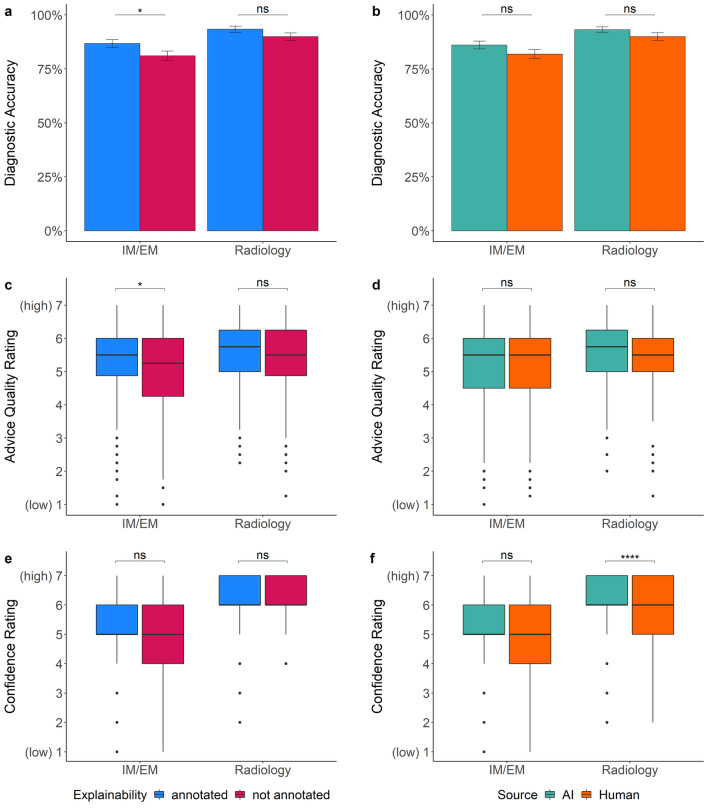
- Overall, annotated advice and AI-labeled advice were associated with higher diagnostic accuracy: annotated OR = 2.30 (95% CI 1.37–3.85, p = 0.002); AI source OR = 2.10 (95% CI 1.22–3.59, p = 0.007); task experts performed better than non-task experts, OR = 2.20 (95% CI 1.40–3.47, p = 0.001).
- Non-task experts (IM/EM physicians) improved mean diagnostic performance by 5.66% with annotated advice (p = 0.042); radiologists improved by 3.41% but this was non-significant (p = 0.120). AI-labeled advice improved performance by 4.22% for non-experts and 3.15% for experts, both non-significant (p = 0.129 and p = 0.155).
- Annotated advice raised advice-quality ratings overall (estimate = 0.25, p = 0.001); among non-task experts it was 0.24 points higher (p = 0.011), while for task experts it was 0.11 points higher but non-significant (p = 0.195). Source of advice did not significantly affect quality ratings (p = 0.645 for IM/EM; p = 0.812 for radiology).
- Radiologists reported 0.32 points higher confidence when advice was labeled as AI vs. human (p < 0.0001); IM/EM physicians’ confidence was only 0.06 points higher (p = 0.497). Highest accuracy occurred with annotated AI advice: non-task experts M = 86.84, SD = 33.89; task experts M = 94.61, SD = 22.64.
Methods
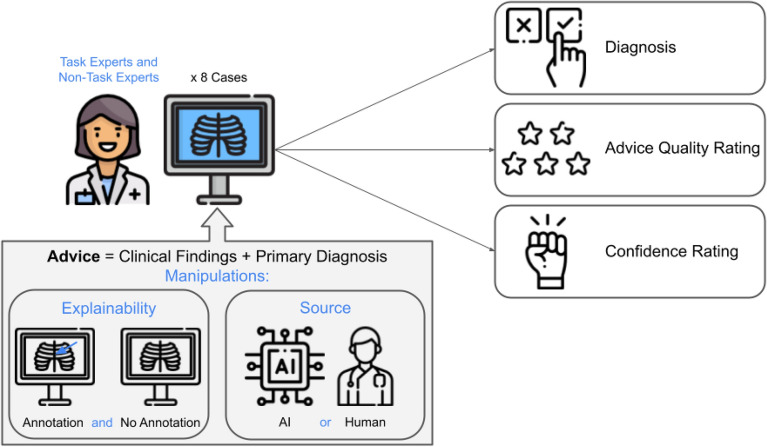
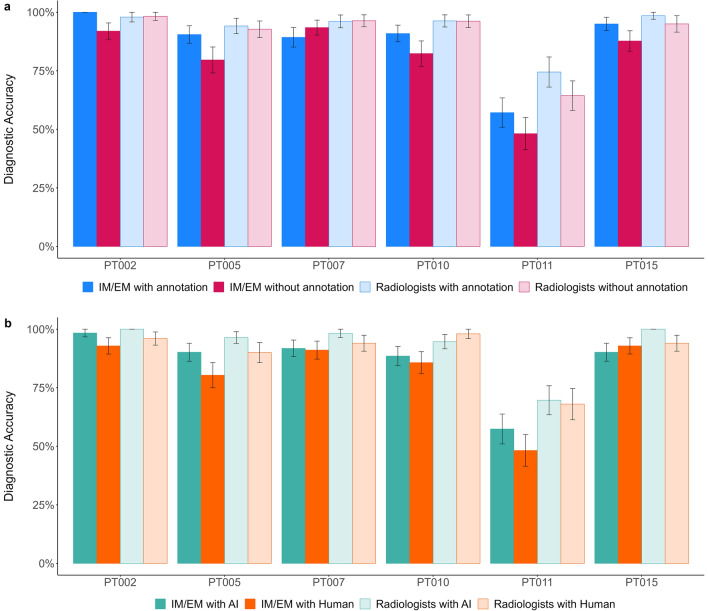
- Pre-registered online 2 × 2 mixed factorial experiment: explainability manipulated within subjects (annotated vs. non-annotated X-rays) and source manipulated between subjects (AI “CHEST-AI” vs. human radiologist “Dr. S. Johnson”). Participants reviewed eight chest X-ray cases from MIMIC-CXR with patient vignettes and correct diagnostic advice; six cases were analyzed because two could not be unambiguously assigned to the explainability condition.
- N = 223 physicians finished the experiment and were included: 117 IM/EM physicians classified as non-task experts and 106 radiologists classified as task experts. The mixed-effects models reported NID = 222, NPATIENTID = 6, and 1,332 observations.
- Three mixed-effects regression models were run: logistic regression for diagnostic accuracy and linear regression for advice-quality ratings and confidence. Predictors included explainability, source, task expertise, their interaction, and control variables, with random effects for participant and patient case.
Limitations
- The paper states: the experiment was online and diagnoses did not affect real patient treatment; only eight cases were presented and only six analyzed; the sample fell short of the a priori power target (planned 128 IM/EM and 128 radiologists; recruited 117 and 106); task-expert accuracy was high, limiting room for improvement; and prior-study participation could not be fully ruled out, though data were collected two years later.
- The paper also states that only correct advice was provided, so it could not test how explanations affect reliance when AI advice is incorrect; the authors note that participants strongly relied on any advice and that more research is needed on incorrect advice.
- Evident from the text: the source manipulation was between-subjects, so source effects may be confounded with individual differences, and the study used a limited set of curated cases, which narrows generalizability.
Model-written summary. Check it against the paper before relying on it.
Integrity signals
Registry
Cites
Statistics
Figures
Verification
Claims the paper makes
14 Valid · 1 Not valid · 2 Not checked · 76 Own results and interpretations
The cited sources support only part of this claim — read each source’s verdict below.
In the paper
“The limited work that does investigate whether AI-CDSS have actual clinical benefits is inconclusive2,5,6, suggesting that the technology might not automatically lead to better patient outcomes.”
§ Non-task expert physicians benefit from correct explainable AI advice when reviewing X-rays > Introduction
What the sources say
- Partly supportedcites [2] van Leeuwen KG Schalekamp S Rutten MJCM van Ginneken B de Rooij M Artificial intelligence in radiology: 100 commercially available products and their scientific evidence Eur. Radiol. 2021 31 3797 3804 10.1007/s00330-021-07892-z 33856519 PMC8128724 sourceExperimental — accuracy not yet measured
The Results > Evidence and Discussion (pages unavailable) show that relatively few studies assessed clinical impact and that the impact of most products in clinical practice remains unknown. The paper does not characterize the findings of the studies that did investigate clinical impact as inconclusive; it says 18 products had evidence of potential clinical impact. Its scope is commercially available AI software in radiology, not AI-CDSS generally. (LLM, conf=0.82)
- Not checked — no full text of the sourcecites [5] Tariq A Current clinical applications of artificial intelligence in radiology and their best supporting evidence J. Am. Coll. Radiol. 2020 17 1371 1381 10.1016/j.jacr.2020.08.018 33153541 source
- Partly supportedcites [6] van Leeuwen KG de Rooij M Schalekamp S van Ginneken B Rutten MJCM How does artificial intelligence in radiology improve efficiency and health outcomes? Pediatr. Radiol. 2021 10.1007/s00247-021-05114-8 PMC9537124 34117522 sourceExperimental — accuracy not yet measured
The Introduction reports that prospective research on benefits in clinical practice covered only 18 of 100 radiology AI products evaluated. The Discussion says impact has been proved in only a limited number of cases, and the Conclusion says little is known about effects on health outcomes. This supports the claim that evidence is limited and conclusions remain uncertain for radiology AI, but does not establish the same conclusion for AI clinical decision-support systems generally. (LLM, conf=0.83)
hedged- Asserted: passes — The authors put it forward as true.
- Checkable: passes — It can be checked against evidence.
- Load-bearing: passes — The paper’s conclusions depend on it.
- Based: passes — The paper gives a reason why it holds.
- Partly supported
The cited sources support only part of this claim — read each source’s verdict below.
In the paper
“but few studies have investigated these products' actual clinical impact (e.g., physicians’ diagnostic performance and patient outcomes) when implemented in a natural clinical setting2.”
§ Non-task expert physicians benefit from correct explainable AI advice when reviewing X-rays > Introduction
What the sources say
- Partly supportedcites [2] van Leeuwen KG Schalekamp S Rutten MJCM van Ginneken B de Rooij M Artificial intelligence in radiology: 100 commercially available products and their scientific evidence Eur. Radiol. 2021 31 3797 3804 10.1007/s00330-021-07892-z 33856519 PMC8128724 sourceExperimental — accuracy not yet measured
The Results > Evidence section reports that only 64 of 237 studies, involving 18 of 100 products, assessed aspects of potential clinical impact; it also says 192 studies were retrospective. Table 1 includes radiologist performance and patient outcomes among its clinical-impact measures. The paper does not establish how many studies assessed actual impact after implementation in a natural clinical setting, and its scope is commercial radiology AI products rather than AI-CDSS products generally. Page numbers are unavailable in our copy. (LLM, conf=0.84)
plain- Asserted: passes — The authors put it forward as true.
- Checkable: passes — It can be checked against evidence.
- Load-bearing: passes — The paper’s conclusions depend on it.
- Based: passes — The paper gives a reason why it holds.
- Partly supported
The cited sources support only part of this claim — read each source’s verdict below.
In the paper
“Previous research has shown that providing case-by-case explanations indeed increases trust in and reliance on the advice, even when the advice is incorrect8.”
§ Non-task expert physicians benefit from correct explainable AI advice when reviewing X-rays > Introduction
What the sources say
- Partly supportedcites [8] Jacobs M How machine-learning recommendations influence clinician treatment selections: The example of antidepressant selection Transl. Psychiatry 2021 11 1 9 10.1038/s41398-021-01224-x 33542191 PMC7862671 sourceExperimental — accuracy not yet measured
The Discussion (page unavailable) says explanations may increase trust and can lead to overreliance; the Results report lower treatment-selection accuracy when incorrect recommendations had feature-based explanations. But the paper does not establish that case-by-case explanations increased both trust and reliance: it found no significant effect of explanation type on confidence or perceived ML utility, and the reported accuracy comparison was against no recommendation, not against unexplained advice. (LLM, conf=0.86)
boostedstates a cause- Asserted: passes — The authors put it forward as true.
- Checkable: passes — It can be checked against evidence.
- Load-bearing: passes — The paper’s conclusions depend on it.
- Based: passes — The paper gives a reason why it holds.
- Partly supported
Every source the paper cites for this claim was checked and supports it.
In the paper
“This finding does not confirm the results from a previous study using the same materials, in which task experts did show algorithm aversion by rating the quality of AI advice lower than human advice7.”
§ Non-task expert physicians benefit from correct explainable AI advice when reviewing X-rays > Discussion
What the sources say
- Supportedcites [7] Gaube S Do as AI say: Susceptibility in deployment of clinical decision-aids NPJ. Digit. Med. 2021 4 1 8 10.1038/s41746-021-00385-9 33608629 PMC7896064 source
The Results section, “Advice quality ratings display algorithmic aversion in experts,” reports that task experts rated advice significantly lower in quality when it was presented as coming from AI rather than a human. The paper identifies those task experts as radiologists. Whether the citing study used the same materials is the citing authors’ description of their own study, not a finding attributed to this source. (LLM, conf=0.92)
plain- Asserted: passes — The authors put it forward as true.
- Checkable: passes — It can be checked against evidence.
- Load-bearing: passes — The paper’s conclusions depend on it.
- Based: passes — The paper gives a reason why it holds.
- Supported
The cited sources support only part of this claim — read each source’s verdict below.
In the paper
“Our participants strongly relied on any advice given to them.”
§ Non-task expert physicians benefit from correct explainable AI advice when reviewing X-rays > Discussion
What the sources say
- Partly supportedcites [7] Gaube S Do as AI say: Susceptibility in deployment of clinical decision-aids NPJ. Digit. Med. 2021 4 1 8 10.1038/s41746-021-00385-9 33608629 PMC7896064 sourceExperimental — accuracy not yet measured
The Discussion reports a general tendency for physicians to agree with diagnostic advice, whether presented as coming from AI or a human, and says they often failed to dismiss inaccurate advice. It does not establish that participants strongly relied on any advice given to them: reliance varied across physicians and cases, and the study tested diagnostic advice in a specific clinical task. (LLM, conf=0.84)
boostedstates a cause- Asserted: passes — The authors put it forward as true.
- Checkable: passes — It can be checked against evidence.
- Load-bearing: passes — The paper’s conclusions depend on it.
- Based: passes — The paper gives a reason why it holds.
- Partly supported
37 more claims
Create a free account to see all 93 claims and every source verdict.
- Probably not a substantial claim. 40
- It may state two separate claims as one. 18
- The quote only partly states this claim. 1
Claims other papers make about this one
Each is checked against this paper’s own text: does it say what the citing paper says it does?
The source backs part of the claim, not all of it — or backs it for a different population, condition or comparison.
In the citing paper
“For instance, physicians with substantial expertise in diagnosing a disease may have better epistemic access (e.g., they will know better when a system is making incorrect diagnoses) than physicians with little expertise [29].”
From On the Quest for Effectiveness in Human Oversight: Interdisciplinary Perspectives (2024) · cites this paper as [29]
Experimental — accuracy not yet measured
Self-check
Percentages, sums and reported differences re-computed from the paper’s own numbers.
Each contradiction between two passages listed here was confirmed by an independent check.
Rated minor: it would not touch a result — a value no result rests on, a p-value that stays on the same side of the significance level, or a conflict that is clerical, resolved elsewhere in the paper, or outside its own findings.
In the paper
§ Non-task expert physicians benefit from correct explainable AI advice when reviewing X-rays > Results > Non-task experts preferred explainable advice
“Task experts rated the quality of the annotated advice on average 0.11 points higher, but the mean difference was statistically non-significant (p = 0.195, see Fig. 2d).”
§ Non-task expert physicians benefit from correct explainable AI advice when reviewing X-rays > Results > Non-task experts benefited from correct explainable AI advice
“Plot (c) displays that non-task experts rated the quality of annotated advice higher than non-annotated advice (pIM/EM = 0.011, pRadiology = 0.195). In (d), it is shown that there was no evidence that the source of advice had an effect on the quality rating (pIM/EM = 0.645, pRadiology = 0.812).”
Citations
Cites
Algorithm aversion: People erroneously avoid algorithms after seeing them err.
Dietvorst, B. J., Simmons, J. P., & Massey, C. (2015) · Journal of Experimental Psychology: General · doi:10.1037/xge0000033 · Cited by 3,232
Algorithm appreciation: People prefer algorithmic to human judgment
Logg, J. M., Minson, J. A., & Moore, D. A. (2019) · Organizational Behavior and Human Decision Processes · doi:10.1016/j.obhdp.2018.12.005 · Cited by 2,061
MIMIC-CXR, a de-identified publicly available database of chest radiographs with free-text reports
Johnson, A. E. W., Pollard, T. J., Berkowitz, S. J., Greenbaum, N. R., Lungren, M. P., Deng, C.-Y., Mark, R. G., & Horng, S. (2019) · Scientific Data · doi:10.1038/s41597-019-0322-0 · Cited by 1,816
The false hope of current approaches to explainable artificial intelligence in health care
Ghassemi, M., Oakden-Rayner, L., & Beam, A. L. (2021) · The Lancet Digital Health · doi:10.1016/s2589-7500(21)00208-9 · Cited by 1,724
Self-citationRajpurkar, P., Irvin, J., Ball, R. L., Zhu, K., Yang, B., Mehta, H., Duan, T., Ding, D., Bagul, A., Langlotz, C. P., et al. (2018) · PLOS Medicine · doi:10.1371/journal.pmed.1002686 · Cited by 1,449 · cited 3×
“The present study had three dependent variables: (1) diagnostic accuracy, (2) advice quality ratings, and (3) confidence in the diagnosis:”
MethodDo as AI say: susceptibility in deployment of clinical decision-aids
Gaube, S., Suresh, H., Raue, M., Merritt, A., Berkowitz, S. J., Lermer, E., Coughlin, J. F., Guttag, J. V., Colak, E., & Ghassemi, M. (2021) · npj Digital Medicine · doi:10.1038/s41746-021-00385-9 · Cited by 543
Self-citationvan Leeuwen, K. G., Schalekamp, S., Rutten, M. J. C. M., van Ginneken, B., & de Rooij, M. (2021) · European Radiology · doi:10.1007/s00330-021-07892-z · Cited by 461 · cited 3×
“The present study had three dependent variables: (1) diagnostic accuracy, (2) advice quality ratings, and (3) confidence in the diagnosis:”
MethodLee, H., Yune, S., Mansouri, M., Kim, M., Tajmir, S. H., Guerrier, C. E., Ebert, S. A., Pomerantz, S. R., Romero, J. M., Kamalian, S., et al. (2018) · Nature Biomedical Engineering · doi:10.1038/s41551-018-0324-9 · Cited by 441
Jacobs, M., Pradier, M. F., McCoy, T. H., Perlis, R. H., Doshi-Velez, F., & Gajos, K. Z. (2021) · Translational Psychiatry · doi:10.1038/s41398-021-01224-x · Cited by 247
How does artificial intelligence in radiology improve efficiency and health outcomes?
van Leeuwen, K. G., de Rooij, M., Schalekamp, S., van Ginneken, B., & Rutten, M. J. C. M. (2022) · Pediatric Radiology · doi:10.1007/s00247-021-05114-8 · Cited by 236
Cited by
The current and future state of AI interpretation of medical images
Rajpurkar, P., & Lungren, M. P. (2023) · New England Journal of Medicine · doi:10.1056/nejmra2301725 · Cited by 443
Rosenbacke, R., Melhus, Å., McKee, M., & Stuckler, D. (2024) · JMIR AI · doi:10.2196/53207 · Cited by 305
“Gaube et al [33] found no difference in trust between experts and nonexperts but reported that the performance of nonexperts who drew upon XAI was superior in clinical practice.”
BackgroundGomez, C., Cho, S. M., Ke, S., Huang, C.-M., & Unberath, M. (2025) · Frontiers in Computer Science · doi:10.3389/fcomp.2024.1521066 · Cited by 209
Large Language Model in Creative Work: The Role of Collaboration Modality and User Expertise
Chen, Z., & Chan, J. (2024) · Management Science · doi:10.1287/mnsc.2023.03014 · Cited by 204
Heterogeneity and predictors of the effects of AI assistance on radiologists
Yu, F., Moehring, A., Banerjee, O., Salz, T., Agarwal, N., & Rajpurkar, P. (2024) · Nature Medicine · doi:10.1038/s41591-024-02850-w · Cited by 200
Combining Human Expertise with Artificial Intelligence: Experimental Evidence from Radiology
Agarwal, N., Moehring, A., Rajpurkar, P., & Salz, T. (2023) · doi:10.3386/w31422 · Cited by 161
Combining Human Expertise with Artificial Intelligence: Experimental Evidence from Radiology
Agarwal, N., Moehring, A., Rajpurkar, P., & Salz, T. (2023) · doi:10.2139/ssrn.4505053 · Cited by 161
“An active literature studies whether AI assistance benefits radiologists, and which radiologists benefit the most (Rajpurkar et al., 2020; Seah et al., 2021; Ahn et al., 2022; Sim et al., 2020; Gaube et al., 2023).”
BackgroundExplainable AI improves task performance in human–AI collaboration
Senoner, J., Schallmoser, S., Kratzwald, B., Feuerriegel, S., & Netland, T. H. (2024) · Scientific Reports · doi:10.1038/s41598-024-82501-9 · Cited by 205
“Prior work has also made use of expert annotations as a proxy for explainable AI 47 .”
On the Quest for Effectiveness in Human Oversight: Interdisciplinary Perspectives
Sterz, S., Baum, K., Biewer, S., Hermanns, H., Lauber-Rönsberg, A., Meinel, P., & Langer, M. (2024) · The 2024 ACM Conference on Fairness Accountability and Transparency · doi:10.1145/3630106.3659051 · Cited by 91
Human-AI interaction in skin cancer diagnosis: a systematic review and meta-analysis
Krakowski, I., Kim, J., Cai, Z. R., Daneshjou, R., Lapins, J., Eriksson, H., Lykou, A., & Linos, E. (2024) · npj Digital Medicine · doi:10.1038/s41746-024-01031-w · Cited by 87
Ufuk, F. (2023) · Radiology · doi:10.1148/radiol.230276 · Cited by 76
Labor Market Exposure to AI: Cross-country Differences and Distributional Implications
Pizzinelli, C., Panton, A., Mendes Tavares, M., Cazzaniga, M., & Li, L. (2023) · IMF Working Papers · doi:10.5089/9798400254802.001 · Cited by 66
“(2020), and Gaube et al. (2023) (11)The original data source is available at https://www.”
BackgroundQuantifying the impact of AI recommendations with explanations on prescription decision making
Nagendran, M., Festor, P., Komorowski, M., Gordon, A. C., & Faisal, A. A. (2023) · npj Digital Medicine · doi:10.1038/s41746-023-00955-z · Cited by 82
Prinster, D., Mahmood, A., Saria, S., Jeudy, J. J., Lin, C. T., Yi, P. H., & Huang, C. (2024) · Radiology · doi:10.1148/radiol.233261 · Cited by 81
Efficiency and Quality of Generative AI–Assisted Radiograph Reporting
Huang, J., Wittbrodt, M. T., Teague, C. N., Karl, E., Galal, G., Thompson, M., Chapa, A. R., Chiu, M.-L., Herynk, B. A., Linchangco, R., et al. (2025) · JAMA Network Open · doi:10.1001/jamanetworkopen.2025.13921 · Cited by 72
Dalvi‐Esfahani, M., Mosharaf‐Dehkordi, M., Leong, L. W., Ramayah, T., & Kanaan-Jebna, A. M. J. (2023) · Technological Forecasting and Social Change · doi:10.1016/j.techfore.2023.122768 · Cited by 53
Thériault-Lauzier, P., Corbin, D., Tastet, O., Langlais, É. L., Taji, B., Kang, G., Chong, A., So, D. Y. F., Tang, A., Gichoya, J. W., et al. (2024) · Canadian Journal of Cardiology · doi:10.1016/j.cjca.2024.05.025 · Cited by 65
Yang, Z., Yao, Z., Tasmin, M., Vashisht, P., Jang, W. S., Ouyang, F., Wang, B., Berlowitz, D., & Yu, H. (2023) · medRxiv · doi:10.1101/2023.10.26.23297629 · Cited by 36
“10 However, most previous imaging CDSS offers only highlight areas deemed significant by AI, 11–15 providing limited insight into the explanation of the diagnosis.”
BackgroundCecil, J., Lermer, E., Hudecek, M. F. C., Sauer, J., & Gaube, S. (2024) · Scientific Reports · doi:10.1038/s41598-024-60220-5 · Cited by 37
“In all experiments, the three dependent variables were based on established measures 17,18 .”
Self-citationZech, J. R., Ezuma, C. O., Patel, S., Edwards, C. R., Posner, R., Hannon, E., Williams, F., Lala, S. V., Ahmad, Z. Y., Moy, M. P., et al. (2024) · Skeletal Radiology · doi:10.1007/s00256-024-04698-0 · Cited by 47
“We believe these results demonstrate how AI is generally most useful in assisting less experienced and less specialized interpreters, as demonstrated in prior work evaluating AI for identifying abnormalities in chest radiographs [22].”
Unveiling GPT-4V's hidden challenges behind high accuracy on USMLE questions: Observational Study
Yang, Z., Yao, Z., Tasmin, M., Vashisht, P., Jang, W. S., Ouyang, F., Wang, B., McManus, D. D., Berlowitz, D. R., & Yu, H. Q. (2025) · Journal of Medical Internet Research · doi:10.2196/65146 · Cited by 51
“For a decision to be trustworthy for clinicians, CDSS should not only make the prediction but also provide accurate explanations [8-10].”
Explainable AI decision support improves accuracy during telehealth strep throat screening
Gomez, C., Smith, B.-L., Zayas, A., Unberath, M., & Canares, T. (2024) · Communications Medicine · doi:10.1038/s43856-024-00568-x · Cited by 30
“The evaluation of AI interface designs includes information that supports predictions in different formats, such as highlighting or summarizing relevant features 34 – 38 andpresentingsimilarcases 39 – 41 .”
MethodArtificial intelligence, tasks, skills, and wages: Worker-level evidence from Germany
Engberg, E., Koch, M. R., Lodefalk, M., & Schroeder, S. (2025) · Research Policy · doi:10.1016/j.respol.2025.105285 · Cited by 64
Advice from artificial intelligence: a review and practical implications
Baines, J. I., Dalal, R. S., Ponce, L. P., & Tsai, H.-C. (2024) · Frontiers in Psychology · doi:10.3389/fpsyg.2024.1390182 · Cited by 28
Nicolson, A., Bradburn, E., Gal, Y., Papageorghiou, A. T., & Noble, J. A. (2025) · npj Digital Medicine · doi:10.1038/s41746-025-02023-0 · Cited by 57
Day, T. G., Matthew, J., Budd, S., Venturini, L., Wright, R., Farruggia, A., Vigneswaran, T. V., Zidere, V., Hajnal, J. V., Razavi, R., et al. (2024) · Ultrasound in Obstetrics and Gynecology · doi:10.1002/uog.27577 · Cited by 31
“Our findings do not support this hypothesis, in contrast to work in other imaging modalities 15 .”
ResultZhang, K., Wang, D., Lin, F., Xie, J., & Zhou, W. (2026) · iScience · doi:10.1016/j.isci.2026.115026 · Cited by 50
AI and XAI second opinion: the danger of false confirmation in human–AI collaboration
Rosenbacke, R., Melhus, Å., McKee, M., & Stückler, D. (2024) · Journal of Medical Ethics · doi:10.1136/jme-2024-110074 · Cited by 33
“11–13 25 However, this can lead to an over-reliance on AI, resulting in new false conflict errors.”
Generative Artificial Intelligence in Medicine
Shanmugam, D., Agrawal, M., Movva, R., Chen, I. Y., Ghassemi, M., Jacobs, M. L., & Pierson, E. (2025) · Annual Review of Biomedical Data Science · doi:10.1146/annurev-biodatasci-103123-095332 · Cited by 42
Self-citationde Oliveira, A. C., Azevedo, J. P. C., Ruback, L., Moreira, R., Teixeira, S. S., & Teles, A. S. (2025) · IEEE Access · doi:10.1109/access.2025.3556245 · Cited by 29
“Some studies show an increase in trust levels [17], [72], [87], [94], [116], while others present contradictory results, indicating that providing explanations may not increase satisfaction or might even decrease users’ trust in a system [27], [37], [45], [51], [94], [116].”
Adarsh, V., & Gangadharan, G. R. (2024) · Machine Learning · doi:10.1007/s10994-023-06504-9 · Cited by 22
“Gaube et al. (2023) found that providing explanations with predictions improved physicians’ diagnostic accuracy and quality rating, particularly for non-task experts.”
Rosenbacke, R., Melhus, Å., & Stückler, D. (2024) · Nature Communications · doi:10.1038/s41467-024-50952-3 · Cited by 20
Bauer, J. M., & Michalowski, M. (2025) · Journal of the American Medical Informatics Association · doi:10.1093/jamia/ocaf110 · Cited by 22
An interdisciplinary perspective on AI-supported decision making in medicine
Ammeling, J., Aubreville, M., Fritz, A., Kießig, A., Krügel, S., & Uhl, M. (2024) · Technology in Society · doi:10.1016/j.techsoc.2024.102791 · Cited by 23
Hein, I., Cecil, J., & Lermer, E. (2024) · Frontiers in Organizational Psychology · doi:10.3389/forgp.2024.1468907 · Cited by 28
Self-citationMashburn, P., Weuthen, F. A., Otte, N., Krabbe, H., Fernandez, G. M., Kraus, T., & Krabbe, J. (2025) · Healthcare · doi:10.3390/healthcare13121394 · Cited by 16
“This was also demonstrated in current research [37].”
Kitamura, F., Prevedello, L. M. S., Colak, E., Halabi, S. S., Lungren, M. P., Ball, R. L., Kalpathy–Cramer, J., Kahn, C. E., Richards, T. J., Talbott, J. F., et al. (2024) · Radiology Artificial Intelligence · doi:10.1148/ryai.230227 · Cited by 23
Self-citationWhere Does My Model Underperform? A Human Evaluation of Slice Discovery Algorithms
Johnson, N., Cabrera, Á. A., Plumb, G., & Talwalkar, A. (2023) · Proceedings of the AAAI Conference on Human Computation and Crowdsourcing · doi:10.1609/hcomp.v11i1.27548 · Cited by 22
“…where their model underperforms, including post-hoc explanations (Kim et al. 2018; Adebayo et al. 2022), methods that generate counterfactual data (Wiles, Albuquerque, and Gowal 2023), and data visualization interfaces (Cabrera et al. 2023; Suresh et al. 2023; Moore, Liao, and Subramonyam 2023).”
InfluentialBolton, W. J., Wilson, R. C., Gilchrist, M. J., Georgiou, P., Holmes, A. H., & Rawson, T. M. (2025) · The Lancet Digital Health · doi:10.1016/j.landig.2025.100912 · Cited by 21
Buschmeyer, K., Hatfield, S., & Zenner, J. (2023) · Frontiers in Artificial Intelligence · doi:10.3389/frai.2023.1249322 · Cited by 29
“It is noteworthy that although the Perceived Time and Performance Pressure scale comprises only two items, it met all the reliability and validity criteria.”
BackgroundInfluentialBetween Innovation and Caution: How Consumers’ Risk Perception Shapes AI Product Decisions
Moon, W.-K., Wei, X., Overton, H. K., & Kim, J. K. (2025) · Journal of Current Issues & Research in Advertising · doi:10.1080/10641734.2025.2468474 · Cited by 13
“Knowledge of AI was measured by an item about the self-reported knowledge of generative AI technology, which is applied on a 100-point scale (0 = no knowledge , 100 = expert-level knowledge ; M = 52.4 SD = 29.4) (Gaube et al. 2023).”
InfluentialAlam, M. S. B., Lameesa, A., Sharmin, S., Afrin, S., Ahmed, S. F., Nikoo, M. R., & Gandomi, A. H. (2025) · Digital Communications and Networks · doi:10.1016/j.dcan.2025.04.001 · Cited by 9
The effect of medical explanations from large language models on diagnostic accuracy in radiology
Spitzer, P., Hendriks, D., Rudolph, J., Schlaeger, S., Ricke, J., Kühl, N., Hoppe, B. F., & Feuerriegel, S. (2026) · npj Digital Medicine · doi:10.1038/s41746-026-02619-0 · Cited by 21
Taking Advice from ChatGPTPreprint
Zhang, P. (2023) · PsyArXiv (OSF Preprints) · doi:10.31234/osf.io/b53vn · Cited by 26
Comparative analysis of AI support levels in clinical interpretation of traumatic pelvic radiographs
Tee, Y., Huang, J., Huang, Y., Hsu, C.-P., Chen, H.-W., Hsieh, C., Fu, C., Cheng, C., & Liao, C. (2025) · npj Digital Medicine · doi:10.1038/s41746-025-01923-5 · Cited by 9
Jackson, N. J., Brown, K. E., Rn, M., Murrow, M., Cauley, M. R., Collins, B. X., Novak, L. L., Benda, N. C., & Ancker, J. S. (2026) · Journal of the American Medical Informatics Association · doi:10.1093/jamia/ocag002 · Cited by 19
“Of the 13 such studies, 5 studies found that xAI improved performance, 48,51,54,62,63 but 6 identified no effect, 33,34,45,64– 66 and 2 showed that xAI worsened human–AI collaborative performance compared to human–AI performance with non-explainable AI.”
InfluentialRosenbacke, R. (2024) · SSRN Electronic Journal · doi:10.2139/ssrn.4773350 · Cited by 9
The Effect of AI-generated Advice on Decision-Making in Personnel SelectionPreprint
Cecil, J., Lermer, E., Hudecek, M. F. C., Sauer, J., & Gaube, S. (2023) · doi:10.31219/osf.io/349xe · Cited by 6
Self-citationFussell, D. A., Tang, C. C., Sternhagen, J., Marrey, V. V., Roman, K. M., Johnson, J. B., Head, M. J., Troutt, H. R., Li, C. H., Chang, P., et al. (2024) · American Journal of Neuroradiology · doi:10.3174/ajnr.a8387 · Cited by 8
The effect of medical explanations from large language models on diagnostic decisions in radiologyPreprint
Spitzer, P., Hendriks, D., Rudolph, J., Schlaeger, S., Ricke, J., Kühl, N., Hoppe, B. F., & Feuerriegel, S. (2025) · medRxiv · doi:10.1101/2025.03.04.25323357 · Cited by 10
Gómez, C., Wang, R., Breininger, K., Casey, C., Bradley, C., Pavlak, M., Pham, A. T., Yohannan, J., & Unberath, M. (2025) · npj Digital Medicine · doi:10.1038/s41746-025-02069-0 · Cited by 7
“Context-speci fi c studies have explored explain-ability with task experts 18 – 20 and generalist providers, revealing biases like over-reliance on AI 21 .”
Muzumala, M. G., Zulu, E. O., Chibuta, P., Nyirenda, M., & Phiri, L. (2025) · Lecture notes in computer science · doi:10.1007/978-3-031-82007-6_12 · Cited by 5
Harkness, R., Frangi, A. F., Zucker, K., & Ravikumar, N. (2023) · SPIE Medical Imaging: Image Processing · doi:10.1117/12.2654345 · Cited by 8
“aided diagnostic/screening systems to routine clinical care.(15) Particularly, multi-label classification tasks, where the co-occurrence of disease makes deep learning models more vulnerable to reliance on confounding factors.”
BackgroundPrado, Á. M., Guerrero-López, A., Arias-Londoño, J. D., & Godino-Llorente, J. I. (2025) · IEEE Access · doi:10.1109/access.2025.3607282 · Cited by 3
Cooke, L. H., Jung, M., Brendel, J. M., Kerkovits, N. M., Foldyna, B., Lu, M. T., & Raghu, V. K. (2026) · npj Digital Medicine · doi:10.1038/s41746-026-02497-6 · Cited by 11
“These problems prevent radiologists from effectively collaborating with models 9,10 , an essential goal for image interpretation systems 11 , and may adversely affect radiologist performance 9 .”
Kobayashi, K., Takamizawa, Y., Miyake, M., Ito, S., Gu, L., Nakatsuka, T., Akagi, Y., Harada, T., Kanemitsu, Y., & Hamamoto, R. (2024) · Artificial Intelligence in Medicine · doi:10.1016/j.artmed.2024.102929 · Cited by 9
When AI Gives Bad Advice: Critical thinking in human-AI collaborationsPreprint
Bilen, E., & Hervé, J. (2025) · SSRN Electronic Journal · doi:10.2139/ssrn.5040466 · Cited by 5
Kohan, A., Xu, J., Xiao, L., Wu, X., Kukkar, A., Hussain, S., Roshanzamir, M., Alizadehsani, R., & Acharya, U. R. (2026) · Research Square · doi:10.21203/rs.3.rs-8976235/v1 · Cited by 5
Rolison, J. J., Gooding, P., Russo, R., & Buchanan, K. E. (2024) · PLoS ONE · doi:10.1371/journal.pone.0292944 · Cited by 3
“Yet research suggests that people do not want to empower ACPs to make moral decisions in a medical context ([11, 12]; but see [13] for the perceptions of physicians) nor in other domains, including decisions about parole and military drones ([11]; see also [14]).”
BackgroundHang, H., Yang, L., Wang, Z., Lin, Z., Li, P., Zhu, J., Liu, R., Pu, S., & Cheng, X. (2025) · Frontiers in Medicine · doi:10.3389/fmed.2025.1618858 · Cited by 4
He, H., Ying, Z., Li, B., Fan, Y., Wang, P., Lu, J., Wu, L., Zhao, H., Guo, Y., Wang, G., et al. (2026) · Communications Medicine · doi:10.1038/s43856-026-01449-1 · Cited by 3
“In contrast, the improvement from plain AI to XAI assistance among senior clinicians was modest in accuracy but signi fi cant in con-fi dence, likely because the model was trained on expert-derived insulin labels and the DIL constraints were aligned with senior-level reasoning 54,55 .”
Trustworthy Artificial Intelligence in Medical Applications: A Mini Survey
Onari, M. A., Grau, I., Nobile, M. S., & Zhang, Y. (2023) · IEEE Conference on Computational Intelligence in Bioinformatics and Computational Biology (CIBCB) · doi:10.1109/cibcb56990.2023.10264883 · Cited by 6
Takayama, T., Sado, K., Suda, K., Tamura, H., Ueda‐Arakawa, N., Ishihara, K., Ueda, Y., Okamoto, K., Santos, L. H. O., Oshika, T., et al. (2026) · PLOS Digital Health · doi:10.1101/2025.10.06.25337211 · Cited by 5
Talabard, M.-P., Durteste, M., Hamid, A., Vingtrinier, G., Quilliet, R., Feydy, A., Guermazi, A., Ventre, J., Lassalle, L., & Regnard, N.-E. (2025) · European Journal of Radiology · doi:10.1016/j.ejrad.2025.112516 · Cited by 1
Alashwal, M., Waheed, U., Algarni, M., Jamshed, H., Zwawi, M., Mansoor, Y., & Hussain, A. (2026) · IEEE Internet of Things Journal · doi:10.1109/jiot.2026.3680091 · Cited by 3
“Most AI-based AC models operate as closed boxes and provide minimal information about the decision-making process [13], [14].”
Efficiency Pitfalls of Explainable AI in Clinical Diagnostic and Treatment Human-AI Workflows
Hunsicker, T., Schulz, A., Leist, R. A., Kiefer, S., Boden, K., Rothaus, K., König, C. J., & Langer, M. (2026) · Human Factors The Journal of the Human Factors and Ergonomics Society · doi:10.1177/00187208261443764 · Cited by 3
Hanhart, J., Brosh, K., Zur, D., Loewenstein, A., & Zadok, D. (2026) · Survey of Ophthalmology · doi:10.1016/j.survophthal.2026.06.007 · Cited by 1
AI vs FRCR: What it means for the future
Ranjan, A., Parpaleix, A., Cardoso, M. J., & Adeleke, S. M. (2023) · European Journal of Radiology · doi:10.1016/j.ejrad.2023.110918 · Cited by 2
Ammeling, J., Manger, C., Kwaka, E., Krügel, S., Uhl, M., Kießig, A., Fritz, A., Ganz, J., Riener, A., Bertram, C., et al. (2023) · Mensch und Computer (MuC) · doi:10.1145/3603555.3608561 · Cited by 1
“Recent studies show, that providing explanations on a case-by-case basis can increase trust and reliance on the advice, even when the advice is incorrect [2, 9, 10, 15].”
BackgroundGrundgeiger, T., Maurer, L., Hölzing, C. R., & Happel, O. (2026) · CHI Conference on Human Factors in Computing Systems · doi:10.1145/3772318.3790619 · Cited by 1
9 KI-gestützte Entscheidungsunterstützungssysteme im Gesundheitswesen
Gaube, S., & Lermer, E. (2023) · De Gruyter eBooks · doi:10.1515/9783111034706-009 · Cited by 4
Self-citationSilkens, M., Leusder, M., Woznitza, N., & Scarbrough, H. (2024) · doi:10.2196/preprints.63087 · Cited by 1
Artificial Intelligence, Tasks, Skills, and Wages: Worker-Level Evidence from GermanyPreprint
Koch, M. R., Engberg, E., Lodefalk, M., & Schroeder, S. (2024) · SSRN Electronic Journal · doi:10.2139/ssrn.4883794
Ausgewählte wissenschaftliche Beiträge des Center for Leadership and People Management
Kuonath, A., Frey, D., Vilser, M., & Lermer, E. (2024) · Springer eBooks · doi:10.1007/978-3-662-67652-3_19
Self-citationArtificial intelligence correctly identifies perfect lateral knee X-rays: a pilot studyPreprint
Oettl, F. C., Shariatnia, M., Kunze, K. N., Allen, A. A., Ranawat, A. S., Pearle, A. D., & Pareek, A. (2024) · Research Square · doi:10.21203/rs.3.rs-4851342/v1
Radiology and the Innovator’s Dilemma: Is Disruption on the Horizon?
Ruohoniemi, D. M., & Krishnaraj, A. (2025) · American Journal of Roentgenology · doi:10.2214/ajr.25.32820
Park, M. S., Shin, S.-H., Han, S., Kang, J., Lee, S.-H., Rhim, J. K., Joo, S.-P., Sheen, S. H., Kim, J. E., Sohn, J., et al. (2025) · Research Square · doi:10.21203/rs.3.rs-6542673/v1
(2025) · Zeitschrift für Gemeinwirtschaft und Gemeinwohl · doi:10.5771/2701-4193-2025-2-105
Factors Influencing the Effectiveness of AI-Assisted Decision-Making in Medicine: A Scoping ReviewPreprint
Jackson, N. J., Brown, K. E., Miller, R., Murrow, M., Cauley, M. R., Collins, B. X., Novak, L. L., Benda, N. C., & Ancker, J. S. (2025) · medRxiv · doi:10.1101/2025.09.02.25334863
“Specifically, xAI increased clinician acceptance of high-performing AI-CDS 61,65 and decreased their trust in the AI-CDS when it provided incorrect recommendations 60,70 .”
InfluentialKhazma, W., Alabed, A., Alhallak, S., et al. (2025) · Research Square · doi:10.21203/rs.3.rs-7992519/v1
Karagoz, G. N., Özçelebi, T., & Meratnia, N. (2025) · Machine Learning and Knowledge Extraction · doi:10.3390/make7040168 · Cited by 1
Raab, F., & Strotzer, Q. (2025) · European Radiology · doi:10.1007/s00330-025-12260-2 · Cited by 1
Consistent explainable image quality assessment for medical imaging
Özer, C., Güler, A., CANSEVER, A. T., & Öksüz, İ. (2026) · Health Information Science and Systems · doi:10.1007/s13755-025-00411-0 · Cited by 9
“Additionally, it has recently been shown that physicians, lacking task-specific knowledge, can benefit from the recommendations of explainable AI more than human advice, particularly in the form of visual annotations [13].”
Devi, G. U., & Maram, B. (2025) · International Conference on Internet of Everything, Microwave Engineering, Communication and Networks (IEMECON) · doi:10.1109/iemecon69302.2025.11365821 · Cited by 1
LLM-TAD: Interpretable Ethereum Fraud Detection Based on Large Language Models
Cheng, S., Yang, Y., Zhang, J., & Li, P. (2025) · International Conference on Blockchain Technology and Information Security (ICBCTIS) · doi:10.1109/icbctis66509.2025.11387240 · Cited by 1
“…methods face a "quality-scale-cost" trilemma: (1) expert annotation ensures high quality but entails extremely high costs and is difficult to scale [14]; (2) crowdsourcing annotation enables large-scale expansion but presents quality control challenges [15]; (3) LLM synthetic generation has lower…”
Sauvage, A., Guillon, A., & Mamzer, M. (2026) · BMC Medical Ethics · doi:10.1186/s12910-026-01454-y
“The combination of AI and medical human expertise has also shown increased potential, such as in the interpretation of chest X-ray [28].”
Croon, P. M., Dhingra, L. S., Pedroso, A. F., & Khera, R. (2026) · Current Heart Failure Reports · doi:10.1007/s11897-026-00764-x · Cited by 4
“Emerging evidence suggests that clinician behavior and decision-making are strongly influenced by AI outputs, depending on factors such as perceived system authority, explanation quality, and user familiarity or trust [116, 117].”
Real-world readiness of explainable AI in clinical decision support: a systematic reviewPreprint
Milbeck, S., Pervan, M., Corriveau, B., Hama, L., Kringos, D. S., & Groene, O. (2026) · Research Square · doi:10.21203/rs.3.rs-10052279/v1
AI in the clinic: a scoping review of AI and clinical expertisePreprint
Owens, E., Buchholz, O., Douar, Y., Thapliyal, V., & Blasimme, A. (2026) · Research Square · doi:10.21203/rs.3.rs-10229460/v1
Frey, N., Agha-Mir-Salim, L., Renner, L., Haufe, S., Voge, L., & Balzer, F. (2026) · Research Square · doi:10.21203/rs.3.rs-10892043/v1 · Cited by 2
Research Design Considerations for Empirical User Studies in MICCAI
Cho, S. M., Gómez, C., Breininger, K., Creighton, F., Guo, X., Ho, D., Ishii, M., Jannin, P., Kersten, M., Kim, S. T., et al. (2026) · Lecture notes in computer science · doi:10.1007/978-3-032-38470-6_27
When the Algorithm Speaks First: Trust, Reliance and the Reconstruction of Clinical Metacognition
Hanhart, J., & Zohar, A. (2026) · Journal of Evaluation in Clinical Practice · doi:10.1111/jep.70652
Metadata
- Authors
- Gaube, S., Suresh, H., Raue, M., Lermer, E., Koch, T. K., Hudecek, M. F. C., Ackery, A. D., Grover, S. C., Coughlin, J. F., Frey, D., Kitamura, F. C., Ghassemi, M., & Colak, E.
- Affiliations
- University Hospital Regensburg (DE)
- MIT Computer Science and Artificial Intelligence Laboratory (US)
- Massachusetts Institute of Technology (US)
- Technische Hochschule Augsburg (DE)
- Ludwig-Maximilians-Universität München (DE)
- University of Regensburg (DE)
- St. Michael's Hospital (CA)
- Universidade Federal de São Paulo (BR)
- Vector Institute (CA)
- Corresponding author
- Gaube, Susanne
- ORCID
- Venue
- Scientific Reports
- Published
- 2023-01-25
- Volume
- 13
- Issue
- 1
- Pages
- 1383-1383
- ISSN
- 2045-2322 (ISSN-L)
- PMC
- PMC9876883
- OpenAlex
- W4317935575
- Cited by
- 92
- References
- 25
- Citations by year
- 2026: 20 · 2025: 29 · 2024: 27 · 2023: 16
- FWCI
- 3.66
- Type
- journal article
- Language
- en
- Open access
- gold
- doi.org
- Licence
- cc-by
- creativecommons.org/licenses/by/4.0 (tdm)
- creativecommons.org/licenses/by/4.0 (vor)
- Locations
- Scientific Reports (publishedVersion, cc-by)
- PubMed Central (publishedVersion, cc-by)
- PubMed (publishedVersion)
- UCL Discovery (University College London) (submittedVersion, cc-by)
- DOAJ (DOAJ: Directory of Open Access Journals) (submittedVersion, cc-by-sa)
- University of Regensburg Publication Server (University of Regensburg) (submittedVersion)
- Funders
- Volkswagen Foundation (98525)
- Ludwig-Maximilians-Universität München
- Topics
- Health Sciences › Medicine › Health Informatics › Artificial Intelligence in Healthcare and Education
- Physical Sciences › Computer Science › Artificial Intelligence › Explainable Artificial Intelligence (XAI)
- Health Sciences › Medicine › Family Practice › Clinical Reasoning and Diagnostic Skills
- Keywords
- explainable AI, radiology, X-ray interpretation, physician decision-making, diagnostic accuracy, visual annotation, diagnostic confidence, human-AI collaboration
- MeSH terms
- Radiologists, Artificial Intelligence, Humans, Physicians, Radiography, X-Rays
About these checks
Registry, retraction, Cites and statistics results are computed, not judged, with one exception: a printed reference that no index lists is read once by a model before it counts as a citation error. Claims are extracted by a model and kept only when their quote appears verbatim in the text; each cited source is then checked, with a model’s help, for whether it says what the claim relies on. Those verdicts can be wrong — read the claim’s quote and the cited source before relying on one.
The claim verdicts this report counts are experimental: their accuracy is not yet measured.
A language model drew the claims from the paper on 2026-10-10, under version 3 of the claim definition (model deepseek-v4.1-flash, prompt extract-v3).
A second model labelled each claim on 2026-10-10 (model jev-1.13-20260917, definition revision gold-guideline-v0.2).
Cited sources are checked with a language model’s help (gpt-6-sol).
Statistics and arithmetic are recomputed, not judged.
Confidence bands are shown only for fields calibrated on our annotated test set. None is calibrated yet, so no band is shown.
What counts as a claim ›How we measure confidence ›How we check this ›
Are you an author, or do you see a problem with this page? Request a review
Data sources
Bibliographic data: Semantic Scholar, OpenAlex, Crossref.
Contains information from the Semantic Scholar Academic Graph Datasets, made available under the ODC Attribution License (ODC-BY 1.0).
Semantic Scholar’s data is described in: Kinney, R., et al. (2023). The Semantic Scholar Open Data Platform. arXiv:2301.10140.
