

Mitigating the contrail cirrus climate impact by reducing aircraft soot number emissions
Open accessThe DOI matches its Crossref record; 53 of the 54 references it cites were found in a registry or an index.
Abstract
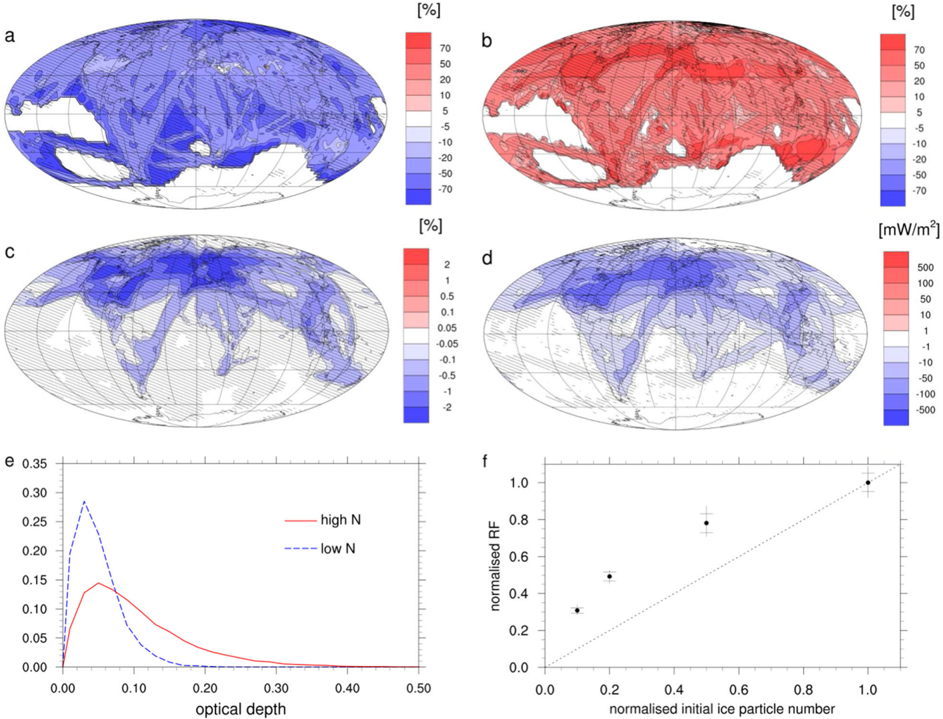
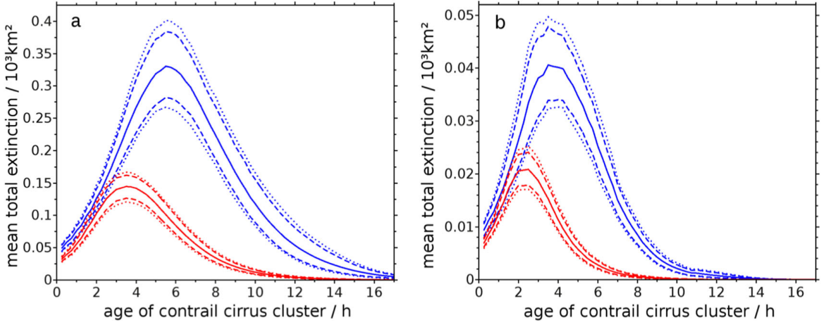
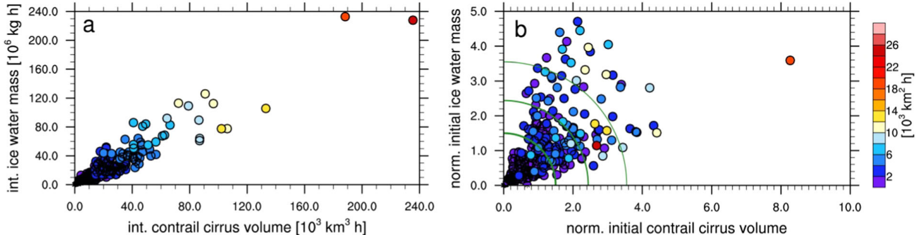
Contrail cirrus are a major component of the climate forcing due to air traffic. For a given contrail cirrus cover, ice water content and ice crystal shape, their impact on radiation is dependent on the number and size of ice crystals. Here we use a global climate model to study the impact of a reduction in initially formed ice crystal numbers, as may be caused by reduced soot number emissions. We find that for reduced initial ice crystal numbers the ice water content is decreased and ice crystal sizes increased, leading to a reduction in contrail cirrus optical depth and doubling the fraction of contrail cirrus that cannot be detected by satellite remote sensing. Contrail cirrus lifetimes and coverage are strongly reduced leading to significant reductions in contrail cirrus radiative forcing. The global climate impact of contrail cirrus is nonlinearly dependent on the reduction in initial ice crystal numbers. A reduction in the initial ice crystal number of 80% leads to a decrease in contrail cirrus radiative forcing by 50%, whereas a twofold reduction leads to a decrease in radiative forcing by approximately 20%. Only a few contrail cirrus outbreaks explain a large percentage of the climate impact. The contrail cirrus climate impact can be effectively mitigated by reducing initial ice crystal concentrations in such outbreak situations. Our results are important for assessments dealing with mitigating the climate impact of aviation and discussions about the use of alternative fuels or lean combustion in aviation.
Overview
The claims and statistics of this paper haven’t been checked yet.
Free: it reads the open-access text and checks the first 5 claims that cite a source we can check. Create a free account to check every claim.
Integrity signals
Registry
Cites
Statistics
Figures

Verification
Claims the paper makes
The claims and statistics of this paper haven’t been checked yet.
Free: it reads the open-access text and checks the first 5 claims that cite a source we can check. Create a free account to check every claim.
Claims other papers make about this one
Each is checked against this paper’s own text: does it say what the citing paper says it does?
The source backs part of the claim, not all of it — or backs it for a different population, condition or comparison.
In the citing paper
“Theoretical studies 18 show that the larger ice crystals sediment and sublimate faster and therefore contrails with reduced ice numbers have a shorter atmospheric lifetime.”
From Cleaner burning aviation fuels can reduce contrail cloudiness (2021) · cites this paper as [18]
Experimental — accuracy not yet measuredThe source backs part of the claim, not all of it — or backs it for a different population, condition or comparison.
In the citing paper
“leading to an uncertainty in contrail cirrus RF of about 20%.”
From The contribution of global aviation to anthropogenic climate forcing for 2000 to 2018 (2021) · cites this paper as Burkhardt et al., 2018
Experimental — accuracy not yet measuredThe cited source says what the claim attributes to it.
In the citing paper
“Initial ice number concentrations in contrails are a key parameter for determining light extinction by contrails 44 , and their climate impact 18 .”
From Cleaner burning aviation fuels can reduce contrail cloudiness (2021) · cites this paper as [18]
The cited source says what the claim attributes to it.
In the citing paper
“Global model simulations suggest that a reduction in the contrail cirrus radiative forcing could be achieved by decreasing the ice crystal number concentration 18 .”
From Cleaner burning aviation fuels can reduce contrail cloudiness (2021) · cites this paper as [18]
The cited source says what the claim attributes to it.
In the citing paper
“mainly caused by the reduced initial ice numbers, and, in addition, by reduced contrail lifetime due to faster sedimentation of the larger ice crystals.”
From Cleaner burning aviation fuels can reduce contrail cloudiness (2021) · cites this paper as [18]
3 more claims about this paper
Create a free account to see every claim other papers make about this one.
Self-check
Percentages, sums and reported differences re-computed from the paper’s own numbers.
The self-check needs the paper’s full text.
Citations
Cites
Statistical Methods in the Atmospheric Sciences
Ramsey, P. H. (1996) · Technometrics · doi:10.1080/00401706.1996.10484553 · Cited by 7,601
Aerosols, Cloud Microphysics, and Fractional Cloudiness
Albrecht, B. A. (1989) · Science · doi:10.1126/science.245.4923.1227 · Cited by 4,422
IPCC (2007): Climate Change The Physical Science Basis
Solomon, S. (2007) · AGU Fall Meeting Abstracts · Cited by 3,476
Pollution and the planetary albedo
Twomey, S. (1974) · Atmospheric Environment (1967) · doi:10.1016/0004-6981(74)90004-3 · Cited by 2,049
Water activity as the determinant for homogeneous ice nucleation in aqueous solutions
Koop, T., Luo, B., Tsias, A., & Peter, T. (2000) · Nature · doi:10.1038/35020537 · Cited by 1,495
Roeckner, E., Brokopf, R., Esch, M., Giorgetta, M., Hagemann, S., Kornblueh, L., Manzini, E., Schlese, U., & Schulzweida, U. (2006) · Journal of Climate · doi:10.1175/jcli3824.1 · Cited by 1,183
Aviation and global climate change in the 21st century
Lee, D. S., Fahey, D. W., Forster, P. M., Newton, P. J., Wit, R. C. N., Lim, L. L., Owen, B., & Sausen, R. (2009) · Atmospheric Environment · doi:10.1016/j.atmosenv.2009.04.024 · Cited by 1,072
Journal of Geophysical Research: Atmospheres
(2018) · Journal of Geophysical Research Atmospheres · doi:10.1002/(issn)2169-8996 · Cited by 914
Encyclopedia of Atmospheric Sciences
(2015) · Choice Reviews Online · doi:10.5860/choice.189285 · Cited by 509
Sundqvist, H. (1978) · Quarterly Journal of the Royal Meteorological Society · doi:10.1002/qj.49710444110 · Cited by 494
Über Bedingungen zur Bildung von Kondensstreifen aus Flugzeugabgasen
Schumann, U. (1996) · Meteorologische Zeitschrift · doi:10.1127/metz/5/1996/4 · Cited by 476
Transport impacts on atmosphere and climate: Metrics
Fuglestvedt, J. S., Shine, K. P., Berntsen, T., Cook, J., Lee, D. S., Stenke, A., Skeie, R. B., Velders, G. J. M., & Waitz, I. A. (2010) · Atmospheric Environment · doi:10.1016/j.atmosenv.2009.04.044 · Cited by 458
Global radiative forcing from contrail cirrus
Burkhardt, U., & Kärcher, B. (2011) · Nature Climate Change · doi:10.1038/nclimate1068 · Cited by 414
Self-citationBiofuel blending reduces particle emissions from aircraft engines at cruise conditions
Moore, R. H., Thornhill, K. L., Weinzierl, B., Sauer, D., D’Ascoli, E., Kim, J., Lichtenstern, M., Scheibe, M., Beaton, B., Beyersdorf, A. J., et al. (2017) · Nature · doi:10.1038/nature21420 · Cited by 414
Transport impacts on atmosphere and climate
Sausen, R. (2010) · Atmospheric Environment · doi:10.1016/j.atmosenv.2010.02.033 · Cited by 248
Radiative forcing by contrails
Meerkötter, R., Schumann, U., Doelling, D. R., Minnis, P., Nakajima, T., & Tsushima, Y. (1999) · Annales Geophysicae · doi:10.1007/s00585-999-1080-7 · Cited by 219
The Atmospheric General Circulation Model ECHAM-4
Roeckner, E., Arpe, K., Bengtsson, L., Christoph, M., Dümenil, L., Esch, M., Giorgetta, M., & Schulzweida, U. (1996) · Publication Database PIK (Potsdam Institute for Climate Impact Research (PIK)) · Cited by 217
Role of aircraft soot emissions in contrail formation
Kärcher, B., & Yu, F. (2009) · Geophysical Research Letters · doi:10.1029/2008gl036649 · Cited by 182 · cited 2×
“Reducing soot emissions even further, would require considering additionally the impact of volatile plume particles on ice nucleation.(17,18) The temperature threshold is usually well exceeded at cruise levels in the extra-tropics, where most of the air traffic is located.”
BackgroundEffect of crystal size spectrum and crystal shape on stratiform cirrus radiative forcing
Zhang, Y., Macke, A., & Albers, F. (1999) · Atmospheric Research · doi:10.1016/s0169-8095(99)00026-5 · Cited by 169
Transformation of contrails into cirrus during SUCCESS
Minnis, P., Young, D. F., Garber, D. P., Nguyen, L., Smith, W. L., & Palikonda, R. (1998) · Geophysical Research Letters · doi:10.1029/97gl03314 · Cited by 161
Development of the GE Aviation Low Emissions TAPS Combustor for Next Generation Aircraft Engines
Foust, M., Thomsen, D., Stickles, R., Cooper, C., & Dodds, W. (2012) · 50th AIAA Aerospace Sciences Meeting including the New Horizons Forum and Aerospace Exposition · doi:10.2514/6.2012-936 · Cited by 158
The climate impact of aviation aerosols
Gettelman, A., & Chen, C. (2013) · Geophysical Research Letters · doi:10.1002/grl.50520 · Cited by 132
Contrail Modeling and Simulation
Paoli, R., & Shariff, K. (2016) · Annual Review of Fluid Mechanics · doi:10.1146/annurev-fluid-010814-013619 · Cited by 131
Air traffic may increase cirrus cloudiness
Boucher, O. (1999) · Nature · doi:10.1038/16169 · Cited by 127
A case study of the radiative forcing of persistent contrails evolving into contrail‐induced cirrus
Haywood, J. M., Allan, R. P., Bornemann, J., Forster, P. M., Francis, P. N., Milton, S., Rädel, G., Rap, A., Shine, K. P., & Thorpe, R. (2009) · Journal of Geophysical Research: Atmospheres · doi:10.1029/2009jd012650 · Cited by 125
AERO2k Global Aviation Emissions Inventories for 2002 and 2025
Eyers, C., Norman, P., Middel, J., Plohr, M., Michot, S., Atkinson, K., & Christou, R. A. (2004) · elib (German Aerospace Center) · Cited by 118
The microphysical pathway to contrail formation
Kärcher, B., Burkhardt, U., Bier, A., Bock, L., & Ford, I. J. (2015) · Journal of Geophysical Research: Atmospheres · doi:10.1002/2015jd023491 · Cited by 114
Self-citationOn the Life Cycle of Individual Contrails and Contrail Cirrus
Schumann, U., & Heymsfield, A. J. (2017) · Meteorological Monographs · doi:10.1175/amsmonographs-d-16-0005.1 · Cited by 112
Cirrus cloud formation and ice supersaturated regions in a global climate model
Lohmann, U., Spichtinger, P., Jess, S., Peter, T., & Smit, H. (2008) · Environmental Research Letters · doi:10.1088/1748-9326/3/4/045022 · Cited by 107
Process‐based simulation of contrail cirrus in a global climate model
Burkhardt, U., & Kärcher, B. (2009) · Journal of Geophysical Research: Atmospheres · doi:10.1029/2008jd011491 · Cited by 106
Self-citationReassessing properties and radiative forcing of contrail cirrus using a climate model
Bock, L., & Burkhardt, U. (2016) · Journal of Geophysical Research: Atmospheres · doi:10.1002/2016jd025112 · Cited by 104
Self-citationContrail life cycle and properties from 1 year of MSG/SEVIRI rapid-scan images
Vázquez-Navarro, M., Mannstein, H., & Kox, S. (2015) · Atmospheric Chemistry and Physics · doi:10.5194/acp-15-8739-2015 · Cited by 97
Righi, M., Hendricks, J., & Sausen, R. (2013) · Atmospheric chemistry and physics · doi:10.5194/acp-13-9939-2013 · Cited by 96
Bock, L., & Burkhardt, U. (2016) · Journal of Geophysical Research: Atmospheres · doi:10.1002/2015jd024475 · Cited by 87
Self-citationLamquin, N., Stubenrauch, C. J., Gierens, K., Burkhardt, U., & Smit, H. (2012) · Atmospheric chemistry and physics · doi:10.5194/acp-12-381-2012 · Cited by 83
Self-citationIntercomparison of radiative forcing calculations of stratospheric water vapour and contrails
Myhre, G., Kvalevåg, M., Rädel, G., Cook, J., Shine, K. P., Clark, H., Karcher, F., Markowicz, K., Kardas, A., Wolkenberg, P., et al. (2009) · Meteorologische Zeitschrift · doi:10.1127/0941-2948/2009/0411 · Cited by 82
Aviation effects on already-existing cirrus clouds
Tesche, M., Achtert, P., Glantz, P., & Noone, K. J. (2016) · Nature Communications · doi:10.1038/ncomms12016 · Cited by 82
Zhou, C., & Penner, J. E. (2014) · Journal of Geophysical Research: Atmospheres · doi:10.1002/2014jd021914 · Cited by 81
Persistent Contrails and Contrail Cirrus. Part II: Full Lifetime Behavior
Lewellen, D. C. (2014) · Journal of the Atmospheric Sciences · doi:10.1175/jas-d-13-0317.1 · Cited by 77
Impacts of aviation fuel sulfur content on climate and human health
Kapadia, Z. Z., Spracklen, D. V., Arnold, S. R., Borman, D. J., Mann, G. W., Pringle, K. J., Monks, S. A., Reddington, C. L., Benduhn, F., Rap, A., et al. (2016) · Atmospheric chemistry and physics · doi:10.5194/acp-16-10521-2016 · Cited by 75
Stratosphere adjusted radiative forcing calculationsin a comprehensive climate model
Stuber, N., SAUSEN, R., & Ponater, M. (2001) · Theoretical and Applied Climatology · doi:10.1007/s007040170041 · Cited by 74
Properties of young contrails – a parametrisation based on large-eddy simulations
Unterstrasser, S. (2016) · Atmospheric Chemistry and Physics · doi:10.5194/acp-16-2059-2016 · Cited by 73
Contrail ice particles in aircraft wakes and their climatic importance
Schumann, U., Jeßberger, P., & Voigt, C. (2013) · Geophysical Research Letters · doi:10.1002/grl.50539 · Cited by 68
Seinfeld, J. H. (1998) · Nature · doi:10.1038/35974 · Cited by 67
Factors controlling contrail cirrus optical depth
Kärcher, B., Burkhardt, U., Unterstrasser, S., & Minnis, P. (2009) · Atmospheric Chemistry and Physics · doi:10.5194/acp-9-6229-2009 · Cited by 67
Self-citationNumerical simulations of contrail-to-cirrus transition – Part 1: An extensive parametric study
Unterstrasser, S., & Gierens, K. (2010) · Atmospheric Chemistry and Physics · doi:10.5194/acp-10-2017-2010 · Cited by 66
Contrail cirrus supporting areas in model and observations
Burkhardt, U., Kärcher, B., Ponater, M., Gierens, K., & Gettelman, A. (2008) · Geophysical Research Letters · doi:10.1029/2008gl034056 · Cited by 64
Self-citationEmission metrics for quantifying regional climate impacts of aviation
Lund, M. T., Aamaas, B., Berntsen, T., Bock, L., Burkhardt, U., Fuglestvedt, J. S., & Shine, K. P. (2017) · Earth System Dynamics · doi:10.5194/esd-8-547-2017 · Cited by 63 · cited 1×
“A change in contrail cirrus radiative forcing cannot be easily translated into a change in the contrail cirrus climate impact, when measured in terms of surface temperatures, since contrail cirrus lifetimes and the impact of radiative forcing on surface temperatures need to be considered.(41,42) Finally, if aviation s…”
BackgroundSelf-citationBier, A., Burkhardt, U., & Bock, L. (2017) · Journal of Geophysical Research Atmospheres · doi:10.1002/2017jd027011 · Cited by 60 · cited 3×
“The life cycle of contrail cirrus clusters and the impact of a reduction in initial ice crystal number are in the extratropics largely controlled by the synoptic situation.(24) Contrails that form within large-scale ice supersaturated areas in the upper troposphere often persist for a long time spreading considerably…”
BackgroundSelf-citationThe importance of contrail ice formation for mitigating the climate impact of aviation
Kärcher, B. (2016) · Journal of Geophysical Research: Atmospheres · doi:10.1002/2015jd024696 · Cited by 53
Wong, H.-W., & Miake-Lye, R. C. (2010) · Atmospheric Chemistry and Physics · doi:10.5194/acp-10-3261-2010 · Cited by 49
Assessing the climate impact of the AHEAD multi-fuel blended wing body
Grewe, V., Bock, L., Burkhardt, U., Dahlmann, K., Gierens, K., Hüttenhofer, L., Unterstrasser, S., Rao, A. G., Bhat, A., Yin, F., et al. (2017) · Meteorologische Zeitschrift · doi:10.1127/metz/2016/0758 · Cited by 47
Self-citationMinnis, P. (2003) · Elsevier eBooks · doi:10.1016/b0-12-227090-8/00036-1 · Cited by 11
Cited by
The contribution of global aviation to anthropogenic climate forcing for 2000 to 2018
Lee, D. S., Fahey, D. W., Skowron, A., Allen, M. R., Burkhardt, U., Chen, Q., Doherty, S. J., Freeman, S., Forster, P. M., Fuglestvedt, J., et al. (2021) · Atmospheric Environment · doi:10.1016/j.atmosenv.2020.117834 · Cited by 1,957
Self-citationHydrogen-powered aircraft: Fundamental concepts, key technologies, and environmental impacts
Adler, E. J., & Martins, J. R. R. A. (2023) · Progress in Aerospace Sciences · doi:10.1016/j.paerosci.2023.100922 · Cited by 329
Grewe, V., Gangoli Rao, A., Grönstedt, T., Xisto, C., Linke, F., Melkert, J., Middel, J., Ohlenforst, B., Blakey, S., Christie, S., et al. (2021) · Nature Communications · doi:10.1038/s41467-021-24091-y · Cited by 325
Cleaner burning aviation fuels can reduce contrail cloudiness
Voigt, C., Kleine, J., Sauer, D., Moore, R. H., Bräuer, T., Le Clercq, P., Kaufmann, S., Scheibe, M., Jurkat-Witschas, T., Aigner, M., et al. (2021) · Communications Earth & Environment · doi:10.1038/s43247-021-00174-y · Cited by 295
Khalili, S., Rantanen, E., Bogdanov, D., & Breyer, C. (2019) · Energies · doi:10.3390/en12203870 · Cited by 290
Metadata
- Authors
- Burkhardt, U., Bock, L., & Bier, A.
- Affiliations
- Deutsches Zentrum für Luft- und Raumfahrt e. V. (DLR) (DE)
- Corresponding author
- Burkhardt, Ulrike
- Venue
- npj Climate and Atmospheric Science
- Published
- 2018-10-19
- Volume
- 1
- Issue
- 1
- ISSN
- 2397-3722 (ISSN-L)
- OpenAlex
- W2896364437
- Cited by
- 203
- References
- 54
- Citations by year
- 2026: 19 · 2025: 31 · 2024: 41 · 2023: 21 · 2022: 35 · 2021: 39 · 2020: 10 · 2019: 7
- FWCI
- 8.19
- Type
- journal article
- Language
- en
- Open access
- gold
- doi.org
- Licence
- cc-by
- creativecommons.org/licenses/by/4.0 (tdm)
- creativecommons.org/licenses/by/4.0 (vor)
- Locations
- npj Climate and Atmospheric Science (publishedVersion, cc-by)
- elib (German Aerospace Center) (acceptedVersion)
- DOAJ (DOAJ: Directory of Open Access Journals) (submittedVersion)
- Funders
- BMWi ATMOSFAIR
- DLR ECLIF
- Topics
- Physical Sciences › Engineering › Aerospace Engineering › Advanced Aircraft Design and Technologies
- Physical Sciences › Environmental Science › Global and Planetary Change › Atmospheric aerosols and clouds
- Physical Sciences › Earth and Planetary Sciences › Atmospheric Science › Atmospheric Ozone and Climate
- Keywords
- contrail cirrus, ice crystal number concentration, radiative forcing, ice water content, ice crystal size, optical depth, aviation climate impact, mitigation, lean combustion, alternative aviation fuels
About these checks
Registry, retraction, Cites and statistics results are computed, not judged, with one exception: a printed reference that no index lists is read once by a model before it counts as a citation error. Claims are extracted by a model and kept only when their quote appears verbatim in the text; each cited source is then checked, with a model’s help, for whether it says what the claim relies on. Those verdicts can be wrong — read the claim’s quote and the cited source before relying on one.
Statistics and arithmetic are recomputed, not judged.
Confidence bands are shown only for fields calibrated on our annotated test set. None is calibrated yet, so no band is shown.
What counts as a claim ›How we measure confidence ›How we check this ›
Are you an author, or do you see a problem with this page? Request a review
Data sources
Bibliographic data: Semantic Scholar, OpenAlex, Crossref.
Contains information from the Semantic Scholar Academic Graph Datasets, made available under the ODC Attribution License (ODC-BY 1.0).
Semantic Scholar’s data is described in: Kinney, R., et al. (2023). The Semantic Scholar Open Data Platform. arXiv:2301.10140.
