

Scalable and accurate deep learning with electronic health records
Open accessThe DOI matches its Crossref record; 75 of the 75 references it cites were found in a registry or an index; 8 of the 19 sources its claims cite were checked for support.
Abstract
Predictive modeling with electronic health record (EHR) data is anticipated to drive personalized medicine and improve healthcare quality. Constructing predictive statistical models typically requires extraction of curated predictor variables from normalized EHR data, a labor-intensive process that discards the vast majority of information in each patient's record. We propose a representation of patients' entire raw EHR records based on the Fast Healthcare Interoperability Resources (FHIR) format. We demonstrate that deep learning methods using this representation are capable of accurately predicting multiple medical events from multiple centers without site-specific data harmonization. We validated our approach using de-identified EHR data from two US academic medical centers with 216,221 adult patients hospitalized for at least 24 h. In the sequential format we propose, this volume of EHR data unrolled into a total of 46,864,534,945 data points, including clinical notes. Deep learning models achieved high accuracy for tasks such as predicting: in-hospital mortality (area under the receiver operator curve [AUROC] across sites 0.93-0.94), 30-day unplanned readmission (AUROC 0.75-0.76), prolonged length of stay (AUROC 0.85-0.86), and all of a patient's final discharge diagnoses (frequency-weighted AUROC 0.90). These models outperformed traditional, clinically-used predictive models in all cases. We believe that this approach can be used to create accurate and scalable predictions for a variety of clinical scenarios. In a case study of a particular prediction, we demonstrate that neural networks can be used to identify relevant information from the patient's chart.
Overview
CoChat Summary
## TL;DR
This retrospective study shows that a single deep learning pipeline using raw EHR data in FHIR format can predict multiple outcomes across two academic hospitals without site-specific feature harmonization. The models outperformed traditional baselines for inpatient mortality, 30-day readmission, long length of stay, and discharge diagnosis prediction.
## Key findings
- The study included 216,221 hospitalizations from 114,003 unique patients; in-hospital death occurred in 2.3% (4,930/216,221), unplanned 30-day readmission in 12.9% (27,918/216,221), and long length of stay in 23.9%.
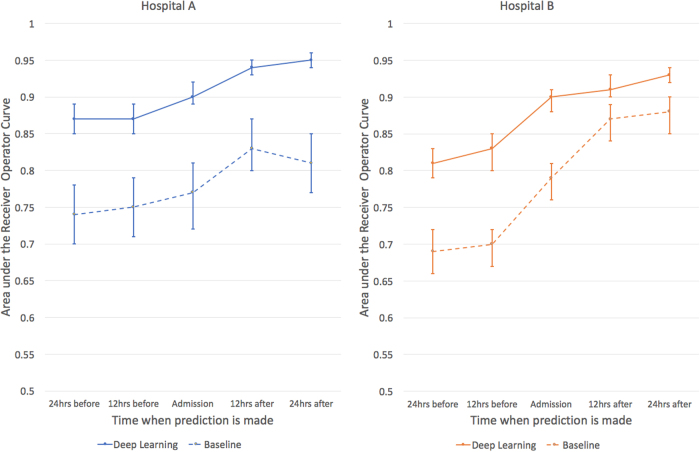
- For inpatient mortality at 24 h after admission, AUROC was 0.95 at Hospital A and 0.93 at Hospital B, versus 0.85 and 0.86 for the augmented Early Warning Score baseline.
- For 30-day readmission at discharge, AUROC was 0.77 at Hospital A and 0.76 at Hospital B, versus 0.70 and 0.68 for the modified HOSPITAL baseline; for long length of stay at 24 h, AUROC was 0.86 and 0.85, versus 0.76 and 0.74 for the modified Liu baseline.
- For predicting all discharge diagnoses (14,025 ICD-9 codes), weighted AUROC was 0.87/0.86 at admission and 0.90 at discharge for both hospitals; micro-F1 at discharge was 0.41 (Hospital A) and 0.40 (Hospital B).
## Methods
- Design: Retrospective study comparing deep learning models to traditional predictive models across two hospitals, with separate results reported for each site.
- Data/sample: De-identified EHR data from UCSF (2012–2016) and UCM (2009–2016), including adults 18+ with hospitalizations of 24 h or longer; UCM also included free-text notes.
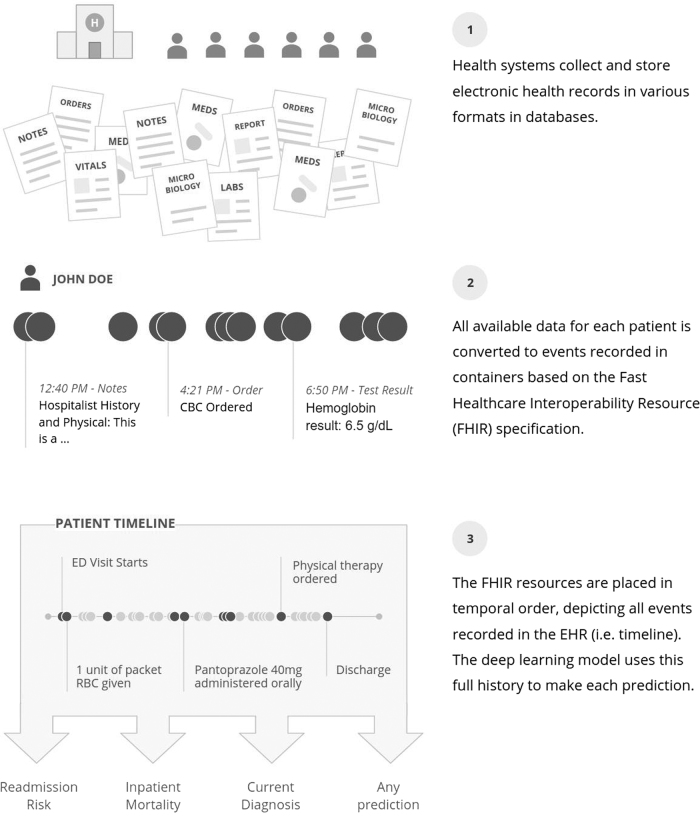
- Analysis: Raw EHR data were converted into time-ordered FHIR-based token sequences and used to train three model types (LSTM, attention-based TANN, and boosted time-based decision stumps), with outputs ensembled; data were split 80/10/10 into development/validation/test sets and evaluated using AUROC, calibration curves, work-up-to-detection ratio, and micro-F1.
## Limitations
- The authors state it is a retrospective study, with “all of the usual limitations.”
- They state that prospective trials are needed to show that accurate predictions improve care.
- They note their approach does not harmonize data between sites, limiting transfer to new sites/cohorts; they also say the methods are computationally intensive and require specialized expertise.
- Evident from the text: the study’s diagnosis task is restricted to ICD-9 codes, and the authors caution that AUROC differences between hospitals, especially regarding notes, cannot be attributed solely to notes because the cohorts differed.
Model-written summary. Check it against the paper before relying on it.
Integrity signals
Registry
Cites
Statistics
Figures
Verification
Claims the paper makes
7 Valid · 0 Not valid · 6 Not checked · 33 Own results and interpretations
The cited sources support only part of this claim — read each source’s verdict below.
In the paper
“We are not aware of a study that predicts as many ICD codes as this study, but our micro-F1 score exceeds that shown on the smaller MIMIC-III dataset when predicting fewer diagnoses (0.40 vs 0.28).68”
§ Scalable and accurate deep learning with electronic health records > Discussion
What the sources say
- Partly supportedcites [68] Perotte A Diagnosis code assignment: models and evaluation metrics J. Am. Med. Inform. Assoc. 2014 21 231 237 10.1136/amiajnl-2013-002159 24296907 PMC3932472 sourceExperimental — accuracy not yet measured
The Results > Prediction models section reports a 27.6% F-measure for the flat SVM, consistent with the cited 0.28 after rounding. But Materials and methods > Datasets identifies the dataset as MIMIC II, not MIMIC-III; the Results also report a higher 39.5% F-measure for this paper’s hierarchy-based model. No page numbers are available in our copy. (LLM, conf=0.89)
hedged- Asserted: passes — The authors put it forward as true.
- Checkable: passes — It can be checked against evidence.
- Load-bearing: passes — The paper’s conclusions depend on it.
- Based: passes — The paper gives a reason why it holds.
- Rests on an assumption not shown here.
- Partly supported
The cited sources support only part of this claim — read each source’s verdict below.
In the paper
“A major challenge in using more of the data available for each patient has been the lack of standards and semantic interoperability of health data from multiple sites.25”
§ Scalable and accurate deep learning with electronic health records > Introduction > Related work
What the sources say
- Partly supportedcites [25] Sun H Semantic processing of EHR data for clinical research J. Biomed. Inform. 2015 58 247 259 10.1016/j.jbi.2015.10.009 26515501 sourceExperimental — accuracy not yet measured
The Introduction (p.1) and Conclusion (Section 5) of our copy clearly support the semantic-interoperability half of the claim: 'the semantic interoperability between different standards remains a challenge', and 'there is no single standard that could serve as the interoperability hub for all the existing clinical data sources and clinical applications', with the Abstract framing the whole paper as responding to 'a growing need to semantically process and integrate clinical data from different sources for clinical research' (multi-site sources are illustrated in Section 4.1.1: a German hospital Oracle database and an Italian regional IHE QED registry). However, the claim's 'lack of standards' is not what this paper says: the Introduction states that standards such as HL7, openEHR and ISO 13606 HAVE been developed to tackle storage and exchange of clinical data, and the residual problem is interoperability AMONG them plus the absence of one unifying hub standard, not an absence of standards. The claim also generalises the source's specific concern (secondary use/reuse of EHR data for clinical research applications) to 'using more of the data available for each patient'. (LLM, conf=0.70)
plainstates a cause- Asserted: passes — The authors put it forward as true.
- Checkable: passes — It can be checked against evidence.
- Load-bearing: passes — The paper’s conclusions depend on it.
- Based: passes — The paper gives a reason why it holds.
- Partly supported
Every source the paper cites for this claim was checked and supports it.
In the paper
“In the current study, we caution that the differences in AUROC across the two hospitals (one with and one without notes) cannot be ascribed to the presence or absence of notes given the difference in cohorts.45”
§ Scalable and accurate deep learning with electronic health records > Discussion
What the sources say
- Supportedcites [45] Walsh C Hripcsak G The effects of data sources, cohort selection, and outcome definition on a predictive model of risk of thirty-day hospital readmissions J. Biomed. Inform. 2014 52 418 426 10.1016/j.jbi.2014.08.006 25182868 PMC4261028 source
The Discussion states that cohort selection affects discriminatory performance and that comparing performance across studies requires the cohorts to be the same. This supports the citing authors’ caution against attributing their two hospitals’ AUROC difference to the presence or absence of notes when the cohorts also differ; the two-hospital comparison is their own study, not a result attributed to this source. (LLM, conf=0.90)
plain- Asserted: passes — The authors put it forward as true.
- Checkable: passes — It can be checked against evidence.
- Load-bearing: passes — The paper’s conclusions depend on it.
- Based: passes — The paper gives a reason why it holds.
- Supported
A result the paper reports from its own data — it cites no other source for it, so there is none to check. The quote shows it is in the paper.
In the paper
“For classifying all diagnosis codes, the weighted AUROCs at admission were 0.87 for Hospital A and 0.86 for Hospital B.”
§ Scalable and accurate deep learning with electronic health records > Results > Inferring discharge diagnoses
plain- Asserted: passes — The authors put it forward as true.
- Checkable: passes — It can be checked against evidence.
- Load-bearing: passes — The paper’s conclusions depend on it.
- Based: passes — The paper gives a reason why it holds.
- Rests on 2 assumptions not shown here.
A result the paper reports from its own data — it cites no other source for it, so there is none to check. The quote shows it is in the paper.
In the paper
“For predicting long length of stay, the AUROCs at 24 h after admission were 0.86 (95% CI 0.86–0.87) for Hospital A and 0.85 (95% CI 0.84–0.86) for Hospital B.”
§ Scalable and accurate deep learning with electronic health records > Results > Long length of stay
plain- Asserted: passes — The authors put it forward as true.
- Checkable: passes — It can be checked against evidence.
- Load-bearing: passes — The paper’s conclusions depend on it.
- Based: passes — The paper gives a reason why it holds.
- Rests on an assumption not shown here.
18 more claims
Create a free account to see all 46 claims and to verify the 2 references still open.
- It may state two separate claims as one. 16
- Probably not a substantial claim. 10
Claims other papers make about this one
Each is checked against this paper’s own text: does it say what the citing paper says it does?
The source backs part of the claim, not all of it — or backs it for a different population, condition or comparison.
In the citing paper
“The most important difference is that the study included co-morbidities, which have been proven to enable better predictions of disease progression trends and treatment outcomes.25,26”
From Development and validation of a screening tool for sepsis without laboratory results in the emergency department: a machine learning study (2025) · cites this paper as [26]
Experimental — accuracy not yet measuredThe source backs part of the claim, not all of it — or backs it for a different population, condition or comparison.
In the citing paper
“For both structured codes and unstructured notes, standardized vocabularies including FHIR [6] and UMLS CUIs [62,63] are introduced to transfer raw tokens into unique phrases to reduce the sparsity of the input data.”
From Deep representation learning of patient data from Electronic Health Records (EHR): A systematic review (2021) · cites this paper as [6]
Experimental — accuracy not yet measuredThe source backs part of the claim, not all of it — or backs it for a different population, condition or comparison.
In the citing paper
“Some FEMRs have tackled this problem by combining unstructured EHR data (i.e., text) with structured EMR data to boost performance on specific phenotyping and prediction tasks69,70.”
From The shaky foundations of large language models and foundation models for electronic health records (2023) · cites this paper as [69]
Experimental — accuracy not yet measuredThe cited source says what the claim attributes to it.
In the citing paper
“To improve performance and provide a degree of interpretability to the model, an attention mechanism is adopted in 13 studies [6,14,27,31,43,57,64,72,76–78,80,88].”
From Deep representation learning of patient data from Electronic Health Records (EHR): A systematic review (2021) · cites this paper as [6]
The cited source says what the claim attributes to it.
In the citing paper
“Advances in artificial intelligence (AI) are driving a revolution across science, enabling exciting new results across chemistry,80–82 biology,83,84 and medicine.85–88”
From Artificial Intelligence and Early Detection of Pancreatic Cancer: 2020 Summative Review (2021) · cites this paper as [85]
8 more claims about this paper
Create a free account to see every claim other papers make about this one.
Citations
Cites
Hochreiter, S., & Schmidhuber, J. (1997) · Neural Computation · doi:10.1162/neco.1997.9.8.1735 · Cited by 102,318 · cited 9×
“Patient records vary significantly in length and density of data-points (e.g. vital sign measurements in an intensive care unit vs outpatient clinic), so we formulated three deep learning neural-network model architectures that take advantage of such data in different ways: one based on recurrent neural networks (LSTM)…”
MethodInfluentialLeCun, Y., Bengio, Y., & Hinton, G. (2015) · Nature · doi:10.1038/nature14539 · Cited by 84,126
Scikit-learn: Machine Learning in Python
Pedregosa, F., Varoquaux, G., Gramfort, A., Michel, V., Thirion, B., Grisel, O., Blondel, M., Müller, A., Nothman, J., Louppe, G., et al. (2012) · arXiv · doi:10.48550/arxiv.1201.0490 · Cited by 71,016
APACHE II: A severity of disease classification system
KNAUS, W. A., DRAPER, E. A., WAGNER, D. P., & ZIMMERMAN, J. E. (1985) · Critical Care Medicine · doi:10.1097/00003246-198510000-00009 · Cited by 13,664
Representation Learning: A Review and New Perspectives
Bengio, Y., Courville, A., & Vincent, P. (2013) · IEEE Transactions on Pattern Analysis and Machine Intelligence · doi:10.1109/tpami.2013.50 · Cited by 13,001 · cited 1×
“Our central insight is that rather than explicitly harmonizing EHR data, mapping it into a highly curated set of structured predictors variables and then feeding those variables into a statistical model, we can instead learn to simultaneously harmonize inputs and predict medical events through direct feature learning…”
BackgroundMIMIC-III, a freely accessible critical care database
Johnson, A. E. W., Pollard, T. J., Shen, L., Lehman, L.-W. H., Feng, M., Ghassemi, M., Moody, B., Szolovits, P., Anthony Celi, L., & Mark, R. G. (2016) · Scientific Data · doi:10.1038/sdata.2016.35 · Cited by 8,141 · cited 1×
“ecord, which includes clinical free-text notes as well as large amounts of structured and semi-structured data. Because of the availability of Medical Information Mart for Intensive Care (MIMIC) data [48], many prior studies also have focused on ICU patients from a single center [92, 41]; other single-center studies h…”
MethodGulshan, V., Peng, L., Coram, M., Stumpe, M. C., Wu, D., Narayanaswamy, A., Venugopalan, S., Widner, K., Madams, T., Cuadros, J., et al. (2016) · JAMA · doi:10.1001/jama.2016.17216 · Cited by 7,697 · cited 1×
“Deep learning emerged as the preferred machine learning approach in machine perception problems ranging from computer vision to speech recognition, but has more recently proven useful in natural language processing, sequence prediction, and mixed modality data settings([36, 16, 21, 56]).”
BackgroundMandell, L. A., Wunderink, R. G., Anzueto, A., Bartlett, J. G., Campbell, G. D., Dean, N. C., Dowell, S. F., File, T. M., Musher, D. M., Niederman, M. S., et al. (2007) · Clinical Infectious Diseases · doi:10.1086/511159 · Cited by 6,202 · cited 1×
“of only 27 variables, rely on traditional generalized linear models, and are built using data at a single center. In clinical practice, simpler models are most commonly deployed, such as the CURB-65 [68, 60], which is a 5-factor model, or single-parameter warning scores [20, 45]. A major challenge in using more of the…”
MethodAPACHE II: a severity of disease classification system.
Knaus, W. A., Draper, E. S., Wagner, D. P., & Zimmerman, J. E. (1985) · PubMed · Cited by 6,034
Predicting the future - big data, machine learning, and clinical medicine
Obermeyer, Z., & Emanuel, E. J. (2016) · New England Journal of Medicine · doi:10.1056/nejmp1606181 · Cited by 3,652 · cited 1×
“In our case study, the model identified elements of the patient’s history and radiology findings to render its prediction, which are critical data-points that a clinician would also use [41].”
Method
Research works printed but not linked: 5
- Wu, Y. et al. Google’s neural machine translation system: bridging the gap between human and machine translation. arXiv [cs.CL] (2016).
- Aczon, M. et al. Dynamic mortality risk predictions in pediatric critical care using recurrent neural networks. arXiv [stat.ML] (2017).
- Suresh, H. et al. Clinical intervention prediction and understanding using deep networks. arXiv [cs.LG] (PMLR, Los Angeles, CA, USA, 2017).
- Razavian, N., Marcus, J. & Sontag, D. Multi-task prediction of disease onsets from longitudinal laboratory tests. In Proceedings of the 1st Machine Learning for Healthcare Conference, (eds F. Doshi-Velez, J. Fackler, D. Kale and B. Wallace, J. Wiens) Vol. 56, pp 73–100 (PMLR, Los Angeles, CA, 2016).
- Bahdanau, D., Cho, K. & Bengio, Y. Neural machine translation by jointly learning to align and translate. arXiv [cs.CL] (2014).
Cited by
Items 1,201–1,300 of 2,601
Yapay Zekâ’nın Yaratıcılığı Üzerine Bir Tartışma
Dilmaç, S. (2024) · Art Vision · doi:10.32547/artvision.1454216 · Cited by 11
HEART: Learning better representation of EHR data with a heterogeneous relation-aware transformer
Huang, T., Rizvi, S. A., Thakur, R. K., Socrates, V., Gupta, M., van Dijk, D., Taylor, R. A., & Ying, R. (2024) · Journal of Biomedical Informatics · doi:10.1016/j.jbi.2024.104741 · Cited by 18
Kremers, H. M., Wyles, C. C., Slusser, J. P., O'Byrne, T. J., Sagheb, E., Lewallen, D. G., Berry, D. J., Osmon, D. R., Sohn, S., & Kremers, W. K. (2024) · The Journal of Arthroplasty · doi:10.1016/j.arth.2024.10.129 · Cited by 6
Zhu, J., Zhou, J., Tao, C., Xia, G., Liu, B., Zheng, X., Xu, L., & Zhang, Z. (2025) · Annals of Medicine · doi:10.1080/07853890.2025.2451184 · Cited by 6
Xu, S., & Sun, M. (2025) · Scientific Reports · doi:10.1038/s41598-025-95938-3 · Cited by 6
“The GA-XGB model demonstrated high efficiency, outperforming six tested ML algorithms in terms of classification robustness, supported by repeated K-Fold cross-validation to prevent overfitting 38 .”
Self-citationSuh, J., Kwun, J.-S., Ahn, H.-B., Kang, S.-H., Yoo, S., 김석, Song, W., Hyun, J., Oh, J. S., & Baek, G. (2025) · Journal of Medical Internet Research · doi:10.2196/66366 · Cited by 9
Tiwari, A., Shah, P. C., Kumar, H., Borse, T., Arun, A. R., Chekragari, M., Ochani, S., Shah, Y. R., Ganesh, A., Ahmed, R., et al. (2025) · Current Cardiology Reviews · doi:10.2174/011573403x351048250329170744 · Cited by 15
“By expanding CVD detection through diagnostic image analysis, AI frameworks can facilitate treatment planning and disease forecasting, such as improving predictions for hospitalization and mortality [17-19].”
Liu, Y., Zhang, Z., Mi, J., Pan, S., Chen, T., Guo, Y. M., He, X., & Bian, J. (2024) · Journal of Biomedical Informatics · doi:10.1016/j.jbi.2025.104851 · Cited by 11
Data interoperability for a systems approach to developmental conditions
Molerus, F., Lynch, C. O., & Bruining, H. (2025) · Neuroscience & Biobehavioral Reviews · doi:10.1016/j.neubiorev.2025.106245 · Cited by 14
“…(Fernandez et al., 2021), integrating diverse data sources for clinical risk predictions (Sun et al., 2021) and clinical decision support tools providing access to a patient ’ s complete medical history integrated from multiple healthcare providers (Semenov et al., 2018; Rajkomar et al., 2018).”
Wang, S., Qiao, J., Wang, R., Chen, H., & Ouyang, Y. (2025) · International Journal of Medical Informatics · doi:10.1016/j.ijmedinf.2025.106000 · Cited by 10
SimTA++: Simple attention neural network for clinical asynchronous time series
Li, Z., Li, J., Kuang, K., Jing, B., Du, B., Liao, F., & Yang, J. (2025) · Neural Networks · doi:10.1016/j.neunet.2025.107735 · Cited by 7
Chilumukuru, N. S., Priyadarshini, P., & Ezunkpe, Y. (2025) · JMIR Formative Research · doi:10.2196/62996 · Cited by 10
“Our web-based deployment aligns with the vision that emphasized the importance of scalable and generalizable deep learning systems in clinical settings [41].”
Cao, S., Li, R., Wu, R., Liu, R., Duprey, A., & Zhao, J. (2026) · JAMIA Open · doi:10.1093/jamiaopen/ooaf167 · Cited by 9
“Notably, CNNs and RNNs have advanced patient outcome prediction, 37 while stacked autoencoders have improved disease prediction accuracy.”
Ajuwon, B. I., Awotundun, O. N., Richardson, A., Roper, K. G., Sheel, M., Rahman, N., Salako, A. O., & Lidbury, B. A. (2023) · International Journal of Medical Informatics · doi:10.1016/j.ijmedinf.2023.105244 · Cited by 8
Stoessel, D., Fa, R., Artemova, S., von Schenck, U., Rostami, H. N., Madiot, P., Landelle, C., Olive, F., Foote, A., Moreau–Gaudry, A., et al. (2023) · BMC Medical Informatics and Decision Making · doi:10.1186/s12911-023-02356-4 · Cited by 6
Kuhar, S., Kaur, A., Raj, T., Pareek, S., Grover, K., & Kumar, R. (2023) · International Conference on System Modeling & Advancement in Research Trends (SMART) · doi:10.1109/smart59791.2023.10428297 · Cited by 8
Clinical deep model to analyse medical multivariate time-series data for health diagnosis
Almahadeen, L., Vijay, R., Shabaz, M., Soni, M., Singh, P. P., Patel, P., & Byeon, H. (2024) · Cyber-Physical Systems · doi:10.1080/23335777.2024.2329677 · Cited by 6
“At present, many works have applied general time-series data analysis methods (represented by a recurrent neural network) to multivariate medical time-series data analysis tasks and have achieved a great improvement compared to traditional models [14].”
AI and the next medical revolution: deep learning’s uncharted healthcare promise
Krithika, L. B., Vishnu, S., Kotei, E., Gadde, A., Kothamasu, G. A., Nallabantu, S. C., & Jayabalasamy, G. (2024) · Engineering Research Express · doi:10.1088/2631-8695/ad56fc · Cited by 9
Hasan, F., Muhtar, M. S., Wu, D., Chen, P.-Y., Hsu, M., Nguyen, P., Chen, T., & Chiu, H. (2024) · Journal of Stroke and Cerebrovascular Diseases · doi:10.1016/j.jstrokecerebrovasdis.2024.107826 · Cited by 8
Early prediction of hypertensive disorders of pregnancy toward preventive early intervention
Mizuno, S., Nagaie, S., Sugawara, J., Tamiya, G., Obara, T., Ishikuro, M., Kuriyama, S., Yaegashi, N., TANAKA, H. L., Yamamoto, M. P., et al. (2024) · AJOG Global Reports · doi:10.1016/j.xagr.2024.100383 · Cited by 11
Panchangam, P. V. R., Tejas, A., Thejas, B. U., & Maniaci, M. J. (2024) · Healthcare · doi:10.3390/healthcare12151497 · Cited by 8
“While this approach has yielded positive results, it often falls short of incorporating crucial patient-specific factors such as comorbidities and medication history, which are known to significantly impact readmission risk [13,17].”
BackgroundXu, C., Yu, B., Zhang, Y., Wang, X., Huang, D., Gong, S., & Hu, W. (2025) · Frontiers in Neurology · doi:10.3389/fneur.2025.1512297 · Cited by 11
“These indicators are not only statistically significant but also carry profound clinical implications (20, 21).”
Self-citationWu, K., Xu, G., Tian, Y., Li, G., Yi, Z., & Tang, X. (2025) · Marine Drugs · doi:10.3390/md23040178 · Cited by 14
“Machine learning, especially deep learning, has been widely used in various fields of computational biology, such as genome research [9,10], biomolecular structure modeling [11,12], drug discovery, drug development [13,14], and medical data analysis [15].”
Genome sequencing is critical for forecasting outcomes following congenital cardiac surgery
Watkins, W. S., Hernandez, E. J., Miller, T. A., Blue, N. R., Zimmerman, R. M., Griffiths, E. R., Frise, E., Bernstein, D., Boskovski, M. T., Brueckner, M. K., et al. (2025) · Nature Communications · doi:10.1038/s41467-025-61625-0 · Cited by 10
Isangadighi, G. E., Mathew, P., Islam, M., Obahor, G., Offordum, A., & Momoh, P. O. (2025) · Journal of Clinical Practice and Medical Research · doi:10.59324/jcpmr.2025.1(1).05 · Cited by 18
Survival Prediction from Longitudinal Health Insurance Data using Graph Pattern Mining
Ren, Y., Zhang, K., & Shi, Y. (2019) · IEEE International Conference on Bioinformatics and Biomedicine (BIBM) · doi:10.1109/bibm47256.2019.8983290 · Cited by 6
“The RNNs can effectively model time series data [4], [18].”
MethodSelf-citationTutorial on Human-Centered Explainability for Healthcare
Chakraborty, P., Kwon, B. C., Dey, S., Dhurandhar, A., Gruen, D. M., Ng, K., Sow, D., & Varshney, K. R. (2020) · ACM SIGKDD Conference on Knowledge Discovery and Data Mining (KDD) · doi:10.1145/3394486.3406470 · Cited by 7
Hospital readmission prediction based on long-term and short-term information fusion
Chen, Z., Lai, C., & Ren, J. (2020) · Applied Soft Computing · doi:10.1016/j.asoc.2020.106690 · Cited by 6
Hung, C.-Y., Chen, H., Wee, L. J. K., Lin, C., & Lee, C.-C. (2020) · Annual International Conference of the IEEE Engineering in Medicine and Biology Society (EMBC) · doi:10.1109/embc44109.2020.9176454 · Cited by 8
“, those based on deep learning algorithms, have already demonstrated impressive power for predicting clinical events in several works [7].”
BackgroundMethodKheradvar, A., Jafarkhani, H., Guy, T. S., & Finn, J. P. (2020) · Future Cardiology · doi:10.2217/fca-2020-0128 · Cited by 5
Batista, A., Pozo, D., & Vera, J. R. (2020) · Computers & Industrial Engineering · doi:10.1016/j.cie.2020.107041 · Cited by 6
Deep Learning Models for Detection and Diagnosis of Alzheimer's Disease
dar, G. M. U. D., Sharma, A. K., & Singh, P. (2021) · Advances in medical technologies and clinical practice book series · doi:10.4018/978-1-7998-7188-0.ch011 · Cited by 7
Improving domain adaptation in de-identification of electronic health records through self-training
Liao, S., Kiros, J., Chen, J., Zhang, Z., & Chen, T. (2021) · Journal of the American Medical Informatics Association · doi:10.1093/jamia/ocab128 · Cited by 5
Alamer, S. A., Ilyas, Q. M., Ahmad, M., & Irfan, D. (2021) · International Journal of Cloud Applications and Computing · doi:10.4018/ijcac.2022010110 · Cited by 9
Early Alert of Elderly Cognitive Impairment using Temporal Streaming Clustering
Ibrahim, O. A., Fu, S., Vassilaki, M. E., Petersen, R. C., Mielke, M. M., Sauver, J. L. S., & Sohn, S. (2021) · IEEE International Conference on Bioinformatics and Biomedicine (BIBM) · doi:10.1109/bibm52615.2021.9669672 · Cited by 7
Hospital Readmission Prediction Using Clinical Admission Notes
Thapa, N. B., Seifollahi, S., & Taheri, S. (2022) · Australasian Computer Science Week Multiconference (ACSW) · doi:10.1145/3511616.3513115 · Cited by 12
“Rajkomar et al. [25] developed a scalable hybrid LSTM and attention-based neural network model combining free-text ontology notes and structured information, and Zhang et al. [32] proposed multi-model architecture combining heterogeneous data from EHR.”
MethodHaudenschild, C., Vaickus, L. J., & Levy, J. (2022) · ACM Symposium on Applied Computing · doi:10.1145/3477314.3507007 · Cited by 9
Descriptive and Predictive Analytics on Electronic Health Records using Machine Learning
Anandi, V., & Ramesh, M. (2022) · International Conference on Advances in Electrical, Computing, Communication and Sustainable Technologies (ICAECT) · doi:10.1109/icaect54875.2022.9808019 · Cited by 11
Mitigating health disparities in EHR via deconfounder
Liu, Z., Li, X., & Yu, P. S. (2022) · ACM International Conference on Bioinformatics, Computational Biology, and Health Informatics (ACM-BCB) · doi:10.1145/3535508.3545516 · Cited by 10
“3545516 [7, 30], auxiliary diagnosis [37], and automated prescription [48].”
BackgroundAI in Medicine: Some Pertinent History
Shortliffe, E. H., & Shah, N. H. (2022) · Cognitive informatics in biomedicine and healthcare · doi:10.1007/978-3-031-09108-7_2 · Cited by 7
Self-citationDoria, A. S. (2023) · Expert Review of Hematology · doi:10.1080/17474086.2023.2192474 · Cited by 11
“…the creation of clinical data infrastructure by building on existing research infrastructure [64,65]; (2) the creation of a common data approach for storage and transfer of healthcare data [58]; (3) the utilization of sharing/using data representations to train ML models by federated learning [66].”
BackgroundArtificial Intelligence, Bioinformatics, and Pathology
Levy, J., Lu, Y., Montivero, M. K. S., Ramwala, O. A., McFadden, J. R., Miles, C., Diamond, A. G., Reddy, R., Reddy, R., Hudson, T. R., et al. (2022) · Advances in Molecular Pathology · doi:10.1016/j.yamp.2023.01.001 · Cited by 10
Li, X., Zhan, Y., Zhao, Y., Wu, Y., Ding, L., Li, Y., Tao, D., & Jin, H. (2023) · Information Fusion · doi:10.1016/j.inffus.2023.101838 · Cited by 6
Artificial intelligence in healthcare
Srivastava, S., Tyagi, A. K., & Sajidha, S. A. (2023) · Elsevier eBooks · doi:10.1016/b978-0-323-99421-7.00015-5 · Cited by 6
McDermott, S. P., & Wasan, A. D. (2023) · Journal of Pain Research · doi:10.2147/jpr.s389160 · Cited by 6
“Recent work utilizing deep learning shows promise for complex applications and could theoretically be incorporated in a future version of this approach.(9,16,18) The error-correcting output code algorithm used in this study allows highly accurate multi-class classification training to occur and can be scaled to multic…”
BackgroundMethodNonlinear neural-like P model for time series classification
Liu, X., Zhao, Y., & Wang, L. (2023) · Theoretical Computer Science · doi:10.1016/j.tcs.2023.114055 · Cited by 6
Self-citationSo, Y. K., Kim, Z., Cheong, T. Y., Chung, M. J., Baek, C., Son, Y., Seok, J., Jung, Y., Ahn, M., Ahn, Y. C., et al. (2023) · Cancers · doi:10.3390/cancers15143540 · Cited by 7
Kohli, M., Kar, A. K., Sinha, S., & Kohli, S. (2024) · Expert Systems · doi:10.1111/exsy.13545 · Cited by 9
“This progress has been notably expedited by incorporating electronic health record (EHR) platforms (Rajkomar et al., 2018).”
AlSaad, R., Malluhi, Q. M., Abd-Alrazaq, A. A., & Boughorbel, S. (2024) · Artificial Intelligence in Medicine · doi:10.1016/j.artmed.2024.102802 · Cited by 9
Kowadlo, G., Mittelberg, Y., Ghomlaghi, M., Stiglitz, D. K., Kishore, K., Guha, R., Nazareth, J. M., & Weinberg, L. (2024) · BMC Medical Informatics and Decision Making · doi:10.1186/s12911-024-02463-w · Cited by 8
“Various techniques have been used such as deep learning [18, 19], logistic regression [20, 21], generalised additive models (GAMs) [6] and decision trees [22, 23, 24, 16].”
BackgroundMethodResultInfluentialApplication of artificial intelligence to hepatobiliary cancer clinical outcomes research
Endo, Y., Alaimo, L., Catalano, G., Chatzipanagiotou, O. P., & Pawlik, T. M. (2024) · Artificial Intelligence Surgery · doi:10.20517/ais.2024.09 · Cited by 7
Kocuvan, P., Zadobovšek, M., & Gams, M. (2024) · Journal of Smart Cities and Society · doi:10.3233/scs-240011 · Cited by 9
“These studies focus on user satisfaction, the accuracy of information provided, and the impact on healthcare outcomes [26].”
Can Big Data Deliver on Its Promises?—Leaps but Not Bounds
Peltan, I. D., Beesley, S. J., & Brown, S. M. (2018) · JAMA Network Open · doi:10.1001/jamanetworkopen.2018.5694 · Cited by 6
Deep Neural Learning for Automated Diagnostic Code Group Prediction Using Unstructured Nursing Notes
Jayasimha, A., Gangavarapu, T., Kamath, S. S., & Krishnan, G. S. (2020) · Joint International Conference on Data Science & Management of Data (CODS-COMAD) · doi:10.1145/3371158.3371176 · Cited by 7
Patient-level Classification on Clinical Note Sequences Guided by Attributed Hierarchical Attention
Şen, C., Hartvigsen, T., Kong, X., & Rundensteiner, E. A. (2019) · IEEE International Conference on Big Data (BigData) · doi:10.1109/bigdata47090.2019.9006403 · Cited by 9
Deep Learning in Medicine. Are We Ready?
Ting, D. S. W., Rim, T. H., Choi, Y. S., & Ledsam, J. R. (2019) · Annals of the Academy of Medicine Singapore · doi:10.47102/annals-acadmedsg.v48n1p1 · Cited by 6
Yang, S., Xiong, H., Xu, K., Wang, L., Bian, J., & Sun, Z. (2020) · Applied Intelligence · doi:10.1007/s10489-020-01810-4 · Cited by 7
Clinical Decision Support Systems in Practice: Current Status and Challenges
Jović, A., Stančin, I., Friganović, K., & Cifrek, M. (2020) · International Convention on Information and Communication Technology, Electronics and Microelectronics · doi:10.23919/mipro48935.2020.9245283 · Cited by 9
“In this respect, unified data formats such as FHIR [30] could be beneficial; however, data is still heterogeneous and has inconsistent semantic coding, which prevents data preparation for ML [11].”
BackgroundPublic Health Impact of Using Biosimilars, Is Automated Follow up Relevant?
Perpoil, A., Grimandi, G., Birklé, S., et al. (2020) · International Journal of Environmental Research and Public Health · doi:10.3390/ijerph18010186 · Cited by 6
“To address this issue, the literature mentions attribution mechanisms to facilitate interpretations [24] which focus on identifying signals that play an important role in generating results.”
BackgroundInfluentialHealth Status Prediction with Local-Global Heterogeneous Behavior Graph
Ma, X., Yang, X., Gao, J., & Xu, C. (2021) · ACM Transactions on Multimedia Computing Communications and Applications · doi:10.1145/3457893 · Cited by 8
GeoAI-based Epidemic Control with Geo-Social Data Sharing on Blockchain
Peng, S., Bai, L., Xiong, L., Qu, Q., Xie, X., & Shu-Lin, W. A. N. G. (2021) · IEEE International Conference on e-Health Networking, Applications and Services (Healthcom) · doi:10.1109/healthcom49281.2021.9399031 · Cited by 7
“Related medical applications include symptom monitoring analysis based on social media [9], crowd disease risk prediction [10], mobile medical care [11] and medical imaging [12].”
BackgroundBetter Application of Bayesian Deep Learning to Diagnose Disease
Singh, P. N. (2021) · International Conference on Computing Methodologies and Communication (ICCMC) · doi:10.1109/iccmc51019.2021.9418301 · Cited by 8
Introduction to drug discovery
Ashenden, S. K. (2021) · Elsevier eBooks · doi:10.1016/b978-0-12-820045-2.00002-7 · Cited by 7
Yilmaz, I., Baza, M., Amer, R., et al. (2021) · Lecture notes in computer science · doi:10.1007/978-3-030-79457-6_44 · Cited by 6
Readmission Prediction with Knowledge Graph Attention and RNN-Based Ordinary Differential Equations
Pei, S., Niu, K., Peng, X., & Zeng, J. (2021) · Lecture notes in computer science · doi:10.1007/978-3-030-82153-1_46 · Cited by 11
The evolution of knowledge on genes associated with human diseases
Dias, T. L., Dalmolin, R. J. S., Amaral, P., Alves, T. L., Schuch, V., Franco, G. R., & Nakaya, H. I. (2021) · iScience · doi:10.1016/j.isci.2021.103610 · Cited by 5
Clinical Artificial Intelligence
McDermott, M. B. A., Nestor, B., & Szolovits, P. (2022) · Clinics in Laboratory Medicine · doi:10.1016/j.cll.2022.09.004 · Cited by 7
An, J., Jung, M., Ryu, S., Choi, Y., & Kim, J. (2023) · Informatics in Medicine Unlocked · doi:10.1016/j.imu.2023.101178 · Cited by 10
Deep Learning Applied on Next Generation Sequencing Data Analysis
Danilevsky, A., & Shomron, N. (2021) · Methods in molecular biology · doi:10.1007/978-1-0716-1103-6_9 · Cited by 7
SAMGEP: A Novel Method for Prediction of Phenotype Event Times Using the Electronic Health RecordPreprint
Ahuja, Y., Wen, J., Hong, C., Xia, Z., Huang, S., & Cai, T. (2021) · medRxiv · doi:10.1101/2021.03.07.21253096 · Cited by 6
“Recurrent neural networks (RNNs), designed for sequence data and wellconditioned to high feature dimensions, have enjoyed widespread application to prediction using longitudinal data.[21-25] One recent RNN-based method optimized for healthcare data, the Reverse Time Attention Model, (RETAIN), offers particularly notab…”
MethodRapid Response System Based On Graph Attention Network For Forecasting Clinical Decline In EHR
Sushma, B. S., Sree, S. D., & Yadav, M. S. (2024) · IEEE International Students' Conference on Electrical, Electronics and Computer Science (SCEECS) · doi:10.1109/sceecs61402.2024.10482300 · Cited by 8
“Explored the possibility of using electronic health record data for predictive modelling, which might improve healthcare quality and tailor therapy [13].”
BackgroundHofer, I. S., & Wax, D. B. (2024) · Journal of Medical Systems · doi:10.1007/s10916-024-02106-7 · Cited by 5
“Since the first paper in the anesthesiology literature by Lee et al. in 2018 [1] dozens of papers have been published leveraging electronic health record data to predict a variety of perioperative outcomes such as mortality [2, 3], acute kidney injury (AKI) [2, 4–6], readmission [7–9] and others.”
The Rapidly Evolving Scenario of Acoustic Voice Analysis in Otolaryngology
Fantini, M., Ciravegna, G., Koudounas, A., Cerquitelli, T., Baralis, E., Succo, G., & Crosetti, E. (2024) · Cureus · doi:10.7759/cureus.73491 · Cited by 17
“DL has emerged as a transformative force across various healthcare domains, ranging from the analysis of electronic health records [44] to medical imaging [45], drug discovery [46], and multi-omics analysis [47], achieving accuracies comparable to, or surpassing, those of human experts.”
Kim, D. H. (2025) · Journal of Personalized Medicine · doi:10.3390/jpm15050175 · Cited by 7
“Rajkomar et al. [53] demonstrated that deep learning using EHR data can achieve robust predictions across various clinical scenarios, highlighting the potential of these methods to complement imaging-based genomic profiling.”
InfluentialFlexible imputation toolkit for electronic health records
Sadr, A. V., Li, J., Hwang, W., Yeasin, M., Wang, M., Lehmann, H. P., Zand, R., & Abedi, V. (2025) · Scientific Reports · doi:10.1038/s41598-025-02276-5 · Cited by 13
AI-Driven Tacrolimus Dosing in Transplant Care: Cohort Study
Huo, M., Perez, S. A., Awdishu, L., Kerr, J., Xie, P., Khan, A., Mekeel, K. L., & Nemati, S. (2025) · JMIR AI · doi:10.2196/67302 · Cited by 7
“The LSTM model is designed to process sequential data, capturing long-term dependencies that are crucial in clinical settings where patient responses to medication evolve over time [22].”
How machine learning on real world clinical data improves adverse event recording for endoscopy
Wittlinger, S., Wiest, I. C., Ladani, M. J., Kather, J. N., Ebert, M. P., Siegel, F. P., & Belle, S. (2025) · npj Digital Medicine · doi:10.1038/s41746-025-01826-5 · Cited by 5
Reimagining clinical AI: from clickstreams to clinical insights with EHR use metadata
Yan, C., Zhang, X., Kannampallil, T., Adler‐Milstein, J., & Chen, Y. (2025) · npj Health Systems · doi:10.1038/s44401-025-00040-5 · Cited by 7
“Uses objective clinical variables to forecast patient trajectories and critical clinical events 93,96 .”
Selvaraj, C., Cho, W. C. S., Kulanthaivel, L., Alothaim, A. S., Vijayakumar, R., Jayaprakashvel, M., & Desai, D. (2025) · 3 Biotech · doi:10.1007/s13205-025-04518-9 · Cited by 12
“Predictive analytics enabled by AI is also able to evaluate patient risk factors so that physicians can foretell complications and customize follow-up treatment in a similar manner (Rajkomar et al. 2018).”
Ahmed, Y. K., & Naji, A. N. A. (2025) · Network Modeling Analysis in Health Informatics and Bioinformatics · doi:10.1007/s13721-025-00641-y · Cited by 11
Ruan, Y., Tan, D. J., Ng, S. K., Huang, L., & Feng, M. (2025) · Journal of Healthcare Informatics Research · doi:10.1007/s41666-025-00219-3 · Cited by 16
“In this study, we aim to predict prolonged length of stay (PLOS), defined as a stay exceeding 7 days [12, 38, 39].”
MoE-Health: A Mixture of Experts Framework for Robust Multimodal Healthcare Prediction
Wang, X., & Yang, C. C. (2025) · ACM International Conference on Bioinformatics, Computational Biology, and Health Informatics (ACM-BCB) · doi:10.1145/3765612.3767207 · Cited by 24
“Traditional approaches, such as logistic regression and gradient boosting, have been widely used for tasks such as mortality prediction, length-of-stay estimation, and hospital readmission prediction [11].”
de Andrade, J. B. C., Cavalcante, M. A. O. D. M., Lopes, T. L. M., Treigher, J. M. S., Balsells, M. D., Vasconcelos, J. L., Monteiro, L. C., & MOTA, D. D. D. S. (2026) · Critical Care · doi:10.1186/s13054-025-05677-0 · Cited by 16
“Missing data in critical care EHRs is substantial and systematically biased [7].”
Aldosari, H. (2026) · Healthcare · doi:10.3390/healthcare14111497 · Cited by 10
“Predictive models based on EHRs, imaging, genomics, and wearable data may help detect clinical deterioration, forecast hospital readmissions, identify patients at risk of complications, and support population health management [1,13].”
Epidemiology of cardiometabolic multiple long-term conditions
Khunti, K., Zaccardi, F., Mehta, R., Gregg, E. W., & Misra, S. (2026) · The Lancet · doi:10.1016/s0140-6736(26)00606-9 · Cited by 17
Mann, D. L. (2019) · JACC Basic to Translational Science · doi:10.1016/j.jacbts.2019.05.002 · Cited by 5
Trust in Artificial Intelligence: Clinicians Are Essential
Bhatt, U., & Shams, Z. (2021) · Health informatics · doi:10.1007/978-3-030-81030-6_10 · Cited by 5
AI-Aided Disease Prediction in Visualized Medicine
Du, J., Huang, M., & Liu, L. (2023) · Advances in experimental medicine and biology · doi:10.1007/978-981-32-9902-3_6 · Cited by 5
Evidence pyramid and artificial intelligence: a metamorphosis of clinical research
Bellini, V., Ori, E., Coccolini, F., & Bignami, E. G. (2023) · Discover Health Systems · doi:10.1007/s44250-023-00050-w · Cited by 7
Deep Learning-Based Recommendation Systems: Review and Critical Analysis
Alam, M. M., & Ahmed, M. (2024) · Lecture notes in networks and systems · doi:10.1007/978-981-99-6544-1_4 · Cited by 10
Pan, P., Wang, Y., Liu, C., Tu, Y., Cheng, H., Yang, Q., Xie, F., Li, Y., Xie, L., & Liu, Y. (2024) · Journal Of Big Data · doi:10.1186/s40537-024-00896-8 · Cited by 9
“Recent studies have shown that novel neural architectures (including LSTM-based neural architectures) perform well in predicting mortality in hospitalized patients with an AUC value of 0.93 [16].”
BackgroundInfluentialMei, Y., Jin, Z., Ma, W., Yingjun, M., Deng, N., Fan, Z., & Wei, S. (2024) · Bioengineering · doi:10.3390/bioengineering11060551 · Cited by 6
“This early identification and personalized treatment approach not only helps to reduce the risk of MACEs but also significantly improves treatment outcomes for patients while optimizing resource allocation within the healthcare system [34,35].”
BackgroundScreening for Heart Failure: Biomarkers to Detect Heightened Risk in the General Population
Kosyakovsky, L. B., de Boer, R. A., & Ho, J. E. (2024) · Current Heart Failure Reports · doi:10.1007/s11897-024-00686-6 · Cited by 6
“Future models may also leverage novel machine learning approaches and longitudinal electronic health data to integrate biomarker information with clinical, biochemical, and imaging data to characterize HF risk across distinct patient populations and HF subtypes [117–119].”
Prediction models for cognitive frailty in community-dwelling older adults: A scoping review
Zhang, Y., Xue, H., Xia, H., & Jiang, X. (2024) · Geriatric Nursing · doi:10.1016/j.gerinurse.2024.09.019 · Cited by 5
Self-citationGenerative AI and Emotional Health: Innovations with Haystack
Agliata, A., Pilato, A. D., Sorrentino, M., Bottiglieri, S., Nardo, E. D., & Ciaramella, A. (2024) · IEEE Symposium on Computers and Communications (ISCC) · doi:10.1109/iscc61673.2024.10733569 · Cited by 5
“For example, research published in Nature and Natural Language Engineering demonstrates how NLP can enhance data collection and analysis in non-clinical settings, thereby supporting medical professionals in their diagnostic and treatment processes [1], [3].”
Background“Enhancing Stroke Prediction with Machine Learning in Smart Healthcare Systems“
Nayak, S., & Gupta, N. S. (2024) · International Conference on Computing, Communication and Networking Technologies (ICCCNT) · doi:10.1109/icccnt61001.2024.10724345 · Cited by 8
High-Dimensional Projected Clustering for Learner Competency Analysis in Medical Training Programs
Harikumar, S., Pillai, C. S. J., Chithra, V. V., Raman, R., Kaimal, M. R., Tang, K., & Nedungadi, P. (2024) · IEEE Access · doi:10.1109/access.2024.3496318 · Cited by 5
“Clustering-based healthcare recommendation systems have drawn increased attention in the academic landscape, stimulated by their potential to offer personalized health-care solutions [66].”
Vora, B., Jindal, A., Velasquez, E. F., Lu, J. J.-Q., & Wu, B. M. (2024) · Clinical and Translational Science · doi:10.1111/cts.70077 · Cited by 5
“6,8 Overall, these models may assist clinicians and scientists in making more informed medical decisions in the future.”
Abbas, S., Iftikhar, M., Shah, M. M., & Khan, S. J. (2024) · Cureus · doi:10.7759/cureus.75851 · Cited by 6
Detrois, K. E., Hartonen, T., Teder‐Laving, M., Jermy, B. S., Läll, K., Yang, Z., FinnGen, Mägi, R., Ripatti, S., & Ganna, A. (2025) · Nature Genetics · doi:10.1038/s41588-025-02298-9 · Cited by 7
“So far, most research has been conducted on a single EHR with limited work on validating the models in different EHR systems and countries 2,12,14,15 .”
Metadata
- Authors
- Rajkomar, A., Oren, E., Chen, K., Dai, A. M., Hajaj, N., Hardt, M., Liu, P. J., Liu, X., Marcus, J., Sun, M., Sundberg, P., Yee, H., Zhang, K., Zhang, Y., Flores, G., Duggan, G. E., Irvine, J., Le, Q., Litsch, K., Mossin, A., Tansuwan, J., Wang, D., Wexler, J., Wilson, J., Ludwig, D., Volchenboum, S. L., Chou, K., Pearson, M., Madabushi, S., Shah, N. H., Butte, A. J., Howell, M. D., Cui, C., Corrado, G. S., & Dean, J.
- Affiliations
- Google (United States) (US)
- University of California, San Francisco (US)
- University of Chicago (US)
- Stanford University (US)
- Corresponding author
- Rajkomar, Alvin
- Venue
- npj Digital Medicine
- Published
- 2018-05-08
- Volume
- 1
- Issue
- 1
- Pages
- 18-18
- ISSN
- 2398-6352 (ISSN-L)
- PMC
- PMC6550175
- OpenAlex
- W2784499877
- Cited by
- 2,648
- References
- 72
- Citations by year
- 2026: 494 · 2025: 457 · 2024: 370 · 2023: 280 · 2022: 228 · 2021: 304 · 2020: 275 · 2019: 186 · 2018: 54
- FWCI
- 115.37
- Type
- journal article
- Language
- en
- Open access
- gold
- doi.org
- Licence
- cc-by
- creativecommons.org/licenses/by/4.0 (tdm)
- creativecommons.org/licenses/by/4.0 (vor)
- Locations
- npj Digital Medicine (publishedVersion, cc-by)
- arXiv (Cornell University) (publishedVersion)
- Europe PMC (PubMed Central) (publishedVersion, cc-by)
- PubMed Central (publishedVersion, cc-by)
- PubMed (publishedVersion)
- DOAJ (DOAJ: Directory of Open Access Journals) (submittedVersion, cc-by-sa)
- eScholarship (California Digital Library) (submittedVersion, cc-by)
- arXiv (Cornell University)
- Topics
- Physical Sciences › Computer Science › Artificial Intelligence › Machine Learning in Healthcare
- Health Sciences › Health Professions › Health Information Management › Electronic Health Records Systems
- Health Sciences › Health Professions › Health Information Management › Artificial Intelligence in Healthcare
- Keywords
- electronic health records, FHIR, deep learning, in-hospital mortality prediction, unplanned hospital readmission, length of hospital stay, hospital discharge diagnoses, clinical notes, data harmonization
About these checks
Registry, retraction, Cites and statistics results are computed, not judged, with one exception: a printed reference that no index lists is read once by a model before it counts as a citation error. Claims are extracted by a model and kept only when their quote appears verbatim in the text; each cited source is then checked, with a model’s help, for whether it says what the claim relies on. Those verdicts can be wrong — read the claim’s quote and the cited source before relying on one.
The claim verdicts this report counts are experimental: their accuracy is not yet measured.
A language model drew the claims from the paper on 2026-10-10, under version 3 of the claim definition (model deepseek-v4.1-flash, prompt extract-v3).
A second model labelled each claim on 2026-10-10 (model jev-1.13-20260917, definition revision gold-guideline-v0.2).
Cited sources are checked with a language model’s help (gpt-6-sol and qwen3.8-omni-flash).
Statistics and arithmetic are recomputed, not judged.
Confidence bands are shown only for fields calibrated on our annotated test set. None is calibrated yet, so no band is shown.
What counts as a claim ›How we measure confidence ›How we check this ›
Are you an author, or do you see a problem with this page? Request a review
Data sources
Bibliographic data: Semantic Scholar, OpenAlex, Crossref.
Contains information from the Semantic Scholar Academic Graph Datasets, made available under the ODC Attribution License (ODC-BY 1.0).
Semantic Scholar’s data is described in: Kinney, R., et al. (2023). The Semantic Scholar Open Data Platform. arXiv:2301.10140.
