

Scalable and accurate deep learning with electronic health records
Open accessThe DOI matches its Crossref record; 73 of the 73 references it cites were found in a registry or an index; 8 of the 19 sources its claims cite were checked for support.
Abstract
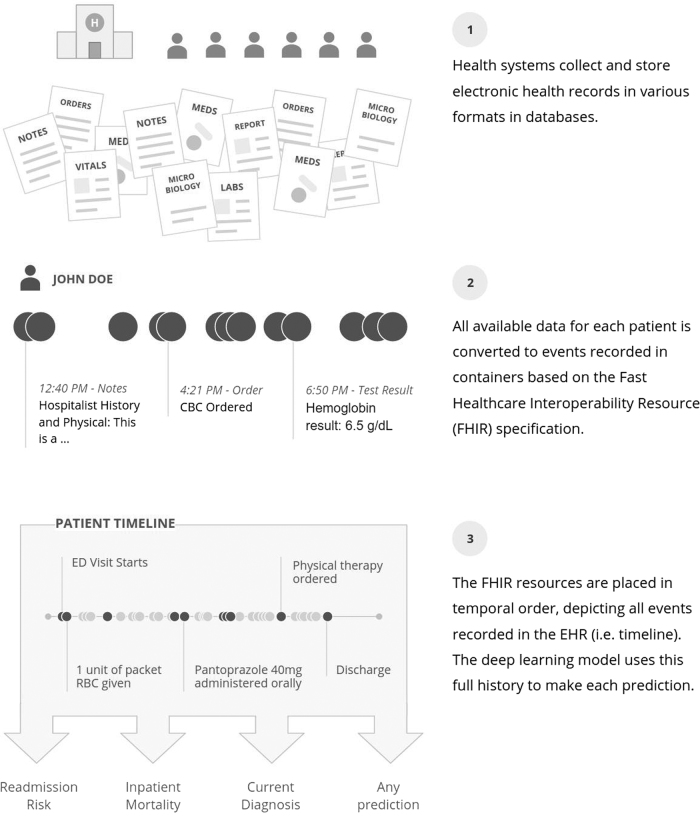
Predictive modeling with electronic health record (EHR) data is anticipated to drive personalized medicine and improve healthcare quality. Constructing predictive statistical models typically requires extraction of curated predictor variables from normalized EHR data, a labor-intensive process that discards the vast majority of information in each patient's record. We propose a representation of patients' entire raw EHR records based on the Fast Healthcare Interoperability Resources (FHIR) format. We demonstrate that deep learning methods using this representation are capable of accurately predicting multiple medical events from multiple centers without site-specific data harmonization. We validated our approach using de-identified EHR data from two US academic medical centers with 216,221 adult patients hospitalized for at least 24 h. In the sequential format we propose, this volume of EHR data unrolled into a total of 46,864,534,945 data points, including clinical notes. Deep learning models achieved high accuracy for tasks such as predicting: in-hospital mortality (area under the receiver operator curve [AUROC] across sites 0.93-0.94), 30-day unplanned readmission (AUROC 0.75-0.76), prolonged length of stay (AUROC 0.85-0.86), and all of a patient's final discharge diagnoses (frequency-weighted AUROC 0.90). These models outperformed traditional, clinically-used predictive models in all cases. We believe that this approach can be used to create accurate and scalable predictions for a variety of clinical scenarios. In a case study of a particular prediction, we demonstrate that neural networks can be used to identify relevant information from the patient's chart.
Overview
CoChat Summary
## TL;DR
This retrospective study shows that a single deep learning pipeline using raw EHR data in FHIR format can predict multiple outcomes across two academic hospitals without site-specific feature harmonization. The models outperformed traditional baselines for inpatient mortality, 30-day readmission, long length of stay, and discharge diagnosis prediction.
## Key findings
- The study included 216,221 hospitalizations from 114,003 unique patients; in-hospital death occurred in 2.3% (4,930/216,221), unplanned 30-day readmission in 12.9% (27,918/216,221), and long length of stay in 23.9%.
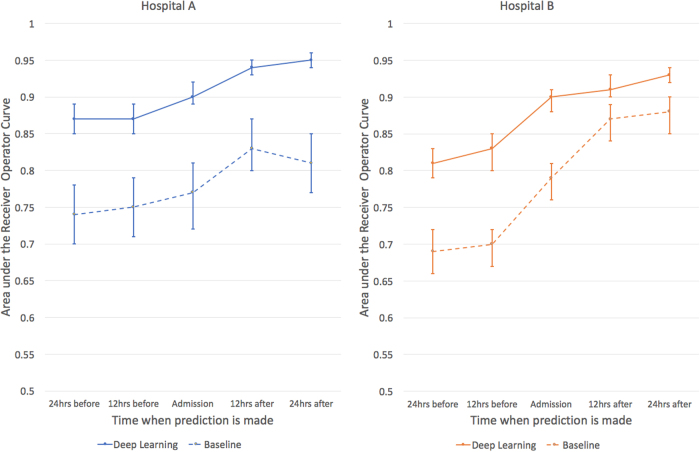
- For inpatient mortality at 24 h after admission, AUROC was 0.95 at Hospital A and 0.93 at Hospital B, versus 0.85 and 0.86 for the augmented Early Warning Score baseline.
- For 30-day readmission at discharge, AUROC was 0.77 at Hospital A and 0.76 at Hospital B, versus 0.70 and 0.68 for the modified HOSPITAL baseline; for long length of stay at 24 h, AUROC was 0.86 and 0.85, versus 0.76 and 0.74 for the modified Liu baseline.
- For predicting all discharge diagnoses (14,025 ICD-9 codes), weighted AUROC was 0.87/0.86 at admission and 0.90 at discharge for both hospitals; micro-F1 at discharge was 0.41 (Hospital A) and 0.40 (Hospital B).
## Methods
- Design: Retrospective study comparing deep learning models to traditional predictive models across two hospitals, with separate results reported for each site.
- Data/sample: De-identified EHR data from UCSF (2012–2016) and UCM (2009–2016), including adults 18+ with hospitalizations of 24 h or longer; UCM also included free-text notes.
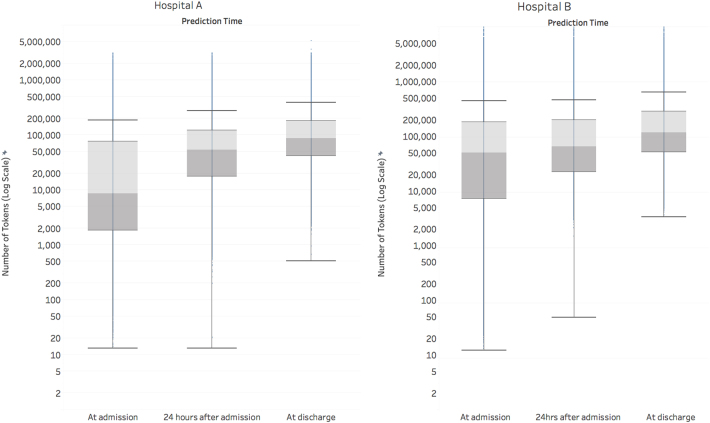
- Analysis: Raw EHR data were converted into time-ordered FHIR-based token sequences and used to train three model types (LSTM, attention-based TANN, and boosted time-based decision stumps), with outputs ensembled; data were split 80/10/10 into development/validation/test sets and evaluated using AUROC, calibration curves, work-up-to-detection ratio, and micro-F1.
## Limitations
- The authors state it is a retrospective study, with “all of the usual limitations.”
- They state that prospective trials are needed to show that accurate predictions improve care.
- They note their approach does not harmonize data between sites, limiting transfer to new sites/cohorts; they also say the methods are computationally intensive and require specialized expertise.
- Evident from the text: the study’s diagnosis task is restricted to ICD-9 codes, and the authors caution that AUROC differences between hospitals, especially regarding notes, cannot be attributed solely to notes because the cohorts differed.
Model-written summary. Check it against the paper before relying on it.
Integrity signals
Registry
Cites
Statistics
Figures
Verification
Claims the paper makes
7 Valid · 0 Not valid · 6 Not checked · 33 Own results and interpretations
The cited sources support only part of this claim — read each source’s verdict below.
In the paper
“We are not aware of a study that predicts as many ICD codes as this study, but our micro-F1 score exceeds that shown on the smaller MIMIC-III dataset when predicting fewer diagnoses (0.40 vs 0.28).68”
§ Scalable and accurate deep learning with electronic health records > Discussion
What the sources say
- Partly supportedcites [68] Perotte, A. et al. Diagnosis code assignment: models and evaluation metrics. J. Am. Med. Inform. Assoc. 21, 231–237 (2014). sourceExperimental — accuracy not yet measured
The Results > Prediction models section reports a 27.6% F-measure for the flat SVM, consistent with the cited 0.28 after rounding. But Materials and methods > Datasets identifies the dataset as MIMIC II, not MIMIC-III; the Results also report a higher 39.5% F-measure for this paper’s hierarchy-based model. No page numbers are available in our copy. (LLM, conf=0.89)
hedged- Asserted: passes — The authors put it forward as true.
- Checkable: passes — It can be checked against evidence.
- Load-bearing: passes — The paper’s conclusions depend on it.
- Based: passes — The paper gives a reason why it holds.
- Rests on an assumption not shown here.
- Partly supported
The cited sources support only part of this claim — read each source’s verdict below.
In the paper
“A major challenge in using more of the data available for each patient has been the lack of standards and semantic interoperability of health data from multiple sites.25”
§ Scalable and accurate deep learning with electronic health records > Introduction > Related work
What the sources say
- Partly supportedcites [25] Sun, H. et al. Semantic processing of EHR data for clinical research. J. Biomed. Inform. 58, 247–259 (2015). sourceExperimental — accuracy not yet measured
The Introduction (p.1) and Conclusion (Section 5) of our copy clearly support the semantic-interoperability half of the claim: 'the semantic interoperability between different standards remains a challenge', and 'there is no single standard that could serve as the interoperability hub for all the existing clinical data sources and clinical applications', with the Abstract framing the whole paper as responding to 'a growing need to semantically process and integrate clinical data from different sources for clinical research' (multi-site sources are illustrated in Section 4.1.1: a German hospital Oracle database and an Italian regional IHE QED registry). However, the claim's 'lack of standards' is not what this paper says: the Introduction states that standards such as HL7, openEHR and ISO 13606 HAVE been developed to tackle storage and exchange of clinical data, and the residual problem is interoperability AMONG them plus the absence of one unifying hub standard, not an absence of standards. The claim also generalises the source's specific concern (secondary use/reuse of EHR data for clinical research applications) to 'using more of the data available for each patient'. (LLM, conf=0.70)
plainstates a cause- Asserted: passes — The authors put it forward as true.
- Checkable: passes — It can be checked against evidence.
- Load-bearing: passes — The paper’s conclusions depend on it.
- Based: passes — The paper gives a reason why it holds.
- Partly supported
Every source the paper cites for this claim was checked and supports it.
In the paper
“In the current study, we caution that the differences in AUROC across the two hospitals (one with and one without notes) cannot be ascribed to the presence or absence of notes given the difference in cohorts.45”
§ Scalable and accurate deep learning with electronic health records > Discussion
What the sources say
- Supportedcites [45] Walsh, C. & Hripcsak, G. The effects of data sources, cohort selection, and outcome definition on a predictive model of risk of thirty-day hospital readmissions. J. Biomed. Inform. 52, 418–426 (2014). source
The Discussion states that cohort selection affects discriminatory performance and that comparing performance across studies requires the cohorts to be the same. This supports the citing authors’ caution against attributing their two hospitals’ AUROC difference to the presence or absence of notes when the cohorts also differ; the two-hospital comparison is their own study, not a result attributed to this source. (LLM, conf=0.90)
plain- Asserted: passes — The authors put it forward as true.
- Checkable: passes — It can be checked against evidence.
- Load-bearing: passes — The paper’s conclusions depend on it.
- Based: passes — The paper gives a reason why it holds.
- Supported
A result the paper reports from its own data — it cites no other source for it, so there is none to check. The quote shows it is in the paper.
In the paper
“For classifying all diagnosis codes, the weighted AUROCs at admission were 0.87 for Hospital A and 0.86 for Hospital B.”
§ Scalable and accurate deep learning with electronic health records > Results > Inferring discharge diagnoses
plain- Asserted: passes — The authors put it forward as true.
- Checkable: passes — It can be checked against evidence.
- Load-bearing: passes — The paper’s conclusions depend on it.
- Based: passes — The paper gives a reason why it holds.
- Rests on 2 assumptions not shown here.
A result the paper reports from its own data — it cites no other source for it, so there is none to check. The quote shows it is in the paper.
In the paper
“For predicting long length of stay, the AUROCs at 24 h after admission were 0.86 (95% CI 0.86–0.87) for Hospital A and 0.85 (95% CI 0.84–0.86) for Hospital B.”
§ Scalable and accurate deep learning with electronic health records > Results > Long length of stay
plain- Asserted: passes — The authors put it forward as true.
- Checkable: passes — It can be checked against evidence.
- Load-bearing: passes — The paper’s conclusions depend on it.
- Based: passes — The paper gives a reason why it holds.
- Rests on an assumption not shown here.
18 more claims
Create a free account to see all 46 claims and to verify the 2 references still open.
- It may state two separate claims as one. 16
- Probably not a substantial claim. 10
Claims other papers make about this one
Each is checked against this paper’s own text: does it say what the citing paper says it does?
The source backs part of the claim, not all of it — or backs it for a different population, condition or comparison.
In the citing paper
“The most important difference is that the study included co-morbidities, which have been proven to enable better predictions of disease progression trends and treatment outcomes.25,26”
From Development and validation of a screening tool for sepsis without laboratory results in the emergency department: a machine learning study (2025) · cites this paper as [26]
Experimental — accuracy not yet measuredThe source backs part of the claim, not all of it — or backs it for a different population, condition or comparison.
In the citing paper
“For both structured codes and unstructured notes, standardized vocabularies including FHIR [6] and UMLS CUIs [62,63] are introduced to transfer raw tokens into unique phrases to reduce the sparsity of the input data.”
From Deep representation learning of patient data from Electronic Health Records (EHR): A systematic review (2021) · cites this paper as [6]
Experimental — accuracy not yet measuredThe source backs part of the claim, not all of it — or backs it for a different population, condition or comparison.
In the citing paper
“Some FEMRs have tackled this problem by combining unstructured EHR data (i.e., text) with structured EMR data to boost performance on specific phenotyping and prediction tasks69,70.”
From The shaky foundations of large language models and foundation models for electronic health records (2023) · cites this paper as [69]
Experimental — accuracy not yet measuredThe cited source says what the claim attributes to it.
In the citing paper
“To improve performance and provide a degree of interpretability to the model, an attention mechanism is adopted in 13 studies [6,14,27,31,43,57,64,72,76–78,80,88].”
From Deep representation learning of patient data from Electronic Health Records (EHR): A systematic review (2021) · cites this paper as [6]
The cited source says what the claim attributes to it.
In the citing paper
“Advances in artificial intelligence (AI) are driving a revolution across science, enabling exciting new results across chemistry,80–82 biology,83,84 and medicine.85–88”
From Artificial Intelligence and Early Detection of Pancreatic Cancer: 2020 Summative Review (2021) · cites this paper as [85]
8 more claims about this paper
Create a free account to see every claim other papers make about this one.
Citations
Cites
Hochreiter, S., & Schmidhuber, J. (1997) · Neural Computation · doi:10.1162/neco.1997.9.8.1735 · Cited by 102,318 · cited 9×
“Patient records vary significantly in length and density of data-points (e.g. vital sign measurements in an intensive care unit vs outpatient clinic), so we formulated three deep learning neural-network model architectures that take advantage of such data in different ways: one based on recurrent neural networks (LSTM)…”
MethodInfluentialLeCun, Y., Bengio, Y., & Hinton, G. (2015) · Nature · doi:10.1038/nature14539 · Cited by 84,126
Scikit-learn: Machine Learning in Python
Pedregosa, F., Varoquaux, G., Gramfort, A., Michel, V., Thirion, B., Grisel, O., Blondel, M., Müller, A., Nothman, J., Louppe, G., et al. (2012) · arXiv · doi:10.48550/arxiv.1201.0490 · Cited by 71,016
APACHE II: A severity of disease classification system
KNAUS, W. A., DRAPER, E. A., WAGNER, D. P., & ZIMMERMAN, J. E. (1985) · Critical Care Medicine · doi:10.1097/00003246-198510000-00009 · Cited by 13,664
Representation Learning: A Review and New Perspectives
Bengio, Y., Courville, A., & Vincent, P. (2013) · IEEE Transactions on Pattern Analysis and Machine Intelligence · doi:10.1109/tpami.2013.50 · Cited by 13,001 · cited 1×
“Our central insight is that rather than explicitly harmonizing EHR data, mapping it into a highly curated set of structured predictors variables and then feeding those variables into a statistical model, we can instead learn to simultaneously harmonize inputs and predict medical events through direct feature learning…”
BackgroundMIMIC-III, a freely accessible critical care database
Johnson, A. E. W., Pollard, T. J., Shen, L., Lehman, L.-W. H., Feng, M., Ghassemi, M., Moody, B., Szolovits, P., Anthony Celi, L., & Mark, R. G. (2016) · Scientific Data · doi:10.1038/sdata.2016.35 · Cited by 8,141 · cited 1×
“ecord, which includes clinical free-text notes as well as large amounts of structured and semi-structured data. Because of the availability of Medical Information Mart for Intensive Care (MIMIC) data [48], many prior studies also have focused on ICU patients from a single center [92, 41]; other single-center studies h…”
MethodGulshan, V., Peng, L., Coram, M., Stumpe, M. C., Wu, D., Narayanaswamy, A., Venugopalan, S., Widner, K., Madams, T., Cuadros, J., et al. (2016) · JAMA · doi:10.1001/jama.2016.17216 · Cited by 7,697 · cited 1×
“Deep learning emerged as the preferred machine learning approach in machine perception problems ranging from computer vision to speech recognition, but has more recently proven useful in natural language processing, sequence prediction, and mixed modality data settings([36, 16, 21, 56]).”
BackgroundMandell, L. A., Wunderink, R. G., Anzueto, A., Bartlett, J. G., Campbell, G. D., Dean, N. C., Dowell, S. F., File, T. M., Musher, D. M., Niederman, M. S., et al. (2007) · Clinical Infectious Diseases · doi:10.1086/511159 · Cited by 6,202 · cited 1×
“of only 27 variables, rely on traditional generalized linear models, and are built using data at a single center. In clinical practice, simpler models are most commonly deployed, such as the CURB-65 [68, 60], which is a 5-factor model, or single-parameter warning scores [20, 45]. A major challenge in using more of the…”
MethodAPACHE II: a severity of disease classification system.
Knaus, W. A., Draper, E. S., Wagner, D. P., & Zimmerman, J. E. (1985) · PubMed · Cited by 6,034
Predicting the future - big data, machine learning, and clinical medicine
Obermeyer, Z., & Emanuel, E. J. (2016) · New England Journal of Medicine · doi:10.1056/nejmp1606181 · Cited by 3,652 · cited 1×
“In our case study, the model identified elements of the patient’s history and radiology findings to render its prediction, which are critical data-points that a clinician would also use [41].”
MethodDeViSE: A Deep Visual-Semantic Embedding Model
Frome, A., Corrado, G. S., Shlens, J., Bengio, S., Dean, J., Ranzato, M., & Mikolov, T. (2013) · neural information processing systems · Cited by 3,134
Self-citationRokach, L. (2010) · Artificial Intelligence Review · doi:10.1007/s10462-009-9124-7 · Cited by 2,657 · cited 1×
“To optimize model accuracy, our final model is an ensemble of predictions from the three underlying model architectures [46].”
MethodMiotto, R., Li, L., Kidd, B. A., & Dudley, J. T. (2016) · Scientific Reports · doi:10.1038/srep26094 · Cited by 1,710 · cited 1×
“In a wellknown work, investigators used auto-encoders to predict a specific set of diagnoses.(29) Subsequent work extended this approach by modeling the temporal sequence of events that occurred in a patient’s record, which may enhance accuracy in scenarios that depend on the order of events, with convolutional and re…”
MethodRisk Prediction Models for Hospital Readmission: A Systematic Review
Kansagara, D., Englander, H., Salanitro, A., Kagen, D., Theobald, C., Freeman, M., & Kripalani, S. (2011) · JAMA · doi:10.1001/jama.2011.1515 · Cited by 1,707 · cited 1×
“The primary endpoints for those predictions were at discharge, when most readmission prediction scores are computed and when all information necessary to assign billing diagnoses is available [28].”
BackgroundShickel, B., Tighe, P. J., Bihorac, A., & Rashidi, P. (2018) · IEEE Journal of Biomedical and Health Informatics · doi:10.1109/jbhi.2017.2767063 · Cited by 1,688 · cited 1×
“Given rapid developments in this field, we point readers to a recent, comprehensive review [88].”
BackgroundIntelligible Models for HealthCare: Predicting Pneumonia Risk and Hospital 30-day Readmission
Caruana, R., Lou, Y., Gehrke, J., Koch, P., Sturm, M., & Elhadad, N. (2015) · Proceedings of the 21th ACM SIGKDD International Conference on Knowledge Discovery and Data Mining · doi:10.1145/2783258.2788613 · Cited by 1,685
The Braden Scale for Predicting Pressure Sore Risk
BERGSTROM, N., BRADEN, B. J., LAGUZZA, A., & HOLMAN, V. (1987) · Nursing Research · doi:10.1097/00006199-198707000-00002 · Cited by 1,415 · cited 1×
“( Bergstrom et al. 1987) The model also placed high weights on concepts such as “pleurx,” the trade-name for a small chest tube.”
BackgroundBates, D. W., Kuperman, G. J., Wang, S., Gandhi, T., Kittler, A., Volk, L., Spurr, C., Khorasani, R., Tanasijevic, M., & Middleton, B. (2003) · Journal of the American Medical Informatics Association · doi:10.1197/jamia.m1370 · Cited by 1,346
Big Data In Health Care: Using Analytics To Identify And Manage High-Risk And High-Cost Patients
Bates, D. W., Saria, S., Ohno-Machado, L., Shah, A., & Escobar, G. (2014) · Health Affairs · doi:10.1377/hlthaff.2014.0041 · Cited by 1,235 · cited 2×
“It is widely suspected that use such efforts, if successful, could provide major benefits not only for patient safety and quality but also in reducing health care costs [4, 33, 26, 42].”
BackgroundSystemic Inflammatory Response Syndrome Criteria in Defining Severe Sepsis
Kaukonen, K.-M., Bailey, M., Pilcher, D., Cooper, D. J., & Bellomo, R. (2015) · New England Journal of Medicine · doi:10.1056/nejmoa1415236 · Cited by 1,166 · cited 1×
“False-negative predictions can miss significant numbers of clinically important events, leading to poor clinical outcomes [29].”
BackgroundPrecision Medicine — Personalized, Problematic, and Promising
Jameson, J. L., & Longo, D. L. (2015) · New England Journal of Medicine · doi:10.1056/nejmsb1503104 · Cited by 1,106
Smith, G. B., Prytherch, D. R., Meredith, P., Schmidt, P. E., & Featherstone, P. I. (2013) · Resuscitation · doi:10.1016/j.resuscitation.2012.12.016 · Cited by 1,077 · cited 3×
“For mortality, we used a logistic model with variables inspired by NEWS [50] score but added additional variables to make it more accurate, including the most recent systolic blood pressure, heart rate, respiratory rate, temperature, and we used 24 common lab tests, like the white-blood cell count, lactate, and creati…”
MethodUnintended consequences of machine learning in medicine
Cabitza, F., Rasoini, R., & Gensini, G. F. (2017) · JAMA · doi:10.1001/jama.2017.7797 · Cited by 1,066
van Walraven, C., Dhalla, I. A., Bell, C., Etchells, E., Stiell, I. G., Zarnke, K., Austin, P. C., & Forster, A. J. (2010) · Canadian Medical Association Journal · doi:10.1503/cmaj.091117 · Cited by 960 · cited 1×
“Inpatient mortality We predicted impending inpatient death, defined as a discharge disposition of “expired” [52, 30, 54, 57].”
BackgroundMultitask learning and benchmarking with clinical time series data
Harutyunyan, H., Khachatrian, H., Kale, D. C., Ver Steeg, G., & Galstyan, A. (2019) · Scientific Data · doi:10.1038/s41597-019-0103-9 · Cited by 958 · cited 1×
“tured and semi-structured data. Because of the availability of Medical Information Mart for Intensive Care (MIMIC) data [48], many prior studies also have focused on ICU patients from a single center [92, 41]; other single-center studies have also focused on ICU patients [61]. Each ICU patient has significantly more da…”
ResultGoldstein, B. A., Navar, A. M., Pencina, M. J., & Ioannidis, J. P. A. (2017) · Journal of the American Medical Informatics Association · doi:10.1093/jamia/ocw042 · Cited by 936 · cited 3×
“In spite of the richness and potential of available data, scaling the development of predictive models is difficult because, for traditional predictive modeling techniques, each outcome to be predicted requires the creation of a custom dataset with specific variables [17].”
BackgroundInfluentialKramer, A. A., & Zimmerman, J. E. (2007) · Critical Care Medicine · doi:10.1097/01.ccm.0000275267.64078.b0 · Cited by 886
Learning to Diagnose with LSTM Recurrent Neural Networks
Lipton, Z. C., Kale, D. C., Elkan, C., & Wetzel, R. (2015) · arXiv · doi:10.48550/arxiv.1511.03677 · Cited by 879
SMART on FHIR: a standards-based, interoperable apps platform for electronic health records
Mandel, J. C., Kreda, D. A., Mandl, K. D., Kohane, I. S., & Ramoni, R. B. (2016) · Journal of the American Medical Informatics Association · doi:10.1093/jamia/ocv189 · Cited by 829
Churpek, M. M., Yuen, T. C., Winslow, C., Meltzer, D. O., Kattan, M. W., & Edelson, D. P. (2016) · Critical Care Medicine · doi:10.1097/ccm.0000000000001571 · Cited by 638 · cited 1×
“unexpected readmission (0.75-0.76 vs 0.69)[71] and increased length of stay (0.85-0.86 vs 0.77) [62]. Direct comparisons to other studies are difficult [98] because of different underlying study designs [52, 29, 97, 103, 77, 21, 80, 89, 53, 14, 84, 31, 104, 87, 96] incomplete definitions of cohorts and outcomes[19, 15], r…”
ResultInfluentialKrumholz, H. M. (2014) · Health Affairs · doi:10.1377/hlthaff.2014.0053 · Cited by 589 · cited 1×
“It is widely suspected that use such efforts, if successful, could provide major benefits not only for patient safety and quality but also in reducing health care costs [4, 33, 26, 42].”
Background(2016) · PubMed · Cited by 576
Donzé, J., Aujesky, D., Williams, D., & Schnipper, J. L. (2013) · JAMA Internal Medicine · doi:10.1001/jamainternmed.2013.3023 · Cited by 553 · cited 5×
“We refer to this as the mHOSPITAL score.”
MethodInfluentialMedical Records That Guide and Teach
Weed, L. L. (1968) · New England Journal of Medicine · doi:10.1056/nejm196803212781204 · Cited by 455
Improving palliative care with deep learning
Avati, A., Jung, K., Harman, S., Downing, L., Ng, A., & Shah, N. H. (2017) · 2017 IEEE International Conference on Bioinformatics and Biomedicine (BIBM) · doi:10.1109/bibm.2017.8217669 · Cited by 439
Self-citationDrew, B. J., Harris, P., Zègre-Hemsey, J. K., Mammone, T., Schindler, D., Salas-Boni, R., Bai, Y., Tinoco, A., Ding, Q., & Hu, X. (2014) · PLoS ONE · doi:10.1371/journal.pone.0110274 · Cited by 438 · cited 1×
“This is problematic because the resulting models may produce imprecise predictions: false-positive predictions can overwhelm physicians, nurses, and other providers with false alarms and subsequent alert fatigue [14], which the Joint Commission identified as a national patient safety priority in 2014 [10].”
BackgroundPosthospital Care Transitions: Patterns, Complications, and Risk Identification
Coleman, E. A., Min, S., Chomiak, A., & Kramer, A. M. (2004) · Health Services Research · doi:10.1111/j.1475-6773.2004.00298.x · Cited by 416
Newton, K. M., Peissig, P. L., Kho, A. N., Bielinski, S. J., Berg, R. L., Choudhary, V., Basford, M., Chute, C. G., Kullo, I. J., Li, R., et al. (2013) · Journal of the American Medical Informatics Association · doi:10.1136/amiajnl-2012-000896 · Cited by 411
Evaluating Discrimination of Risk Prediction Models: The C Statistic
Pencina, M. J., & D’Agostino, R. B. (2015) · JAMA · doi:10.1001/jama.2015.11082 · Cited by 386 · cited 1×
“We assessed model discrimination by calculating AUROC and model calibration using comparisons of predicted and empirical probability curves.(85) We did not use the Hosmer–Lemeshow test as it may be misleadingly significant with large sample sizes.”
MethodEscobar, G. J., Greene, J. D., Scheirer, P., Gardner, M. N., Draper, D., & Kipnis, P. (2008) · Medical Care · doi:10.1097/mlr.0b013e3181589bb6 · Cited by 316 · cited 1×
“unexpected readmission (0.75-0.76 vs 0.69)[71] and increased length of stay (0.85-0.86 vs 0.77) [62]. Direct comparisons to other studies are difficult [98] because of different underlying study designs [52, 29, 97, 103, 77, 21, 80, 89, 53, 14, 84, 31, 104, 87, 96] incomplete definitions of cohorts and outcomes[19, 15], r…”
ResultInfluentialElectronic Health Record Adoption In US Hospitals: Progress Continues, But Challenges Persist
Adler-Milstein, J., DesRoches, C. M., Kralovec, P., Foster, G., Worzala, C., Charles, D., Searcy, T., & Jha, A. K. (2015) · Health Affairs · doi:10.1377/hlthaff.2015.0992 · Cited by 310 · cited 2×
“Despite the rich data now digitized in EHRs [3], a recent systematic review of the medical literature [34] found that predictive models built with EHR data use a median of only 27 variables, rely on traditional generalized linear models, and are built using data at a single center.”
BackgroundMethodA comparison of models for predicting early hospital readmissions
Futoma, J., Morris, J., & Lucas, J. (2015) · Journal of Biomedical Informatics · doi:10.1016/j.jbi.2015.05.016 · Cited by 283 · cited 1×
“, 89, 53, 14, 84, 31, 104, 87, 96] incomplete definitions of cohorts and outcomes[19, 15], restrictions on disease-specific cohorts [19, 15, 95, 10, 101, 23, 37] or use of data unavailable in real-time [23, 42, 33]. Therefore, we implemented baselines based on the HOSPITAL score [25], NEWS [89] score, and Liu’s model [6…”
MethodDiagnosis code assignment: models and evaluation metrics
Perotte, A., Pivovarov, R., Natarajan, K., Weiskopf, N., Wood, F., & Elhadad, N. (2014) · Journal of the American Medical Informatics Association · doi:10.1136/amiajnl-2013-002159 · Cited by 244 · cited 1×
“multiple diagnoses), for our model is higher than that reported in the literature in an ICU data-set with fewer diagnoses [44].”
ResultRothman, M. J., Rothman, S. I., & Beals, J. (2013) · Journal of Biomedical Informatics · doi:10.1016/j.jbi.2013.06.011 · Cited by 233 · cited 1×
“Direct comparisons to other studies are difficult [98] because of different underlying study designs [52, 29, 97, 103, 77, 21, 80, 89, 53, 14, 84, 31, 104, 87, 96] incomplete definitions of cohorts and outcomes[19, 15], restrictions on disease-specific cohorts [19, 15, 95, 10, 101, 23, 37] or use of…”
ResultShams, I., Ajorlou, S., & Yang, K. (2014) · Health Care Management Science · doi:10.1007/s10729-014-9278-y · Cited by 186
Integrating Predictive Analytics Into High-Value Care: The Dawn of Precision Delivery
Parikh, R. B., Kakad, M., & Bates, D. W. (2016) · JAMA · doi:10.1001/jama.2015.19417 · Cited by 168
Why the C-statistic is not informative to evaluate early warning scores and what metrics to use
Romero-Brufau, S., Huddleston, J. M., Escobar, G. J., & Liebow, M. (2015) · Critical Care · doi:10.1186/s13054-015-0999-1 · Cited by 144
Finlay, G. D., Rothman, M. J., & Smith, R. A. (2014) · Journal of Hospital Medicine · doi:10.1002/jhm.2132 · Cited by 119 · cited 1×
“Direct comparisons to other studies are difficult [98] because of different underlying study designs [52, 29, 97, 103, 77, 21, 80, 89, 53, 14, 84, 31, 104, 87, 96] incomplete definitions of cohorts and outcomes[19, 15], restrictions on disease-specific cohorts [19, 15, 95, 10, 101, 23, 37] or use of data unavailable i…”
ResultSustained effectiveness of a primary-team–based rapid response system*
Howell, M. D., Ngo, L., Folcarelli, P., Yang, J., Mottley, L., Marcantonio, E. R., Sands, K. E., Moorman, D., & Aronson, M. D. (2012) · Critical Care Medicine · doi:10.1097/ccm.0b013e318259007b · Cited by 107 · cited 1×
“In clinical practice, simpler models are most commonly deployed, such as the CURB-65 [68, 60], which is a 5-factor model, or single-parameter warning scores [20, 45].”
MethodSelf-citationTabak, Y. P., Sun, X., Nunez, C. M., & Johannes, R. S. (2014) · Journal of the American Medical Informatics Association · doi:10.1136/amiajnl-2013-001790 · Cited by 107 · cited 1×
“Inpatient mortality We predicted impending inpatient death, defined as a discharge disposition of “expired” [52, 30, 54, 57].”
BackgroundGrumbach, K., Lucey, C. R., & Johnston, S. C. (2014) · JAMA · doi:10.1001/jama.2014.705 · Cited by 106 · cited 1×
“Second, although it is widely believed that accurate predictions can be used to improve care [4], this is not a foregone conclusion and prospective trials are needed to demonstrate this [34, 20].”
BackgroundKellett, J. G., & Kim, A. (2011) · Resuscitation · doi:10.1016/j.resuscitation.2011.08.022 · Cited by 103 · cited 1×
“Inpatient mortality We predicted impending inpatient death, defined as a discharge disposition of “expired” [52, 30, 54, 57].”
BackgroundMining high-dimensional administrative claims data to predict early hospital readmissions
He, D., Mathews, S. C., Kalloo, A. N., & Hutfless, S. (2014) · Journal of the American Medical Informatics Association · doi:10.1136/amiajnl-2013-002151 · Cited by 93 · cited 1×
“, 89, 53, 14, 84, 31, 104, 87, 96] incomplete definitions of cohorts and outcomes[19, 15], restrictions on disease-specific cohorts [19, 15, 95, 10, 101, 23, 37] or use of data unavailable in real-time [23, 42, 33]. Therefore, we implemented baselines based on the HOSPITAL score [25], NEWS [89] score, and Liu’s model [6…”
MethodLiu, V., Kipnis, P., Gould, M. K., & Escobar, G. J. (2010) · Medical Care · doi:10.1097/mlr.0b013e3181e359f3 · Cited by 87 · cited 6×
“For long length of stay, we used a logistic model with variables similar to those used by Liu [62]: the age, gender, Hierarchical Condition Categories, admission source, hospital service, and the same 24 common lab tests used in the aEWS score.”
MethodInfluentialRisk Factors for Unplanned Hospital Readmission in Otolaryngology Patients
Graboyes, E. M., Liou, T., Kallogjeri, D., Nussenbaum, B. A., & Diaz, J. A. (2013) · Otolaryngology · doi:10.1177/0194599813500023 · Cited by 84
Nguyen, O. K., Makam, A. N., Clark, C., Zhang, S., Xie, B., Velasco, F., Amarasingham, R., & Halm, E. A. (2016) · Journal of Hospital Medicine · doi:10.1002/jhm.2568 · Cited by 76 · cited 1×
“, than did traditional models. To the best of our knowledge, our models outperform existing EHR literature for predicting mortality (0.92-0.94 vs 0.91), [93] unexpected readmission (0.75-0.76 vs 0.69)[71] and increased length of stay (0.85-0.86 vs 0.77) [62]. Direct comparisons to other studies are difficult [98] becaus…”
ResultInfluentialEscobar, G. J., Ragins, A., Scheirer, P., Liu, V., Robles, J., & Kipnis, P. (2015) · Medical Care · doi:10.1097/mlr.0000000000000435 · Cited by 76
Walsh, C., & Hripcsak, G. (2014) · Journal of Biomedical Informatics · doi:10.1016/j.jbi.2014.08.006 · Cited by 75
Halamka, J. D., & Tripathi, M. (2017) · New England Journal of Medicine · doi:10.1056/nejmp1709851 · Cited by 74 · cited 1×
“Future research is needed to determine how models trained at one site can be best applied to another site, [22] which would be especially useful for sites with limited historical data to train a model with.”
BackgroundPredictive model of readmission to internal medicine wards
Zapatero, A., Barba, R., Marco, J. P., Hinojosa, J., Plaza, S., Losa, J. E., & Canora, J. (2012) · European Journal of Internal Medicine · doi:10.1016/j.ejim.2012.01.005 · Cited by 71
Choudhry, S. A., Li, J., Davis, D., Erdmann, C., Sikka, R., & Sutariya, B. (2013) · Online Journal of Public Health Informatics · doi:10.5210/ojphi.v5i2.4726 · Cited by 69 · cited 1×
“comparisons to other studies are difficult [98] because of different underlying study designs [52, 29, 97, 103, 77, 21, 80, 89, 53, 14, 84, 31, 104, 87, 96] incomplete definitions of cohorts and outcomes[19, 15], restrictions on disease-specific cohorts [19, 15, 95, 10, 101, 23, 37] or use of data unavailable in real-time…”
MethodData Acquisition, Curation, and Use for a Continuously Learning Health System
Krumholz, H. M., Terry, S. F., & Waldstreicher, J. (2016) · JAMA · doi:10.1001/jama.2016.12537 · Cited by 66 · cited 1×
“limitations. Second, although it is widely believed that accurate predictions can be used to improve care [7], this is not a foregone conclusion and prospective trials are needed to demonstrate this [57, 38]. Third, a necessary implication of personalized predictions is that they leverage many small data points specifi…”
BackgroundFunctional status before and during acute hospitalization and readmission risk identification
Tonkikh, O., Shadmi, E., Flaks‐Manov, N., Hoshen, M., Balicer, R. D., & Zisberg, A. (2016) · Journal of Hospital Medicine · doi:10.1002/jhm.2595 · Cited by 63
Whitlock, T. L., Tignor, A. S., Webster, E., Repas, K. A., Conwell, D. L., Banks, P. A., & Wu, B. U. (2010) · Clinical Gastroenterology and Hepatology · doi:10.1016/j.cgh.2010.08.017 · Cited by 57 · cited 1×
“ause of different underlying study designs [52, 29, 97, 103, 77, 21, 80, 89, 53, 14, 84, 31, 104, 87, 96] incomplete definitions of cohorts and outcomes[19, 15], restrictions on disease-specific cohorts [19, 15, 95, 10, 101, 23, 37] or use of data unavailable in real-time [23, 42, 33]. Therefore, we implemented baselines…”
MethodSemantic processing of EHR data for clinical research
Sun, H., Depraetere, K., De Roo, J., Mels, G., De Vloed, B., Twagirumukiza, M., & Colaert, D. (2015) · Journal of Biomedical Informatics · doi:10.1016/j.jbi.2015.10.009 · Cited by 56
Betihavas, V., Frost, S. A., Newton, P. J., Macdonald, P. S., Stewart, S., Carrington, M. J., Chan, Y., & Davidson, P. M. (2015) · Heart Lung and Circulation · doi:10.1016/j.hlc.2015.04.168 · Cited by 51 · cited 1×
“…difficult [98] because of different underlying study designs [52, 29, 97, 103, 77, 21, 80, 89, 53, 14, 84, 31, 104, 87, 96] incomplete definitions of cohorts and outcomes[19, 15], restrictions on disease-specific cohorts [19, 15, 95, 10, 101, 23, 37] or use of data unavailable in real-time [23, 42, 33].”
BackgroundRedesigning Hospital Alarms for Patient Safety: Alarmed and Potentially Dangerous
Chopra, V., & McMahon, L. F. (2014) · JAMA · doi:10.1001/jama.2014.710 · Cited by 45 · cited 1×
“This is problematic because the resulting models may produce imprecise predictions: false-positive predictions can overwhelm physicians, nurses, and other providers with false alarms and subsequent alert fatigue [14], which the Joint Commission identified as a national patient safety priority in 2014 [10].”
BackgroundBeyond Genes and Molecules — A Precision Delivery Initiative for Precision Medicine
Parikh, R. B., Schwartz, J. S., & Navathe, A. S. (2017) · New England Journal of Medicine · doi:10.1056/nejmp1613224 · Cited by 42 · cited 1×
“It is widely suspected that use such efforts, if successful, could provide major benefits not only for patient safety and quality but also in reducing health care costs [4, 33, 26, 42].”
BackgroundReal-Time Automated Sampling of Electronic Medical Records Predicts Hospital Mortality
Khurana, H. S., Groves, R. H., Simons, M. P., Martin, M. J., Stoffer, B., Kou, S., Gerkin, R. D., Reiman, E. M., & Parthasarathy, S. (2016) · The American Journal of Medicine · doi:10.1016/j.amjmed.2016.02.037 · Cited by 31 · cited 1×
“unexpected readmission (0.75-0.76 vs 0.69)[71] and increased length of stay (0.85-0.86 vs 0.77) [62]. Direct comparisons to other studies are difficult [98] because of different underlying study designs [52, 29, 97, 103, 77, 21, 80, 89, 53, 14, 84, 31, 104, 87, 96] incomplete definitions of cohorts and outcomes[19, 15], r…”
ResultInfluentialTsui, E. L. H., Au, S., Wong, C., Cheung, A., & Lam, P. K. W. (2013) · Health Informatics Journal · doi:10.1177/1460458213501095 · Cited by 27 · cited 1×
“unexpected readmission (0.75-0.76 vs 0.69)[71] and increased length of stay (0.85-0.86 vs 0.77) [62]. Direct comparisons to other studies are difficult [98] because of different underlying study designs [52, 29, 97, 103, 77, 21, 80, 89, 53, 14, 84, 31, 104, 87, 96] incomplete definitions of cohorts and outcomes[19, 15], r…”
ResultInfluentialPine, M. B., Jordan, H. S., Elixhauser, A., et al. (2008) · Medical Decision Making · doi:10.1177/0272989x08323297 · Cited by 25 · cited 1×
“Direct comparisons to other studies are difficult [98] because of different underlying study designs [52, 29, 97, 103, 77, 21, 80, 89, 53, 14, 84, 31, 104, 87, 96] incomplete definitions of cohorts and outcomes[19, 15], restrictions on disease-specific cohorts [19, 15, 95, 10, 101, 23, 37] or use of data unavailable i…”
ResultYamana, H., Matsui, H., Fushimi, K., & Yasunaga, H. (2015) · BMC Health Services Research · doi:10.1186/s12913-015-0889-x · Cited by 22 · cited 1×
“Inpatient mortality We predicted impending inpatient death, defined as a discharge disposition of “expired” [52, 30, 54, 57].”
BackgroundLim, W. S., Smith, D. L., Wise, M. P., et al. (2015) · BMJ Open Respiratory Research · doi:10.1136/bmjresp-2015-000091 · Cited by 22 · cited 1×
“In clinical practice, simpler models are most commonly deployed, such as the CURB-65 [68, 60], which is a 5-factor model, or single-parameter warning scores [20, 45].”
Method
Research works printed but not linked: 6
- Dai, A. M. & Le, Q. V. Semi-supervised sequence learning. In Advances in Neural Information Processing Systems 28 (eds Cortes, C., Lawrence, N. D., Lee, D. D., Sugiyama, M. & Garnett, R.), pp 3079–3087 (Curran Associates, Inc. Red Hook, NY, 2015).
- Aczon, M. et al. Dynamic mortality risk predictions in pediatric critical care using recurrent neural networks. arXiv [stat.ML] (2017).
- Suresh, H. et al. Clinical intervention prediction and understanding using deep networks. arXiv [cs.LG] (PMLR, Los Angeles, CA, USA, 2017).
- Razavian, N., Marcus, J. & Sontag, D. Multi-task prediction of disease onsets from longitudinal laboratory tests. In Proceedings of the 1st Machine Learning for Healthcare Conference, (eds F. Doshi-Velez, J. Fackler, D. Kale and B. Wallace, J. Wiens) Vol. 56, pp 73–100 (PMLR, Los Angeles, CA, 2016).
- Che, Z., Purushotham, S., Cho, K., Sontag, D. & Liu, Y. Recurrent neural networks for multivariate time series with missing values. arXiv [cs.LG] (2016).
- Bahdanau, D., Cho, K. & Bengio, Y. Neural machine translation by jointly learning to align and translate. arXiv [cs.CL] (2014).
Cited by
High-performance medicine: the convergence of human and artificial intelligence
Topol, E. J. (2019) · Nature Medicine · doi:10.1038/s41591-018-0300-7 · Cited by 10,450
A guide to deep learning in healthcare
Esteva, A., Robicquet, A., Ramsundar, B., Kuleshov, V., DePristo, M., Chou, K., Cui, C., Corrado, G., Thrun, S., & Dean, J. (2019) · Nature Medicine · doi:10.1038/s41591-018-0316-z · Cited by 5,312
“Here, large-scale RNNs are beginning to demonstrate impressive predictive results by combining structured and unstructured data in a semisupervised way 33 .”
BackgroundMethodSelf-citationRajkomar, A., Dean, J., & Kohane, I. (2019) · New England Journal of Medicine · doi:10.1056/nejmra1814259 · Cited by 4,579
Self-citationThe potential for artificial intelligence in healthcare
Davenport, T., & Kalakota, R. (2019) · Future Healthcare Journal · doi:10.7861/futurehosp.6-2-94 · Cited by 3,800
“To our knowledge thus far there have been no jobs eliminated and EHR systems, have been somewhat responsible for the lack of job impact.”
Deep learning for time series classification: a review
Ismail Fawaz, H., Forestier, G., Weber, J., Idoumghar, L., & Muller, P.-A. (2019) · Data Mining and Knowledge Discovery · doi:10.1007/s10618-019-00619-1 · Cited by 3,342
Metadata
- Authors
- Rajkomar, A., Oren, E., Chen, K., Dai, A. M., Hajaj, N., Hardt, M., Liu, P. J., Liu, X., Marcus, J., Sun, M., Sundberg, P., Yee, H., Zhang, K., Zhang, Y., Flores, G., Duggan, G. E., Irvine, J., Le, Q., Litsch, K., Mossin, A., Tansuwan, J., Wang, D., Wexler, J., Wilson, J., Ludwig, D., Volchenboum, S. L., Chou, K., Pearson, M., Madabushi, S., Shah, N. H., Butte, A. J., Howell, M. D., Cui, C., Corrado, G. S., & Dean, J.
- Affiliations
- Google (United States) (US)
- University of California, San Francisco (US)
- University of Chicago (US)
- Stanford University (US)
- Corresponding author
- Rajkomar, Alvin
- Venue
- npj Digital Medicine
- Published
- 2018-05-08
- Volume
- 1
- Issue
- 1
- Pages
- 18-18
- ISSN
- 2398-6352 (ISSN-L)
- PMC
- PMC6550175
- OpenAlex
- W2784499877
- Cited by
- 2,648
- References
- 72
- Citations by year
- 2026: 494 · 2025: 457 · 2024: 370 · 2023: 280 · 2022: 228 · 2021: 304 · 2020: 275 · 2019: 186 · 2018: 54
- FWCI
- 115.37
- Type
- journal article
- Language
- en
- Open access
- gold
- doi.org
- Licence
- cc-by
- creativecommons.org/licenses/by/4.0 (tdm)
- creativecommons.org/licenses/by/4.0 (vor)
- Locations
- npj Digital Medicine (publishedVersion, cc-by)
- arXiv (Cornell University) (publishedVersion)
- Europe PMC (PubMed Central) (publishedVersion, cc-by)
- PubMed Central (publishedVersion, cc-by)
- PubMed (publishedVersion)
- DOAJ (DOAJ: Directory of Open Access Journals) (submittedVersion, cc-by-sa)
- eScholarship (California Digital Library) (submittedVersion, cc-by)
- arXiv (Cornell University)
- Topics
- Physical Sciences › Computer Science › Artificial Intelligence › Machine Learning in Healthcare
- Health Sciences › Health Professions › Health Information Management › Electronic Health Records Systems
- Health Sciences › Health Professions › Health Information Management › Artificial Intelligence in Healthcare
- Keywords
- electronic health records, FHIR, deep learning, in-hospital mortality prediction, unplanned hospital readmission, length of hospital stay, hospital discharge diagnoses, clinical notes, data harmonization
About these checks
Registry, retraction, Cites and statistics results are computed, not judged, with one exception: a printed reference that no index lists is read once by a model before it counts as a citation error. Claims are extracted by a model and kept only when their quote appears verbatim in the text; each cited source is then checked, with a model’s help, for whether it says what the claim relies on. Those verdicts can be wrong — read the claim’s quote and the cited source before relying on one.
The claim verdicts this report counts are experimental: their accuracy is not yet measured.
A language model drew the claims from the paper on 2026-10-10, under version 3 of the claim definition (model deepseek-v4.1-flash, prompt extract-v3).
A second model labelled each claim on 2026-10-10 (model jev-1.13-20260917, definition revision gold-guideline-v0.2).
Cited sources are checked with a language model’s help (gpt-6-sol and qwen3.8-omni-flash).
Statistics and arithmetic are recomputed, not judged.
Confidence bands are shown only for fields calibrated on our annotated test set. None is calibrated yet, so no band is shown.
What counts as a claim ›How we measure confidence ›How we check this ›
Are you an author, or do you see a problem with this page? Request a review
Data sources
Bibliographic data: Semantic Scholar, OpenAlex, Crossref.
Contains information from the Semantic Scholar Academic Graph Datasets, made available under the ODC Attribution License (ODC-BY 1.0).
Semantic Scholar’s data is described in: Kinney, R., et al. (2023). The Semantic Scholar Open Data Platform. arXiv:2301.10140.
