

Scalable and accurate deep learning with electronic health records
Open accessThe DOI matches its Crossref record; 75 of the 75 references it cites were found in a registry or an index; 8 of the 19 sources its claims cite were checked for support.
Abstract
Predictive modeling with electronic health record (EHR) data is anticipated to drive personalized medicine and improve healthcare quality. Constructing predictive statistical models typically requires extraction of curated predictor variables from normalized EHR data, a labor-intensive process that discards the vast majority of information in each patient's record. We propose a representation of patients' entire raw EHR records based on the Fast Healthcare Interoperability Resources (FHIR) format. We demonstrate that deep learning methods using this representation are capable of accurately predicting multiple medical events from multiple centers without site-specific data harmonization. We validated our approach using de-identified EHR data from two US academic medical centers with 216,221 adult patients hospitalized for at least 24 h. In the sequential format we propose, this volume of EHR data unrolled into a total of 46,864,534,945 data points, including clinical notes. Deep learning models achieved high accuracy for tasks such as predicting: in-hospital mortality (area under the receiver operator curve [AUROC] across sites 0.93-0.94), 30-day unplanned readmission (AUROC 0.75-0.76), prolonged length of stay (AUROC 0.85-0.86), and all of a patient's final discharge diagnoses (frequency-weighted AUROC 0.90). These models outperformed traditional, clinically-used predictive models in all cases. We believe that this approach can be used to create accurate and scalable predictions for a variety of clinical scenarios. In a case study of a particular prediction, we demonstrate that neural networks can be used to identify relevant information from the patient's chart.
Overview
CoChat Summary
## TL;DR
This retrospective study shows that a single deep learning pipeline using raw EHR data in FHIR format can predict multiple outcomes across two academic hospitals without site-specific feature harmonization. The models outperformed traditional baselines for inpatient mortality, 30-day readmission, long length of stay, and discharge diagnosis prediction.
## Key findings
- The study included 216,221 hospitalizations from 114,003 unique patients; in-hospital death occurred in 2.3% (4,930/216,221), unplanned 30-day readmission in 12.9% (27,918/216,221), and long length of stay in 23.9%.
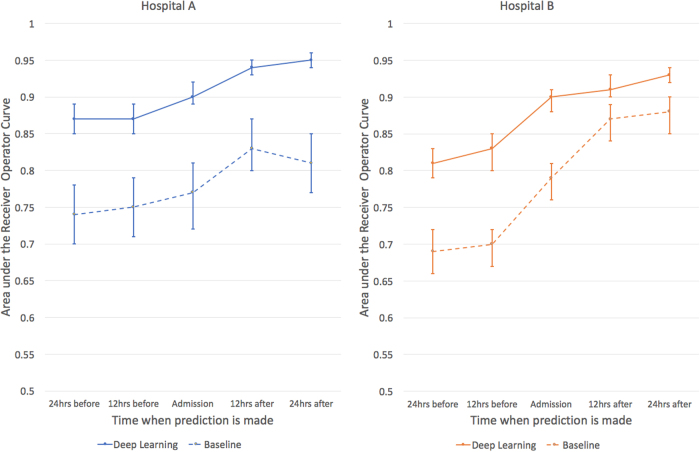
- For inpatient mortality at 24 h after admission, AUROC was 0.95 at Hospital A and 0.93 at Hospital B, versus 0.85 and 0.86 for the augmented Early Warning Score baseline.
- For 30-day readmission at discharge, AUROC was 0.77 at Hospital A and 0.76 at Hospital B, versus 0.70 and 0.68 for the modified HOSPITAL baseline; for long length of stay at 24 h, AUROC was 0.86 and 0.85, versus 0.76 and 0.74 for the modified Liu baseline.
- For predicting all discharge diagnoses (14,025 ICD-9 codes), weighted AUROC was 0.87/0.86 at admission and 0.90 at discharge for both hospitals; micro-F1 at discharge was 0.41 (Hospital A) and 0.40 (Hospital B).
## Methods
- Design: Retrospective study comparing deep learning models to traditional predictive models across two hospitals, with separate results reported for each site.
- Data/sample: De-identified EHR data from UCSF (2012–2016) and UCM (2009–2016), including adults 18+ with hospitalizations of 24 h or longer; UCM also included free-text notes.
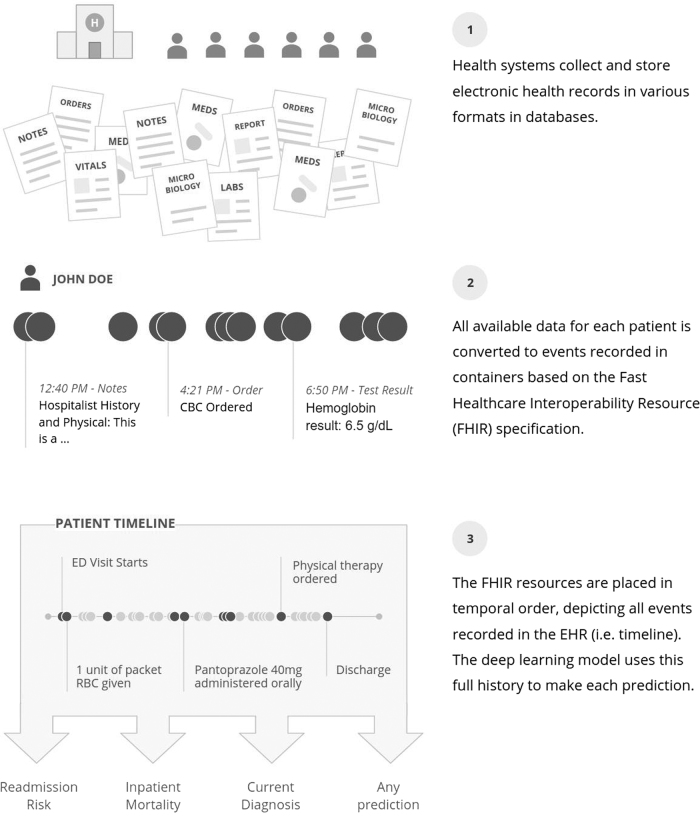
- Analysis: Raw EHR data were converted into time-ordered FHIR-based token sequences and used to train three model types (LSTM, attention-based TANN, and boosted time-based decision stumps), with outputs ensembled; data were split 80/10/10 into development/validation/test sets and evaluated using AUROC, calibration curves, work-up-to-detection ratio, and micro-F1.
## Limitations
- The authors state it is a retrospective study, with “all of the usual limitations.”
- They state that prospective trials are needed to show that accurate predictions improve care.
- They note their approach does not harmonize data between sites, limiting transfer to new sites/cohorts; they also say the methods are computationally intensive and require specialized expertise.
- Evident from the text: the study’s diagnosis task is restricted to ICD-9 codes, and the authors caution that AUROC differences between hospitals, especially regarding notes, cannot be attributed solely to notes because the cohorts differed.
Model-written summary. Check it against the paper before relying on it.
Integrity signals
Registry
Cites
Statistics
Figures
Verification
Claims the paper makes
7 Valid · 0 Not valid · 6 Not checked · 33 Own results and interpretations
The cited sources support only part of this claim — read each source’s verdict below.
In the paper
“We are not aware of a study that predicts as many ICD codes as this study, but our micro-F1 score exceeds that shown on the smaller MIMIC-III dataset when predicting fewer diagnoses (0.40 vs 0.28).68”
§ Scalable and accurate deep learning with electronic health records > Discussion
What the sources say
- Partly supportedcites [68] Perotte A Diagnosis code assignment: models and evaluation metrics J. Am. Med. Inform. Assoc. 2014 21 231 237 10.1136/amiajnl-2013-002159 24296907 PMC3932472 sourceExperimental — accuracy not yet measured
The Results > Prediction models section reports a 27.6% F-measure for the flat SVM, consistent with the cited 0.28 after rounding. But Materials and methods > Datasets identifies the dataset as MIMIC II, not MIMIC-III; the Results also report a higher 39.5% F-measure for this paper’s hierarchy-based model. No page numbers are available in our copy. (LLM, conf=0.89)
hedged- Asserted: passes — The authors put it forward as true.
- Checkable: passes — It can be checked against evidence.
- Load-bearing: passes — The paper’s conclusions depend on it.
- Based: passes — The paper gives a reason why it holds.
- Rests on an assumption not shown here.
- Partly supported
The cited sources support only part of this claim — read each source’s verdict below.
In the paper
“A major challenge in using more of the data available for each patient has been the lack of standards and semantic interoperability of health data from multiple sites.25”
§ Scalable and accurate deep learning with electronic health records > Introduction > Related work
What the sources say
- Partly supportedcites [25] Sun H Semantic processing of EHR data for clinical research J. Biomed. Inform. 2015 58 247 259 10.1016/j.jbi.2015.10.009 26515501 sourceExperimental — accuracy not yet measured
The Introduction (p.1) and Conclusion (Section 5) of our copy clearly support the semantic-interoperability half of the claim: 'the semantic interoperability between different standards remains a challenge', and 'there is no single standard that could serve as the interoperability hub for all the existing clinical data sources and clinical applications', with the Abstract framing the whole paper as responding to 'a growing need to semantically process and integrate clinical data from different sources for clinical research' (multi-site sources are illustrated in Section 4.1.1: a German hospital Oracle database and an Italian regional IHE QED registry). However, the claim's 'lack of standards' is not what this paper says: the Introduction states that standards such as HL7, openEHR and ISO 13606 HAVE been developed to tackle storage and exchange of clinical data, and the residual problem is interoperability AMONG them plus the absence of one unifying hub standard, not an absence of standards. The claim also generalises the source's specific concern (secondary use/reuse of EHR data for clinical research applications) to 'using more of the data available for each patient'. (LLM, conf=0.70)
plainstates a cause- Asserted: passes — The authors put it forward as true.
- Checkable: passes — It can be checked against evidence.
- Load-bearing: passes — The paper’s conclusions depend on it.
- Based: passes — The paper gives a reason why it holds.
- Partly supported
Every source the paper cites for this claim was checked and supports it.
In the paper
“In the current study, we caution that the differences in AUROC across the two hospitals (one with and one without notes) cannot be ascribed to the presence or absence of notes given the difference in cohorts.45”
§ Scalable and accurate deep learning with electronic health records > Discussion
What the sources say
- Supportedcites [45] Walsh C Hripcsak G The effects of data sources, cohort selection, and outcome definition on a predictive model of risk of thirty-day hospital readmissions J. Biomed. Inform. 2014 52 418 426 10.1016/j.jbi.2014.08.006 25182868 PMC4261028 source
The Discussion states that cohort selection affects discriminatory performance and that comparing performance across studies requires the cohorts to be the same. This supports the citing authors’ caution against attributing their two hospitals’ AUROC difference to the presence or absence of notes when the cohorts also differ; the two-hospital comparison is their own study, not a result attributed to this source. (LLM, conf=0.90)
plain- Asserted: passes — The authors put it forward as true.
- Checkable: passes — It can be checked against evidence.
- Load-bearing: passes — The paper’s conclusions depend on it.
- Based: passes — The paper gives a reason why it holds.
- Supported
A result the paper reports from its own data — it cites no other source for it, so there is none to check. The quote shows it is in the paper.
In the paper
“For classifying all diagnosis codes, the weighted AUROCs at admission were 0.87 for Hospital A and 0.86 for Hospital B.”
§ Scalable and accurate deep learning with electronic health records > Results > Inferring discharge diagnoses
plain- Asserted: passes — The authors put it forward as true.
- Checkable: passes — It can be checked against evidence.
- Load-bearing: passes — The paper’s conclusions depend on it.
- Based: passes — The paper gives a reason why it holds.
- Rests on 2 assumptions not shown here.
A result the paper reports from its own data — it cites no other source for it, so there is none to check. The quote shows it is in the paper.
In the paper
“For predicting long length of stay, the AUROCs at 24 h after admission were 0.86 (95% CI 0.86–0.87) for Hospital A and 0.85 (95% CI 0.84–0.86) for Hospital B.”
§ Scalable and accurate deep learning with electronic health records > Results > Long length of stay
plain- Asserted: passes — The authors put it forward as true.
- Checkable: passes — It can be checked against evidence.
- Load-bearing: passes — The paper’s conclusions depend on it.
- Based: passes — The paper gives a reason why it holds.
- Rests on an assumption not shown here.
18 more claims
Create a free account to see all 46 claims and to verify the 2 references still open.
- It may state two separate claims as one. 16
- Probably not a substantial claim. 10
Claims other papers make about this one
Each is checked against this paper’s own text: does it say what the citing paper says it does?
The source backs part of the claim, not all of it — or backs it for a different population, condition or comparison.
In the citing paper
“The most important difference is that the study included co-morbidities, which have been proven to enable better predictions of disease progression trends and treatment outcomes.25,26”
From Development and validation of a screening tool for sepsis without laboratory results in the emergency department: a machine learning study (2025) · cites this paper as [26]
Experimental — accuracy not yet measuredThe source backs part of the claim, not all of it — or backs it for a different population, condition or comparison.
In the citing paper
“For both structured codes and unstructured notes, standardized vocabularies including FHIR [6] and UMLS CUIs [62,63] are introduced to transfer raw tokens into unique phrases to reduce the sparsity of the input data.”
From Deep representation learning of patient data from Electronic Health Records (EHR): A systematic review (2021) · cites this paper as [6]
Experimental — accuracy not yet measuredThe source backs part of the claim, not all of it — or backs it for a different population, condition or comparison.
In the citing paper
“Some FEMRs have tackled this problem by combining unstructured EHR data (i.e., text) with structured EMR data to boost performance on specific phenotyping and prediction tasks69,70.”
From The shaky foundations of large language models and foundation models for electronic health records (2023) · cites this paper as [69]
Experimental — accuracy not yet measuredThe cited source says what the claim attributes to it.
In the citing paper
“To improve performance and provide a degree of interpretability to the model, an attention mechanism is adopted in 13 studies [6,14,27,31,43,57,64,72,76–78,80,88].”
From Deep representation learning of patient data from Electronic Health Records (EHR): A systematic review (2021) · cites this paper as [6]
The cited source says what the claim attributes to it.
In the citing paper
“Advances in artificial intelligence (AI) are driving a revolution across science, enabling exciting new results across chemistry,80–82 biology,83,84 and medicine.85–88”
From Artificial Intelligence and Early Detection of Pancreatic Cancer: 2020 Summative Review (2021) · cites this paper as [85]
8 more claims about this paper
Create a free account to see every claim other papers make about this one.
Citations
Cites
Hochreiter, S., & Schmidhuber, J. (1997) · Neural Computation · doi:10.1162/neco.1997.9.8.1735 · Cited by 102,318 · cited 9×
“Patient records vary significantly in length and density of data-points (e.g. vital sign measurements in an intensive care unit vs outpatient clinic), so we formulated three deep learning neural-network model architectures that take advantage of such data in different ways: one based on recurrent neural networks (LSTM)…”
MethodInfluentialLeCun, Y., Bengio, Y., & Hinton, G. (2015) · Nature · doi:10.1038/nature14539 · Cited by 84,126
Scikit-learn: Machine Learning in Python
Pedregosa, F., Varoquaux, G., Gramfort, A., Michel, V., Thirion, B., Grisel, O., Blondel, M., Müller, A., Nothman, J., Louppe, G., et al. (2012) · arXiv · doi:10.48550/arxiv.1201.0490 · Cited by 71,016
APACHE II: A severity of disease classification system
KNAUS, W. A., DRAPER, E. A., WAGNER, D. P., & ZIMMERMAN, J. E. (1985) · Critical Care Medicine · doi:10.1097/00003246-198510000-00009 · Cited by 13,664
Representation Learning: A Review and New Perspectives
Bengio, Y., Courville, A., & Vincent, P. (2013) · IEEE Transactions on Pattern Analysis and Machine Intelligence · doi:10.1109/tpami.2013.50 · Cited by 13,001 · cited 1×
“Our central insight is that rather than explicitly harmonizing EHR data, mapping it into a highly curated set of structured predictors variables and then feeding those variables into a statistical model, we can instead learn to simultaneously harmonize inputs and predict medical events through direct feature learning…”
BackgroundMIMIC-III, a freely accessible critical care database
Johnson, A. E. W., Pollard, T. J., Shen, L., Lehman, L.-W. H., Feng, M., Ghassemi, M., Moody, B., Szolovits, P., Anthony Celi, L., & Mark, R. G. (2016) · Scientific Data · doi:10.1038/sdata.2016.35 · Cited by 8,141 · cited 1×
“ecord, which includes clinical free-text notes as well as large amounts of structured and semi-structured data. Because of the availability of Medical Information Mart for Intensive Care (MIMIC) data [48], many prior studies also have focused on ICU patients from a single center [92, 41]; other single-center studies h…”
MethodGulshan, V., Peng, L., Coram, M., Stumpe, M. C., Wu, D., Narayanaswamy, A., Venugopalan, S., Widner, K., Madams, T., Cuadros, J., et al. (2016) · JAMA · doi:10.1001/jama.2016.17216 · Cited by 7,697 · cited 1×
“Deep learning emerged as the preferred machine learning approach in machine perception problems ranging from computer vision to speech recognition, but has more recently proven useful in natural language processing, sequence prediction, and mixed modality data settings([36, 16, 21, 56]).”
BackgroundMandell, L. A., Wunderink, R. G., Anzueto, A., Bartlett, J. G., Campbell, G. D., Dean, N. C., Dowell, S. F., File, T. M., Musher, D. M., Niederman, M. S., et al. (2007) · Clinical Infectious Diseases · doi:10.1086/511159 · Cited by 6,202 · cited 1×
“of only 27 variables, rely on traditional generalized linear models, and are built using data at a single center. In clinical practice, simpler models are most commonly deployed, such as the CURB-65 [68, 60], which is a 5-factor model, or single-parameter warning scores [20, 45]. A major challenge in using more of the…”
MethodAPACHE II: a severity of disease classification system.
Knaus, W. A., Draper, E. S., Wagner, D. P., & Zimmerman, J. E. (1985) · PubMed · Cited by 6,034
Predicting the future - big data, machine learning, and clinical medicine
Obermeyer, Z., & Emanuel, E. J. (2016) · New England Journal of Medicine · doi:10.1056/nejmp1606181 · Cited by 3,652 · cited 1×
“In our case study, the model identified elements of the patient’s history and radiology findings to render its prediction, which are critical data-points that a clinician would also use [41].”
Method
Research works printed but not linked: 5
- Wu, Y. et al. Google’s neural machine translation system: bridging the gap between human and machine translation. arXiv [cs.CL] (2016).
- Aczon, M. et al. Dynamic mortality risk predictions in pediatric critical care using recurrent neural networks. arXiv [stat.ML] (2017).
- Suresh, H. et al. Clinical intervention prediction and understanding using deep networks. arXiv [cs.LG] (PMLR, Los Angeles, CA, USA, 2017).
- Razavian, N., Marcus, J. & Sontag, D. Multi-task prediction of disease onsets from longitudinal laboratory tests. In Proceedings of the 1st Machine Learning for Healthcare Conference, (eds F. Doshi-Velez, J. Fackler, D. Kale and B. Wallace, J. Wiens) Vol. 56, pp 73–100 (PMLR, Los Angeles, CA, 2016).
- Bahdanau, D., Cho, K. & Bengio, Y. Neural machine translation by jointly learning to align and translate. arXiv [cs.CL] (2014).
Cited by
Items 1,101–1,200 of 2,601
Pitoglou, S., Filntisi, A., Αναστασίου, Α., Matsopoulos, G. K., & Koutsouris, D. (2022) · Frontiers in Digital Health · doi:10.3389/fdgth.2022.841853 · Cited by 11
Electronic Health Record Optimization for Artificial Intelligence
Dighe, A. S. (2022) · Clinics in Laboratory Medicine · doi:10.1016/j.cll.2022.09.003 · Cited by 8
Alam, F., Ananbeh, O., Malik, K. M., Odayani, A. A., Hussain, I. B., Kaabia, N. M., Aidaroos, A. Y. A., & Saudagar, A. K. J. (2023) · Diagnostics · doi:10.3390/diagnostics13101760 · Cited by 8
“Rajkomar et al. [15] proposed a three-tier approach by combining three DL models to predict hospital readmission and patients’ LoS based on data belonging to patients with varying diseases, without identifying the cohort of risk factors affecting patient LoS.”
MethodHong, W. S., Rudas, Á., Bell, E., & Chiang, J. N. (2023) · JAMIA Open · doi:10.1093/jamiaopen/ooad053 · Cited by 8
Hoffman, H., Wood, J., Cote, J. R., Jalal, M. S., Otite, F. O., Masoud, H., & Gould, G. (2023) · World Neurosurgery · doi:10.1016/j.wneu.2023.11.060 · Cited by 9
MedCT-BERT: Multimodal Mortality Prediction using Medical ConvTransformer-BERT Model
Zhang, K., Niu, K., Zhou, Y., Tai, W., & Lu, G. (2023) · IEEE International Conference on Tools with Artificial Intelligence (ICTAI) · doi:10.1109/ictai59109.2023.00109 · Cited by 10
“…prevalence of large-scale electronic health records (EHR) plays a crucial and decisive role in data-driven clinical decision support systems [1], providing more opportunities for using artificial intelligence methods to reduce the mortality risk of patients in intensive care units [2]–[4].”
BackgroundSelf-citationKewalchand, P. S. (2024) · International Journal of Advanced Research in Science Communication and Technology · doi:10.48175/ijarsct-15285 · Cited by 8
Real-Time Applications of Artificial Intelligence Technology in Daily Operations
Renugadevi, R., Shobana, J., Arthi, K., Kalpana, A. V., Satishkumar, D., & Sivaraja, M. (2024) · Advances in computational intelligence and robotics book series · doi:10.4018/979-8-3693-2615-2.ch012 · Cited by 11
Fogleman, B. M., Goldman, M., Holland, A. B., Dyess, G. A., & Patel, A. (2024) · Cureus · doi:10.7759/cureus.58032 · Cited by 20
“While many systems have developed software to streamline workflow and efficiency for their specific EHR model, the standardization and interoperability between systems have not seen the same attention [37-40].”
MethodNainamalai, V., Qair, H. A., Pelanis, E., Jenssen, H. B., Fretland, Å. A., Edwin, B., Elle, O. J., & Balasingham, I. (2024) · European Journal of Radiology Open · doi:10.1016/j.ejro.2024.100582 · Cited by 10
Nedbal, C., Adithya, S., Gite, S., et al. (2024) · Journal of Endourology · doi:10.1089/end.2024.0120 · Cited by 8
“11 With this study, we aim to develop ML algorithms for the automated prediction of postoperative ureteroscopy outcomes, for pediatric kidney stones, based on preoperative characteristics.”
Artificial Intelligence Empowering Medical Image Processing
Geroski, T., & Filipović, N. (2024) · Springer eBooks · doi:10.1007/978-3-031-60044-9_7 · Cited by 9
Machine Learning and IoT in Precision Healthcare
Paul, S., & Latha, C. B. C. (2024) · Studies in computational intelligence · doi:10.1007/978-981-97-5624-7_6 · Cited by 10
Modine, T., & Overtchouk, P. (2019) · JACC: Cardiovascular Interventions · doi:10.1016/j.jcin.2019.06.004 · Cited by 8
What does digitalization hold for the creation of real-world evidence?
Pisaniello, H. L., & Dixon, W. G. (2019) · Rheumatology · doi:10.1093/rheumatology/kez068 · Cited by 12
Predictors of Readmissions and Length of Stay for Diabetes Related Patients
AlTurki, L. S., Aloraini, K., Aldughayshim, A., & Albahli, S. (2019) · IEEE/ACS International Conference on Computer Systems and Applications (AICCSA) · doi:10.1109/aiccsa47632.2019.9035280 · Cited by 20
“, unplanned readmissions, long hospital stays, in-hospital mortalities)[1][2].”
BackgroundMethodInfluentialMeta-Learning Enhanced Neural ODE for Citywide Next POI Recommendation
Tan, H., Yao, D., Huang, T., et al. (2021) · Proceedings/IEEE International Conference on Mobile Data Management · doi:10.1109/mdm52706.2021.00023 · Cited by 8
“Neural ODE(Neural Ordinary Differential Equation) is recently proposed by [4] which outperforms other works on modeling real-world sporadically time series, e.g. standard RNN [3], [17] and RNN-decay [2], [3], [19], [22].”
BackgroundZhang, W., Li, D., Feng, M., Hu, B., Fan, Y., Chen, Q., & Wang, R. (2021) · Frontiers in Oncology · doi:10.3389/fonc.2021.754882 · Cited by 10
“Although there has been exponential growth in the number of studies involving radiomics methods, the application of word embedding techniques is still limited (12, 13).”
BackgroundExplainable Deep Learning for Readmission Prediction with Tree-GloVe Embedding
Jiang, J., Hewner, S. J., & Chandola, V. (2021) · IEEE International Conference on Healthcare Informatics (ICHI) · doi:10.1109/ichi52183.2021.00031 · Cited by 11
Reichenpfader, D., & Hanke, S. (2021) · Smart Cities · doi:10.3390/smartcities4040070 · Cited by 10
“These heterogeneous data types need to be standardised for improved automated analysis and prediction [76].”
BackgroundMucić, D., Shore, J. H., Hilty, D. M., Krysta, K., & Krzystanek, M. (2021) · Current Psychiatry Reports · doi:10.1007/s11920-021-01300-5 · Cited by 8
A Comparison of Models Predicting One-Year Mortality at Time of Admission
Pierce, R. P., Raithel, S., Brandt, L. C., Clary, K. W., & Craig, K. W. (2021) · Journal of Pain and Symptom Management · doi:10.1016/j.jpainsymman.2021.11.006 · Cited by 11
Applying Machine Learning Techniques for Stroke Prediction in Patients
Kavitha, R. K., Jaisingh, W., & Sujithra, S. R. (2021) · International Conference on Advancements in Electrical, Electronics, Communication, Computing and Automation (ICAECA) · doi:10.1109/icaeca52838.2021.9675652 · Cited by 8
Yang, T., Jiang, C., & Li, P. (2022) · Computational Intelligence and Neuroscience · doi:10.1155/2022/6118798 · Cited by 11
“However, with the wide broadcast of videos related to sports events, how to scientifically manage the data of sports video is becoming a problem that arises researchers’ focus [3].”
Background(2020) · American Journal of Health-System Pharmacy · doi:10.1093/ajhp/zxaa395 · Cited by 9
Zang, C., Goodman, M. S., Zhu, Z., Yang, L., Yin, Z., Tamás, Z., Sharma, V., Wang, F., & Shao, N. (2022) · Scientific Reports · doi:10.1038/s41598-022-16160-z · Cited by 9
Xu, H., Zheng, Q., Zhu, J., Xie, Z., Cheng, H., Li, P., & Ji, Y. (2022) · Disease Markers · doi:10.1155/2022/7593750 · Cited by 9
“Currently, in the medical fi eld, deep learning is mainly used in the research of medical imaging [7, 8] and electronic health record (EHR) [9, 10].”
BackgroundA Clinical Framework for Evaluating Machine Learning Studies
Ghazi, L., Ahmad, T., & Wilson, F. P. (2022) · JACC Heart Failure · doi:10.1016/j.jchf.2022.07.002 · Cited by 8
van der Linden, S., Sevastjanova, R., Funk, M., & El‐Assady, M. (2023) · ACM Transactions on Management Information Systems · doi:10.1145/3564275 · Cited by 11
Ahuja, Y., Wen, J., Hong, C., Xia, Z., Huang, S., & Cai, T. (2022) · Scientific Reports · doi:10.1038/s41598-022-22585-3 · Cited by 10
Deep Semi-supervised Learning for Time-Series Classification
Goschenhofer, J. (2022) · Advances in intelligent systems and computing · doi:10.1007/978-981-19-6153-3_15 · Cited by 12
Guan, J., Leung, E. Y. M., Kwok, K. O., & Chen, F. Y. (2023) · BMC Medical Research Methodology · doi:10.1186/s12874-022-01824-1 · Cited by 11
Hoffman, H., Wood, J. S., Cote, J. R., Jalal, M. S., Masoud, H., & Gould, G. (2023) · Journal of Stroke and Cerebrovascular Diseases · doi:10.1016/j.jstrokecerebrovasdis.2023.106989 · Cited by 11
Hansen, A. V., Mortensen, L. H., Ekstrøm, C. T., Trompet, S., & Westendorp, R. G. J. (2023) · Scientific Reports · doi:10.1038/s41598-023-28102-4 · Cited by 9
Assessing the FAIRness of databases on the EHDEN portal: A case study on two Dutch ICU databases
Puttmann, D., de Groot, R., de Keizer, N. F., Ronald Cornet, A., Elbers, P., Dongelmans, D. A., & Bakhshi‐Raiez, F. (2023) · International Journal of Medical Informatics · doi:10.1016/j.ijmedinf.2023.105104 · Cited by 9
Intensive Care Unit readmission prediction with correlation enhanced multi-task learning
Niu, K., Pei, S., Peng, X., Zeng, J., & Zhang, K. (2023) · Computers & Electrical Engineering · doi:10.1016/j.compeleceng.2023.108780 · Cited by 9
Self-citationIndrasiri, P. L., Kashyap, B., & Pathirana, P. N. (2025) · International Journal of Machine Learning and Cybernetics · doi:10.1007/s13042-025-02613-0 · Cited by 11
“This issue is critical in healthcare, where data on rare diseases is inherently scarce, yet vital for understanding disease progression and aiding patient care [13–15].”
Building artificial intelligence‐based personalized predictive models
Bhandari, M., & Reddiboina, M. (2019) · British Journal of Urology · doi:10.1111/bju.14746 · Cited by 9
Sun, Z., Peng, S., Yang, Y., Wang, X., & Li, F. (2019) · IEEE International Conference on Bioinformatics and Biomedicine (BIBM) · doi:10.1109/bibm47256.2019.8983098 · Cited by 17
Cedillo-Pozos, A., Ternovoy, S. K., & Roldán-Valadéz, E. (2020) · Insights into Imaging · doi:10.1186/s13244-019-0814-7 · Cited by 10
Artificial intelligence assisted surgery
Witkowski, E. R., & Ward, T. M. (2020) · Elsevier eBooks · doi:10.1016/b978-0-12-818438-7.00008-3 · Cited by 9
Ponselvakumar, A. P., Anandamurugan, S., Logeswaran, K., Nivashini, S., Showentharya, S. K., & Jayashree, S. (2021) · IOP Conference Series Materials Science and Engineering · doi:10.1088/1757-899x/1055/1/012110 · Cited by 10
The future of artificial intelligence in healthcare
Radakovich, N., & Nazha, A. (2021) · Elsevier eBooks · doi:10.1016/b978-0-12-820273-9.00016-6 · Cited by 7
Machine Learning in Risk Prediction
Sundström, J., & Schön, T. B. (2020) · Hypertension · doi:10.1161/hypertensionaha.120.13516 · Cited by 8
Chen, R. (2020) · medRxiv · doi:10.1101/2020.05.01.20088294 · Cited by 10
Juliet, A. H., Kalaiselvi, K., & Sathya, K. (2024) · International Conference on Communications and Signal Processing (ICCSP) · doi:10.1109/iccsp60870.2024.10543404 · Cited by 8
“The scarceness and imbalance of data within CAD prediction datasets may lead to a model that reflects biases present in the available data [12].”
BackgroundExplainable text-tabular models for predicting mortality risk in companion animals
Burton, J., Farrell, S., Noble, P. M., & Moubayed, N. A. (2024) · Scientific Reports · doi:10.1038/s41598-024-64551-1 · Cited by 12
Machine learning tools match physician accuracy in multilingual text annotation
Zielonka, M., Czyżewski, A., Szplit, D., Graff, B., Szyndler, A., Budzisz, M., & Narkiewicz, K. (2025) · Scientific Reports · doi:10.1038/s41598-025-89754-y · Cited by 12
RiskPath: Explainable deep learning for multistep biomedical prediction in longitudinal data
de Lacy, N., Ramshaw, M. J., & Lam, W. Y. (2025) · Patterns · doi:10.1016/j.patter.2025.101240 · Cited by 12
Robust temporal knowledge inference via pathway snapshots with liquid neural network
Han, P., Wang, J., Liu, D., Liu, L., & Song, T. (2025) · Methods · doi:10.1016/j.ymeth.2025.05.003 · Cited by 7
Nzeako, T. R., Elendu, C., Echefu, G. C., Olanisa, O., Kiladejo, A., & Bob-Manuel, E. D. (2025) · Annals of Medicine and Surgery · doi:10.1097/ms9.0000000000003602 · Cited by 11
“By rapidly analyzing vast amounts of patient data, AI reduces physician workload and improves diagnostic accuracy and treatment planning [ 51 , 52 ] .”
Makhseed, A., Arian, H., & Shuaib, A. S. (2025) · Clinical Cosmetic and Investigational Dermatology · doi:10.2147/ccid.s543045 · Cited by 17
Popa, M. V., Buzea, C. G., Gurzu, I. L., Salim, C., Gurzu, B., Rusu, D. I., Ochiuz, L., & Duceac, L. D. (2025) · Healthcare · doi:10.3390/healthcare13182266 · Cited by 10
“These models have demonstrated state-of-the-art performance across various healthcare applications, from ICU risk stratification [22] to predicting read-missions [23] and chronic disease onset [24].”
InfEHR: Clinical phenotype resolution through deep geometric learning on electronic health records
Kauffman, J., Holmes, E., Vaid, A., Charney, A. W., Kovatch, P., Lampert, J. M., Sakhuja, A., Žitnik, M., Glicksberg, B. S., Hofer, I. S., et al. (2025) · Nature Communications · doi:10.1038/s41467-025-63366-6 · Cited by 18
Deep learning models for ICU readmission prediction: a systematic review and meta-analysis
Koumantakis, E., Remoundou, K., Colombi, N., Fava, C., Roussaki, I. G., Visconti, A., & Berchialla, P. (2025) · Critical Care · doi:10.1186/s13054-025-05642-x · Cited by 11
“Among those, deep learning (DL) models have gained significant attention in healthcare, especially in the analysis of medical images [13–16], and in the prediction of prolonged hospital stay and readmissions [17].”
Multi-agent systems for clinical decision support: A systematic review
Silveira, A. L., Righi, R. D. R., & da Costa, C. A. (2025) · Applied Soft Computing · doi:10.1016/j.asoc.2025.114447 · Cited by 21
AI based colorectal disease detection using real-time screening colonoscopy
Jiang, J., Xie, Q., Zhuo, C., Cai, J., Xia, T., Yang, H., Yang, B. R., Peng, H. Y., Bai, X., Yan, M., et al. (2021) · Precision Clinical Medicine · doi:10.1093/pcmedi/pbab013 · Cited by 9
Application of Wavelet Transform for Machine Learning Classification of Time Series
Kirichenko, L., Пичугина, О. С., Радівілова, Т., & Pavlenko, K. (2022) · Lecture notes on data engineering and communications technologies · doi:10.1007/978-3-031-16203-9_31 · Cited by 11
Artificial Intelligence is changing Health and eHealth care
Akshaya, A. V. R., Vigneshwaran, S., & Ram Kumar, C. (2022) · EAI Endorsed Transactions on Smart Cities · doi:10.4108/eetsc.v6i3.2274 · Cited by 8
“Time, cash, and assets are undeniably saved when code issues and bogus claims are found and revised [17].”
BackgroundSaad, M., Salze, B., Trillat, B., Corniou, O., Vallée, A., Guen, M. L., Latouche, A., & Fischler, M. (2022) · Journal of Clinical Medicine · doi:10.3390/jcm11195829 · Cited by 7
“Prediction scores [24–26] and machine learning algorithms [27] are not specific to the minimally invasive transsphenoidal hypophysectomy.”
BackgroundImplicit Bias and Machine Learning in Health Care
Zaidi, D., & Miller, T. (2023) · Southern Medical Journal · doi:10.14423/smj.0000000000001489 · Cited by 7
Chen, Z., Siltala-Li, L., Lassila, M., Malo, P., Vilkkumaa, E., Saaresranta, T., & Virkki, A. V. (2023) · IEEE Journal of Translational Engineering in Health and Medicine · doi:10.1109/jtehm.2023.3276943 · Cited by 9
“Following in the wake of the deep learning revolution in the NLP field, much research with EHRs has considered scalable deep learning in light of the two domains’ parallels [12], [13], [58], [59], [60].”
Pedersen, C. F., Andersen, M. Ø., Carreon, L. Y., Skov, S. T., Doering, P., & Eiskjær, S. P. (2024) · North American Spine Society Journal (NASSJ) · doi:10.1016/j.xnsj.2024.100309 · Cited by 9
“…Abbreviations: AUC, area under the curve; CI, confidence interval; MCC, Matthews correlation coefficient; PPV, positive predicted value; NPV, negative predicted value. for handling high dimensional data, less vulnerable to missingness and are claimed to outperform traditional algorithms [ 21 , 22 ].”
Harbaoui, N., Makkawi, K., Tmazirte, N. A., & Najjar, M. E. B. E. (2024) · Journal of Intelligent & Robotic Systems · doi:10.1007/s10846-023-01906-2 · Cited by 12
“In recent years, advanced deep learning technologies have received significant attention in several research fields [42, 46].”
Budiman, A. S., Putri, D. N. N., Candra, H., Djuana, E., Sari, T. K., Aji, D. P. B., Putri, L. R., Sitepu, E., Speaks, D. T., & Pasang, T. (2024) · Solar Energy Materials and Solar Cells · doi:10.1016/j.solmat.2024.112927 · Cited by 8
Xu, S., & Sun, M. (2024) · High Blood Pressure & Cardiovascular Prevention · doi:10.1007/s40292-024-00666-w · Cited by 8
“The GA-XGB model demonstrated high efficiency, and among 6 ML algorithms tested, it provided the best performance in terms of classification robustness, aided by strategies such as repeated K-Fold cross-validation to prevent overfitting [41].”
MethodSelf-citationNour, S. M., Shehab, R. S., Said, S. A., & Halim, I. T. A. (2025) · Applied System Innovation · doi:10.3390/asi8010007 · Cited by 7
“Furthermore, according to [13], AI-powered predictive analytics can lessen stress in healthcare facilities, help with resource allocation, and predict patient admissions.”
eHealth in Zimbabwe, a Case of Techno-Social Development
Chawurura, T., Manhibi, R., van Dijk, J., & van Stam, G. (2019) · IFIP advances in information and communication technology · doi:10.1007/978-3-030-18400-1_2 · Cited by 9
Leveraging the health information technology infrastructure to advance federal research priorities
Zayas‐Cabán, T., Abernethy, A. P., Brennan, P. F., Devaney, S. A., Kerlavage, A. R., Ramoni, R. B., & White, P. (2020) · Journal of the American Medical Informatics Association · doi:10.1093/jamia/ocaa011 · Cited by 11
Yee, W.-L. S., & Drum, C. L. (2020) · Advanced Therapeutics · doi:10.1002/adtp.201900163 · Cited by 8
Deep Semi-supervised Learning for Time Series Classification
Goschenhofer, J., Hvingelby, R., Rügamer, D., Thomas, J., Wagner, M., & Bischl, B. (2021) · International Conference on Machine Learning and Applications · doi:10.1109/icmla52953.2021.00072 · Cited by 12
“Time series classification (TSC) spans many real-world applications in domains from healthcare [1] over cybersecurity [2] to manufacturing [3].”
BackgroundPrediction of Hospital Readmission Combining Rule-based and Machine Learning Model
Teo, K., Lai, K. W., Yong, C. W., Pingguan‐Murphy, B., Chuah, J. H., & Tee, C. A. T. (2020) · International Computer Symposium · doi:10.1109/ics51289.2020.00076 · Cited by 11
Artificial Neural Network to Predict the Effect of Obesity on the Risk of Tuberculosis Infection
Badawi, A. F., Liu, C. J., Rihem, A. A., & Gupta, A. (2021) · Journal of Public Health Research · doi:10.4081/jphr.2021.1985 · Cited by 11
A High-Fidelity Model to Predict Length of Stay in the Neonatal Intensive Care Unit
Wang, K., Hussain, W. A., Birge, J. R., Schreiber, M. D., & Adelman, D. (2021) · INFORMS journal on computing · doi:10.1287/ijoc.2021.1062 · Cited by 9
“Rajkomar et al. (2018) modeled a larger, multi-center time-series dataset using recurrent neural networks to predict mortality within 24h, 30-day readmissions and weeklong length of stay.”
InfluentialPredicting Clinical Events Based on Raw Text: From Bag-of-Words to Attention-Based Transformers
Roussinov, D., Conkie, A., Patterson, A., & Sainsbury, C. A. R. (2022) · Frontiers in Digital Health · doi:10.3389/fdgth.2021.810260 · Cited by 10
“Tables 13 , 14 present the performance of the fully-connected single-layer network that uses non-text attributes only.”
BackgroundFlaks‐Manov, N., Shadmi, E., Yahalom, R., Perry‐Mezre, H., Balicer, R. D., & Srulovici, E. (2021) · Journal of Nursing Management · doi:10.1111/jonm.13495 · Cited by 8
Weight-of-evidence through shrinkage and spline binning for interpretable nonlinear classification
Raymaekers, J., Verbeke, W., & Verdonck, T. (2021) · Applied Soft Computing · doi:10.1016/j.asoc.2021.108160 · Cited by 24
“On tabular datasets, which are commonly encountered in the context of credit scoring and healthcare analytics, they have been shown to provide only marginal performance gains [21, 29].”
BackgroundGood Data Science Practice: Moving Toward a Code of Practice for Drug Development
Baillie, M., Moloney, C., Mueller, C. P., Dorn, J. F., Branson, J., & Ohlssen, D. I. (2022) · Statistics in Biopharmaceutical Research · doi:10.1080/19466315.2022.2063172 · Cited by 10
“…the increasing adoption of computationally intensive Bayesian models to support health technology assessments that can synthesize evidence and data from multiple sources (Welton et al. 2012), or deep learning models that can integrate and model large data volumes jointly (Rajkomar et al. 2018).”
BackgroundIoMT in Healthcare Industry—Concepts and Applications
Mitra, A., Roy, U., & Tripathy, B. K. (2022) · Studies in computational intelligence · doi:10.1007/978-981-19-2416-3_8 · Cited by 8
Improving graph embeddings via entity linking: A case study on Italian clinical notes
D’Auria, D., Moscato, V., Postiglione, M., Romito, G., & Sperlí, G. (2022) · Intelligent Systems with Applications · doi:10.1016/j.iswa.2022.200161 · Cited by 19
Multivariate Sequential Analytics for Cardiovascular Disease Event Prediction
Hsu, W. W. Y., Warren, J., & Riddle, P. (2022) · Methods of Information in Medicine · doi:10.1055/s-0042-1758687 · Cited by 8
Herrero-Zazo, M., Fitzgerald, T. W., Taylor, V., Street, H., Chaudhry, A., Bradley, J. R., Birney, E., & Keevil, V. L. (2022) · iScience · doi:10.1016/j.isci.2022.105876 · Cited by 8
Teo, Z. L., Kwee, A. K., Lim, J. C. W., Lam, C. S. P., Ho, D., Maurer‐Stroh, S., Su, Y., Chesterman, S. A., Chen, T., Tan, C. C., et al. (2023) · Annals of the Academy of Medicine Singapore · doi:10.47102/annals-acadmedsg.2022452 · Cited by 10
Early Expected Discharge Date Accuracy During Hospitalization: A Multivariable Analysis
Piniella, N. R., Fuller, T. E., Smith, L., et al. (2023) · Journal of Medical Systems · doi:10.1007/s10916-023-01952-1 · Cited by 7
“Nonetheless, the rapid adoption of APIs provides an opportunity to use external data sources to improve predictions beyond EHR data alone [38–41].”
Applications of Artificial Intelligence for Health Informatics: A Systematic Review
Hasan, M. E., Islam, M. J., Islam, R., Chen, D., Sanín, C., & Xu, G. (2023) · Journal of Artificial Intelligence for Medical Sciences · doi:10.55578/joaims.230920.001 · Cited by 18
Forecasting Treatment Outcomes Over Time Using Alternating Deep Sequential Models
Wu, F. C., Zhao, G., Zhou, Y., Qian, X., Elias, B.-K., & Lehman, L.-W. H. (2023) · IEEE Transactions on Biomedical Engineering · doi:10.1109/tbme.2023.3331298 · Cited by 11
“Deep learning methods: are being increasingly studied in clinical healthcare applications and show better performance than traditional machine learning models [1], [28], [29].”
BackgroundMethodGeneralized Estimating Equations Boosting (GEEB) machine for correlated data
Wang, Y.-W., Yang, H., Chen, Y., & Guo, C. (2024) · Journal Of Big Data · doi:10.1186/s40537-023-00875-5 · Cited by 7
Zwerwer, L. R., Luz, C. F., Soudis, D., Giudice, N., Nijsten, M. W., Glasner, C., Renes, M. H., & Sinha, B. N. M. (2024) · Scientific Reports · doi:10.1038/s41598-024-52741-w · Cited by 9
“This time-aware nature (and its similarity to clinical reasoning) in addition to previous reports on the beneficial use of LSTM in the field of infection management with EHR built the background for the choice of this methodology 25–27 .”
ResultRecommender System for Responsive Engagement of Senior Adults in Daily Activities
Kulev, I., Valk, C. A. L., Lü, Y., & Pu, P. (2020) · Journal of Population Ageing · doi:10.1007/s12062-020-09263-w · Cited by 10
Designing National Health Stack for Public Health: Role of ICT-Based Knowledge Management System
Malhotra, C., Kotwal, V., & Basu, A. (2019) · ITU Kaleidoscope Academic Conference (ITU K) · doi:10.23919/ituk48006.2019.8996135 · Cited by 11
“Literature is replete with application of wireless technology almost two decades ago in the area of telemedicine in select countries of Europe including Athens (Greece), Cyprus, Italy and Sweden [6] and the use of artificial intelligence and artificial neural networks (ANNs) for maintaining and analyzing electronic he…”
BackgroundConstruction of patient service system based on QFD in internet of things
Huang, A., Cao, J., & Zhang, H. (2020) · The Journal of Supercomputing · doi:10.1007/s11227-020-03359-y · Cited by 8
Gao, F., Deng, K., & Hu, C. (2020) · International Conference on Big Data and Informatization Education (ICBDIE) · doi:10.1109/icbdie50010.2020.00104 · Cited by 7
Sepsis Deterioration Prediction Using Channelled Long Short-Term Memory Networks
Svenson, P., Haralabopoulos, G., & Torres, M. T. (2020) · Lecture notes in computer science · doi:10.1007/978-3-030-59137-3_32 · Cited by 7
Rivera, E. A. T., Chamberlain, J. M., Patel, A. K., Zeng‐Treitler, Q., Bost, J. E., Heneghan, J. A., Morizono, H., & Pollack, M. M. (2021) · Critical Care Explorations · doi:10.1097/cce.0000000000000505 · Cited by 9
Hur, K., Lee, J., Oh, J., Price, W., Kim, Y., & Choi, E. (2021) · doi:10.2196/preprints.32523 · Cited by 8
“Given the sequential nature of the longitudinal EHR data, diverse works have been proposed to learn patient representations using recurrent neural networks (RNN) across objectives such as accurate prediction, interpretability, or scalability [19, 5, 4, 28, 21, 30, 36], while other works have focused predominantly on l…”
BackgroundKeerthika, K., Kannan, M. R., & Saravanan, T. (2024) · Wiley eBooks · doi:10.1002/9781394272587.ch7 · Cited by 8
Predicting Hospital Readmissions in a Commercially Insured Population over Varying Time Horizons
Henderson, M. A., Hirshon, J. M., Han, F., Donohue, M., & Stockwell, I. (2022) · Journal of General Internal Medicine · doi:10.1007/s11606-022-07950-2 · Cited by 6
Drozdov, I. A., Szubert, B., Rowe, I. A. C., Kendall, T. J., & Fallowfield, J. A. (2024) · Annals of Hepatology · doi:10.1016/j.aohep.2024.101528 · Cited by 8
Digital Technology in Healthcare—An Ethical Overview
Hansson, S. O., & Fröding, B. E. E. (2024) · Digital Society · doi:10.1007/s44206-024-00121-2 · Cited by 14
“In this sense, decisions by machine learning systems may also be explainable (Lipton, 2018; Rajkomar et al., 2018).”
Clinical outcome-guided deep temporal clustering for disease progression subtyping
Wang, D., Ma, X., Schulz, P. E., Jiang, X., & Kim, Y. (2024) · Journal of Biomedical Informatics · doi:10.1016/j.jbi.2024.104732 · Cited by 10
Self-citation
Metadata
- Authors
- Rajkomar, A., Oren, E., Chen, K., Dai, A. M., Hajaj, N., Hardt, M., Liu, P. J., Liu, X., Marcus, J., Sun, M., Sundberg, P., Yee, H., Zhang, K., Zhang, Y., Flores, G., Duggan, G. E., Irvine, J., Le, Q., Litsch, K., Mossin, A., Tansuwan, J., Wang, D., Wexler, J., Wilson, J., Ludwig, D., Volchenboum, S. L., Chou, K., Pearson, M., Madabushi, S., Shah, N. H., Butte, A. J., Howell, M. D., Cui, C., Corrado, G. S., & Dean, J.
- Affiliations
- Google (United States) (US)
- University of California, San Francisco (US)
- University of Chicago (US)
- Stanford University (US)
- Corresponding author
- Rajkomar, Alvin
- Venue
- npj Digital Medicine
- Published
- 2018-05-08
- Volume
- 1
- Issue
- 1
- Pages
- 18-18
- ISSN
- 2398-6352 (ISSN-L)
- PMC
- PMC6550175
- OpenAlex
- W2784499877
- Cited by
- 2,648
- References
- 72
- Citations by year
- 2026: 494 · 2025: 457 · 2024: 370 · 2023: 280 · 2022: 228 · 2021: 304 · 2020: 275 · 2019: 186 · 2018: 54
- FWCI
- 115.37
- Type
- journal article
- Language
- en
- Open access
- gold
- doi.org
- Licence
- cc-by
- creativecommons.org/licenses/by/4.0 (tdm)
- creativecommons.org/licenses/by/4.0 (vor)
- Locations
- npj Digital Medicine (publishedVersion, cc-by)
- arXiv (Cornell University) (publishedVersion)
- Europe PMC (PubMed Central) (publishedVersion, cc-by)
- PubMed Central (publishedVersion, cc-by)
- PubMed (publishedVersion)
- DOAJ (DOAJ: Directory of Open Access Journals) (submittedVersion, cc-by-sa)
- eScholarship (California Digital Library) (submittedVersion, cc-by)
- arXiv (Cornell University)
- Topics
- Physical Sciences › Computer Science › Artificial Intelligence › Machine Learning in Healthcare
- Health Sciences › Health Professions › Health Information Management › Electronic Health Records Systems
- Health Sciences › Health Professions › Health Information Management › Artificial Intelligence in Healthcare
- Keywords
- electronic health records, FHIR, deep learning, in-hospital mortality prediction, unplanned hospital readmission, length of hospital stay, hospital discharge diagnoses, clinical notes, data harmonization
About these checks
Registry, retraction, Cites and statistics results are computed, not judged, with one exception: a printed reference that no index lists is read once by a model before it counts as a citation error. Claims are extracted by a model and kept only when their quote appears verbatim in the text; each cited source is then checked, with a model’s help, for whether it says what the claim relies on. Those verdicts can be wrong — read the claim’s quote and the cited source before relying on one.
The claim verdicts this report counts are experimental: their accuracy is not yet measured.
A language model drew the claims from the paper on 2026-10-10, under version 3 of the claim definition (model deepseek-v4.1-flash, prompt extract-v3).
A second model labelled each claim on 2026-10-10 (model jev-1.13-20260917, definition revision gold-guideline-v0.2).
Cited sources are checked with a language model’s help (gpt-6-sol and qwen3.8-omni-flash).
Statistics and arithmetic are recomputed, not judged.
Confidence bands are shown only for fields calibrated on our annotated test set. None is calibrated yet, so no band is shown.
What counts as a claim ›How we measure confidence ›How we check this ›
Are you an author, or do you see a problem with this page? Request a review
Data sources
Bibliographic data: Semantic Scholar, OpenAlex, Crossref.
Contains information from the Semantic Scholar Academic Graph Datasets, made available under the ODC Attribution License (ODC-BY 1.0).
Semantic Scholar’s data is described in: Kinney, R., et al. (2023). The Semantic Scholar Open Data Platform. arXiv:2301.10140.
