

Scalable and accurate deep learning with electronic health records
Open accessThe DOI matches its Crossref record; 75 of the 75 references it cites were found in a registry or an index; 8 of the 19 sources its claims cite were checked for support.
Abstract
Predictive modeling with electronic health record (EHR) data is anticipated to drive personalized medicine and improve healthcare quality. Constructing predictive statistical models typically requires extraction of curated predictor variables from normalized EHR data, a labor-intensive process that discards the vast majority of information in each patient's record. We propose a representation of patients' entire raw EHR records based on the Fast Healthcare Interoperability Resources (FHIR) format. We demonstrate that deep learning methods using this representation are capable of accurately predicting multiple medical events from multiple centers without site-specific data harmonization. We validated our approach using de-identified EHR data from two US academic medical centers with 216,221 adult patients hospitalized for at least 24 h. In the sequential format we propose, this volume of EHR data unrolled into a total of 46,864,534,945 data points, including clinical notes. Deep learning models achieved high accuracy for tasks such as predicting: in-hospital mortality (area under the receiver operator curve [AUROC] across sites 0.93-0.94), 30-day unplanned readmission (AUROC 0.75-0.76), prolonged length of stay (AUROC 0.85-0.86), and all of a patient's final discharge diagnoses (frequency-weighted AUROC 0.90). These models outperformed traditional, clinically-used predictive models in all cases. We believe that this approach can be used to create accurate and scalable predictions for a variety of clinical scenarios. In a case study of a particular prediction, we demonstrate that neural networks can be used to identify relevant information from the patient's chart.
Overview
CoChat Summary
## TL;DR
This retrospective study shows that a single deep learning pipeline using raw EHR data in FHIR format can predict multiple outcomes across two academic hospitals without site-specific feature harmonization. The models outperformed traditional baselines for inpatient mortality, 30-day readmission, long length of stay, and discharge diagnosis prediction.
## Key findings
- The study included 216,221 hospitalizations from 114,003 unique patients; in-hospital death occurred in 2.3% (4,930/216,221), unplanned 30-day readmission in 12.9% (27,918/216,221), and long length of stay in 23.9%.
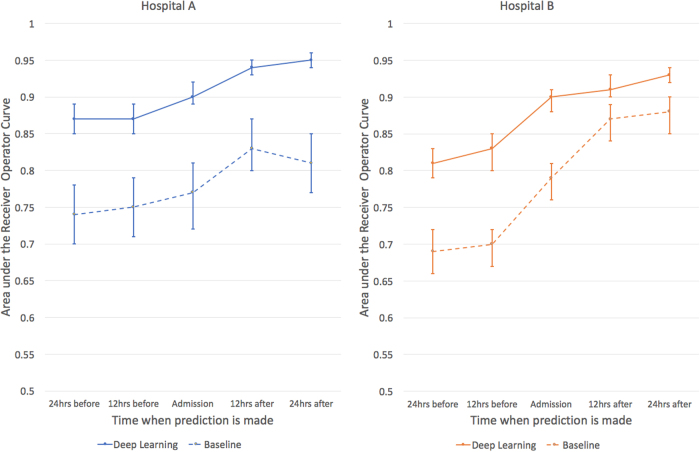
- For inpatient mortality at 24 h after admission, AUROC was 0.95 at Hospital A and 0.93 at Hospital B, versus 0.85 and 0.86 for the augmented Early Warning Score baseline.
- For 30-day readmission at discharge, AUROC was 0.77 at Hospital A and 0.76 at Hospital B, versus 0.70 and 0.68 for the modified HOSPITAL baseline; for long length of stay at 24 h, AUROC was 0.86 and 0.85, versus 0.76 and 0.74 for the modified Liu baseline.
- For predicting all discharge diagnoses (14,025 ICD-9 codes), weighted AUROC was 0.87/0.86 at admission and 0.90 at discharge for both hospitals; micro-F1 at discharge was 0.41 (Hospital A) and 0.40 (Hospital B).
## Methods
- Design: Retrospective study comparing deep learning models to traditional predictive models across two hospitals, with separate results reported for each site.
- Data/sample: De-identified EHR data from UCSF (2012–2016) and UCM (2009–2016), including adults 18+ with hospitalizations of 24 h or longer; UCM also included free-text notes.
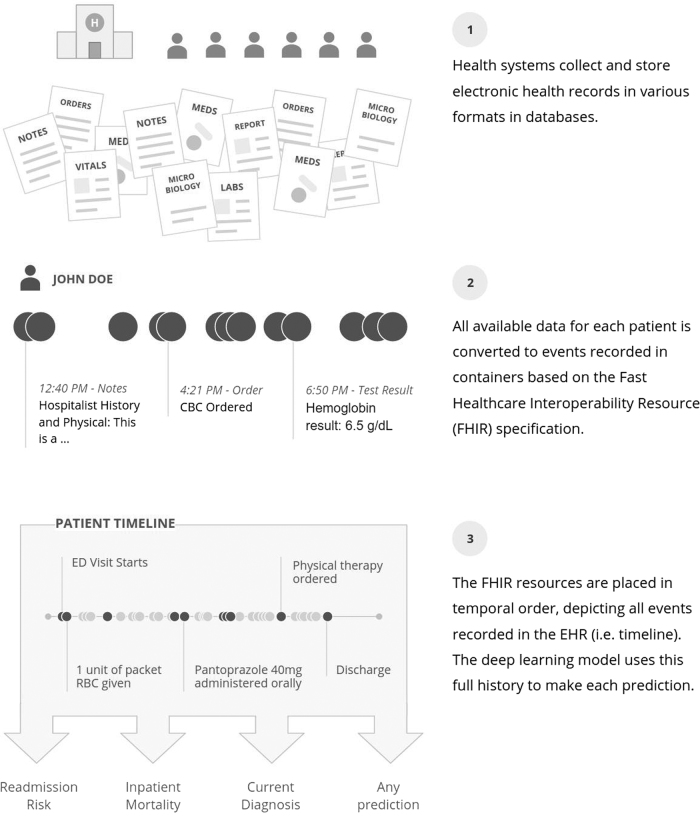
- Analysis: Raw EHR data were converted into time-ordered FHIR-based token sequences and used to train three model types (LSTM, attention-based TANN, and boosted time-based decision stumps), with outputs ensembled; data were split 80/10/10 into development/validation/test sets and evaluated using AUROC, calibration curves, work-up-to-detection ratio, and micro-F1.
## Limitations
- The authors state it is a retrospective study, with “all of the usual limitations.”
- They state that prospective trials are needed to show that accurate predictions improve care.
- They note their approach does not harmonize data between sites, limiting transfer to new sites/cohorts; they also say the methods are computationally intensive and require specialized expertise.
- Evident from the text: the study’s diagnosis task is restricted to ICD-9 codes, and the authors caution that AUROC differences between hospitals, especially regarding notes, cannot be attributed solely to notes because the cohorts differed.
Model-written summary. Check it against the paper before relying on it.
Integrity signals
Registry
Cites
Statistics
Figures
Verification
Claims the paper makes
7 Valid · 0 Not valid · 6 Not checked · 33 Own results and interpretations
The cited sources support only part of this claim — read each source’s verdict below.
In the paper
“We are not aware of a study that predicts as many ICD codes as this study, but our micro-F1 score exceeds that shown on the smaller MIMIC-III dataset when predicting fewer diagnoses (0.40 vs 0.28).68”
§ Scalable and accurate deep learning with electronic health records > Discussion
What the sources say
- Partly supportedcites [68] Perotte A Diagnosis code assignment: models and evaluation metrics J. Am. Med. Inform. Assoc. 2014 21 231 237 10.1136/amiajnl-2013-002159 24296907 PMC3932472 sourceExperimental — accuracy not yet measured
The Results > Prediction models section reports a 27.6% F-measure for the flat SVM, consistent with the cited 0.28 after rounding. But Materials and methods > Datasets identifies the dataset as MIMIC II, not MIMIC-III; the Results also report a higher 39.5% F-measure for this paper’s hierarchy-based model. No page numbers are available in our copy. (LLM, conf=0.89)
hedged- Asserted: passes — The authors put it forward as true.
- Checkable: passes — It can be checked against evidence.
- Load-bearing: passes — The paper’s conclusions depend on it.
- Based: passes — The paper gives a reason why it holds.
- Rests on an assumption not shown here.
- Partly supported
The cited sources support only part of this claim — read each source’s verdict below.
In the paper
“A major challenge in using more of the data available for each patient has been the lack of standards and semantic interoperability of health data from multiple sites.25”
§ Scalable and accurate deep learning with electronic health records > Introduction > Related work
What the sources say
- Partly supportedcites [25] Sun H Semantic processing of EHR data for clinical research J. Biomed. Inform. 2015 58 247 259 10.1016/j.jbi.2015.10.009 26515501 sourceExperimental — accuracy not yet measured
The Introduction (p.1) and Conclusion (Section 5) of our copy clearly support the semantic-interoperability half of the claim: 'the semantic interoperability between different standards remains a challenge', and 'there is no single standard that could serve as the interoperability hub for all the existing clinical data sources and clinical applications', with the Abstract framing the whole paper as responding to 'a growing need to semantically process and integrate clinical data from different sources for clinical research' (multi-site sources are illustrated in Section 4.1.1: a German hospital Oracle database and an Italian regional IHE QED registry). However, the claim's 'lack of standards' is not what this paper says: the Introduction states that standards such as HL7, openEHR and ISO 13606 HAVE been developed to tackle storage and exchange of clinical data, and the residual problem is interoperability AMONG them plus the absence of one unifying hub standard, not an absence of standards. The claim also generalises the source's specific concern (secondary use/reuse of EHR data for clinical research applications) to 'using more of the data available for each patient'. (LLM, conf=0.70)
plainstates a cause- Asserted: passes — The authors put it forward as true.
- Checkable: passes — It can be checked against evidence.
- Load-bearing: passes — The paper’s conclusions depend on it.
- Based: passes — The paper gives a reason why it holds.
- Partly supported
Every source the paper cites for this claim was checked and supports it.
In the paper
“In the current study, we caution that the differences in AUROC across the two hospitals (one with and one without notes) cannot be ascribed to the presence or absence of notes given the difference in cohorts.45”
§ Scalable and accurate deep learning with electronic health records > Discussion
What the sources say
- Supportedcites [45] Walsh C Hripcsak G The effects of data sources, cohort selection, and outcome definition on a predictive model of risk of thirty-day hospital readmissions J. Biomed. Inform. 2014 52 418 426 10.1016/j.jbi.2014.08.006 25182868 PMC4261028 source
The Discussion states that cohort selection affects discriminatory performance and that comparing performance across studies requires the cohorts to be the same. This supports the citing authors’ caution against attributing their two hospitals’ AUROC difference to the presence or absence of notes when the cohorts also differ; the two-hospital comparison is their own study, not a result attributed to this source. (LLM, conf=0.90)
plain- Asserted: passes — The authors put it forward as true.
- Checkable: passes — It can be checked against evidence.
- Load-bearing: passes — The paper’s conclusions depend on it.
- Based: passes — The paper gives a reason why it holds.
- Supported
A result the paper reports from its own data — it cites no other source for it, so there is none to check. The quote shows it is in the paper.
In the paper
“For classifying all diagnosis codes, the weighted AUROCs at admission were 0.87 for Hospital A and 0.86 for Hospital B.”
§ Scalable and accurate deep learning with electronic health records > Results > Inferring discharge diagnoses
plain- Asserted: passes — The authors put it forward as true.
- Checkable: passes — It can be checked against evidence.
- Load-bearing: passes — The paper’s conclusions depend on it.
- Based: passes — The paper gives a reason why it holds.
- Rests on 2 assumptions not shown here.
A result the paper reports from its own data — it cites no other source for it, so there is none to check. The quote shows it is in the paper.
In the paper
“For predicting long length of stay, the AUROCs at 24 h after admission were 0.86 (95% CI 0.86–0.87) for Hospital A and 0.85 (95% CI 0.84–0.86) for Hospital B.”
§ Scalable and accurate deep learning with electronic health records > Results > Long length of stay
plain- Asserted: passes — The authors put it forward as true.
- Checkable: passes — It can be checked against evidence.
- Load-bearing: passes — The paper’s conclusions depend on it.
- Based: passes — The paper gives a reason why it holds.
- Rests on an assumption not shown here.
18 more claims
Create a free account to see all 46 claims and to verify the 2 references still open.
- It may state two separate claims as one. 16
- Probably not a substantial claim. 10
Claims other papers make about this one
Each is checked against this paper’s own text: does it say what the citing paper says it does?
The source backs part of the claim, not all of it — or backs it for a different population, condition or comparison.
In the citing paper
“The most important difference is that the study included co-morbidities, which have been proven to enable better predictions of disease progression trends and treatment outcomes.25,26”
From Development and validation of a screening tool for sepsis without laboratory results in the emergency department: a machine learning study (2025) · cites this paper as [26]
Experimental — accuracy not yet measuredThe source backs part of the claim, not all of it — or backs it for a different population, condition or comparison.
In the citing paper
“For both structured codes and unstructured notes, standardized vocabularies including FHIR [6] and UMLS CUIs [62,63] are introduced to transfer raw tokens into unique phrases to reduce the sparsity of the input data.”
From Deep representation learning of patient data from Electronic Health Records (EHR): A systematic review (2021) · cites this paper as [6]
Experimental — accuracy not yet measuredThe source backs part of the claim, not all of it — or backs it for a different population, condition or comparison.
In the citing paper
“Some FEMRs have tackled this problem by combining unstructured EHR data (i.e., text) with structured EMR data to boost performance on specific phenotyping and prediction tasks69,70.”
From The shaky foundations of large language models and foundation models for electronic health records (2023) · cites this paper as [69]
Experimental — accuracy not yet measuredThe cited source says what the claim attributes to it.
In the citing paper
“To improve performance and provide a degree of interpretability to the model, an attention mechanism is adopted in 13 studies [6,14,27,31,43,57,64,72,76–78,80,88].”
From Deep representation learning of patient data from Electronic Health Records (EHR): A systematic review (2021) · cites this paper as [6]
The cited source says what the claim attributes to it.
In the citing paper
“Advances in artificial intelligence (AI) are driving a revolution across science, enabling exciting new results across chemistry,80–82 biology,83,84 and medicine.85–88”
From Artificial Intelligence and Early Detection of Pancreatic Cancer: 2020 Summative Review (2021) · cites this paper as [85]
8 more claims about this paper
Create a free account to see every claim other papers make about this one.
Citations
Cites
Hochreiter, S., & Schmidhuber, J. (1997) · Neural Computation · doi:10.1162/neco.1997.9.8.1735 · Cited by 102,318 · cited 9×
“Patient records vary significantly in length and density of data-points (e.g. vital sign measurements in an intensive care unit vs outpatient clinic), so we formulated three deep learning neural-network model architectures that take advantage of such data in different ways: one based on recurrent neural networks (LSTM)…”
MethodInfluentialLeCun, Y., Bengio, Y., & Hinton, G. (2015) · Nature · doi:10.1038/nature14539 · Cited by 84,126
Scikit-learn: Machine Learning in Python
Pedregosa, F., Varoquaux, G., Gramfort, A., Michel, V., Thirion, B., Grisel, O., Blondel, M., Müller, A., Nothman, J., Louppe, G., et al. (2012) · arXiv · doi:10.48550/arxiv.1201.0490 · Cited by 71,016
APACHE II: A severity of disease classification system
KNAUS, W. A., DRAPER, E. A., WAGNER, D. P., & ZIMMERMAN, J. E. (1985) · Critical Care Medicine · doi:10.1097/00003246-198510000-00009 · Cited by 13,664
Representation Learning: A Review and New Perspectives
Bengio, Y., Courville, A., & Vincent, P. (2013) · IEEE Transactions on Pattern Analysis and Machine Intelligence · doi:10.1109/tpami.2013.50 · Cited by 13,001 · cited 1×
“Our central insight is that rather than explicitly harmonizing EHR data, mapping it into a highly curated set of structured predictors variables and then feeding those variables into a statistical model, we can instead learn to simultaneously harmonize inputs and predict medical events through direct feature learning…”
BackgroundMIMIC-III, a freely accessible critical care database
Johnson, A. E. W., Pollard, T. J., Shen, L., Lehman, L.-W. H., Feng, M., Ghassemi, M., Moody, B., Szolovits, P., Anthony Celi, L., & Mark, R. G. (2016) · Scientific Data · doi:10.1038/sdata.2016.35 · Cited by 8,141 · cited 1×
“ecord, which includes clinical free-text notes as well as large amounts of structured and semi-structured data. Because of the availability of Medical Information Mart for Intensive Care (MIMIC) data [48], many prior studies also have focused on ICU patients from a single center [92, 41]; other single-center studies h…”
MethodGulshan, V., Peng, L., Coram, M., Stumpe, M. C., Wu, D., Narayanaswamy, A., Venugopalan, S., Widner, K., Madams, T., Cuadros, J., et al. (2016) · JAMA · doi:10.1001/jama.2016.17216 · Cited by 7,697 · cited 1×
“Deep learning emerged as the preferred machine learning approach in machine perception problems ranging from computer vision to speech recognition, but has more recently proven useful in natural language processing, sequence prediction, and mixed modality data settings([36, 16, 21, 56]).”
BackgroundMandell, L. A., Wunderink, R. G., Anzueto, A., Bartlett, J. G., Campbell, G. D., Dean, N. C., Dowell, S. F., File, T. M., Musher, D. M., Niederman, M. S., et al. (2007) · Clinical Infectious Diseases · doi:10.1086/511159 · Cited by 6,202 · cited 1×
“of only 27 variables, rely on traditional generalized linear models, and are built using data at a single center. In clinical practice, simpler models are most commonly deployed, such as the CURB-65 [68, 60], which is a 5-factor model, or single-parameter warning scores [20, 45]. A major challenge in using more of the…”
MethodAPACHE II: a severity of disease classification system.
Knaus, W. A., Draper, E. S., Wagner, D. P., & Zimmerman, J. E. (1985) · PubMed · Cited by 6,034
Predicting the future - big data, machine learning, and clinical medicine
Obermeyer, Z., & Emanuel, E. J. (2016) · New England Journal of Medicine · doi:10.1056/nejmp1606181 · Cited by 3,652 · cited 1×
“In our case study, the model identified elements of the patient’s history and radiology findings to render its prediction, which are critical data-points that a clinician would also use [41].”
Method
Research works printed but not linked: 5
- Wu, Y. et al. Google’s neural machine translation system: bridging the gap between human and machine translation. arXiv [cs.CL] (2016).
- Aczon, M. et al. Dynamic mortality risk predictions in pediatric critical care using recurrent neural networks. arXiv [stat.ML] (2017).
- Suresh, H. et al. Clinical intervention prediction and understanding using deep networks. arXiv [cs.LG] (PMLR, Los Angeles, CA, USA, 2017).
- Razavian, N., Marcus, J. & Sontag, D. Multi-task prediction of disease onsets from longitudinal laboratory tests. In Proceedings of the 1st Machine Learning for Healthcare Conference, (eds F. Doshi-Velez, J. Fackler, D. Kale and B. Wallace, J. Wiens) Vol. 56, pp 73–100 (PMLR, Los Angeles, CA, 2016).
- Bahdanau, D., Cho, K. & Bengio, Y. Neural machine translation by jointly learning to align and translate. arXiv [cs.CL] (2014).
Cited by
High-performance medicine: the convergence of human and artificial intelligence
Topol, E. J. (2019) · Nature Medicine · doi:10.1038/s41591-018-0300-7 · Cited by 10,450
A guide to deep learning in healthcare
Esteva, A., Robicquet, A., Ramsundar, B., Kuleshov, V., DePristo, M., Chou, K., Cui, C., Corrado, G., Thrun, S., & Dean, J. (2019) · Nature Medicine · doi:10.1038/s41591-018-0316-z · Cited by 5,312
“Here, large-scale RNNs are beginning to demonstrate impressive predictive results by combining structured and unstructured data in a semisupervised way 33 .”
BackgroundMethodSelf-citationRajkomar, A., Dean, J., & Kohane, I. (2019) · New England Journal of Medicine · doi:10.1056/nejmra1814259 · Cited by 4,579
Self-citationThe potential for artificial intelligence in healthcare
Davenport, T., & Kalakota, R. (2019) · Future Healthcare Journal · doi:10.7861/futurehosp.6-2-94 · Cited by 3,800
Deep learning for time series classification: a review
Ismail Fawaz, H., Forestier, G., Weber, J., Idoumghar, L., & Muller, P.-A. (2019) · Data Mining and Knowledge Discovery · doi:10.1007/s10618-019-00619-1 · Cited by 3,342
Key challenges for delivering clinical impact with artificial intelligence
Kelly, C. J., Karthikesalingam, A., Suleyman, M., Corrado, G., & King, D. (2019) · BMC Medicine · doi:10.1186/s12916-019-1426-2 · Cited by 3,136
“…scores for transfer to intensive care [33], predicting in-hospital mortality, readmission risk, prolonged length of stay and discharge diagnoses [34], predicting future deterioration, including acute kidney injury [35], improving decision-making strategies, including weaning of mechanical…”
BackgroundSelf-citationOn the Opportunities and Risks of Foundation Models
Bommasani, R., Hudson, D. A., Adeli, E., Altman, R., Arora, S., von Arx, S., Bernstein, M. S., Bohg, J., Bosselut, A., Brunskill, E., et al. (2021) · arXiv · doi:10.48550/arxiv.2108.07258 · Cited by 2,676
Self-citationThe “All of Us” Research Program
The All of Us Research Program Investigators (2019) · New England Journal of Medicine · doi:10.1056/nejmsr1809937 · Cited by 2,440
Christodoulou, E., Ma, J., Collins, G. S., Steyerberg, E. W., Verbakel, J. Y., & Van Calster, B. (2019) · Journal of Clinical Epidemiology · doi:10.1016/j.jclinepi.2019.02.004 · Cited by 2,119
“Some researchers claim that ML will not outperform LR when only a limited set of prespecified predictors is considered, and that the advantage of ML lies in better handling a huge amount of predictors [3,7,12,15,16,104].”
BackgroundAn overview of deep learning in medical imaging focusing on MRI
Lundervold, A. S., & Lundervold, A. (2019) · Zeitschrift für Medizinische Physik · doi:10.1016/j.zemedi.2018.11.002 · Cited by 2,058
“seizures [17] and cardiac arrests [18], to computer-aided detection [19] and diagnosis [20] supporting clinical decision making and survival analysis [21], to drug discovery [22] and as an aid in therapy selection and pharmacogenomics [23], to increased operational efficiency [24], stratified care delivery [25], and a…”
BackgroundPrecision medicine, AI, and the future of personalized health care
Johnson, K. B., Wei, W., Weeraratne, D., Frisse, M. E., Misulis, K., Rhee, K., Zhao, J., & Snowdon, J. L. (2021) · Clinical and Translational Science · doi:10.1111/cts.12884 · Cited by 1,854
“In the provider space, AI is used for evidence-based clinical decision support,(11) detection of adverse events, and the usage of electronic health record (EHR) data to predict patients at risk for readmission.(12) Healthcare policymakers and government use AI-based tools to control and predict infections and outbreak…”
MethodArtificial intelligence and deep learning in ophthalmology
Ting, D. S. W., Pasquale, L. R., Peng, L., Campbell, J. P., Lee, A. Y., Raman, R., Tan, G. S. W., Schmetterer, L., Keane, P. A., & Wong, T. Y. (2019) · British Journal of Ophthalmology · doi:10.1136/bjophthalmol-2018-313173 · Cited by 1,554
Artificial Intelligence and Deep Learning in Ophthalmology
Wang, Z., Keane, P. A., Chiang, M., Cheung, C. Y., Wong, T. Y., & Ting, D. S. W. (2022) · Artificial Intelligence in Medicine · doi:10.1007/978-3-030-64573-1_200 · Cited by 1,524
Ensuring fairness in machine learning to advance health equity.
Rajkomar, A., Hardt, M., Howell, M. D., Corrado, G., & Chin, M. H. (2018) · Annals of Internal Medicine · doi:10.7326/m18-1990 · Cited by 1,341
“For example, a recent model to predict hospital readmissions examined hundreds of thousands of pieces of information, including the free text of clinical notes (24).”
BackgroundSelf-citationA clinically applicable approach to continuous prediction of future acute kidney injury
Tomašev, N., Glorot, X., Rae, J. W., Zielinski, M., Askham, H., Saraiva, A., Mottram, A., Meyer, C., Ravuri, S., Protsyuk, I., et al. (2019) · Nature · doi:10.1038/s41586-019-1390-1 · Cited by 1,086
Study on artificial intelligence: The state of the art and future prospects
Zhang, C., & Lu, Y. (2021) · Journal of Industrial Information Integration · doi:10.1016/j.jii.2021.100224 · Cited by 1,066
Ahmed, Z., Mohamed, K., Zeeshan, S., & Dong, X. (2020) · Database · doi:10.1093/database/baaa010 · Cited by 1,035
“nodular BCC, dermal nevus and seborrheic keratosis in dermatopathology (116); diabetic retinopathy (64); type 2 diabetes subgroups (66); diabetic retinopathy by analyzing retinal images; histological prediction in women with cytological abnormalities; measure medication adherence via camera interface (65); and cardiac…”
BackgroundExplainable artificial intelligence: a comprehensive review
Minh, D., Wang, H. X., Li, Y. F., & Nguyen, T. N. (2022) · Artificial Intelligence Review · doi:10.1007/s10462-021-10088-y · Cited by 983
Multitask learning and benchmarking with clinical time series data
Harutyunyan, H., Khachatrian, H., Kale, D. C., Ver Steeg, G., & Galstyan, A. (2019) · Scientific Data · doi:10.1038/s41597-019-0103-9 · Cited by 958
“isease (19) Other upper respiratory disease (20) Pleurisy; pneumothorax; pulmonary collapse (21) Pneumonia (22) Respiratory failure; insufficiency; arrest (23) Septicemia (except in labor) (24) Shock (25) 1.00 0.75 0.50 0.25 0.00 0.25 0.50 0.75 1.00 Figure 9. Correlations between task labels. Experiments, Model select…”
MethodInfluentialRasmy, L., Xiang, Y., Xie, Z., Tao, C., & Zhi, D. (2021) · npj Digital Medicine · doi:10.1038/s41746-021-00455-y · Cited by 886
“For performance measurement, we used AUC as our primary evaluation metric, which has been widely adopted by many previous studies of disease prediction [12,14,49].”
BackgroundMethodRedefining Radiology: A Review of Artificial Intelligence Integration in Medical Imaging
Najjar, R. (2023) · Diagnostics · doi:10.3390/diagnostics13172760 · Cited by 886
Automated machine learning: Review of the state-of-the-art and opportunities for healthcare
Waring, J., Lindvall, C., & Umeton, R. (2020) · Artificial Intelligence in Medicine · doi:10.1016/j.artmed.2020.101822 · Cited by 834
Markus, A. F., Kors, J. A., & Rijnbeek, P. R. (2021) · Journal of Biomedical Informatics · doi:10.1016/j.jbi.2020.103655 · Cited by 811
Artificial Intelligence and Black‐Box Medical Decisions: Accuracy versus Explainability
London, A. J. (2019) · Hastings Center Report · doi:10.1002/hast.973 · Cited by 801
Xiao, C., Choi, E., & Sun, J. (2018) · Journal of the American Medical Informatics Association · doi:10.1093/jamia/ocy068 · Cited by 792
Artificial intelligence in retina
Schmidt-Erfurth, U., Sadeghipour, A., Gerendas, B. S., Waldstein, S. M., & Bogunović, H. (2018) · Progress in Retinal and Eye Research · doi:10.1016/j.preteyeres.2018.07.004 · Cited by 779
European Resuscitation Council Guidelines 2021: Basic Life Support
Olasveengen, T. M., Semeraro, F., Ristagno, G., Castren, M., Handley, A., Kuzovlev, A., Monsieurs, K. G., Raffay, V., Smyth, M., Soar, J., et al. (2021) · Resuscitation · doi:10.1016/j.resuscitation.2021.02.009 · Cited by 734
“Artificial intelligence (AI) has been applied to health conditions demonstrating that a computer can help with clinical decisionmaking.(126,127) The use of AI as a tool to improve the key components of the chain of survival is under evaluation.”
AI in Medical Imaging Informatics: Current Challenges and Future Directions
Panayides, A. S., Amini, A., Filipovic, N. D., Sharma, A., Tsaftaris, S. A., Young, A., Foran, D., Do, N., Golemati, S., Kurc, T., et al. (2020) · IEEE Journal of Biomedical and Health Informatics · doi:10.1109/jbhi.2020.2991043 · Cited by 713
“Undoubtedly, research in deep learning applications and methods is expected to grow, especially in in view of documented advances across the spectrum of healthcare data, including EHR [260], genomic [261], [262], physiological parameters [263], and natural language data processing [264].”
Artificial Intelligence in Cardiovascular Imaging
Dey, D., Slomka, P. J., Leeson, P., Comaniciu, D., Shrestha, S., Sengupta, P. P., & Marwick, T. H. (2019) · Journal of the American College of Cardiology · doi:10.1016/j.jacc.2018.12.054 · Cited by 680
“Concurrently, ML integration of clinical data and imaging measures has been shown to improve prediction of prognostic outcomes (23,70,96).”
MethodTuli, S., Basumatary, N., Gill, S. S., Kahani, M., Arya, R. C., Wander, G. S., & Buyya, R. (2020) · Future Generation Computer Systems · doi:10.1016/j.future.2019.10.043 · Cited by 669
“SADL [23] ✓ ✓”
BackgroundDeep Learning—A Technology With the Potential to Transform Health Care
Hinton, G. (2018) · JAMA · doi:10.1001/jama.2018.11100 · Cited by 667
Evaluation and accurate diagnoses of pediatric diseases using artificial intelligence
Liang, H., Tsui, B. Y., Ni, H., Valentim, C. C. S., Baxter, S. L., Liu, G., Cai, W., Kermany, D. S., Sun, X., Chen, J., et al. (2019) · Nature Medicine · doi:10.1038/s41591-018-0335-9 · Cited by 659
“This represents an improvement upon other techniques, such as mapping the attributes to a fixed format (Fast Healthcare Interoperability Resources), as was done recently in an AI-based analysis of EHR data 13 .”
MethodSelf-citationFrontiers in Artificial Intelligence and Applications
Yadav, J., Shukla, S., Sharma, K., Soni, N., Agarwal, S., & Pathak, P. C. (2022) · 2022 3rd International Conference on Computation, Automation and Knowledge Management (ICCAKM) · doi:10.1109/iccakm54721.2022.9990098 · Cited by 660
“AI advancement has been a critical development tactic for countries all over the world, boosting global competitiveness and ensuring global security [5] [6].”
BackgroundVellido, A. (2020) · Neural Computing and Applications · doi:10.1007/s00521-019-04051-w · Cited by 635
Introducing artificial intelligence training in medical education
Paranjape, K., Schinkel, M., Nannan Panday, R., Car, J., & Nanayakkara, P. (2019) · JMIR Medical Education · doi:10.2196/16048 · Cited by 634
Minimum information about clinical artificial intelligence modeling: the MI-CLAIM checklist.
Norgeot, B., Quer, G., Beaulieu-Jones, B. K., Torkamani, A., Dias, R., Gianfrancesco, M., Arnaout, R., Kohane, I. S., Saria, S., Topol, E., et al. (2020) · Nature Medicine · doi:10.1038/s41591-020-1041-y · Cited by 665
Self-citationClinicalBERT: Modeling Clinical Notes and Predicting Hospital Readmission
Huang, K., Altosaar, J., & Ranganath, R. (2019) · arXiv · doi:10.48550/arxiv.1904.05342 · Cited by 618
Communication-efficient federated learning via knowledge distillation
Wu, C., Wu, F., Lyu, L., Huang, Y., & Xie, X. (2022) · Nature Communications · doi:10.1038/s41467-022-29763-x · Cited by 618
“T he boom of deep learning in recent years has greatly bene fi ted humans in various fi elds such as intelligent healthcare 1 and personalized web applications 2 .”
Applications of machine learning to diagnosis and treatment of neurodegenerative diseases
Myszczynska, M. A., Ojamies, P. N., Lacoste, A. M. B., Neil, D., Saffari, A., Mead, R., Hautbergue, G. M., Holbrook, J. D., & Ferraiuolo, L. (2020) · Nature Reviews Neurology · doi:10.1038/s41582-020-0377-8 · Cited by 595
The need for uncertainty quantification in machine-assisted medical decision making
Begoli, E., Bhattacharya, T., & Kusnezov, D. (2019) · Nature Machine Intelligence · doi:10.1038/s42256-018-0004-1 · Cited by 597
“…DL methods have been used in the predictive scenarios related to quality of care, and clinical outcomes where large neural networks were used as function estimators in place of classical predictive models, with reported performance better than the state-of-the-art, classical model approaches 9–11 .”
MethodExploiting machine learning for end-to-end drug discovery and development
Ekins, S., Puhl, A. C., Zorn, K. M., Lane, T. R., Russo, D. P., Klein, J. J., Hickey, A. J., & Clark, A. M. (2019) · Nature Materials · doi:10.1038/s41563-019-0338-z · Cited by 578
Artificial intelligence and machine learning in clinical development: a translational perspective
Shah, P., Kendall, F., Khozin, S., Goosen, R., Hu, J., Laramie, J., Ringel, M., & Schork, N. (2019) · npj Digital Medicine · doi:10.1038/s41746-019-0148-3 · Cited by 498
Artificial Intelligence and Personalized Medicine
Schork, N. J. (2019) · Cancer Treatment and Research · doi:10.1007/978-3-030-16391-4_11 · Cited by 488
“[ 52–54] In addition to the creation of learning systems, there are many initiatives to aggregate data on patients and patient materials to enable data mining and AI-based analyses, for example in cancer contexts,[55] but also for more general settings as well.”
BackgroundEarly prediction of circulatory failure in the intensive care unit using machine learning
Hyland, S. L., Faltys, M., Hüser, M., Lyu, X., Gumbsch, T., Esteban, C., Bock, C., Horn, M., Moor, M., Rieck, B., et al. (2020) · Nature Medicine · doi:10.1038/s41591-020-0789-4 · Cited by 477
“This finding reflects recent observations 30 that careful feature design, combined with state-of-the-art ML approaches, can outperform deep learning.”
BackgroundThe “inconvenient truth” about AI in healthcare
Panch, T., Mattie, H., & Celi, L. A. (2019) · npj Digital Medicine · doi:10.1038/s41746-019-0155-4 · Cited by 473
Artificial intelligence in clinical and genomic diagnostics
Dias, R., & Torkamani, A. (2019) · Genome Medicine · doi:10.1186/s13073-019-0689-8 · Cited by 456
Lauritsen, S. M., Kristensen, M., Olsen, M. V., Larsen, M. S., Lauritsen, K. M., Jørgensen, M. J., Lange, J., & Thiesson, B. (2020) · Nature Communications · doi:10.1038/s41467-020-17431-x · Cited by 448
RETRACTED ARTICLE: Artificial intelligence and machine learning in precision and genomic medicine
Quazi, S. (2022) · Medical Oncology · doi:10.1007/s12032-022-01711-1 · Cited by 432
RetractedShifting machine learning for healthcare from development to deployment and from models to data
Zhang, A., Xing, L., Zou, J., & Wu, J. C. (2022) · Nature Biomedical Engineering · doi:10.1038/s41551-022-00898-y · Cited by 420
Hernandez-Boussard, T., Bozkurt, S., Ioannidis, J. P. A., & Shah, N. H. (2020) · Journal of the American Medical Informatics Association · doi:10.1093/jamia/ocaa088 · Cited by 410
Self-citationDeep learning in bioinformatics: Introduction, application, and perspective in the big data era
Li, Y., Huang, C., Ding, L., Li, Z., Pan, Y., & Gao, X. (2019) · Methods · doi:10.1016/j.ymeth.2019.04.008 · Cited by 401
AI in Health: State of the Art, Challenges, and Future Directions
Wang, F., & Preininger, A. (2019) · Yearbook of Medical Informatics · doi:10.1055/s-0039-1677908 · Cited by 398
The Application of Deep Learning in Cancer Prognosis Prediction
Zhu, W., Xie, L., Han, J., & Guo, X. (2020) · Cancers · doi:10.3390/cancers12030603 · Cited by 380
“classification of skin cancer types [72,73], identification of pathological histological slides [74], identification of Aβ plague region in Alzheimer’s patients, classification of cancer cells from normal cells using nuclear morphometric measure [75], and extraction information from electronic health records (EHR) to…”
BackgroundIntegrated multimodal artificial intelligence framework for healthcare applications
Soenksen, L. R., Ma, Y., Zeng, C., Boussioux, L., Villalobos Carballo, K., Na, L., Wiberg, H. M., Li, M. L., Fuentes, I., & Bertsimas, D. (2022) · npj Digital Medicine · doi:10.1038/s41746-022-00689-4 · Cited by 380
Digital transformation in healthcare – architectures of present and future information technologies
Gopal, G., Suter-Crazzolara, C., Toldo, L., & Eberhardt, W. (2019) · Clinical Chemistry and Laboratory Medicine (CCLM) · doi:10.1515/cclm-2018-0658 · Cited by 369
Axes of a revolution: challenges and promises of big data in healthcare
Shilo, S., Rossman, H., & Segal, E. (2020) · Nature Medicine · doi:10.1038/s41591-019-0727-5 · Cited by 370
“Standardizing medical data into a universal format will enable collaborations across multiple countries and resources 34,35 .”
BackgroundThe STARD-AI reporting guideline for diagnostic accuracy studies using artificial intelligence
Sounderajah, V., Guni, A., Liu, X., Collins, G. S., Karthikesalingam, A., Markar, S. R., Golub, R. M., Denniston, A. K., Shetty, S., Moher, D., et al. (2025) · Nature Medicine · doi:10.1038/s41591-025-03953-8 · Cited by 592
Self-citationFahim, Y. A., Hasani, I. W., Kabba, S., & Ragab, W. M. (2025) · European Journal of Medical Research · doi:10.1186/s40001-025-03196-w · Cited by 329
“[31].”
The shaky foundations of large language models and foundation models for electronic health records
Wornow, M., Xu, Y., Thapa, R., Patel, B., Steinberg, E., Fleming, S., Pfeffer, M. A., Fries, J., & Shah, N. H. (2023) · npj Digital Medicine · doi:10.1038/s41746-023-00879-8 · Cited by 324
Self-citationChatGPT for shaping the future of dentistry: the potential of multi-modal large language model
Huang, H., Zheng, O., Wang, D., Yin, J., Wang, Z., Ding, S., Yin, H., Xu, C., Yang, R., Zheng, Q., et al. (2023) · International Journal of Oral Science · doi:10.1038/s41368-023-00239-y · Cited by 324
Self-citationPredicting hospital admission at emergency department triage using machine learning
Hong, W. S., Haimovich, A. D., & Taylor, R. A. (2018) · PLOS ONE · doi:10.1371/journal.pone.0201016 · Cited by 326
Payrovnaziri, S. N., Chen, Z., Rengifo-Moreno, P., Miller, T., Bian, J., Chen, J. H., Liu, X., & He, Z. (2020) · Journal of the American Medical Informatics Association · doi:10.1093/jamia/ocaa053 · Cited by 313
Self-citationDesai, R. J., Wang, S. V., Vaduganathan, M., Evers, T., & Schneeweiss, S. (2020) · JAMA Network Open · doi:10.1001/jamanetworkopen.2019.18962 · Cited by 292
How to develop machine learning models for healthcare
Chen, P.-H. C., Liu, Y., & Peng, L. (2019) · Nature Materials · doi:10.1038/s41563-019-0345-0 · Cited by 274
Chakraborty, C., Bhattacharya, M., Pal, S., & Lee, S.-S. (2024) · Current Research in Biotechnology · doi:10.1016/j.crbiot.2023.100164 · Cited by 274
Machine learning for antimicrobial peptide identification and design
Wan, F., Wong, F., Collins, J. J., & de la Fuente-Nunez, C. (2024) · Nature Reviews Bioengineering · doi:10.1038/s44222-024-00152-x · Cited by 273
“drug discovery and development 28,41–44 , and medical data analysis 45,46 .”
BackgroundCombining structured and unstructured data for predictive models: a deep learning approach
Zhang, D., Yin, C., Zeng, J., Yuan, X., & Zhang, P. (2020) · BMC Medical Informatics and Decision Making · doi:10.1186/s12911-020-01297-6 · Cited by 269
Big data analytics for personalized medicine
Cirillo, D., & Valencia, A. (2019) · Current Opinion in Biotechnology · doi:10.1016/j.copbio.2019.03.004 · Cited by 269
Deep learning and the electrocardiogram: review of the current state-of-the-art
Somani, S., Russak, A. J., Richter, F., Zhao, S., Vaid, A., Chaudhry, F., De Freitas, J. K., Naik, N., Miotto, R., Nadkarni, G. N., et al. (2021) · EP Europace · doi:10.1093/europace/euaa377 · Cited by 264
Deep Learning for Time Series Classification and Extrinsic Regression: A Current Survey
Mohammadi Foumani, N., Miller, L., Tan, C. W., Webb, G. I., Forestier, G., & Salehi, M. (2024) · ACM Computing Surveys · doi:10.1145/3649448 · Cited by 268
“There are many applications that require time series analysis such as human activity recognition [3–5], diagnosis based on electronic health records [6, 7], and systems monitoring problems [8].”
BackgroundArtificial intelligence in positive mental health: a narrative review
Thakkar, A., Gupta, A., & De Sousa, A. (2024) · Frontiers in Digital Health · doi:10.3389/fdgth.2024.1280235 · Cited by 251
Ten Ways Artificial Intelligence Will Transform Primary Care
Lin, S. Y., Mahoney, M. R., & Sinsky, C. A. (2019) · Journal of General Internal Medicine · doi:10.1007/s11606-019-05035-1 · Cited by 248
Ayala Solares, J. R., Diletta Raimondi, F. E., Zhu, Y., Rahimian, F., Canoy, D., Tran, J., Pinho Gomes, A. C., Payberah, A. H., Zottoli, M., Nazarzadeh, M., et al. (2020) · Journal of Biomedical Informatics · doi:10.1016/j.jbi.2019.103337 · Cited by 247
Artificial Intelligence in Pathology
Chang, H. Y., Jung, C. K., Woo, J. I., Lee, S., Cho, J., Kim, S. W., & Kwak, T.-Y. (2019) · Journal of Pathology and Translational Medicine · doi:10.4132/jptm.2018.12.16 · Cited by 246
Should Health Care Demand Interpretable Artificial Intelligence or Accept “Black Box” Medicine?
Wang, F., Kaushal, R., & Khullar, D. (2020) · Annals of Internal Medicine · doi:10.7326/m19-2548 · Cited by 244
“intelligence (AI), such as detection of atrial fibrillation from electrocardiography, retinopathy from optical coherence tomography, and in-hospital mortality risk from electronic health records, have emerged (1–3).”
BackgroundMachine Learning for Clinical Outcome Prediction
Shamout, F., Zhu, T., & Clifton, D. A. (2021) · IEEE Reviews in Biomedical Engineering · doi:10.1109/rbme.2020.3007816 · Cited by 239
“Some studies also report the false positives to true positives ratio [11] and the inverse of the PPV known as the work-up-to-detection ratio [58],”
BackgroundDang, A. (2023) · Pharmaceutical Medicine · doi:10.1007/s40290-022-00456-6 · Cited by 241
“One study even reported successful prediction of multiple medical events when ML tools were applied to EHR data from various centres [85].”
MethodSi, Y., Du, J., Li, Z., Jiang, X., Miller, T., Wang, F., Jim Zheng, W., & Roberts, K. (2021) · Journal of Biomedical Informatics · doi:10.1016/j.jbi.2020.103671 · Cited by 235
“For both structured codes and unstructured notes, standardized vocabularies including FHIR [6] and UMLS CUIs [55,56] are introduced to transfer”
BackgroundMethodInfluentialDubovitskaya, A., Baig, F., Xu, Z., Shukla, R., Zambani, P. S., Swaminathan, A., Jahangir, M. M., Chowdhry, K., Lachhani, R., Idnani, N., et al. (2020) · Journal of Medical Internet Research · doi:10.2196/13598 · Cited by 234
“Historical EHR data can also empower predictive modeling to drive personalized medicine and improve health care quality through machine learning [2].”
BackgroundMachine learning model to predict mental health crises from electronic health records
Garriga, R., Mas, J., Abraha, S., Nolan, J., Harrison, O., Tadros, G., & Matic, A. (2022) · Nature Medicine · doi:10.1038/s41591-022-01811-5 · Cited by 229
“Nonetheless, several studies have considered predictions of unplanned hospital readmissions regardless of their underpinning reason 17,43–46 and obtained AUROCs between 0.750 and 0.791 for predicting the risk of readmission within 30 days (similar to our results of 0.797 within 28 days).”
ResultInfluentialA scalable discrete-time survival model for neural networks
Gensheimer, M. F., & Narasimhan, B. (2019) · PeerJ · doi:10.7717/peerj.6257 · Cited by 229
Time Series Prediction Using Deep Learning Methods in Healthcare
Morid, M. A., Sheng, O. R. L., & Dunbar, J. (2023) · ACM Transactions on Management Information Systems · doi:10.1145/3531326 · Cited by 231
“This approach also proved to be efficacious in predicting heart failure [46], vascular diseases [82], hospital mortality [13] and hospital readmission [13].”
BackgroundMethodInfluentialA systematic review of the prediction of hospital length of stay: Towards a unified framework
Stone, K., Zwiggelaar, R., Jones, P., & Mac Parthaláin, N. (2022) · PLOS Digital Health · doi:10.1371/journal.pdig.0000017 · Cited by 231
“2018 [21] General LoS Intelligent Data Mining”
BackgroundNatural Language Processing for Smart Healthcare
Zhou, B., Yang, G., Shi, Z., & Ma, S. (2024) · IEEE Reviews in Biomedical Engineering · doi:10.1109/rbme.2022.3210270 · Cited by 230
“Voice-controlled home automation systems and robots may assist the elderly and the disabled in their daily lives [171], while robots (especially androids and other robots that communicate with people) can even encourage and accompany them through social interactions [172], [173].”
BackgroundRise of Deep Learning for Genomic, Proteomic, and Metabolomic Data Integration in Precision Medicine
Grapov, D., Fahrmann, J., Wanichthanarak, K., & Khoomrung, S. (2018) · OMICS: A Journal of Integrative Biology · doi:10.1089/omi.2018.0097 · Cited by 226
“More recently, researchers have developed near automated methods to harmonize raw EHR data to FHIR formats (Rajkomar et al., 2018).”
MethodNorgeot, B., Glicksberg, B. S., Trupin, L., Lituiev, D., Gianfrancesco, M., Oskotsky, B., Schmajuk, G., Yazdany, J., & Butte, A. J. (2019) · JAMA Network Open · doi:10.1001/jamanetworkopen.2019.0606 · Cited by 225
Self-citationMachine learning for comprehensive forecasting of Alzheimer’s Disease progression
Fisher, C. K., Smith, A. M., Walsh, J. R., Diseases, C. A. M., Simon, A. J., Edgar, C., Jack, C. R., Holtzman, D., Russell, D., Hill, D., et al. (2019) · Scientific Reports · doi:10.1038/s41598-019-49656-2 · Cited by 223
Deep learning and alternative learning strategies for retrospective real-world clinical data
Chen, D., Liu, S., Kingsbury, P., Sohn, S., Storlie, C. B., Habermann, E. B., Naessens, J. M., Larson, D. W., & Liu, H. (2019) · npj Digital Medicine · doi:10.1038/s41746-019-0122-0 · Cited by 223
The state of the art of deep learning models in medical science and their challenges
Bhatt, C., Kumar, I., Vijayakumar, V., Singh, K. U., & Kumar, A. (2021) · Multimedia Systems · doi:10.1007/s00530-020-00694-1 · Cited by 222
Machine-learning-based diagnostics of EEG pathology
Gemein, L. A. W., Schirrmeister, R. T., Chrabąszcz, P., Wilson, D., Boedecker, J., Schulze-Bonhage, A., Hutter, F., & Ball, T. (2020) · NeuroImage · doi:10.1016/j.neuroimage.2020.117021 · Cited by 218
Machine learning and algorithmic fairness in public and population health
Mhasawade, V., Zhao, Y., & Chunara, R. (2021) · Nature Machine Intelligence · doi:10.1038/s42256-021-00373-4 · Cited by 218
Predicting Alzheimer's disease progression using deep recurrent neural networks
Nguyen, M., He, T., An, L., Alexander, D. C., Feng, J., & Yeo, B. T. T. (2020) · NeuroImage · doi:10.1016/j.neuroimage.2020.117203 · Cited by 210
“In the context of medical applications, RNNs have been used to model electronic health records (Lipton et al., 2016a; Choi et al., 2016; Esteban et al., 2016; Pham et al., 2017; Rajkomar et al., 2018; Suo et al., 2018) and AD disease progression (Nguyen et al., 2018; Ghazi et al., 2019).”
MethodArtificial intelligence in science: An emerging general method of invention
Bianchini, S., Müller, M., & Pelletier, P. (2022) · Research Policy · doi:10.1016/j.respol.2022.104604 · Cited by 213
Kim, M., Chen, C., Wang, P., Mulvey, J. J., Yang, Y., Wun, C., Antman-Passig, M., Luo, H.-B., Cho, S., Long-Roche, K., et al. (2022) · Nature Biomedical Engineering · doi:10.1038/s41551-022-00860-y · Cited by 214
Deep representation learning of electronic health records to unlock patient stratification at scale
Landi, I., Glicksberg, B. S., Lee, H.-C., Cherng, S., Landi, G., Danieletto, M., Dudley, J. T., Furlanello, C., & Miotto, R. (2020) · npj Digital Medicine · doi:10.1038/s41746-020-0301-z · Cited by 213
KAME: Knowledge-based Attention Model for Diagnosis Prediction in Healthcare
Ma, F., You, Q., Xiao, H., Chitta, R., Zhou, J., & Gao, J. (2018) · Proceedings of the 27th ACM International Conference on Information and Knowledge Management · doi:10.1145/3269206.3271701 · Cited by 213
Machine learning as a supportive tool to recognize cardiac arrest in emergency calls
Blomberg, S. N., Folke, F., Ersbøll, A. K., Christensen, H. C., Torp-Pedersen, C., Sayre, M. R., Counts, C. R., & Lippert, F. K. (2019) · Resuscitation · doi:10.1016/j.resuscitation.2019.01.015 · Cited by 209
Converting tabular data into images for deep learning with convolutional neural networks
Zhu, Y., Brettin, T., Xia, F., Partin, A., Shukla, M., Yoo, H., Evrard, Y. A., Doroshow, J. H., & Stevens, R. L. (2021) · Scientific Reports · doi:10.1038/s41598-021-90923-y · Cited by 210
Singh, A., Kanaujia, A., Singh, V. K., & Vinuesa, R. (2024) · Sustainable Development · doi:10.1002/sd.2706 · Cited by 211
Benefits and Risks of AI in Health Care: Narrative Review
Chustecki, M. (2024) · Interactive Journal of Medical Research · doi:10.2196/53616 · Cited by 208
“ML models can also be used to forecast populations at risk of specific diseases or accidents [19,20].”
Metadata
- Authors
- Rajkomar, A., Oren, E., Chen, K., Dai, A. M., Hajaj, N., Hardt, M., Liu, P. J., Liu, X., Marcus, J., Sun, M., Sundberg, P., Yee, H., Zhang, K., Zhang, Y., Flores, G., Duggan, G. E., Irvine, J., Le, Q., Litsch, K., Mossin, A., Tansuwan, J., Wang, D., Wexler, J., Wilson, J., Ludwig, D., Volchenboum, S. L., Chou, K., Pearson, M., Madabushi, S., Shah, N. H., Butte, A. J., Howell, M. D., Cui, C., Corrado, G. S., & Dean, J.
- Affiliations
- Google (United States) (US)
- University of California, San Francisco (US)
- University of Chicago (US)
- Stanford University (US)
- Corresponding author
- Rajkomar, Alvin
- Venue
- npj Digital Medicine
- Published
- 2018-05-08
- Volume
- 1
- Issue
- 1
- Pages
- 18-18
- ISSN
- 2398-6352 (ISSN-L)
- PMC
- PMC6550175
- OpenAlex
- W2784499877
- Cited by
- 2,648
- References
- 72
- Citations by year
- 2026: 494 · 2025: 457 · 2024: 370 · 2023: 280 · 2022: 228 · 2021: 304 · 2020: 275 · 2019: 186 · 2018: 54
- FWCI
- 115.37
- Type
- journal article
- Language
- en
- Open access
- gold
- doi.org
- Licence
- cc-by
- creativecommons.org/licenses/by/4.0 (tdm)
- creativecommons.org/licenses/by/4.0 (vor)
- Locations
- npj Digital Medicine (publishedVersion, cc-by)
- arXiv (Cornell University) (publishedVersion)
- Europe PMC (PubMed Central) (publishedVersion, cc-by)
- PubMed Central (publishedVersion, cc-by)
- PubMed (publishedVersion)
- DOAJ (DOAJ: Directory of Open Access Journals) (submittedVersion, cc-by-sa)
- eScholarship (California Digital Library) (submittedVersion, cc-by)
- arXiv (Cornell University)
- Topics
- Physical Sciences › Computer Science › Artificial Intelligence › Machine Learning in Healthcare
- Health Sciences › Health Professions › Health Information Management › Electronic Health Records Systems
- Health Sciences › Health Professions › Health Information Management › Artificial Intelligence in Healthcare
- Keywords
- electronic health records, FHIR, deep learning, in-hospital mortality prediction, unplanned hospital readmission, length of hospital stay, hospital discharge diagnoses, clinical notes, data harmonization
About these checks
Registry, retraction, Cites and statistics results are computed, not judged, with one exception: a printed reference that no index lists is read once by a model before it counts as a citation error. Claims are extracted by a model and kept only when their quote appears verbatim in the text; each cited source is then checked, with a model’s help, for whether it says what the claim relies on. Those verdicts can be wrong — read the claim’s quote and the cited source before relying on one.
The claim verdicts this report counts are experimental: their accuracy is not yet measured.
A language model drew the claims from the paper on 2026-10-10, under version 3 of the claim definition (model deepseek-v4.1-flash, prompt extract-v3).
A second model labelled each claim on 2026-10-10 (model jev-1.13-20260917, definition revision gold-guideline-v0.2).
Cited sources are checked with a language model’s help (gpt-6-sol and qwen3.8-omni-flash).
Statistics and arithmetic are recomputed, not judged.
Confidence bands are shown only for fields calibrated on our annotated test set. None is calibrated yet, so no band is shown.
What counts as a claim ›How we measure confidence ›How we check this ›
Are you an author, or do you see a problem with this page? Request a review
Data sources
Bibliographic data: Semantic Scholar, OpenAlex, Crossref.
Contains information from the Semantic Scholar Academic Graph Datasets, made available under the ODC Attribution License (ODC-BY 1.0).
Semantic Scholar’s data is described in: Kinney, R., et al. (2023). The Semantic Scholar Open Data Platform. arXiv:2301.10140.
