

Wearable sensors for Parkinson’s disease: which data are worth collecting for training symptom detection models
Open accessThe DOI matches its Crossref record; 40 of the 42 references it cites were found in a registry or an index.
Abstract
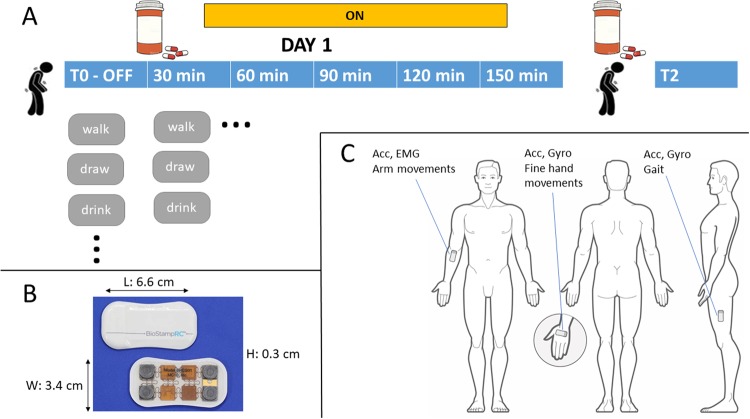
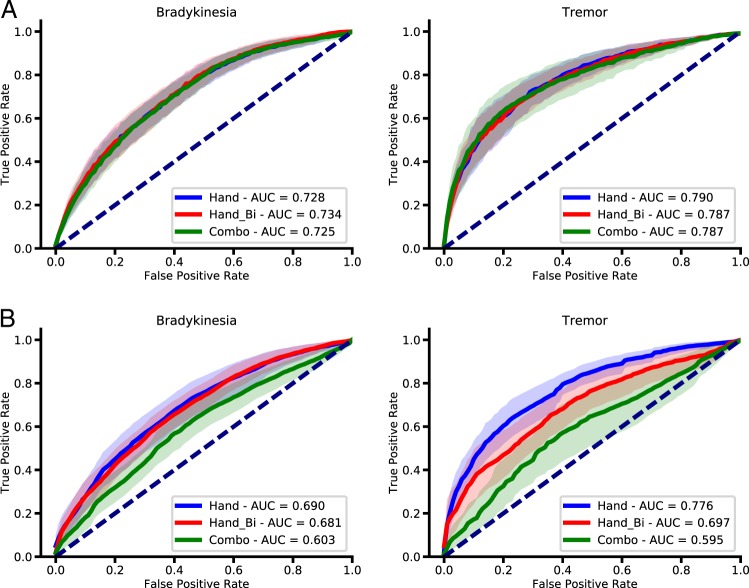
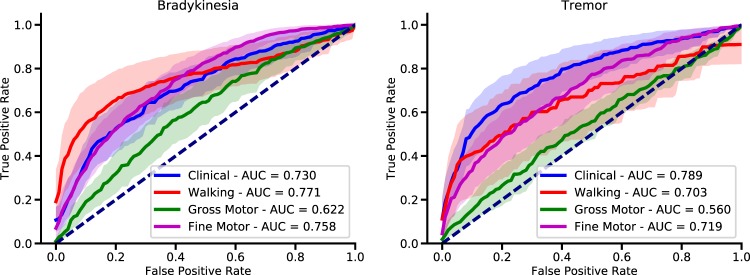
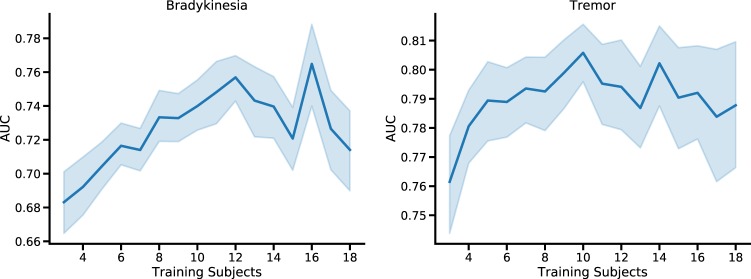
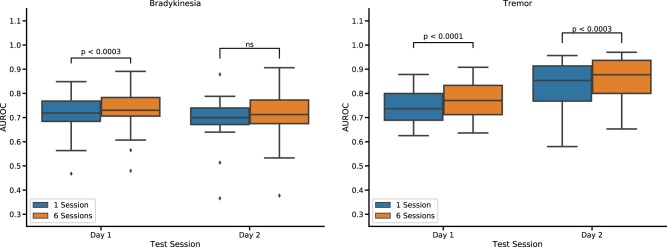
Machine learning algorithms that use data streams captured from soft wearable sensors have the potential to automatically detect PD symptoms and inform clinicians about the progression of disease. However, these algorithms must be trained with annotated data from clinical experts who can recognize symptoms, and collecting such data are costly. Understanding how many sensors and how much labeled data are required is key to successfully deploying these models outside of the clinic. Here we recorded movement data using 6 flexible wearable sensors in 20 individuals with PD over the course of multiple clinical assessments conducted on 1 day and repeated 2 weeks later. Participants performed 13 common tasks, such as walking or typing, and a clinician rated the severity of symptoms (bradykinesia and tremor). We then trained convolutional neural networks and statistical ensembles to detect whether a segment of movement showed signs of bradykinesia or tremor based on data from tasks performed by other individuals. Our results show that a single wearable sensor on the back of the hand is sufficient for detecting bradykinesia and tremor in the upper extremities, whereas using sensors on both sides does not improve performance. Increasing the amount of training data by adding other individuals can lead to improved performance, but repeating assessments with the same individuals—even at different medication states—does not substantially improve detection across days. Our results suggest that PD symptoms can be detected during a variety of activities and are best modeled by a dataset incorporating many individuals.
Overview
The claims and statistics of this paper haven’t been checked yet.
Free: it reads the open-access text and checks the first 5 claims that cite a source we can check. Create a free account to check every claim.
Integrity signals
Registry
Cites
Statistics
Figures
Verification
Claims the paper makes
The claims and statistics of this paper haven’t been checked yet.
Free: it reads the open-access text and checks the first 5 claims that cite a source we can check. Create a free account to check every claim.
Claims other papers make about this one
Each is checked against this paper’s own text: does it say what the citing paper says it does?
The check wasn’t confident either way, so it gives no verdict — never disputed.
In the citing paper
“Moreover, some diseases of the locomotor system provoke abnormal elevations of metabolites and biomarkers, such as L-dopa in Parkinson’s disease[246–248] uric acid in gout,[45] which are very important evaluation factors.”
From Flexible Electronics and Devices as Human–Machine Interfaces for Medical Robotics (2022) · cites this paper as [246]
Experimental — accuracy not yet measuredIn the citing paper
“For example, for Parkinson's disease, a single sensor on the hand is enough to detect tremors 9 .”
From Skin sensors are the future of health care (2019) · cites this paper as [9]
Self-check
Percentages, sums and reported differences re-computed from the paper’s own numbers.
The self-check needs the paper’s full text.
Citations
Cites
Breiman, L. (2001) · Machine Learning · doi:10.1023/a:1010933404324 · Cited by 133,538
LeCun, Y., Bengio, Y., & Hinton, G. (2015) · Nature · doi:10.1038/nature14539 · Cited by 84,126
(2014) · Cited by 33,419
Parkinson's disease: clinical features and diagnosis
Jankovic, J. (2008) · Journal of Neurology, Neurosurgery & Psychiatry · doi:10.1136/jnnp.2007.131045 · Cited by 5,720
Adams, J. L., Dinesh, K., Xiong, M., Tarolli, C. G., Sharma, S., Sheth, N., Aranyosi, A. J., Zhu, W., Goldenthal, S., Biglan, K. M., et al. (2017) · Digital Biomarkers · doi:10.1159/000479018 · Cited by 3,171
Epidemiology of Parkinson’s disease
Tysnes, O.-B., & Storstein, A. (2017) · Journal of Neural Transmission · doi:10.1007/s00702-017-1686-y · Cited by 2,414
The prevalence of Parkinson's disease: a systematic review and meta-analysis
Pringsheim, T., Jette, N., Frolkis, A., & Steeves, T. D. L. (2014) · Movement Disorders · doi:10.1002/mds.25945 · Cited by 2,188
The Unified Parkinson's Disease Rating Scale (UPDRS): Status and recommendations
Movement Disorder Society Task Force on Rating Scales for Parkinson's Disease (2003) · Movement Disorders · doi:10.1002/mds.10473 · Cited by 1,810
Technology in Parkinson’s disease: challenges and opportunities
Espay, A. J., Bonato, P., Nahab, F. B., Maetzler, W., Dean, J. M., Klucken, J., Eskofier, B. M., Merola, A., Horak, F., Lang, A. E., et al. (2016) · Movement Disorders · doi:10.1002/mds.26642 · Cited by 654
Self-citationMonitoring Motor Fluctuations in Patients With Parkinson's Disease Using Wearable Sensors
Patel, S., Lorincz, K., Hughes, R., Huggins, N., Growdon, J., Standaert, D., Akay, M., Dy, J., Welsh, M., & Bonato, P. (2009) · IEEE Transactions on Information Technology in Biomedicine · doi:10.1109/titb.2009.2033471 · Cited by 623
Cited by
Items 201–214 of 214
The role of wearable technology in improving the care of pediatric heart failure
Edelson, J. B., Gao, S., Gandla, D., & Keating, B. J. (2025) · Elsevier eBooks · doi:10.1016/b978-0-443-13279-7.00035-3
Vilches, J. R., Thomsen, T. H., Karottki, N. F. L. C., Biering‐Sørensen, B., Puthusserypady, S. K., & Tolu, S. (2025) · Annual International Conference of the IEEE Engineering in Medicine and Biology Society (EMBC) · doi:10.1109/embc58623.2025.11253014 · Cited by 3
“Similar studies with comparable primary endpoints, such as the classification of healthy individuals versus PD patients based on motion data from tasks selected by MDS-UPDRS III, have successfully used this sample size, supporting its suitability for the present study [22], [34], [35], [36].”
Deep Learning-Driven Automated Assessment of Parkinson's Disease Severity From Hand Tremor
Vanitha, V., Hari, B. V., & Adithyan, B. (2025) · Advances in computational intelligence and robotics book series · doi:10.4018/979-8-3693-9521-9.ch014
Virbel-Fleischman, C. (2021) · theses.fr (ABES) · doi:10.70675/21583008z772az4c86z822dza5cca46513d5
Analysis of Early Signs of Parkinson's Disease Using Wrist-Worn Imu and Machine Learning
Hammoud, M., Haydar, O., Андреевич, Л. С., & Somov, A. (2026) · International Youth Conference on Radio Electronics, Electrical and Power Engineering (REEPE) · doi:10.1109/reepe69046.2026.11481429
“IMU-based approaches span a spectrum of complexity, ranging from single-sensor configurations (e.g., wrist [18] or dorsum-mounted [19]) to bilateral wrist setups exploiting asymmetry [20], [21], and to multi-sensor arrays distributed across the trunk and limbs [22], [23].”
SGC-RML: A reliable and interpretable longitudinal assessment for PD in real-world DNSPreprint
Wei, W., Gao, R., Yao, S., 赵萱珍, Huang, C., & Huang, H.-W. (2026) · arXiv (Cornell University) · doi:10.48550/arxiv.2605.08302
“These resources have driven the application of machine learning and deep learning in PD diagnosis, symptom assessment, remote monitoring, and progression modeling [15, 16, 47, 45].”
Hammoud, M., & Somov, A. (2026) · IEEE Sensors Journal · doi:10.1109/jsen.2026.3701543
“The study by Lonini et al. [25] redefined e ffi ciency in PD monitoring by demonstrating that a single dorsum-mounted sensor could e ff ectively capture tremor and BR in the upper extremities during daily activities (e.g., walking and typing).”
A Cost-Effective Flexible Sensor for Physical Activity and Resting Respiration Monitoring
Sharmin, S., Adry, T. Z., & Haider, M. R. (2026) · IEEE Journal on Flexible Electronics · doi:10.1109/jflex.2026.3711570
“These metrics provide critical insights into pulmonary function, cardiovascular health, and overall physical well-being [8], [9], [10], [11].”
Geetha, D., & Kumar, M. S. (2026) · International Journal of Artificial Intelligence and Machine Learning · doi:10.51483/ijaiml.6.6s.2026.139-162
Early detection of Parkinson’s disease using multimodal information
Ghosh, S., & Roy, S. D. (2026) · Elsevier eBooks · doi:10.1016/b978-0-443-33455-9.00033-x
DiningMotion: Transforming Everyday Dining Objects into a Hand Movement Monitoring Platform
Guo, J., Agarwal, S., An, J., Dahle, E., Prasad, A., Savic, M., Taur, R., & Dong, Y. (2026) · doi:10.1145/3842657.3842782
Advancing Multidisciplinary Research for Sustainable Innovation and Global Excellence
Rabha, B., Catherine, J. B., Hemalatha, D., & Brishya, G. (2026) · doi:10.65647/msp/142/2026
Modeling cognitive impairment in Parkinson's patients using deep learning
Thakur, A., Sharma, R., Devi, A., Kumar, K., & Shah, T. M. (2026) · Elsevier eBooks · doi:10.1016/b978-0-443-27722-1.00013-4
She, Z., Shi, L., Xie, D., Jiang, F., Zhong, C., Cheng, Z., Shuning, J., Xie, H., Li, Y., & Zhou, J. (2026) · Chemical Engineering Journal · doi:10.1016/j.cej.2026.183437
Metadata
- Authors
- Lonini, L., Dai, A., Shawen, N., Simuni, T., Poon, C., Shimanovich, L., Daeschler, M., Ghaffari, R., Rogers, J. A., & Jayaraman, A.
- Affiliations
- Northwestern University (US)
- Michael J. Fox Foundation (US)
- Corresponding author
- Jayaraman, Arun
- ORCID
- Venue
- npj Digital Medicine
- Published
- 2018-11-23
- Volume
- 1
- Issue
- 1
- Pages
- 64-64
- ISSN
- 2398-6352 (ISSN-L)
- PMC
- PMC6550186
- OpenAlex
- W2900586747
- Semantic Scholar
- 69bc66f31dc79359b2ec7e83e9edb927adb2f13a
- Cited by
- 209
- References
- 42
- Citations by year
- 2026: 11 · 2025: 31 · 2024: 23 · 2023: 31 · 2022: 29 · 2021: 38 · 2020: 32 · 2019: 14
- FWCI
- 10.50
- Type
- journal article
- Language
- en
- Open access
- gold
- doi.org
- Licence
- cc-by
- creativecommons.org/licenses/by/4.0 (tdm)
- creativecommons.org/licenses/by/4.0 (vor)
- Locations
- npj Digital Medicine (publishedVersion, cc-by)
- Europe PMC (PubMed Central) (publishedVersion, cc-by)
- PubMed Central (publishedVersion, cc-by)
- PubMed (publishedVersion)
- DOAJ (DOAJ: Directory of Open Access Journals) (submittedVersion)
- Funders
- Michael J. Fox Foundation for Parkinson's Research (14702)
- Northwestern University (T32GM008152)
- National Institutes of Health
- Feinberg School of Medicine
- National Institute of General Medical Sciences (T32GM008152)
- Topics
- Physical Sciences › Computer Science › Computer Vision and Pattern Recognition › Context-Aware Activity Recognition Systems
- Physical Sciences › Engineering › Biomedical Engineering › Non-Invasive Vital Sign Monitoring
- Health Sciences › Medicine › Clinical Neurology › Parkinson's Disease Mechanisms and Treatments
- Keywords
- Parkinson's disease, wearable sensors, bradykinesia, tremor, symptom detection, convolutional neural networks, statistical ensembles, movement data, sensor placement, training data size, cross-subject transfer, medication state, upper limb
About these checks
Registry, retraction, Cites and statistics results are computed, not judged, with one exception: a printed reference that no index lists is read once by a model before it counts as a citation error. Claims are extracted by a model and kept only when their quote appears verbatim in the text; each cited source is then checked, with a model’s help, for whether it says what the claim relies on. Those verdicts can be wrong — read the claim’s quote and the cited source before relying on one.
Statistics and arithmetic are recomputed, not judged.
Confidence bands are shown only for fields calibrated on our annotated test set. None is calibrated yet, so no band is shown.
What counts as a claim ›How we measure confidence ›How we check this ›
Are you an author, or do you see a problem with this page? Request a review
Data sources
Bibliographic data: Semantic Scholar, OpenAlex, Crossref.
Contains information from the Semantic Scholar Academic Graph Datasets, made available under the ODC Attribution License (ODC-BY 1.0).
Semantic Scholar’s data is described in: Kinney, R., et al. (2023). The Semantic Scholar Open Data Platform. arXiv:2301.10140.
