

Wearable sensors for Parkinson’s disease: which data are worth collecting for training symptom detection models
Open accessThe DOI matches its Crossref record; 40 of the 42 references it cites were found in a registry or an index.
Abstract
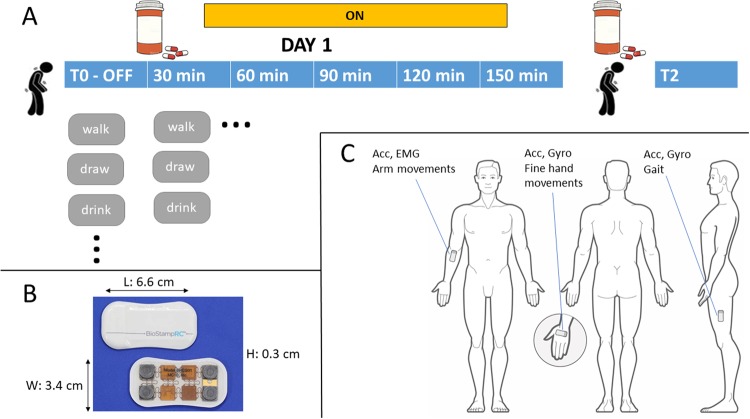
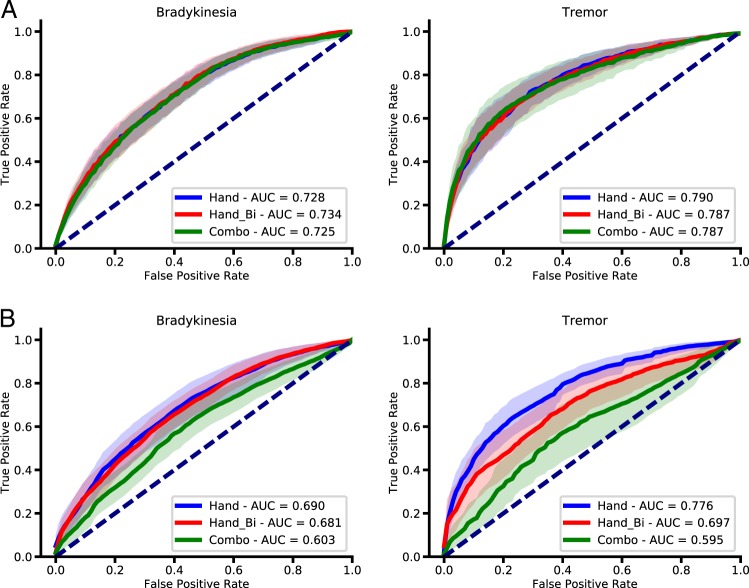
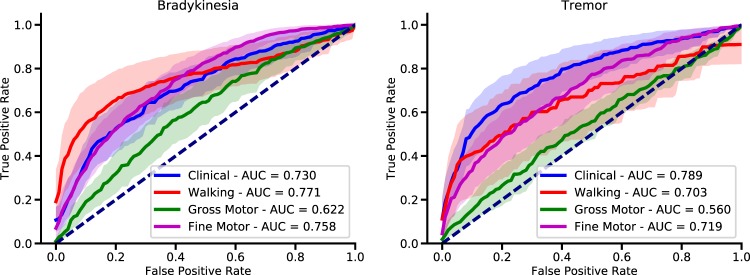
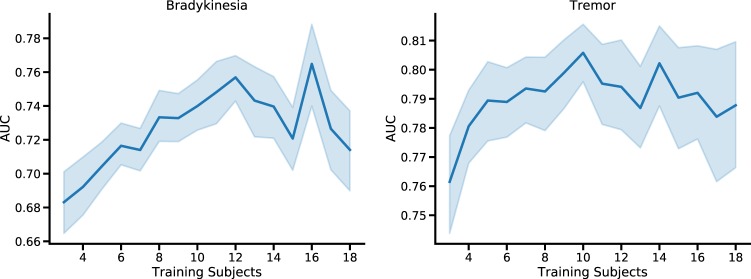
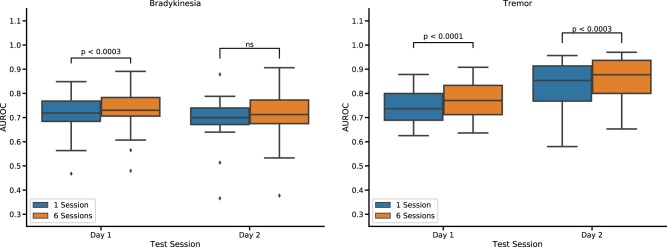
Machine learning algorithms that use data streams captured from soft wearable sensors have the potential to automatically detect PD symptoms and inform clinicians about the progression of disease. However, these algorithms must be trained with annotated data from clinical experts who can recognize symptoms, and collecting such data are costly. Understanding how many sensors and how much labeled data are required is key to successfully deploying these models outside of the clinic. Here we recorded movement data using 6 flexible wearable sensors in 20 individuals with PD over the course of multiple clinical assessments conducted on 1 day and repeated 2 weeks later. Participants performed 13 common tasks, such as walking or typing, and a clinician rated the severity of symptoms (bradykinesia and tremor). We then trained convolutional neural networks and statistical ensembles to detect whether a segment of movement showed signs of bradykinesia or tremor based on data from tasks performed by other individuals. Our results show that a single wearable sensor on the back of the hand is sufficient for detecting bradykinesia and tremor in the upper extremities, whereas using sensors on both sides does not improve performance. Increasing the amount of training data by adding other individuals can lead to improved performance, but repeating assessments with the same individuals—even at different medication states—does not substantially improve detection across days. Our results suggest that PD symptoms can be detected during a variety of activities and are best modeled by a dataset incorporating many individuals.
Overview
The claims and statistics of this paper haven’t been checked yet.
Free: it reads the open-access text and checks the first 5 claims that cite a source we can check. Create a free account to check every claim.
Integrity signals
Registry
Cites
Statistics
Figures
Verification
Claims the paper makes
The claims and statistics of this paper haven’t been checked yet.
Free: it reads the open-access text and checks the first 5 claims that cite a source we can check. Create a free account to check every claim.
Claims other papers make about this one
Each is checked against this paper’s own text: does it say what the citing paper says it does?
The check wasn’t confident either way, so it gives no verdict — never disputed.
In the citing paper
“Moreover, some diseases of the locomotor system provoke abnormal elevations of metabolites and biomarkers, such as L-dopa in Parkinson’s disease[246–248] uric acid in gout,[45] which are very important evaluation factors.”
From Flexible Electronics and Devices as Human–Machine Interfaces for Medical Robotics (2022) · cites this paper as [246]
Experimental — accuracy not yet measuredIn the citing paper
“For example, for Parkinson's disease, a single sensor on the hand is enough to detect tremors 9 .”
From Skin sensors are the future of health care (2019) · cites this paper as [9]
Self-check
Percentages, sums and reported differences re-computed from the paper’s own numbers.
The self-check needs the paper’s full text.
Citations
Cites
Breiman, L. (2001) · Machine Learning · doi:10.1023/a:1010933404324 · Cited by 133,538
LeCun, Y., Bengio, Y., & Hinton, G. (2015) · Nature · doi:10.1038/nature14539 · Cited by 84,126
(2014) · Cited by 33,419
Parkinson's disease: clinical features and diagnosis
Jankovic, J. (2008) · Journal of Neurology, Neurosurgery & Psychiatry · doi:10.1136/jnnp.2007.131045 · Cited by 5,720
Adams, J. L., Dinesh, K., Xiong, M., Tarolli, C. G., Sharma, S., Sheth, N., Aranyosi, A. J., Zhu, W., Goldenthal, S., Biglan, K. M., et al. (2017) · Digital Biomarkers · doi:10.1159/000479018 · Cited by 3,171
Epidemiology of Parkinson’s disease
Tysnes, O.-B., & Storstein, A. (2017) · Journal of Neural Transmission · doi:10.1007/s00702-017-1686-y · Cited by 2,414
The prevalence of Parkinson's disease: a systematic review and meta-analysis
Pringsheim, T., Jette, N., Frolkis, A., & Steeves, T. D. L. (2014) · Movement Disorders · doi:10.1002/mds.25945 · Cited by 2,188
The Unified Parkinson's Disease Rating Scale (UPDRS): Status and recommendations
Movement Disorder Society Task Force on Rating Scales for Parkinson's Disease (2003) · Movement Disorders · doi:10.1002/mds.10473 · Cited by 1,810
Technology in Parkinson’s disease: challenges and opportunities
Espay, A. J., Bonato, P., Nahab, F. B., Maetzler, W., Dean, J. M., Klucken, J., Eskofier, B. M., Merola, A., Horak, F., Lang, A. E., et al. (2016) · Movement Disorders · doi:10.1002/mds.26642 · Cited by 654
Self-citationMonitoring Motor Fluctuations in Patients With Parkinson's Disease Using Wearable Sensors
Patel, S., Lorincz, K., Hughes, R., Huggins, N., Growdon, J., Standaert, D., Akay, M., Dy, J., Welsh, M., & Bonato, P. (2009) · IEEE Transactions on Information Technology in Biomedicine · doi:10.1109/titb.2009.2033471 · Cited by 623
Motor fluctuations and dyskinesias in Parkinson's disease: Clinical manifestations
Jankovic, J. (2005) · Movement Disorders · doi:10.1002/mds.20458 · Cited by 547
Ambulatory monitoring of freezing of gait in Parkinson’s disease
Moore, S. T., MacDougall, H. G., & Ondo, W. G. (2008) · Journal of Neuroscience Methods · doi:10.1016/j.jneumeth.2007.08.023 · Cited by 526
Ensembles of Deep LSTM Learners for Activity Recognition using Wearables
Guan, Y., & Plötz, T. (2017) · Proceedings of the ACM on Interactive, Mobile, Wearable and Ubiquitous Technologies · doi:10.1145/3090076 · Cited by 511
Thenganatt, M. A., & Jankovic, J. (2014) · JAMA Neurology · doi:10.1001/jamaneurol.2013.6233 · Cited by 506
Pathophysiology of L-dopa-induced motor and non-motor complications in Parkinson's disease
Bastide, M. F., Meissner, W. G., Picconi, B., Fasano, S., Fernagut, P.-O., Feyder, M., Francardo, V., Alcacer, C., Ding, Y., Brambilla, R., et al. (2015) · Progress in Neurobiology · doi:10.1016/j.pneurobio.2015.07.002 · Cited by 475
Liu, Y., Norton, J. J. S., Qazi, R., Zou, Z., Ammann, K. R., Liu, H., Yan, L., Tran, P. L., Jang, K.-I., Lee, J. W., et al. (2016) · Science Advances · doi:10.1126/sciadv.1601185 · Cited by 397
Self-citationDetecting and monitoring the symptoms of Parkinson's disease using smartphones: A pilot study
Arora, S., Venkataraman, V., Zhan, A., Donohue, S., Biglan, K. M., Dorsey, E. R., & Little, M. A. (2015) · Parkinsonism & Related Disorders · doi:10.1016/j.parkreldis.2015.02.026 · Cited by 387
Zhan, A., Mohan, S., Tarolli, C., Schneider, R. B., Adams, J. L., Sharma, S., Elson, M. J., Spear, K. L., Glidden, A. M., Little, M. A., et al. (2018) · JAMA Neurology · doi:10.1001/jamaneurol.2018.0809 · Cited by 381
Quantitative wearable sensors for objective assessment of Parkinson's disease
Maetzler, W., Domingos, J., Srulijes, K., Ferreira, J. J., & Bloem, B. R. (2013) · Movement Disorders · doi:10.1002/mds.25628 · Cited by 374
Free‐living monitoring of Parkinson's disease: Lessons from the field
Del Din, S., Godfrey, A., Mazzà, C., Lord, S., & Rochester, L. (2016) · Movement Disorders · doi:10.1002/mds.26718 · Cited by 370
The hallmarks of Parkinson's disease
Antony, P. M. A., Diederich, N. J., Krüger, R., & Balling, R. (2013) · The FEBS Journal · doi:10.1111/febs.12335 · Cited by 300
Hauser, R. A., Friedlander, J., Zesiewicz, T. A., Adler, C. H., Seeberger, L. C., O'Brien, C. F., Molho, E. S., & Factor, S. A. (2000) · Clinical Neuropharmacology · doi:10.1097/00002826-200003000-00003 · Cited by 300
Rodríguez-Martín, D., Samà, A., Pérez-López, C., Català, A., Moreno Arostegui, J. M., Cabestany, J., Bayés, À., Alcaine, S., Mestre, B., Prats, A., et al. (2017) · PLOS ONE · doi:10.1371/journal.pone.0171764 · Cited by 237
Camps, J., Samà, A., Martín, M., Rodríguez-Martín, D., Pérez-López, C., Moreno Arostegui, J. M., Cabestany, J., Català, A., Alcaine, S., Mestre, B., et al. (2018) · Knowledge-Based Systems · doi:10.1016/j.knosys.2017.10.017 · Cited by 224
Unbiased and Mobile Gait Analysis Detects Motor Impairment in Parkinson's Disease
Klucken, J., Barth, J., Kugler, P., Schlachetzki, J., Henze, T., Marxreiter, F., Kohl, Z., Steidl, R., Hornegger, J., Eskofier, B., et al. (2013) · PLoS ONE · doi:10.1371/journal.pone.0056956 · Cited by 217
Silva de Lima, A. L., Evers, L. J. W., Hahn, T., Bataille, L., Hamilton, J. L., Little, M. A., Okuma, Y., Bloem, B. R., & Faber, M. J. (2017) · Journal of Neurology · doi:10.1007/s00415-017-8424-0 · Cited by 191
Eskofier, B. M., Lee, S. I., Daneault, J.-F., Golabchi, F. N., Ferreira-Carvalho, G., Vergara-Diaz, G., Sapienza, S., Costante, G., Klucken, J., Kautz, T., et al. (2016) · 2016 38th Annual International Conference of the IEEE Engineering in Medicine and Biology Society (EMBC) · doi:10.1109/embc.2016.7590787 · Cited by 180
PD Disease State Assessment in Naturalistic Environments Using Deep Learning
Hammerla, N., Fisher, J., Andras, P., Rochester, L., Walker, R., & Ploetz, T. (2015) · Proceedings of the AAAI Conference on Artificial Intelligence · doi:10.1609/aaai.v29i1.9484 · Cited by 179
The spectrum of “off” in Parkinson's disease: What have we learned over 40 years?
Chou, K. L., Stacy, M., Simuni, T., Miyasaki, J., Oertel, W. H., Sethi, K., Fernandez, H. H., & Stocchi, F. (2018) · Parkinsonism & Related Disorders · doi:10.1016/j.parkreldis.2018.02.001 · Cited by 168
Self-citationThe motor phenotype of Parkinson's disease in relation to age at onset
Wickremaratchi, M. M., Knipe, M. D. W., Sastry, B. S. D., Morgan, E., Jones, A., Salmon, R., Weiser, R., Moran, M., Davies, D., Ebenezer, L., et al. (2011) · Movement Disorders · doi:10.1002/mds.23469 · Cited by 153
Accelerometric assessment of levodopa-induced dyskinesias in Parkinson's disease
Hoff, J. I., v/d Plas, A. A., Wagemans, E. A. H., & van Hilten, J. J. (2001) · Movement Disorders · doi:10.1002/1531-8257(200101)16:1<58::aid-mds1018>3.0.co;2-9 · Cited by 127
Toward Personalized Activity Recognition Systems With a Semipopulation Approach
Hong, J.-H., Ramos, J., & Dey, A. K. (2016) · IEEE Transactions on Human-Machine Systems · doi:10.1109/thms.2015.2489688 · Cited by 94
Unsupervised home monitoring of Parkinson's disease motor symptoms using body-worn accelerometers
Fisher, J. M., Hammerla, N. Y., Ploetz, T., Andras, P., Rochester, L., & Walker, R. W. (2016) · Parkinsonism & Related Disorders · doi:10.1016/j.parkreldis.2016.09.009 · Cited by 94
Pham, T. T. T., Moore, S. T., Lewis, S. J. G., Nguyen, D. N., Dutkiewicz, E., Fuglevand, A. J., McEwan, A. L., & Leong, P. H. W. (2017) · IEEE Transactions on Biomedical Engineering · doi:10.1109/tbme.2017.2665438 · Cited by 93
Odin, P., Chaudhuri, К. R., Volkmann, J., Antonini, A., Storch, A., Dietrichs, E., Pirtošek, Z., Henriksen, T., Horne, M. K., Devos, D., et al. (2018) · npj Parkinson's Disease · doi:10.1038/s41531-018-0051-7 · Cited by 91
Use and interpretation of on/off diaries in Parkinson's disease
Reimer, J. (2004) · Journal of Neurology, Neurosurgery & Psychiatry · doi:10.1136/jnnp.2003.022780 · Cited by 84
Subtypes of Parkinson's disease: state of the field and future directions
Marras, C. (2015) · Current Opinion in Neurology · doi:10.1097/wco.0000000000000219 · Cited by 76
High‐resolution tracking of motor disorders in Parkinson's disease during unconstrained activity
Roy, S. H., Cole, B. T., Gilmore, L. D., De Luca, C. J., Thomas, C. A., Saint‐Hilaire, M. M., & Nawab, S. H. (2013) · Movement Disorders · doi:10.1002/mds.25391 · Cited by 61
MONTGOMERY, G. K., & REYNOLDS, N. C. (1990) · The Journal of Nervous and Mental Disease · doi:10.1097/00005053-199010000-00004 · Cited by 41
Lonini, L., Gupta, A. N., Kording, K. P., & Jayaraman, A. (2016) · Annual International Conference of the IEEE Engineering in Medicine and Biology Society (EMBC) · doi:10.1109/embc.2016.7591425 · Cited by 30
Self-citationEstimating Bradykinesia in Parkinson's Disease with a Minimum Number of Wearable Sensors
Daneault, J., Lee, S. I., Golabchi, F. N., Patel, S., Shih, L. C., Paganoni, S., & Bonato, P. (2017) · IEEE/ACM Conference on Connected Health: Applications, Systems and Engineering Technologies · doi:10.1109/chase.2017.94 · Cited by 24 · cited 2×
“However, there is no consensus on the minimal data collection procedure, including number of sensors and sensor locations, or number of repeated clinical assessments and type of activities required to develop an accurate model while maximizing patient compliance.(16,17) This information is critical towards facilitatin…”
BackgroundResultRespiratory Artefact Removal in Forced Oscillation Measurements: A Machine Learning Approach
Pham, T. T. T., Thamrin, C., Robinson, P. D., McEwan, A. L., & Leong, P. H. W. (2016) · IEEE Transactions on Biomedical Engineering · doi:10.1109/tbme.2016.2554599 · Cited by 17
Cited by
Advances in healthcare wearable devices
Iqbal, S. M. A., Mahgoub, I., Du, E., Leavitt, M. A., & Asghar, W. (2021) · npj Flexible Electronics · doi:10.1038/s41528-021-00107-x · Cited by 714
“Reproduced with permission50 Copyright © Oura Ring, 2020. c Position of sensors for the detection of bradykinesia and tremor features of PD. Reproduced with permission from Lonini et al.71 Copyright © npj Digital Medicine, 2018. d Earphones for the portable acquisition of EEG with reference and ground electrodes on le…”
MethodFlexible Electronics and Devices as Human–Machine Interfaces for Medical Robotics
Heng, W., Solomon, S., & Gao, W. (2022) · Advanced Materials · doi:10.1002/adma.202107902 · Cited by 609
How Machine Learning Will Transform Biomedicine
Goecks, J., Jalili, V., Heiser, L. M., & Gray, J. W. (2020) · Cell · doi:10.1016/j.cell.2020.03.022 · Cited by 582
“…detection of atrial fibrillation (Bumgarner et al., 2018), blood cholesterol monitoring (Fu and Guo, 2018), early detection of Parkinson’s disease (Lonini et al., 2018), self-adherence to medications (Car et al., 2017; Toh et al., 2016), and early warning of heart attack (Sahoo et al., 2017).”
Functional Fiber Materials to Smart Fiber Devices
Chen, C., Feng, J., Li, J., Guo, Y., Shi, X., & Peng, H. (2023) · Chemical Reviews · doi:10.1021/acs.chemrev.2c00192 · Cited by 308
Microfluidic Point-of-Care Devices: New Trends and Future Prospects for eHealth Diagnostics
Mejía-Salazar, J. R., Rodrigues Cruz, K., Materón Vásques, E. M., & Novais de Oliveira Jr., O. (2020) · Sensors · doi:10.3390/s20071951 · Cited by 225
Metadata
- Authors
- Lonini, L., Dai, A., Shawen, N., Simuni, T., Poon, C., Shimanovich, L., Daeschler, M., Ghaffari, R., Rogers, J. A., & Jayaraman, A.
- Affiliations
- Northwestern University (US)
- Michael J. Fox Foundation (US)
- Corresponding author
- Jayaraman, Arun
- ORCID
- Venue
- npj Digital Medicine
- Published
- 2018-11-23
- Volume
- 1
- Issue
- 1
- Pages
- 64-64
- ISSN
- 2398-6352 (ISSN-L)
- PMC
- PMC6550186
- OpenAlex
- W2900586747
- Cited by
- 209
- References
- 42
- Citations by year
- 2026: 11 · 2025: 31 · 2024: 23 · 2023: 31 · 2022: 29 · 2021: 38 · 2020: 32 · 2019: 14
- FWCI
- 10.50
- Type
- journal article
- Language
- en
- Open access
- gold
- doi.org
- Licence
- cc-by
- creativecommons.org/licenses/by/4.0 (tdm)
- creativecommons.org/licenses/by/4.0 (vor)
- Locations
- npj Digital Medicine (publishedVersion, cc-by)
- Europe PMC (PubMed Central) (publishedVersion, cc-by)
- PubMed Central (publishedVersion, cc-by)
- PubMed (publishedVersion)
- DOAJ (DOAJ: Directory of Open Access Journals) (submittedVersion)
- Funders
- Michael J. Fox Foundation for Parkinson's Research (14702)
- Northwestern University (T32GM008152)
- National Institutes of Health
- Feinberg School of Medicine
- National Institute of General Medical Sciences (T32GM008152)
- Topics
- Physical Sciences › Computer Science › Computer Vision and Pattern Recognition › Context-Aware Activity Recognition Systems
- Physical Sciences › Engineering › Biomedical Engineering › Non-Invasive Vital Sign Monitoring
- Health Sciences › Medicine › Clinical Neurology › Parkinson's Disease Mechanisms and Treatments
- Keywords
- Parkinson's disease, wearable sensors, bradykinesia, tremor, symptom detection, convolutional neural networks, statistical ensembles, movement data, sensor placement, training data size, cross-subject transfer, medication state, upper limb
About these checks
Registry, retraction, Cites and statistics results are computed, not judged, with one exception: a printed reference that no index lists is read once by a model before it counts as a citation error. Claims are extracted by a model and kept only when their quote appears verbatim in the text; each cited source is then checked, with a model’s help, for whether it says what the claim relies on. Those verdicts can be wrong — read the claim’s quote and the cited source before relying on one.
Statistics and arithmetic are recomputed, not judged.
Confidence bands are shown only for fields calibrated on our annotated test set. None is calibrated yet, so no band is shown.
What counts as a claim ›How we measure confidence ›How we check this ›
Are you an author, or do you see a problem with this page? Request a review
Data sources
Bibliographic data: Semantic Scholar, OpenAlex, Crossref.
Contains information from the Semantic Scholar Academic Graph Datasets, made available under the ODC Attribution License (ODC-BY 1.0).
Semantic Scholar’s data is described in: Kinney, R., et al. (2023). The Semantic Scholar Open Data Platform. arXiv:2301.10140.
