

Real-world menstrual cycle characteristics of more than 600,000 menstrual cycles
Open accessThe DOI matches its Crossref record; 55 of the 55 references it cites were found in a registry or an index; 22 of the 66 sources its claims cite were checked for support.
Abstract
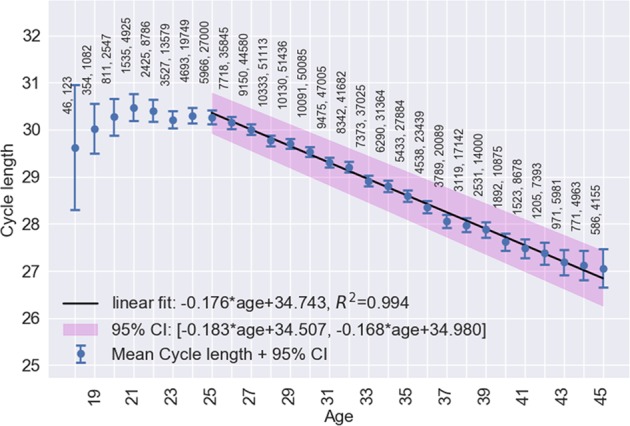
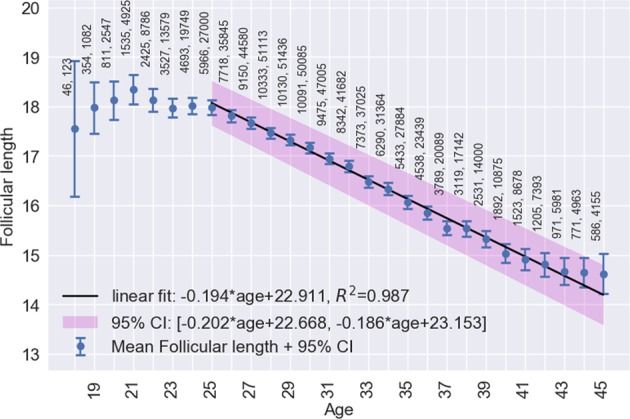
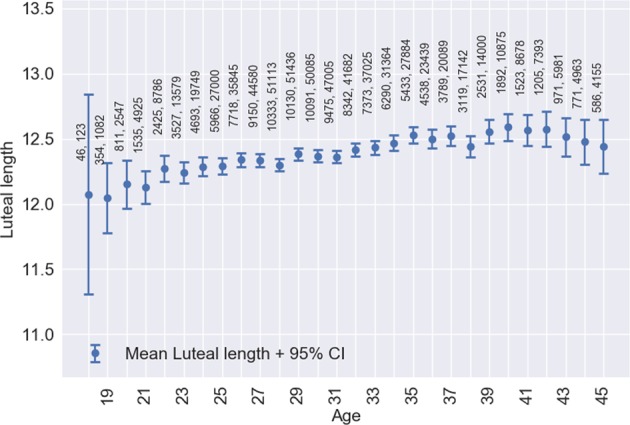
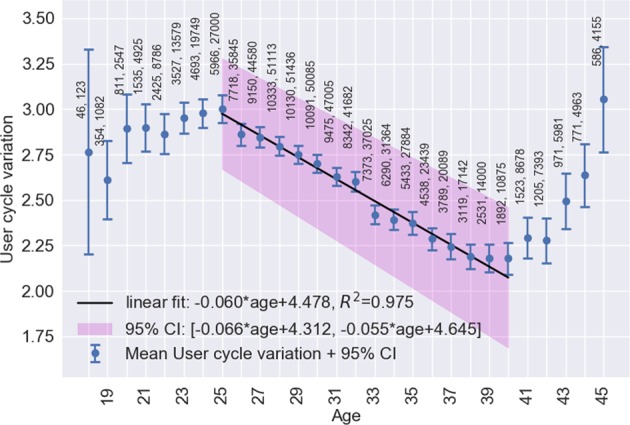
The use of apps that record detailed menstrual cycle data presents a new opportunity to study the menstrual cycle. The aim of this study is to describe menstrual cycle characteristics observed from a large database of cycles collected through an app and investigate associations of menstrual cycle characteristics with cycle length, age and body mass index (BMI). Menstrual cycle parameters, including menstruation, basal body temperature (BBT) and luteinising hormone (LH) tests as well as age and BMI were collected anonymously from real-world users of the Natural Cycles app. We analysed 612,613 ovulatory cycles with a mean length of 29.3 days from 124,648 users. The mean follicular phase length was 16.9 days (95% CI: 10–30) and mean luteal phase length was 12.4 days (95% CI: 7–17). Mean cycle length decreased by 0.18 days (95% CI: 0.17–0.18, R 2 = 0.99) and mean follicular phase length decreased by 0.19 days (95% CI: 0.19–0.20, R 2 = 0.99) per year of age from 25 to 45 years. Mean variation of cycle length per woman was 0.4 days or 14% higher in women with a BMI of over 35 relative to women with a BMI of 18.5–25. This analysis details variations in menstrual cycle characteristics that are not widely known yet have significant implications for health and well-being. Clinically, women who wish to plan a pregnancy need to have intercourse on their fertile days. In order to identify the fertile period it is important to track physiological parameters such as basal body temperature and not just cycle length.
Overview
CoChat Summary
## TL;DR
This app-based observational study analyzed 612,613 ovulatory menstrual cycles from 124,648 users and found that menstrual-cycle differences are driven mainly by follicular phase variation, not a fixed “day 14” ovulation pattern. Cycle length and follicular phase length decreased with age, while BMI had little effect except for greater cycle-length variation in BMI >35.
## Key findings
- The study analyzed 612,613 ovulatory cycles from 124,648 users; mean cycle length was 29.3 days, mean follicular phase length was 16.9 days (95% CI: 10–30), and mean luteal phase length was 12.4 days (95% CI: 7–17).
- Among 81,605 cycles (13%) that were 28 days long, mean follicular and luteal phase lengths were 15.4 and 12.6 days, respectively.
- Cycle length decreased with age: between the youngest and oldest age cohorts, mean cycle length was 2.9 days (10%) shorter (95% CI: 2.9–3.0), and follicular phase length was 3.2 days (20%) shorter (95% CI: 3.2–3.3); luteal phase length changed very little.
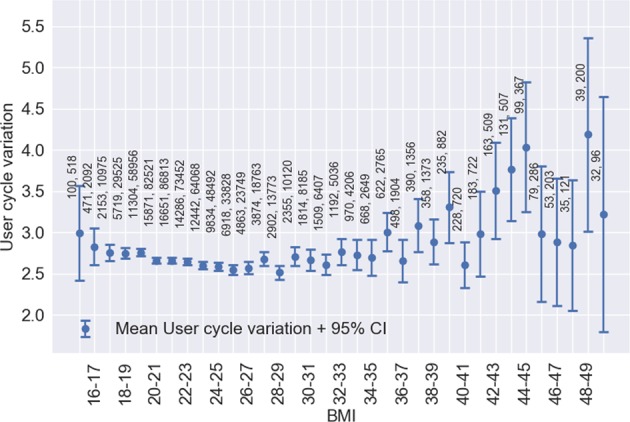
- In BMI analyses, women with BMI 35–50 had 0.4 days (14%) higher per-user cycle-length variation than women with BMI 18.5–25 (95% CI: 0.3–0.5), and underweight women had bleed length 0.2 days (5%) longer than the healthy-weight group.
- The paper reports that 18% of cycles had luteal phases of less than 11 days, and that very short cycles had much shorter follicular phases than normal-length cycles, while very long cycles had much longer follicular phases.
## Methods
- Prospective observational subanalysis of data from the Natural Cycles app, using daily basal body temperature (BBT), menstruation dates, optional urinary LH tests, plus age and BMI collected in-app.
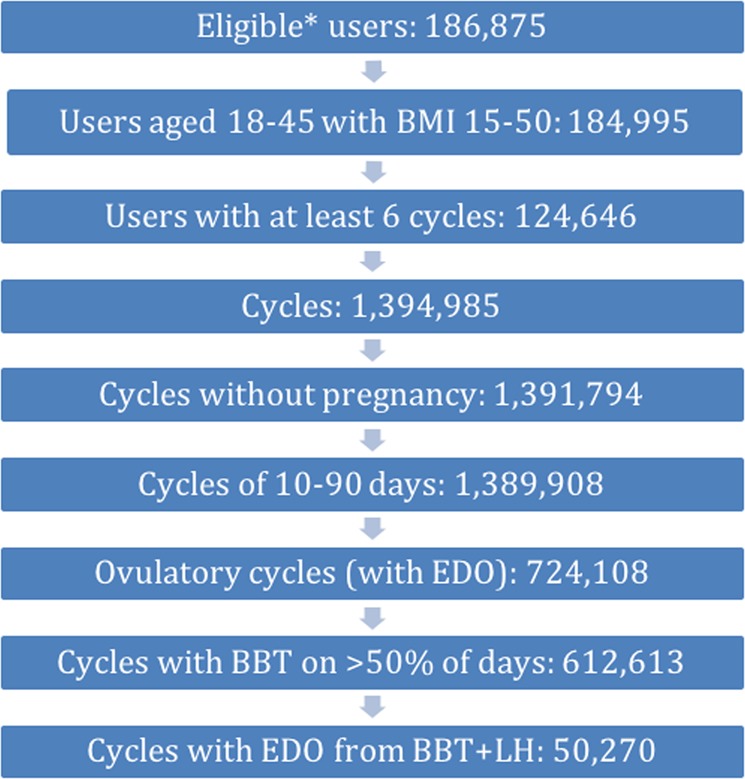
- Included users registered 1 Sept 2016 to 1 Feb 2019, aged 18–45, BMI 15–50, with no hormonal contraception in the prior 12 months; cycles required at least six complete cycles, length 10–90 days, and valid temperature entries on at least 50% of cycle days.
- Main analysis calculated mean cycle, bleed, follicular, and luteal phase lengths in ovulatory cycles, then compared cohorts by cycle length, age, and BMI; because of very large sample sizes, the authors used bootstrapped mean differences with 95% CIs rather than p values.
## Limitations
- The authors state that the study population came solely from app users and may not be representative of the wider population; they note that only 8% of women in the study were obese versus 15% in the general population.
- Only cycles with ovulation detected were included; of the 1.4 million cycles considered, 665,603 (48%) were excluded because ovulation was not detected, creating selection bias, which the paper explicitly acknowledges.
- The paper notes possible human error in self-reported bleeding, LH tests, and temperature measurements, and that measuring BBT and LH every 24 h limits phase-length precision.
Model-written summary. Check it against the paper before relying on it.
Integrity signals
Registry
Cites
Statistics
Figures
Verification
Claims the paper makes
15 Valid · 1 Not valid · 18 Not checked · 60 Own results and interpretations
The cited sources support only part of this claim — read each source’s verdict below.
In the paper
“It is, therefore, unsurprising that several studies have shown that calendar apps are not accurate in identifying the fertile window.35–38”
§ Real-world menstrual cycle characteristics of more than 600,000 menstrual cycles > Discussion
What the sources say
- Not checked — no full text of the sourcecites [35] Setton R Tierney C Tsai T The accuracy of web sites and cellular phone applications in predicting the fertile window Obstet. Gynecol. 2016 128 58 63 10.1097/AOG.0000000000001341 27275788 source
- Supportedcites [36] Freis A Plausibility of menstrual cycle apps claiming to support conception Front. Public Health 2018 6 98 10.3389/fpubh.2018.00098 29666788 PMC5891577 source
The Results (‘Apps Predicting the Fertile Days Based on Data of Previous Cycles’; page not provided) report that the tested calendar-based apps misstated ovulation when cycle length differed from the estimate. The Discussion says their method often missed the most fertile days because cycle length and ovulation day vary. This paper supports the claim as one of the studies cited, without itself needing to establish what every other cited study found. (LLM, conf=0.91)
- Partly supportedcites [37] Sohda S Suzuki K Igari I Relationship between the menstrual cycle and timing of ovulation revealed by new protocols: analysis of data from a self-tracking health app J. Med. Internet Res. 2017 19 e391 10.2196/jmir.7468 29180346 PMC5725625 sourceExperimental — accuracy not yet measured
The Discussion’s Principal Findings say that two existing calendar-based methods did not explain the study data well and were less accurate for certain cycle lengths. That supports concern about calendar-based ovulation predictions, but the paper evaluates prediction methods rather than the accuracy of calendar apps in identifying the fertile window. (LLM, conf=0.84)
- Supportedcites [38] Johnson S Marriott L Zinaman M Can apps and calendar methods predict ovulation with accuracy? Curr. Med. Res. Opin. 2018 34 1587 1594 10.1080/03007995.2018.1475348 29749274 source
The Discussion reports that this study's findings agree with two earlier studies that found low accuracy in apps' predictions of fertile windows. It also explains that wider predicted windows can include ovulation more often but offer poor precision for timing intercourse. (LLM, conf=0.91)
plain- Asserted: passes — The authors put it forward as true.
- Checkable: passes — It can be checked against evidence.
- Load-bearing: passes — The paper’s conclusions depend on it.
- Based: passes — The paper gives a reason why it holds.
Every source the paper cites for this claim was checked and supports it.
In the paper
“Available data, however, suggests that there may be significant variability in fertile days.1,4”
§ Real-world menstrual cycle characteristics of more than 600,000 menstrual cycles > Introduction
What the sources say
- Supportedcites [1] Wilcox AJ The timing of the ‘fertile window’ in the menstrual cycle: day specific estimates from a prospective study Br. Med. J. 2000 321 1259 1262 10.1136/bmj.321.7271.1259 11082086 PMC27529 source
The paper’s ‘What this study adds’ section states that the timing of the fertile window is highly variable, even among women who regard their cycles as regular. The Results section also reports ovulation occurring from day 8 to day 60, supporting variability in when fertile days occur. (LLM, conf=0.95)
- Supportedcites [4] Fehring RJ Schneider M Raviele K Variability in the phases of the menstrual cycle J. Obstet. Gynecol. Neonatal Nurs. 2006 35 376 384 10.1111/j.1552-6909.2006.00051.x 16700687 source
The Variability of Fertile Window section reports that the six fertile days fell anywhere between cycle days 4 and 23 across about 95% of cycles. This directly supports the hedged claim that fertile days may vary significantly. (LLM, conf=0.94)
hedged- Asserted: passes — The authors put it forward as true.
- Checkable: passes — It can be checked against evidence.
- Load-bearing: passes — The paper’s conclusions depend on it.
- Based: passes — The paper gives a reason why it holds.
- Supported
The sources with a verdict support this claim; the rest weren’t checked yet, have no full text we could read, or their verdicts aren’t rated yet.
In the paper
“but there is much greater variation than this.1,4–7”
§ Real-world menstrual cycle characteristics of more than 600,000 menstrual cycles > Introduction
What the sources say
- Supportedcites [1] Wilcox AJ The timing of the ‘fertile window’ in the menstrual cycle: day specific estimates from a prospective study Br. Med. J. 2000 321 1259 1262 10.1136/bmj.321.7271.1259 11082086 PMC27529 source
The Clinical guidelines section says the fertile window can occur much earlier or later than guidelines suggest. The Conclusions section reports that it falls entirely within the guideline days in only about 30% of women, supporting the claimed greater variation in its timing. (LLM, conf=0.90)
- Supportedcites [4] Fehring RJ Schneider M Raviele K Variability in the phases of the menstrual cycle J. Obstet. Gynecol. Neonatal Nurs. 2006 35 376 384 10.1111/j.1552-6909.2006.00051.x 16700687 source
The Implications of Findings section says menstrual-cycle parameters vary considerably even among healthy, regularly cycling women. The Variability of Follicular and Luteal Phases section explicitly finds a wider luteal-phase range than those listed in the medical and nursing textbooks in Table 3 (page unavailable in our copy). (LLM, conf=0.88)
- Not checked — no full text of the sourcecites [5] Mihm M Gangooly S Muttukrishna S The normal menstrual cycle in women Anim. Reprod. Sci. 2011 124 229 236 10.1016/j.anireprosci.2010.08.030 20869180 source
- Not checked — no full text of the sourcecites [6] Treloar AE Boynton RE Behn BG Brown BW Variation of the human menstrual cycle through reproductive life Int. J. Fertil. 1967 12 77 126 5419031 source
- Not checked — no full text of the sourcecites [7] Lenton EA Landgren B Sexton L Normal variation in the length of the luteal phase of the menstrual cycle: identification of the short luteal phase BJOG 1984 91 685 689 10.1111/j.1471-0528.1984.tb04831.x 6743610 source
plain- Asserted: passes — The authors put it forward as true.
- Checkable: passes — It can be checked against evidence.
- Load-bearing: passes — The paper’s conclusions depend on it.
- Based: passes — The paper gives a reason why it holds.
- Supported
Every source the paper cites for this claim was checked and supports it.
In the paper
“Besides the potential benefits to the individual, fertility awareness apps and the associated databases of fertility data provide a unique opportunity to examine a large number of menstrual cycles in order to improve understanding.25,26”
§ Real-world menstrual cycle characteristics of more than 600,000 menstrual cycles > Introduction
What the sources say
- Supportedcites [25] Liu, B. et al. Predicting pregnancy using large-scale data from a women’s health tracking mobile application.In The World Wide Web Conference (pp. 2999–3005) (ACM, 2019). PMC6752881 31538145 source
The Introduction describes health-tracking apps as a new data source and says they have already been used to study menstrual-cycle fluctuations and lengths. It also reports a dataset with tens of millions of observations from tens of thousands of women, supporting the claimed opportunity to study menstrual cycles at scale. (LLM, conf=0.91)
- Supportedcites [26] Symul, L., Wac, K., Hillard, P. & Salathe, M. Assessment of menstrual health status and evolution through mobile apps for fertility awareness. bioRxiv10.1101/385054 (2019). PMC6635432 31341953 source
The Abstract says menstrual-tracking apps provide an unparalleled view of menstrual health at population scale and reports data from over 2.7 million cycles. The Introduction and Discussion likewise describe using app-collected data to assess menstrual health and study fertility patterns. (LLM, conf=0.93)
plain- Asserted: passes — The authors put it forward as true.
- Checkable: passes — It can be checked against evidence.
- Load-bearing: passes — The paper’s conclusions depend on it.
- Based: passes — The paper gives a reason why it holds.
- Supported
Every source the paper cites for this claim was checked and supports it.
In the paper
“Nevertheless, the length of the luteal phase may also deviate significantly from 14 days.”
§ Real-world menstrual cycle characteristics of more than 600,000 menstrual cycles > Introduction
What the sources say
- Supportedcites [1] Wilcox AJ The timing of the ‘fertile window’ in the menstrual cycle: day specific estimates from a prospective study Br. Med. J. 2000 321 1259 1262 10.1136/bmj.321.7271.1259 11082086 PMC27529 source
The Clinical guidelines section (page not provided) reports that ovulation occurred exactly 14 days before the next menses in only 10% of the study's 28-day cycles. The interval from ovulation to the next menses ranged from 7 to 19 days, supporting the claim that luteal-phase length may differ substantially from 14 days. (LLM, conf=0.94)
hedged- Asserted: passes — The authors put it forward as true.
- Checkable: passes — It can be checked against evidence.
- Load-bearing: unclear — It is unclear whether the paper’s conclusions depend on it.
- Based: passes — The paper gives a reason why it holds.
- Supported
44 more claims
Create a free account to see all 94 claims and to verify the 3 references still open.
- It may state two separate claims as one. 25
- Probably not a substantial claim. 30
- The quote only partly states this claim. 1
Claims other papers make about this one
Each is checked against this paper’s own text: does it say what the citing paper says it does?
The source backs part of the claim, not all of it — or backs it for a different population, condition or comparison.
In the citing paper
“This process results in quasi-periodic hormone profiles with a cycle length of 25 to 35 days (Bakos et al., 1994;Harlow, 2000;Bull et al., 2019).”
From Hormonal regulation of ovarian follicle growth in humans: Model-based exploration of cycle variability and parameter sensitivities (2022) · cites this paper as Bull et al., 2019
Experimental — accuracy not yet measuredThe source backs part of the claim, not all of it — or backs it for a different population, condition or comparison.
In the citing paper
“In line with the literature (Bull et al., 2019), we implemented the model in a way that little variation occurs in the length of the luteal phase.”
From Hormonal regulation of ovarian follicle growth in humans: Model-based exploration of cycle variability and parameter sensitivities (2022) · cites this paper as Bull et al., 2019
Experimental — accuracy not yet measuredThe source backs part of the claim, not all of it — or backs it for a different population, condition or comparison.
In the citing paper
“Also, evident from this “big data” set is the variability in menstrual cycle duration between women and within menstrual cycles of the same woman, mostly as a result of variability in the duration of the follicular phase [39].”
From Temperature regulation in women: Effects of the menstrual cycle (2020) · cites this paper as [39]
Experimental — accuracy not yet measuredThe cited source says what the claim attributes to it.
In the citing paper
“The simulated average cycle length ranges from 22.7 to 27.8 days (Fig. A.6), which is within the physiological range (Bull et al., 2019).”
From Hormonal regulation of ovarian follicle growth in humans: Model-based exploration of cycle variability and parameter sensitivities (2022) · cites this paper as Bull et al., 2019
The cited source says what the claim attributes to it.
In the citing paper
“As earlier studies have already shown (11, 23–26), we found a significant decrease in cycle length with age (Table 1 and Figs. 2 and 3).”
From Women temporarily synchronize their menstrual cycles with the luminance and gravimetric cycles of the Moon (2021) · cites this paper as [26]
3 more claims about this paper
Create a free account to see every claim other papers make about this one.
Citations
Cites
An Introduction to the Bootstrap
Efron, B., & Tibshirani, R. J. (1994) · doi:10.1201/9780429246593 · Cited by 40,500
An Introduction to the Bootstrap
Efron, B., & Tibshirani, R. J. (1993) · doi:10.1007/978-1-4899-4541-9 · Cited by 21,230
(2000) · PubMed · Cited by 13,173
The Diagnosis of Polycystic Ovary Syndrome during Adolescence
Witchel, S. F., Oberfield, S., Rosenfield, R. L., Codner, E., Bonny, A., Ibáñez, L., Pena, A., Horikawa, R., Gomez-Lobo, V., Joel, D., et al. (2015) · Hormone Research in Paediatrics · doi:10.1159/000375530 · Cited by 3,113
An Introduction to the Bootstrap.
Buckland, S. T., Efron, B., & Tibshirani, R. J. (1994) · Biometrics · doi:10.2307/2532810 · Cited by 3,103
VARIATION OF THE HUMAN MENSTRUAL CYCLE THROUGH REPRODUCTIVE LIFE
TRELOAR, A. E., BOYNTON, R. E., BEHN, B. G., & BROWN, B. W. (1968) · Obstetrical & Gynecological Survey · doi:10.1097/00006254-196801000-00019 · Cited by 1,018 · cited 2×
“With increasing age, cycle length reduces and the timing of ovulation becomes earlier; the variation of a woman’s cycle length reduces with age until menopause.(5,6,8,9) Cycle characteristics also may be affected by ethnicity, high body mass index (BMI), stress and lifestyle factors.”
BackgroundResultPsychological impact of infertility
Cousineau, T. M., & Domar, A. D. (2007) · Best Practice & Research Clinical Obstetrics & Gynaecology · doi:10.1016/j.bpobgyn.2006.12.003 · Cited by 997 · cited 1×
“Anecdotally there is poor understanding of fertility amongst the general population, which can lead to both unintended pregnancies and delayed time to conception with associated psychological suffering for those wishing to start a family.(40) Fertility education delivered through an app has the potential to improve do…”
BackgroundResearch Commentary —Too Big to Fail: Large Samples and the p -Value Problem
Lin, M., Lucas, H. C., & Shmueli, G. (2013) · Information Systems Research · doi:10.1287/isre.2013.0480 · Cited by 972 · cited 1×
“Owing to the very large sample sizes in this study, P values were not calculated since they can be very small even if differences between cohorts are of no clinical significance.(49) Instead, effect size between two cohorts was estimated as a mean difference with a 95% confidence interval calculated from 200 bootstrap…”
MethodTorous, J., Nicholas, J., Larsen, M. E., Firth, J., & Christensen, H. (2018) · Evidence Based Mental Health · doi:10.1136/eb-2018-102891 · Cited by 790
(1977) · PubMed · Cited by 488
Cited by
Items 201–300 of 399
Contraception, Fertility Tracking, and the Limits of Medical Devices Regulation
McMillan, C. A. W. (2023) · Law Technology and Humans · doi:10.5204/lthj.3047 · Cited by 8
Polycystic ovary syndrome v.2023: Simplified diagnostic criteria for an East Asian phenotype
Yong, E., Teoh, W. S., & Huang, Z. (2023) · Annals of the Academy of Medicine Singapore · doi:10.47102/annals-acadmedsg.202369 · Cited by 8
“37 There is increasing appreciation that PCOS is not a binary all-or-none condition but represents a continuum of those with none, 1, 2 or more of the phenotypic features associated with PCOS, such as HA, oligo/ amenorrhoea and PCOM.”
Background(Re)making menstrual hygiene discourses in India
Gopee, A. K. (2024) · Tapuya Latin American Science Technology and Society · doi:10.1080/25729861.2024.2410509 · Cited by 12
“The amount of tissue that needs to be expelled from the body is a factor in the length of menstruation (Bull et al. 2019).”
Peri-implantation intercourse does not lower fecundability
Stanford, J. B., Hansen, J. L., Willis, S. K., Hu, N., & Thomas, A. (2020) · Human Reproduction · doi:10.1093/humrep/deaa156 · Cited by 5
“We estimated ovulation to occur 12 days prior to the last day of the cycle, which corresponds to a median luteal phase length of 12 days (Bull et al., 2019; Najmabadi et al., 2020).”
MethodLi, H., Gibson, E. A., Jukic, A. M. Z., Baird, D. D., Wilcox, A. J., Curry, C. L., Fischer‐Colbrie, T., Onnela, J.-P. “., Williams, M. A., Hauser, R. B., et al. (2022) · medRxiv · doi:10.1101/2022.09.30.22280382 · Cited by 5
“A study among a very large number of app users reported participants with BMI between 35-50 kg/m2 had higher cycle variation by 0·4 days and longer mean cycle length by 0·5 days than those with a healthy BMI (21).”
BackgroundInfluentialPredictive Modeling of Menstrual Cycle Length: A Time Series Forecasting ApproachPreprint
Rego, R. C. B. (2023) · Research Square · doi:10.21203/rs.3.rs-3050181/v1 · Cited by 5
Menstrual cycle influence on skeletal muscle mitochondrial respiration in humans
Nelson, W. B., Pfeifer, B. S., Lovell, A. R., Marchant, E. D., Mitchell, B. V., Atkinson, E. L., Murphy, T. L., Poulsen, S. L., Baird, J. R. K., Hancock, C. R., et al. (2025) · Physiological Reports · doi:10.14814/phy2.70458 · Cited by 6
“Occurring roughly every 29 days (Bull et al., 2019), this rhythmic cycle is regulated by phasic changes in circulating pituitary hormones (follicle stimulating hormone and luteinizing hormone) and ovarian hormones (estradiol and progesterone) (Reed & Carr, 2000).”
Oester, C., Norris, D., Lovell, R. J., Pedlar, C. R., Bruinvels, G., & Kalkhoven, J. T. (2026) · Sports Medicine · doi:10.1007/s40279-026-02411-w · Cited by 7
“Examples of non-modifiable factors include age [62], genetics [63], past experiences [64] and underlying reproductive health conditions such as polycystic ovary syndrome (PCOS)”
The illusion of empowerment: commercializing women’s health in the digital age
Nickel, B., Copp, T., & Mintzes, B. J. (2026) · Health Promotion International · doi:10.1093/heapro/daag074 · Cited by 6
“The use of fertility and cycle tracking apps has exponentially increased since their release over a decade ago (Bull et al. 2019, Rampazzo et al. 2024).”
Nwafor, G., MUOBOGHARE, N., & OSAFILE, C. O. (2022) · International Journal of Applied Research in Social Sciences · doi:10.51594/ijarss.v4i11.481 · Cited by 6
“Moreover, Bull et al. (2019) point out that there is a huge selection of period tracker apps, with 7% of the 90,088 health applications in the Apple store recently focusing on women's health and pregnancy.”
BackgroundTkachenko, O. Y., Kahland, T., Lindenwald, D. L., Heistermann, M., Drummer, C., Daskalaki, M., Rüger, N., & Behr, R. (2024) · Journal of Ovarian Research · doi:10.1186/s13048-024-01441-0 · Cited by 4
“In contrast to humans, the average follicular phase in marmosets is considerably shorter (8 days [8, 9] compared to 16.9 days in humans [10]), while the luteal phase is longer than in humans (on average, 20 days in marmoset [8, 9] vs. 12.4 days in humans [10]) and more variable.”
BackgroundInfluentialPredicting Postprandial Glycemic Responses With Limited Data in Type 1 and Type 2 Diabetes
Shen, Y., Choi, E., & Kleinberg, S. (2025) · Journal of Diabetes Science and Technology · doi:10.1177/19322968251321508 · Cited by 9
“For durations within 21 to 35 days, 29 that value was used as the cycle length.”
Grootenhuis, A., Hiereth, F. C., Škarabot, J., Oßwald, M., Vecchio, A. D., Grüber, M., & Ruggiero, L. (2025) · Scandinavian Journal of Medicine and Science in Sports · doi:10.1111/sms.70065 · Cited by 5
“Of the 22 females, 19 reported to be eumenorrheic (regular cycle between 21 and 35 days for the previous 12 months; [49]), and 6 had taken oral contraceptives within the previous 12 months.”
Wearable intelligence: can we transform fertility tracking through digital innovation?
Ali, Z. E., Ammar, O. F., Liperis, G., Sharma, K., Hall, J., Grace, B., & Fraire-Zamora, J. J. (2025) · Human Reproduction · doi:10.1093/humrep/deaf148 · Cited by 4
Adnan, T., Li, H., Peer, K., Peebles, E., James, K. E., & Mahalingaiah, S. (2023) · Journal of Medical Internet Research · doi:10.2196/42164 · Cited by 8
“…cycle in the population, examine associations between menstrual cycle characteristics (eg, cycle length and variability) and symptoms, and explore the potential of such self-tracking data in phenotyping endometriosis and predicting polycystic ovary syndrome (PCOS) among patient populations [2-4].”
McLagan, B., Dexheimer, J. D., Strock, N. C. A., et al. (2024) · Women s Health · doi:10.1177/17455057241266455 · Cited by 4
Knowledge of the ovulatory cycle and its determinants among adolescent females in Ghana
Afrifa-Anane, G. F. (2025) · BMC Women s Health · doi:10.1186/s12905-025-03558-w · Cited by 4
“However, there can be variations in the day of ovulation depending on the length of one’s menstrual cycle [10, 11].”
Song, Y., Prisciandaro, J. J., Apšvalka, D., Bernard, M., Berrington, A., Castelo-Branco, M. S., Britton, M. K., Correia, M., Cuypers, K., Domagalik, A., et al. (2025) · Journal of Neuroscience Methods · doi:10.1016/j.jneumeth.2025.110430 · Cited by 5
“For example, recent work highlights links between average cycle variability and length with age (Bull et al., 2019).”
Ammon, K., & Conlon, C. (2025) · Irish Journal of Sociology · doi:10.1177/07916035251342139 · Cited by 4
“(Bull et al., 2019).”
The performance of a fertility tracking device
van de Roemer, N., Haile, L. T., & Koch, M. C. (2021) · The European Journal of Contraception & Reproductive Health Care · doi:10.1080/13625187.2021.1871599 · Cited by 4
“By measuring BBT, the time-point of ovulation and thus the infertile days after ovulation can be precisely defined [16].”
BackgroundHenningsson, S., Leknes, S., Asperholm, M., Eikemo, M., & Westberg, L. (2021) · Biological Psychology · doi:10.1016/j.biopsycho.2021.108164 · Cited by 5
The Politics, Promises, and Perils of Data: Evidence-Driven Policy and Practice for Menstrual Health
Winkler, I. T., Bobel, C., Houghton, L. C., Elhadad, N., Gruer, C., & Paranjothy, V. (2020) · Women s Reproductive Health · doi:10.1080/23293691.2020.1820240 · Cited by 5
No Differences in Value-Based Decision-Making Due to Use of Oral Contraceptives
Lewis, C. A., Kimmig, A.-C. S., Kroemer, N. B., Pooseh, S., Smolka, M. N., Sacher, J., & Derntl, B. (2022) · Frontiers in Endocrinology · doi:10.3389/fendo.2022.817825 · Cited by 4
“(6)]: In the follicular phase, both estradiol and progesterone levels are low in the beginning, with estradiol slowly rising and surging before ovulation (periovulatory phase, ~ day 14).”
BackgroundHamilton, K., & Harper, J. C. (2024) · Human Fertility · doi:10.1080/14647273.2024.2345675 · Cited by 8
“This cycle on average occurs over a 28day cycle but can vary in length for each person (Bull et al., 2019).”
Self-citationPedersen, E. S., Mikkelsen, E. M., Sørensen, H. T., Hatch, E. E., Wise, L. A., Rothman, K. J., Stanford, J. B., & Laursen, A. S. D. (2024) · Paediatric and Perinatal Epidemiology · doi:10.1111/ppe.13108 · Cited by 4
“UPDATE: I’m pregnant!”: Inferring Global Use of Fertility Tracking AppsPreprint
Rampazzo, F., Raybould, A., Rampazzo, P., barker, R., & Leasure, D. R. (2022) · doi:10.31235/osf.io/2va3n · Cited by 4
Ainsworth, A. J., Peven, K., Bamford, R., Zhaunova, L., Salimgaraev, R., Prentice, C., Wickham, A. P., Cunningham, A. C., Goddard, F. G. B., Ponzo, S., et al. (2022) · Research Square · doi:10.1101/2022.10.20.22280407 · Cited by 6
Unexpected plasma gonadal steroid and reproductive hormone levels across the mouse estrous cyclePreprint
Wall, E. G., Desai, R., Aung, Z. K., Yeo, S., Grattan, D. R., Handelsman, D. J., & Herbison, A. E. (2023) · bioRxiv (Cold Spring Harbor Laboratory) · doi:10.1101/2023.02.28.530435 · Cited by 3
“In women, the menstrual 47 cycle typically lasts 28 days and consists of follicular, ovulatory and luteal phases with well48 defined stereotypic patterns and levels of circulating reproductive hormones (2).”
BackgroundBarlow, A., Blodgett, J. M., Williams, S., Pedlar, C. R., & Bruinvels, G. (2023) · medRxiv · doi:10.1101/2023.07.12.23292497 · Cited by 4
“Briefly, total menstrual cycle length is used to retrospectively calculate phases 2 and 3, based on previous research evaluating and predicting the lengths of the follicular and luteal phases using thousands of menstrual cycles (21-23).”
MethodAnalysis of systemic effects of dioxin on human health through template-and-anchor modeling
Kumbale, C. M., Zhang, Q., & Voit, E. O. (2025) · PLoS Computational Biology · doi:10.1371/journal.pcbi.1012840 · Cited by 7
“The menstrual cycle length varies considerably within a population, due to both intra-and inter-individual differences [55,57–59], and particularly in the duration of the follicular phase [55,56].”
Granholm, R. L., Gauthier, A. H., & Stulp, G. (2025) · Demographic Research · doi:10.4054/demres.2025.52.24 · Cited by 5
Hedges, M. S., Hewings-Martin, Y., Karam, J., Castaneda, R., Cunningham, A. C., Xu, Y., Zhaunova, L., Faubion, S. S., & SHUFELT, C. L. (2026) · Menopause The Journal of The North American Menopause Society · doi:10.1097/gme.0000000000002730 · Cited by 5
Rafiee, Y., Heine, C., & Schacht, A. (2023) · PLoS ONE · doi:10.1371/journal.pone.0295176 · Cited by 2
“The menstrual cycle consists of follicular and luteal phases [27], with the late follicular phase around the ovulation exhibiting the highest estradiol levels and the mid-luteal phase containing the highest progesterone levels [28].”
BackgroundUnderstanding Fertile Window: A Key to Pregnancy as well as Contraception
Tiwari, P. K., Kadiri, S. K., Dubey, P., Singh, D., Khobragade, D. S., & Sahu, P. K. (2024) · Current Women s Health Reviews · doi:10.2174/0115734048282403240101112918 · Cited by 3
Dittmar, M., Möllgaard, L., & Engelhard, F. (2024) · Chronobiology International · doi:10.1080/07420528.2024.2342945 · Cited by 4
“The menstrual cycle is a circalunar rhythm that has a period of on average 29 days (Bull et al. 2019).”
BackgroundMenstrual-Cycle and Hormonal-Contraceptive Tracking in Gaelic Football: From the Lab to the Field
Taim, B. C., Catháin, C. Ó., Elliott-Sale, K. J., Madigan, S. M., & Chéilleachair, N. N. (2024) · International Journal of Sports Physiology and Performance · doi:10.1123/ijspp.2023-0489 · Cited by 4
Reis, A. P. R., Ioannidou, E., Stuart, K. V., Wagner, S. K., Foster, P. J., Khawaja, A. P., Petzold, A., Sivaprasad, S., Pontikos, N., Keane, P. A., et al. (2025) · Eye · doi:10.1038/s41433-025-03592-w · Cited by 4
“In the years preceding menopause, menstrual fluctuations become more irregular [3–5], until a permanent hormonal decline is established.”
Improving Replication in Endometrial Omics: Understanding the Influence of the Menstrual Cycle
Chung, J., & Rogers, P. A. W. (2025) · International Journal of Molecular Sciences · doi:10.3390/ijms26020857 · Cited by 4
Silva, A. F., Trybulski, R., Trybek, G., Moska, W., Aidar, F. J., & González-Férnandez, F. T. (2025) · Journal of Sports Science and Medicine · doi:10.52082/jssm.2025.532 · Cited by 7
Menstrual Cycles as Key to Embodied Synchronisation
Rodriguez-Muguruza, A. (2023) · Interdisciplinary evolution research · doi:10.1007/978-3-031-30304-3_6 · Cited by 3
Ali, Z. E., Liperis, G., Mincheva, M. N., Serdarogullari, M., Uraji, J., Ammar, O. F., & Fraire-Zamora, J. J. (2023) · Human Reproduction · doi:10.1093/humrep/dead159 · Cited by 4
Abdullah, W. H. (2024) · PLOS Global Public Health · doi:10.1371/journal.pgph.0003079 · Cited by 3
The effect of quercetin and citrulline on cycling time trial performance
Kurtz, J. A., Grazer, J. L., Wilson, K. E., Feresin, R. G., Doyle, J. A., Middleton, R., Devis, E., VanDusseldorp, T. A., Fasczewski, K. S., & Otis, J. S. (2024) · Journal of the International Society of Sports Nutrition · doi:10.1080/15502783.2024.2416909 · Cited by 6
“All females were tested during their follicular phase (approximately day 0 to day 16, assuming a 30-day regular cycle [39]), where female sex hormone concentrations are relatively stable and most similar to other women [40].”
BackgroundKurtz, J. A., Feresin, R. G., Grazer, J. L., Otis, J. S., Wilson, K. E., Doyle, J. A., & Zwetsloot, K. A. (2025) · Nutrients · doi:10.3390/nu17020224 · Cited by 4
Effects of Menstrual Cycle Phase on Fluid Regulation during Walking Exercise.
Nose, Y., Fujita, K., Wada, T., Nishimura, K., & Hakoda, M. (2020) · PubMed Central · Cited by 14
“When Am I Fertile?”: A Pilot Study Comparing Ovulation Prediction Accuracy of Apps and LH Kits
Enenbach, M., Haworth, C., Hawkins, C., & Kochmann, M. (2021) · Journal of Student Research · doi:10.47611/jsr.v10i1.1216 · Cited by 3
Hsu, L.-T., Chin, T.-H., Huang, S. Y., Yang, L., Pan, Y., & Chang, C. L. (2021) · Taiwanese Journal of Obstetrics and Gynecology · doi:10.1016/j.tjog.2021.09.002 · Cited by 3
Barrau-Sastre, P., Birulés, I., Verdaguer-Rodríguez, M., López‐Carrilero, R., Ferrer-Quintero, M., García‐Mieres, H., Díaz-Cutraro, L., Grasa, E., Pousa, E., Lorente, E., et al. (2022) · Women · doi:10.3390/women2020015 · Cited by 4
Prado, R. C. R. (2022) · Sports Medicine · doi:10.1007/s40279-022-01786-w · Cited by 4
Re: Challenges and future directions in menstrual cycle research
Prado, R. C. R., Silveira, R., Takito, M. Y., & Asano, R. Y. (2020) · Paediatric and Perinatal Epidemiology · doi:10.1111/ppe.12708 · Cited by 3
A Survey of Mathematical Modeling of Hormonal Contraception and the Menstrual Cycle
Zhao, L., Kim, R., Oremland, L. S., Chowkwale, M., Pillis, L. G. D., & Brooks, H. Z. (2024) · The IMA volumes in mathematics and its applications · doi:10.1007/978-3-031-58516-6_3 · Cited by 2
Parental Perception of Health-Related Quality of Life of Children [8-12 Years] Living with HIV
Salako, A. O. (2021) · The Central European Journal of Paediatrics · doi:10.5457/p2005-114.281 · Cited by 2
Seasonal variations of menstrual cycle length in a large, US-based, digital cohort
Li, H., Curry, C. L., Fischer‐Colbrie, T., Onnela, J.-P. “., Williams, M. A., Hauser, R. B., Coull, B. A., Jukic, A. M. Z., & Mahalingaiah, S. (2023) · International Journal of Hygiene and Environmental Health · doi:10.1016/j.ijheh.2023.114308 · Cited by 4
Menstrual Temporality: Cyclic Bodies in a Linear World
Jackson, S. P. (2024) · Journal of the British Society for Phenomenology · doi:10.1080/00071773.2024.2347257 · Cited by 3
skipTrack: An R package for Identifying Skips in Self-Tracked Mobile Menstrual Cycle Data
Duttweiler, L., Mahalingaiah, S., & Coull, B. A. (2024) · The Journal of Open Source Software · doi:10.21105/joss.06928 · Cited by 2
The ethics of menstrual tracking applications
Vidal, C. (2024) · Nature Human Behaviour · doi:10.1038/s41562-024-02031-2 · Cited by 2
O’Shea, M., Varua, M. E., Duffy, S. M., Eathorne, A., & Armour, M. (2026) · Australian Journal of Social Issues · doi:10.1002/ajs4.70092 · Cited by 9
A systematic review of resting-state EEG across the menstrual cycle and its mental health relevance
García-Granados, M. D., Cruz‐Aguilar, M. A., Hernández-López, L. E., Mondragón‐Ceballos, R., Martínez-Mota, L., Rivera-García, A. P., & Ramírez‐Salado, I. (2026) · Archives of Women s Mental Health · doi:10.1007/s00737-025-01654-2 · Cited by 251
“The late F phase is distinguished by the highest levels of estradiol and low progesterone, whereas the L phase is characterized by the highest level of progesterone and a lower secondary estradiol peak (Bull et al. 2019).”
Plasma proteomic signature of the human menstrual cycle
Riishede, I., Rode, L., Lundegaard, P. R., Rand, S. A., Dyrskjøt, L., Larsen, O. H., Ekelund, C. K., Pinborg, A. B., Stender, S., & Ghouse, J. (2026) · Nature Medicine · doi:10.1038/s41591-026-04326-5 · Cited by 6
“First, despite that several previous publications have documented the validity of self-reported menstrual cycle characteristics 24,25 , some degree of misclassification is expected, such as recall error and cycle-to-cycle variability 26,27 .”
Time Series Forecasting Approach for Predictive Modeling of Next Menstrual Cycle Length
Oliveira, P. J., Cavalcante, C., & Rego, R. C. B. (2023) · doi:10.21528/cbic2023-089 · Cited by 2
The prevalence of menstrual changes in COVID-19 vaccinated women: A cross-sectional study
Safiah, M. H., Ashabi, K. K. A., Khalayli, N., et al. (2024) · Preventive Medicine Reports · doi:10.1016/j.pmedr.2024.102804 · Cited by 2
“It is well-established that stress and anxiety can elicit a hormonal response in the body, which in turn can affect the menstrual cycle (Bull et al., 2019; Abdel-Moneim et al., 2022).”
BackgroundShkodzik, K. (2024) · Seminars in Reproductive Medicine · doi:10.1055/s-0044-1793829 · Cited by 4
Are there any differences in pain thresholds during the menstrual cycle?
Savic, A., Savanov, B., Subic, L., Popović, D., Aleksandrić, T., & Knežević, A. (2024) · Medicinski pregled · doi:10.2298/mpns2408228s · Cited by 2
The development and initial validation of the Health and Reproductive Survey (HeRS)
Duffy, D., Yourkavitch, J., Bruinvels, G., Rinaldi, N. J., & Wideman, L. (2021) · Women s Health · doi:10.1177/17455065211004814 · Cited by 4
“was anything confusing?), (2) relevance (i.”
BackgroundMethodInfluentialEnéa, C., Arc, C., & Delpech, N. (2022) · Science & Sports · doi:10.1016/j.scispo.2021.07.005 · Cited by 4
role of adequate vitamin D levels in the menstrual cycle of reproductive-age women
Meliana, A., Salsabila, H., Witarto, B. S., & Wahyunitisari, M. R. (2022) · Majalah Obstetri & Ginekologi · doi:10.20473/mog.v30i32022.154-160 · Cited by 3
Mengelkoch, S., Cunningham, K., Gassen, J., Targonskaya, A., Zhaunova, L., Salimgaraev, R., & Hill, S. E. (2024) · Scientific Reports · doi:10.1038/s41598-024-60599-1 · Cited by 2
Cardio-respiratory variability of healthy young subjects
Barajas‐Martínez, A., Tello‐Santoyo, G., Berumen-Cano, P., Robles-Cabrera, A., López-Rivera, J. A., Fossión, R., Toledo-Roy, J. C., Frank, A., Estañol, B., & Rivera, A. L. (2021) · AIP conference proceedings · doi:10.1063/5.0051115 · Cited by 2
Power, C. (2023) · Journal of Global Faultlines · doi:10.13169/jglobfaul.9.2.0126 · Cited by 1
Peyton, S. R. (2023) · Med · doi:10.1016/j.medj.2023.07.009 · Cited by 1
Estrogen predicts multimodal emotion recognition accuracy across the menstrual cycle
Jang, D., Lybeck, M., Cortes, D. S., Elfenbein, H. A., & Laukka, P. (2024) · PLoS ONE · doi:10.1371/journal.pone.0312404 · Cited by 2
Dorjee, K., Sadoff, R. C., Mansour, F. R., Dorjee, S., Binder, E. M., Stetson, M., Yuen, R., & Kim, H. (2025) · PLoS ONE · doi:10.1371/journal.pone.0320162 · Cited by 1
Fertility Awareness-Based Methods for Family Planning: A Systematic Review
Bassas, R. A., Alharbi, M. S., & Harbi, S. S. A. (2025) · Cureus · doi:10.7759/cureus.86233 · Cited by 3
“For example, in a study by Bull et al., data was analyzed from 612,613 ovulatory cycles, which showed that only 20% of participants had menstrual cycle period of 28 days [34].”
InfluentialAnderson, R., Rollo, I., Martin, D., Burden, R. J., Randell, R. K., Twist, C., & Moss, S. L. (2025) · Experimental Physiology · doi:10.1113/ep092476 · Cited by 2
“Despite being reported within general population studies (Bull et al., 2019; Chiazze et al., 1968), the variability of MC characteristics (e.g., MC length, phase length, hormone concentrations) within elite athletic populationsiscurrentlyunknown.”
Physical Activity and Sex Steroid Hormones in Women: A Prospective Study
Słojewska, K., Galbarczyk, A., Klimek, M., Blukacz, M., & Jasieńska, G. (2025) · American Journal of Human Biology · doi:10.1002/ajhb.70184 · Cited by 1
From Fertility to Overall Health: Barriers and Catalysts to a Holistic Menstrual Health Perspective
Lin, G., Le, M. N., Lessard, P.-W., Einstein, G., Truong, K. N., & Mariakakis, A. T. (2026) · ACM Transactions on Computing for Healthcare · doi:10.1145/3785664 · Cited by 2
“Such patterns not only differ across individuals but also within the same individual across different life stages [7].”
Tylstedt, B. (2026) · Postdigital Science and Education · doi:10.1007/s42438-025-00616-2 · Cited by 1
Marcantei, C., Metz, L., Ramos, I., Pereira, B., Dutheil, F., Vincent, S. D. S., Duclos, M., & Isacco, L. (2026) · Physiology & Behavior · doi:10.1016/j.physbeh.2026.115262 · Cited by 1
Gombert, M., & Baker, F. C. (2026) · Chronobiology International · doi:10.1080/07420528.2025.2600571 · Cited by 1
“If the ovulation date is missing, the functions estimate the date to be 12.4 d before onset of the next menses, based on a study that measured the duration of the luteal phases in 600 000 menstrual cycles (Bull et al. 2019).”
InfluentialGranholm, R. L., Cantineau, A. E., Hoek, A., & Stulp, G. (2026) · Human Reproduction · doi:10.1093/humrep/deag006 · Cited by 5
Malave-Ortiz, S., McNeley, S. A. M., Denslow, S. A., Bangma, J., Ferguson, K. K., Fenton, S. E., & Shaw, N. D. (2026) · The Journal of Clinical Endocrinology & Metabolism · doi:10.1210/clinem/dgag148
The benefits and harms of using a period tracking app: A qualitative study of women’s experiences
Woodland, C., Nickel, B., Graham, A., & Copp, T. (2026) · Patient Education and Counseling · doi:10.1016/j.pec.2026.109755 · Cited by 1
Menopause: a new beginning of happy years
Kumar, M., & Singh, S. (2022) · International Journal of Reproduction Contraception Obstetrics and Gynecology · doi:10.18203/2320-1770.ijrcog20220597 · Cited by 1
Fertility Status Does Not Facilitate Women’s Judgment of Male Sexual Orientation
Semenyna, S. W., Rule, N. O., & Vasey, P. L. (2022) · Archives of Sexual Behavior · doi:10.1007/s10508-022-02356-x · Cited by 1
“To allow for within-woman cycle variation (e.g., Blake et al., 2016; Bull et al., 2019), participants were retained if they were up to 17 days post predicted ovulation, meaning they could be up to three days past expected menstruation at time of study completion.”
Backgroundvon Wolff, M. (2022) · Springer eBooks · doi:10.1007/978-3-030-97571-5_8 · Cited by 1
Evaluation of the effect of the menstrual cycle on hearing
Kaya, B., Çiftçi, H. N., Çelebi, Z., et al. (2022) · Hearing Balance and Communication · doi:10.1080/21695717.2022.2148991 · Cited by 1
“A normal menstrual cycle consists of two periods separated by ovulation: the follicular and the luteal phases [2].”
BackgroundKadın Sporcularda Menstrual Siklusun Farklı Fazlarının Bazı Performans Parametreleri Üzerine Etkisi
Kanik, G., & Mor, A. (2025) · Spor ve Performans Araştırmaları Dergisi · doi:10.17155/omuspd.1604320 · Cited by 2
Menstrual Cycle Length Changes Following Vaccination Against Influenza Alone or With COVID-19
Boniface, E. R., Darney, B. G., van Lamsweerde, A., Benhar, E., Alvergne, A., & Edelman, A. B. (2025) · JAMA Network Open · doi:10.1001/jamanetworkopen.2025.7871 · Cited by 4
Ajayi, O. O., Charles-Davies, M. A., Inetor, J. I., & Ademola, A. F. (2022) · Rwanda medical journal · doi:10.4314/rmj.v79i2.3
“Therefore, females with shorter menstrual cycles spend less time in the follicular phase [10].”
Backgroundvon Wolff, M. (2022) · Springer eBooks · doi:10.1007/978-3-030-97571-5_6 · Cited by 1
Current opinion in endocrine and metabolic research perimenopause: Utility of testing
Rushing, J., & Santoro, N. F. (2022) · Current Opinion in Endocrine and Metabolic Research · doi:10.1016/j.coemr.2022.100402 · Cited by 4
Menteşe, B., & Kutlu, N. (2022) · Physiology & Behavior · doi:10.1016/j.physbeh.2022.114003 · Cited by 3
Term Stimulation – two case reports
Villar, L., Diamond, M. P., Rosas, I. M., et al. (2023) · Journal of IVF-Worldwide · doi:10.46989/001c.87674 · Cited by 1
COVID-19 - Considerations for the female athletePreprint
Bruinvels, G., Lewis, N. A., Blagrove, R. C., et al. (2020) · doi:10.31219/osf.io/6ervy · Cited by 1
Bottenhorn, K. L., Salo, T., Peraza, J. A., Riedel, M. C., Flannery, J. S., Kimbler, A., Toll, A. L., Suarez, D., Cruz, F. M., Zagales, I., et al. (2024) · bioRxiv (Cold Spring Harbor Laboratory) · doi:10.1101/2024.04.16.589598 · Cited by 1
Factors associated with HIV susceptibility in the female genital tract
Bradley, F. (2020) · Figshare
Ultrasonographic Monitoring of Follicle Growth in Controlled Ovarian Hyperstimulation
D’Angelo, A. (2020) · CRC Press eBooks · doi:10.1201/9781351046237-8
Tracking Menstrual Cycle Using Smartphone Apps
Dotlić, J. (2021) · The Central European Journal of Paediatrics · doi:10.5457/p2005-114.282
Zia, Y., Velloza, J., Oluoch, L. M., Momanyi, R., Mbugua, S., Njoroge, J., Gakuo, S., Mugo, E., Thuo, N. B., Kiptinness, C., et al. (2021) · Reproductive Health · doi:10.1186/s12978-021-01128-5
“If visits were skipped and data on menstrual cycle length were not available, the average menstrual cycle length for women by age group was used to calculate menstrual cycle dates [17] (2% of cycles).”
MethodSchleifenbaum, L., Arslan, R. C., Stern, J., et al. (2022) · doi:10.31234/osf.io/7xeca
Metadata
- Authors
- Bull, J. R., Rowland, S. P., Scherwitzl, E. B., Scherwitzl, R., Danielsson, K. G., & Harper, J.
- Affiliations
- University College London (GB)
- Corresponding author
- Bull, Jonathan R.
- Venue
- npj Digital Medicine
- Published
- 2019-08-27
- Volume
- 2
- Issue
- 1
- Pages
- 83-83
- ISSN
- 2398-6352 (ISSN-L)
- PMC
- PMC6710244
- OpenAlex
- W2970585464
- Semantic Scholar
- 14b8c784b73216f7348e35914ac911a45dfb9283
- Cited by
- 404
- References
- 54
- Citations by year
- 2026: 60 · 2025: 49 · 2024: 76 · 2023: 80 · 2022: 62 · 2021: 50 · 2020: 25 · 2019: 2
- FWCI
- 32.00
- Type
- journal article
- Language
- en
- Open access
- gold
- doi.org
- Licence
- cc-by
- creativecommons.org/licenses/by/4.0 (tdm)
- creativecommons.org/licenses/by/4.0 (vor)
- Locations
- npj Digital Medicine (publishedVersion, cc-by)
- PubMed Central (publishedVersion, cc-by)
- PubMed (publishedVersion)
- DOAJ (DOAJ: Directory of Open Access Journals) (submittedVersion)
- UCL Discovery (University College London) (submittedVersion)
- Funders
- Full time employee of Natural Cycles Nordic AB
- Topics
- Health Sciences › Medicine › Public Health, Environmental and Occupational Health › Menstrual Health and Disorders
- Health Sciences › Medicine › Reproductive Medicine › Hypothalamic control of reproductive hormones
- Health Sciences › Medicine › Reproductive Medicine › Ovarian function and disorders
- Keywords
- menstrual cycle, cycle length, follicular phase, luteal phase, basal body temperature, body mass index, age, fertility monitoring, ovulation, fertility awareness
About these checks
Registry, retraction, Cites and statistics results are computed, not judged, with one exception: a printed reference that no index lists is read once by a model before it counts as a citation error. Claims are extracted by a model and kept only when their quote appears verbatim in the text; each cited source is then checked, with a model’s help, for whether it says what the claim relies on. Those verdicts can be wrong — read the claim’s quote and the cited source before relying on one.
The claim verdicts this report counts are experimental: their accuracy is not yet measured.
A language model drew the claims from the paper on 2026-10-09, under version 3 of the claim definition (model deepseek-v4.1-flash, prompt extract-v3).
A second model labelled each claim on 2026-10-09 (model jev-1.13-20260917, definition revision gold-guideline-v0.2).
Cited sources are checked with a language model’s help (gpt-6-sol).
Statistics and arithmetic are recomputed, not judged.
Confidence bands are shown only for fields calibrated on our annotated test set. None is calibrated yet, so no band is shown.
What counts as a claim ›How we measure confidence ›How we check this ›
Are you an author, or do you see a problem with this page? Request a review
Data sources
Bibliographic data: Semantic Scholar, OpenAlex, Crossref.
Contains information from the Semantic Scholar Academic Graph Datasets, made available under the ODC Attribution License (ODC-BY 1.0).
Semantic Scholar’s data is described in: Kinney, R., et al. (2023). The Semantic Scholar Open Data Platform. arXiv:2301.10140.
