

Real-world menstrual cycle characteristics of more than 600,000 menstrual cycles
Open accessThe DOI matches its Crossref record; 55 of the 55 references it cites were found in a registry or an index; 22 of the 66 sources its claims cite were checked for support.
Abstract
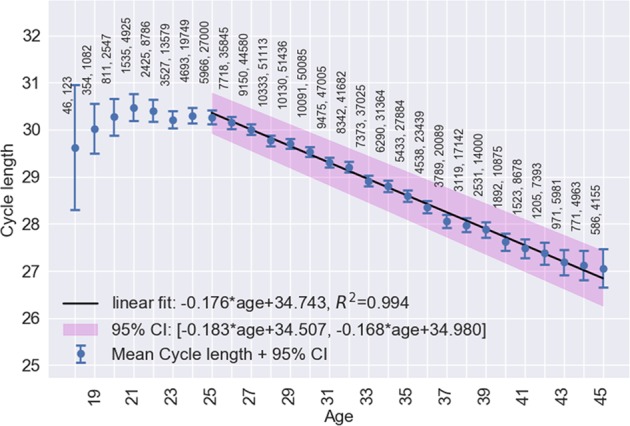
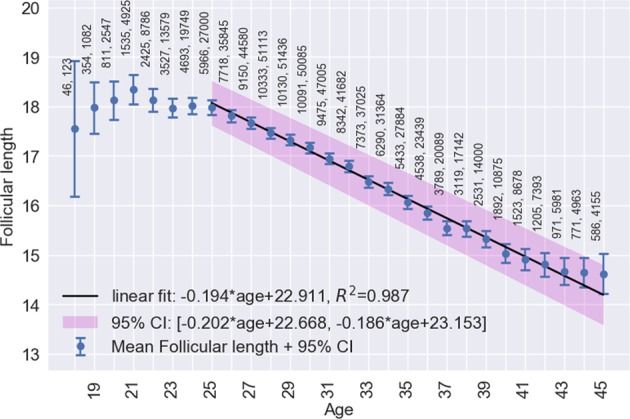
The use of apps that record detailed menstrual cycle data presents a new opportunity to study the menstrual cycle. The aim of this study is to describe menstrual cycle characteristics observed from a large database of cycles collected through an app and investigate associations of menstrual cycle characteristics with cycle length, age and body mass index (BMI). Menstrual cycle parameters, including menstruation, basal body temperature (BBT) and luteinising hormone (LH) tests as well as age and BMI were collected anonymously from real-world users of the Natural Cycles app. We analysed 612,613 ovulatory cycles with a mean length of 29.3 days from 124,648 users. The mean follicular phase length was 16.9 days (95% CI: 10–30) and mean luteal phase length was 12.4 days (95% CI: 7–17). Mean cycle length decreased by 0.18 days (95% CI: 0.17–0.18, R 2 = 0.99) and mean follicular phase length decreased by 0.19 days (95% CI: 0.19–0.20, R 2 = 0.99) per year of age from 25 to 45 years. Mean variation of cycle length per woman was 0.4 days or 14% higher in women with a BMI of over 35 relative to women with a BMI of 18.5–25. This analysis details variations in menstrual cycle characteristics that are not widely known yet have significant implications for health and well-being. Clinically, women who wish to plan a pregnancy need to have intercourse on their fertile days. In order to identify the fertile period it is important to track physiological parameters such as basal body temperature and not just cycle length.
Overview
CoChat Summary
## TL;DR
This app-based observational study analyzed 612,613 ovulatory menstrual cycles from 124,648 users and found that menstrual-cycle differences are driven mainly by follicular phase variation, not a fixed “day 14” ovulation pattern. Cycle length and follicular phase length decreased with age, while BMI had little effect except for greater cycle-length variation in BMI >35.
## Key findings
- The study analyzed 612,613 ovulatory cycles from 124,648 users; mean cycle length was 29.3 days, mean follicular phase length was 16.9 days (95% CI: 10–30), and mean luteal phase length was 12.4 days (95% CI: 7–17).
- Among 81,605 cycles (13%) that were 28 days long, mean follicular and luteal phase lengths were 15.4 and 12.6 days, respectively.
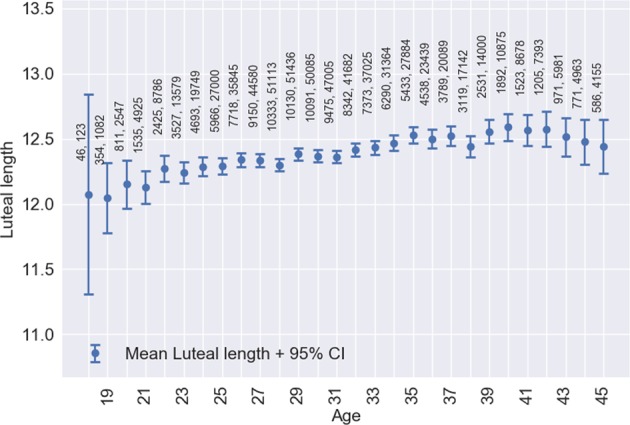
- Cycle length decreased with age: between the youngest and oldest age cohorts, mean cycle length was 2.9 days (10%) shorter (95% CI: 2.9–3.0), and follicular phase length was 3.2 days (20%) shorter (95% CI: 3.2–3.3); luteal phase length changed very little.
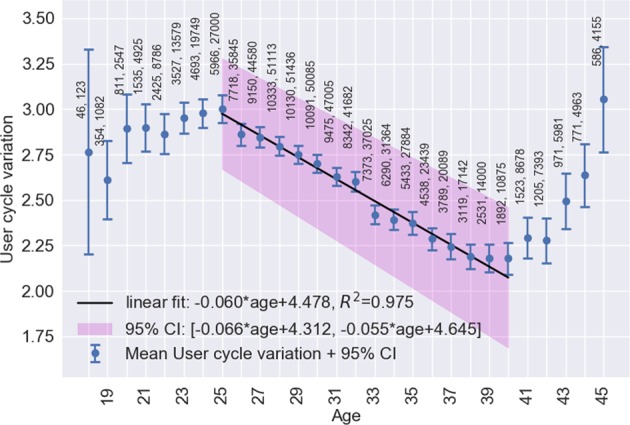
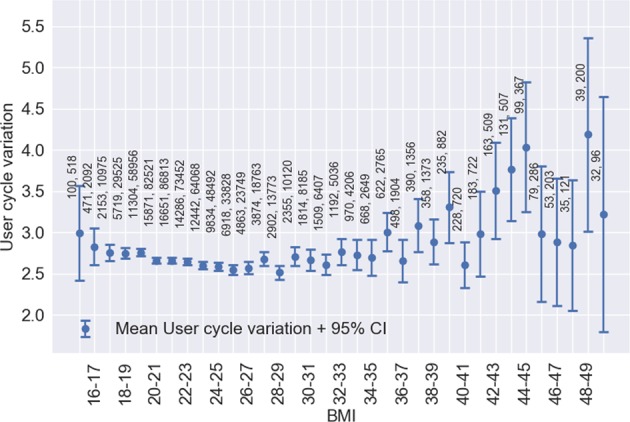
- In BMI analyses, women with BMI 35–50 had 0.4 days (14%) higher per-user cycle-length variation than women with BMI 18.5–25 (95% CI: 0.3–0.5), and underweight women had bleed length 0.2 days (5%) longer than the healthy-weight group.
- The paper reports that 18% of cycles had luteal phases of less than 11 days, and that very short cycles had much shorter follicular phases than normal-length cycles, while very long cycles had much longer follicular phases.
## Methods
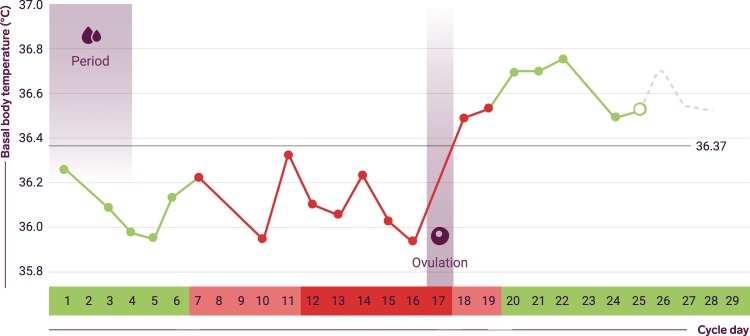
- Prospective observational subanalysis of data from the Natural Cycles app, using daily basal body temperature (BBT), menstruation dates, optional urinary LH tests, plus age and BMI collected in-app.
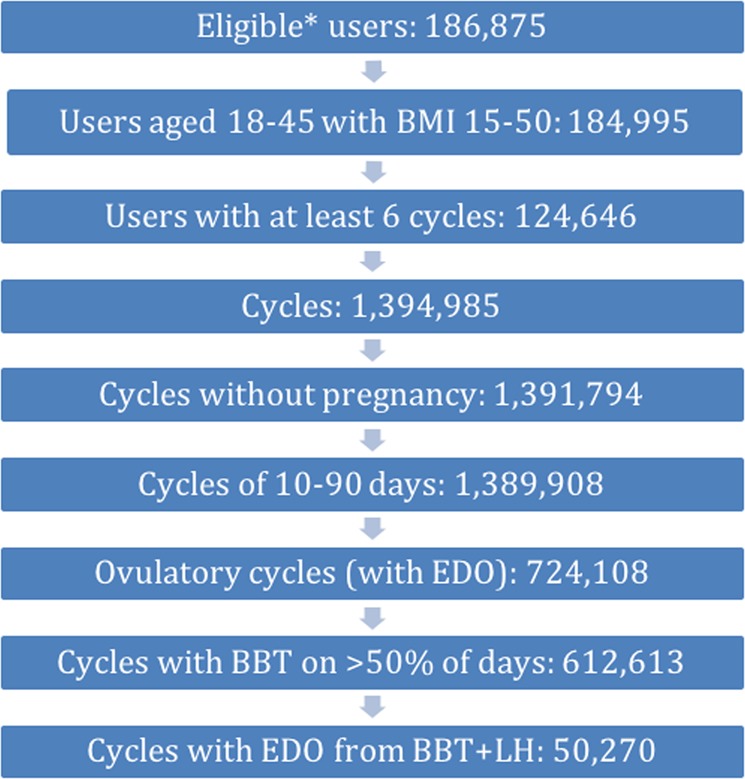
- Included users registered 1 Sept 2016 to 1 Feb 2019, aged 18–45, BMI 15–50, with no hormonal contraception in the prior 12 months; cycles required at least six complete cycles, length 10–90 days, and valid temperature entries on at least 50% of cycle days.
- Main analysis calculated mean cycle, bleed, follicular, and luteal phase lengths in ovulatory cycles, then compared cohorts by cycle length, age, and BMI; because of very large sample sizes, the authors used bootstrapped mean differences with 95% CIs rather than p values.
## Limitations
- The authors state that the study population came solely from app users and may not be representative of the wider population; they note that only 8% of women in the study were obese versus 15% in the general population.
- Only cycles with ovulation detected were included; of the 1.4 million cycles considered, 665,603 (48%) were excluded because ovulation was not detected, creating selection bias, which the paper explicitly acknowledges.
- The paper notes possible human error in self-reported bleeding, LH tests, and temperature measurements, and that measuring BBT and LH every 24 h limits phase-length precision.
Model-written summary. Check it against the paper before relying on it.
Integrity signals
Registry
Cites
Statistics
Figures
Verification
Claims the paper makes
15 Valid · 1 Not valid · 18 Not checked · 60 Own results and interpretations
The cited sources support only part of this claim — read each source’s verdict below.
In the paper
“It is, therefore, unsurprising that several studies have shown that calendar apps are not accurate in identifying the fertile window.35–38”
§ Real-world menstrual cycle characteristics of more than 600,000 menstrual cycles > Discussion
What the sources say
- Not checked — no full text of the sourcecites [35] Setton R Tierney C Tsai T The accuracy of web sites and cellular phone applications in predicting the fertile window Obstet. Gynecol. 2016 128 58 63 10.1097/AOG.0000000000001341 27275788 source
- Supportedcites [36] Freis A Plausibility of menstrual cycle apps claiming to support conception Front. Public Health 2018 6 98 10.3389/fpubh.2018.00098 29666788 PMC5891577 source
The Results (‘Apps Predicting the Fertile Days Based on Data of Previous Cycles’; page not provided) report that the tested calendar-based apps misstated ovulation when cycle length differed from the estimate. The Discussion says their method often missed the most fertile days because cycle length and ovulation day vary. This paper supports the claim as one of the studies cited, without itself needing to establish what every other cited study found. (LLM, conf=0.91)
- Partly supportedcites [37] Sohda S Suzuki K Igari I Relationship between the menstrual cycle and timing of ovulation revealed by new protocols: analysis of data from a self-tracking health app J. Med. Internet Res. 2017 19 e391 10.2196/jmir.7468 29180346 PMC5725625 sourceExperimental — accuracy not yet measured
The Discussion’s Principal Findings say that two existing calendar-based methods did not explain the study data well and were less accurate for certain cycle lengths. That supports concern about calendar-based ovulation predictions, but the paper evaluates prediction methods rather than the accuracy of calendar apps in identifying the fertile window. (LLM, conf=0.84)
- Supportedcites [38] Johnson S Marriott L Zinaman M Can apps and calendar methods predict ovulation with accuracy? Curr. Med. Res. Opin. 2018 34 1587 1594 10.1080/03007995.2018.1475348 29749274 source
The Discussion reports that this study's findings agree with two earlier studies that found low accuracy in apps' predictions of fertile windows. It also explains that wider predicted windows can include ovulation more often but offer poor precision for timing intercourse. (LLM, conf=0.91)
plain- Asserted: passes — The authors put it forward as true.
- Checkable: passes — It can be checked against evidence.
- Load-bearing: passes — The paper’s conclusions depend on it.
- Based: passes — The paper gives a reason why it holds.
Every source the paper cites for this claim was checked and supports it.
In the paper
“Available data, however, suggests that there may be significant variability in fertile days.1,4”
§ Real-world menstrual cycle characteristics of more than 600,000 menstrual cycles > Introduction
What the sources say
- Supportedcites [1] Wilcox AJ The timing of the ‘fertile window’ in the menstrual cycle: day specific estimates from a prospective study Br. Med. J. 2000 321 1259 1262 10.1136/bmj.321.7271.1259 11082086 PMC27529 source
The paper’s ‘What this study adds’ section states that the timing of the fertile window is highly variable, even among women who regard their cycles as regular. The Results section also reports ovulation occurring from day 8 to day 60, supporting variability in when fertile days occur. (LLM, conf=0.95)
- Supportedcites [4] Fehring RJ Schneider M Raviele K Variability in the phases of the menstrual cycle J. Obstet. Gynecol. Neonatal Nurs. 2006 35 376 384 10.1111/j.1552-6909.2006.00051.x 16700687 source
The Variability of Fertile Window section reports that the six fertile days fell anywhere between cycle days 4 and 23 across about 95% of cycles. This directly supports the hedged claim that fertile days may vary significantly. (LLM, conf=0.94)
hedged- Asserted: passes — The authors put it forward as true.
- Checkable: passes — It can be checked against evidence.
- Load-bearing: passes — The paper’s conclusions depend on it.
- Based: passes — The paper gives a reason why it holds.
- Supported
The sources with a verdict support this claim; the rest weren’t checked yet, have no full text we could read, or their verdicts aren’t rated yet.
In the paper
“but there is much greater variation than this.1,4–7”
§ Real-world menstrual cycle characteristics of more than 600,000 menstrual cycles > Introduction
What the sources say
- Supportedcites [1] Wilcox AJ The timing of the ‘fertile window’ in the menstrual cycle: day specific estimates from a prospective study Br. Med. J. 2000 321 1259 1262 10.1136/bmj.321.7271.1259 11082086 PMC27529 source
The Clinical guidelines section says the fertile window can occur much earlier or later than guidelines suggest. The Conclusions section reports that it falls entirely within the guideline days in only about 30% of women, supporting the claimed greater variation in its timing. (LLM, conf=0.90)
- Supportedcites [4] Fehring RJ Schneider M Raviele K Variability in the phases of the menstrual cycle J. Obstet. Gynecol. Neonatal Nurs. 2006 35 376 384 10.1111/j.1552-6909.2006.00051.x 16700687 source
The Implications of Findings section says menstrual-cycle parameters vary considerably even among healthy, regularly cycling women. The Variability of Follicular and Luteal Phases section explicitly finds a wider luteal-phase range than those listed in the medical and nursing textbooks in Table 3 (page unavailable in our copy). (LLM, conf=0.88)
- Not checked — no full text of the sourcecites [5] Mihm M Gangooly S Muttukrishna S The normal menstrual cycle in women Anim. Reprod. Sci. 2011 124 229 236 10.1016/j.anireprosci.2010.08.030 20869180 source
- Not checked — no full text of the sourcecites [6] Treloar AE Boynton RE Behn BG Brown BW Variation of the human menstrual cycle through reproductive life Int. J. Fertil. 1967 12 77 126 5419031 source
- Not checked — no full text of the sourcecites [7] Lenton EA Landgren B Sexton L Normal variation in the length of the luteal phase of the menstrual cycle: identification of the short luteal phase BJOG 1984 91 685 689 10.1111/j.1471-0528.1984.tb04831.x 6743610 source
plain- Asserted: passes — The authors put it forward as true.
- Checkable: passes — It can be checked against evidence.
- Load-bearing: passes — The paper’s conclusions depend on it.
- Based: passes — The paper gives a reason why it holds.
- Supported
Every source the paper cites for this claim was checked and supports it.
In the paper
“Besides the potential benefits to the individual, fertility awareness apps and the associated databases of fertility data provide a unique opportunity to examine a large number of menstrual cycles in order to improve understanding.25,26”
§ Real-world menstrual cycle characteristics of more than 600,000 menstrual cycles > Introduction
What the sources say
- Supportedcites [25] Liu, B. et al. Predicting pregnancy using large-scale data from a women’s health tracking mobile application.In The World Wide Web Conference (pp. 2999–3005) (ACM, 2019). PMC6752881 31538145 source
The Introduction describes health-tracking apps as a new data source and says they have already been used to study menstrual-cycle fluctuations and lengths. It also reports a dataset with tens of millions of observations from tens of thousands of women, supporting the claimed opportunity to study menstrual cycles at scale. (LLM, conf=0.91)
- Supportedcites [26] Symul, L., Wac, K., Hillard, P. & Salathe, M. Assessment of menstrual health status and evolution through mobile apps for fertility awareness. bioRxiv10.1101/385054 (2019). PMC6635432 31341953 source
The Abstract says menstrual-tracking apps provide an unparalleled view of menstrual health at population scale and reports data from over 2.7 million cycles. The Introduction and Discussion likewise describe using app-collected data to assess menstrual health and study fertility patterns. (LLM, conf=0.93)
plain- Asserted: passes — The authors put it forward as true.
- Checkable: passes — It can be checked against evidence.
- Load-bearing: passes — The paper’s conclusions depend on it.
- Based: passes — The paper gives a reason why it holds.
- Supported
Every source the paper cites for this claim was checked and supports it.
In the paper
“Nevertheless, the length of the luteal phase may also deviate significantly from 14 days.”
§ Real-world menstrual cycle characteristics of more than 600,000 menstrual cycles > Introduction
What the sources say
- Supportedcites [1] Wilcox AJ The timing of the ‘fertile window’ in the menstrual cycle: day specific estimates from a prospective study Br. Med. J. 2000 321 1259 1262 10.1136/bmj.321.7271.1259 11082086 PMC27529 source
The Clinical guidelines section (page not provided) reports that ovulation occurred exactly 14 days before the next menses in only 10% of the study's 28-day cycles. The interval from ovulation to the next menses ranged from 7 to 19 days, supporting the claim that luteal-phase length may differ substantially from 14 days. (LLM, conf=0.94)
hedged- Asserted: passes — The authors put it forward as true.
- Checkable: passes — It can be checked against evidence.
- Load-bearing: unclear — It is unclear whether the paper’s conclusions depend on it.
- Based: passes — The paper gives a reason why it holds.
- Supported
44 more claims
Create a free account to see all 94 claims and to verify the 3 references still open.
- It may state two separate claims as one. 25
- Probably not a substantial claim. 30
- The quote only partly states this claim. 1
Claims other papers make about this one
Each is checked against this paper’s own text: does it say what the citing paper says it does?
The source backs part of the claim, not all of it — or backs it for a different population, condition or comparison.
In the citing paper
“This process results in quasi-periodic hormone profiles with a cycle length of 25 to 35 days (Bakos et al., 1994;Harlow, 2000;Bull et al., 2019).”
From Hormonal regulation of ovarian follicle growth in humans: Model-based exploration of cycle variability and parameter sensitivities (2022) · cites this paper as Bull et al., 2019
Experimental — accuracy not yet measuredThe source backs part of the claim, not all of it — or backs it for a different population, condition or comparison.
In the citing paper
“In line with the literature (Bull et al., 2019), we implemented the model in a way that little variation occurs in the length of the luteal phase.”
From Hormonal regulation of ovarian follicle growth in humans: Model-based exploration of cycle variability and parameter sensitivities (2022) · cites this paper as Bull et al., 2019
Experimental — accuracy not yet measuredThe source backs part of the claim, not all of it — or backs it for a different population, condition or comparison.
In the citing paper
“Also, evident from this “big data” set is the variability in menstrual cycle duration between women and within menstrual cycles of the same woman, mostly as a result of variability in the duration of the follicular phase [39].”
From Temperature regulation in women: Effects of the menstrual cycle (2020) · cites this paper as [39]
Experimental — accuracy not yet measuredThe cited source says what the claim attributes to it.
In the citing paper
“The simulated average cycle length ranges from 22.7 to 27.8 days (Fig. A.6), which is within the physiological range (Bull et al., 2019).”
From Hormonal regulation of ovarian follicle growth in humans: Model-based exploration of cycle variability and parameter sensitivities (2022) · cites this paper as Bull et al., 2019
The cited source says what the claim attributes to it.
In the citing paper
“As earlier studies have already shown (11, 23–26), we found a significant decrease in cycle length with age (Table 1 and Figs. 2 and 3).”
From Women temporarily synchronize their menstrual cycles with the luminance and gravimetric cycles of the Moon (2021) · cites this paper as [26]
3 more claims about this paper
Create a free account to see every claim other papers make about this one.
Citations
Cites
An Introduction to the Bootstrap
Efron, B., & Tibshirani, R. J. (1994) · doi:10.1201/9780429246593 · Cited by 40,500
An Introduction to the Bootstrap
Efron, B., & Tibshirani, R. J. (1993) · doi:10.1007/978-1-4899-4541-9 · Cited by 21,230
(2000) · PubMed · Cited by 13,173
The Diagnosis of Polycystic Ovary Syndrome during Adolescence
Witchel, S. F., Oberfield, S., Rosenfield, R. L., Codner, E., Bonny, A., Ibáñez, L., Pena, A., Horikawa, R., Gomez-Lobo, V., Joel, D., et al. (2015) · Hormone Research in Paediatrics · doi:10.1159/000375530 · Cited by 3,113
An Introduction to the Bootstrap.
Buckland, S. T., Efron, B., & Tibshirani, R. J. (1994) · Biometrics · doi:10.2307/2532810 · Cited by 3,103
VARIATION OF THE HUMAN MENSTRUAL CYCLE THROUGH REPRODUCTIVE LIFE
TRELOAR, A. E., BOYNTON, R. E., BEHN, B. G., & BROWN, B. W. (1968) · Obstetrical & Gynecological Survey · doi:10.1097/00006254-196801000-00019 · Cited by 1,018 · cited 2×
“With increasing age, cycle length reduces and the timing of ovulation becomes earlier; the variation of a woman’s cycle length reduces with age until menopause.(5,6,8,9) Cycle characteristics also may be affected by ethnicity, high body mass index (BMI), stress and lifestyle factors.”
BackgroundResultPsychological impact of infertility
Cousineau, T. M., & Domar, A. D. (2007) · Best Practice & Research Clinical Obstetrics & Gynaecology · doi:10.1016/j.bpobgyn.2006.12.003 · Cited by 997 · cited 1×
“Anecdotally there is poor understanding of fertility amongst the general population, which can lead to both unintended pregnancies and delayed time to conception with associated psychological suffering for those wishing to start a family.(40) Fertility education delivered through an app has the potential to improve do…”
BackgroundResearch Commentary —Too Big to Fail: Large Samples and the p -Value Problem
Lin, M., Lucas, H. C., & Shmueli, G. (2013) · Information Systems Research · doi:10.1287/isre.2013.0480 · Cited by 972 · cited 1×
“Owing to the very large sample sizes in this study, P values were not calculated since they can be very small even if differences between cohorts are of no clinical significance.(49) Instead, effect size between two cohorts was estimated as a mean difference with a 95% confidence interval calculated from 200 bootstrap…”
MethodTorous, J., Nicholas, J., Larsen, M. E., Firth, J., & Christensen, H. (2018) · Evidence Based Mental Health · doi:10.1136/eb-2018-102891 · Cited by 790
(1977) · PubMed · Cited by 488
Wilcox, A. J. (2000) · BMJ · doi:10.1136/bmj.321.7271.1259 · Cited by 452 · cited 3×
“For example, the luteal phase length was between 7 and 19 days in a sample of 28 day cycles.(1) With increasing age, cycle length reduces and the timing of ovulation becomes earlier; the variation of a woman’s cycle length reduces with age until menopause.”
BackgroundThe normal menstrual cycle in women
Mihm, M., Gangooly, S., & Muttukrishna, S. (2011) · Animal Reproduction Science · doi:10.1016/j.anireprosci.2010.08.030 · Cited by 448 · cited 1×
“With increasing age, cycle length reduces and the timing of ovulation becomes earlier; the variation of a woman’s cycle length reduces with age until menopause.(5,6,8,9) Cycle characteristics also may be affected by ethnicity, high body mass index (BMI), stress and lifestyle factors.”
BackgroundThe FIGO recommendations on terminologies and definitions for normal and abnormal uterine bleeding
Fraser, I., Critchley, H., Broder, M., & Munro, M. (2011) · Seminars in Reproductive Medicine · doi:10.1055/s-0031-1287662 · Cited by 384 · cited 1×
“The ‘normal’ menstrual cycle is conventionally classified as 21–35 days in length, frequent menstrual bleeding (polymenorrheic) cycles as being under 21 (very short cycles) and infrequent menstrual bleeding (oligomenorrheic cycles) as being over 35 days (very long cycles).(48) In this study bleed length was defined as…”
BackgroundVariability in the phases of the menstrual cycle
Fehring, R. J., Schneider, M., & Raviele, K. (2006) · Journal of Obstetric, Gynecologic & Neonatal Nursing · doi:10.1111/j.1552-6909.2006.00051.x · Cited by 376 · cited 2×
“The variation in cycle length is attributed mainly to the timing of ovulation.(4) Nevertheless, the length of the luteal phase may also deviate significantly from 14 days.”
BackgroundThe length and variability of the human menstrual cycle
Chiazze, L. (1968) · JAMA: The Journal of the American Medical Association · doi:10.1001/jama.1968.03140060001001 · Cited by 374 · cited 2×
“With increasing age, cycle length reduces and the timing of ovulation becomes earlier; the variation of a woman’s cycle length reduces with age until menopause.(5,6,8,9) Cycle characteristics also may be affected by ethnicity, high body mass index (BMI), stress and lifestyle factors.”
BackgroundResultEpidemiology of Obesity in Adults: Latest Trends
Inoue, Y., Qin, B., Poti, J., Sokol, R., & Gordon-Larsen, P. (2018) · Current Obesity Reports · doi:10.1007/s13679-018-0317-8 · Cited by 308
(1967) · PubMed · Cited by 257
LENTON, E. A., LANDGREN, B., & SEXTON, L. (1984) · BJOG: An International Journal of Obstetrics & Gynaecology · doi:10.1111/j.1471-0528.1984.tb04831.x · Cited by 239
Influence of Medical Conditions and Lifestyle Factors on the Menstrual Cycle
Rowland, A. S., Baird, D. D., Long, S., Wegienka, G., Harlow, S. D., Alavanja, M., & Sandler, D. P. (2002) · Epidemiology · doi:10.1097/00001648-200211000-00011 · Cited by 239 · cited 1×
“This effect is expected because pre-existing medical condition (PCOS) is associated with obesity and causes erratic menstrual cycles.(10) Future research may investigate the effect of BMI on cycle characteristics in greater depth.”
BackgroundBehre, H. M., Kuhlage, J., Gaβner, C., Sonntag, B., Schem, C., Schneider, H. P. G., & Nieschlag, E. (2000) · Human Reproduction · doi:10.1093/humrep/15.12.2478 · Cited by 238
Detection of ovulation, a review of currently available methods
Su, H., Yi, Y., Wei, T., Chang, T., & Cheng, C. (2017) · Bioengineering & Translational Medicine · doi:10.1002/btm2.10058 · Cited by 231 · cited 2×
“3 °C following ovulation.(44) The higher level of BBT is sustained during the luteal phase before falling back to the lower level at the start of the next cycle.”
BackgroundMethodHarlow, S. D., & Matanoski, G. M. (1991) · American Journal of Epidemiology · doi:10.1093/oxfordjournals.aje.a115800 · Cited by 208
Factors Affecting Menstrual Cycle Characteristics
Liu, Y., Gold, E. B., Lasley, B. L., & Johnson, W. O. (2004) · American Journal of Epidemiology · doi:10.1093/aje/kwh188 · Cited by 191 · cited 1×
“With increasing age, cycle length reduces and the timing of ovulation becomes earlier; the variation of a woman’s cycle length reduces with age until menopause.(5,6,8,9) Cycle characteristics also may be affected by ethnicity, high body mass index (BMI), stress and lifestyle factors.”
BackgroundUsing the ratio of urinary oestrogen and progesterone metabolites to estimate day of ovulation
Baird, D. D., Weinberg, C. R., Wilcox, A. J., McConnaughey, D. R., & Musey, P. I. (1991) · Statistics in Medicine · doi:10.1002/sim.4780100209 · Cited by 160 · cited 2×
“Another marker besides the BBT shift that has been used in clinical settings to estimate the day of ovulation is the day of luteal transition (DLT) defined as the ratio of oestrogen to progesterone falling below a critical threshold.(28,47) The DLT ovulation detection algorithm has been designed to coincide with the p…”
MethodAging and the environment affect gamete and embryo potential: can we intervene?
Meldrum, D. R., Casper, R. F., Diez-Juan, A., Simon, C., Domar, A. D., & Frydman, R. (2016) · Fertility and Sterility · doi:10.1016/j.fertnstert.2016.01.013 · Cited by 159
Chronological aspects of ultrasonic, hormonal, and other indirect indices of ovulation
Ecochard, R., Boehringer, H., Rabilloud, M., & Marret, H. (2001) · BJOG: An International Journal of Obstetrics & Gynaecology · doi:10.1111/j.1471-0528.2001.00194.x · Cited by 149 · cited 4×
“4 days after the estimated start of the LH surge,(20) similar to a comprehensive study of different markers of ovulation by Ecochard et al.(45) where the FHP was most often 2 days after the LH peak.”
MethodInfluentialBaird, D. D., McConnaughey, D. R., Weinberg, C. R., Musey, P. L., Collins, D. C., Kesner, J. S., Knecht, E. A., & Wilcox, A. J. (1995) · Epidemiology · doi:10.1097/00001648-199509000-00015 · Cited by 142 · cited 4×
“We compared the distribution of follicular and luteal phase lengths in our sample of 612,613 cycles to two reference data sets: a sample of 688 cycles obtained by Baird et al.28 and a sample of 327 cycles obtained by Lenton et al.7 (Supplementary Results).”
MethodInfluentialCan apps and calendar methods predict ovulation with accuracy?
Johnson, S., Marriott, L., & Zinaman, M. (2018) · Current Medical Research and Opinion · doi:10.1080/03007995.2018.1475348 · Cited by 115
Panth, N., Gavarkovs, A., Tamez, M., & Mattei, J. (2018) · Frontiers in Public Health · doi:10.3389/fpubh.2018.00211 · Cited by 113
The Performance of Fertility Awareness-based Method Apps Marketed to Avoid Pregnancy
Duane, M., Contreras, A., Jensen, E. T., & White, A. (2016) · The Journal of the American Board of Family Medicine · doi:10.3122/jabfm.2016.04.160022 · Cited by 110
Shilaih, M., Goodale, B. M., Falco, L., Kübler, F., De Clerck, V., & Leeners, B. (2018) · Bioscience Reports · doi:10.1042/bsr20171279 · Cited by 109
Perfect-use and typical-use Pearl Index of a contraceptive mobile app
Berglund Scherwitzl, E., Lundberg, O., Kopp Kallner, H., Gemzell Danielsson, K., Trussell, J., & Scherwitzl, R. (2017) · Contraception · doi:10.1016/j.contraception.2017.08.014 · Cited by 101 · cited 2×
“Some fertility apps are based on sophisticated algorithms for individualised identification of the fertile window relying on physiological parameters such as BBT which are more acceptable for large numbers of women.(14,27) Whilst LH test kits have been used to determine the day of ovulation for decades, they have a si…”
BackgroundMethodInfluentialSelf-citationEffectiveness of Fertility Awareness–Based Methods for Pregnancy Prevention: A Systematic Review
Peragallo Urrutia, R., Polis, C. B., Jensen, E. T., Greene, M. E., Kennedy, E., & Stanford, J. B. (2018) · Obstetrics & Gynecology · doi:10.1097/aog.0000000000002784 · Cited by 101
Obesity and assisted reproductive technology outcomes
Bellver, J., Busso, C., Pellicer, A., Remohí, J., & Simón, C. (2006) · Reproductive BioMedicine Online · doi:10.1016/s1472-6483(10)61181-9 · Cited by 100
The need to improve fertility awareness
Harper, J., Boivin, J., O’Neill, H. C., Brian, K., Dhingra, J., Dugdale, G., Edwards, G., Emmerson, L., Grace, B., Hadley, A., et al. (2017) · Reproductive Biomedicine & Society Online · doi:10.1016/j.rbms.2017.03.002 · Cited by 100
Self-citationIdentification and prediction of the fertile window using NaturalCycles
Berglund Scherwitzl, E., Lindén Hirschberg, A., & Scherwitzl, R. (2015) · The European Journal of Contraception & Reproductive Health Care · doi:10.3109/13625187.2014.988210 · Cited by 90
Self-citationFertility awareness-based mobile application for contraception
Berglund Scherwitzl, E., Gemzell Danielsson, K., Sellberg, J. A., & Scherwitzl, R. (2016) · The European Journal of Contraception & Reproductive Health Care · doi:10.3109/13625187.2016.1154143 · Cited by 81 · cited 2×
“Some fertility apps are based on sophisticated algorithms for individualised identification of the fertile window relying on physiological parameters such as BBT which are more acceptable for large numbers of women.(14,27) Whilst LH test kits have been used to determine the day of ovulation for decades, they have a si…”
BackgroundMethodInfluentialSelf-citationPlausibility of Menstrual Cycle Apps Claiming to Support Conception
Freis, A., Freundl-Schütt, T., Wallwiener, L.-M., Baur, S., Strowitzki, T., Freundl, G., & Frank-Herrmann, P. (2018) · Frontiers in Public Health · doi:10.3389/fpubh.2018.00098 · Cited by 80
Assessment of Menstrual Health Status and Evolution through Mobile Apps for Fertility Awareness
Symul, L., Wac, K., Hillard, P., & Salathé, M. (2018) · doi:10.1101/385054 · Cited by 80
Assessment of menstrual health status and evolution through mobile apps for fertility awareness
Symul, L., Wac, K., Hillard, P., & Salathé, M. (2019) · npj Digital Medicine · doi:10.1038/s41746-019-0139-4 · Cited by 78 · cited 1×
“Besides the potential benefits to the individual, fertility awareness apps and the associated databases of fertility data provide a unique opportunity to examine a large number of menstrual cycles in order to improve understanding.(25,26) The mobile app used in the study can be used to prevent a pregnancy (‘Prevent’ m…”
MethodTime relationships between basal body temperature and ovulation or plasma progestins
de Mouzon, J., Testart, J., Lefevre, B., Pouly, J.-L., & Frydman, R. (1984) · Fertility and Sterility · doi:10.1016/s0015-0282(16)47600-4 · Cited by 76 · cited 2×
“This means that ovulation itself is estimated to occur on the day of the last low temperature before the rise as suggested by Hilgers and Bailey46 and Mouzon et al.43 We define the EDO as the day before the FHP, the day of the last low temperature.”
MethodUser profile and preferences in fertility apps for preventing pregnancy: an exploratory pilot study
Starling, M. S., Kandel, Z., Haile, L., & Simmons, R. G. (2018) · mHealth · doi:10.21037/mhealth.2018.06.02 · Cited by 60
Natural Family Planning. II. Basal Body Temperature and Estimated Time of Ovulation
HILGERS, T. W., & BAILEY, A. J. (1980) · Obstetrics & Gynecology · doi:10.1097/00006250-198003000-00013 · Cited by 57
The accuracy of web sites and cellular phone applications in predicting the fertile window
Setton, R., Tierney, C., & Tsai, T. (2016) · Obstetrics & Gynecology · doi:10.1097/aog.0000000000001341 · Cited by 50
Menstruation and Menstrual Disorders
Harlow, S. D., Windham, G. C., & Paramsothy, P. (2012) · Elsevier eBooks · doi:10.1016/b978-0-12-384978-6.00012-1 · Cited by 48
Sohda, S., Suzuki, K., & Igari, I. (2017) · Journal of Medical Internet Research · doi:10.2196/jmir.7468 · Cited by 47
Regidor, P.-A., Kaczmarczyk, M., Schiweck, E., Goeckenjan-Festag, M., & Alexander, H. (2018) · Gynecological Endocrinology · doi:10.1080/09513590.2017.1390737 · Cited by 44
Jennings, V., Haile, L. T., Simmons, R. G., Spieler, J., & Shattuck, D. (2019) · The European Journal of Contraception & Reproductive Health Care · doi:10.1080/13625187.2019.1581164 · Cited by 41
Block, J. P., Subramanian, S. V., Christakis, N. A., & O’Malley, A. J. (2013) · PLoS ONE · doi:10.1371/journal.pone.0063217 · Cited by 35
Predicting pregnancy using large-scale data from a women's health tracking mobile application
Liu, B., Shi, S., Wu, Y., Thomas, D., Symul, L., Pierson, E., & Leskovec, J. (2019) · The World Wide Web Conference · doi:10.1145/3308558.3313512 · Cited by 34 · cited 1×
“Besides the potential benefits to the individual, fertility awareness apps and the associated databases of fertility data provide a unique opportunity to examine a large number of menstrual cycles in order to improve understanding.(25,26) The mobile app used in the study can be used to prevent a pregnancy (‘Prevent’ m…”
MethodAssessing the Efficacy of an App-Based Method of Family Planning: The Dot Study Protocol
Simmons, R. G., Shattuck, D. C., & Jennings, V. H. (2017) · JMIR Research Protocols · doi:10.2196/resprot.6886 · Cited by 27
Abstracts of the 34rd Annual Meeting of the European Society of Human Reproduction and Embryology
(2018) · Human Reproduction · doi:10.1093/humrep/33.supplement_1.1 · Cited by 26
Godbert, S., Miró, F., Shreeves, C., Gnoth, C., & Johnson, S. (2015) · Archives of Gynecology and Obstetrics · doi:10.1007/s00404-015-3732-z · Cited by 24 · cited 1×
“The start of the surge is approximately 28–48 h before follicle rupture and peak LH levels are reached 12 h before follicle rupture.(42) After follicle rupture the corpus luteum forms, marking the start of the luteal phase, and secretes progesterone for the duration of the luteal phase in order to prime the endometriu…”
BackgroundMenstruation and Menstrual Disorders
HARLOW, S. D. (2000) · Women and Health · doi:10.1016/b978-012288145-9/50012-7 · Cited by 24
The Normal Menstrual Cycle and the Control of Ovulation -- Endotext
Kr, F., Anawalt, B., Boyce, A., et al. (2000) · Cited by 17
Cited by
Menstruation: science and society
Critchley, H. O. D., Babayev, E., Bulun, S. E., Clark, S., Garcia-Grau, I., Gregersen, P. K., Kilcoyne, A., Kim, J.-Y. J., Lavender, M., Marsh, E. E., et al. (2020) · American Journal of Obstetrics and Gynecology · doi:10.1016/j.ajog.2020.06.004 · Cited by 448
Current Guidelines for Diagnosing PCOS
Christ, J. P., & Cedars, M. I. (2023) · Diagnostics · doi:10.3390/diagnostics13061113 · Cited by 340
“Even among those with ovulatory cycles, however, there can be significant heterogeneity between individuals and within a single individual in overall cycle, follicular phase, and luteal phase length [49].”
BackgroundEdelman, A., Boniface, E. R., Benhar, E., Han, L., Matteson, K. A., Favaro, C., Pearson, J. T., & Darney, B. G. (2022) · Obstetrics & Gynecology · doi:10.1097/aog.0000000000004695 · Cited by 274
Temperature regulation in women: Effects of the menstrual cycle
Baker, F. C., Siboza, F., & Fuller, A. (2020) · Temperature · doi:10.1080/23328940.2020.1735927 · Cited by 262
“Also, evident from this “big data” set is the variability in menstrual cycle duration between women and within menstrual cycles of the same woman, mostly as a result of variability in the duration of the follicular phase [39].”
BackgroundBarrington, D. J., Robinson, H. J., Wilson, E., & Hennegan, J. (2021) · PLOS ONE · doi:10.1371/journal.pone.0255001 · Cited by 183
“Introduction At any given moment approximately 10% of the global population is experiencing their menstrual period [1].”
Background
Metadata
- Authors
- Bull, J. R., Rowland, S. P., Scherwitzl, E. B., Scherwitzl, R., Danielsson, K. G., & Harper, J.
- Affiliations
- University College London (GB)
- Corresponding author
- Bull, Jonathan R.
- Venue
- npj Digital Medicine
- Published
- 2019-08-27
- Volume
- 2
- Issue
- 1
- Pages
- 83-83
- ISSN
- 2398-6352 (ISSN-L)
- PMC
- PMC6710244
- OpenAlex
- W2970585464
- Semantic Scholar
- 14b8c784b73216f7348e35914ac911a45dfb9283
- Cited by
- 404
- References
- 54
- Citations by year
- 2026: 60 · 2025: 49 · 2024: 76 · 2023: 80 · 2022: 62 · 2021: 50 · 2020: 25 · 2019: 2
- FWCI
- 32.00
- Type
- journal article
- Language
- en
- Open access
- gold
- doi.org
- Licence
- cc-by
- creativecommons.org/licenses/by/4.0 (tdm)
- creativecommons.org/licenses/by/4.0 (vor)
- Locations
- npj Digital Medicine (publishedVersion, cc-by)
- PubMed Central (publishedVersion, cc-by)
- PubMed (publishedVersion)
- DOAJ (DOAJ: Directory of Open Access Journals) (submittedVersion)
- UCL Discovery (University College London) (submittedVersion)
- Funders
- Full time employee of Natural Cycles Nordic AB
- Topics
- Health Sciences › Medicine › Public Health, Environmental and Occupational Health › Menstrual Health and Disorders
- Health Sciences › Medicine › Reproductive Medicine › Hypothalamic control of reproductive hormones
- Health Sciences › Medicine › Reproductive Medicine › Ovarian function and disorders
- Keywords
- menstrual cycle, cycle length, follicular phase, luteal phase, basal body temperature, body mass index, age, fertility monitoring, ovulation, fertility awareness
About these checks
Registry, retraction, Cites and statistics results are computed, not judged, with one exception: a printed reference that no index lists is read once by a model before it counts as a citation error. Claims are extracted by a model and kept only when their quote appears verbatim in the text; each cited source is then checked, with a model’s help, for whether it says what the claim relies on. Those verdicts can be wrong — read the claim’s quote and the cited source before relying on one.
The claim verdicts this report counts are experimental: their accuracy is not yet measured.
A language model drew the claims from the paper on 2026-10-09, under version 3 of the claim definition (model deepseek-v4.1-flash, prompt extract-v3).
A second model labelled each claim on 2026-10-09 (model jev-1.13-20260917, definition revision gold-guideline-v0.2).
Cited sources are checked with a language model’s help (gpt-6-sol).
Statistics and arithmetic are recomputed, not judged.
Confidence bands are shown only for fields calibrated on our annotated test set. None is calibrated yet, so no band is shown.
What counts as a claim ›How we measure confidence ›How we check this ›
Are you an author, or do you see a problem with this page? Request a review
Data sources
Bibliographic data: Semantic Scholar, OpenAlex, Crossref.
Contains information from the Semantic Scholar Academic Graph Datasets, made available under the ODC Attribution License (ODC-BY 1.0).
Semantic Scholar’s data is described in: Kinney, R., et al. (2023). The Semantic Scholar Open Data Platform. arXiv:2301.10140.
