

Real-world menstrual cycle characteristics of more than 600,000 menstrual cycles
Open accessThe DOI matches its Crossref record; 55 of the 55 references it cites were found in a registry or an index; 22 of the 66 sources its claims cite were checked for support.
Abstract
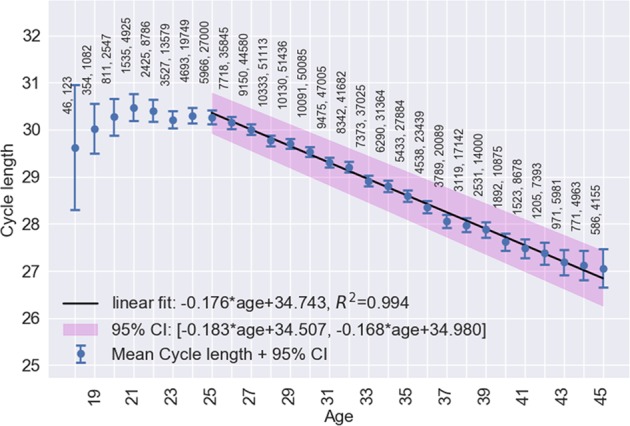
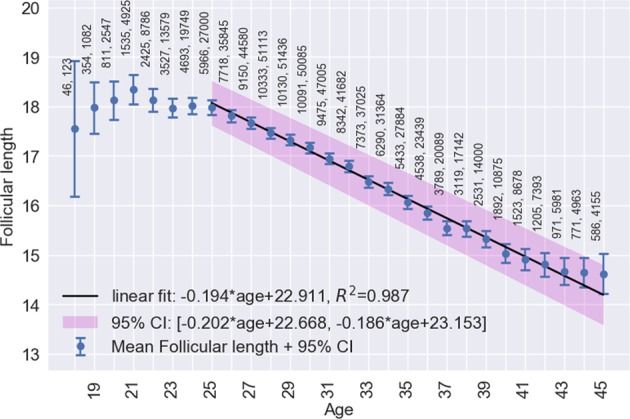
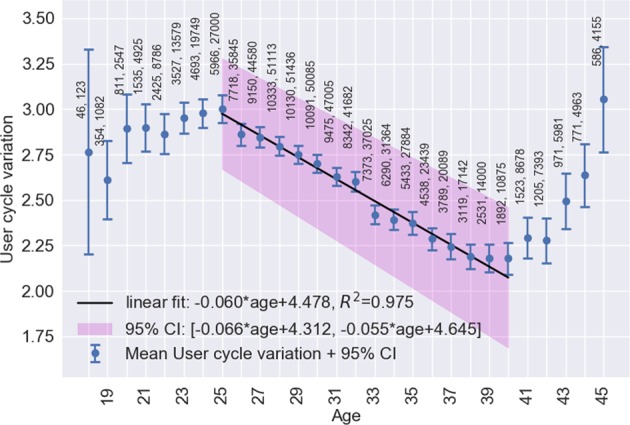
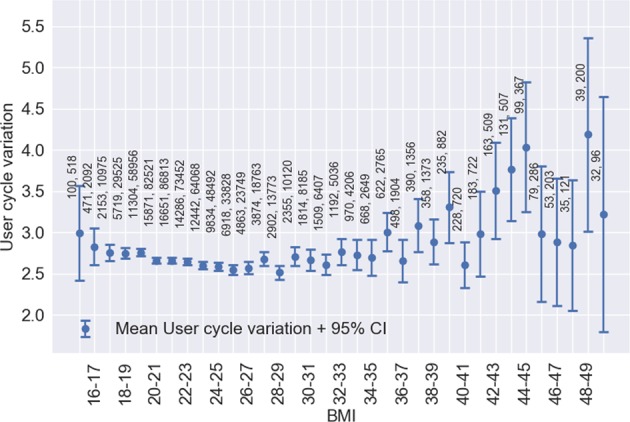
The use of apps that record detailed menstrual cycle data presents a new opportunity to study the menstrual cycle. The aim of this study is to describe menstrual cycle characteristics observed from a large database of cycles collected through an app and investigate associations of menstrual cycle characteristics with cycle length, age and body mass index (BMI). Menstrual cycle parameters, including menstruation, basal body temperature (BBT) and luteinising hormone (LH) tests as well as age and BMI were collected anonymously from real-world users of the Natural Cycles app. We analysed 612,613 ovulatory cycles with a mean length of 29.3 days from 124,648 users. The mean follicular phase length was 16.9 days (95% CI: 10–30) and mean luteal phase length was 12.4 days (95% CI: 7–17). Mean cycle length decreased by 0.18 days (95% CI: 0.17–0.18, R 2 = 0.99) and mean follicular phase length decreased by 0.19 days (95% CI: 0.19–0.20, R 2 = 0.99) per year of age from 25 to 45 years. Mean variation of cycle length per woman was 0.4 days or 14% higher in women with a BMI of over 35 relative to women with a BMI of 18.5–25. This analysis details variations in menstrual cycle characteristics that are not widely known yet have significant implications for health and well-being. Clinically, women who wish to plan a pregnancy need to have intercourse on their fertile days. In order to identify the fertile period it is important to track physiological parameters such as basal body temperature and not just cycle length.
Overview
CoChat Summary
## TL;DR
This app-based observational study analyzed 612,613 ovulatory menstrual cycles from 124,648 users and found that menstrual-cycle differences are driven mainly by follicular phase variation, not a fixed “day 14” ovulation pattern. Cycle length and follicular phase length decreased with age, while BMI had little effect except for greater cycle-length variation in BMI >35.
## Key findings
- The study analyzed 612,613 ovulatory cycles from 124,648 users; mean cycle length was 29.3 days, mean follicular phase length was 16.9 days (95% CI: 10–30), and mean luteal phase length was 12.4 days (95% CI: 7–17).
- Among 81,605 cycles (13%) that were 28 days long, mean follicular and luteal phase lengths were 15.4 and 12.6 days, respectively.
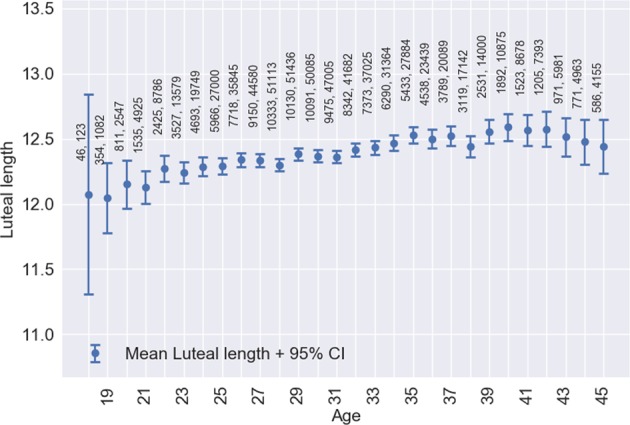
- Cycle length decreased with age: between the youngest and oldest age cohorts, mean cycle length was 2.9 days (10%) shorter (95% CI: 2.9–3.0), and follicular phase length was 3.2 days (20%) shorter (95% CI: 3.2–3.3); luteal phase length changed very little.
- In BMI analyses, women with BMI 35–50 had 0.4 days (14%) higher per-user cycle-length variation than women with BMI 18.5–25 (95% CI: 0.3–0.5), and underweight women had bleed length 0.2 days (5%) longer than the healthy-weight group.
- The paper reports that 18% of cycles had luteal phases of less than 11 days, and that very short cycles had much shorter follicular phases than normal-length cycles, while very long cycles had much longer follicular phases.
## Methods
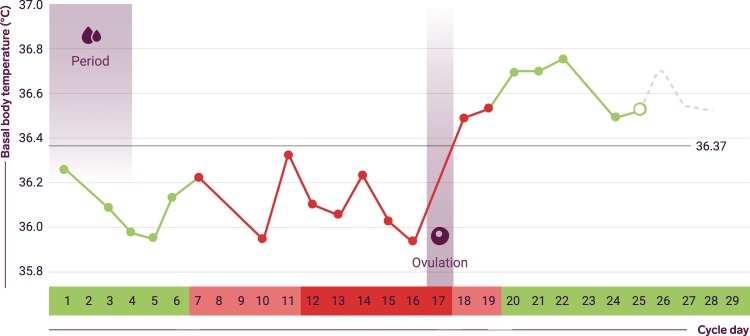
- Prospective observational subanalysis of data from the Natural Cycles app, using daily basal body temperature (BBT), menstruation dates, optional urinary LH tests, plus age and BMI collected in-app.
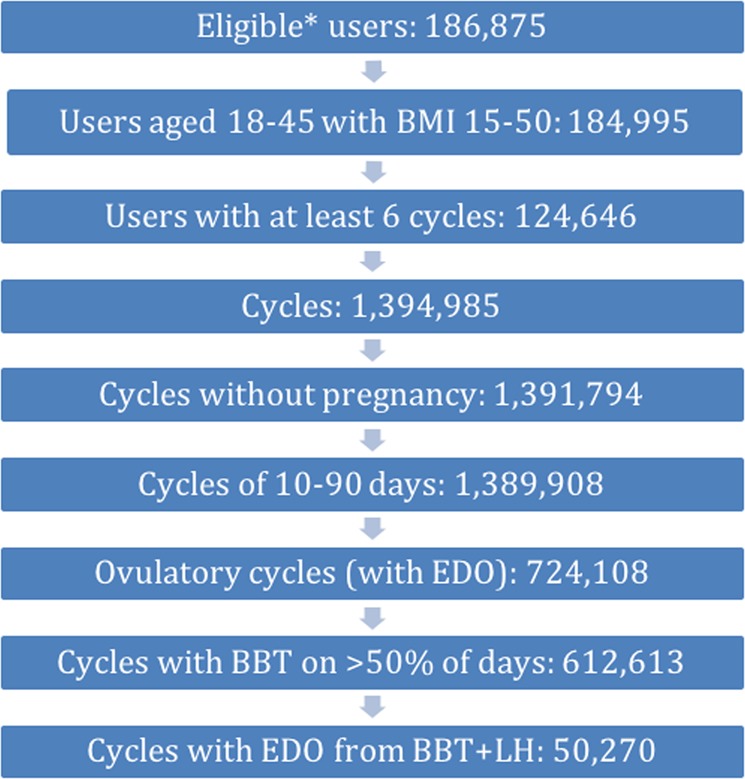
- Included users registered 1 Sept 2016 to 1 Feb 2019, aged 18–45, BMI 15–50, with no hormonal contraception in the prior 12 months; cycles required at least six complete cycles, length 10–90 days, and valid temperature entries on at least 50% of cycle days.
- Main analysis calculated mean cycle, bleed, follicular, and luteal phase lengths in ovulatory cycles, then compared cohorts by cycle length, age, and BMI; because of very large sample sizes, the authors used bootstrapped mean differences with 95% CIs rather than p values.
## Limitations
- The authors state that the study population came solely from app users and may not be representative of the wider population; they note that only 8% of women in the study were obese versus 15% in the general population.
- Only cycles with ovulation detected were included; of the 1.4 million cycles considered, 665,603 (48%) were excluded because ovulation was not detected, creating selection bias, which the paper explicitly acknowledges.
- The paper notes possible human error in self-reported bleeding, LH tests, and temperature measurements, and that measuring BBT and LH every 24 h limits phase-length precision.
Model-written summary. Check it against the paper before relying on it.
Integrity signals
Registry
Cites
Statistics
Figures
Verification
Claims the paper makes
15 Valid · 1 Not valid · 18 Not checked · 60 Own results and interpretations
The cited sources support only part of this claim — read each source’s verdict below.
In the paper
“It is, therefore, unsurprising that several studies have shown that calendar apps are not accurate in identifying the fertile window.35–38”
§ Real-world menstrual cycle characteristics of more than 600,000 menstrual cycles > Discussion
What the sources say
- Not checked — no full text of the sourcecites [35] Setton R Tierney C Tsai T The accuracy of web sites and cellular phone applications in predicting the fertile window Obstet. Gynecol. 2016 128 58 63 10.1097/AOG.0000000000001341 27275788 source
- Supportedcites [36] Freis A Plausibility of menstrual cycle apps claiming to support conception Front. Public Health 2018 6 98 10.3389/fpubh.2018.00098 29666788 PMC5891577 source
The Results (‘Apps Predicting the Fertile Days Based on Data of Previous Cycles’; page not provided) report that the tested calendar-based apps misstated ovulation when cycle length differed from the estimate. The Discussion says their method often missed the most fertile days because cycle length and ovulation day vary. This paper supports the claim as one of the studies cited, without itself needing to establish what every other cited study found. (LLM, conf=0.91)
- Partly supportedcites [37] Sohda S Suzuki K Igari I Relationship between the menstrual cycle and timing of ovulation revealed by new protocols: analysis of data from a self-tracking health app J. Med. Internet Res. 2017 19 e391 10.2196/jmir.7468 29180346 PMC5725625 sourceExperimental — accuracy not yet measured
The Discussion’s Principal Findings say that two existing calendar-based methods did not explain the study data well and were less accurate for certain cycle lengths. That supports concern about calendar-based ovulation predictions, but the paper evaluates prediction methods rather than the accuracy of calendar apps in identifying the fertile window. (LLM, conf=0.84)
- Supportedcites [38] Johnson S Marriott L Zinaman M Can apps and calendar methods predict ovulation with accuracy? Curr. Med. Res. Opin. 2018 34 1587 1594 10.1080/03007995.2018.1475348 29749274 source
The Discussion reports that this study's findings agree with two earlier studies that found low accuracy in apps' predictions of fertile windows. It also explains that wider predicted windows can include ovulation more often but offer poor precision for timing intercourse. (LLM, conf=0.91)
plain- Asserted: passes — The authors put it forward as true.
- Checkable: passes — It can be checked against evidence.
- Load-bearing: passes — The paper’s conclusions depend on it.
- Based: passes — The paper gives a reason why it holds.
Every source the paper cites for this claim was checked and supports it.
In the paper
“Available data, however, suggests that there may be significant variability in fertile days.1,4”
§ Real-world menstrual cycle characteristics of more than 600,000 menstrual cycles > Introduction
What the sources say
- Supportedcites [1] Wilcox AJ The timing of the ‘fertile window’ in the menstrual cycle: day specific estimates from a prospective study Br. Med. J. 2000 321 1259 1262 10.1136/bmj.321.7271.1259 11082086 PMC27529 source
The paper’s ‘What this study adds’ section states that the timing of the fertile window is highly variable, even among women who regard their cycles as regular. The Results section also reports ovulation occurring from day 8 to day 60, supporting variability in when fertile days occur. (LLM, conf=0.95)
- Supportedcites [4] Fehring RJ Schneider M Raviele K Variability in the phases of the menstrual cycle J. Obstet. Gynecol. Neonatal Nurs. 2006 35 376 384 10.1111/j.1552-6909.2006.00051.x 16700687 source
The Variability of Fertile Window section reports that the six fertile days fell anywhere between cycle days 4 and 23 across about 95% of cycles. This directly supports the hedged claim that fertile days may vary significantly. (LLM, conf=0.94)
hedged- Asserted: passes — The authors put it forward as true.
- Checkable: passes — It can be checked against evidence.
- Load-bearing: passes — The paper’s conclusions depend on it.
- Based: passes — The paper gives a reason why it holds.
- Supported
The sources with a verdict support this claim; the rest weren’t checked yet, have no full text we could read, or their verdicts aren’t rated yet.
In the paper
“but there is much greater variation than this.1,4–7”
§ Real-world menstrual cycle characteristics of more than 600,000 menstrual cycles > Introduction
What the sources say
- Supportedcites [1] Wilcox AJ The timing of the ‘fertile window’ in the menstrual cycle: day specific estimates from a prospective study Br. Med. J. 2000 321 1259 1262 10.1136/bmj.321.7271.1259 11082086 PMC27529 source
The Clinical guidelines section says the fertile window can occur much earlier or later than guidelines suggest. The Conclusions section reports that it falls entirely within the guideline days in only about 30% of women, supporting the claimed greater variation in its timing. (LLM, conf=0.90)
- Supportedcites [4] Fehring RJ Schneider M Raviele K Variability in the phases of the menstrual cycle J. Obstet. Gynecol. Neonatal Nurs. 2006 35 376 384 10.1111/j.1552-6909.2006.00051.x 16700687 source
The Implications of Findings section says menstrual-cycle parameters vary considerably even among healthy, regularly cycling women. The Variability of Follicular and Luteal Phases section explicitly finds a wider luteal-phase range than those listed in the medical and nursing textbooks in Table 3 (page unavailable in our copy). (LLM, conf=0.88)
- Not checked — no full text of the sourcecites [5] Mihm M Gangooly S Muttukrishna S The normal menstrual cycle in women Anim. Reprod. Sci. 2011 124 229 236 10.1016/j.anireprosci.2010.08.030 20869180 source
- Not checked — no full text of the sourcecites [6] Treloar AE Boynton RE Behn BG Brown BW Variation of the human menstrual cycle through reproductive life Int. J. Fertil. 1967 12 77 126 5419031 source
- Not checked — no full text of the sourcecites [7] Lenton EA Landgren B Sexton L Normal variation in the length of the luteal phase of the menstrual cycle: identification of the short luteal phase BJOG 1984 91 685 689 10.1111/j.1471-0528.1984.tb04831.x 6743610 source
plain- Asserted: passes — The authors put it forward as true.
- Checkable: passes — It can be checked against evidence.
- Load-bearing: passes — The paper’s conclusions depend on it.
- Based: passes — The paper gives a reason why it holds.
- Supported
Every source the paper cites for this claim was checked and supports it.
In the paper
“Besides the potential benefits to the individual, fertility awareness apps and the associated databases of fertility data provide a unique opportunity to examine a large number of menstrual cycles in order to improve understanding.25,26”
§ Real-world menstrual cycle characteristics of more than 600,000 menstrual cycles > Introduction
What the sources say
- Supportedcites [25] Liu, B. et al. Predicting pregnancy using large-scale data from a women’s health tracking mobile application.In The World Wide Web Conference (pp. 2999–3005) (ACM, 2019). PMC6752881 31538145 source
The Introduction describes health-tracking apps as a new data source and says they have already been used to study menstrual-cycle fluctuations and lengths. It also reports a dataset with tens of millions of observations from tens of thousands of women, supporting the claimed opportunity to study menstrual cycles at scale. (LLM, conf=0.91)
- Supportedcites [26] Symul, L., Wac, K., Hillard, P. & Salathe, M. Assessment of menstrual health status and evolution through mobile apps for fertility awareness. bioRxiv10.1101/385054 (2019). PMC6635432 31341953 source
The Abstract says menstrual-tracking apps provide an unparalleled view of menstrual health at population scale and reports data from over 2.7 million cycles. The Introduction and Discussion likewise describe using app-collected data to assess menstrual health and study fertility patterns. (LLM, conf=0.93)
plain- Asserted: passes — The authors put it forward as true.
- Checkable: passes — It can be checked against evidence.
- Load-bearing: passes — The paper’s conclusions depend on it.
- Based: passes — The paper gives a reason why it holds.
- Supported
Every source the paper cites for this claim was checked and supports it.
In the paper
“Nevertheless, the length of the luteal phase may also deviate significantly from 14 days.”
§ Real-world menstrual cycle characteristics of more than 600,000 menstrual cycles > Introduction
What the sources say
- Supportedcites [1] Wilcox AJ The timing of the ‘fertile window’ in the menstrual cycle: day specific estimates from a prospective study Br. Med. J. 2000 321 1259 1262 10.1136/bmj.321.7271.1259 11082086 PMC27529 source
The Clinical guidelines section (page not provided) reports that ovulation occurred exactly 14 days before the next menses in only 10% of the study's 28-day cycles. The interval from ovulation to the next menses ranged from 7 to 19 days, supporting the claim that luteal-phase length may differ substantially from 14 days. (LLM, conf=0.94)
hedged- Asserted: passes — The authors put it forward as true.
- Checkable: passes — It can be checked against evidence.
- Load-bearing: unclear — It is unclear whether the paper’s conclusions depend on it.
- Based: passes — The paper gives a reason why it holds.
- Supported
44 more claims
Create a free account to see all 94 claims and to verify the 3 references still open.
- It may state two separate claims as one. 25
- Probably not a substantial claim. 30
- The quote only partly states this claim. 1
Claims other papers make about this one
Each is checked against this paper’s own text: does it say what the citing paper says it does?
The source backs part of the claim, not all of it — or backs it for a different population, condition or comparison.
In the citing paper
“This process results in quasi-periodic hormone profiles with a cycle length of 25 to 35 days (Bakos et al., 1994;Harlow, 2000;Bull et al., 2019).”
From Hormonal regulation of ovarian follicle growth in humans: Model-based exploration of cycle variability and parameter sensitivities (2022) · cites this paper as Bull et al., 2019
Experimental — accuracy not yet measuredThe source backs part of the claim, not all of it — or backs it for a different population, condition or comparison.
In the citing paper
“In line with the literature (Bull et al., 2019), we implemented the model in a way that little variation occurs in the length of the luteal phase.”
From Hormonal regulation of ovarian follicle growth in humans: Model-based exploration of cycle variability and parameter sensitivities (2022) · cites this paper as Bull et al., 2019
Experimental — accuracy not yet measuredThe source backs part of the claim, not all of it — or backs it for a different population, condition or comparison.
In the citing paper
“Also, evident from this “big data” set is the variability in menstrual cycle duration between women and within menstrual cycles of the same woman, mostly as a result of variability in the duration of the follicular phase [39].”
From Temperature regulation in women: Effects of the menstrual cycle (2020) · cites this paper as [39]
Experimental — accuracy not yet measuredThe cited source says what the claim attributes to it.
In the citing paper
“The simulated average cycle length ranges from 22.7 to 27.8 days (Fig. A.6), which is within the physiological range (Bull et al., 2019).”
From Hormonal regulation of ovarian follicle growth in humans: Model-based exploration of cycle variability and parameter sensitivities (2022) · cites this paper as Bull et al., 2019
The cited source says what the claim attributes to it.
In the citing paper
“As earlier studies have already shown (11, 23–26), we found a significant decrease in cycle length with age (Table 1 and Figs. 2 and 3).”
From Women temporarily synchronize their menstrual cycles with the luminance and gravimetric cycles of the Moon (2021) · cites this paper as [26]
3 more claims about this paper
Create a free account to see every claim other papers make about this one.
Citations
Cites
An Introduction to the Bootstrap
Efron, B., & Tibshirani, R. J. (1994) · doi:10.1201/9780429246593 · Cited by 40,500
An Introduction to the Bootstrap
Efron, B., & Tibshirani, R. J. (1993) · doi:10.1007/978-1-4899-4541-9 · Cited by 21,230
(2000) · PubMed · Cited by 13,173
The Diagnosis of Polycystic Ovary Syndrome during Adolescence
Witchel, S. F., Oberfield, S., Rosenfield, R. L., Codner, E., Bonny, A., Ibáñez, L., Pena, A., Horikawa, R., Gomez-Lobo, V., Joel, D., et al. (2015) · Hormone Research in Paediatrics · doi:10.1159/000375530 · Cited by 3,113
An Introduction to the Bootstrap.
Buckland, S. T., Efron, B., & Tibshirani, R. J. (1994) · Biometrics · doi:10.2307/2532810 · Cited by 3,103
VARIATION OF THE HUMAN MENSTRUAL CYCLE THROUGH REPRODUCTIVE LIFE
TRELOAR, A. E., BOYNTON, R. E., BEHN, B. G., & BROWN, B. W. (1968) · Obstetrical & Gynecological Survey · doi:10.1097/00006254-196801000-00019 · Cited by 1,018 · cited 2×
“With increasing age, cycle length reduces and the timing of ovulation becomes earlier; the variation of a woman’s cycle length reduces with age until menopause.(5,6,8,9) Cycle characteristics also may be affected by ethnicity, high body mass index (BMI), stress and lifestyle factors.”
BackgroundResultPsychological impact of infertility
Cousineau, T. M., & Domar, A. D. (2007) · Best Practice & Research Clinical Obstetrics & Gynaecology · doi:10.1016/j.bpobgyn.2006.12.003 · Cited by 997 · cited 1×
“Anecdotally there is poor understanding of fertility amongst the general population, which can lead to both unintended pregnancies and delayed time to conception with associated psychological suffering for those wishing to start a family.(40) Fertility education delivered through an app has the potential to improve do…”
BackgroundResearch Commentary —Too Big to Fail: Large Samples and the p -Value Problem
Lin, M., Lucas, H. C., & Shmueli, G. (2013) · Information Systems Research · doi:10.1287/isre.2013.0480 · Cited by 972 · cited 1×
“Owing to the very large sample sizes in this study, P values were not calculated since they can be very small even if differences between cohorts are of no clinical significance.(49) Instead, effect size between two cohorts was estimated as a mean difference with a 95% confidence interval calculated from 200 bootstrap…”
MethodTorous, J., Nicholas, J., Larsen, M. E., Firth, J., & Christensen, H. (2018) · Evidence Based Mental Health · doi:10.1136/eb-2018-102891 · Cited by 790
(1977) · PubMed · Cited by 488
Cited by
Items 301–399 of 399
Andrologierelevante Gynäkologie
Knuth, U. A. (2021) · Springer Reference Medizin · doi:10.1007/978-3-662-61904-9_41-1
Luteal Phase Support in Natural Cycle and Minimal Stimulation IVF
von Wolff, M. (2022) · Springer eBooks · doi:10.1007/978-3-030-97571-5_14
FEATURES OF CLINICAL PRESENTATION OF ABNORMAL UTERINE BLEEDING IN WOMEN OF REPRODUCTIVE AGE
Blagoveshchensky, R. (2022) · Bulletin of Problems Biology and Medicine · doi:10.29254/2077-4214-2022-3-166-12-17
A concise review on breast cancer in pregnancy
Yuvaraj, K., Govindhan, E., Francis Kevin Raj, S., Pavithra, J., & Muralidharan, P. (2023) · International Journal of Science and Research Archive · doi:10.30574/ijsra.2023.8.2.0272 · Cited by 1
Masternak, M., Grabczak, M., Szaflik, T., Mroczkowska, B., Mokros, Ł., Smolarz, B., Romanowicz, H., & Szyłło, K. (2023) · Life · doi:10.3390/life13051151
“struation, preparing the endometrium lining for the next menstrual cycle, resulting in vaginal bleeding that lasts an average of five days [8].”
BackgroundCannabis Use Across the Menstrual Cycle: The Impact of Negative Affect and Coping Motives
Morris, P. E. (2023) · Louisiana State University · doi:10.31390/gradschool_theses.5770
Andrologierelevante Gynäkologie
Knuth, U. A. (2023) · Springer Reference Medizin · doi:10.1007/978-3-662-61901-8_41
Timing of COVID19 vaccination drives menstrual cycle changesPreprint
Edelman, A. B., Boniface, E. R., Male, V. H., et al. (2023) · Research Square · doi:10.21203/rs.3.rs-3171222/v1
Physiological effects of steroids
Honour, J. W. (2023) · Elsevier eBooks · doi:10.1016/b978-0-12-818124-9.00015-2
Hosseinzadeh, P., Peck, J. D., Burks, H. R., Souter, I. C., Xing, A., Craig, L. B., Diamond, M. P., & Hansen, K. R. (2023) · F&S Reports · doi:10.1016/j.xfre.2023.08.003
Changes in Women’s Menstruation Cycle After COVID-19 Vaccination and Infection
Ulfa, M., Tinartayu, S., Fitriani, D., Merkusi, S., & Veterini, V. (2023) · Mutiara Medika: Jurnal Kedokteran dan Kesehatan · doi:10.18196/mmjkk.v23i2.18947
Rafiee, Y. (2023) · eDiss (Georg-August-Universität Göttingen) · doi:10.53846/goediss-10083
Dozortsev, D. I., & Diamond, M. P. (2023) · Journal of IVF-Worldwide · doi:10.46989/001c.87947
Menstrual Cycle and Performance: What Is Next?
Prado, R. C. R., & Kilpatrick, M. W. (2023) · Sports Health A Multidisciplinary Approach · doi:10.1177/19417381231197609 · Cited by 1
Aghani, N., Bhagwani, Imtiaz, S., et al. (2023) · Pakistan Journal of Health Sciences · doi:10.54393/pjhs.v4i09.1037
Gynecology Relevant to Andrology
Knuth, U. A. (2023) · Springer eBooks · doi:10.1007/978-3-031-31574-9_40
Yazed, M. S. M., Mahmud, F., Morsin, M., et al. (2023) · AIP conference proceedings · doi:10.1063/5.0142091
PENGARUH STATUS GIZI TERHADAP SIKLUS DAN LAMA MENSTRUASI PADA REMAJA PUTRI
Nisa, J., Chikmah, A. M., & Harnawati, R. A. (2023) · Siklus Journal Research Midwifery Politeknik Tegal · doi:10.30591/siklus.v12i02.4355
Perestroika, G. D., Devi, A. A., Argaheni, N. B., Maulina, R., Wahidah, N. J., Setyani, R. A., & Indrawati, F. L. (2023) · Journal of Health Sciences · doi:10.33086/jhs.v16i03.4598
Aitkenhead, R., Kirkwood, L., Florida-James, G. D., & Ingram-Sills, L. (2023) · Journal of Applied Sports Sciences · doi:10.37393/jass.2023.02.6
Habeeb, S. (2023) · Springer eBooks · doi:10.1007/978-3-031-08956-5_1521-1
Sabarini, S. S., Riyadi, S., Kristiyanto, A., Liskustyawati, H., Prasetyo, Y. B., & Salimi, M. (2024) · Multidisciplinary Science Journal · doi:10.31893/multiscience.2023114
Tkachenko, O. Y., Kahland, T., Lindenwald, D. L., et al. (2024) · Research Square · doi:10.21203/rs.3.rs-4011214/v1
TINGKAT PENGETAHUAN REMAJA PUTRI TENTANG GANGGUAN MENSTRUASI
Sari, A. N., & Ediyono, S. (2024) · Avicenna Journal of Health Research · doi:10.36419/avicenna.v7i1.1029 · Cited by 7
Visuospatial Function in Women with Premenstrual Dysphoric Disorder
Hamidovic, A., Cho, S., Smadi, S., & Davis, J. M. (2024) · Journal of Clinical Medicine · doi:10.3390/jcm13072004 · Cited by 1
“These studies drew speculative inferences about the effects of estradiol based on the cycle day, which may be an erroneous approach as phase duration and estradiol levels are significantly variable both within and between women [15,16].”
BackgroundMacGregor, K. A., Ho, F. K. W., Celis-Morales, C. A., Pell, J. P., Gallagher, I. J., & Moran, C. N. (2023) · Figshare · doi:10.6084/m9.figshare.24779186
Menstruation: Myths, Mechanisms, Models and Malfunctions
Cousins, F. L., & Saunders, P. T. K. (2024) · Frontiers research topics · doi:10.3389/978-2-8325-4935-3
Timing of Coronavirus Disease 2019 (COVID-19) Vaccination and Effects on Menstrual Cycle Changes
Hosoya, S., Itoi, S., Piedvache, A., et al. (2024) · Obstetrics and Gynecology · doi:10.1097/aog.0000000000005624
SantaBarbara, K., Helms, E. R., STEWART, T. I., Armour, M., & HARRIS, N. K. (2024) · The Journal of Sports Medicine and Physical Fitness · doi:10.23736/s0022-4707.24.15752-0 · Cited by 1
Retinal morphology across the menstrual cycle: insights from the UK BiobankPreprint
Reis, A. P. R., Ioannidou, E., Wagner, S. K., et al. (2024) · Research Square · doi:10.21203/rs.3.rs-4529810/v1
Premenstrual dysphoric disorder—an undervalued diagnosis? A cross-sectional study in Hungarian women
Pataki, B., Kiss, B. L., Kálmán, S., et al. (2024) · Comprehensive Psychoneuroendocrinology · doi:10.1016/j.cpnec.2024.100256
“The length of the luteal phase was estimated based on the cycle length [17].”
MethodHumanizing the endocrine milieu of female mice for women’s health-related studiesPreprint
Constantin, C., Matvienko, D., László, C., Scabia, V., Battista, L., Binz, P., Bruce, S., & Brisken, C. (2024) · Research Square · doi:10.21203/rs.3.rs-4808879/v1
Edades, J., Kalafat, E., Ata, B., et al. (2024) · Ultrasound in Obstetrics and Gynecology · doi:10.1002/uog.29123
Ovulation Day Prediction Using Machine Learning
Gupta, U. C., Ampaty, R. S., Amalapurapu, Y. G., & Kumar, R. (2024) · Lecture notes in networks and systems · doi:10.1007/978-981-97-2671-4_60 · Cited by 2
Christin‐Maître, S., & Vatier, C. (2024) · Elsevier eBooks · doi:10.1016/b978-0-443-13825-6.00127-8
Tindal, K., Cousins, F. L., Palmer, K. R., Ellery, S. J., Vollenhoven, B. J., Gargett, C. E., Gordon, A., Bradford, B. F., & Davies-Tuck, M. L. (2025) · BMJ Open · doi:10.1136/bmjopen-2024-091813
“With the uptake of menstrual cycle tracking applications, 49 participants can also refer to this data if they have trouble with recall.”
Introducción a la Anatomía y Fisiología Femenina Género Diverse
Pastor, D. A. (2021) · Figshare · doi:10.31235/osf.io/dvuk4 · Cited by 2
Jadhav, M. A., Poojari, S. D., Bhosale, S. R., & Patil, H. (2025) · International Journal of Advanced Research in Science Communication and Technology · doi:10.48175/ijarsct-23530
Impact of menstruation on strength gains: A 12-week study
Holland-Coulton, I., Tallent, J., Price, P., & Cushion, E. J. (2025) · Science & Sports · doi:10.1016/j.scispo.2025.02.002
Reliability of Cycle Applications for Pregnancy Planning and Contraception: A Systematic Review
Rabe, I., & Ehlers, J. P. (2025) · Mayo Clinic Proceedings Digital Health · doi:10.1016/j.mcpdig.2025.100239 · Cited by 1
“62 People with a higher BMI can also experience greater cycle fl uctuations, 40,63 which can have an impact on the likelihood of pregnancy.”
Seasonality and the menstrual cycle: a qualitative study
Bayraktar, B. N. Y., & İlçioğlu, K. (2025) · Biological Rhythm Research · doi:10.1080/09291016.2025.2523979
de Jonge, A., Verhoeven, C. J. M., Jong, E. F., van Dillen, J., & Bakker, P. (2025) · doi:10.1007/978-90-368-3142-0_4
Pierre, S. R. S., Johnson, S. C., Muccini, J., Bourne, B., Laniakea, B. H., Delp, S. L., & Hicks, J. L. (2025) · medRxiv · doi:10.1101/2025.09.11.25335594
“…the participant displayed peaks in luteinizing hormone and follicle-stimulating hormone preceding peaks in E3G, the urine metabolite for estradiol, and PdG, the urine metabolite for progesterone (Bull et al., 2019; Pattnaik et al., 2023) that are indicative of normal ovulatory menstrual cycles.”
Gonzalez, A., O’Day, J. J., Johnson, S. C., Kim, J., Jasinski, S. R., Holmes, K. E., Delp, S. L., & Hicks, J. L. (2026) · npj Digital Medicine · doi:10.1038/s41746-026-02799-9 · Cited by 2
“We observed that the timing of skin temperature and respiratory rate returning to their mean values was similar to hormone-kit-derived follicularphasetimingsacrosscyclelengthsfrom previousstudies 23 .”
Payne, L. A., Edelman, A. B., Darney, B. G., et al. (2025) · PLoS ONE · doi:10.1371/journal.pone.0331346
Decoding menstrual health across the lifespan: a scoping review of digital health tools in research
Johnson, S. C., O’Day, J. J., Kraus, E., Delp, S. L., & Hicks, J. L. (2026) · npj Women s Health · doi:10.1038/s44294-026-00146-7 · Cited by 8
“Afterage25,cyclelengthshortenedwithincreasingagedueto an estimated shortening of the follicular phase 44,45,53 .”
InfluentialChen, T., & Chien, L. (2025) · Journal of Nursing Research · doi:10.1097/jnr.0000000000000705
Doroshuk, M. L., Lebrun, C. M., & Doyle–Baker, P. K. (2025) · Women s Health Reports · doi:10.1177/26884844251379415 · Cited by 1
“The remaining 44% of participants either dropped out (5), were lost to follow-up (6), not considered eumenor-rheic (8), or did not create an account in the app during the protocol lead up to the study start (2).”
InfluentialGraham, K. D., Kilungeja, G., Gregg, N. M., Karoly, P. J., Kreidl, O. P., MajidiRad, A., Brinkmann, B. H., & Nasseri, M. (2025) · Physiological Measurement · doi:10.1088/1361-6579/ae1114
Gynecologic Health in Female Ultramarathon Runners
Snow, J. H., Brouwer, L. R., Nichols, J. A., et al. (2025) · Wilderness and Environmental Medicine · doi:10.1177/10806032251385908
Mortimer, R. M., Asokan, G., Baird, D. D., Wilcox, A. J., Abrams, K., Curry, C. L., Onnela, J.-P. “., Coull, B. A., Hauser, R. B., Williams, M. A., et al. (2025) · American Journal of Obstetrics and Gynecology · doi:10.1016/j.ajog.2025.11.031 · Cited by 2
Cooper, P. A., Boniface, E. R., Darney, B. G., Edelman, A. B., Sear, R., Shea, A. A., Walters, S., Weber, K., Vitzthum, V. J., & Alvergne, A. (2025) · medRxiv · doi:10.1101/2025.11.26.25341088
“Most simply, younger women often experience more variable menstrual cycles 53,61,89 , which could lead to cycle-phase classification errors.”
InfluentialThe Role of Hormonal Contraceptive Type in Female Self-Reported Intrasexual Competition and Jealousy
Burns, C., Jimenez-Delgado, S., Kandus, J., & Hahn, A. C. (2025) · Adaptive Human Behavior and Physiology · doi:10.1007/s40750-025-00274-5
“This inconclusiveness is potentially due to individual variation in menstrual phase timing (Bull et al., 2019; Fehring et al., 2006 ).”
Casto, K. V., & Stern, J. (2026) · Psychoneuroendocrinology · doi:10.1016/j.psyneuen.2026.107742 · Cited by 2
Within-individual changes in BMI and menstrual irregularity: a cohort study using real-world data
Itoi, S., Sampei, M., Tatsumi, T., Ishida, R., Izumi, G., Osuga, Y., Koga, K., Narumi, S., & Morisaki, N. (2026) · BMC Women s Health · doi:10.1186/s12905-026-04308-2 · Cited by 4
“Prior analyses of menstrual tracking app data have shown that, among ovulatory cycles, mean cycle length remains relatively stable within the BMI range of 15–35, but becomes more variable at extreme BMI levels [18].”
How well do women understand their menstrual cycles? Insights from 383,085 UK based women
Ali, Z. E., Wainwright, E., Murugesu, S., Moraru, S., Lawrie, L., Getreu, N., & O’Neill, H. C. (2026) · Reproductive Health · doi:10.1186/s12978-026-02275-3
“Although a 28-day cycle is often cited as average [6], large-scale cycle tracking data from over 600,000 cycles demonstrate wide intra-and inter-individual variation, with only 13% of cycles lasting 28 days [7].”
History and Use of Fertility Awareness-Based Methods
Urrutia, R. P. (2026) · Reproductive medicine for clinicians · doi:10.1007/978-3-032-07322-8_6
Menstrual cycle estradiol fluctuations predict changes in affect and socioemotional functioning
Sander, B. J., Preston, D., & Gordon, J. L. (2026) · Psychoneuroendocrinology · doi:10.1016/j.psyneuen.2026.107789
Brondolin, E., Hadengue, B., Perro, D., et al. (2026) · medRxiv · doi:10.64898/2026.02.12.26346180
Self-citationMarcantei, C., Metz, L., Ramos, I., Pereira, B., Dutheil, F., de Saint-Vincent, S., Duclos, M., & Isacco, L. (2026) · Nutrition Metabolism and Cardiovascular Diseases · doi:10.1016/j.numecd.2026.104637
Mobile device data for the study of miscarriage and its causes
Nobles, J. E., Cannon, L. M., Hwang, S., Malloy, S. M., Noddin, K., & Wilcox, A. J. (2026) · npj Women s Health · doi:10.1038/s44294-026-00129-8 · Cited by 1
“Mobiledevice “ apps ” that allow people to track menstrual cycles and pregnancies are well-suited for the collection of health information at the scale of populations, particularly on under-studied dimensions of reproductive health 12 – 16 .”
Security and risk governance in AI-driven medical imaging systems: An uncertainty-aware framework
Ahmad, S., Kumar, K., Prakash, A., & Shahnawaz (2026) · EDPACS · doi:10.1080/07366981.2026.2640131
Discovery of Latent Dynamical Patterns in Biomedical Data
Tamura, Y., Matsubara, Y., Kimura, T., Fujiwara, R., Sekitani, T., Machimura, S., Endo, M., Kimura, T., & Sakurai, Y. (2025) · IEEE ... International Conference on Data Mining workshops · doi:10.1109/icdmw69685.2025.00096
Tracking androgens in female elite athletes: menstrual cycle and hormonal contraceptive effects
Nolte, J., Voss, S. C., Keiler, A. M., Büthe, E., Legerlotz, K., & Platen, P. (2026) · BMC Women s Health · doi:10.1186/s12905-026-04344-y · Cited by 1
“As a result, the measurement and interpretation of sex hormones is particularly important in the female athlete population for the further understanding female androgen profiles and furthermore to develop cycle-based training strategies tailored to the individual needs of athletes [11–13].”
Is ‘period syncing’ real? 2 reproductive health experts explain
Ford, E. A., & Copp, T. (2026) · doi:10.64628/aa.f6mrkv6jd
Optimizing oral contraceptive timing: Daytime intake reduces doses and enhances efficacy
Gavina, B. L. A., Lee, T., Cawiding, O. R., Choi, S., Choi, S., Kim, S., & Kim, J. K. (2026) · PLoS Computational Biology · doi:10.1371/journal.pcbi.1014040
Ovarian hormones, hormonal contraceptives and reward processing
Novick, A. M., Weinhold, E. R., & Epperson, C. N. (2026) · BJPsych Advances · doi:10.1192/bja.2026.10206 · Cited by 1
Study of the involvement of brain tryptophan metabolism in obesity-induced memory deficits
Mezo‐González, C. E. (2022) · theses.fr (ABES) · doi:10.70675/d788c1bfz3965z4981za000z9c3f9f464001
Mécanismes d'action de l'Œstradiol dans l'ovaire humain en conditions physiologique et polykystique
Marie, C. (2024) · theses.fr (ABES) · doi:10.70675/1310af87z3c5ez4c52zad31z9af8ec853cee
Wang, Z., Peebles, E., Asokan, G., Duttweiler, L., Jukic, A. M., Wilcox, A. J., Abrams, K., Suharwardy, S. H., Hauser, R. B., Williams, M. A., et al. (2026) · Environment International · doi:10.1016/j.envint.2026.110260
What’s Normal? Differentiating Typical Menstrual Changes from Signs of Underlying Conditions
King, S. (2026) · Women s Reproductive Health · doi:10.1080/23293691.2026.2652925 · Cited by 1
Bradbury, K. E., McClung, H. L., Ranadive, S. M., Oppenheimer, A. V., Goldenstein, S. J., Stachenfeld, N. S., Charkoudian, N., & Giersch, G. E. W. (2026) · Journal of Applied Physiology · doi:10.1152/japplphysiol.01189.2025 · Cited by 1
Messinis, I. E., & Messini, C. I. (2026) · Springer eBooks · doi:10.1007/978-3-032-05381-7_12 · Cited by 1
Brondolin, E., Hadengue, B., Perro, D., Gemzell‐Danielsson, K., Granne, I., Nguyen, B. T., Costescu, D., Wender, M. C. O., Scherwitzl, E. B., Scherwitzl, R., et al. (2026) · The European Journal of Contraception & Reproductive Health Care · doi:10.1080/13625187.2026.2669220 · Cited by 1
“…defined as positive lh tests recorded on one or two consecutive days with no other positive lh tests in the same cycle. the identified lh surge was verified by requiring the resulting luteal phase length to fall within ±2 days of the population average luteal phase length [13] (Figure 2).”
Self-citationGombert, M., Taitz, A., Kiss, O., & Baker, F. C. (2026) · Science Advances · doi:10.1126/sciadv.aeb1175
“In the absence of fertilization, progesterone and estrogen levels decline, leading to the breakdown of the endometrial lining and onset of menstruation, occurring, on average, 12.4 days [95 % confidence interval (CI): 7 to 17] after ovulation ( 21 ).”
InfluentialMétodos de contracepção comportamentais e consciência da fertilidade Número especial 1 – 2026
Cordioli, E., MONTEIRO, I. M. U., & Wender, M. C. O. (2026) · Femina · doi:10.61622/0100-7254544202604
Vanmeerhaeghe, A. F., Milà, R., Pujol-Marzo, M., Casadevall-Sayeras, P., Nieto, A., Nevot-Casas, O., & Peña, J. (2026) · The Journal of Strength and Conditioning Research · doi:10.1519/jsc.0000000000005509
Sundermann, A. C., Jasper, E. A., Buckley, R. H., Rothman, K. J., & Wise, L. A. (2026) · Fertility and Sterility · doi:10.1016/j.fertnstert.2026.06.022
Thomas, N., Huang, K., Schneider‐Futschik, E. K., Pollack, B., Tal, M. C., Fineberg, D., Wang, X. Y., Gurvich, C., Pretorius, R., Bergquist, J., et al. (2026) · Frontiers in Neuroendocrinology · doi:10.1016/j.yfrne.2026.101268
Pohle, C., Büchel, D., Sandbakk, S. B., Sandbakk, Ø., Pletzer, B., & Baumeister, J. (2026) · Women s Health · doi:10.1177/17455057261456871
“The expected luteal phase (LP) length was determined based on data from Bull et al. 42 .”
Sari, D. F., Fatmawati, L., & Basri, A. H. (2026) · Indonesian Journal of Innovation Multidisipliner Research · doi:10.69693/ijim.v4i3.1287
Making Sense of the Cycle: Statistical Modeling Techniques for Menstrual Health Data
Lupton‐Smith, C., Koffman, L. J., Stoms, M., Goldsmith, J., & Freemas, J. A. (2026) · Women s Reproductive Health · doi:10.1080/23293691.2026.2692118
Definition of Infertility and Indications for Fertility Evaluation: Consensus Document
Minjeur, M., Parnell, T. A., Stanford, J. B., Boyle, P. C., Arraztoa, J. A., Horodenchuk, Z., Suszczewicz, N., & McCarthy, K. (2026) · Journal of Restorative Reproductive Medicine · doi:10.63264/zvpr3e66
Adhikari, R., Kundu, C. K., Giacomoni, M., Johnson, K. O., Kamath, S., Edwards, B., & Pullinger, S. A. (2026) · Women in Sport and Physical Activity Journal · doi:10.1123/wspaj.2026-0061
Sex differences in innate immune cell responses: Impact on cancer immunity and response to therapy
Ramin, S., & Medler, T. R. (2026) · Frontiers in Immunology · doi:10.3389/fimmu.2026.1864861 · Cited by 1
“Female mice have a 4-day reproductive cycle while humans have a 24-34-day cycle, and human females experience menopause while rodents do not (208).”
Ulman, S. M., Garcia, J., Jones, J., Davis, A. N., Erdman, A. L., Wilson, P. L., & Ellis, H. B. (2026) · Journal of the Pediatric Orthopaedic Society of North America · doi:10.1016/j.jposna.2026.100434
Giersch, G. E. W., Bradbury, K. E., Bozzini, B. N., Aaron, K. G., Walker, L. A., Foulis, S. A., Hughes, J. M., Charkoudian, N., & Popp, K. L. (2026) · Temperature · doi:10.1080/23328940.2026.2710566
“Bull et al. [14] reported that ambient temperature did not influence length of menstrual cycle in premenopausal women.”
Quantitative risk assessment framework for metal exposure from tampon use
Shakya, A., Berlinski, S., Unice, K., Paulo, H., Falconer, D., & Paustenbach, D. J. (2026) · Environmental Advances · doi:10.1016/j.envadv.2026.100748
Validity of self-reported menstrual cycle length
Bates‐Fraser, L. C., Wong, M., Gaudet, M. M., Chiang, K. E., Deubler, E. L., Teras, L. R., & Patel, A. V. (2026) · Annals of Epidemiology · doi:10.1016/j.annepidem.2026.110259
Exploring engagement patterns in a reproductive health app using the Technology Acceptance Model
Kazakoff, A., & Doyle–Baker, P. K. (2026) · Frontiers in Reproductive Health · doi:10.3389/frph.2026.1904798
“Across all users, engagement peaked between days 26 – 31, with secondary peaks around days 56 and 84, corresponding to approximately 30-day intervals.”
InfluentialEfectos del ciclo menstrual en la función vocal de cantantes femeninas: una revisión sistemática
Romero-Arias, T., García, F. D. L., Quintero, D. D. C., & Fernández, A. C. (2026) · Revista de Logopedia Foniatría y Audiología · doi:10.1016/j.rlfa.2026.100579
Xu, J., Towey, D., Adwin, J., Wang, H., & Zhang, G. (2026) · IEEE Annual International Computer Software and Applications Conference (COMPSAC) · doi:10.1109/compsac69091.2026.00335
“This matters because variability is not exceptional in real-world populations [1, 4].”
InfluentialTsiarli, M. A., & Larschan, E. (2026) · Frontiers in Behavioral Neuroscience · doi:10.3389/fnbeh.2026.1888207
“3 Sex-differences following body plan establishment and initiation of nervous system development In humans, embryo implantation takes place around days 19–22 of a typical 28-day menstrual cycle (Bull et al., 2019).”
Menstrual cycle length trajectories and their health correlates across the reproductive lifespanPreprint
Mitsunami, M., Peebles, E., Zhang, B., Coull, B. A., James-Todd, T. M., Chavarro, J. E., Hart, J. E., Laden, F., & Mahalingaiah, S. (2026) · Research Square · doi:10.21203/rs.3.rs-10629991/v1
Buades‐Rotger, M., Hendricks, R. C., Roncarati, B., Calderón-García, M., Bergmann, K., & Pérez-Cano, F. J. (2026) · Psychological Medicine · doi:10.1017/s0033291726105315
“Indeed, there is substantial variability in menstrual cycle length (especially in the follicular phase) even in relatively homogeneous cohorts of healthy young women (Bull et al., 2019; Henry, Shirin, Goshtasebi, & Prior, 2024).”
Sarıyer, E. T., Baş, M., & Çetinkaya, H. Ç. (2026) · Nutrients · doi:10.3390/nu18172893
“The high standard deviation for cycle length ( ± 7.29 days) shows variation in cycle regularity, which is a common finding in young adults and related to anovulatory cycles and poor follicular development at the edges of reproductive lifespan [32,33].”
InfluentialLawrenz, B., Didar, H., Ata, B., Marqueta, L., Melado, L., Ruiz, F., Gallego, R. D., Elkhatib, I., & Fatemi, H. M. M. (2026) · Reproductive BioMedicine Online · doi:10.1016/j.rbmo.2026.105980
Krupska, A., Habirek, K. S., Porażko, M. M., et al. (2026) · International Journal of Innovative Technologies in Social Science · doi:10.31435/ijitss.3(51).2026.6107
Cycloom: Designing with and for Menstrual Lived Experiences through Digital Weaving
Li, Y., Shang, Y., Kirk, D. S., Ford, A., & Nissen, B. (2026) · Nordic Conference on Human-Computer Interaction · doi:10.1145/3829807.3829808
Metadata
- Authors
- Bull, J. R., Rowland, S. P., Scherwitzl, E. B., Scherwitzl, R., Danielsson, K. G., & Harper, J.
- Affiliations
- University College London (GB)
- Corresponding author
- Bull, Jonathan R.
- Venue
- npj Digital Medicine
- Published
- 2019-08-27
- Volume
- 2
- Issue
- 1
- Pages
- 83-83
- ISSN
- 2398-6352 (ISSN-L)
- PMC
- PMC6710244
- OpenAlex
- W2970585464
- Semantic Scholar
- 14b8c784b73216f7348e35914ac911a45dfb9283
- Cited by
- 404
- References
- 54
- Citations by year
- 2026: 60 · 2025: 49 · 2024: 76 · 2023: 80 · 2022: 62 · 2021: 50 · 2020: 25 · 2019: 2
- FWCI
- 32.00
- Type
- journal article
- Language
- en
- Open access
- gold
- doi.org
- Licence
- cc-by
- creativecommons.org/licenses/by/4.0 (tdm)
- creativecommons.org/licenses/by/4.0 (vor)
- Locations
- npj Digital Medicine (publishedVersion, cc-by)
- PubMed Central (publishedVersion, cc-by)
- PubMed (publishedVersion)
- DOAJ (DOAJ: Directory of Open Access Journals) (submittedVersion)
- UCL Discovery (University College London) (submittedVersion)
- Funders
- Full time employee of Natural Cycles Nordic AB
- Topics
- Health Sciences › Medicine › Public Health, Environmental and Occupational Health › Menstrual Health and Disorders
- Health Sciences › Medicine › Reproductive Medicine › Hypothalamic control of reproductive hormones
- Health Sciences › Medicine › Reproductive Medicine › Ovarian function and disorders
- Keywords
- menstrual cycle, cycle length, follicular phase, luteal phase, basal body temperature, body mass index, age, fertility monitoring, ovulation, fertility awareness
About these checks
Registry, retraction, Cites and statistics results are computed, not judged, with one exception: a printed reference that no index lists is read once by a model before it counts as a citation error. Claims are extracted by a model and kept only when their quote appears verbatim in the text; each cited source is then checked, with a model’s help, for whether it says what the claim relies on. Those verdicts can be wrong — read the claim’s quote and the cited source before relying on one.
The claim verdicts this report counts are experimental: their accuracy is not yet measured.
A language model drew the claims from the paper on 2026-10-09, under version 3 of the claim definition (model deepseek-v4.1-flash, prompt extract-v3).
A second model labelled each claim on 2026-10-09 (model jev-1.13-20260917, definition revision gold-guideline-v0.2).
Cited sources are checked with a language model’s help (gpt-6-sol).
Statistics and arithmetic are recomputed, not judged.
Confidence bands are shown only for fields calibrated on our annotated test set. None is calibrated yet, so no band is shown.
What counts as a claim ›How we measure confidence ›How we check this ›
Are you an author, or do you see a problem with this page? Request a review
Data sources
Bibliographic data: Semantic Scholar, OpenAlex, Crossref.
Contains information from the Semantic Scholar Academic Graph Datasets, made available under the ODC Attribution License (ODC-BY 1.0).
Semantic Scholar’s data is described in: Kinney, R., et al. (2023). The Semantic Scholar Open Data Platform. arXiv:2301.10140.
