

ACTsmart–development and feasibility of digital acceptance and commitment therapy for adults with chronic pain
Open accessThe DOI matches its Crossref record; 45 of the 46 references it cites were found in a registry or an index.
Abstract
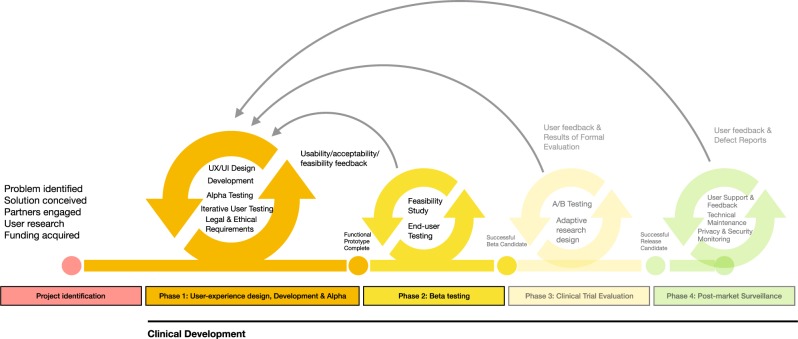
Accessibility of evidence-based behavioral health interventions is one of the main challenges in health care and effective treatment approaches are not always available for patients that would benefit from them. Digitization has dramatically changed the health care landscape. Although mHealth has shown promise in addressing issues of accessibility and reach, there is vast room for improvements. The integration of technical innovations and theory driven development is a key concern. Digital solutions developed by industry alone often lack a clear theoretical framework and the solutions are not properly evaluated to meet the standards of scientifically proven efficacy. On the other hand, mHealth interventions developed in academia may be theory driven but lack user friendliness and are commonly technically outdated by the time they are implemented in regular care, if they ever are. In an ongoing project aimed at scientific innovation, the mHealth Agile Development and Evaluation Lifecycle was used to combine strengths from both industry and academia in the development of ACTsmart – a smartphone-based Acceptance and Commitment Therapy treatment for adult chronic pain patients. The present study describes the early development of ACTsmart, in the process of moving the product from alpha testing to a clinical trial ready solution.
Overview
The claims and statistics of this paper haven’t been checked yet.
Free: it reads the open-access text and checks the first 5 claims that cite a source we can check. Create a free account to check every claim.
Integrity signals
Registry
Cites
Statistics
Figures
Verification
Claims the paper makes
The claims and statistics of this paper haven’t been checked yet.
Free: it reads the open-access text and checks the first 5 claims that cite a source we can check. Create a free account to check every claim.
Claims other papers make about this one
Each is checked against this paper’s own text: does it say what the citing paper says it does?
The source backs part of the claim, not all of it — or backs it for a different population, condition or comparison.
In the citing paper
“The pattern found, of PII and PIPS improving significantly over time during ACT while pain intensity did not, is in line with the previous studies on treatment effects published by our group [12,13,31,39,40,41,42].”
From Baseline Pro-Inflammatory Cytokine Levels Moderate Psychological Inflexibility in Behavioral Treatment for Chronic Pain (2022) · cites this paper as [39]
Experimental — accuracy not yet measuredThe cited source says what the claim attributes to it.
In the citing paper
“Five studies used qualitative data from interviews to inform the creation of Personas (Bartels et al., 2022; Elbers et al., 2021; Gentili et al., 2020; Ledel Solem et al., 2020; Ledel Solem et al., 2019; Liu et al., 2020).”
From Using Personas in the development of eHealth interventions for chronic pain: A scoping review and narrative synthesis (2023) · cites this paper as Gentili et al., 2020
The cited source says what the claim attributes to it.
In the citing paper
“Half of the included studies reported how Personas were created or used (Bartels et al., 2022; Elbers et al., 2021; Gentili et al., 2020; Ledel Solem et al., 2020; Liu et al., 2020), while the other half only mentioned the term ‘Personas’ without details, making it impossible to understand or replicate their approach.”
From Using Personas in the development of eHealth interventions for chronic pain: A scoping review and narrative synthesis (2023) · cites this paper as Gentili et al., 2020
The cited source says what the claim attributes to it.
In the citing paper
“Two studies described the Personas use briefly as “the interface was built based on Personas” (Gentili et al., 2020) or Personas were used for the “exploration of context” (Hochstenbach et al., 2017).”
From Using Personas in the development of eHealth interventions for chronic pain: A scoping review and narrative synthesis (2023) · cites this paper as Gentili et al., 2020
The cited source says what the claim attributes to it.
In the citing paper
“Five of the identified studies involved patients to create Personas, either by recruiting and interviewing patients directly (Gentili et al., 2020; Liu et al., 2020) or relying on previous qualitative information (Bartels et al., 2022; Elbers et al., 2021; Ledel Solem et al., 2020; Ledel Solem et al., 2019).”
From Using Personas in the development of eHealth interventions for chronic pain: A scoping review and narrative synthesis (2023) · cites this paper as Gentili et al., 2020
1 more claim about this paper
Create a free account to see every claim other papers make about this one.
Self-check
Percentages, sums and reported differences re-computed from the paper’s own numbers.
The self-check needs the paper’s full text.
Citations
Cites
Acceptance and commitment therapy: model, processes and outcomes
Hayes, S. C., Luoma, J. B., Bond, F. W., Masuda, A., & Lillis, J. (2006) · Behaviour Research and Therapy · doi:10.1016/j.brat.2005.06.006 · Cited by 6,587
(1999) · Cited by 5,934
Survey of chronic pain in Europe: Prevalence, impact on daily life, and treatment
Breivik, H., Collett, B., Ventafridda, V., Cohen, R., & Gallacher, D. (2006) · European Journal of Pain · doi:10.1016/j.ejpain.2005.06.009 · Cited by 5,486
How we design feasibility studies
Bowen, D. J., Kreuter, M., Spring, B., Cofta-Woerpel, L., Linnan, L., Weiner, D., Bakken, S., Kaplan, C. P., Squiers, L., Fabrizio, C., et al. (2009) · American Journal of Preventive Medicine · doi:10.1016/j.amepre.2009.02.002 · Cited by 4,021
Agile Software Development with SCRUM
Schwaber, K., & Beedle, M. (2001) · Cited by 2,656
Psychological therapies for the management of chronic pain (excluding headache) in adults
Williams, A. C. D. C., Eccleston, C., & Morley, S. (2012) · Cochrane Database of Systematic Reviews · doi:10.1002/14651858.cd007407.pub3 · Cited by 1,634
Andersson, G., Cuijpers, P., Carlbring, P., Riper, H., & Hedman, E. (2014) · World Psychiatry · doi:10.1002/wps.20151 · Cited by 1,077
Health behavior models in the age of mobile interventions: are our theories up to the task?
Riley, W. T., Rivera, D. E., Atienza, A. A., Nilsen, W., Allison, S. M., & Mermelstein, R. (2011) · Translational Behavioral Medicine · doi:10.1007/s13142-011-0021-7 · Cited by 978
Andrews, G., Basu, A., Cuijpers, P., Craske, M. G., McEvoy, P., English, C. L., & Newby, J. M. (2018) · Journal of Anxiety Disorders · doi:10.1016/j.janxdis.2018.01.001 · Cited by 922
Acceptance and commitment therapy and mindfulness for chronic pain: Model, process, and progress.
McCracken, L. M., & Vowles, K. E. (2014) · American Psychologist · doi:10.1037/a0035623 · Cited by 627
Internet-Delivered Psychological Treatments
Andersson, G. (2016) · Annual Review of Clinical Psychology · doi:10.1146/annurev-clinpsy-021815-093006 · Cited by 595
Payne, H. E., Lister, C., West, J. H., & Bernhardt, J. M. (2015) · JMIR mHealth and uHealth · doi:10.2196/mhealth.3335 · Cited by 524
Acceptance and Values-Based Action in Chronic Pain: A Study of Treatment Effectiveness and Process
Vowles, K. E., & McCracken, L. M. (2008) · Journal of Consulting and Clinical Psychology · doi:10.1037/0022-006x.76.3.397 · Cited by 500
Mobile Learning: Transforming the Delivery of Education and Training
Ally, M. (2009) · Cited by 487
McCracken, L. M., & Morley, S. (2014) · The Journal of Pain · doi:10.1016/j.jpain.2013.10.014 · Cited by 464
Mobile Learning: Transforming the Delivery of Education and Training
(2009) · Athabasca University Press eBooks · doi:10.15215/aupress/9781897425435.01 · Cited by 431
Wicksell, R. K., Melin, L., Lekander, M., & Olsson, G. L. (2009) · Pain · doi:10.1016/j.pain.2008.11.006 · Cited by 393
Self-citationiPhone Apps for Smoking Cessation
Abroms, L. C., Padmanabhan, N., Thaweethai, L., & Phillips, T. (2011) · American Journal of Preventive Medicine · doi:10.1016/j.amepre.2010.10.032 · Cited by 365
Smartphone applications for pain management
Rosser, B. A., & Eccleston, C. (2011) · Journal of Telemedicine and Telecare · doi:10.1258/jtt.2011.101102 · Cited by 364
Mobile Applications for Weight Management
Azar, K. M. J., Lesser, L. I., Laing, B. Y., Stephens, J., Aurora, M. S., Burke, L. E., & Palaniappan, L. P. (2013) · American Journal of Preventive Medicine · doi:10.1016/j.amepre.2013.07.005 · Cited by 334
Epidemiology of Chronic Pain with Psychological Comorbidity: Prevalence, Risk, Course, and Prognosis
Tunks, E. R., Crook, J., & Weir, R. (2008) · The Canadian Journal of Psychiatry · doi:10.1177/070674370805300403 · Cited by 323 · cited 1×
“Many individuals display significant reductions in daily functioning and quality of life and chronic pain is associated with elevated risks of insomnia, depression, suicidality, and anxiety.(14,15) Cognitive, behavioral, and emotional factors play an important role in the maintenance of pain-related impairment(16) and…”
BackgroundWeight loss—there is an app for that! But does it adhere to evidence-informed practices?
Breton, E. R., Fuemmeler, B. F., & Abroms, L. C. (2011) · Translational Behavioral Medicine · doi:10.1007/s13142-011-0076-5 · Cited by 276
Psychological treatment of chronic pain
Kerns, R. D., Sellinger, J., & Goodin, B. R. (2011) · Annual Review of Clinical Psychology · doi:10.1146/annurev-clinpsy-090310-120430 · Cited by 267
Cowan, L. T., Van Wagenen, S. A., Brown, B. A., Hedin, R. J., Seino-Stephan, Y., Hall, P. C., & West, J. H. (2013) · Health Education & Behavior · doi:10.1177/1090198112452126 · Cited by 264
Wicksell, R. K., Olsson, G. L., & Hayes, S. C. (2010) · European Journal of Pain · doi:10.1016/j.ejpain.2010.05.001 · Cited by 259 · cited 3×
“To date, the ACT based treatment program for chronic pain patients has been evaluated in nine clinical trials, including fi ve RCT ’ s 31,34 – 37 with results illustrating the ef fi cacy of the protocol.”
BackgroundMethodSelf-citationLalloo, C., Jibb, L. A., Rivera, J., Agarwal, A., & Stinson, J. N. (2015) · The Clinical Journal of Pain · doi:10.1097/ajp.0000000000000171 · Cited by 257
Acceptance and commitment therapy for fibromyalgia: A randomized controlled trial.
Wicksell, R. K., Kemani, M., Jensen, K., Kosek, E., Kadetoff, D., Sorjonen, K., Ingvar, M., & Olsson, G. L. (2013) · European Journal of Pain · doi:10.1002/j.1532-2149.2012.00224.x · Cited by 244
Self-citationWicksell, R. K., Ahlqvist, J., Bring, A., Melin, L., & Olsson, G. L. (2008) · Cognitive Behaviour Therapy · doi:10.1080/16506070802078970 · Cited by 235
Self-citationA learner‐centric view of mobile seamless learning
Wong, L. (2012) · British Journal of Educational Technology · doi:10.1111/j.1467-8535.2011.01245.x · Cited by 234
Baker, T. B., Gustafson, D. H., & Shah, D. (2014) · Journal of Medical Internet Research · doi:10.2196/jmir.2925 · Cited by 221
The Most Popular Smartphone Apps for Weight Loss: A Quality Assessment
Chen, J., Cade, J. E., & Allman-Farinelli, M. (2015) · JMIR mHealth and uHealth · doi:10.2196/mhealth.4334 · Cited by 219
Jensen, M. P., & Turk, D. C. (2014) · American Psychologist · doi:10.1037/a0035641 · Cited by 196
Mobile Learning: Transforming the Delivery of Education and Training
Zawacki-Richter, O. (2009) · The International Review of Research in Open and Distributed Learning · doi:10.19173/irrodl.v10i4.751 · Cited by 175
Thomas, S. L., Hyde, J., Karunaratne, A., Kausman, R., & Komesaroff, P. A. (2008) · Nutrition Journal · doi:10.1186/1475-2891-7-34 · Cited by 163 · cited 1×
“13 Chronic pain affects 18 – 30% of the adult population.”
Development of Smartphone Applications for Nutrition and Physical Activity Behavior Change
Hebden, L., Cook, A., van der Ploeg, H. P., & Allman-Farinelli, M. (2012) · JMIR Research Protocols · doi:10.2196/resprot.2205 · Cited by 160
Mediators of change in Acceptance and Commitment Therapy for pediatric chronic pain
Wicksell, R. K., Olsson, G. L., & Hayes, S. C. (2011) · Pain · doi:10.1016/j.pain.2011.09.003 · Cited by 160
Self-citationAndrews, G., Davies, M., & Titov, N. (2011) · Australian & New Zealand Journal of Psychiatry · doi:10.3109/00048674.2010.538840 · Cited by 152
(2012) · Journal of the Association for Information Systems · Cited by 127
Agile research to complement agile development: A proposal for an mHealth research lifecycle
Wilson, K., Bell, C., Wilson, L., & Witteman, H. (2018) · npj Digital Medicine · doi:10.1038/s41746-018-0053-1 · Cited by 118 · cited 7×
“To conclude, the results and completion of the fi rst three phases of the mHealth Agile Development & Evaluation Lifecycle has provided the opportunity to further optimize ACTsmart as well as validate that the form of delivery is feasible and acceptable.”
MethodInfluentialeHealth communication and behavior change: promise and performance
Neuhauser, L., & Kreps, G. L. (2010) · Social Semiotics · doi:10.1080/10350330903438386 · Cited by 111
Andrews, G., & Williams, A. D. (2014) · Clinical Psychology Review · doi:10.1016/j.cpr.2014.05.006 · Cited by 85
Lindner, P., Ivanova, E., Ly, K. H., Andersson, G., & Carlbring, P. (2013) · Trials · doi:10.1186/1745-6215-14-437 · Cited by 39
Where There's an App, There's a Way?
Backinger, C. L., & Augustson, E. M. (2011) · American Journal of Preventive Medicine · doi:10.1016/j.amepre.2010.11.014 · Cited by 31
A validation of the pain interference index in adults with long-standing pain
Kemani, M. K., Zetterqvist, V., Kanstrup, M., Holmström, L., & Wicksell, R. K. (2016) · Acta Anaesthesiologica Scandinavica · doi:10.1111/aas.12599 · Cited by 23
Self-citationMorris, E. M. J. (2008) · Behavioural and Cognitive Psychotherapy · doi:10.1017/s1352465808004670 · Cited by 5
Cited by
Newton, A. S., Bagnell, A. L., Rosychuk, R. J., Duguay, J., Wozney, L., Huguet, A., Henderson, J. L., & Curran, J. (2020) · JMIR mhealth and uhealth · doi:10.2196/18439 · Cited by 69
“The app design process incorporated academia, end users, and industry to create an engaging and useful intervention tool [11].”
van de Graaf, D. L., Trompetter, H. R., Smeets, T., & Mols, F. (2021) · Internet Interventions · doi:10.1016/j.invent.2021.100465 · Cited by 49
Bartels, S. L., Taygar, A. S., Johnsson, S. I., Petersson, S., Flink, I., Boersma, K., McCracken, L. M., & Wicksell, R. K. (2023) · Internet Interventions · doi:10.1016/j.invent.2023.100619 · Cited by 46
“development team (Gentili et al., 2020; Silva and Teixeira, 2019) • Facilitate a more concrete”
BackgroundMethodInfluentialSelf-citationGupta, M., Malik, T., & Sinha, C. (2022) · JMIR Research Protocols · doi:10.2196/36910 · Cited by 43
“While many have shown promising results for different aspects of pain management, most of them involved human therapists [45,46], focused on passive consumption of psychoeducational content [45,90], or required an additional device [91,92].”
BackgroundmHealth for pediatric chronic pain: state of the art and future directions
Richardson, P. A., Harrison, L. E., Heathcote, L. C., Rush, G., Shear, D., Lalloo, C., Hood, K., Wicksell, R. K., Stinson, J., & Simons, L. E. (2020) · Expert Review of Neurotherapeutics · doi:10.1080/14737175.2020.1819792 · Cited by 34
Self-citation
Metadata
- Authors
- Gentili, C., Zetterqvist, V., Rickardsson, J., Holmström, L., Simons, L. E., & Wicksell, R. K.
- Affiliations
- Karolinska University Hospital (SE)
- Uppsala University (SE)
- Stanford Medicine (US)
- Corresponding author
- Gentili, Charlotte
- ORCID
- Venue
- npj Digital Medicine
- Published
- 2020-02-13
- Volume
- 3
- Issue
- 1
- Pages
- 20-20
- ISSN
- 2398-6352 (ISSN-L)
- PMC
- PMC7018849
- OpenAlex
- W3006320333
- Cited by
- 24
- References
- 46
- Citations by year
- 2026: 1 · 2025: 4 · 2024: 3 · 2023: 4 · 2022: 5 · 2021: 2 · 2020: 5
- FWCI
- 3.62
- Type
- journal article
- Language
- en
- Open access
- gold
- doi.org
- Licence
- cc-by
- creativecommons.org/licenses/by/4.0 (tdm)
- creativecommons.org/licenses/by/4.0 (vor)
- Locations
- npj Digital Medicine (publishedVersion, cc-by)
- PubMed Central (publishedVersion, cc-by)
- PubMed (publishedVersion)
- KTH Publication Database DiVA (KTH Royal Institute of Technology) (submittedVersion, other-oa)
- DOAJ (DOAJ: Directory of Open Access Journals) (submittedVersion, cc-by-sa)
- Funders
- AFA Försäkring
- Topics
- Social Sciences › Psychology › Applied Psychology › Digital Mental Health Interventions
- Social Sciences › Psychology › Clinical Psychology › Mindfulness and Compassion Interventions
- Health Sciences › Health Professions › General Health Professions › Mobile Health and mHealth Applications
- Keywords
- acceptance and commitment therapy, chronic pain, mobile health, smartphone-based intervention, digital mental health
About these checks
Registry, retraction, Cites and statistics results are computed, not judged, with one exception: a printed reference that no index lists is read once by a model before it counts as a citation error. Claims are extracted by a model and kept only when their quote appears verbatim in the text; each cited source is then checked, with a model’s help, for whether it says what the claim relies on. Those verdicts can be wrong — read the claim’s quote and the cited source before relying on one.
Statistics and arithmetic are recomputed, not judged.
Confidence bands are shown only for fields calibrated on our annotated test set. None is calibrated yet, so no band is shown.
What counts as a claim ›How we measure confidence ›How we check this ›
Are you an author, or do you see a problem with this page? Request a review
Data sources
Bibliographic data: Semantic Scholar, OpenAlex, Crossref.
Contains information from the Semantic Scholar Academic Graph Datasets, made available under the ODC Attribution License (ODC-BY 1.0).
Semantic Scholar’s data is described in: Kinney, R., et al. (2023). The Semantic Scholar Open Data Platform. arXiv:2301.10140.
