

Presenting machine learning model information to clinical end users with model facts labels
Open accessThe DOI matches its Crossref record; 23 of the 23 references it cites were found in a registry or an index.
Abstract
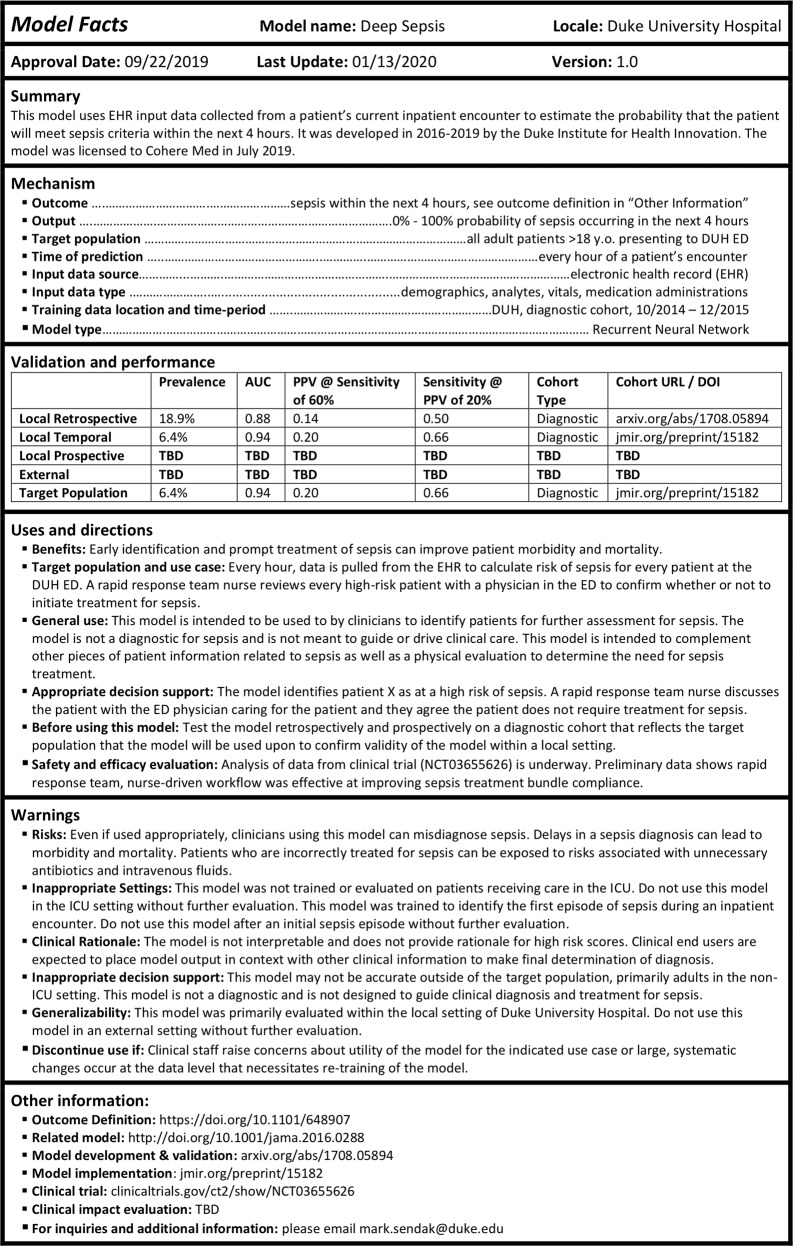
There is tremendous enthusiasm surrounding the potential for machine learning to improve medical prognosis and diagnosis. However, there are risks to translating a machine learning model into clinical care and clinical end users are often unaware of the potential harm to patients. This perspective presents the "Model Facts" label, a systematic effort to ensure that front-line clinicians actually know how, when, how not, and when not to incorporate model output into clinical decisions. The "Model Facts" label was designed for clinicians who make decisions supported by a machine learning model and its purpose is to collate relevant, actionable information in 1-page. Practitioners and regulators must work together to standardize presentation of machine learning model information to clinical end users in order to prevent harm to patients. Efforts to integrate a model into clinical practice should be accompanied by an effort to clearly communicate information about a machine learning model with a "Model Facts" label.
Overview
The claims and statistics of this paper haven’t been checked yet.
Free: it reads the open-access text and checks the first 5 claims that cite a source we can check. Create a free account to check every claim.
Integrity signals
Registry
Cites
Statistics
Figures
Verification
Claims the paper makes
The claims and statistics of this paper haven’t been checked yet.
Free: it reads the open-access text and checks the first 5 claims that cite a source we can check. Create a free account to check every claim.
Claims other papers make about this one
Each is checked against this paper’s own text: does it say what the citing paper says it does?
The check wasn’t confident either way, so it gives no verdict — never disputed.
In the citing paper
“Models of innovation are dependent on political, cultural, and institutional factors, requiring a high degree of contextual specificity in each case study23,24.”
From The algorithm journey map: a tangible approach to implementing AI solutions in healthcare (2024) · cites this paper as [24]
Experimental — accuracy not yet measuredIn the citing paper
“Providing a model facts label should be provided to the end users is advised, including the system’s technical specifications, statistical working, limitations, fairness criteria and validation, implementation disclaimer, and links to process logs22,101.”
From Guidelines and quality criteria for artificial intelligence-based prediction models in healthcare: a scoping review (2022) · cites this paper as [101]
Self-check
Percentages, sums and reported differences re-computed from the paper’s own numbers.
The self-check needs the paper’s full text.
Citations
Cites
Rogers, E. M., Singhal, A., & Quinlan, M. M. (2019) · An Integrated Approach to Communication Theory and Research · doi:10.4324/9780203710753-35 · Cited by 37,322
High-performance medicine: the convergence of human and artificial intelligence
Topol, E. J. (2019) · Nature Medicine · doi:10.1038/s41591-018-0300-7 · Cited by 10,450
Collins, G. S., Reitsma, J. B., Altman, D. G., & Moons, K. G. M. (2015) · Annals of Internal Medicine · doi:10.7326/m14-0697 · Cited by 3,267
Gluesing, J. C. (2012) · Leadership in Science and Technology: A Reference Handbook · doi:10.4135/9781412994231.n14 · Cited by 3,210
Key challenges for delivering clinical impact with artificial intelligence
Kelly, C. J., Karthikesalingam, A., Suleyman, M., Corrado, G., & King, D. (2019) · BMC Medicine · doi:10.1186/s12916-019-1426-2 · Cited by 3,136
Model Cards for Model Reporting
Mitchell, M., Wu, S., Zaldivar, A., Barnes, P., Vasserman, L., Hutchinson, B., Spitzer, E., Raji, I. D., & Gebru, T. (2019) · Proceedings of the Conference on Fairness, Accountability, and Transparency · doi:10.1145/3287560.3287596 · Cited by 2,681 · cited 1×
“Outside of health care, preliminary efforts have begun to standardize documentation to accompany a trained machine learning model 21 .”
BackgroundThe practical implementation of artificial intelligence technologies in medicine
He, J., Baxter, S. L., Xu, J., Xu, J., Zhou, X., & Zhang, K. (2019) · Nature Medicine · doi:10.1038/s41591-018-0307-0 · Cited by 2,246
Intelligible Models for HealthCare: Predicting Pneumonia Risk and Hospital 30-day Readmission
Caruana, R., Lou, Y., Gehrke, J., Koch, P., Sturm, M., & Elhadad, N. (2015) · Proceedings of the 21th ACM SIGKDD International Conference on Knowledge Discovery and Data Mining · doi:10.1145/2783258.2788613 · Cited by 1,685
Do no harm: a roadmap for responsible machine learning for health care
Wiens, J., Saria, S., Sendak, M., Ghassemi, M., Liu, V. X., Doshi-Velez, F., Jung, K., Heller, K., Kale, D., Saeed, M., et al. (2019) · Nature Medicine · doi:10.1038/s41591-019-0548-6 · Cited by 1,266 · cited 1×
“The clinical utility of models is widely questioned and the need to communicate the limitations of machine learning systems has been highlighted 3,4 .”
BackgroundSelf-citationPark, S. H., & Han, K. (2018) · Radiology · doi:10.1148/radiol.2017171920 · Cited by 894
Cited by
Items 101–200 of 320
Incorporating artificial intelligence in palliative care: opportunities and challenges
Munive, J. E. U. (2024) · Hospice and Palliative Medicine International Journal · doi:10.15406/hpmij.2024.07.00244 · Cited by 13
Eliminating the AI digital divide by building local capacity
Gulamali, F., Kim, J. Y., Pejavara, K., Thomas, C., Mathur, V., Eigen, Z. J., Lifson, M. A., Patel, M. R., Shaw, K., Tobey, D., et al. (2025) · PLOS Digital Health · doi:10.1371/journal.pdig.0001026 · Cited by 14
“This includes the ability to assess bias, evaluate and monitor local product performance, and provide educational support to frontline users using tools like Model Fact Labels to enhance targeted clinical actions [41].”
Self-citationML4H Auditing: From Paper to Practice
Oala, L., Fehr, J., Gilli, L., Balachandran, P., Leite, A. W., Calderón-Ramírez, S., Xie-Li, D., Nobis, G., Alvarado, E. A. M., Jaramillo-Gutierrez, G., et al. (2020) · SERVAL (Université de Lausanne) · Cited by 53
Trașcă, D.-M., Pluta, I. D., Carmen, S., Văruţ, R.-M., Singer, C. E., Radivojević, K., & Stoica, G. A. (2025) · Pharmaceutics · doi:10.3390/pharmaceutics17121564 · Cited by 14
“Achieving interoperability with electronic health records (EHRs) and ensuring that AI outputs align with clinical pathways are equally crucial for effective implementation and user adoption [136,137].”
Squires, M., Tao, X., Elangovan, S., Gururajan, R., Zhou, X., Li, Y., & Acharya, U. R. (2023) · Computer Methods and Programs in Biomedicine · doi:10.1016/j.cmpb.2023.107771 · Cited by 13
Impact of the COVID-19 Pandemic on the Health Workforce in Canada
Tardif, A., Gupta, B., McNeely, L., & Feeney, W. (2022) · Healthcare Quarterly · doi:10.12927/hcq.2022.26812 · Cited by 13
AI-CDSS Design Guidelines and Practice Verification
He, X., Xi, Z., Ding, H., Liu, Y., & Zhu, H. (2023) · International Journal of Human-Computer Interaction · doi:10.1080/10447318.2023.2235882 · Cited by 14
“Connect AI information to clinical feature(s) visually (Amie et al., 2020; Cheng et al., 2022; Helman et al., 2022; Henry et al., 2022; Higgins et al., 2023; Matthiesen et al., 2021; Miller, Capan, et al., 2018; M € uller et al., 2020; Sendak et al., 2020; Xie et al., 2020; Yang et al., 2023).”
Marwaha, J. S., Yuan, W., Poddar, M., Elsamadisi, P., & Brat, G. A. (2025) · npj Digital Medicine · doi:10.1038/s41746-025-01960-0 · Cited by 12
Sandhu, S., Sendak, M., Ratliff, W., Knechtle, W. S., Fulkerson, W. J., & Balu, S. (2023) · Patterns · doi:10.1016/j.patter.2023.100710 · Cited by 16
“For our machine learning projects, we create ‘‘Model Facts’’ sheets to communicate important model information.(26) Similar to product information for food and drugs, our model label specifications include model name, locale, and version, summary of the model, mechanism of risk score calculation, validation and perfor…”
BackgroundSelf-citationPharmacy Futures: Summit on Artificial Intelligence in Pharmacy Practice
Luchen, G. G., Fera, T., Anderson, S. V., & Chen, D. C. (2024) · American Journal of Health-System Pharmacy · doi:10.1093/ajhp/zxae279 · Cited by 10
Balcarcel, D. R., Mehta, S. D., Dixon, C. G., Woods-Hill, C. Z., Goligher, E. C., van Amsterdam, W. A. C., & Yehya, N. (2025) · The Lancet Digital Health · doi:10.1016/j.landig.2025.100880 · Cited by 13
Kanthavel, R., & Dhaya, R. (2025) · Innovation and Emerging Technologies · doi:10.1142/s2737599425500252 · Cited by 11
Kolossváry, M., Smith, E. E., Reeves, M. J., Layton, A. T., Mills, N. L., Motwani, M., Goto, S., & Atkins, N. (2025) · Circulation · doi:10.1161/circulationaha.125.074325 · Cited by 11
Wang, S. M., Hogg, H. D. J., Sangvai, D. G., Patel, M. R., Weissler, E. H., Kellogg, K. C., Ratliff, W., Balu, S., & Sendak, M. (2023) · JMIR Formative Research · doi:10.2196/43963 · Cited by 11
“The study was motivated by the need to better understand diverse stakeholder needs to improve algorithm documentation, communication, and training materials, which are crucial for the safe and responsible use of ML-driven CDS [17,18].”
Self-citationLü, Y., Chen, C., Qiu, J., Ji, Q., Zhou, L. D., Xiong, H., & Wu, T. (2025) · Renal Failure · doi:10.1080/0886022x.2025.2587490 · Cited by 11
“…predictions align with established medical knowledge and pathophysiological principles, ensuring safer and more accountable clinical decisions [44]. thirdly, regulatory compliance scenarios where healthcare systems must justify predictions to external stakeholders, including quality metrics…”
Exploring environmental sustainability of artificial intelligence in radiology: A scoping review
Champendal, M., Lokaj, B., de Gevigney, V. D., Brulé, G., Zaghir, J., Boiko, P., Lovis, C., Müller, H., Schmid, J., & Ribeiro, R. T. (2025) · European Journal of Radiology · doi:10.1016/j.ejrad.2025.112558 · Cited by 12
Potential for Algorithmic Bias in Clinical Decision Instrument Development
Obra, J. K. L., Singh, C., Watkins, K., Feng, J., Obermeyer, Z., & Kornblith, A. E. (2025) · npj Digital Medicine · doi:10.1038/s41746-025-02119-7 · Cited by 10
“Going forward, we recommend that these factors (in addition to standard best practices 16 ) are conveyed clearly to clinicians, e.g. in a model card 17 .”
Mersal, F. A., Mersal, N. A., Ibrahim, N. M., Elgazzar, S. E., Alanazi, A. M., Alzughaibi, S., Alanazi, E. M., & Elsayed, E. A. H. (2026) · Digital Health · doi:10.1177/20552076261429671 · Cited by 9
“This interpretation is consistent with Sendak et al., 24 who documented multiple “ implementation challenges ” undermining otherwise robust predictive models due to poor EHR integration, alert fatigue, and misalignment between algorithmic outputs and clinical decision processes.”
Clinical Deployment of Machine Learning Tools in Transplant Medicine: What Does the Future Hold?
Rabindranath, M., Naghibzadeh, M., Zhao, X., Holdsworth, S., Brudno, M., Sidhu, A., & Bhat, M. (2023) · Transplantation · doi:10.1097/tp.0000000000004876 · Cited by 9
“74,75 This can help ensure some transparency so that ML outputs are used appropriately.”
Integration of AI in surgical decision support: improving clinical judgment
Balch, J. A., Shickel, B., Bihorac, A., Upchurch, G. R., & Loftus, T. J. (2024) · Global Surgical Education - Journal of the Association for Surgical Education · doi:10.1007/s44186-024-00257-2 · Cited by 10
“We recommend medical algorithmic audits and model cards that report on these metrics as well as why, when, and how the models fail [47, 48].”
An Oncology Artificial Intelligence Fact Sheet for Cancer Clinicians
Bitterman, D. S., Kamal, A., & Mak, R. H. (2023) · JAMA Oncology · doi:10.1001/jamaoncol.2023.0012 · Cited by 9
Lin, A. L., Parrish, A. B., Cary, M. P., Silcox, C., Balu, S., Jelovsek, J. E., O’Brien, C. L., Pencina, M. J., Poon, E. G., & Economou-Zavlanos, N. (2025) · Annual Review of Biomedical Data Science · doi:10.1146/annurev-biodatasci-103123-094601 · Cited by 10
Self-citationScott, I. A., Shaw, T. J., Slade, C., Wan, T. T., Barmanray, R., Coorey, C. P., Johnson, S. L., Bell, L. M., Herd, M., & Sullivan, C. M. (2025) · Internal Medicine Journal · doi:10.1111/imj.70112 · Cited by 8
Addressing Missingness in Predictive Models That Use Electronic Health Record Data
Lin, S., Groenwold, R. H. H., Mehta, H. B., Kim, J. S., & Segal, J. B. (2025) · Annals of Internal Medicine · doi:10.7326/annals-24-01516 · Cited by 10
Explainability in context: calibrating appropriate trust and reliance in artificial intelligence
Davis, S. E., & Salwei, M. E. (2026) · Journal of the American Medical Informatics Association · doi:10.1093/jamia/ocag082 · Cited by 10
“21,22 Access to model fact sheets can allow users to determine whether a model was robustly and reliability design and whether it is relevant and applicable to current care decision.”
Toward Patient-Centered AI Fact Labels: Leveraging Extrinsic Trust Cues
Yoo, D. W., Stroud, A. M., Zhu, X., Miller, J. E., & Barry, B. A. (2025) · Designing Interactive Systems Conference · doi:10.1145/3715336.3735758 · Cited by 9
“Our approach builds on prior research and extends existing AI documentation frameworks by integrating underutilized extrinsic trust cues.”
InfluentialAhmad, M. A., & Eckert, C. (2023) · Surgical Clinics of North America · doi:10.1016/j.suc.2023.03.002 · Cited by 8
Montero, A. M. B., Huet‐Dastarac, M., Herranz-Hernández, S. M., Tengler, B., Buhl, E. S., Galapon, A., Cárdenas, C. E. S., Fusella, M., Herbin, G., de Hond, Y. J. M., et al. (2026) · Physics and Imaging in Radiation Oncology · doi:10.1016/j.phro.2026.100940 · Cited by 7
Evaluating Behaviors of General Purpose Language Models in a Pedagogical Context
Karumbaiah, S., Ganesh, A., Bharadwaj, A., & Anderson, L. (2024) · Lecture notes in computer science · doi:10.1007/978-3-031-64299-9_4 · Cited by 10
Schnetler, R. J., van der Vegt, A. H., Kalke, V. R., Lane, P., & Scott, I. A. (2025) · BMJ Quality & Safety · doi:10.1136/bmjqs-2024-018328 · Cited by 9
“Whether a single or multiple models are used across different sites, ML model ‘fact sheets’ provided to clinicians, as proposed by Sendak et al , 37 should reflect the accuracy of the model at that site and care location.”
Niazi, S. K. (2025) · Pharmaceuticals · doi:10.3390/ph18071024 · Cited by 10
Ruberg, S. J., Menon, S., & Demanuele, C. (2023) · Harvard Data Science Review · doi:10.1162/99608f92.c1292c54 · Cited by 7
Patel, A. K., Trujillo-Rivera, E. A., Chamberlain, J. M., Morizono, H., & Pollack, M. M. (2024) · PLoS ONE · doi:10.1371/journal.pone.0288233 · Cited by 7
ROADMAP: An Ontology of Medical AI Models and Datasets
Suri, A., Takahashi, M. S., Retson, T., Gonzales, R. A., Park, S. H., & Kahn, C. E. (2026) · Radiology Artificial Intelligence · doi:10.1148/ryai.260069 · Cited by 7
RAISE -- Radiology AI Safety, an End-to-end lifecycle approachPreprint
Cardoso, M. J., Moosbauer, J., Cook, T. S., Erdal, B. S., Genereaux, B. W., Gupta, V., Landman, B. A., Lee, T., Nachev, P., Somasundaram, E., et al. (2023) · arXiv (Cornell University) · doi:10.48550/arxiv.2311.14570 · Cited by 8
“These can be informally augmented by professional societies (e.g. American College of Radiology, Radiological Society of North America, European College of Radiology), promoting best practice recommendations for AI usage and reporting [7], [8].”
BackgroundKhadka, R., Lind, P. G., Yazidi, A., & Belhadi, A. (2025) · SoftwareX · doi:10.1016/j.softx.2025.102140 · Cited by 6
“Sendak et al. [10] introduced the Model Facts label, designed for clinicians who make decisions supported by machine learning models.”
When OpenClaw Meets Hospital: Toward an Agentic Operating System for Dynamic Clinical WorkflowsPreprint
Yang, W., Qiu, H., Zhang, B. Y., Li, C., Huang, Z., Feng, X., Yu, R., & Dong, J. (2026) · arXiv (Cornell University) · doi:10.48550/arxiv.2603.11721 · Cited by 6
“Within healthcare, substantial work has examined the requirements for integrating AI systems into clinical environments 12–14 .”
Schönfelder, A., Eberlein-Gonska, M., Hülsken-Giesler, M., Jovy-Klein, F., Kather, J. N., Kohoutek, E., Lennefer, T., Liebert, E., Lipprandt, M., Mathias, R., et al. (2026) · Journal of Medical Internet Research · doi:10.2196/80754 · Cited by 6
Wi, C.-I., Overgaard, S. M., Malik, M., Watson, D., Sharma, D., Le‐Rademacher, J. G., Kelleher, D. P., Zheng, L., Ohde, J. W., Lynch, B., et al. (2026) · Journal of the National Medical Association · doi:10.1016/j.jnma.2026.04.001 · Cited by 7
The promises and challenges of clinical AI in community paediatric medicine
Singh, D. A., Nagaraj, S., Daniel, R. C., Flood, C. M., Kulik, D. M., Flook, R., Goldenberg, A., Brudno, M., & Stedman, I. (2023) · Paediatrics & Child Health · doi:10.1093/pch/pxac080 · Cited by 6
Essentials for AI Research in Cardiology: Challenges and Mitigations
Jaltotage, B., & Dwivedi, G. (2024) · CJC Open · doi:10.1016/j.cjco.2024.07.015 · Cited by 7
“31 It aims to inform end users about the appropriate circumstances for using an AI system in clinical decision-making, as well as when not to do so.”
Strachna, O., & Asan, O. (2021) · IEEE International Symposium on Systems Engineering · doi:10.1109/isse51541.2021.9582546 · Cited by 6
Wu, X., Hu, F., Zhang, T., Pan, Y., He, J., Zhang, R., Zhou, H., & Shi, H. (2025) · Scientific Reports · doi:10.1038/s41598-025-10119-6 · Cited by 4
“Additionally, to better serve clinical practice, we incorporated a “Model Facts” label (Table S1), which guides clinicians on how, when, and when not to use model outputs in decision-making 19 .”
Threshold-Optimized and Calibrated Logistic Regression for Breast Cancer Classification
Watrianthos, R., Rayendra, R., Asri, E., Yuhefizar, Y., & Humaira, H. (2025) · Salud Ciencia y Tecnología · doi:10.56294/saludcyt20252241 · Cited by 8
Fernández, E. I., Chen, K. C., Seoane, F., & Abtahi, F. (2026) · Frontiers in Artificial Intelligence · doi:10.3389/frai.2026.1716819 · Cited by 4
“Automated evaluation via the Claude API yielded high concordance with expert reviewers (Fleiss’s κ = 0.63), supporting the technical consistency of AI-assisted interpretation (Sendak et al., 2020).”
InfluentialJang, H., Yoo, W., Hwang, S., & Lee, K. (2025) · Medicina · doi:10.3390/medicina61111896 · Cited by 4
Lamberti, G., Panzuto, F., Massironi, S., Cives, M., Salvia, A. L., Spada, F., Faggiano, A., Pusceddu, S., Albertelli, M., Tafuto, S., et al. (2025) · npj Digital Medicine · doi:10.1038/s41746-025-02274-x · Cited by 4
“ThisapproachalignswithcontemporaryperspectivesonAI-assisteddeci-sionsupport,whichemphasisecollaborationbetweencliniciansand adaptivealgorithmstoimprovequalityandsafetyofcare 26,27 .”
Forecasting migraine with time-series machine learning from mobile health data
Faisal, F., Poole, A. C., Danelakis, A., Meisingset, T. W., Bjørk, M., Khanevski, A. N., Kristoffersen, E. S., Kumelj, T., Larsen, I. C. K., Lunder, O. V., et al. (2026) · The Journal of Headache and Pain · doi:10.1186/s10194-026-02346-7 · Cited by 4
Jeong, M.-A., & Kim, S.-D. (2026) · Applied Sciences · doi:10.3390/app16105146 · Cited by 5
“Emergency medicine and general medicine involve more complex, multimodal diagnostic reasoning integrating symptoms, history, examination findings, and laboratory data, which is less amenable to current AI architectures [28,40,41,51–54].”
Striking a Balance: Innovation, Equity, and Consistency in AI Health Technologies
Perakslis, E. D., Nolen, K., Fricklas, E., & Tubb, T. (2025) · JMIR AI · doi:10.2196/57421 · Cited by 4
Terry, A. L., Thompson, K., Tsuei, S. H., & Lizotte, D. J. (2025) · Canadian Family Physician · doi:10.46747/cfp.7106e90 · Cited by 5
Banda, J. M., Shah, N. H., & Periyakoil, V. S. (2023) · JAMIA Open · doi:10.1093/jamiaopen/ooad043 · Cited by 4
Stroud, A. M., Miller, J. E., & Barry, B. A. (2025) · The American Journal of Bioethics · doi:10.1080/15265161.2025.2457775 · Cited by 4
“Some current examples of AI documentation approaches include “model cards” or “nutrition labels,” which provide a structured format to consoli-date and present key information about an AI model or tool (Sendak et al. 2020).”
Li, N., Shi, Y., Zhao, Y., & Zhan, S. (2025) · Intelligent Medicine · doi:10.1016/j.imed.2025.07.002 · Cited by 6
Kpodzro, S., Kim, J. Y., Hasan, A., Thomas, C., Draugelis, M. E., Jeffries, S. M., Beecy, A., Stroum, C., Valladares, A., Eigen, Z. J., et al. (2026) · NEJM AI · doi:10.1056/aip2500985 · Cited by 4
Self-citationDas, O., Tang, L., Oh, E. S., Suárez, J. I., Theodore, N., & Azad, T. D. (2025) · GeroScience · doi:10.1007/s11357-025-01997-9 · Cited by 5
Bakidou, A., Hagiwara, M. A., Lee, E., Caragounis, E.-C., Sjöqvist, B. A., Seth, M., Jönsson, A., & Candefjord, S. (2025) · Digital Health · doi:10.1177/20552076251403207 · Cited by 9
“Examples of such communication items that have received attention are systematic model descriptions intended for clinical users, 22 and incorporation of warning alerts when the model input does not match the model ’ s intended use.”
Mingels, S. M. B., Piehl, H., Therrien, M., Akhmad, E. S., van Hienen, A. R., van Soest, J., Hochstenbach, L. M. J., Dekker, A. L. A. J., Damman, O. C., & Fijten, R. (2026) · JMIR Medical Education · doi:10.2196/85228 · Cited by 4
“These concepts combined resulted in “Model Facts” [33], an overview to “collate relevant, actionable information in a compact overview to ensure that clinicians know how, when, how not, and when not to use model output in their clinical decisions” [33].”
InfluentialSharma, V., Chawla, G. K., Kukreti, S., Ahuja, K., & Singh, S. (2026) · Exploration of Medicine · doi:10.37349/emed.2026.1001383 · Cited by 3
Wang, X., Xiong, D., Cui, S., Duan, B., Hung, Y., Jing, H. E., Ding, G., Tang, Y., & Wang, Q. (2026) · Discover Oncology · doi:10.1007/s12672-026-04864-x · Cited by 6
“Human-centered design is required so that AI outputs are concise, interpretable, and surfaced at the right moment in existing tools [125].”
InfluentialYankam, B. M. (2026) · Frontiers in Artificial Intelligence · doi:10.3389/frai.2026.1739192 · Cited by 3
“Machine learning algorithms have proliferated across the healthcare sector, with applications ranging from sepsis prediction and cancer diagnosis to surgical outcome forecasting and personalized treatment selection (Sendak et al., 2020; Nagendran et al., 2020; Rajkomar et al., 2019).”
InfluentialNavigating AI and machine learning in cancer research: an end-to-end translational framework
Saha, S., Ali, M. S., Tengli, A. K., Prasad, S. R., Mallikarjunaswamy, P., Pillappan, R., & Javarappa, K. K. (2026) · Journal of Translational Medicine · doi:10.1186/s12967-026-08503-5 · Cited by 3
“It ensures reliability, detect potential biases, and support safe clinical use of AI systems [53].”
León-Ariza, S. A., Orobio, M. C., Ibáñez-Gutiérrez, H. M., García-Serna, J., & Vivas, D. A. (2026) · Medical Teacher · doi:10.1080/0142159x.2026.2685794 · Cited by 4
Noori, G. H., Bibi, S., & Lee, S. W. (2026) · INQUIRY The Journal of Health Care Organization Provision and Financing · doi:10.1177/00469580261478793 · Cited by 3
Reevaluating Human Values for Patient Care in the Age of Artificial Intelligence:
Lopez, M. (2024) · Journal of AI Law and Regulation · doi:10.21552/aire/2024/1/7 · Cited by 3
Stidham, R. W., Vickers, A. J., Singh, K., & Waljee, A. K. (2021) · Gut · doi:10.1136/gutjnl-2021-324712 · Cited by 3
Machine Learning Applied to Routinely Collected Health Administrative Data
Rosella, L. C., & Harish, V. (2022) · Healthcare Quarterly · doi:10.12927/hcq.2022.26813 · Cited by 4
Evaluating the Efficiency of Deep Learning Models for Personalized Healthcare
Goel, A., & Neduncheliyan, S. (2023) · IEEE Engineering Informatics · doi:10.1109/ieeeconf58110.2023.10520611 · Cited by 3
The Challenge Dataset – simple evaluation for safe, transparent healthcare AI deploymentPreprint
Sanayei, J. K., Abdalla, M., Ahluwalia, M., Seyyed-Kalantari, L., Minotti, S. C., & Fine, B. (2022) · medRxiv · doi:10.1101/2022.12.15.22280619 · Cited by 4
“[36 ] Another important benefit is that elucidating points of failure can mitigate automation bias.”
BackgroundZablah, I., Agudelo-Santos, C., Molina, Y., Madrid, M., Zelaya, A., Argueta, E., Diaz, S., & Garcia-Loureiro, A. J. (2026) · Diagnostics · doi:10.3390/diagnostics16010132 · Cited by 3
“The model serves as decision support that complements, not replaces, clinical judgment, with protocols allowing provider override when warranted [38].”
Yan, Y., Zeng, J.-Q., & Ding, X. (2026) · Artificial Intelligence in Gastroenterology · doi:10.35712/aig.v7.i1.112357 · Cited by 2
Building Trust: Public Priorities for Health Care AI Labeling
Sielaff, M. L., Platt, J. E., Tan, S., Ryan, K. A., Nong, P., & Kardia, S. L. R. (2026) · The American Journal of Managed Care · doi:10.37765/ajmc.2026.89875 · Cited by 2
Yang, Z. (2026) · International Journal of Medical Informatics · doi:10.1016/j.ijmedinf.2026.106314 · Cited by 2
Deng, J., Gharavi, A. E., Heybati, K., Haile, D., Ahn, E. S., Mardini, S., & Gibreel, W. O. (2026) · Journal of Plastic Reconstructive & Aesthetic Surgery · doi:10.1016/j.bjps.2026.05.033 · Cited by 2
Research integrity and data ethics in AI-driven integrated healthcare: a critical appraisal
Zeng, W., Wei, H., Chen, Y., Tang, J., Ge, J., & Chen, H. (2026) · Frontiers in Public Health · doi:10.3389/fpubh.2026.1838551 · Cited by 2
“AI-powered clinical decision support systems (CDSS) aggregate information from electronic health records, laboratory values, imaging studies, and genomic data to generate diagnostic and therapeutic recommendations (14, 15).”
Sharma, K., Sharma, P., & Sharma, P. (2026) · Indian Heart Journal · doi:10.1016/j.ihj.2026.06.002 · Cited by 4
Aikodon, N., Olier, I., Johnston, B. W., Welters, I. D., Lip, G. Y. H., & Ortega‐Martorell, S. (2026) · npj Digital Medicine · doi:10.1038/s41746-026-02890-1 · Cited by 1
“…translating predictive models into clinical practice remains challenging, requiring not only high discrimination performance but also appropriate calibration, interpretability, generalisability across institutions, and alignment with clinical work fl ows and decision-making timescales 24,25 .”
Touati, A., Boufahja, F., Hamadi, N. B., Touaitia, R., & Idres, T. (2026) · Microbial Drug Resistance · doi:10.1177/10766294261467803 · Cited by 2
“163 This need is reinforced by a work-shop study in which interdisciplinary health care stakeholders understood only about two-thirds of sepsis-model documentation on average and identi fi ed technical jargon, unexplained abbreviations, weak contextual clarity, and dense data presentation as…”
Post, C. E., Bitter, T., Briscoe, A., van Langen, I., Fluit, R., Verdonschot, N. J. J., & Janssen, D. W. (2024) · Bioengineering · doi:10.3390/bioengineering11020116 · Cited by 2
Labeling of Direct-to-Consumer Medical Artificial Intelligence Applications for “Self-Diagnosis”
Gerke, S. (2024) · Cambridge University Press eBooks · doi:10.1017/9781009373234.014 · Cited by 2
Zapata, S. M., Hutchings, A., Grieve, R., Hinchliffe, R. J., Smart, N. J., Moonesinghe, R., Bellingan, G. J., Vohra, R., Moug, S. J., & O’Neill, S. (2024) · Medical Decision Making · doi:10.1177/0272989x241289336 · Cited by 2
Awe, O. O., & Adepoju, J. M. (2024) · STEAM-H: Science, Technology, Engineering, Agriculture, Mathematics & Health · doi:10.1007/978-3-031-72215-8_16 · Cited by 2
Understanding the Policy Space for AgeTech: Implications for AI and Digital Health
Paquette, D. R., Orr-Ewing, L., Anderson, B., Marlin, B. M., Choudhry, N. K., & Ganesan, D. (2024) · Public Policy & Aging Report · doi:10.1093/ppar/prae023 · Cited by 2
Digital public health technologies: rationale for a multidisciplinary research laboratoryPreprint
Андрейченко, А. Е., Gorbacheva, A. M., Denisova, D., Okhotin, A., Kriuchkova, A., Pushkina, N., & Барчук, А. А. (2022) · OSF Preprints (OSF Preprints) · doi:10.31219/osf.io/2kxbm · Cited by 2
Kueper, J. K. (2023) · Mayo Clinic Proceedings: Digital Health · doi:10.1016/j.mcpdig.2023.10.005 · Cited by 1
Agha-Mir-Salim, L., Frey, N., Kaiser, Z., Mosch, L. K., Weicken, E., Freyer, O., Ma, J., Mittermaier, M., Meyer, A., Gilbert, S., et al. (2026) · medRxiv · doi:10.64898/2026.04.15.26350930 · Cited by 2
Roy, M., Reid, R. R., Senkaiahliyan, S., Doria, A. S., Phillips, J. H., Brudno, M., & Singh, D. A. (2024) · Artificial Intelligence Surgery · doi:10.20517/ais.2024.69 · Cited by 1
Cofini, V., Muselli, M., Piccardi, L., Benvenuti, E., Pangrazio, G. D., Mancinelli, M., Cimino, E., Palermo, P., Petrucci, E., Picchi, G., et al. (2026) · Frontiers in Digital Health · doi:10.3389/fdgth.2026.1787117 · Cited by 2
“The innovative methodology of using AI-generated diagnoses and measuring physician concordance provides concrete data on the real-world utility of AI, an approach that addresses the gap between theoretical AI capabilities and practical clinical applications highlighted by Sendak et al. (48).”
Engineering AI Ethics for Transparency
Ramachandran, M. (2025) · Springer eBooks · doi:10.1007/978-981-95-2909-4_15 · Cited by 1
Strategien für die KI-Implementierung: Fachliche und ethische Grundlagen
Plafky, C. S., & Badertscher, H. (2025) · Springer eBooks · doi:10.1007/978-3-658-49009-6_11 · Cited by 1
Evans, R., Bryant, L. D., Russell, G., Wong, D., & Absolom, K. L. (2026) · International Journal of Medical Informatics · doi:10.1016/j.ijmedinf.2026.106360 · Cited by 1
AI-Enabled Precision Echocardiography: Toward Personalized Cardiovascular Care
Saikhan, L. A. (2026) · Diagnostics · doi:10.3390/diagnostics16050694 · Cited by 1
“Workflow analysis should determine the most effective integration points, while staff training supports technical proficiency and shared understanding of AI capabilities and limitations [71–73].”
InfluentialGenerative AI-Driven Telehealth and Smart Patient Engagement in Nursing
Tyagi, V. (2026) · Advances in computational intelligence and robotics book series · doi:10.4018/979-8-3373-8247-0.ch011 · Cited by 1
Triage Nurses’ Perceptions of Artificial Intelligence: A Cross-Sectional Study
Ciulli, A., Ceccanti, L., & Gheri, F. (2026) · Journal of Emergency Nursing · doi:10.1016/j.jen.2026.02.001 · Cited by 1
Explainable AI framework for psilocybin depression treatment optimization
Sungheetha, A., Sharma, R. R., Aroba, O. J., Mahapatra, S., & Mahendhiran, P. D. (2026) · Frontiers in Computer Science · doi:10.3389/fcomp.2025.1652190 · Cited by 1
Özmen, M. M., & Oviedo, R. J. (2026) · Journal of Robotic Surgery · doi:10.1007/s11701-026-03301-z · Cited by 1
Bold, B., Tokuda, B., Kashif, M. S., Fadzli, F., Wee, N. K., Kanwal, U., Nguyen, T. N., & Wah, N. P. S. (2026) · Japanese Journal of Radiology · doi:10.1007/s11604-026-01971-1 · Cited by 2
“…aligns with clinical AI translation research consistently shows that machine learning tools frequently fail to progress from procurement to routine clinical practice when deployment pathways do not prioritise workflow integration, clinician engagement, and operational governance [ 14 – 17 ].”
Understanding and Mitigating Unintended Bias in Medical AI Systems
Tyner-Monroe, S., Rakova, B., Kim, J. Y., Sendak, M., Balu, S., Tobey, D., Darling, C., Eigen, Z. J., Kloeppel, K., & Sharma, D. (2026) · Harvard Data Science Review · doi:10.1162/99608f92.59ca6018 · Cited by 1
Self-citationSodnomdavaa, T., & Gantumur, U. (2026) · International Journal of Environmental Research and Public Health · doi:10.3390/ijerph23040496 · Cited by 1
“…how model information is communicated to clinical end users, such as the use of model fact labels, have been shown to provide a practical means of clarifying model purpose, conditions of use, and key limitations, thereby supporting more informed and responsible adoption in clinical settings [22].”
Shen, Y., Wu, Y., Qiu, Y., & Wu, J. (2026) · Frontiers in Medicine · doi:10.3389/fmed.2026.1818061 · Cited by 1
“Sendak et al. (53) explored presenting machine learning model information to clinical end users, while Shah et al. (54) addressed making machine learning models clinically useful.”
Metadata
- Authors
- Sendak, M. P., Gao, M., Brajer, N., & Balu, S.
- Affiliations
- Duke University (US)
- Corresponding author
- Sendak, Mark P.
- Venue
- npj Digital Medicine
- Published
- 2020-03-23
- Volume
- 3
- Issue
- 1
- Pages
- 41-41
- ISSN
- 2398-6352 (ISSN-L)
- PMC
- PMC7090057
- OpenAlex
- W3012875567
- Cited by
- 279
- References
- 23
- Citations by year
- 2026: 102 · 2025: 55 · 2024: 35 · 2023: 35 · 2022: 28 · 2021: 17 · 2020: 7
- FWCI
- 6.41
- Type
- journal article
- Language
- en
- Open access
- gold
- doi.org
- Licence
- cc-by
- creativecommons.org/licenses/by/4.0 (tdm)
- creativecommons.org/licenses/by/4.0 (vor)
- Locations
- npj Digital Medicine (publishedVersion, cc-by)
- PubMed Central (publishedVersion, cc-by)
- PubMed (publishedVersion)
- DOAJ (DOAJ: Directory of Open Access Journals) (submittedVersion, cc-by-sa)
- Funders
- Duke Institute for Health Innovation
- Topics
- Health Sciences › Medicine › Health Informatics › Artificial Intelligence in Healthcare and Education
- Physical Sciences › Computer Science › Artificial Intelligence › Explainable Artificial Intelligence (XAI)
- Physical Sciences › Computer Science › Artificial Intelligence › Machine Learning in Healthcare
- Keywords
- machine learning model interpretability, clinical decision support, clinical implementation of AI, patient safety, model transparency
About these checks
Registry, retraction, Cites and statistics results are computed, not judged, with one exception: a printed reference that no index lists is read once by a model before it counts as a citation error. Claims are extracted by a model and kept only when their quote appears verbatim in the text; each cited source is then checked, with a model’s help, for whether it says what the claim relies on. Those verdicts can be wrong — read the claim’s quote and the cited source before relying on one.
Statistics and arithmetic are recomputed, not judged.
Confidence bands are shown only for fields calibrated on our annotated test set. None is calibrated yet, so no band is shown.
What counts as a claim ›How we measure confidence ›How we check this ›
Are you an author, or do you see a problem with this page? Request a review
Data sources
Bibliographic data: Semantic Scholar, OpenAlex, Crossref.
Contains information from the Semantic Scholar Academic Graph Datasets, made available under the ODC Attribution License (ODC-BY 1.0).
Semantic Scholar’s data is described in: Kinney, R., et al. (2023). The Semantic Scholar Open Data Platform. arXiv:2301.10140.
