

Presenting machine learning model information to clinical end users with model facts labels
Open accessThe DOI matches its Crossref record; 23 of the 23 references it cites were found in a registry or an index.
Abstract
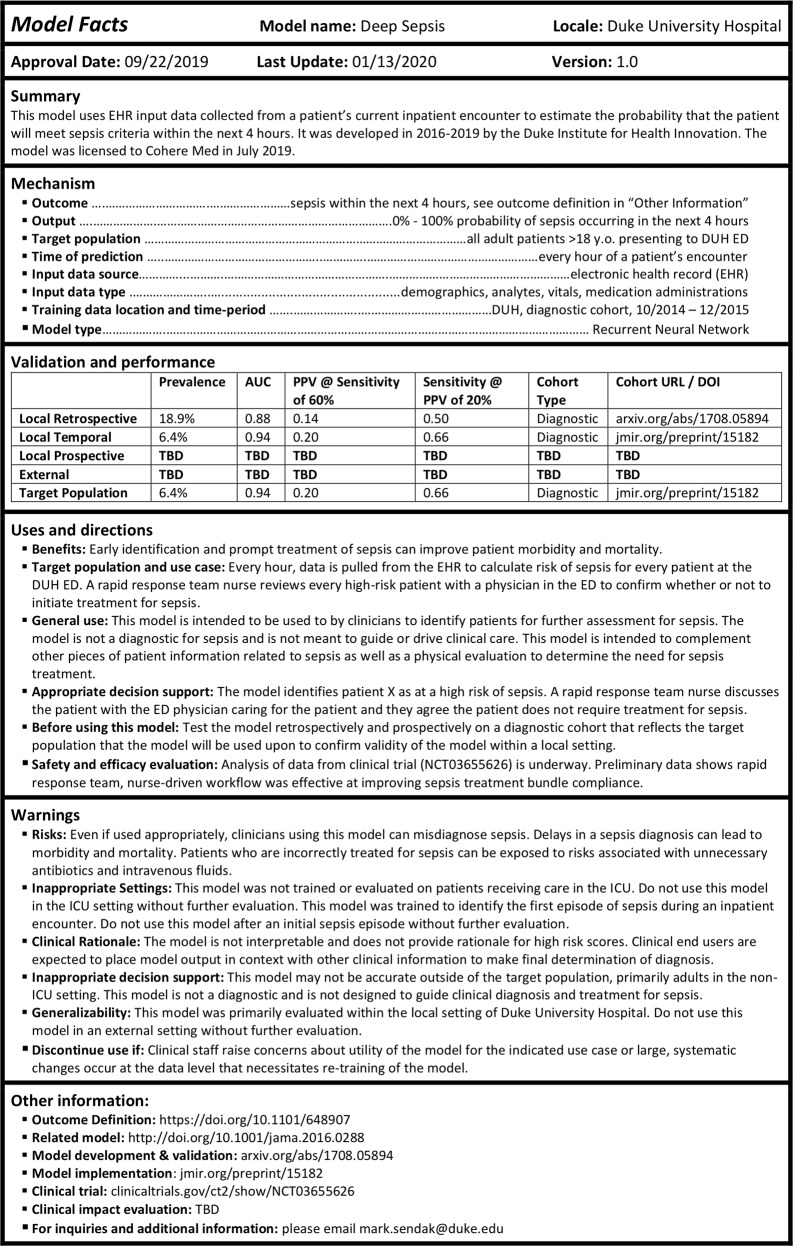
There is tremendous enthusiasm surrounding the potential for machine learning to improve medical prognosis and diagnosis. However, there are risks to translating a machine learning model into clinical care and clinical end users are often unaware of the potential harm to patients. This perspective presents the "Model Facts" label, a systematic effort to ensure that front-line clinicians actually know how, when, how not, and when not to incorporate model output into clinical decisions. The "Model Facts" label was designed for clinicians who make decisions supported by a machine learning model and its purpose is to collate relevant, actionable information in 1-page. Practitioners and regulators must work together to standardize presentation of machine learning model information to clinical end users in order to prevent harm to patients. Efforts to integrate a model into clinical practice should be accompanied by an effort to clearly communicate information about a machine learning model with a "Model Facts" label.
Overview
The claims and statistics of this paper haven’t been checked yet.
Free: it reads the open-access text and checks the first 5 claims that cite a source we can check. Create a free account to check every claim.
Integrity signals
Registry
Cites
Statistics
Figures
Verification
Claims the paper makes
The claims and statistics of this paper haven’t been checked yet.
Free: it reads the open-access text and checks the first 5 claims that cite a source we can check. Create a free account to check every claim.
Claims other papers make about this one
Each is checked against this paper’s own text: does it say what the citing paper says it does?
The check wasn’t confident either way, so it gives no verdict — never disputed.
In the citing paper
“Models of innovation are dependent on political, cultural, and institutional factors, requiring a high degree of contextual specificity in each case study23,24.”
From The algorithm journey map: a tangible approach to implementing AI solutions in healthcare (2024) · cites this paper as [24]
Experimental — accuracy not yet measuredIn the citing paper
“Providing a model facts label should be provided to the end users is advised, including the system’s technical specifications, statistical working, limitations, fairness criteria and validation, implementation disclaimer, and links to process logs22,101.”
From Guidelines and quality criteria for artificial intelligence-based prediction models in healthcare: a scoping review (2022) · cites this paper as [101]
Self-check
Percentages, sums and reported differences re-computed from the paper’s own numbers.
The self-check needs the paper’s full text.
Citations
Cites
Rogers, E. M., Singhal, A., & Quinlan, M. M. (2019) · An Integrated Approach to Communication Theory and Research · doi:10.4324/9780203710753-35 · Cited by 37,322
High-performance medicine: the convergence of human and artificial intelligence
Topol, E. J. (2019) · Nature Medicine · doi:10.1038/s41591-018-0300-7 · Cited by 10,450
Collins, G. S., Reitsma, J. B., Altman, D. G., & Moons, K. G. M. (2015) · Annals of Internal Medicine · doi:10.7326/m14-0697 · Cited by 3,267
Gluesing, J. C. (2012) · Leadership in Science and Technology: A Reference Handbook · doi:10.4135/9781412994231.n14 · Cited by 3,210
Key challenges for delivering clinical impact with artificial intelligence
Kelly, C. J., Karthikesalingam, A., Suleyman, M., Corrado, G., & King, D. (2019) · BMC Medicine · doi:10.1186/s12916-019-1426-2 · Cited by 3,136
Model Cards for Model Reporting
Mitchell, M., Wu, S., Zaldivar, A., Barnes, P., Vasserman, L., Hutchinson, B., Spitzer, E., Raji, I. D., & Gebru, T. (2019) · Proceedings of the Conference on Fairness, Accountability, and Transparency · doi:10.1145/3287560.3287596 · Cited by 2,681 · cited 1×
“Outside of health care, preliminary efforts have begun to standardize documentation to accompany a trained machine learning model 21 .”
BackgroundThe practical implementation of artificial intelligence technologies in medicine
He, J., Baxter, S. L., Xu, J., Xu, J., Zhou, X., & Zhang, K. (2019) · Nature Medicine · doi:10.1038/s41591-018-0307-0 · Cited by 2,246
Intelligible Models for HealthCare: Predicting Pneumonia Risk and Hospital 30-day Readmission
Caruana, R., Lou, Y., Gehrke, J., Koch, P., Sturm, M., & Elhadad, N. (2015) · Proceedings of the 21th ACM SIGKDD International Conference on Knowledge Discovery and Data Mining · doi:10.1145/2783258.2788613 · Cited by 1,685
Do no harm: a roadmap for responsible machine learning for health care
Wiens, J., Saria, S., Sendak, M., Ghassemi, M., Liu, V. X., Doshi-Velez, F., Jung, K., Heller, K., Kale, D., Saeed, M., et al. (2019) · Nature Medicine · doi:10.1038/s41591-019-0548-6 · Cited by 1,266 · cited 1×
“The clinical utility of models is widely questioned and the need to communicate the limitations of machine learning systems has been highlighted 3,4 .”
BackgroundSelf-citationPark, S. H., & Han, K. (2018) · Radiology · doi:10.1148/radiol.2017171920 · Cited by 894
Cited by
Items 301–320 of 320
Song, Z., 侯东江, Zhang, T., Huang, H., Chen, X., Lu, X., Bai, D., Xie, X., Li, Y., Cao, T., et al. (2026) · npj Digital Medicine · doi:10.1038/s41746-026-03338-2
Subversion of clinical judgment by conversational artificial intelligencePreprint
Barrit, S., Salvagno, M., Corriero, A., Sushil, M., Pate, T., Klug, J., Aries, M. J. H., Benghanem, S., Baggiani, M., Cane, G., et al. (2026) · medRxiv · doi:10.64898/2026.10.05.26364541
Singh, A. J., Singh, A., Kumar, S., Dhelim, S., & Singh, C. (2026) · International Journal of Medical Informatics · doi:10.1016/j.ijmedinf.2026.106760
Provider Experiences with AI Clinical Decision Support in eSanjeevaniPreprint
Bhagat, P., Rana, S., Kaur, K. N., Sivasubramanian, S., Garg, V., Khalikar, S., Dutta, T., Chander, A., Sood, S., & Singh, H. (2026) · medRxiv · doi:10.64898/2026.10.12.26365316
AI Model Reporting Standards in Health Care: Systematic Review and Consolidation
Akhmad, E. S., Slob, D., Gomes, A. L., Mingels, S. M. B., Dekker, A. L. A. J., & van Soest, J. (2026) · JMIR AI · doi:10.2196/92329
“Some questions are addressed by commonly used Model card [39] and Model Facts [35].”
Chinagorom, H. C. (2026) · World Scientific News · doi:10.65770/dssf5027
Negoiță, D.-C., Gîndac, C., Akula, A., Marin, K. C., & Ilie, A. C. (2026) · Current Oncology · doi:10.3390/curroncol33100626
“Structured model information, such as the fact labels proposed by Sendak and colleagues, offers a complementary way to communicate intended use and limitations [28].”
Yang, J., Feelders, A., & Siebes, A. P. J. M. (2026) · Lecture notes in computer science · doi:10.1007/978-3-032-37679-4_17
Verification Debt as Agentic Artificial Intelligence Accelerates Clinical Analysis (Preprint)Preprint
Guillen-Ramirez, H., Endrich, O., & Beldi, G. (2026) · doi:10.2196/preprints.114328
TransSurv: compatibility-aware transfer learning for target-cohort survival prediction
Qu, Z., Zhang, H., Nathanson, K. L., Fang, Y., Li, H., & Wang, J. (2026) · Briefings in Bioinformatics · doi:10.1093/bib/bbag532
“…together with cohort-resolved coefficient–deviation summaries that make explicit which auxiliary cohorts were retained and how much each contributed to the target-centered fit, providing the dataset-level transparency that has been emphasized in recent clinical-AI deployment guidance [ 15, 16].”
Role of artificial intelligence in irritable bowel syndrome: A narrative review
Issa, I. A., & Issa, T. (2026) · Artificial Intelligence in Gastroenterology · doi:10.35712/aig.127488
AI-Enabled Patient Profiling for Personalized Nursing Care and Health Support: Scoping Review
Zhang, J., Zhang, F., Guo, Y., Zhang, J., Zhong, H., Guo, X., & Tan, M. (2026) · Journal of Medical Internet Research · doi:10.2196/103362
Dasharadhi, S. (2026) · International Journal of Advanced Artificial Intelligence Research · doi:10.55640/ijaair-v03i10-04
Rathore, H., & Rodriguez, R. (2026) · doi:10.2196/preprints.115523
Chow, J. C. L., & Li, K. (2026) · Information · doi:10.3390/info17111082
Tang, H., Li, S., & Wang, Q. (2026) · Frontiers in Public Health · doi:10.3389/fpubh.2026.1977062
Guidance for the development of artificial intelligence reporting guidelines in healthcare
Ge, L., Du, S., Liu, J., Tong, B., Lai, H., Marušić, A., Saito, H., Spruyt, K., Ozaki, A., Vélez, C. M., et al. (2026) · AI Evidence-Based Medicine · doi:10.1097/ai9.0000000000000010
Predictive Inventory Allocation Models for Regional Pandemic Preparedness Networks
Mendes, D. F. (2026) · Journal of Engineering Research and Sciences · doi:10.55708/js0511001
Transforming Telemedicine through Advanced Data Analytics and Predictive Intelligence
Shingate, S., Nawale, S., & Kakde, S. (2026) · doi:10.1109/worldsuas70880.2026.11767029
AI for Postoperative Pain and Opioid Stewardship in Pediatric Surgery: A Systematic Review
Shamsi, A. (2026) · Pain Management Nursing · doi:10.1016/j.pmn.2026.10.003
Metadata
- Authors
- Sendak, M. P., Gao, M., Brajer, N., & Balu, S.
- Affiliations
- Duke University (US)
- Corresponding author
- Sendak, Mark P.
- Venue
- npj Digital Medicine
- Published
- 2020-03-23
- Volume
- 3
- Issue
- 1
- Pages
- 41-41
- ISSN
- 2398-6352 (ISSN-L)
- PMC
- PMC7090057
- OpenAlex
- W3012875567
- Cited by
- 279
- References
- 23
- Citations by year
- 2026: 102 · 2025: 55 · 2024: 35 · 2023: 35 · 2022: 28 · 2021: 17 · 2020: 7
- FWCI
- 6.41
- Type
- journal article
- Language
- en
- Open access
- gold
- doi.org
- Licence
- cc-by
- creativecommons.org/licenses/by/4.0 (tdm)
- creativecommons.org/licenses/by/4.0 (vor)
- Locations
- npj Digital Medicine (publishedVersion, cc-by)
- PubMed Central (publishedVersion, cc-by)
- PubMed (publishedVersion)
- DOAJ (DOAJ: Directory of Open Access Journals) (submittedVersion, cc-by-sa)
- Funders
- Duke Institute for Health Innovation
- Topics
- Health Sciences › Medicine › Health Informatics › Artificial Intelligence in Healthcare and Education
- Physical Sciences › Computer Science › Artificial Intelligence › Explainable Artificial Intelligence (XAI)
- Physical Sciences › Computer Science › Artificial Intelligence › Machine Learning in Healthcare
- Keywords
- machine learning model interpretability, clinical decision support, clinical implementation of AI, patient safety, model transparency
About these checks
Registry, retraction, Cites and statistics results are computed, not judged, with one exception: a printed reference that no index lists is read once by a model before it counts as a citation error. Claims are extracted by a model and kept only when their quote appears verbatim in the text; each cited source is then checked, with a model’s help, for whether it says what the claim relies on. Those verdicts can be wrong — read the claim’s quote and the cited source before relying on one.
Statistics and arithmetic are recomputed, not judged.
Confidence bands are shown only for fields calibrated on our annotated test set. None is calibrated yet, so no band is shown.
What counts as a claim ›How we measure confidence ›How we check this ›
Are you an author, or do you see a problem with this page? Request a review
Data sources
Bibliographic data: Semantic Scholar, OpenAlex, Crossref.
Contains information from the Semantic Scholar Academic Graph Datasets, made available under the ODC Attribution License (ODC-BY 1.0).
Semantic Scholar’s data is described in: Kinney, R., et al. (2023). The Semantic Scholar Open Data Platform. arXiv:2301.10140.
