

Presenting machine learning model information to clinical end users with model facts labels
Open accessThe DOI matches its Crossref record; 23 of the 23 references it cites were found in a registry or an index.
Abstract
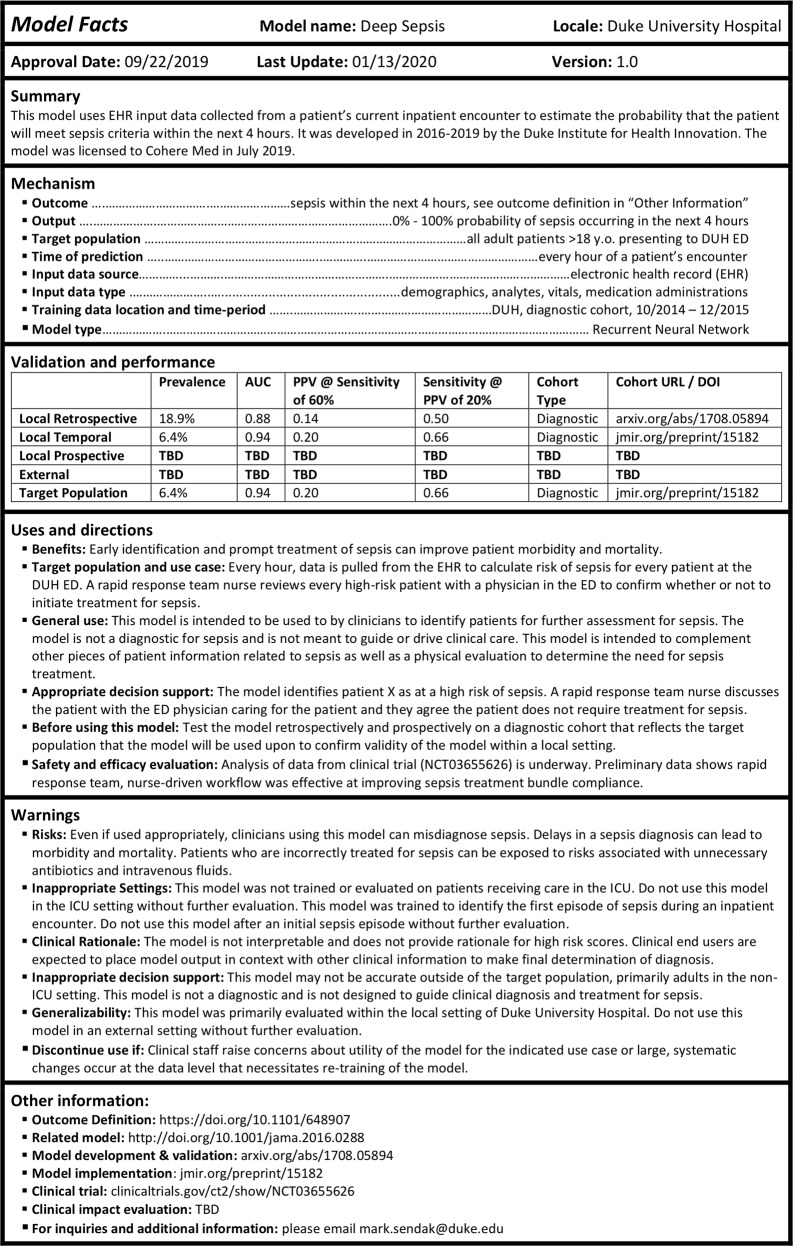
There is tremendous enthusiasm surrounding the potential for machine learning to improve medical prognosis and diagnosis. However, there are risks to translating a machine learning model into clinical care and clinical end users are often unaware of the potential harm to patients. This perspective presents the "Model Facts" label, a systematic effort to ensure that front-line clinicians actually know how, when, how not, and when not to incorporate model output into clinical decisions. The "Model Facts" label was designed for clinicians who make decisions supported by a machine learning model and its purpose is to collate relevant, actionable information in 1-page. Practitioners and regulators must work together to standardize presentation of machine learning model information to clinical end users in order to prevent harm to patients. Efforts to integrate a model into clinical practice should be accompanied by an effort to clearly communicate information about a machine learning model with a "Model Facts" label.
Overview
The claims and statistics of this paper haven’t been checked yet.
Free: it reads the open-access text and checks the first 5 claims that cite a source we can check. Create a free account to check every claim.
Integrity signals
Registry
Cites
Statistics
Figures
Verification
Claims the paper makes
The claims and statistics of this paper haven’t been checked yet.
Free: it reads the open-access text and checks the first 5 claims that cite a source we can check. Create a free account to check every claim.
Claims other papers make about this one
Each is checked against this paper’s own text: does it say what the citing paper says it does?
The check wasn’t confident either way, so it gives no verdict — never disputed.
In the citing paper
“Models of innovation are dependent on political, cultural, and institutional factors, requiring a high degree of contextual specificity in each case study23,24.”
From The algorithm journey map: a tangible approach to implementing AI solutions in healthcare (2024) · cites this paper as [24]
Experimental — accuracy not yet measuredIn the citing paper
“Providing a model facts label should be provided to the end users is advised, including the system’s technical specifications, statistical working, limitations, fairness criteria and validation, implementation disclaimer, and links to process logs22,101.”
From Guidelines and quality criteria for artificial intelligence-based prediction models in healthcare: a scoping review (2022) · cites this paper as [101]
Self-check
Percentages, sums and reported differences re-computed from the paper’s own numbers.
The self-check needs the paper’s full text.
Citations
Cites
Rogers, E. M., Singhal, A., & Quinlan, M. M. (2019) · An Integrated Approach to Communication Theory and Research · doi:10.4324/9780203710753-35 · Cited by 37,322
High-performance medicine: the convergence of human and artificial intelligence
Topol, E. J. (2019) · Nature Medicine · doi:10.1038/s41591-018-0300-7 · Cited by 10,450
Collins, G. S., Reitsma, J. B., Altman, D. G., & Moons, K. G. M. (2015) · Annals of Internal Medicine · doi:10.7326/m14-0697 · Cited by 3,267
Gluesing, J. C. (2012) · Leadership in Science and Technology: A Reference Handbook · doi:10.4135/9781412994231.n14 · Cited by 3,210
Key challenges for delivering clinical impact with artificial intelligence
Kelly, C. J., Karthikesalingam, A., Suleyman, M., Corrado, G., & King, D. (2019) · BMC Medicine · doi:10.1186/s12916-019-1426-2 · Cited by 3,136
Model Cards for Model Reporting
Mitchell, M., Wu, S., Zaldivar, A., Barnes, P., Vasserman, L., Hutchinson, B., Spitzer, E., Raji, I. D., & Gebru, T. (2019) · Proceedings of the Conference on Fairness, Accountability, and Transparency · doi:10.1145/3287560.3287596 · Cited by 2,681 · cited 1×
“Outside of health care, preliminary efforts have begun to standardize documentation to accompany a trained machine learning model 21 .”
BackgroundThe practical implementation of artificial intelligence technologies in medicine
He, J., Baxter, S. L., Xu, J., Xu, J., Zhou, X., & Zhang, K. (2019) · Nature Medicine · doi:10.1038/s41591-018-0307-0 · Cited by 2,246
Intelligible Models for HealthCare: Predicting Pneumonia Risk and Hospital 30-day Readmission
Caruana, R., Lou, Y., Gehrke, J., Koch, P., Sturm, M., & Elhadad, N. (2015) · Proceedings of the 21th ACM SIGKDD International Conference on Knowledge Discovery and Data Mining · doi:10.1145/2783258.2788613 · Cited by 1,685
Do no harm: a roadmap for responsible machine learning for health care
Wiens, J., Saria, S., Sendak, M., Ghassemi, M., Liu, V. X., Doshi-Velez, F., Jung, K., Heller, K., Kale, D., Saeed, M., et al. (2019) · Nature Medicine · doi:10.1038/s41591-019-0548-6 · Cited by 1,266 · cited 1×
“The clinical utility of models is widely questioned and the need to communicate the limitations of machine learning systems has been highlighted 3,4 .”
BackgroundSelf-citationPark, S. H., & Han, K. (2018) · Radiology · doi:10.1148/radiol.2017171920 · Cited by 894
Cited by
Collins, G. S., Moons, K. G. M., Dhiman, P., Riley, R. D., Beam, A. L., Van Calster, B., Ghassemi, M., Liu, X., Reitsma, J. B., van Smeden, M., et al. (2024) · BMJ · doi:10.1136/bmj-2023-078378 · Cited by 4,718
Rajpurkar, P., Chen, E., Banerjee, O., & Topol, E. J. (2022) · Nature Medicine · doi:10.1038/s41591-021-01614-0 · Cited by 3,212
“AI systems can be packaged with easy-to-read instructions, explaining how and when they should be used; it may be helpful for such user manuals to be standardized across systems 99 .”
BackgroundDo as AI say: susceptibility in deployment of clinical decision-aids
Gaube, S., Suresh, H., Raue, M., Merritt, A., Berkowitz, S. J., Lermer, E., Coughlin, J. F., Guttag, J. V., Colak, E., & Ghassemi, M. (2021) · npj Digital Medicine · doi:10.1038/s41746-021-00385-9 · Cited by 543
de Hond, A. A. H., Leeuwenberg, A. M., Hooft, L., Kant, I. M. J., Nijman, S. W. J., van Os, H. J. A., Aardoom, J. J., Debray, T. P. A., Schuit, E., van Smeden, M., et al. (2022) · npj Digital Medicine · doi:10.1038/s41746-021-00549-7 · Cited by 499
“Providing a model facts label should be provided to the end users is advised, including the system ’ s technical speci fi cations, statistical working, limitations, fairness criteria and validation, implementation disclaimer, and links to process logs 22,101 .”
BackgroundHealth data poverty: an assailable barrier to equitable digital health care
Ibrahim, H., Liu, X., Zariffa, N., Morris, A. D., & Denniston, A. K. (2021) · The Lancet Digital Health · doi:10.1016/s2589-7500(20)30317-4 · Cited by 326
Competencies for the Use of Artificial Intelligence–Based Tools by Health Care Professionals
Russell, R. G., Lovett Novak, L., Patel, M., Garvey, K. V., Craig, K. J. T., Jackson, G. P., Moore, D., & Miller, B. M. (2023) · Academic Medicine · doi:10.1097/acm.0000000000004963 · Cited by 320
Toward a responsible future: recommendations for AI-enabled clinical decision support
Labkoff, S., Oladimeji, B., Kannry, J., Solomonides, A., Leftwich, R., Koski, E., Joseph, A. L., Lopez-Gonzalez, M., Fleisher, L. A., Nolen, K., et al. (2024) · Journal of the American Medical Informatics Association · doi:10.1093/jamia/ocae209 · Cited by 252
“Sendak et al 48 suggested one example of such a label in 2020.”
BackgroundJabbour, S., Fouhey, D., Shepard, S., Valley, T. S., Kazerooni, E. A., Banovic, N., Wiens, J., & Sjoding, M. W. (2023) · JAMA · doi:10.1001/jama.2023.22295 · Cited by 236
Developing a delivery science for artificial intelligence in healthcare
Li, R. C., Asch, S. M., & Shah, N. H. (2020) · npj Digital Medicine · doi:10.1038/s41746-020-00318-y · Cited by 193
Deep Learning for Malignancy Risk Estimation of Pulmonary Nodules Detected at Low-Dose Screening CT
Venkadesh, K. V., Setio, A. A. A., Schreuder, A., Scholten, E. T., Chung, K., W. Wille, M. M., Saghir, Z., van Ginneken, B., Prokop, M., & Jacobs, C. (2021) · Radiology · doi:10.1148/radiol.2021204433 · Cited by 179
“We made the algorithm freely accessible to the public for research purposes ( https://grand-challenge.org/algorithms/pulmo-nary-nodule-malignancy-prediction ) along with a Model Facts label (26) containing the most important information for end users (Appendix E1 [online]).”
Integrating a Machine Learning System Into Clinical Workflows: Qualitative Study
Sandhu, S., Lin, A. L., Brajer, N., Sperling, J., Ratliff, W., Bedoya, A. D., Balu, S., O'Brien, C., & Sendak, M. P. (2020) · Journal of Medical Internet Research · doi:10.2196/22421 · Cited by 168
“Model developers should develop clear product labels to help clinicians understand when and how to appropriately incorporate machine learning model outputs into clinical decisions [43].”
BackgroundSelf-citationFehr, J., Citro, B., Malpani, R., Lippert, C., & Madai, V. I. (2024) · Frontiers in Digital Health · doi:10.3389/fdgth.2024.1267290 · Cited by 188
Predicting sex from retinal fundus photographs using automated deep learning
Korot, E., Pontikos, N., Liu, X., Wagner, S. K., Faes, L., Huemer, J. C., Balaskas, K., Denniston, A. K., Khawaja, A. P., & Keane, P. A. (2021) · Scientific Reports · doi:10.1038/s41598-021-89743-x · Cited by 162
Olczak, J., Pavlopoulos, J., Prijs, J., Ijpma, F. F. A., Doornberg, J. N., Lundström, C., Hedlund, J., & Gordon, M. (2021) · Acta Orthopaedica · doi:10.1080/17453674.2021.1918389 · Cited by 127
“To critically assess AI results in the clinical workflow, we could supply standardized “model facts labels” along with the AI tool (Sendak et al. 2020); this is similar to the facts labels accompanying drugs to inform practitioners on suitable usage.”
MethodArtificial intelligence sepsis prediction algorithm learns to say “I don’t know”
Shashikumar, S. P., Wardi, G., Malhotra, A., & Nemati, S. (2021) · npj Digital Medicine · doi:10.1038/s41746-021-00504-6 · Cited by 125
The explainability paradox: Challenges for xAI in digital pathology
Evans, T., Retzlaff, C. O., Geißler, C., Kargl, M., Plass, M., Müller, H., Kiehl, T.-R., Zerbe, N., & Holzinger, A. (2022) · Future Generation Computer Systems · doi:10.1016/j.future.2022.03.009 · Cited by 135
van de Sande, D., Van Genderen, M. E., Smit, J. M., Huiskens, J., Visser, J. J., Veen, R. E. R., van Unen, E., BA, O. H., Gommers, D., & Bommel, J. V. (2022) · BMJ Health & Care Informatics · doi:10.1136/bmjhci-2021-100495 · Cited by 135
A framework for the oversight and local deployment of safe and high-quality prediction models
Bedoya, A. D., Economou-Zavlanos, N. J., Goldstein, B. A., Young, A., Jelovsek, J. E., O’Brien, C., Parrish, A. B., Elengold, S., Lytle, K., Balu, S., et al. (2022) · Journal of the American Medical Informatics Association · doi:10.1093/jamia/ocac078 · Cited by 119
Self-citationFraser, A. G., Biasin, E., Bijnens, B., Bruining, N., Caiani, E. G., Cobbaert, K., Davies, R. H., Gilbert, S. H., Hovestadt, L., Kamenjasevic, E., et al. (2023) · Expert Review of Medical Devices · doi:10.1080/17434440.2023.2184685 · Cited by 88
“Methodological guidelines Park 2020 JAMIA Open [65] Cross-specialty Recommendations for a phased approach to medical AI evaluation Sendak 2020 EMJ Innovation [66] European Medical Journal Cross-specialty Recommendations for translation of ML products into healthcare delivery McCradden 2020 Nature Medicine [67] Cross-s…”
MethodSalwei, M. E., & Carayon, P. (2022) · Journal of Cognitive Engineering and Decision Making · doi:10.1177/15553434221097357 · Cited by 112
“Despite expanding recognition of the need for transparent and explainable AI (Sendak et al., 2020; Sujan, 2021; Warden et al., 2019), little is known about how AI will be interpreted by users and how this interpretation will in fl uence decision making in healthcare (Matheny et al., 2019).”
BackgroundGonzález-Gonzalo, C., Thee, E. F., Klaver, C. C. W., Lee, A. Y., Schlingemann, R. O., Tufail, A., Verbraak, F., & Sánchez, C. I. (2022) · Progress in Retinal and Eye Research · doi:10.1016/j.preteyeres.2021.101034 · Cited by 103
“While transparency in the reporting of limitations of AI systems has been stressed, guardrails to protect against possible risks and consequences of inappropriate use of AI systems still need to be developed (Sendak et al., 2020).”
University of California, S. F., Adler-Milstein, J., Aggarwal, N., University of Wisconsin-Madison, Ahmed, M., National Academy of Medicine, Castner, J., Incorporated, C., Evans, B. J., University of Florida, et al. (2022) · NAM Perspectives · doi:10.31478/202209c · Cited by 82
“To avoid drift in workflow or use of AI tools, project leaders should clearly document algorithms and regularly train staff on appropriate use (Sendak et al., 2020c).”
BackgroundMethodSelf-citationTemporal pointwise convolutional networks for length of stay prediction in the intensive care unit
Rocheteau, E., Liò, P., & Hyland, S. (2021) · Proceedings of the Conference on Health, Inference, and Learning · doi:10.1145/3450439.3451860 · Cited by 56
“Such variability can undermine trust or result in unsafe application of systems [43].”
BackgroundArtificial intelligence in hospital infection prevention: an integrative review
Arab, R. A. E., Almoosa, Z., Alkhunaizi, M., Abuadas, F. H. A., & Somerville, J. G. (2025) · Frontiers in Public Health · doi:10.3389/fpubh.2025.1547450 · Cited by 101
“Traditional approaches to infection control often rely on manual surveillance and retrospective analyses, whereas AI introduces a paradigm shift toward proactive, real-time risk assessment and decision-making (24, 76).”
Bozkurt, S., Cahan, E. M., Seneviratne, M. G., Sun, R., Lossio-Ventura, J. A., Ioannidis, J. P. A., & Hernandez-Boussard, T. (2020) · Journal of the American Medical Informatics Association · doi:10.1093/jamia/ocaa164 · Cited by 65
“21,24 To assess population representativeness of ML models’ training population, direct access to study data is often necessary, as is some-times done for randomized controlled trials.”
BackgroundArtificial Intelligence in Cardiovascular Care—Part 2: Applications
Jain, S. S., Elias, P., Poterucha, T., Randazzo, M., Lopez Jimenez, F., Khera, R., Perez, M., Ouyang, D., Pirruccello, J., Salerno, M., et al. (2024) · Journal of the American College of Cardiology · doi:10.1016/j.jacc.2024.03.401 · Cited by 74
Early Detection of Sepsis With Machine Learning Techniques: A Brief Clinical Perspective
Giacobbe, D. R., Signori, A., Del Puente, F., Mora, S., Carmisciano, L., Briano, F., Vena, A., Ball, L., Robba, C., Pelosi, P., et al. (2021) · Frontiers in Medicine · doi:10.3389/fmed.2021.617486 · Cited by 65
“In this regard, there are no standardized directives on the optimal way to present model pitfalls to clinicians together with the model output, although “model facts” labels have started to be proposed (100).”
BackgroundA framework for understanding label leakage in machine learning for health care
Davis, S. E., Matheny, M. E., Balu, S., & Sendak, M. (2023) · Journal of the American Medical Informatics Association · doi:10.1093/jamia/ocad178 · Cited by 76
Self-citationAchieving large-scale clinician adoption of AI-enabled decision support
Scott, I. A., van der Vegt, A., Lane, P., McPhail, S., & Magrabi, F. (2024) · BMJ Health & Care Informatics · doi:10.1136/bmjhci-2023-100971 · Cited by 65
“26 Tool developers should share model code and input features to allow other researchers Box 1 Shortcomings in comparative studies of artificial intelligence versus clinician 21 22 A systematic review of 82 studies compared the diagnostic accuracy of deep learning tools versus clinicians in…”
BackgroundRegulatory Aspects of the Use of Artificial Intelligence Medical Software
Zanca, F., Brusasco, C., Pesapane, F., Kwade, Z., Beckers, R., & Avanzo, M. (2022) · Seminars in Radiation Oncology · doi:10.1016/j.semradonc.2022.06.012 · Cited by 66
A normative framework for artificial intelligence as a sociotechnical system in healthcare
McCradden, M. D., Joshi, S. D., Anderson, J. A., & London, A. J. (2023) · Patterns · doi:10.1016/j.patter.2023.100864 · Cited by 74
Economou-Zavlanos, N. J., Bessias, S., Cary, M. P., Bedoya, A. D., Goldstein, B. A., Jelovsek, J. E., O’Brien, C. L., Walden, N., Elmore, M., Parrish, A. B., et al. (2024) · Journal of the American Medical Informatics Association · doi:10.1093/jamia/ocad221 · Cited by 73
Self-citationLu, J. H., Callahan, A., Patel, B. S., Morse, K. E., Dash, D., Pfeffer, M. A., & Shah, N. H. (2022) · JAMA Network Open · doi:10.1001/jamanetworkopen.2022.27779 · Cited by 52
Thériault-Lauzier, P., Corbin, D., Tastet, O., Langlais, É. L., Taji, B., Kang, G., Chong, A., So, D. Y. F., Tang, A., Gichoya, J. W., et al. (2024) · Canadian Journal of Cardiology · doi:10.1016/j.cjca.2024.05.025 · Cited by 65
Breaking Bias: The Role of Artificial Intelligence in Improving Clinical Decision-Making
Brown, C., Nazeer, R., Gibbs, A., Le Page, P., & Mitchell, A. R. (2023) · Cureus · doi:10.7759/cureus.36415 · Cited by 55
Effect of Human-AI Interaction on Detection of Malignant Lung Nodules on Chest Radiographs
Lee, J. H., Hong, H., Nam, G., Hwang, E. J., & Park, C. M. (2023) · Radiology · doi:10.1148/radiol.222976 · Cited by 53
Twala, B. (2025) · Frontiers in Aging Neuroscience · doi:10.3389/fnagi.2025.1638340 · Cited by 55
The Role of Artificial Intelligence Model Documentation in Translational Science: Scoping Review
Brereton, T. A., Malik, M. M., Lifson, M. A., Greenwood, J. D., Peterson, K. J., & Overgaard, S. M. (2023) · Interactive Journal of Medical Research · doi:10.2196/45903 · Cited by 50
“…our previous studies were not explicitly mentioned in the literature, for example, Google’s Model Card for model reporting [45], Model Facts Labels [46], DECIDE-AI (Developmental and Exploratory Clinical Investigations of Decision support systems driven by Artificial Intelligence) [47], and AI…”
Considerations in the reliability and fairness audits of predictive models for advance care planning
Lu, J., Sattler, A., Wang, S., Khaki, A. R., Callahan, A., Fleming, S., Fong, R., Ehlert, B., Li, R. C., Shieh, L., et al. (2022) · Frontiers in Digital Health · doi:10.3389/fdgth.2022.943768 · Cited by 40
Joshi, S. D., Urteaga, I., van Amsterdam, W. A. C., Hripcsak, G. M., Elias, P. A., Recht, B., Elhadad, N., Fackler, J. C., Sendak, M., Wiens, J., et al. (2025) · Journal of the American Medical Informatics Association · doi:10.1093/jamia/ocae301 · Cited by 57
Self-citationThe MI-CLAIM-GEN checklist for generative artificial intelligence in health
Miao, B. Y., Chen, I. Y., Williams, C. Y. K., Davidson, J., García-Agúndez, A., Sun, S., Zack, T. I., Saria, S., Arnaout, R., Quer, G., et al. (2025) · Nature Medicine · doi:10.1038/s41591-024-03470-0 · Cited by 54
Factors for Patient Trust and Acceptance of Medical Artificial Intelligence
Bracic, A., Spector‐Bagdady, K., Towle, S., Zhang, R., James, C. A., & Price, W. N., II (2026) · JAMA Network Open · doi:10.1001/jamanetworkopen.2026.0815 · Cited by 45
Chen, Z., Liu, X., Yang, Q., Wang, Y.-J., Miao, K., Gong, Z., Yu, Y., Leonov, A., Liu, C., Feng, Z., et al. (2023) · JAMA Network Open · doi:10.1001/jamanetworkopen.2023.1671 · Cited by 43
Clinical use of artificial intelligence requires AI-capable organizations
Novak, L. L., Russell, R. G., Garvey, K., Patel, M., Thomas Craig, K. J., Snowdon, J., & Miller, B. (2023) · JAMIA Open · doi:10.1093/jamiaopen/ooad028 · Cited by 43
“Scholars have begun to work on mechanisms and approaches to this challenge.(52) These Model Facts Labels should be structured to allow continuous learning for each of the target audiences, and ideally would be required for regulatory approval.”
BackgroundStroud, A. M., Minteer, S. A., Zhu, X., Ridgeway, J. L., Miller, J. E., & Barry, B. A. (2025) · PLOS Digital Health · doi:10.1371/journal.pdig.0000826 · Cited by 49
“Many, both internal and external to the healthcare sector, have proposed AI model documentation in the form of AI labeling and sharing of associated data sets [11,13,16,50,51].”
Clinician's guide to trustworthy and responsible artificial intelligence in cardiovascular imaging
Szabo, L., Raisi-Estabragh, Z., Salih, A., McCracken, C., Ruiz Pujadas, E., Gkontra, P., Kiss, M., Maurovich-Horvath, P., Vago, H., Merkely, B., et al. (2022) · Frontiers in Cardiovascular Medicine · doi:10.3389/fcvm.2022.1016032 · Cited by 36
Clinician Trust in Artificial Intelligence
Rojas, J. C., Teran, M., & Umscheid, C. A. (2023) · Critical Care Clinics · doi:10.1016/j.ccc.2023.02.004 · Cited by 35
Advancing primary care with Artificial Intelligence and Machine Learning
Yang, Z., Silcox, C., Sendak, M., Rose, S., Rehkopf, D., Phillips, R., Peterson, L., Marino, M., Maier, J., Lin, S., et al. (2022) · Healthcare · doi:10.1016/j.hjdsi.2021.100594 · Cited by 38
Self-citationArtificial intelligence for ultrasonography: unique opportunities and challenges
Park, S. H. (2021) · Ultrasonography · doi:10.14366/usg.20078 · Cited by 37
“org Ultrasonography 40(1), January 2021 5 deliver such information to the end-users of AI more effectively and explicitly would also be an important next step [36].”
BackgroundVillegas, F., Bello, R. D., Andres, É. A., Dhont, J., Janssen, T. M., Milan, L., Robert, C., Sălăgean, G. A. M., Tejedor, N., Trnková, P., et al. (2024) · Radiotherapy and Oncology · doi:10.1016/j.radonc.2024.110387 · Cited by 37
Revolutionising Acute Cardiac Care With Artificial Intelligence: Opportunities and Challenges
Doolub, G., Khurshid, S. S., Thériault-Lauzier, P., Lapalme, A. N., Tastet, O., So, D. Y. F., Langlais, É. L., Corbin, D., & Avram, R. (2024) · Canadian Journal of Cardiology · doi:10.1016/j.cjca.2024.06.011 · Cited by 41
“19 These fundamental considerations lay the foundation for the responsible and effective utilisation of AI in acute cardiac care, ultimately improving patient outcomes and bolstering the quality of emergency medical services.”
Better Reporting of Studies on Artificial Intelligence: CONSORT-AI and Beyond
Schwendicke, F., & Krois, J. (2021) · Journal of Dental Research · doi:10.1177/0022034521998337 · Cited by 37
“Model fact labels (comparable to food labeling) are examples supporting such communication (Sendak et al. 2020).”
Backgroundvan Geloven, N., Keogh, R. H., van Amsterdam, W. A. C., Cinà, G., Krijthe, J. H., Peek, N. B., Luijken, K., Magliacane, S., Morzywołek, P., van Ommen, T., et al. (2025) · Annals of Internal Medicine · doi:10.7326/annals-24-00279 · Cited by 45
“(27,35,36) In addition to the usual elements required in reporting of prediction models (outcome, target population, moment of intended use, predictors etc), the prediction estimand formally describes the treatment conditions under which predictions hold (e.g. risk under current care, and how such…”
Algorithmovigilance, lessons from pharmacovigilance
Balendran, A., Benchoufi, M., Evgeniou, T., & Ravaud, P. (2024) · npj Digital Medicine · doi:10.1038/s41746-024-01237-y · Cited by 34
“For example, Sendak et al. introduced the “ Model facts ” labels, a one-page document summarizing key information about a machine learning model used in clinical settings 46 .”
BackgroundLatest developments of generative artificial intelligence and applications in ophthalmology
Feng, X., Xu, K., Luo, M., Chen, H., Yang, Y., He, Q., Song, C., Li, R., Wu, Y., Wang, H., et al. (2024) · Asia-Pacific Journal of Ophthalmology · doi:10.1016/j.apjo.2024.100090 · Cited by 39
Accelerating ophthalmic artificial intelligence research: the role of an open access data repository
Kras, A., Celi, L. A., & Miller, J. B. (2020) · Current Opinion in Ophthalmology · doi:10.1097/icu.0000000000000678 · Cited by 35
“Barriers to clinicians engaging with artificial intelligence are diminishing [53] and risk communication and management is improving for clinical end users to make more informed data-driven decisions [73].”
BackgroundBig Data and Artificial Intelligence: Opportunities and Threats in Electrophysiology
van de Leur, R. R., Boonstra, M., Bagheri, A., Roudijk, R. W., Sammani, A., Taha, K., Doevendans, P. A., van der Harst, P., van Dam, P. M., Hassink, R. J., et al. (2020) · Arrhythmia & Electrophysiology Review · doi:10.15420/aer.2020.26 · Cited by 37
“Standardised leaflets have been proposed to instruct clinicians when, and more importantly when not, to use an algorithm.(91) This is particularly important if an algorithm is trained on a cohort using a specific subgroup of patients.”
BackgroundWong, K. K. L., Han, Y., Cai, Y., Ouyang, W., Du, H., & Liu, C. (2025) · Bioengineering · doi:10.3390/bioengineering12101070 · Cited by 39
“Reflecting this, human–AI trust research in healthcare increasingly integrates machine learning perspectives, ethical responsibility allocation, and decision/cognitive engineering approaches [77,78].”
Burns, C. M., Pung, L., Witt, D., Gao, M. C., Sendak, M., Balu, S., Krakower, D., Marcus, J. L., Okeke, N. L., & Clement, M. E. (2022) · Clinical Infectious Diseases · doi:10.1093/cid/ciac775 · Cited by 35
Self-citationPiloting a Survey-Based Assessment of Transparency and Trustworthiness with Three Medical AI Tools
Fehr, J., Jaramillo-Gutierrez, G., Oala, L., Gröschel, M. I., Bierwirth, M., Balachandran, P., Leite, A. W., & Lippert, C. (2022) · Healthcare · doi:10.3390/healthcare10101923 · Cited by 38
“We assumed that each medical AI product has application boundaries [24,31] that should be reported and scored zero transparency and trustworthiness points if these were not disclosed.”
BackgroundMethodAI-Powered Predictive Models in Implant Dentistry: Planning, Risk Assessment, and Outcomes
Neji, G., Gasparro, R., Tlili, M., Dhahri, A., Khanfir, F., Sammartino, G., Aliberti, A., Campana, M. D., & Amor, F. B. (2025) · Journal of Clinical Medicine · doi:10.3390/jcm15010228 · Cited by 38
“For this reason, clinicians must critically evaluate AI predictions, contextualize them with patient-specific information, and remain aware of the limitations associated with model generalizability and dataset dependency [30].”
Considerations for the Design and Implementation of COVID-19 Contact Tracing Apps: Scoping Review
Osmanlliu, E., Rafie, E., Bédard, S., Paquette, J., Gore, G. C., & Pomey, M. (2021) · JMIR mhealth and uhealth · doi:10.2196/27102 · Cited by 36
“This approach was used by members of the health care machine learning community to promote the transparent and responsible use of clinical decision support tools [71].”
MethodEstévez, M., Benedum, C. M., Jiang, C., Cohen, A. B., Phadke, S., Sarkar, S., & Bozkurt, S. (2022) · Cancers · doi:10.3390/cancers14133063 · Cited by 33
“Sendak et al. suggested including a “Warning” section for all clinical ML models developed for point of care [18] an approach that can be extended to ML-extracted RWD.”
BackgroundGarbin, C., & Marques, O. (2022) · Radiology Artificial Intelligence · doi:10.1148/ryai.210127 · Cited by 31
“It gives the end user “actionable information” (16) at the point where it is most needed, when the products are used.”
BackgroundInfluentialIntegrating artificial intelligence into an ophthalmologist’s workflow: obstacles and opportunities
Taribagil, P., Hogg, H. D. J., Balaskas, K., & Keane, P. A. (2023) · Expert Review of Ophthalmology · doi:10.1080/17469899.2023.2175672 · Cited by 40
“This need has also begun to be addressed through complementary documents with wider accessibility [60].”
BackgroundStructured reporting to improve transparency of analyses in prognostic marker studies
Sauerbrei, W., Haeussler, T., Balmford, J., & Huebner, M. (2022) · BMC Medicine · doi:10.1186/s12916-022-02304-5 · Cited by 31
“To present machine learning model information, a model facts label was recently proposed [76].”
MethodEnabling collaborative governance of medical AI
Price, W. N., Sendak, M., Balu, S., & Singh, K. (2023) · Nature Machine Intelligence · doi:10.1038/s42256-023-00699-1 · Cited by 27
Self-citationTowards a Multi-Stakeholder process for developing responsible AI governance in consumer health
Rozenblit, L., Price, A. I., Solomonides, A. E., Joseph, A. L., Srivastava, G., Labkoff, S. E., deBronkart, D., Singh, R., Dattani, K., López-González, M., et al. (2024) · International Journal of Medical Informatics · doi:10.1016/j.ijmedinf.2024.105713 · Cited by 29
Ahluwalia, M., Abdalla, M., Sanayei, J., Seyyed-Kalantari, L., Hussain, M., Ali, A., & Fine, B. (2023) · Radiology: Artificial Intelligence · doi:10.1148/ryai.220270 · Cited by 26
Pfohl, S. R., Zhang, H., Xu, Y., Foryciarz, A., Ghassemi, M., & Shah, N. H. (2022) · Scientific Reports · doi:10.1038/s41598-022-07167-7 · Cited by 43
“[16] Mark P Sendak, Michael Gao, Nathan Brajer, and Suresh Balu.”
BackgroundPark, D., So, K., Prabhakar, S. K., Kim, C., Lee, J. J., Sohn, J., Kim, J. H., Lee, S., & Won, D.-O. (2025) · Biomedical Engineering Letters · doi:10.1007/s13534-025-00486-4 · Cited by 28
Collins, G. S., Moons, K. G. M., Dhiman, P., Riley, R. D., Beam, A. L., CALSTER, B. V., Ghassemi, M., Liu, X., Reitsma, J. B., van Smeden, M., et al. (2025) · Ewha Medical Journal · doi:10.12771/emj.2025.00668 · Cited by 28
AI model transferability in healthcare: a sociotechnical perspective
Wiesenfeld, B. M., Aphinyanaphongs, Y., & Nov, O. (2022) · Nature Machine Intelligence · doi:10.1038/s42256-022-00544-x · Cited by 29
The Role of Artificial Intelligence in Chronic Liver Diseases and Liver Transplantation
Spann, A., Strauss, A. T., Davis, S. E., & Bhat, M. (2025) · Gastroenterology · doi:10.1053/j.gastro.2025.05.012 · Cited by 24
A scoping review on pediatric sepsis prediction technologies in healthcare
Tennant, R., Graham, J., Kern, J., Mercer, K., Ansermino, J. M., & Burns, C. M. (2024) · npj Digital Medicine · doi:10.1038/s41746-024-01361-9 · Cited by 23
Rusanov, B., Ebert, M. A., Sabet, M., Rowshanfarzad, P., Barry, N., Kendrick, J., Alkhatib, Z., Gill, S., Dass, J., Bucknell, N. W., et al. (2025) · Physical and Engineering Sciences in Medicine · doi:10.1007/s13246-024-01513-x · Cited by 23
“The concept of a “model facts sheet” has been proposed to summarize algorithm information, purpose, and design principles in a standardized format [48].”
Muralidhar, D., Belloum, R., & Ashok, A. (2025) · International Journal of Human-Computer Studies · doi:10.1016/j.ijhcs.2025.103591 · Cited by 25
Standardization of Artificial Intelligence Development in Radiotherapy
de Biase, A., Sourlos, N., & van Ooijen, P. M. A. (2022) · Seminars in Radiation Oncology · doi:10.1016/j.semradonc.2022.06.010 · Cited by 22
Kwak, S. G., & Kim, J. (2025) · Korean Journal of Anesthesiology · doi:10.4097/kja.25075 · Cited by 20
“Using a standardized reporting system also allows for concise information about the AI model to be provided [15].”
Bolocan, V.-O., Mitoi, A., Nicu-Canareica, O., Băean, M.-L., Medar, C., & Popa, G.-A. (2025) · Journal of Imaging · doi:10.3390/jimaging11100335 · Cited by 22
“Continuous learning systems: Current AI models remain static after deployment, unable to learn from accumulating clinical experience [115].”
The algorithm journey map: a tangible approach to implementing AI solutions in healthcare
Boag, W., Hasan, A., Kim, J. Y., Revoir, M., Nichols, M., Ratliff, W., Gao, M., Zilberstein, S., Samad, Z., Hoodbhoy, Z., et al. (2024) · npj Digital Medicine · doi:10.1038/s41746-024-01061-4 · Cited by 19
Self-citationYang, H. S., Çubukçu, H. C., Ben, F. D., Duan, X., Feng, J., Frans, G., Gruson, D., King, M. C., Nieto, J., Wang, B., et al. (2026) · Clinical Chemistry and Laboratory Medicine (CCLM) · doi:10.1515/cclm-2025-1322 · Cited by 19
“Examples of such model facts labels have been published in literature or online [27, 28].”
Cheung, J. L. S., Ali, A. A. A., Abdalla, M., & Fine, B. (2022) · Canadian Association of Radiologists Journal · doi:10.1177/08465371221131200 · Cited by 24
“20”
Verma, A. A., Trbovich, P., Mamdani, M., & Shojania, K. G. (2023) · BMJ Quality & Safety · doi:10.1136/bmjqs-2022-015713 · Cited by 19
Oakley, W., Tandle, S., Perkins, Z., & Marsden, M. E. R. (2024) · The Journal of Trauma: Injury, Infection, and Critical Care · doi:10.1097/ta.0000000000004385 · Cited by 17
Sendak, M., Liu, V. X., Beecy, A., Vidal, D. E., Shaw, K., Lifson, M. A., Tobey, D., Valladares, A., Loufek, B. T., Mogri, M., et al. (2024) · Journal of the American Medical Informatics Association · doi:10.1093/jamia/ocae119 · Cited by 19
Self-citationKey Information Influencing Patient Decision-Making About AI in Health Care: Survey Experiment Study
Zhu, X., Stroud, A. M., Minteer, S. A., Yoo, D. W., Ridgeway, J. L., Mooghali, M., Miller, J. E., & Barry, B. A. (2026) · Journal of Medical Internet Research · doi:10.2196/75615 · Cited by 20
“As a result, there is growing research on best practices for transparent and standardized documentation, reporting, and communication of AI/ML models for clinicians [21-25].”
AI-Driven Medical Imaging Platform: Advancements in Image Analysis and Healthcare Diagnosis
Eldin, W. S., & Kaboudan, A. (2023) · Journal of ACS Advances in Computer Science · doi:10.21608/asc.2023.328064 · Cited by 28
“Additionally, seamless integration into clinical workflows and collaborative research efforts present opportunities for further exploration [27, 28, 33].”
BackgroundBramstedt, K. A. (2025) · Journal of Medical Systems · doi:10.1007/s10916-025-02216-w · Cited by 16
“The AFL concept was proposed several years ago [ 11], and a style was proposed by Sendak et al. [13], yet it is complex, designed for clinicians, and lacks the simplicity of DFLs. Aligning with the 78.6% of patients who argued the necessity of AI disclosure labels in a recent study by Stroud et al.…”
InfluentialEditorial: Surfacing best practices for AI software development and integration in healthcare
Sendak, M., Vidal, D. E., Trujillo, S., Singh, K., Liu, X., & Balu, S. (2023) · Frontiers in Digital Health · doi:10.3389/fdgth.2023.1150875 · Cited by 16
“Third, there is an urgent need to develop and formalize standard AI software integration definitions, processes, and procedures as well as communication approaches (20).”
BackgroundSelf-citationEvaluating and mitigating unfairness in multimodal remote mental health assessments
Jiang, Z., Seyedi, S. S., Griner, E. L., Abbasi, A., Rad, A. B., Kwon, H., Cotes, R. O., & Clifford, G. D. (2024) · PLOS Digital Health · doi:10.1371/journal.pdig.0000413 · Cited by 18
“…in those tools, clinicians, researchers, and developers should work together to raise awareness of fairness evaluation and standardize fairness reporting practices, such as involving clinicians in the design of algorithms [63] and clearly communicating the facts about the algorithms [64].”
BackgroundMachine Learning for Targeted Advance Care Planning in Cancer Patients: A Quality Improvement Study
Patel, M. N., Mara, A., Acker, Y., Gollon, J., Setji, N., Walter, J., Wolf, S. P., Zafar, S. Y., Balu, S., Gao, M. C., et al. (2024) · Journal of Pain and Symptom Management · doi:10.1016/j.jpainsymman.2024.08.036 · Cited by 15
“28,33 Trust may wane over time.”
Self-citationSperling, J. B., Welsh, W. E., Haseley, E., Quenstedt, S., Muhigaba, P. B., Brown, A., Ephraim, P. L., Shafi, T., Waitzkin, M. B., Casarett, D., et al. (2024) · Journal of the American Medical Informatics Association · doi:10.1093/jamia/ocae255 · Cited by 15
AI in Health Science: A Perspective
Mishra, R., Chaudhary, K., & Mishra, I. (2022) · Current Pharmaceutical Biotechnology · doi:10.2174/1389201023666220929145220 · Cited by 15
Waldock, W. J., Guni, A., Darzi, A. W., & Ashrafian, H. (2026) · PLOS Digital Health · doi:10.1371/journal.pdig.0001310 · Cited by 23
“By synthesizing evidence across 17 specialties, this review reveals patterns transcending individual contexts [72,73].”
Evaluation of Human-Understandability of Global Model Explanations Using Decision Tree
Sivaprasad, A., Reiter, E., Tintarev, N., & Oren, N. (2024) · Communications in computer and information science · doi:10.1007/978-3-031-50396-2_3 · Cited by 19
“Current regulations such as model fact tables [25] are useful for clinicians and approaches of local model interpretation [15,24] to model developers.”
BackgroundOff-label use of artificial intelligence models in healthcare
Krishnamoorthy, M., Sjoding, M. W., & Wiens, J. (2024) · Nature Medicine · doi:10.1038/s41591-024-02870-6 · Cited by 18
Koski, E., Das, A. K., Hsueh, P.-Y. S., Solomonides, A. E., Joseph, A. L., Srivastava, G., Johnson, C. E., Kannry, J. L., Oladimeji, B., Price, A. I., et al. (2025) · Journal of the American Medical Informatics Association · doi:10.1093/jamia/ocaf133 · Cited by 18
Demonstrating Trustworthiness to Patients in Data‐Driven Health Care
Nong, P. (2023) · The Hastings Center Report · doi:10.1002/hast.1526 · Cited by 13
Metadata
- Authors
- Sendak, M. P., Gao, M., Brajer, N., & Balu, S.
- Affiliations
- Duke University (US)
- Corresponding author
- Sendak, Mark P.
- Venue
- npj Digital Medicine
- Published
- 2020-03-23
- Volume
- 3
- Issue
- 1
- Pages
- 41-41
- ISSN
- 2398-6352 (ISSN-L)
- PMC
- PMC7090057
- OpenAlex
- W3012875567
- Cited by
- 279
- References
- 23
- Citations by year
- 2026: 102 · 2025: 55 · 2024: 35 · 2023: 35 · 2022: 28 · 2021: 17 · 2020: 7
- FWCI
- 6.41
- Type
- journal article
- Language
- en
- Open access
- gold
- doi.org
- Licence
- cc-by
- creativecommons.org/licenses/by/4.0 (tdm)
- creativecommons.org/licenses/by/4.0 (vor)
- Locations
- npj Digital Medicine (publishedVersion, cc-by)
- PubMed Central (publishedVersion, cc-by)
- PubMed (publishedVersion)
- DOAJ (DOAJ: Directory of Open Access Journals) (submittedVersion, cc-by-sa)
- Funders
- Duke Institute for Health Innovation
- Topics
- Health Sciences › Medicine › Health Informatics › Artificial Intelligence in Healthcare and Education
- Physical Sciences › Computer Science › Artificial Intelligence › Explainable Artificial Intelligence (XAI)
- Physical Sciences › Computer Science › Artificial Intelligence › Machine Learning in Healthcare
- Keywords
- machine learning model interpretability, clinical decision support, clinical implementation of AI, patient safety, model transparency
About these checks
Registry, retraction, Cites and statistics results are computed, not judged, with one exception: a printed reference that no index lists is read once by a model before it counts as a citation error. Claims are extracted by a model and kept only when their quote appears verbatim in the text; each cited source is then checked, with a model’s help, for whether it says what the claim relies on. Those verdicts can be wrong — read the claim’s quote and the cited source before relying on one.
Statistics and arithmetic are recomputed, not judged.
Confidence bands are shown only for fields calibrated on our annotated test set. None is calibrated yet, so no band is shown.
What counts as a claim ›How we measure confidence ›How we check this ›
Are you an author, or do you see a problem with this page? Request a review
Data sources
Bibliographic data: Semantic Scholar, OpenAlex, Crossref.
Contains information from the Semantic Scholar Academic Graph Datasets, made available under the ODC Attribution License (ODC-BY 1.0).
Semantic Scholar’s data is described in: Kinney, R., et al. (2023). The Semantic Scholar Open Data Platform. arXiv:2301.10140.
