

Presenting machine learning model information to clinical end users with model facts labels
Open accessThe DOI matches its Crossref record; 23 of the 23 references it cites were found in a registry or an index.
Abstract
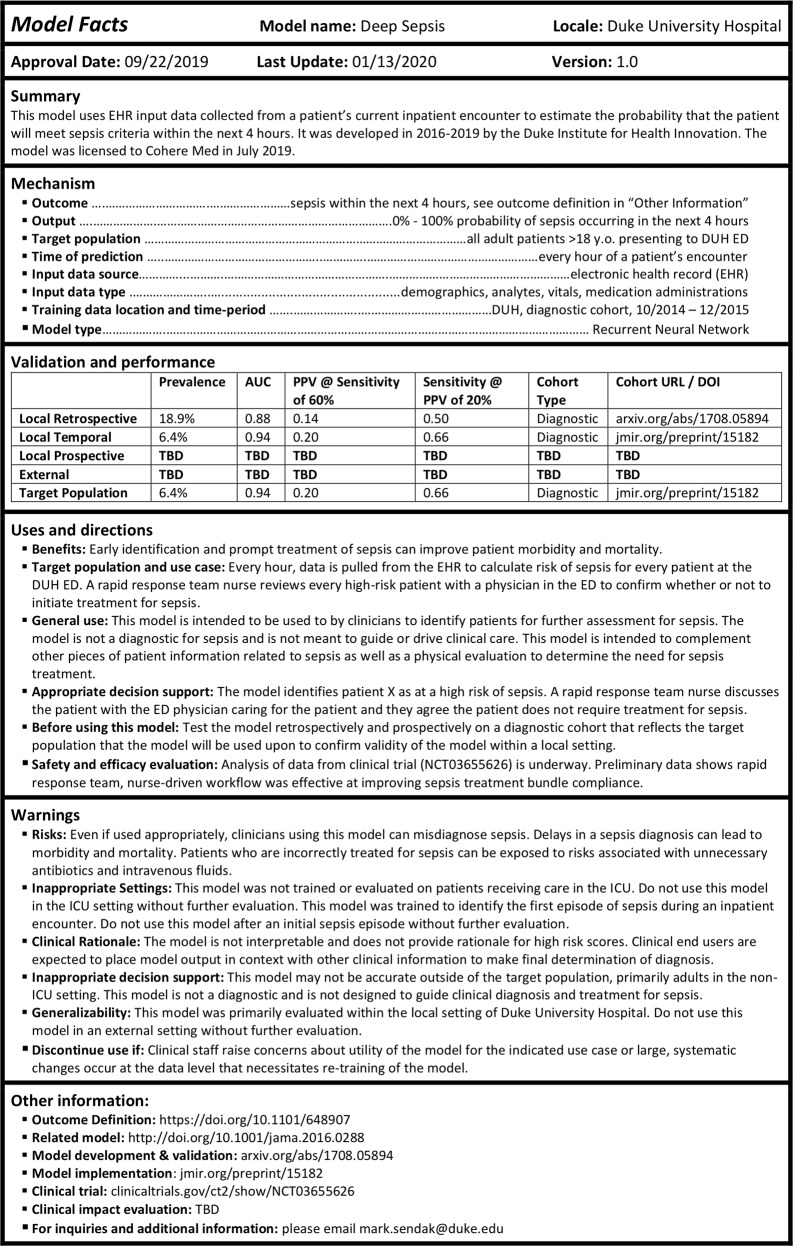
There is tremendous enthusiasm surrounding the potential for machine learning to improve medical prognosis and diagnosis. However, there are risks to translating a machine learning model into clinical care and clinical end users are often unaware of the potential harm to patients. This perspective presents the "Model Facts" label, a systematic effort to ensure that front-line clinicians actually know how, when, how not, and when not to incorporate model output into clinical decisions. The "Model Facts" label was designed for clinicians who make decisions supported by a machine learning model and its purpose is to collate relevant, actionable information in 1-page. Practitioners and regulators must work together to standardize presentation of machine learning model information to clinical end users in order to prevent harm to patients. Efforts to integrate a model into clinical practice should be accompanied by an effort to clearly communicate information about a machine learning model with a "Model Facts" label.
Overview
The claims and statistics of this paper haven’t been checked yet.
Free: it reads the open-access text and checks the first 5 claims that cite a source we can check. Create a free account to check every claim.
Integrity signals
Registry
Cites
Statistics
Figures
Verification
Claims the paper makes
The claims and statistics of this paper haven’t been checked yet.
Free: it reads the open-access text and checks the first 5 claims that cite a source we can check. Create a free account to check every claim.
Claims other papers make about this one
Each is checked against this paper’s own text: does it say what the citing paper says it does?
The check wasn’t confident either way, so it gives no verdict — never disputed.
In the citing paper
“Models of innovation are dependent on political, cultural, and institutional factors, requiring a high degree of contextual specificity in each case study23,24.”
From The algorithm journey map: a tangible approach to implementing AI solutions in healthcare (2024) · cites this paper as [24]
Experimental — accuracy not yet measuredIn the citing paper
“Providing a model facts label should be provided to the end users is advised, including the system’s technical specifications, statistical working, limitations, fairness criteria and validation, implementation disclaimer, and links to process logs22,101.”
From Guidelines and quality criteria for artificial intelligence-based prediction models in healthcare: a scoping review (2022) · cites this paper as [101]
Self-check
Percentages, sums and reported differences re-computed from the paper’s own numbers.
The self-check needs the paper’s full text.
Citations
Cites
Rogers, E. M., Singhal, A., & Quinlan, M. M. (2019) · An Integrated Approach to Communication Theory and Research · doi:10.4324/9780203710753-35 · Cited by 37,322
High-performance medicine: the convergence of human and artificial intelligence
Topol, E. J. (2019) · Nature Medicine · doi:10.1038/s41591-018-0300-7 · Cited by 10,450
Collins, G. S., Reitsma, J. B., Altman, D. G., & Moons, K. G. M. (2015) · Annals of Internal Medicine · doi:10.7326/m14-0697 · Cited by 3,267
Gluesing, J. C. (2012) · Leadership in Science and Technology: A Reference Handbook · doi:10.4135/9781412994231.n14 · Cited by 3,210
Key challenges for delivering clinical impact with artificial intelligence
Kelly, C. J., Karthikesalingam, A., Suleyman, M., Corrado, G., & King, D. (2019) · BMC Medicine · doi:10.1186/s12916-019-1426-2 · Cited by 3,136
Model Cards for Model Reporting
Mitchell, M., Wu, S., Zaldivar, A., Barnes, P., Vasserman, L., Hutchinson, B., Spitzer, E., Raji, I. D., & Gebru, T. (2019) · Proceedings of the Conference on Fairness, Accountability, and Transparency · doi:10.1145/3287560.3287596 · Cited by 2,681 · cited 1×
“Outside of health care, preliminary efforts have begun to standardize documentation to accompany a trained machine learning model 21 .”
BackgroundThe practical implementation of artificial intelligence technologies in medicine
He, J., Baxter, S. L., Xu, J., Xu, J., Zhou, X., & Zhang, K. (2019) · Nature Medicine · doi:10.1038/s41591-018-0307-0 · Cited by 2,246
Intelligible Models for HealthCare: Predicting Pneumonia Risk and Hospital 30-day Readmission
Caruana, R., Lou, Y., Gehrke, J., Koch, P., Sturm, M., & Elhadad, N. (2015) · Proceedings of the 21th ACM SIGKDD International Conference on Knowledge Discovery and Data Mining · doi:10.1145/2783258.2788613 · Cited by 1,685
Do no harm: a roadmap for responsible machine learning for health care
Wiens, J., Saria, S., Sendak, M., Ghassemi, M., Liu, V. X., Doshi-Velez, F., Jung, K., Heller, K., Kale, D., Saeed, M., et al. (2019) · Nature Medicine · doi:10.1038/s41591-019-0548-6 · Cited by 1,266 · cited 1×
“The clinical utility of models is widely questioned and the need to communicate the limitations of machine learning systems has been highlighted 3,4 .”
BackgroundSelf-citationPark, S. H., & Han, K. (2018) · Radiology · doi:10.1148/radiol.2017171920 · Cited by 894
Cited by
Items 201–300 of 320
Mercier, G., Delmas, C., Huet, F., & Roubille, F. (2026) · BMC Cardiovascular Disorders · doi:10.1186/s12872-026-05976-6 · Cited by 1
Wearable Biomedical Sensors in Clinical Toxicology Continuous Monitoring and Early Warning Systems
Kaya, H., Tan, E., Terzioğlu, P., & Oral, R. A. (2026) · Eurasian Journal of Toxicology · doi:10.51262/ejtox.1933913 · Cited by 1
Walston, S. L., Takita, H., Mitsuyama, Y., Sato, J., & Ueda, D. (2026) · European Radiology · doi:10.1007/s00330-026-12652-y · Cited by 1
“We also support the trend towards standardizing sub-group reporting into a consistent and easy-to-read “ facts label ” style presentation [47].”
A Safety-Constrained Architecture for Adaptive Clinical Decision Support
Wendakoon, K., & Tripathi, N. (2026) · Communications in computer and information science · doi:10.1007/978-3-032-28819-6_21 · Cited by 1
Korngiebel, D. M., Solomonides, A. E., & Goodman, K. W. (2022) · Cognitive informatics in biomedicine and healthcare · doi:10.1007/978-3-031-09108-7_18 · Cited by 2
Checklist for Medical Imaging using Artificial Intelligence by Evaluation of Machine Learning Models
Bhatnagar, S. (2023) · International Conference on Inventive Research in Computing Applications (ICIRCA) · doi:10.1109/icirca57980.2023.10220939 · Cited by 1
“In order to objectively assess AI outputs in the clinical workflow, established "model facts labels" could be included with the AI techniques [10].”
MethodAI agents in drug discovery: A review of evolution, applications, and future directions
Das, S., Ferdaus, M. M., & Dam, T. (2026) · Computer Methods and Programs in Biomedicine · doi:10.1016/j.cmpb.2026.109539 · Cited by 2
Responsible AI in Action: Planning through Implementation of a Mortality Model for Palliative CarePreprint
Nau, C., Wang, S. E., Habib, M. H., Zhong, H., Viveros, L. A., Sida, S. M., Mulvaney, K. M., Durr, K., Han, B., Creekmur, B., et al. (2025) · medRxiv · doi:10.1101/2025.08.06.25333148 · Cited by 1
Bridging the Gap: Consensus-Based Considerations for AI Usefulness in Healthcare
Salwei, M. E., Morse, K., Saria, S., Shah, N. H., Bedoya, A., Beyer, M., del Río, A. M., Chornenky, D., Lin, A. L., Ruparel, S., et al. (2026) · The American Journal of Bioethics · doi:10.1080/15265161.2026.2617850 · Cited by 2
Хассанин, Х. (2021) · Естественные и Технические Науки · doi:10.37882/2223-2966.2021.11.39
“Однако многочислен-ные препятствия мешают разработке и внедрению систем оповещения о сепсисе в масштабах всей больницы[7].”
Kochhar, G. S., Carleton, N. M., & Thakkar, S. J. (2021) · Gastrointestinal Endoscopy · doi:10.1016/j.gie.2021.05.010
Young, A. A., Petersen, S. E., & Lamata, P. (2023) · Springer eBooks · doi:10.1007/978-3-031-05071-8_9
The Application of Non-invasive Inverse ECG Techniques in Cardiomyopathy
Boonstra, M. (2023) · Utrecht University Repository (Utrecht University) · doi:10.33540/1807
Exploring and Assessing AI Models
van Ooijen, P. M. A., & Morozov, S. (2024) · Imaging informatics for healthcare professionals · doi:10.1007/978-3-031-68942-0_5
Key information influencing patient decision-making about AI in healthcare – A survey experimentPreprint
Zhu, X., Stroud, A. M., Minteer, S. A., Yoo, D. W., Ridgeway, J. L., Mooghali, M., Miller, J. E., & Barry, B. A. (2025) · OSF Preprints (OSF Preprints) · doi:10.31219/osf.io/4hx7r_v2
Building federated bridges: data silos connected by global FAIR-ways
Choudhury, A. (2025) · Research Publications (Maastricht University) · doi:10.26481/dis.20250915ac · Cited by 1
Von der Entwicklung zur Praxis: KI-gestützte Systeme in der Sozialen Arbeit einführen
Plafky, C. S., & Badertscher, H. (2025) · Springer eBooks · doi:10.1007/978-3-658-49009-6_9
Wang, Z., Ge, L., Zhu, Y., Chen, X., & Cheng, X. (2025) · Digital Health · doi:10.1177/20552076251393281
“11,12 Furthermore, the integration of explainable arti fi cial intelligence (XAI) techniques, such as SHapley Additive exPlanations (SHAP), has greatly enhanced model transparency by elucidating the contribution of individual features to prediction outcomes.”
A Machine Learning-Based Clinical Decision Support System to Improve End-of-Life Care
Pierce, R. P., Kell, A., Eskridge, B. R., Brandt, L. C., Clary, K. W., & Craig, K. W. (2025) · Applied Clinical Informatics · doi:10.1055/a-2630-3204
Mandhana, D. M., & Engemann, K. N. (2025) · De Gruyter eBooks · doi:10.1515/9783111595306-006
Patino-Mateus, J. D., Quiroga-Gutierrez, N., & Saldana, C. S. (2025) · touchREVIEWS in Infectious Diseases · doi:10.17925/id.2025.4.1.2
Outbreak Investigations of Nosocomial Infections
(2025) · Frontiers research topics · doi:10.3389/978-2-8325-7112-5
Bridging the implementation gap in AI ‐assisted flow cytometry
Yu, Z., Cheng, W. Q., & Liu, S. (2025) · Cytometry Part B Clinical Cytometry · doi:10.1002/cytob.70002
Yoon, J., Kim, T., Han, J. J., Hwang, J. S., Han, J. M., Park, J. I., Song, H., & Hwang, D. D.-J. (2025) · International Journal of Human-Computer Interaction · doi:10.1080/10447318.2025.2603628
“A potential solution is to standardize the information presented to clinicians using clear, accessible language and empirically testing these standards could support the development of explanations that clinicians can more easily understand and apply (Sendak et al., 2020).”
Szyszka, M., Grygorowicz, A., Baran, K., Ględa, M., Radecka, W., Kozak, W., Szreiber, A., Grela, K., Nowacka, K., Jabłoński, K., et al. (2025) · International Journal of Innovative Technologies in Social Science · doi:10.31435/ijitss.4(48).2025.4661
Quttainah, M. A. (2026) · المجلة العربية للعلوم الإدارية. · doi:10.34120/ajas.2025.1507
Machine Learning in Healthcare: Security, Supply Chains, and Patient Engagement
Taylor, T. M., Lopez, K. P., & James, J. F. (2025) · International Journal of Multidisciplinary Research and Growth Evaluation · doi:10.54660/.ijmrge.2025.6.6.1285-1295
Sussan, T. T., Brawley, R. R., Eckroth, J., Mossell, J., & Weitao, T. (2026) · JMIR Neurotechnology · doi:10.2196/69708
“…(1) interface design that presents AI outputs as preliminary suggestions explicitly requiring verification rather than definitive conclusions [43-45]; (2) transparent uncertainty quantification, ideally displaying the model’s self-reported modality contributions alongside confidence…”
Alam, J. U. (2026) · American Journal of Advanced Technology and Engineering Solutions · doi:10.63125/mv67zd78
Foundations of Artificial Intelligence and Machine Learning in Modern Healthcare
Kaniwa, F., & Dinakenyane, O. (2026) · Artificial intelligence · doi:10.5772/intechopen.1010326
Vinnakota, A., Hodgman, M. W., & Ehrmann, D. E. (2026) · Frontiers in Medicine · doi:10.3389/fmed.2026.1734400
Shoumi, M. N., Harada, K., Oshita, H., Sakashita, S., & Inoue, S. (2026) · doi:10.2196/preprints.93374
Modeling Cognitive and Implicit Biases in Multi-Agent Medical Systems for Clinical Diagnoses
Hassan, N., Liu, B. D. X., Thallapragada, R., Bui, R., Chinta, N., Bisht, A., Chaliha, D. J., & Zhu, K. (2025) · IEEE International Conference on Computer Vision Workshops · doi:10.1109/iccvw69036.2025.00793 · Cited by 2
“However, most existing research has focused on single-agent systems rather than the complex interactions that occur in multi-agent collaborative environments [26].”
Zhang, H., & Liu, Y. (2026) · Hemodynamics · doi:10.1097/hd9.0000000000000015
Onyambu, S. B., Litell, J. M., & Sultan, O. W. (2026) · Journal of Critical Care · doi:10.1016/j.jcrc.2026.155541
Gupta, S. (2026) · Elsevier eBooks · doi:10.1016/b978-0-443-45252-9.00013-x · Cited by 4
Artificial intelligence bias and fairness in clinical applications
Kumar, D., Rastogi, R., & Sah, N. (2026) · Elsevier eBooks · doi:10.1016/b978-0-443-44111-0.00014-7
Kibet., V. (2026) · International Journal of Research and Innovation in Social Science · doi:10.47772/ijriss.2026.100300361
Li, C., Shi, T., Xiao, G., Zhang, Y., Wang, Y., Liang, Y., Tang, C., Lin, N., & Wang, K. J. (2026) · Frontiers in Cellular and Infection Microbiology · doi:10.3389/fcimb.2026.1792743
“This tool allows for real-time risk assessment without specialized software, supporting timely decision-making regarding surveillance intensity and early intervention (Sendak et al., 2020a, b).”
Kim, Y., Kim, M., Kim, S., Cho, S., & Kim, J. (2026) · CHI Conference on Human Factors in Computing Systems · doi:10.1145/3772318.3790971
“This design enables clinicians to leverage the analytical capabilities of AI while ensuring that the final communication with patients is accurate, safe, and contextually appropriate [69, 83, 86].”
InfluentialAdindu, C., Agodirin, S., Nasir, A. A., Olowookere, S. O., Saidu, A. I., Abdulkareem, J. F., Abdulraheem, N., Abdur-Rahman, L., Jimoh, N. O., Obarakpo, B. N., et al. (2026) · Journal of Surgical Research · doi:10.1016/j.jss.2026.03.114
Datta, A. (2026) · IEEE International Conference on AI Engineering and Innovations (AIEI) · doi:10.1109/aiei69164.2026.11497556
“Most current research studies focus on individual aspects of trustworthiness and provide little insight regarding how to balance competing trade-offs between different aspects of trustworthiness in end-to-end clinical or administrative work-flows [12].”
Personalized Medical Recommendation System Using Collaborative Filtering
Priya, S., Reddy, M. T., Sruthi, E., Kalyani, B., Mohamed Sithik, M., & Ramamoorthi, S. (2026) · International Conference on Intelligent Computing and Control Systems (ICICCS) · doi:10.1109/iciccs67901.2026.11502878
“Sendak et al. also dealt with the concept of model inter-pretability among clinical users and highlighted the importance of AI-based healthcare to be transparent and trustworthy [10].”
Machine Learning Models for Predicting Post-Hepatectomy Liver Failure: A Systematic Review
Muntean, C., Gaborean, V., Vonica, R. C., Ştefănigă, S.-A., Faur, A. M., & Feier, C. V. I. (2026) · AI · doi:10.3390/ai7050166
“…XGBoost framework used by Tang et al. [39,43,45] highlighted total bilirubin, MELD score, and ICG-R15 as dominant contributors, whereas broader discussions on high-stakes clinical AI continue to favor transparent or inherently interpretable strategies over opaque black-box deployment [46,50,54].”
Cai, J., Li, P., Feng, X., Wang, Y., Li, W., Chen, G., Zhu, T., Hao, X., & AIR-CG group (2026) · doi:10.2196/preprints.101309
Avakian, A. (2026) · Clinical Imaging · doi:10.1016/j.clinimag.2026.110841
Risk-Aware Human-AI Collaboration Framework for High-Stakes Decision Systems
Patel, T., Kumari, M., & Parikh, M. (2026) · International Conference on Artificial Intelligence, Systems, and Emerging Technologies (ICAISET) · doi:10.1109/icaiset66439.2026.11541740 · Cited by 1
“Domain work in healthcare [18], [28], [29] and finance [30] emphasizes context-aware accountability.”
Roy, S., Bagchi, D., Pradhan, S., Biswas, S., Deb, P., & Paul, P. (2026) · International Journal of Drug Delivery Technology · doi:10.25258/ijddt.16.49s.3
Nguyen, M. N. (2026) · Research Square · doi:10.21203/rs.3.rs-10058406/v1
Alghafri, T. S., Harthi, S. A., Ishaq, A. B., AlHarthi, H., Muaini, M. A., Al-Ghadani, R., (, A. A., AlHarb, M., AlSaadi, A., Abdesselam, A., et al. (2026) · JMIR Research Protocols · doi:10.2196/99626
“…national-scale recruitment across all 11 governorates, prospective alignment with SPIRIT 2025, CONSORT 2025, STROBE, COREQ, and TRIPOD+AI [45,48], the use of multiple validated psychosocial instruments, an explicit fairness and external-validation plan, and a coordinated research-management…”
Kargarandehkordi, A., Banerjee, A., Jaiswal, A., Qian, Y., Slade, C. R., Sun, Y., Flynn, A., Hai, M., Singh, R., Nguyen, N. T., et al. (2026) · Lecture notes in computer science · doi:10.1007/978-3-032-29548-4_15
Public regulatory data infrastructure for lifecycle oversight of AI medical devicesPreprint
Han, Y., & Ceross, A. (2026) · Research Square · doi:10.21203/rs.3.rs-10095369/v1
Ahmed, M. M., Adebayo, U. O., Othman, Z. K., Oweidat, M. H., Okesanya, O. J., Kasimieh, O., Musa, S. S., Ong, C. J. N., Branda, F., & Lucero‐Prisno, D. E. (2026) · Intelligent Oncology · doi:10.1016/j.intonc.2026.100071
Chikke Gowda, H. N., Vijayabanu, S., N., A. Y. H., Appireddygari, S., C., T. B., Chaudhary, A., Nelavala, A. D., Singh, M. S., Chanu, C. A., Priya, J. S. S., et al. (2026) · International Journal of Research in Medical Sciences · doi:10.18203/2320-6012.ijrms20262196
Kirchhoff, J., Berns, F., Schieder, C., & Schobel, J. (2026) · Frontiers in Digital Health · doi:10.3389/fdgth.2026.1871438 · Cited by 2
“This integration should follow established CDSS implementation principles: decision support must be embedded at the point of decision, fit existing workflow, and be monitored after deployment rather than treated as a static technical artifact [16 – 18].”
Macdonald, T., Dinnes, J., Maniatopoulos, G., Solebo, A. L., Hogg, H. D. J., Alderman, J. E., Engelmann, J., Owen, R., Ganapathi, S., Ng, V., et al. (2026) · The Lancet Digital Health · doi:10.1016/j.landig.2026.101033 · Cited by 1
Zantvoort, K., Brouwer, S., Schlicker, N., Mross, P. M., Jerrentrup, A., Hirsch, M. C., & Russ, P. G. (2026) · Frontiers in Digital Health · doi:10.21203/rs.3.rs-10003720/v1
Li, B., Pi, S., Xu, M., Mu, H., Liu, X., Huang, X., Wu, Z., Zheng, Z., Li, Y. L., Wu, D., et al. (2026) · BMC Infectious Diseases · doi:10.1186/s12879-026-13954-8
“…high-dimensional, nonlinear clinical data, enabling the discovery of complex relationships that may be over-looked by traditional approaches [10, 11], Furthermore, the integration of explainable artificial intelligence (XAI) techniques, such as SHapley Additive exPlanations (SHAP), has…”
Clear by Design: Consensus-Based Transparency Practices to Foster Trust in Health AI
Lehmann, L. S., Overgaard, S. M., Saria, S., Jenders, R. A., Saenz, A. D., Durón, Y., Moreno, R., Brereton, T. A., Liza, F. F., Hill, B., et al. (2026) · The American Journal of Bioethics · doi:10.1080/15265161.2026.2699626
Jenks, C. (2026) · Artificial intelligence · doi:10.5772/intechopen.1015699
Considering artificial intelligence within innovative medical devices in primary care
Heslin, S. M. (2026) · Journal of Family Medicine and Primary Care · doi:10.4103/jfmpc.jfmpc_86_26
“[3,4] As the authors appropriately highlight, family physicians play a significant role as stewards of technology.”
IoT-XAI Fusion for Smart and Transparent Clinical Decision Support Systems
Tirumalasetty, P. (2026) · Algorithms for intelligent systems · doi:10.1007/978-3-032-32423-8_21
Dong, Y., Jiang, P., & Zhou, X. (2026) · Medical Review · doi:10.1515/mr-2026-0027
“Clinicians do not need full access to every model parameter, but they need enough information to understand the intended use, input requirements, output meaning, uncertainty handling, limitations, and evidence behind the claim [22 – 24, 91].”
Faraci, A., Coppola, G., Principato, S., Scarantino, A., Scardamaglia, A., & Ruggieri, G. (2026) · Dissertation Nursing · doi:10.54103/dn/29713
Awe, O. O., de Souza, J. S., Cruz, E. K. B., Adekunle, O. O., Owolabi, P. J., & Oladeji, E. O. (2026) · BMC Medical Informatics and Decision Making · doi:10.1186/s12911-026-03732-6
Rohilla, H., Singh, A. P., & Ratna, S. (2026) · International Conference on Data Science for Cyber-Physical Systems Resilience using Advanced Applications (ICDCA) · doi:10.1109/icdca69396.2026.11620238
“Current methods provide limited transparency and lack the uncertainty estimates that clinicians require for safe deployment [57], [58].”
Smeriglio, E., Imbesi, M., Xiao, J., Smeriglio, A., & Trombetta, D. (2026) · Frontiers in Aging Neuroscience · doi:10.3389/fnagi.2026.1924338
“Models should therefore be evaluated according to interpretability, subgroup robustness, calibration, failure modes, and clinical actionability in addition to discrimination performance (Sendak et al., 2020; Vollmer et al., 2020; Vasey et al., 2022).”
InfluentialAmmirato, S., Russo, A., Cutrì, L., & Linzalone, R. (2026) · Lecture notes in networks and systems · doi:10.1007/978-3-032-23684-5_37
Artificial wisdom in gastrointestinal diagnostics: A new frontier in translational reasoning
Issa, I. A., & Issa, T. (2026) · Artificial Intelligence in Gastroenterology · doi:10.35712/aig.v7.i2.118884
Praschk, A., Fischill-Neudeck, V., Caspari, T., & Wiesinger, H. (2026) · Journal of Medical Systems · doi:10.1007/s10916-026-02449-3
“…[ 33] and FUTURE-AI’s principles [ 27], and framing them in “Model Facts”-style disclosures, can enhance transparency and support context-appropriate use, ensuring that LLM outputs are treated as inputs for further investigation rather than defini - tive epidemiological endpoints [ 34, 35].”
AI Agents and Agentic AI in Medicine: An Autonomy-Centred Scoping Review and Research AgendaPreprint
Nicolò, V. D., Torre, D. L., & Iacone, I. (2026) · Research Square · doi:10.17605/osf.io/wy8bn
Fundamentals of Multimodal AI for Clinical Use
Dinç, R., & Ardıç, N. (2026) · Springer eBooks · doi:10.1007/978-3-032-26723-8_3
Monitoring and Adaptive Agents
Dinç, R., & Ardıç, N. (2026) · Springer eBooks · doi:10.1007/978-3-032-26723-8_13
Emergency and Intensive Care: Real-Time Multi-agent Coordination
Dinç, R., & Ardıç, N. (2026) · Springer eBooks · doi:10.1007/978-3-032-26723-8_18
Clinical Application and Scaling of Agentic Systems
Dinç, R., & Ardıç, N. (2026) · Springer eBooks · doi:10.1007/978-3-032-26723-8_19
Wang, H., & Zhang, X. (2026) · Digital Health · doi:10.1177/20552076261479403
Facts label for transparent communication of AI Risks in mental health technology
Moon, K., Tamura, M., Redmond, J. R., Craigen, G., Haidari, Z., Trainum, B., & King, D. R. (2026) · Frontiers in Psychiatry · doi:10.3389/fpsyt.2026.1887887
“The healthcare community has begun developing health-AI facts labels, including the clinician-targeted Duke Model Facts Label (26), the more technical CHAI Nutrition Label (27), and Bramstedt ’ s patient-centered AI facts label (28).”
When the Medication Record Disagrees with Itself: A Multi-Agent Reconciliation Architecture
Botha, P., Wyk, A. V., & Marais, J. (2026) · Archives of Pharmacy Practice · doi:10.51847/zrzlpexlrl
Translating Algorithmic Uncertainty into Actionable Medication Advice
Zayed, O., Ibrahim, L., & Mansour, A. (2025) · Archives of Pharmacy Practice · doi:10.51847/a5cyik22em
A Medication Intelligence Command Centre for Coordinating Risk, Workload, and Escalation
der Meer, E. V., Jansen, L., de Vries, B., & Claes, S. (2026) · Archives of Pharmacy Practice · doi:10.51847/z6mnnplflo
Vijay, A., Govind, N., Moorthy, A. K., Dunn, P. J., Lababidi, Z., Jones, S., Ståhlberg, M., Ibrahim, S., Koochek, K., Shah, K., et al. (2026) · medRxiv · doi:10.64898/2026.08.17.26360643
Jung, J.-Y., Yang, W., & Kim, J.-J. (2026) · JMIR Medical Informatics · doi:10.2196/92831
“A notable distinction between the present work and many previous ML studies is the explicit framing of the system as a clinical decision support tool [49,50].”
Integrating AI into Time-Sensitive Clinical Workflows: A BPMN-Driven Case Study on Acute Stroke Care
Russo, A., Cutrì, L., Ammirato, S., Felicetti, A. M., & Conforti, D. (2026) · IEEE International Workshop on Metrology for Living Environment (MetroLivEnv) · doi:10.1109/metrolivenv70468.2026.11659855
“Four key integration barriers emerge: siloed systems that disrupt communication and increase cognitive burden [22]; lack of interpretability and accountability [14], [23]; a narrow focus on isolated outcomes rather than holistic patient care [24]; and poor interoperability with existing systems…”
Singh, D. B., Dangi, Y., & Pokharel, B. P. (2026) · Health Science Reports · doi:10.1002/hsr2.73117
Haroz, E. E., Bradshaw, C. P., & Feaster, D. J. (2026) · Prevention Science · doi:10.1007/s11121-026-01971-7
“…prevention science but has received uneven attention in the broader AI-in-health literature, and developing this connection in ways that account for ethics, downstream resources, and community partnership is among the next steps the field should prioritize (Sendak et al., 2020; Wiens et al., 2019).”
Koshmanova, E., Kirkove, D., Voz, B., Gillain, N., Matagne, A., Bruwier, L., Waltregny, D., & Pétré, B. (2026) · Journal of Medical Internet Research · doi:10.2196/101751
“As a result, AI-generated outputs may remain difficult to interpret in isolation and require clinical contextualization to become meaningful in practice [44,45].”
Feto, H., Uthamacumaran, A., & Zenil, H. (2026) · arXiv (Cornell University) · doi:10.48550/arxiv.2609.01653
An AI-Orchestrated Emergency Department Triage Intelligence Architecture
Gonzalez, M., Ruiz, J., Torres, L., & Ruiz, E. (2023) · Journal of Artificial Intelligence for Healthcare Systems · doi:10.68159/i924388275
Tanaka, H., Sato, Y., Mori, K., Okabe, R., & Ito, T. (2021) · Journal of Health Informatics and Digital Systems · doi:10.68159/d049294389
A Population Health Intelligence Mesh for Cross-Regional Healthcare Analytics Integration
Amrani, F. Z., Benali, Y., & Gonzalez, M. (2024) · Journal of Artificial Intelligence for Healthcare Systems · doi:10.68159/s068544189
Building Clinical Artificial Intelligence at the PICU Bedside: Recognizing the Clinician-Builder
Gilad, D., Tsur, A., & Lerner, R. K. (2026) · Critical Care Explorations · doi:10.1097/cce.0000000000001486
“…what is built and how success is judged: intended use and user population, risk classification (17), the evidence and validation plan (18), human-oversight provisions, and life-cycle governance—model registration, safety thresholds, monitoring cadence, rollback, and sunset criteria (19, 20).”
İncir, S., Palaoğlu, K. E., & Oğuz, O. (2026) · Clinical Chemistry and Laboratory Medicine (CCLM) · doi:10.1515/cclm-2026-1371
“…for: for a rule set an inventory giving each rule its author, date and threshold rationale; for a supplied model a provider speci fi cation sheet of the kind proposed by the IFCC committee and by the model facts and minimum information about clinical AI modelling (MI-CLAIM) initiatives [12, 13, 20].”
Rethinking Objectivity in Clinical AI: A Qualitative Study of Concussion Evaluators
Zaidi, A. M., Saw, J. J.-W., Fu, L., Arneson, K., Kim, I., Cross, A., & Karahalios, K. G. (2026) · Proceedings of the ACM on Human-Computer Interaction · doi:10.1145/3816992
“…the epistemological orientation (outlined in Section 3.1) of many current CDSTs, which prioritizes consistency and formalization over flexibility and reasoning transparency, and assumes that medical decisions occur in a vacuum, free from contextual constraints or considerations [44, 94, 116].”
InfluentialFischer, D., Meier, L., Braun, T., Koch, S., & Roth, F. (2022) · Journal of Health Informatics and Digital Systems · doi:10.68159/t171804850
Silva, M., Santos, B., Pinto, R., & Teixeira, L. (2026) · Journal of Health Informatics and Digital Systems · doi:10.68159/f309521630
Zhang, H., Zhao, L., Yang, W., Li, B., 林, 婉., Chen, X., Mo, L., Dai, S., Chen, W., Fan, Y., et al. (2026) · Annals of Medicine · doi:10.1080/07853890.2026.2737005
“Clinical implementation of artificial intelligence models requires independent validation, calibration monitoring, workflow integration, transparent presentation of model information [34], and prospective assessment of safety and usefulness [35–37].”
Significance of a Classification Scheme for Assessing Evidence Quality in AI Systems
Andrae, S. (2026) · IGI Global eBooks · doi:10.4018/979-8-2600-0090-8.ch014
Metadata
- Authors
- Sendak, M. P., Gao, M., Brajer, N., & Balu, S.
- Affiliations
- Duke University (US)
- Corresponding author
- Sendak, Mark P.
- Venue
- npj Digital Medicine
- Published
- 2020-03-23
- Volume
- 3
- Issue
- 1
- Pages
- 41-41
- ISSN
- 2398-6352 (ISSN-L)
- PMC
- PMC7090057
- OpenAlex
- W3012875567
- Cited by
- 279
- References
- 23
- Citations by year
- 2026: 102 · 2025: 55 · 2024: 35 · 2023: 35 · 2022: 28 · 2021: 17 · 2020: 7
- FWCI
- 6.41
- Type
- journal article
- Language
- en
- Open access
- gold
- doi.org
- Licence
- cc-by
- creativecommons.org/licenses/by/4.0 (tdm)
- creativecommons.org/licenses/by/4.0 (vor)
- Locations
- npj Digital Medicine (publishedVersion, cc-by)
- PubMed Central (publishedVersion, cc-by)
- PubMed (publishedVersion)
- DOAJ (DOAJ: Directory of Open Access Journals) (submittedVersion, cc-by-sa)
- Funders
- Duke Institute for Health Innovation
- Topics
- Health Sciences › Medicine › Health Informatics › Artificial Intelligence in Healthcare and Education
- Physical Sciences › Computer Science › Artificial Intelligence › Explainable Artificial Intelligence (XAI)
- Physical Sciences › Computer Science › Artificial Intelligence › Machine Learning in Healthcare
- Keywords
- machine learning model interpretability, clinical decision support, clinical implementation of AI, patient safety, model transparency
About these checks
Registry, retraction, Cites and statistics results are computed, not judged, with one exception: a printed reference that no index lists is read once by a model before it counts as a citation error. Claims are extracted by a model and kept only when their quote appears verbatim in the text; each cited source is then checked, with a model’s help, for whether it says what the claim relies on. Those verdicts can be wrong — read the claim’s quote and the cited source before relying on one.
Statistics and arithmetic are recomputed, not judged.
Confidence bands are shown only for fields calibrated on our annotated test set. None is calibrated yet, so no band is shown.
What counts as a claim ›How we measure confidence ›How we check this ›
Are you an author, or do you see a problem with this page? Request a review
Data sources
Bibliographic data: Semantic Scholar, OpenAlex, Crossref.
Contains information from the Semantic Scholar Academic Graph Datasets, made available under the ODC Attribution License (ODC-BY 1.0).
Semantic Scholar’s data is described in: Kinney, R., et al. (2023). The Semantic Scholar Open Data Platform. arXiv:2301.10140.
