

The DOI matches its Crossref record; 45 of the 45 references it cites were found in a registry or an index.
Digitizing clinical trials
Open accessAbstract
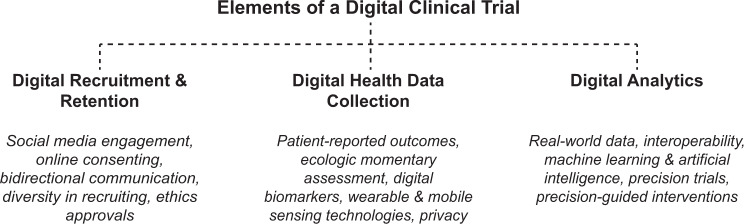
Clinical trials are a fundamental tool used to evaluate the efficacy and safety of new drugs and medical devices and other health system interventions. The traditional clinical trials system acts as a quality funnel for the development and implementation of new drugs, devices and health system interventions. The concept of a “digital clinical trial” involves leveraging digital technology to improve participant access, engagement, trial-related measurements, and/or interventions, enable concealed randomized intervention allocation, and has the potential to transform clinical trials and to lower their cost. In April 2019, the US National Institutes of Health (NIH) and the National Science Foundation (NSF) held a workshop bringing together experts in clinical trials, digital technology, and digital analytics to discuss strategies to implement the use of digital technologies in clinical trials while considering potential challenges. This position paper builds on this workshop to describe the current state of the art for digital clinical trials including (1) defining and outlining the composition and elements of digital trials; (2) describing recruitment and retention using digital technology; (3) outlining data collection elements including mobile health, wearable technologies, application programming interfaces (APIs), digital transmission of data, and consideration of regulatory oversight and guidance for data security, privacy, and remotely provided informed consent; (4) elucidating digital analytics and data science approaches leveraging artificial intelligence and machine learning algorithms; and (5) setting future priorities and strategies that should be addressed to successfully harness digital methods and the myriad benefits of such technologies for clinical research.
Overview
The claims and statistics of this paper haven’t been checked yet.
Run the check — free, no account needed. It reads the open-access text and checks the sources it cites.
Integrity signals
Registry
Cites
Statistics
Figures
Verification
Claims the paper makes
The claims and statistics of this paper haven’t been checked yet.
Run the check — free, no account needed. It reads the open-access text and checks the sources it cites.
Claims other papers make about this one
Each is checked against this paper’s own text: does it say what the citing paper says it does?
The source backs part of the claim, not all of it — or backs it for a different population, condition or comparison.
In the citing paper
“Digital clinical trials could leverage multiple sources of participants' data to enable automatic phenotyping and subgrouping 34 , which could be useful for adaptive clinical trial designs that use ongoing results to modify the trial in real time 39,40 .”
From Multimodal biomedical AI (2022) · cites this paper as [34]
Experimental — accuracy not yet measuredThe source backs part of the claim, not all of it — or backs it for a different population, condition or comparison.
In the citing paper
“Data from wearable technology (including heart rate, sleep, physical activity, electrocardiography, oxygen saturation and glucose monitoring) and smartphone-enabled self-reported questionnaires can be useful for monitoring clinical trial patients, identifying adverse events or ascertaining trial outcomes 34 .”
From Multimodal biomedical AI (2022) · cites this paper as [34]
Experimental — accuracy not yet measured
Self-check
Percentages, sums and reported differences re-computed from the paper’s own numbers.
The self-check needs the paper’s full text.
Citations
Cites
Fully integrated wearable sensor arrays for multiplexed in situ perspiration analysis
Gao, W., Emaminejad, S., Nyein, H. Y. Y., Challa, S., Chen, K., Peck, A., Fahad, H. M., Ota, H., Shiraki, H., Kiriya, D., et al. (2016) · Nature · doi:10.1038/nature16521 · Cited by 5,087 · cited 1×
“Examples include wearable sweat sensing for glucose and lactate, as well as electrolytes 34 , cardiogenic chest wall vibrations to assess clinical status of patients with heart failure 35 , or structural health markers for knee joint injury obtained through a brace 36 .”
BackgroundParticipation in Cancer Clinical Trials: Race-, Sex-, and Age-Based Disparities
Murthy, V. H., Krumholz, H. M., & Gross, C. P. (2004) · JAMA · doi:10.1001/jama.291.22.2720 · Cited by 2,078
Self-citationA Randomized Trial of Hydroxychloroquine as Postexposure Prophylaxis for Covid-19
Boulware, D. R., Pullen, M. F., Bangdiwala, A. S., Pastick, K. A., Lofgren, S. M., Okafor, E. C., Skipper, C. P., Nascene, A. A., Nicol, M. R., Abassi, M., et al. (2020) · New England Journal of Medicine · doi:10.1056/nejmoa2016638 · Cited by 1,349
Fogel, D. B. (2018) · Contemporary Clinical Trials Communications · doi:10.1016/j.conctc.2018.08.001 · Cited by 1,035
Kennedy-Martin, T., Curtis, S., Faries, D., Robinson, S., & Johnston, J. (2015) · Trials · doi:10.1186/s13063-015-1023-4 · Cited by 878
SMART on FHIR: a standards-based, interoperable apps platform for electronic health records
Mandel, J. C., Kreda, D. A., Mandl, K. D., Kohane, I. S., & Ramoni, R. B. (2016) · Journal of the American Medical Informatics Association · doi:10.1093/jamia/ocv189 · Cited by 829
Self-citationAccuracy of Smartphone Applications and Wearable Devices for Tracking Physical Activity Data
Case, M. A., Burwick, H. A., Volpp, K. G., & Patel, M. S. (2015) · JAMA · doi:10.1001/jama.2014.17841 · Cited by 694
Microrandomized trials: An experimental design for developing just-in-time adaptive interventions.
Klasnja, P., Hekler, E. B., Shiffman, S., Boruvka, A., Almirall, D., Tewari, A., & Murphy, S. A. (2015) · Health Psychology · doi:10.1037/hea0000305 · Cited by 671
Self-citationShcherbina, A., Mattsson, C., Waggott, D., Salisbury, H., Christle, J., Hastie, T., Wheeler, M., & Ashley, E. (2017) · Journal of Personalized Medicine · doi:10.3390/jpm7020003 · Cited by 625
Unger, J. M., Vaidya, R., Hershman, D. L., Minasian, L. M., & Fleury, M. E. (2018) · JNCI Journal of the National Cancer Institute · doi:10.1093/jnci/djy221 · Cited by 604
Research works printed but not linked: 1
- NIH NHLBI. Digital Clinical Trials Workshop: Creating a Vision for the Future. https://www.nhlbi.nih.gov/events/2019/digital-clinical-trials-workshop-creating-vision-future. Accessed 10 Jun 2020.
Cited by
Sorted by citations
Acosta, J. N., Falcone, G. J., Rajpurkar, P., & Topol, E. J. (2022) · Nature Medicine · doi:10.1038/s41591-022-01981-2 · Cited by 1,365
Embracing cancer complexity: Hallmarks of systemic disease
Swanton, C., Bernard, E., Abbosh, C., André, F., Auwerx, J. H., Balmain, A., Bar‐Sagi, D., Bernards, R., Bullman, S., DeGregori, J. V., et al. (2024) · Cell · doi:10.1016/j.cell.2024.02.009 · Cited by 578
Whitelaw, S., Pellegrini, D. M., Mamas, M. A., Cowie, M., & Van Spall, H. G. C. (2021) · European Heart Journal - Digital Health · doi:10.1093/ehjdh/ztab005 · Cited by 241
The Lancet Breast Cancer Commission
Coles, C. E., Earl, H. M., Anderson, B. O., Barrios, C. H., Bienz, M., Bliss, J. M., Cameron, D., Cardoso, F., Cui, W., Francis, P. A., et al. (2024) · The Lancet · doi:10.1016/s0140-6736(24)00747-5 · Cited by 209
Envisioning the Future of Personalized Medicine: Role and Realities of Digital Twins
Vallée, A. (2024) · Journal of Medical Internet Research · doi:10.2196/50204 · Cited by 154
Metadata
- Authors
- Inan, O. T., Tenaerts, P., Prindiville, S. A., Reynolds, H. R., Dizon, D. S., Cooper-Arnold, K., Turakhia, M., Pletcher, M. J., Preston, K. L., Krumholz, H. M., Marlin, B. M., Mandl, K. D., Klasnja, P., Spring, B., Iturriaga, E., Campo, R., Desvigne-Nickens, P., Rosenberg, Y., Steinhubl, S. R., & Califf, R. M.
- Affiliations
- Georgia Institute of Technology (US)
- Duke University (US)
- National Institutes of Health (US)
- New York University (US)
- Brown University (US)
- VA Palo Alto Health Care System (US)
- University of California, San Francisco (US)
- Yale New Haven Hospital (US)
- University of Massachusetts Amherst (US)
- Boston Children's Hospital (US)
- University of Michigan (US)
- Northwestern University (US)
- Scripps Research Institute (US)
- Corresponding author
- Inan, O. T.
- ORCID
- Venue
- npj Digital Medicine
- Published
- 2020-07-31
- Volume
- 3
- Issue
- 1
- Pages
- 101-101
- ISSN
- 2398-6352 (ISSN-L)
- PMC
- PMC7395804
- OpenAlex
- W3046739387
- Cited by
- 329
- References
- 44
- Citations by year
- 2026: 29 · 2025: 55 · 2024: 67 · 2023: 56 · 2022: 70 · 2021: 49 · 2020: 3
- FWCI
- 8.48
- Type
- journal article
- Language
- en
- Open access
- gold
- doi.org
- Locations
- npj Digital Medicine (publishedVersion, cc-by)
- PubMed Central (publishedVersion, cc-by)
- PubMed (publishedVersion)
- DOAJ (DOAJ: Directory of Open Access Journals) (submittedVersion, cc-by-sa)
- eScholarship (California Digital Library) (submittedVersion)
- eScholarship (California Digital Library) (submittedVersion, cc-by)
- Funders
- National Science Foundation (1922762)
- American Heart Association
- Bristol-Myers Squibb
- Pfizer
- AstraZeneca
- Sanofi
- Yale University
- Cytokinetics
- Shenzhen Center for Health Information
- Verily Life Sciences
- National Institutes of Health (UL1TR001114)
- U.S. Food and Drug Administration
- Abbott Vascular
- National Heart, Lung, and Blood Institute
- National Center for Advancing Translational Sciences
- Topics
- Health Sciences › Health Professions › General Health Professions › Mobile Health and mHealth Applications
- Physical Sciences › Mathematics › Statistics and Probability › Statistical Methods in Clinical Trials
- Social Sciences › Psychology › Applied Psychology › Digital Mental Health Interventions
- Keywords
- digital health technologies, participant recruitment and retention, mobile health, wearable devices, application programming interfaces, data security and privacy, artificial intelligence in clinical trials, machine learning, data analytics, regulatory oversight
About these checks
Registry, retraction, Cites and statistics results are computed, not judged, with one exception: a printed reference that no index lists is read once by a model before it counts as a citation error. Claims are extracted by a model and kept only when their quote appears verbatim in the text; each cited source is then checked, with a model’s help, for whether it says what the claim relies on. Those verdicts can be wrong — read the claim’s quote and the cited source before relying on one.
Statistics and arithmetic are recomputed, not judged.
Confidence bands are shown only for fields calibrated on our annotated test set. None is calibrated yet, so no band is shown.
What counts as a claim ›How we measure confidence ›How we check this ›
Are you an author, or do you see a problem with this page? Request a review
