

Med-BERT: pretrained contextualized embeddings on large-scale structured electronic health records for disease prediction
Open accessThe DOI matches its Crossref record; 71 of the 71 references it cites were found in a registry or an index.
Abstract
Deep learning (DL)-based predictive models from electronic health records (EHRs) deliver impressive performance in many clinical tasks. Large training cohorts, however, are often required by these models to achieve high accuracy, hindering the adoption of DL-based models in scenarios with limited training data. Recently, bidirectional encoder representations from transformers (BERT) and related models have achieved tremendous successes in the natural language processing domain. The pretraining of BERT on a very large training corpus generates contextualized embeddings that can boost the performance of models trained on smaller datasets. Inspired by BERT, we propose Med-BERT, which adapts the BERT framework originally developed for the text domain to the structured EHR domain. Med-BERT is a contextualized embedding model pretrained on a structured EHR dataset of 28,490,650 patients. Fine-tuning experiments showed that Med-BERT substantially improves the prediction accuracy, boosting the area under the receiver operating characteristics curve (AUC) by 1.21–6.14% in two disease prediction tasks from two clinical databases. In particular, pretrained Med-BERT obtains promising performances on tasks with small fine-tuning training sets and can boost the AUC by more than 20% or obtain an AUC as high as a model trained on a training set ten times larger, compared with deep learning models without Med-BERT. We believe that Med-BERT will benefit disease prediction studies with small local training datasets, reduce data collection expenses, and accelerate the pace of artificial intelligence aided healthcare.
Overview
The claims and statistics of this paper haven’t been checked yet.
Free: it reads the open-access text and checks the first 5 claims that cite a source we can check. Create a free account to check every claim.
Integrity signals
Registry
Cites
Statistics
Figures

Verification
Claims the paper makes
The claims and statistics of this paper haven’t been checked yet.
Free: it reads the open-access text and checks the first 5 claims that cite a source we can check. Create a free account to check every claim.
Claims other papers make about this one
Each is checked against this paper’s own text: does it say what the citing paper says it does?
The source backs part of the claim, not all of it — or backs it for a different population, condition or comparison.
In the citing paper
“In biomedical informatics, numerous models utilizing this approach, such as BioBERT, MedBERT, and BiomedBERT, have been developed by training models on various relevant text corpora, such as EHR data and biomedical academic literature15–17.”
From OnSIDES database: Extracting adverse drug events from drug labels using natural language processing models (2025) · cites this paper as [17]
Experimental — accuracy not yet measuredThe source backs part of the claim, not all of it — or backs it for a different population, condition or comparison.
In the citing paper
“Machine learning methods11–14, particularly deep learning, typically employ neural networks and the first generation of transformer-based large language models (e.g., BERT).”
From A critical assessment of using ChatGPT for extracting structured data from clinical notes (2024) · cites this paper as [14]
Experimental — accuracy not yet measuredThe source backs part of the claim, not all of it — or backs it for a different population, condition or comparison.
In the citing paper
“MedBERT is limited to ICD 10 codes and evaluated on a small subset of disorders, which might be insufficient for estimating general performance.”
From Foresight-a generative pretrained transformer for modelling of patient timelines using electronic health records: a retrospective modelling study (2024) · cites this paper as [6]
Experimental — accuracy not yet measuredThe cited source says what the claim attributes to it.
In the citing paper
“Med-BERT was pretrained on structured EHR data from over 28 million patients and evaluated on the prediction of pancreatic cancer, and heart failure in patients with diabetes61.”
From Orchestrating explainable artificial intelligence for multimodal and longitudinal data in medical imaging (2024) · cites this paper as [61]
The cited source says what the claim attributes to it.
In the citing paper
“Structured EHR baselines implemented embedding, based and transformer, based architectures for disease prediction from longitudinal clinical records56.”
From K-STAMM: a knowledge-enhanced spatial - temporal attention model with multimodal fusion for pneumonia prediction (2026) · cites this paper as [56]
2 more claims about this paper
Create a free account to see every claim other papers make about this one.
Self-check
Percentages, sums and reported differences re-computed from the paper’s own numbers.
The self-check needs the paper’s full text.
Citations
Cites
BERT: Pre-training of Deep Bidirectional Transformers for Language Understanding
Devlin, J., Chang, M.-W., Lee, K., & Toutanova, K. (2019) · Proceedings of the 2019 Conference of the North American Chapter of the Association for Computational Linguistics: Human Language Technologies, Volume 1 (Long and Short Papers) · doi:10.18653/v1/n19-1423 · Cited by 54,325 · cited 1×
“For pre-training we used mainly the BERT recommended parameters [29].”
MethodGlove: Global Vectors for Word Representation
Pennington, J., Socher, R., & Manning, C. (2014) · Proceedings of the 2014 Conference on Empirical Methods in Natural Language Processing (EMNLP) · doi:10.3115/v1/d14-1162 · Cited by 34,071
Pan, S. J., & Yang, Q. (2010) · IEEE Transactions on Knowledge and Data Engineering · doi:10.1109/tkde.2009.191 · Cited by 23,387 · cited 1×
“Transfer learning was developed to address the issue whereby some representations were first pretrained on large volumes of unannotated datasets and then further adapted to guide other tasks [23].”
BackgroundLanguage Models are Few-Shot Learners
Brown, T. B., Mann, B., Ryder, N., Subbiah, M., Kaplan, J., Dhariwal, P., Neelakantan, A., Shyam, P., Sastry, G., Askell, A., et al. (2020) · arXiv · doi:10.48550/arxiv.2005.14165 · Cited by 23,372
Dermatologist-level classification of skin cancer with deep neural networks
Esteva, A., Kuprel, B., Novoa, R. A., Ko, J., Swetter, S. M., Blau, H. M., & Thrun, S. (2017) · Nature · doi:10.1038/nature21056 · Cited by 14,362
Deep Contextualized Word Representations
Peters, M., Neumann, M., Iyyer, M., Gardner, M., Clark, C., Lee, K., & Zettlemoyer, L. (2018) · Proceedings of the 2018 Conference of the North American Chapter of the Association for Computational Linguistics: Human Language Technologies, Volume 1 (Long Papers) · doi:10.18653/v1/n18-1202 · Cited by 11,983 · cited 1×
“This pre-training-fine-tuning paradigm has been proven to be extremely effective in natural language processing (NLP) [24-30] and, recently, computer visions [31,32].”
Empirical Evaluation of Gated Recurrent Neural Networks on Sequence Modeling
Chung, J., Gulcehre, C., Cho, K., & Bengio, Y. (2014) · arXiv · doi:10.48550/arxiv.1412.3555 · Cited by 11,008 · cited 1×
“For Ex-1 and Ex-2, we adopted GRU [50], Bi-GRU [51], and RETAIN [12] as our base models.”
MethodA simple framework for contrastive learning of visual representations
Chen, T., Kornblith, S., Norouzi, M., & Hinton, G. (2020) · arXiv · doi:10.48550/arxiv.2002.05709 · Cited by 10,857
Enriching Word Vectors with Subword Information
Bojanowski, P., Grave, E., Joulin, A., & Mikolov, T. (2017) · Transactions of the Association for Computational Linguistics · doi:10.1162/tacl_a_00051 · Cited by 9,645
Transformers: State-of-the-Art Natural Language Processing
Wolf, T., Debut, L., Sanh, V., Chaumond, J., Delangue, C., Moi, A., Cistac, P., Rault, T., Louf, R., Funtowicz, M., et al. (2020) · Proceedings of the 2020 Conference on Empirical Methods in Natural Language Processing: System Demonstrations · doi:10.18653/v1/2020.emnlp-demos.6 · Cited by 8,741
Re-epithelialization and immune cell behaviour in an ex vivo human skin model
Rakita, A., Nikolić, N., Mildner, M., Matiasek, J., & Elbe-Bürger, A. (2020) · Scientific Reports · doi:10.1038/s41598-019-56847-4 · Cited by 8,228
MIMIC-III, a freely accessible critical care database
Johnson, A. E. W., Pollard, T. J., Shen, L., Lehman, L.-W. H., Feng, M., Ghassemi, M., Moody, B., Szolovits, P., Anthony Celi, L., & Mark, R. G. (2016) · Scientific Data · doi:10.1038/sdata.2016.35 · Cited by 8,141 · cited 1×
“Pre-training data source CPRD (primary care data) [45] MIMIC III (ICU data) [46] Cerner HealthFacts (general EHRs)”
MethodBioBERT: a pre-trained biomedical language representation model for biomedical text mining
Lee, J., Yoon, W., Kim, S., Kim, D., Kim, S., So, C. H., & Kang, J. (2020) · Bioinformatics · doi:10.1093/bioinformatics/btz682 · Cited by 7,218 · cited 1×
“isions [31,32]. Among the models, bidirectional encoder representations from transformers (BERT) are one of the most popular ones for handling sequential inputs, e.g., texts, with numerous variations [33, 34, 35, 36, 37, 38, 39]. BERT also has been applied to the clinical domain, where there already were publicly avai…”
MethodXLNet: Generalized Autoregressive Pretraining for Language Understanding
Yang, Z., Dai, Z., Yang, Y., Carbonell, J., Salakhutdinov, R., & Le, Q. V. (2019) · arXiv · doi:10.48550/arxiv.1906.08237 · Cited by 6,687
Artificial intelligence in healthcare: past, present and future
Jiang, F., Jiang, Y., Zhi, H., Dong, Y., Li, H., Ma, S., Wang, Y., Dong, Q., Shen, H., & Wang, Y. (2017) · Stroke and Vascular Neurology · doi:10.1136/svn-2017-000101 · Cited by 4,837
ALBERT: A Lite BERT for Self-supervised Learning of Language Representations
Lan, Z., Chen, M., Goodman, S., Gimpel, K., Sharma, P., & Soricut, R. (2019) · arXiv · doi:10.48550/arxiv.1909.11942 · Cited by 4,308
Universal Language Model Fine-tuning for Text Classification
Howard, J., & Ruder, S. (2018) · Proceedings of the 56th Annual Meeting of the Association for Computational Linguistics (Volume 1: Long Papers) · doi:10.18653/v1/p18-1031 · Cited by 4,100
The potential for artificial intelligence in healthcare
Davenport, T., & Kalakota, R. (2019) · Future Healthcare Journal · doi:10.7861/futurehosp.6-2-94 · Cited by 3,800 · cited 1×
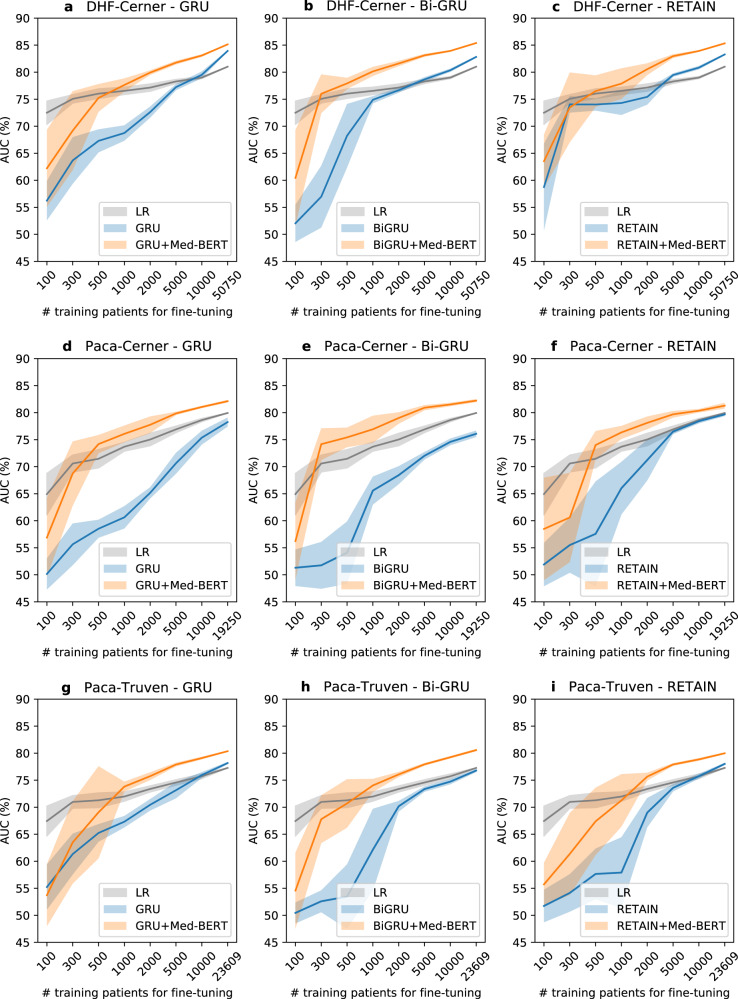
“(5) The performance boost of Med-BERT is observed across all sample sizes, demonstrating the enabling power of pretrained models for clinical tasks for which only limited training data are available.”
BackgroundSciBERT: A Pretrained Language Model for Scientific Text
Beltagy, I., Lo, K., & Cohan, A. (2019) · Proceedings of the 2019 Conference on Empirical Methods in Natural Language Processing and the 9th International Joint Conference on Natural Language Processing (EMNLP-IJCNLP) · doi:10.18653/v1/d19-1371 · Cited by 3,218
Coudray, N., Ocampo, P. S., Sakellaropoulos, T., Narula, N., Snuderl, M., Fenyö, D., Moreira, A. L., Razavian, N., & Tsirigos, A. (2018) · Nature Medicine · doi:10.1038/s41591-018-0177-5 · Cited by 2,930 · cited 1×
“Given enough training samples, deep-learning models can achieve comparable or even better performance than domain experts in the diagnosis of certain diseases [15-19].”
BackgroundArtificial intelligence in healthcare
Yu, K.-H., Beam, A. L., & Kohane, I. S. (2018) · Nature Biomedical Engineering · doi:10.1038/s41551-018-0305-z · Cited by 2,817
Data Resource Profile: Clinical Practice Research Datalink (CPRD)
Herrett, E., Gallagher, A. M., Bhaskaran, K., Forbes, H., Mathur, R., van Staa, T., & Smeeth, L. (2015) · International Journal of Epidemiology · doi:10.1093/ije/dyv098 · Cited by 2,667
Scalable and accurate deep learning with electronic health records
Rajkomar, A., Oren, E., Chen, K., Dai, A. M., Hajaj, N., Hardt, M., Liu, P. J., Liu, X., Marcus, J., Sun, M., et al. (2018) · npj Digital Medicine · doi:10.1038/s41746-018-0029-1 · Cited by 2,648 · cited 2×
“For performance measurement, we used AUC as our primary evaluation metric, which has been widely adopted by many previous studies of disease prediction [12,14,49].”
BackgroundMethodAdvances in Neural Information Processing Systems 27 (NIPS 2014)
Zhong, M., Goddard, N., & Sutton, C. A. (2014) · Cited by 2,636
Why Does Unsupervised Pre-training Help Deep Learning?
Erhan, D., Bengio, Y., Courville, A. C., Manzagol, P.-A., Vincent, P., & Bengio, S. (2010) · Journal of Machine Learning Research · Cited by 2,631
Revisiting Unreasonable Effectiveness of Data in Deep Learning Era
Sun, C., Shrivastava, A., Singh, S., & Gupta, A. (2017) · 2017 IEEE International Conference on Computer Vision (ICCV) · doi:10.1109/iccv.2017.97 · Cited by 2,484
Scalable and accurate deep learning with electronic health records.
Rajkomar, A., Oren, E., Chen, K., Dai, A. M., Hajaj, N., Hardt, M., Liu, P. J., Liu, X., Marcus, J., Sun, M., et al. (2018) · eScholarship (California Digital Library) · Cited by 2,242
The “Meaningful Use” Regulation for Electronic Health Records
Blumenthal, D., & Tavenner, M. (2010) · New England Journal of Medicine · doi:10.1056/nejmp1006114 · Cited by 2,059 · cited 1×
“put source for disease prediction, offer rich and well-structured information that reflects the disease progression of each patient and are one of the most valuable resources for health data analysis [41,42]. Adapting the BERT framework to structured EHRs is a natural idea based on the analogy between natural language…”
BackgroundPrediction of cardiovascular risk factors from retinal fundus photographs via deep learning
Poplin, R., Varadarajan, A. V., Blumer, K., Liu, Y., McConnell, M. V., Corrado, G. S., Peng, L., & Webster, D. R. (2018) · Nature Biomedical Engineering · doi:10.1038/s41551-018-0195-0 · Cited by 1,865 · cited 1×
“Given enough training samples, deep-learning models can achieve comparable or even better performance than domain experts in the diagnosis of certain diseases [15-19].”
BackgroundAlsentzer, E., Murphy, J., Boag, W., Weng, W.-H., Jindi, D., Naumann, T., & McDermott, M. (2019) · Proceedings of the 2nd Clinical Natural Language Processing Workshop · doi:10.18653/v1/w19-1909 · Cited by 1,736 · cited 2×
“BERT also has been applied to the clinical domain, where there already were publicly available models pre-trained on clinical texts [33,34,40].”
MethodERNIE: Enhanced Language Representation with Informative Entities
Zhang, Z., Han, X., Liu, Z., Jiang, X., Sun, M., & Liu, Q. (2019) · Proceedings of the 57th Annual Meeting of the Association for Computational Linguistics · doi:10.18653/v1/p19-1139 · Cited by 1,482
Use of Electronic Health Records in U.S. Hospitals
Jha, A. K., DesRoches, C. M., Campbell, E. G., Donelan, K., Rao, S. R., Ferris, T. G., Shields, A., Rosenbaum, S., & Blumenthal, D. (2009) · New England Journal of Medicine · doi:10.1056/nejmsa0900592 · Cited by 1,473
How Multilingual is Multilingual BERT?
Pires, T., Schlinger, E., & Garrette, D. (2019) · Proceedings of the 57th Annual Meeting of the Association for Computational Linguistics · doi:10.18653/v1/p19-1493 · Cited by 1,351
Disease Prediction by Machine Learning Over Big Data From Healthcare Communities
Chen, M., Hao, Y., Hwang, K., Wang, L., & Wang, L. (2017) · IEEE Access · doi:10.1109/access.2017.2694446 · Cited by 1,311 · cited 1×
“Artificial intelligence (AI)-aided disease prediction has undergone considerable development in recent years [1-3].”
BackgroundImproving Distributional Similarity with Lessons Learned from Word Embeddings
Levy, O., Goldberg, Y., & Dagan, I. (2015) · Transactions of the Association for Computational Linguistics · doi:10.1162/tacl_a_00134 · Cited by 1,308
VideoBERT: A Joint Model for Video and Language Representation Learning
Sun, C., Myers, A., Vondrick, C., Murphy, K., & Schmid, C. (2019) · 2019 IEEE/CVF International Conference on Computer Vision (ICCV) · doi:10.1109/iccv.2019.00756 · Cited by 1,172
Transformers: State-of-the-Art Natural Language Processing
Wolf, T., Debut, L., Sanh, V., et al. (2020) · Zenodo (CERN European Organization for Nuclear Research) · doi:10.5281/zenodo.5347031 · Cited by 1,152
Transformers: State-of-the-Art Natural Language Processing
Wolf, T., Debut, L., Sanh, V., D., M., Châtel, G., Chaumond, J., Rault, T., Voss, C., Wang, F., et al. (2019) · Zenodo (CERN European Organization for Nuclear Research) · doi:10.5281/zenodo.3385997 · Cited by 1,037
Ahmed, Z., Mohamed, K., Zeeshan, S., & Dong, X. (2020) · Database · doi:10.1093/database/baaa010 · Cited by 1,035 · cited 1×
“At present, it can improve the precision of diagnosis, enable disease prevention by early warning, streamline clinical decision making, and reduce healthcare costs [4-7].”
BackgroundRETAIN: an interpretable predictive model for healthcare using reverse time attention mechanism
Choi, E., Bahadori, M. T., Kulas, J. A., Schuetz, A., Stewart, W. F., & Sun, J. (2016) · arXiv · doi:10.48550/arxiv.1608.05745 · Cited by 1,029
International Conference on Machine Learning (ICML-99).
Scheffer, T. (1999) · Künstliche Intell. · Cited by 1,003
Machine Health Monitoring Using Local Feature-Based Gated Recurrent Unit Networks
Zhao, R., Wang, D., Yan, R., Mao, K., Shen, F., & Wang, J. (2018) · IEEE Transactions on Industrial Electronics · doi:10.1109/tie.2017.2733438 · Cited by 877 · cited 1×
“For Ex-1 and Ex-2, we adopted GRU [50], Bi-GRU [51], and RETAIN [12] as our base models.”
Method2017 Cardiovascular and Stroke Endpoint Definitions for Clinical Trials
Hicks, K. A., Mahaffey, K. W., Mehran, R., Nissen, S. E., Wiviott, S. D., Dunn, B., Solomon, S. D., Marler, J. R., Teerlink, J. R., Farb, A., et al. (2018) · Circulation · doi:10.1161/circulationaha.117.033502 · Cited by 750
Publicly Available Clinical BERT Embeddings
Alsentzer, E., Murphy, J. R., Boag, W., Weng, W., Jin, D., Naumann, T., & McDermott, M. B. A. (2019) · arXiv (Cornell University) · doi:10.48550/arxiv.1904.03323 · Cited by 693 · cited 2×
“BERT also has been applied to the clinical domain, where there already were publicly available models pre-trained on clinical texts [33,34,40].”
MethodClinicalBERT: Modeling Clinical Notes and Predicting Hospital Readmission
Huang, K., Altosaar, J., & Ranganath, R. (2019) · arXiv · doi:10.48550/arxiv.1904.05342 · Cited by 618
Patient Subtyping via Time-Aware LSTM Networks
Baytas, I. M., Xiao, C., Zhang, X., Wang, F., Jain, A. K., & Zhou, J. (2017) · Proceedings of the 23rd ACM SIGKDD International Conference on Knowledge Discovery and Data Mining · doi:10.1145/3097983.3097997 · Cited by 613 · cited 1×
“For performance measurement, we used AUC as our primary evaluation metric, which has been widely adopted by many previous studies of disease prediction [12,14,49].”
MethodA Multiscale Visualization of Attention in the Transformer Model
Vig, J. (2019) · Proceedings of the 57th Annual Meeting of the Association for Computational Linguistics: System Demonstrations · doi:10.18653/v1/p19-3007 · Cited by 600
BEHRT: Transformer for Electronic Health Records
Li, Y., Rao, S., Solares, J. R. A., Hassaine, A., Ramakrishnan, R., Canoy, D., Zhu, Y., Rahimi, K., & Salimi-Khorshidi, G. (2020) · Scientific Reports · doi:10.1038/s41598-020-62922-y · Cited by 595 · cited 1×
“To the best of our knowledge, there are only two relevant studies in literature: BEHRT [43] and G-BERT [44].”
ResultMa, F., Chitta, R., Zhou, J., You, Q., Sun, T., & Gao, J. (2017) · Proceedings of the 23rd ACM SIGKDD International Conference on Knowledge Discovery and Data Mining · doi:10.1145/3097983.3098088 · Cited by 576
(2016) · PubMed · Cited by 576
Chung, S. W., Han, S. S., Lee, J. W., Oh, K.-S., Kim, N. R., Yoon, J. P., Kim, J. Y., Moon, S. H., Kwon, J., Lee, H.-J., et al. (2018) · Acta Orthopaedica · doi:10.1080/17453674.2018.1453714 · Cited by 462 · cited 1×
“Given enough training samples, deep-learning models can achieve comparable or even better performance than domain experts in the diagnosis of certain diseases [15-19].”
BackgroundPredicting Alzheimer's disease: a neuroimaging study with 3D convolutional neural networks
Payan, A., & Montana, G. (2015) · arXiv (Cornell University) · doi:10.48550/arxiv.1502.02506 · Cited by 401
Artificial Intelligence Versus Clinicians in Disease Diagnosis: Systematic Review
Shen, J., Zhang, C. J. P., Jiang, B., Chen, J., Song, J., Liu, Z., He, Z., Wong, S. Y., Fang, P.-H., & Ming, W.-K. (2019) · JMIR Medical Informatics · doi:10.2196/10010 · Cited by 373 · cited 1×
“Given enough training samples, deep-learning models can achieve comparable or even better performance than domain experts in the diagnosis of certain diseases [15-19].”
Background2017 Cardiovascular and Stroke Endpoint Definitions for Clinical Trials
Hicks, K. A., Mahaffey, K. W., Mehran, R., Nissen, S. E., Wiviott, S. D., Dunn, B., Solomon, S. D., Marler, J. R., Teerlink, J. R., Farb, A., et al. (2018) · Journal of the American College of Cardiology · doi:10.1016/j.jacc.2017.12.048 · Cited by 335
Lysaght, T., Lim, H. Y., Xafis, V., & Ngiam, K. Y. (2019) · Asian Bioethics Review · doi:10.1007/s41649-019-00096-0 · Cited by 332
Continuous scanning for Bragg coherent X-ray imaging
Li, N., Dupraz, M., Wu, L., Leake, S. J., Resta, A., Carnis, J., Labat, S., Almog, E., Rabkin, E., Favre-Nicolin, V., et al. (2020) · Scientific Reports · doi:10.1038/s41598-020-69678-5 · Cited by 321
Pre-training of Graph Augmented Transformers for Medication Recommendation
Shang, J., Ma, T., Xiao, C., & Sun, J. (2019) · Proceedings of the Twenty-Eighth International Joint Conference on Artificial Intelligence · doi:10.24963/ijcai.2019/825 · Cited by 311
Cho, J., Lee, K., Shin, E., Choy, G., & Do, S. (2015) · arXiv · doi:10.48550/arxiv.1511.06348 · Cited by 268
Doctor AI: Predicting Clinical Events via Recurrent Neural Networks
Choi, E., Bahadori, M. T., Schuetz, A., Stewart, W. F., & Sun, J. (2015) · arXiv (Cornell University) · doi:10.48550/arxiv.1511.05942 · Cited by 244 · cited 1×
“Powerful AI tools, advanced conventional machine learning [8-10], and deep-learning [11-14] approaches also have been widely applied in clinical predictive modeling and have gained numerous successes.”
BackgroundPredicting Hospital Readmission via Cost-Sensitive Deep Learning
Wang, H., Cui, Z., Chen, Y., Avidan, M., Abdallah, A. B., & Kronzer, A. (2018) · IEEE/ACM Transactions on Computational Biology and Bioinformatics · doi:10.1109/tcbb.2018.2827029 · Cited by 213 · cited 1×
“At present, it can improve the precision of diagnosis, enable disease prevention by early warning, streamline clinical decision making, and reduce healthcare costs [4-7].”
BackgroundClinical Concept Embeddings Learned from Massive Sources of Multimodal Medical Data
Beam, A. L., Kompa, B., Schmaltz, A., Fried, I., Weber, G., Palmer, N., Shi, X., Cai, T., & Kohane, I. S. (2019) · Biocomputing 2020 · doi:10.1142/9789811215636_0027 · Cited by 176
Readmission prediction via deep contextual embedding of clinical concepts
Xiao, C., Ma, T., Dieng, A. B., Blei, D. M., & Wang, F. (2018) · PLOS ONE · doi:10.1371/journal.pone.0195024 · Cited by 118
Health data analytics using scalable logistic regression with stochastic gradient descent
Manogaran, G., & Lopez, D. (2018) · International Journal of Advanced Intelligence Paradigms · doi:10.1504/ijaip.2018.10010530 · Cited by 111 · cited 1×
“sion of diagnosis, enable disease prevention by early warning, streamline clinical decision making, and reduce healthcare costs [4, 5, 6, 7]. Powerful AI tools, advanced conventional machine learning [8, 9, 10], and deep-learning [11, 12, 13, 14] approaches also have been widely applied in clinical predictive modeling…”
BackgroundParkinson’s Disease Prediction Using Artificial Neural Network
Sadek, R. M., Mohammed, S. A., Abunbehan, A. K., Ghattas, A. K. H. A., Badawi, M. R., Mortaja, M. N., Abu-Nasser, B. S., & Abu-Naser, S. S. (2019) · PhilPapers (PhilPapers Foundation) · Cited by 107
Transfer Learning for Clinical Time Series Analysis Using Deep Neural Networks
Gupta, P., Malhotra, P., Narwariya, J., Vig, L., & Shroff, G. (2020) · Journal of Healthcare Informatics Research · doi:10.1007/s41666-019-00062-3 · Cited by 81
Health data analytics using scalable logistic regression with stochastic gradient descent
Manogaran, G., & Lopez, D. (2018) · International Journal of Advanced Intelligence Paradigms · doi:10.1504/ijaip.2018.089494 · Cited by 65
Gentil, M.-L., Cuggia, M., Fiquet, L., Hagenbourger, C., Berre, T. L., Banâtre, A., Renault, É., Bouzillé, G., & Chapron, A. (2017) · BMC Medical Informatics and Decision Making · doi:10.1186/s12911-017-0538-x · Cited by 63 · cited 1×
“of cases for new or rare conditions; difficulty in data cleaning and annotation, especially if collected from different sources; and some governance issues that hinder the data acquisition [22].”
BackgroundXiang, Y., Ji, H., Zhou, Y., Li, F., Du, J., Rasmy, L., Wu, S., Zheng, W. J., Xu, H., Zhi, D., et al. (2020) · Journal of Medical Internet Research · doi:10.2196/16981 · Cited by 51
Self-citationTime-sensitive clinical concept embeddings learned from large electronic health records
Xiang, Y., Xu, J. M., Si, Y., Li, Z., Rasmy, L., Zhou, Y., Tiryaki, F., Li, F., Zhang, Y., Wu, Y., et al. (2019) · BMC Medical Informatics and Decision Making · doi:10.1186/s12911-019-0766-3 · Cited by 38 · cited 2×
“…methods; (2) Ex-2: compare Med-BERT with one state-of-the-art clinical word2vec-style embedding, t-W2V (trained on the full Cerner cohort) [47]; and (3) Ex-3: investigate how much the pre-trained model can help in transfer learning, i.e., when only a proportion of training samples are…”
MethodSelf-citationAdhikari, A., Ram, A., Tang, R., Hamilton, W. L., & Lin, J. (2020) · Workshop on Representation Learning for NLP · doi:10.18653/v1/2020.repl4nlp-1.10 · Cited by 27
An effective Feature Selection for Heart Disease Prediction with Aid of Hybrid Kernel SVM
Keerthika, T., & Premalatha, K. (2017) · International Journal of Business Intelligence and Data Mining · doi:10.1504/ijbidm.2017.10009441 · Cited by 3 · cited 1×
“sion of diagnosis, enable disease prevention by early warning, streamline clinical decision making, and reduce healthcare costs [4, 5, 6, 7]. Powerful AI tools, advanced conventional machine learning [8, 9, 10], and deep-learning [11, 12, 13, 14] approaches also have been widely applied in clinical predictive modeling…”
Background
Research works printed but not linked: 3
- Sun, C., Shrivastava, A., Singh, S. & Gupta, A. In Proceedings of the IEEE International Conference on Computer Vision, 843–852.
- Mikolov, T., Sutskever, I., Chen, K., Corrado, G. S. & Dean, J. Distributed representations of words and phrases and their compositionality. In Advances in Neural Information Processing Systems, 3111–3119 (NIPS, 2013).
- Radford A Language models are unsupervised multitask learners OpenAI Blog 2019 1 9
Cited by
On the Opportunities and Risks of Foundation Models
Bommasani, R., Hudson, D. A., Adeli, E., Altman, R., Arora, S., von Arx, S., Bernstein, M. S., Bohg, J., Bosselut, A., Brunskill, E., et al. (2021) · arXiv · doi:10.48550/arxiv.2108.07258 · Cited by 2,676
Multimodal learning with transformers: A survey
Xu, P., Zhu, X., & Clifton, D. A. (2023) · IEEE Transactions on Pattern Analysis and Machine Intelligence · doi:10.1109/tpami.2023.3275156 · Cited by 1,072
Self-supervised learning in medicine and healthcare
Krishnan, R., Rajpurkar, P., & Topol, E. J. (2022) · Nature Biomedical Engineering · doi:10.1038/s41551-022-00914-1 · Cited by 605
Sources of bias in artificial intelligence that perpetuate healthcare disparities—A global review
Celi, L. A., Cellini, J., Charpignon, M.-L., Dee, E. C., Dernoncourt, F., Eber, R., Mitchell, W. G., Moukheiber, L., Schirmer, J., Situ, J., et al. (2022) · PLOS Digital Health · doi:10.1371/journal.pdig.0000022 · Cited by 576
Beyond the Imitation Game: Quantifying and extrapolating the capabilities of language models
Srivastava, A., Rastogi, A., Rao, A., Shoeb, A. A. M., Abid, A., Fisch, A., Brown, A. R., Santoro, A., Gupta, A., Garriga-Alonso, A., et al. (2022) · arXiv · doi:10.48550/arxiv.2206.04615 · Cited by 569
Metadata
- Authors
- Rasmy, L., Xiang, Y., Xie, Z., Tao, C., & Zhi, D.
- Affiliations
- The University of Texas Health Science Center at Houston (US)
- Peng Cheng Laboratory (CN)
- Corresponding author
- Xiang, Yang
- Zhi, Degui
- Venue
- npj Digital Medicine
- Published
- 2021-05-20
- Volume
- 4
- Issue
- 1
- Pages
- 86-86
- ISSN
- 2398-6352 (ISSN-L)
- PMC
- PMC8137882
- OpenAlex
- W3160137267
- Semantic Scholar
- 5d4de0fa45aeddc31142e6a24666d06ed7923f1e
- Cited by
- 886
- References
- 71
- Citations by year
- 2026: 184 · 2025: 226 · 2024: 196 · 2023: 146 · 2022: 90 · 2021: 41
- FWCI
- 41.96
- Type
- journal article
- Language
- en
- Open access
- gold
- doi.org
- Licence
- cc-by
- creativecommons.org/licenses/by/4.0 (tdm)
- creativecommons.org/licenses/by/4.0 (vor)
- Locations
- npj Digital Medicine (publishedVersion, cc-by)
- PubMed Central (publishedVersion, cc-by)
- PubMed (publishedVersion)
- DOAJ (DOAJ: Directory of Open Access Journals) (submittedVersion, cc-by-sa)
- Funders
- Cancer Prevention and Research Institute of Texas (RP170668, RP160015)
- American Heart Association (19GPSGC35180031)
- Topics
- Physical Sciences › Computer Science › Artificial Intelligence › Machine Learning in Healthcare
- Health Sciences › Health Professions › Health Information Management › Artificial Intelligence in Healthcare
- Health Sciences › Medicine › Health Informatics › Artificial Intelligence in Healthcare and Education
- Keywords
- BERT, contextual embeddings, disease prediction, pre-trained language models, limited training data, fine-tuning, clinical text representation
About these checks
Registry, retraction, Cites and statistics results are computed, not judged, with one exception: a printed reference that no index lists is read once by a model before it counts as a citation error. Claims are extracted by a model and kept only when their quote appears verbatim in the text; each cited source is then checked, with a model’s help, for whether it says what the claim relies on. Those verdicts can be wrong — read the claim’s quote and the cited source before relying on one.
Statistics and arithmetic are recomputed, not judged.
Confidence bands are shown only for fields calibrated on our annotated test set. None is calibrated yet, so no band is shown.
What counts as a claim ›How we measure confidence ›How we check this ›
Are you an author, or do you see a problem with this page? Request a review
Data sources
Bibliographic data: Semantic Scholar, OpenAlex, Crossref.
Contains information from the Semantic Scholar Academic Graph Datasets, made available under the ODC Attribution License (ODC-BY 1.0).
Semantic Scholar’s data is described in: Kinney, R., et al. (2023). The Semantic Scholar Open Data Platform. arXiv:2301.10140.
