

Natural language processing applied to mental illness detection: a narrative review
Open accessThe DOI matches its Crossref record; 214 of the 214 references it cites were found in a registry or an index.
Abstract
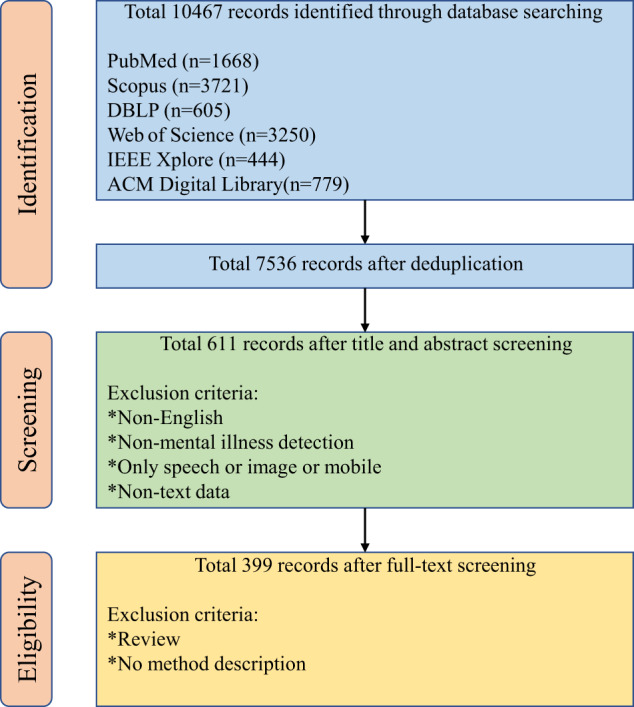
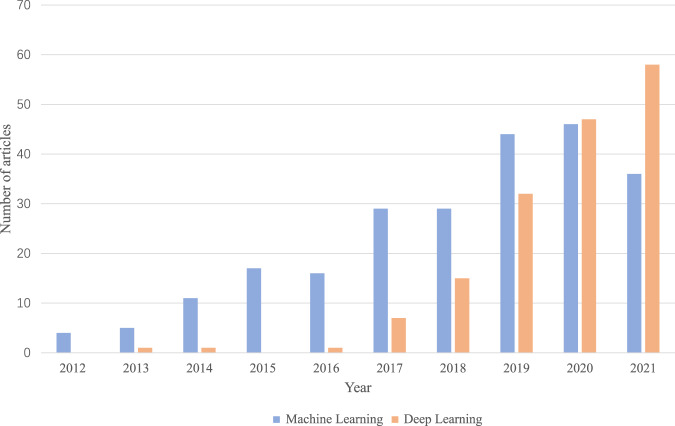
Mental illness is highly prevalent nowadays, constituting a major cause of distress in people’s life with impact on society’s health and well-being. Mental illness is a complex multi-factorial disease associated with individual risk factors and a variety of socioeconomic, clinical associations. In order to capture these complex associations expressed in a wide variety of textual data, including social media posts, interviews, and clinical notes, natural language processing (NLP) methods demonstrate promising improvements to empower proactive mental healthcare and assist early diagnosis. We provide a narrative review of mental illness detection using NLP in the past decade, to understand methods, trends, challenges and future directions. A total of 399 studies from 10,467 records were included. The review reveals that there is an upward trend in mental illness detection NLP research. Deep learning methods receive more attention and perform better than traditional machine learning methods. We also provide some recommendations for future studies, including the development of novel detection methods, deep learning paradigms and interpretable models.
Overview
The claims and statistics of this paper haven’t been checked yet.
Free: it reads the open-access text and checks the first 5 claims that cite a source we can check. Create a free account to check every claim.
Integrity signals
Registry
Cites
Statistics
Figures
Verification
Claims the paper makes
The claims and statistics of this paper haven’t been checked yet.
Free: it reads the open-access text and checks the first 5 claims that cite a source we can check. Create a free account to check every claim.
Claims other papers make about this one
Each is checked against this paper’s own text: does it say what the citing paper says it does?
The cited source says what the claim attributes to it.
In the citing paper
“In order to avoid missing studies, we crosschecked our study selection with existing literature reviews 8,10,13,17,19 and no additional studies were added.”
From Linguistic markers for identifying post-traumatic stress disorder and associated symptoms: a systematic literature review (2025) · cites this paper as [13]
Self-check
Percentages, sums and reported differences re-computed from the paper’s own numbers.
The self-check needs the paper’s full text.
Citations
Cites
Vaswani, A., Shazeer, N., Parmar, N., Uszkoreit, J., Jones, L., Gomez, A. N., Kaiser, L., & Polosukhin, I. (2017) · arXiv · doi:10.48550/arxiv.1706.03762 · Cited by 120,404 · cited 1×
“Recently, transformer architectures 147 were able to solve long-range dependencies using attention and recurrence.”
BackgroundHochreiter, S., & Schmidhuber, J. (1997) · Neural Computation · doi:10.1162/neco.1997.9.8.1735 · Cited by 102,318 · cited 13×
“RNN-based methods LSTM or GRU (some with attention mechanism) 32,133,136,232 – 234 Standard RNN structure: Long Short-Term Memory networks (LSTM) or Gate Recurrent Unit(GRU), and some studies add attention mechanism.”
MethodInfluentialLeCun, Y., Bengio, Y., & Hinton, G. (2015) · Nature · doi:10.1038/nature14539 · Cited by 84,126
Glove: Global Vectors for Word Representation
Pennington, J., Socher, R., & Manning, C. (2014) · Proceedings of the 2014 Conference on Empirical Methods in Natural Language Processing (EMNLP) · doi:10.3115/v1/d14-1162 · Cited by 34,071 · cited 1×
“There are many different embedding techniques, such as ELMo, GloVe word embedding 118 , word2vec 119 and contextual language encoder representations (e.g., bidirectional encoder representations from transformers (BERT) 120 and ALBERT[121).”
Method(2003) · Journal of Machine Learning Research · doi:10.5555/944919.944937 · Cited by 32,337
PRISMA-P Group, Moher, D., Shamseer, L., Clarke, M., Ghersi, D., Liberati, A., Petticrew, M., Shekelle, P., & Stewart, L. A. (2015) · Systematic Reviews · doi:10.1186/2046-4053-4-1 · Cited by 26,223
Learning Phrase Representations using RNN Encoder–Decoder for Statistical Machine Translation
Cho, K., van Merrienboer, B., Gulcehre, C., Bahdanau, D., Bougares, F., Schwenk, H., & Bengio, Y. (2014) · Proceedings of the 2014 Conference on Empirical Methods in Natural Language Processing (EMNLP) · doi:10.3115/v1/d14-1179 · Cited by 25,545 · cited 8×
“RNN-based methods LSTM or GRU (some with attention mechanism) 32,133,136,232 – 234 Standard RNN structure: Long Short-Term Memory networks (LSTM) or Gate Recurrent Unit(GRU), and some studies add attention mechanism.”
MethodInfluential"Why Should I Trust You?": Explaining the Predictions of Any Classifier
Ribeiro, M. T., Singh, S., & Guestrin, C. (2016) · Proceedings of the 22nd ACM SIGKDD International Conference on Knowledge Discovery and Data Mining · doi:10.1145/2939672.2939778 · Cited by 17,555
VADER: a parsimonious rule-based model for sentiment analysis of social media text
Hutto, C., & Gilbert, E. (2014) · Proceedings of the International AAAI Conference on Web and Social Media · doi:10.1609/icwsm.v8i1.14550 · Cited by 6,087
The Psychological Meaning of Words: LIWC and Computerized Text Analysis Methods
Tausczik, Y. R., & Pennebaker, J. W. (2010) · Journal of Language and Social Psychology · doi:10.1177/0261927x09351676 · Cited by 5,774
Research works printed but not linked: 21
- Khan A Husain MS Khan A Analysis of mental state of users using social media to predict depression! a survey Int. J. Adv. Res. Comput. Sci. 2018 9 100 106
- Trifan A Antunes R Matos S Oliveira JL Understanding depression from psycholinguistic patterns in social media texts Adv. Inf. Retr. 2020 12036 402
- Delahunty, F., Wood, I. D. & Arcan, M. First insights on a passive major depressive disorder prediction system with incorporated conversational chatbot. In Irish Conference on Artificial Intelligence and Cognitive Science (2018).
- Prakash, A., Agarwal, K., Shekhar, S., Mutreja, T. & Chakraborty, P. S. An ensemble learning approach for the detection of depression and mental illness over twitter data. In 2021 8th International Conference on Computing for Sustainable Global Development (INDIACom), pp. 565–570 (2021).
- Desmet, B. & Hoste, V. Recognising suicidal messages in dutch social media. In 9th International Conference on Language Resources and Evaluation (LREC), pp. 830–835 (2014).
- Zhou, D., Bousquet, O., Lal, T. N., Weston, J. & Schölkopf, B. Learning with local and global consistency. In Advances in Neural Information Processing Systems, pp. 321–328 (2004).
- Ghannay, S., Favre, B., Esteve, Y. & Camelin, N. Word embedding evaluation and combination. In Proc. Tenth International Conference on Language Resources and Evaluation (LREC’16), pp. 300–305 (2016).
- Mikolov, T., Chen, K., Corrado, G. & Dean, J. Efficient estimation of word representations in vector space. In Proc. 1st International Conference on Learning Representations (ICLR) Workshops Track. (2013).
- Devlin, J., Chang, M. W., Lee, K. & Toutanova, K. Bert: Pre-training of deep bidirectional transformers for languageunderstanding. In Proc. NAACL-HLT, pp. 4171–4186 (2019).
- Pascanu, R., Mikolov, T. & Bengio, Y. On the difficulty of training recurrent neural networks. In International Conference on Machine Learning, pp. 1310–1318 (2013).
- Bahdanau, D., Cho, K. & Bengio, Y. Neural machine translation by jointly learning to align and translate. In Proc. 3rd International Conference on Learning Representations (ICLR) (2015).
- Settles, B. Closing the loop: fast, interactive semi-supervised annotation with queries on features and instances. In Proc. 2011 Conference on Empirical Methods in Natural Language Processing, pp. 1467–1478 (2011).
- Maupomé, D. & Meurs, M. -J. Using topic extraction on social media content for the early detection of depression. In CLEF (Working Notes) vol. 2125 (2018)
- Wang, W. Y., Singh, S. & Li, J. Deep adversarial learning for nlp. In Proc. 2019 Conference of the North American Chapter of the Association for Computational Linguistics: Tutorials, pp. 1–5 (2019).
- Li, Y., Tian, X., Liu, T. & Tao, D. Multi-task model and feature joint learning. In Twenty-Fourth International Joint Conference on Artificial Intelligence (2015).
- Xu, Z., Pérez-Rosas, V. & Mihalcea, R. Inferring social media users’ mental health status from multimodal information. In Proc. 12th Language Resources and Evaluation Conference, pp. 6292–6299 (2020).
- Mittal, A. et al. Multi-modal detection of alzheimer’s disease from speech and text. In Proc. BIOKDD'21 (2021).
- Song, H., You, J., Chung, J. -W. & Park, J. C. Feature attention network: Interpretable depression detection from social media. In Proc. 32nd Pacific Asia Conference on Language, Information and Computation (2018).
- Stephen JJ Prabu P Detecting the magnitude of depression in twitter users using sentiment analysis Int. J. Electr. Comput. Eng. 2019 9 3247
- Mikolov, T., Sutskever, I., Chen, K., Corrado, G. S. & Dean, J. Distributed representations of words and phrases and their compositionality. In Advances in Neural Information Processing Systems, pp. 3111–3119 (2013).
- Bandyopadhyay, A., Achilles, L., Mandl, T., Mitra, M. & Saha, S. K. Identification of depression strength for users of online platforms: a comparison of text retrieval approaches. In Proc. CEUR Workshop Proceedings, vol. 2454, pp. 331–342 (2019).
Cited by
Items 401–475 of 475
Gabarrón, E., Massicot, N., & Denecke, K. (2026) · doi:10.2196/preprints.95374
Interpretable learning for detection of cognitive distortions from natural language texts
Kolonin, A., & Arinicheva, A. (2026) · PeerJ Computer Science · doi:10.7717/peerj-cs.3699
Contextual Stress Detection in Social Media Using Transformer-Based Language Models
Rajput, G. K., Singh, D., Rani, P., Saxena, V. K., Ranjan, J., & Chakravarty, A. (2025) · International Conference on Advanced Computing and Emerging Technologies (ACET) · doi:10.1109/acet67282.2025.11430265
Analyzing the Impact of Deep Learning and Machine Learning on Mental Disorders: a Bibliometric Study
Al-Tarawneh, A. M. A., Alkhawaja, L. A., Salameh, M. I., Olimat, L. A., Mashal, R., & Almadhoon, M. A. (2026) · Procedia Computer Science · doi:10.1016/j.procs.2026.01.078
AI and Mental Health Innovations in Detection, Prevention, and Support for Learners
Murshidi, G. H. A., Munir, S., Munir, Z., Opoku, M. P., Nuryana, Z., & Zaabi, A. A. (2026) · Advances in computational intelligence and robotics book series · doi:10.4018/979-8-3373-4222-1.ch019
Conclusions and Future Directions in Primary Care
Clark, M. S., & Brieler, J. A. (2026) · Springer eBooks · doi:10.1007/978-3-032-09558-9_14
AI-Driven Mental Health Assessment: Insights from Classical ML and Deep Transformers
Gumber, H. K., & Srivastava, G. (2025) · International Conference on Emerging Technologies and Innovation for Sustainability (EmergIN) · doi:10.1109/emergin67762.2025.11450775
“However, these models can be prone to demographic differences and may not offer the best performance for the marginalized communities [8].”
Harnessing AI in healthcare: Detecting mental health disorders via social media
Sahu, V., Dubey, A., Agrawal, S., Verma, S., Thakur, M., Sahu, A., Tripti, & Chandra, A. (2026) · AIP conference proceedings · doi:10.1063/5.0326218
Sun, J., Ma, S., Fan, Y., & Washington, P. Y. (2026) · Applied Sciences · doi:10.3390/app16073388 · Cited by 1
Subtle impairments of facial emotion expressions in individuals at ultra-high risk for psychosis
Kristensen, T. D., Ebdrup, B. H., Ambrosen, K. S., Nordentoft, M., Glenthøj, L. B., & Graßhof, S. (2026) · Frontiers in Psychiatry · doi:10.3389/fpsyt.2026.1743609
“Although a classi fi cation accuracy around 0.7 commonly is considered acceptable, lower accuracies can still provide valuable insights when rigorous validation procedures such as cross-validation and permutation testing are applied (35).”
InfluentialKumar, M., Kumar, A., Sharma, A. K., Gupta, N., Shankar, A., & Kumar, G. (2026) · Research Square · doi:10.21203/rs.3.rs-9158982/v1
Research on Emotion-Enhanced Mental Health Monitoring Based on Natural Language Processing
Zhao, L., Zhao, M., & Wang, S. (2026) · International Symposium on Computer Applications and Information Systems (ISCAIS) · doi:10.1109/iscait69154.2026.11477199
“Zhang et al. [5] provided a comprehensive narrative review of natural language processing applied to mental illness detection, highlighting the potential of text-based approaches for identifying various mental health conditions.”
Haque, O., Hossain, A., Tabassum, M., Khan, R., & Tamim, F. S. (2025) · International Conference on Computer and Information Technology (ICCIT) · doi:10.1109/iccit68739.2025.11490465
“A review of 399 studies on mental illness detection using NLP showed that deep learning generally outperforms traditional machine learning, with growing focus on novel, interpretable models [6].”
Mental Health Monitoring with NLP: Transformer-Based Models for Depression Detection on Reddit
Bhatt, K., Pandey, P., & Chaturvedi, N. (2026) · Lecture notes in networks and systems · doi:10.1007/978-981-95-7241-0_1
Ku, C. S., Weiner, D. M., Wells, M., Huang, A., & Peltier, M. R. (2026) · Information · doi:10.3390/info17050463
Rubeis, G. (2026) · Springer eBooks · doi:10.1007/978-3-032-14301-3_6
Artificial intelligence strategies for emotion recognition in cancer pain research
Cascella, M., Zarrella, A., Conti, V., Filippelli, A., Bruno, M. P., Esposito, D., Feo, R. D., Cerrone, V., Guerra, C., Lisio, F. D., et al. (2026) · Exploration of Medicine · doi:10.37349/emed.2026.1001404
Exploring the Cinderella Complex in Digital Narratives: An Unsupervised Text Mining Study
Wardhani, N. K. G. K., Phang, A. T., Wulandari, L. A., & Sagala, N. T. M. (2026) · International Conference on Current Research in Artificial Intelligence and Data Science (ICCRAIDS) · doi:10.1109/iccraids67816.2026.11519655
Speech markers of psychological change following a psychedelic 5-MeO-DMT retreat
Kuc, J., McAlpine, R. G., Sellers, A., Blackburne, G., Lametti, D. R., & Skipper, J. I. (2026) · Journal of Psychopharmacology · doi:10.1177/02698811261443690
“…of these findings to clinical populations remains limited-an important consideration given the increasing use of psychedelics in therapeutic contexts (Yao et al., 2024), where language (Zhang et al., 2022) and speech (Low et al., 2020) are being studied as potential diagnostic markers.”
Screening anxiety via contrastive autobiographical recall
Shahid, S. I., Najaran, M. H. T., Förster, F., & Steuber, V. (2026) · Frontiers in Digital Health · doi:10.3389/fdgth.2026.1798100 · Cited by 1
“For mental health applications, where auditability and transparent linkage between model inputs and participant-authored text are often required, it can be preferable to improve robustness without generating new text (9, 21).”
Gabarrón, E., Massicot, N., & Denecke, K. (2026) · JMIR Mental Health · doi:10.2196/95374
“…between measurements, suggesting that spontane-ous free text may carry signals about the user’s internal state, consistent with previous research [37]. the most negative sentiment scores were observed during nighttime hours, supporting the notion that emotional distress and suicidal ideation…”
Li, Z., Xiong, T., Li, W., Chishti, M. N. U. H., Zeng, L., Chen, Y., Yu, T., Li, L., & Liao, J. (2026) · Plastic and Aesthetic Research · doi:10.20517/2347-9264.2026.17
AI and Mental Health Support in the Workplace
Rose, N. N., Hamidun, N., Ishak, A. S., Khalid, F. K., & Othman, N. F. (2026) · Advances in computational intelligence and robotics book series · doi:10.4018/979-8-3373-4227-6.ch007 · Cited by 1
Evaluating Socio-Cultural Awareness of LLMs in Arabic Mental Health: A Benchmarking Study
Alsakiti, S., Alhuzali, H., & Alasmari, A. (2026) · IEEE International Conference on Computing and Machine Intelligence (ICMI) · doi:10.1109/icmi68585.2026.11539951
“In recent years, rapid advancements in Artificial Intelligence (AI) and Natural Language Processing (NLP) have transformed digital mental healthcare, enabling early detection, patient engagement, and personalized interventions [2]– [4].”
Attention-Augmented BiGRU for Mental Health State Classification from Reddit Conversational Data
Saiphy, S., Meenakshi, K., & Bhargava, D. (2026) · International Conference on Intelligent Systems in Engineering, Secured Systems and Cybersecurity (ICISESSC) · doi:10.1109/icisessc68634.2026.11542586
Hossain, M. R., Syed, L., Sharif, S. T., Asif, A. R., Oitizzo, H. Z., Rahman, R., & Hasan, R. (2026) · IEEE International Conference on Quantum Photonics, Artificial Intelligence & Networking (QPAIN) · doi:10.1109/qpain69676.2026.11545880
Lopez, D. C. P., Magboo, V. P. C., & Magboo, M. S. A. (2026) · ASU International Conference in Emerging Technologies for Sustainability and Intelligent Systems (ICETSIS) · doi:10.1109/icetsis68266.2026.11548859
“Zhang et al. (2022), conducted a review of natural language processing (NLP) methods for mental health illness detection among social media posts, interviews and clinical notes [15].”
Saima, R., Ahmed, K. E. U., & O’Connor, M. (2026) · JMIR AI · doi:10.2196/71219
“This gap underlines the difficulty in predicting and intervening in suicidal behaviors, which is a critical area of concern for mental health professionals [14].”
A Dual-Agent Framework for Mental Health Text Classification with Retrieval-Augmented Support
Weng, F. (2026) · International Seminar on Artificial Intelligence, Networking and Information Technology (AINIT) · doi:10.1109/ainit70033.2026.11557945
“Comprehensive reviews confirm that the field has grown rapidly in recent years, especially in social-media-based monitoring, risk detection, and automated screening [1], [2], [14], [15].”
Named Entity Recognition in Arabic Mental Health Using Large Language Models
Alfaifi, A., Alhuzali, H., & Alasmari, A. (2026) · ACM Transactions on Asian and Low-Resource Language Information Processing · doi:10.1145/3811876
WellMind: Real-Time Mental Health Tracking through NLP-Driven Behavioral Insights
Madhura, J., Shalini, K. B., Reddy, G. N., Chethan, G. S., Samprith, G., & Guruprasad, G. Y. (2026) · International Conference on AI-Driven Innovations & Applications (IC-AIDA) · doi:10.1109/ic-aida68291.2026.11564394
“Zhang et al. presented a comprehensive narrative review demonstrating that deep learning and transformer-based architectures substantially outperform traditional machine learning techniques in detecting disorders such as depression and anxiety through linguistic analysis [1].”
The missing informant: should we ask adolescents what they tell their AI?
Kaşak, M., Çelik, Y. S., Öztürk, Y., & Efe, A. (2026) · European Child & Adolescent Psychiatry · doi:10.1007/s00787-026-03117-0
Shirgaonkar, Y., & Gokhale, D. (2026) · Eating and Weight Disorders - Studies on Anorexia Bulimia and Obesity · doi:10.1007/s40519-026-01882-0
“Without these adaptations, these models may fail to identify vulnerable individuals, creating an important health equity concern [64].”
Automated Mental Health Evaluation From Text using ML And NLP
Sirisha, K., Asritha, A., & Thota, P. (2026) · International Conference on Inventive Computing and Informatics (ICICI) · doi:10.1109/icici68773.2026.11581005
“[12].”
Gagana, K. G., Peddibhotla, C. P., Deepak, P. J., Pasha, F., & Agarwal, P. R. (2026) · Smart innovation, systems and technologies · doi:10.1007/978-3-032-18849-6_15
Anoop, V. S., & Meena, P. N. (2026) · Springer eBooks · doi:10.1007/978-3-032-23626-5_3
Mu, W. (2025) · Asia Conference on Cognitive Engineering and Intelligent Interaction (CEII) · doi:10.1109/ceii67787.2025.00076
“Big data, as a highly real-time and widely covered information resource, helps to achieve dynamic monitoring and continuous management of the mental health status of university students [14].”
Wang, H., Chen, J., Xue, Y., & Yuan, W. (2026) · International Conference on Artificial Intelligence, Big Data and Algorithms (CAIBDA) · doi:10.1109/caibda70336.2026.11621075
“Depressed users show reduced lexical diversity across all five measures and a steeper Zipf slope, consistent with vocabulary constriction [22].”
Senanayake, A., & Liang, Z. (2026) · ACM International Conference on Bioinformatics, Computational Biology, and Health Informatics (ACM-BCB) · doi:10.1145/3807503.3819474
“However, research specifically targeting anxiety detection remains comparatively limited despite its widespread prevalence [53].”
Dai, Y., Han, H., & Xu, Y. (2026) · Behavioral Sciences · doi:10.3390/bs16081315
“…has demonstrated that AI exhibits considerable potential in the identification of mental health disorders (Khurana et al., 2023; Uban et al., 2021; Zhang et al., 2022), the formulation of personalized treatment regimens (Mohsin et al., 2023; Sarker, 2021; Thieme et al., 2023), and the development…”
Singh, S., Chandra, M., & Awasthi, D. (2026) · Lecture notes in networks and systems · doi:10.1007/978-3-032-28594-2_45
Rizwan, M., Nabergoj, D., & Demšar, J. (2026) · JMIR Infodemiology · doi:10.2196/preprints.106441
Lee, A., Das, R., Huang, A., Bhasuran, B., & He, Z. (2026) · IEEE International Conference on Healthcare Informatics (ICHI) · doi:10.1109/ichi69079.2026.00083
“The studies mainly focused on specific mental health conditions such as depression and suicidal ideation [9], [10], [11].”
Design and Evaluation of an AI-Based Journaling and Emotional Support Prototype
Aitymov, A., Kulatayev, A., Baibolatov, B., & Aigerim, K. (2026) · International Conference on Cybersecurity, Digital Forensics, and AI Applications (ICCSDFAI) · doi:10.1109/iccsdfai70505.2026.11647865
“In the background, it processes user-written input to support reflective feedback and insight generation [13] and helps users review mood-related patterns over time.”
Sinag, J. R., & Babaran-Sinag, J. R. (2026) · International Conference on Emerging Trends in Information, Communication & Systems (ICETICS) · doi:10.1109/icetics69505.2026.11651287
“Zhang et al. [9] found that mental disorder identification techniques evolved from lexicon and feature engineering approaches to deep contextual models.”
Darvishi, H., Sadeghi, M., Moradi, A., Rezaei, M., & Rashidi, A. P. (2026) · Research Square · doi:10.21203/rs.3.rs-10463285/v1
Addressing the Problems of Data Variations, Quality, and Scarcity in Training Deep Neural Networks
Sun, J. (2026) · Digital Commons - DU (University of Denver) · doi:10.56902/etdcrp.2026.66
A Comparative Analysis of RNN, LSTM, and GRU for Text-Based Depression Detection
Machich, C., Jallaglag, A., & Sabri, M. A. (2026) · International Conference on Circuit, Systems and Communication (ICCSC) · doi:10.1109/iccsc71566.2026.11650520
“Consequently, the development of accurate approaches for the early identification of depressive symptoms has become a critical area of research [2].”
InfluentialMarron, G. A. C., Mamani-Aliaga, A., Bustincio, R. W. C., Junior, W. V. L., & Bittencourt, L. F. (2026) · International Conference on Distributed Computing in Smart Systems and the Internet of Things (DCOSS-IoT) · doi:10.1109/dcoss-iot69657.2026.00171
“The application of FL to sentiment analysis and psychological disorder detection is an emerging field due to strict privacy regulations [2], [4].”
Human-AI Collaborative Framework for Identifying Behavioral Health Conditions from Clinical Notes
Azmee, A. A., Nweke, F., Khan, M. A. A. H., & Pei, Y. (2026) · IEEE/ACM Conference on Connected Health: Applications, Systems and Engineering Technologies · doi:10.1109/chase69719.2026.00009
“The modified version of Recurrent Neural Network (RNN) models including Long-Short Term Memory (LSTM) and Gated Recurrent Unit (GRU) are widely used by researcher due to their since they can capture long range dependencies well [15].”
Bauer, J. F., Gerczuk, M., Schindler‐Gmelch, L., Schuller, B. W., & Berking, M. (2026) · BMC Psychiatry · doi:10.1186/s12888-026-08575-z
“In contrast, this is typically not the case for natural language models that use machine learning to analyze lexical content [39].”
Kangson, R., & Chowanda, A. (2026) · International Conference on Electronics Representation and Algorithm (ICERA) · doi:10.1109/icera72709.2026.11666697
“User-generated social media data can be used to identify patterns that correlate with mental status, helping researchers apply machine-learning techniques to predict fluctuations in mental health distress [6].”
Modeling Co-Existing Mental Health Risks in Social Media via Multi-Label Learning and LLM
Özer, Z., Kenger, E., Gözükara, G., & Canbay, P. (2026) · El-Cezeri Fen ve Mühendislik Dergisi · doi:10.31202/ecjse.1885302
Nawaz, S., Nawaz, L., Ali, H., Yaqoob, M., & Saeed, M. M. (2026) · Digital Medicine · doi:10.1097/dm-2026-00028
A Sentiment-Driven Deep Learning System for Hospital Recommendation
Mehenaoui, Z., Tadjer, H., Lafifi, Y., Merabti, C., Abderazek, H., & Laouissi, A. (2026) · Electronics · doi:10.3390/electronics15184099
“Analyzing sentiment and emotional reviews in online textual data enables the detection of mental illness, a major contributor to psychological distress impacting societal health and well-being [46].”
Emotion State Recognition Combined with Traditional Chinese Emotion Theory
Leung, C. H. C., Xu, Z., & Yuan, L. (2025) · IEEE/WIC/ACM International Conference on Web Intelligence and Intelligent Agent Technology (WI-IAT) · doi:10.1109/wi-iat67162.2025.00127
“Theneed for reliable emotion recognition extends far beyond academic inquiry; it is critical for safety, mental health, and user experience [20, 2].”
Liu, Z. (2026) · International Conference on Digital Society and Artificial Intelligence (DSAI) · doi:10.1145/3833541.3833805
“Prior studies have shown that text-based mental health identification has strong potential for assisted screening, risk warning, and intelligent support [2].”
Wrzosek, K., Udrycka, K., Kuchta, K., Poleszak, J., Leśniak, M., & Kowalewski, P. (2026) · International Journal of Innovative Technologies in Social Science · doi:10.31435/ijitss.3(51).2026.6484
Neurograph: A Multi-Relational Graph Neural Framework for Early Mental Health Detection
Chhabra, G., Rastogi, A., Singh, H., Rajput, G. K., Singh, P. K., & Mehrotra, T. (2026) · International Conference on Green Technologies and Sustainable Solutions (GTSS) · doi:10.1109/gtss68743.2026.11679877
“[6] summarise 399 studies published within the past decade and note the high effectiveness of CNN, RNN, and transformer models, limitations of the methods in generalisation, explain ability and data bias.”
He, C., & Zhao, J. (2026) · Medicine · doi:10.1097/md.0000000000050781
“[30] The article “Photonic Synapses Based on Inorganic Perovskite Quantum Dots for Neuromorphic Computing” belongs to Group #9, with a co-occurrence frequency of 8.”
Ayon, Z. A. H., Ismail, N. H., Kamarudin, N. S., Abdullah, M. Z. T., & Murti, M. A. (2026) · IEEE International Conference on Artificial Intelligence Implementation & Applications (ICAIIA) · doi:10.1109/icaiia70172.2026.11691724
“NLP techniques allow to identify the emotional state, symptom expression and language patterns of distress directly from the written narrative, without the patient filling out a questionnaire [5].”
Juarto, B., & Tiara, K. A. (2026) · International Conference on Information Management and Technology (ICIMTech) · doi:10.1109/icimtech202671078.2026.11699052
“Surveys of suicidal-ideation detection and of NLP for mental illness concur that pretrained transformer encoders consistently outperform feature-engineered classifiers, and identify depression, anxiety and cognitive-distortion screening as the most active task families [3], [4].”
Ling, A. H. S., McKay, E., Lawrence, K. A., & Richmond, S. (2026) · Computers in Human Behavior Reports · doi:10.1016/j.chbr.2026.101339
Lenz, E., Seuffert, S., Wiegert, J., Mülfarth, R. R., Mrozek, A., Kircher, T., Schwarz, E., & Stein, F. (2026) · Research Square · doi:10.21203/rs.3.rs-10942665/v1
Chen, S., Zhang, C., Chen, X., Zhao, Y., Zhang, Y., Zhang, H., & Bian, X. (2026) · Journal of Medical Internet Research · doi:10.2196/98164
“This limitation is especially problematic for keyword-based approaches, which often fail to capture the semantic complexity of health-related language [8].”
Utami, N. T., Pramesti, D., & Fa’rifah, R. Y. (2026) · International Conference on Information Technology and Computing (ICITCOM) · doi:10.1109/icitcom70739.2026.11714371
Seven, E., & Yucel, E. (2026) · Network Modeling Analysis in Health Informatics and Bioinformatics · doi:10.1007/s13721-026-00885-2
Recent advances of AI-assisted diagnostic methods for neurological diseases
Wen, J., Yin, J., Fan, L., Fang, M., Wei, X., & Li, P. (2026) · Neurocomputing · doi:10.1016/j.neucom.2026.135385
Anxiety Detection in a Low-Resource Setting: When Does Feature Engineering Outperform Deep Learning?
Keisar, C. I., & HaCohen‐Kerner, Y. (2026) · Communications in computer and information science · doi:10.1007/978-3-032-28457-0_31
A hybrid DistilBERT–LLaMA-2–BiLSTM model for depression detection from social media texts
Amri, M., Fahfouhi, H. E., & Haddouch, K. (2026) · Network Modeling Analysis in Health Informatics and Bioinformatics · doi:10.1007/s13721-026-00893-2
“Depression detection from social media texts can be viewed as a specific application of text classification in mental health (Zhang et al. 2022).”
AI for multilingual mental health recognition via social media analysis:A systematic review
Zulfa, A. Q., Wibirama, S., Alfarozi, S. A. I., & Kusrohmaniah, S. (2026) · Array · doi:10.1016/j.array.2026.101373
Powering the future: A bibliometric investigation of the factors shaping renewable energy markets
Rasheed, M. H., Rasheed, M. S., Kamdar, I., & Khalid, J. (2026) · Elsevier eBooks · doi:10.1016/b978-0-443-29977-3.00007-x
Motta, F., Morandini, P., Maffia, F., Vecellio, M. L., Tonutti, A., Santis, M. D., Costanzo, A., Puggioni, F., Savevski, V., & Selmi, C. (2023) · Zenodo (CERN European Organization for Nuclear Research) · doi:10.5281/zenodo.10075048
Niger, T., Hasan, M. K., & Mahmud, H. (2026) · Research Square · doi:10.21203/rs.3.rs-10942885/v1
Metadata
- Authors
- Zhang, T., Schoene, A. M., Ji, S., & Ananiadou, S.
- Affiliations
- University of Manchester (GB)
- Aalto University (FI)
- Corresponding author
- Ananiadou, Sophia
- Venue
- npj Digital Medicine
- Published
- 2022-04-08
- Volume
- 5
- Issue
- 1
- Pages
- 46-46
- ISSN
- 2398-6352 (ISSN-L)
- PMC
- PMC8993841
- OpenAlex
- W4223610593
- Semantic Scholar
- 099f8bf42b95a4c239bc338b05821b592c60f44b
- Cited by
- 476
- References
- 204
- Citations by year
- 2026: 101 · 2025: 144 · 2024: 124 · 2023: 85 · 2022: 22
- FWCI
- 14.07
- Type
- journal article
- Language
- en
- Open access
- gold
- doi.org
- Licence
- cc-by
- creativecommons.org/licenses/by/4.0 (tdm)
- creativecommons.org/licenses/by/4.0 (vor)
- Locations
- npj Digital Medicine (publishedVersion, cc-by)
- PubMed Central (publishedVersion, cc-by)
- PubMed (publishedVersion)
- Aaltodoc (Aalto University) (submittedVersion, cc-by)
- DOAJ (DOAJ: Directory of Open Access Journals) (submittedVersion)
- Research Explorer (The University of Manchester) (submittedVersion)
- Funders
- Alan Turing Institute
- Horizon 2020 Framework Programme (874703)
- Topics
- Social Sciences › Psychology › Social Psychology › Mental Health via Writing
- Physical Sciences › Computer Science › Artificial Intelligence › Sentiment Analysis and Opinion Mining
- Physical Sciences › Computer Science › Artificial Intelligence › Emotion and Mood Recognition
- Keywords
- mental disorder detection, natural language processing, early diagnosis, social media text analysis, clinical notes, deep learning, interpretable models, mental health services, text classification
About these checks
Registry, retraction, Cites and statistics results are computed, not judged, with one exception: a printed reference that no index lists is read once by a model before it counts as a citation error. Claims are extracted by a model and kept only when their quote appears verbatim in the text; each cited source is then checked, with a model’s help, for whether it says what the claim relies on. Those verdicts can be wrong — read the claim’s quote and the cited source before relying on one.
Statistics and arithmetic are recomputed, not judged.
Confidence bands are shown only for fields calibrated on our annotated test set. None is calibrated yet, so no band is shown.
What counts as a claim ›How we measure confidence ›How we check this ›
Are you an author, or do you see a problem with this page? Request a review
Data sources
Bibliographic data: Semantic Scholar, OpenAlex, Crossref.
Contains information from the Semantic Scholar Academic Graph Datasets, made available under the ODC Attribution License (ODC-BY 1.0).
Semantic Scholar’s data is described in: Kinney, R., et al. (2023). The Semantic Scholar Open Data Platform. arXiv:2301.10140.
