

Multimodal machine learning in precision health: A scoping review
Open accessThe DOI matches its Crossref record; 199 of the 203 references it cites were found in a registry or an index; 22 of the 44 sources its claims cite were checked for support.
Abstract
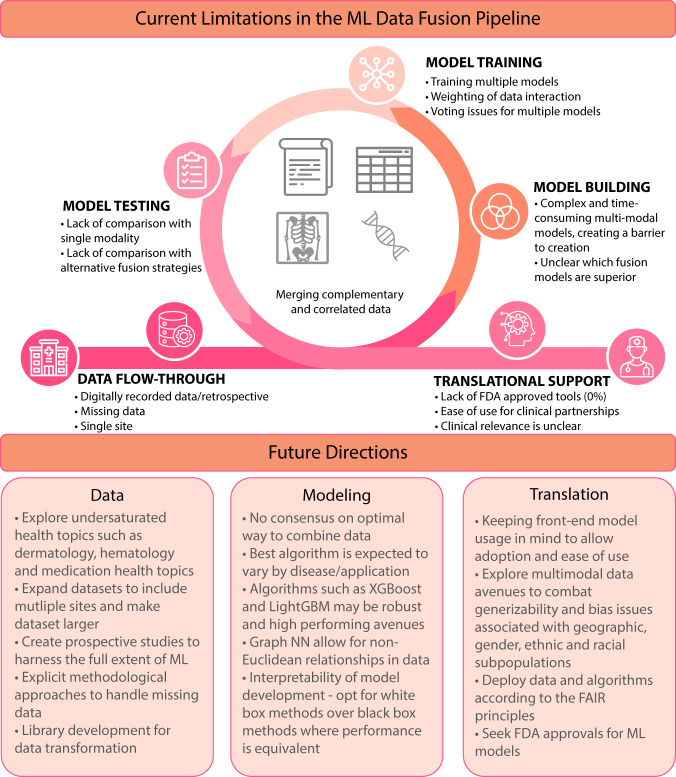
Machine learning is frequently being leveraged to tackle problems in the health sector including utilization for clinical decision-support. Its use has historically been focused on single modal data. Attempts to improve prediction and mimic the multimodal nature of clinical expert decision-making has been met in the biomedical field of machine learning by fusing disparate data. This review was conducted to summarize the current studies in this field and identify topics ripe for future research. We conducted this review in accordance with the PRISMA extension for Scoping Reviews to characterize multi-modal data fusion in health. Search strings were established and used in databases: PubMed, Google Scholar, and IEEEXplore from 2011 to 2021. A final set of 128 articles were included in the analysis. The most common health areas utilizing multi-modal methods were neurology and oncology. Early fusion was the most common data merging strategy. Notably, there was an improvement in predictive performance when using data fusion. Lacking from the papers were clear clinical deployment strategies, FDA-approval, and analysis of how using multimodal approaches from diverse sub-populations may improve biases and healthcare disparities. These findings provide a summary on multimodal data fusion as applied to health diagnosis/prognosis problems. Few papers compared the outputs of a multimodal approach with a unimodal prediction. However, those that did achieved an average increase of 6.4% in predictive performance (as measured by AUC) over the single best unimodal model.
Overview
CoChat Summary
## TL;DR
This scoping review summarizes 128 articles on multimodal machine learning in health from 2011–2021 and finds that early fusion was the most common data-merging strategy. Across the included studies, multimodal approaches generally improved predictive performance over unimodal methods, but clinical translation, FDA approval, and rigorous reporting were largely lacking.
## Key findings
- The final cohort included 128 articles, and the most common health areas were neurology and oncology.
- 126/128 papers explicitly reported a validation procedure; the most common were N-fold cross validation (55), train-test split (51), leave-one-out cross validation (10), and external dataset validation (10).
- Early fusion was the most common data-merging strategy; late fusion was much less common, with n = 20 papers.
- Among papers that compared multimodal vs unimodal prediction, the multimodal approach achieved an average increase of 6.4% in predictive accuracy/AUC.
- Less than half of the papers were published in journals intended for a clinical audience (37.6%), and none had FDA-approved clinical tools.
## Methods
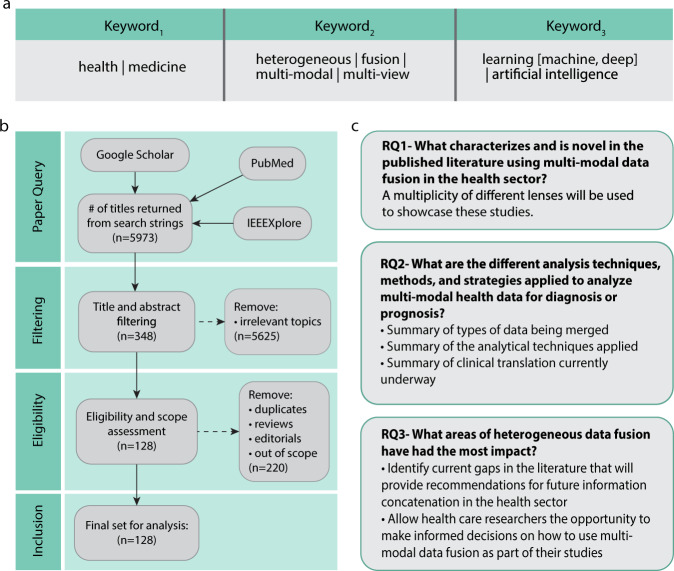
- The authors conducted a PRISMA-ScR scoping review of multimodal/multiview machine learning in health, searching PubMed, Google Scholar, and IEEEXplore for studies published 2011–2021 in English.
- Inclusion criteria required original research on multimodal or multiview machine learning for diagnostic or prognostication applications in human-derived data; 128 articles met criteria after 2-person verification.
- They extracted study characteristics, health topics, modality combinations, fusion type, machine-learning methods, validation, outcomes, and limitations, and summarized the literature descriptively.
## Limitations
- The paper states that it was not a systematic review, so some eligible titles may have been missed.
- The authors note that they did not perform a critical appraisal of methodological quality of the included studies.
- Evident from the text: many included studies had common methodological issues such as single-site cohorts, small sample sizes, retrospective data, imbalanced samples, missing-data handling, confounding, and limited interpretability, which likely affect generalizability and clinical use.
Model-written summary. Check it against the paper before relying on it.
Integrity signals
Registry
Cites
Statistics
Figures
Verification
Claims the paper makes
16 Valid · 3 Not valid · 14 Not checked · 40 Own results and interpretations
Every source the paper cites for this claim was checked and supports it.
In the paper
“Data from different sources and file formats are rarely uniform, and this is especially the case with clinical data21.”
§ Multimodal machine learning in precision health: A scoping review > Introduction
What the sources say
- Supportedcites [21] Kohane IS What every reader should know about studies using electronic health record data but may be afraid to ask J. Med. Internet Res. 2021 23 e22219 10.2196/22219 33600347 PMC7927948 source
The Data Collection and Handling section says clinical data elements can use different units and codes across hospitals and even within one health system, requiring harmonization. The Data Type section also describes differences between codified records and clinical narrative text. Together, these support the cited point that clinical data from different sources are often not uniform. (LLM, conf=0.87)
plain- Asserted: passes — The authors put it forward as true.
- Checkable: passes — It can be checked against evidence.
- Load-bearing: passes — The paper’s conclusions depend on it.
- Based: passes — The paper gives a reason why it holds.
- Supported
Every source the paper cites for this claim was checked and supports it.
In the paper
“Medication/drug topics present an underrepresented area, with only two papers being published in this field50,66.”
§ Multimodal machine learning in precision health: A scoping review > Discussion
What the sources say
- Supportedcites [50] Sivan K Predicting risk for Alcohol Use Disorder using longitudinal data with multimodal biomarkers and family history: A machine learning study Mol. Psychiatry 2021 26 1133 1141 10.1038/s41380-019-0534-x 31595034 PMC7138692 source
The Methods (Participants; page not supplied) describe this as a study predicting later alcohol use disorder, so the source serves as an example of a drug-related paper. The statement that there were only two such papers is the citing authors’ count, not a finding attributed to this individual study. (LLM, conf=0.86)
- Supportedcites [66] Yi, Z. et al. Predicting adverse drug reactions of combined medication from heterogeneous pharmacologic databases. BMC Bioinform.19, 517 (2018). PMC6311930 30598065 source
The Abstract Background and Background and motivation identify this paper as research on adverse drug reactions from combined medication. The citation identifies one of the two medication/drug papers counted by the citing authors; it does not attribute the literature count to this source. (LLM, conf=0.90)
plain- Asserted: passes — The authors put it forward as true.
- Checkable: passes — It can be checked against evidence.
- Load-bearing: passes — The paper’s conclusions depend on it.
- Based: passes — The paper gives a reason why it holds.
- Supported
The cited sources support only part of this claim — read each source’s verdict below.
In the paper
“Seldom were machine learning investigations on prospective data, an issue endemic in the field84.”
§ Multimodal machine learning in precision health: A scoping review > Discussion
What the sources say
- Partly supportedcites [84] Niha, B. et al. Radiogenomic analysis of hypoxia pathway is predictive of overall survival in Glioblastoma. Sci. Rep.8, 7 (2018). PMC5758516 29311558 sourceExperimental — accuracy not yet measured
The Methods (Study Population) describe this machine-learning study as a retrospective analysis, and the Discussion identifies retrospective data collection as a limitation. That supports one example of non-prospective research, but the paper does not establish that prospective machine-learning investigations are seldom conducted across the field. (LLM, conf=0.78)
plain- Asserted: passes — The authors put it forward as true.
- Checkable: passes — It can be checked against evidence.
- Load-bearing: unclear — It is unclear whether the paper’s conclusions depend on it.
- Based: passes — The paper gives a reason why it holds.
- Partly supported
The cited sources support only part of this claim — read each source’s verdict below.
In the paper
“Multiple studies have now pointed out that if the data an ML model is trained on is biased this often yields bias in the predictions186,187.”
§ Multimodal machine learning in precision health: A scoping review > Discussion
What the sources say
- Partly supportedcites [186] Obermeyer Z Powers B Vogeli C Mullainathan S Dissecting racial bias in an algorithm used to manage the health of populations Science 2019 366 447 53. 10.1126/science.aax2342 31649194 sourceExperimental — accuracy not yet measured
The paper explains that using health care costs as a training label produced racially biased predictions of health needs because costs reflect unequal access to care (p. 2; Mechanism of bias, p. 4). This supports the claim that bias in training data can lead to biased predictions, but the study does not establish that this *often* happens across ML models. (LLM, conf=0.82)
- Not checked — no full text of the sourcecites [187] Wang H Using machine learning to integrate sociobehavioral factors in predicting cardiovascular-related mortality risk Stud. Health Technol. Inf. 2019 264 433 437 31437960 source
hedgedstates a possible cause- Asserted: passes — The authors put it forward as true.
- Checkable: passes — It can be checked against evidence.
- Load-bearing: passes — The paper’s conclusions depend on it.
- Based: passes — The paper gives a reason why it holds.
- Partly supported
The sources with a verdict support this claim; the rest weren’t checked yet, have no full text we could read, or their verdicts aren’t rated yet.
In the paper
“While incorporating disparate data does lend itself to seemingly better predictions139, as knowledge around certain diseases accumulates, data fusion in healthcare is an evolving target that warrants proactively adapting to the dynamic landscape190.”
§ Multimodal machine learning in precision health: A scoping review > Discussion
What the sources say
- Supportedcites [139] Nikolaos K Prediction models of functional outcomes for individuals in the clinical high-risk state for psychosis or with recent-onset depression: A multimodal, multisite machine learning analysis JAMA Psychiatry 2018 75 1156 1172 10.1001/jamapsychiatry.2018.2165 30267047 PMC6248111 source
The Discussion reports improved prognostic performance from blending structural MRI and functional data, particularly for patients with ambiguous clinical decision scores. It describes these results as evidence of improvements from multimodal risk assessment, supporting the citing sentence’s qualified claim. The supplied passages do not provide page numbers. (LLM, conf=0.90)
- Not checked — no full text of the sourcecites [190] Luo Y Wunderink RG Lloyd-Jones D Proactive vs reactive machine learning in health care: Lessons from the COVID-19 pandemic JAMA 2022 327 623 624 10.1001/jama.2021.24935 35085382 source
hedgedstates a possible cause- Asserted: passes — The authors put it forward as true.
- Checkable: passes — It can be checked against evidence.
- Load-bearing: unclear — It is unclear whether the paper’s conclusions depend on it.
- Based: passes — The paper gives a reason why it holds.
- Supported
32 more claims · 1 with their cited sources checked
Create a free account to see all 73 claims and to verify the 2 references still open.
- Probably not a substantial claim. 22
- It may state two separate claims as one. 18
Claims other papers make about this one
Each is checked against this paper’s own text: does it say what the citing paper says it does?
The source backs part of the claim, not all of it — or backs it for a different population, condition or comparison.
In the citing paper
“Generative AI can analyse a patient’s genetic makeup, lifestyle and medical history to predict how they might respond to different treatments [48].”
From Generative AI in healthcare: an implementation science informed translational path on application, integration and governance (2024) · cites this paper as [48]
Experimental — accuracy not yet measuredThe source backs part of the claim, not all of it — or backs it for a different population, condition or comparison.
In the citing paper
“Machine learning models that integrate task-relevant multimodal EHR have been shown to yield superior performance compared to those relying on a single modality2–6.”
From MoMA: a mixture-of-multimodal-agents architecture for enhancing clinical prediction modelling (2025) · cites this paper as [6]
Experimental — accuracy not yet measuredThe source backs part of the claim, not all of it — or backs it for a different population, condition or comparison.
In the citing paper
“By using various fusion strategies designed to integrate information from multiple data modalities effectively, multimodal models allow for the compensation of information that may be missing or incomplete in any single modality, thus providing more comprehensive and clinically relevant insights into a patient’s condition that can match the cognitive behavior of healthcare providers [7,8,16,17].”
From Multimodal Artificial Intelligence for Precision Critical Care: A Scoping Review (2026) · cites this paper as [17]
Experimental — accuracy not yet measuredThe source backs part of the claim, not all of it — or backs it for a different population, condition or comparison.
In the citing paper
“In multimodal AI, variations in clinical practice, resource availability, and patient characteristics can lead to systematic underrepresentation of certain patient groups or clinical scenarios in the data, resulting in biased model training and reduced fairness [8,17].”
From Multimodal Artificial Intelligence for Precision Critical Care: A Scoping Review (2026) · cites this paper as [17]
Experimental — accuracy not yet measuredThe cited source says what the claim attributes to it.
In the citing paper
“which aligns with the 6.4 percentage points improvement reported previously by Kline et al. (2022).”
From Navigating the landscape of multimodal AI in medicine: A scoping review on technical challenges and clinical applications (2025) · cites this paper as Kline et al. (2022)
6 more claims about this paper
Create a free account to see every claim other papers make about this one.
Citations
Cites
PRISMA Extension for Scoping Reviews (PRISMA-ScR): Checklist and Explanation
Tricco, A. C., Lillie, E., Zarin, W., O'Brien, K. K., Colquhoun, H., Levac, D., Moher, D., Peters, M. D. J., Horsley, T., Weeks, L., et al. (2018) · Annals of Internal Medicine · doi:10.7326/m18-0850 · Cited by 43,565
The FAIR Guiding Principles for scientific data management and stewardship
Wilkinson, M. D., Dumontier, M., Aalbersberg, I. J., Appleton, G., Axton, M., Baak, A., Blomberg, N., Boiten, J.-W., da Silva Santos, L. B., Bourne, P. E., et al. (2016) · Scientific Data · doi:10.1038/sdata.2016.18 · Cited by 18,423
LightGBM: A Highly Efficient Gradient Boosting Decision Tree
(2017) · HAL · Cited by 10,512
The cancer genome atlas pan-cancer analysis project
The Cancer Genome Atlas Research Network, Weinstein, J. N., Collisson, E. A., Mills, G. B., Shaw, K. R. M., Ozenberger, B. A., Ellrott, K., Shmulevich, I., Sander, C., & Stuart, J. M. (2013) · Nature Genetics · doi:10.1038/ng.2764 · Cited by 9,092 · cited 1×
“This is likely fostered by curated databases that lend themselves to multi-modality predictions such as Alzheimer ’ s Disease Neuroimaging Initiative 165 and The Cancer Genome Atlas Program 166 .”
BackgroundDissecting racial bias in an algorithm used to manage the health of populations
Obermeyer, Z., Powers, B., Vogeli, C., & Mullainathan, S. (2019) · Science · doi:10.1126/science.aax2342 · Cited by 7,137
By the 2019 American Geriatrics Society Beers Criteria® Update Expert Panel (2019) · Journal of the American Geriatrics Society · doi:10.1111/jgs.15767 · Cited by 3,163
Key challenges for delivering clinical impact with artificial intelligence
Kelly, C. J., Karthikesalingam, A., Suleyman, M., Corrado, G., & King, D. (2019) · BMC Medicine · doi:10.1186/s12916-019-1426-2 · Cited by 3,136
Deep learning for healthcare: review, opportunities and challenges
Miotto, R., Wang, F., Wang, S., Jiang, X., & Dudley, J. T. (2018) · Briefings in Bioinformatics · doi:10.1093/bib/bbx044 · Cited by 3,076 · cited 1×
“Clinical decision support has long been an aim for those implementing algorithms and machine learning in the health sphere 1 – 3 .”
Self-citationEnsemble based systems in decision making
Polikar, R. (2006) · IEEE Circuits and Systems Magazine · doi:10.1109/mcas.2006.1688199 · Cited by 2,938
Alzheimer's Disease Neuroimaging Initiative (ADNI)
Petersen, R. C., Aisen, P. S., Beckett, L. A., Donohue, M. C., Gamst, A. C., Harvey, D. J., Jack, C. R., Jagust, W. J., Shaw, L. M., Toga, A. W., et al. (2010) · Neurology · doi:10.1212/wnl.0b013e3181cb3e25 · Cited by 2,572
Research works printed but not linked: 8
- Alan NS Christopher LB Franklin EW Revisions to the JDL data fusion model Sens. Fusion.: Architectures, Algorithms, Appl. III 1999 3719 430
- Xiaosong, W., Yifan, P., Le, L., Zhiyong, L. & Ronald, M. S. TieNet: Text-Image embedding network for common thorax disease classification and reporting in chest X-rays. In Proceedings of the IEEE Computer Society Conference on Computer Vision and Pattern Recognition 9049–9058 (IEEE Computer Society, 2018).
- Yanbo, X., Siddharth, B., Shriprasad, R. D., Kevin, O. M. & Jimeng, S. RAIM: Recurrent attentive and intensive model of multimodal patient monitoring data. In Proceedings of the ACM SIGKDD International Conference on Knowledge Discovery and Data Mining 2565–2573 (Association for Computing Machinery, 2018).
- Esra, Z. et al. Multimodal fusion strategies for outcome prediction in Stroke. In HEALTHINF 2020 - 13th International Conference on Health Informatics, Proceedings
- Wenhuan Z Anupam G Daniel HH On the application of advanced machine learning methods to analyze enhanced, multimodal data from persons infected with covid-19 Computation 2021 9 1 15
- Cao, W. et al. Brits: Bidirectional Recurrent Rmputation for Time Series. NeurIPS, 31 (2018).
- Luo, Y. & Mao, C. ScanMap: Supervised confounding aware non-negative matrix factorization for polygenic risk modeling. In Machine Learning for Healthcare Conference; 2020: PMLR 27–45 (2020).
- Kalavathy R Suresh RM Pharmacovigilance from electronic medical records to report adverse events J. Chem. Pharm. Sci. 2015 2015 188 191
Cited by
Items 201–300 of 524
Chawla, V., Çizmeci, M. N., Sullivan, K. M., Gritz, E. C., Cardona, V. Q., Menkiti, O. R., Natarajan, G., Rao, R., McAdams, R. M., & Dizon, M. L. V. (2025) · Pediatric Research · doi:10.1038/s41390-025-04336-y · Cited by 5
“118 Examples of pipeline fusion in pediatric neuroprog-nostication studies include combining T2-weighted MRI, DTI, resting state functional MRI, and clinical data, 16 combining T1-weighted MRI and DTI 17,18 , and combining MRI and wearable sensor data.”
Detrois, K. E., Hartonen, T., Teder‐Laving, M., Jermy, B. S., Läll, K., Yang, Z., FinnGen, Mägi, R., Ripatti, S., & Ganna, A. (2025) · Nature Genetics · doi:10.1038/s41588-025-02298-9 · Cited by 7
“More complex models could further exploit the longitudinal nature of EHR information and use other data modalities available in the EHR systems 5,15,42 .”
FPGA-based automatic Pill Dispenser using Decision Tree Classifier
(2023) · Journal of Population Therapeutics and Clinical Pharmacology · doi:10.47750/jptcp.2023.30.11.017 · Cited by 5
Anomaly Detection - Recent Advances, AI and ML Perspectives and Applications
Krishna Parimala, V. (2023) · Artificial intelligence · doi:10.5772/intechopen.110988 · Cited by 6
Mosaic LSM: A Liquid State Machine Approach for Multimodal Longitudinal Data Analysis
Budhraja, S., Singh, B., Doborjeh, M., Doborjeh, Z., Tan, S. C. W., Lai, E. M.-K., Goh, W. W. B., & Kasabov, N. K. (2023) · International Joint Conference on Neural Networks (IJCNN) · doi:10.1109/ijcnn54540.2023.10191256 · Cited by 5
“This type of data can be useful for more accurate diagnosis, prognosis and the development of personalized medicine and treatment planning [2].”
BackgroundMulti-Modal Fusion of Routine Care Electronic Health Records (EHR): A Scoping Review
Miled, Z. B., Shebesh, J. A., Su, J., Dexter, P. R., Grout, R. W., & Boustani, M. A. (2025) · Information · doi:10.3390/info16010054 · Cited by 13
Howard, M. A., Lawn, T., & Kowalczyk, O. S. (2023) · Current Opinion in Supportive and Palliative Care · doi:10.1097/spc.0000000000000653 · Cited by 4
PheSeq, a Bayesian deep learning model to enhance and interpret the gene-disease association studies
Yao, X., Ouyang, S., Lian, Y., Peng, Q., Zhou, X., Huang, F., Hu, X., Shi, F., & Xia, J. (2024) · Genome Medicine · doi:10.1186/s13073-024-01330-7 · Cited by 6
“There are three main types of data fusion strategies used in machine learning; early (data-level), intermediate (joint-level), and late (decision-level) [89, 90].”
BackgroundA Scalable Framework for Closed-Loop Neuromodulation with Deep LearningPreprint
Gebodh, N., Miskovic, V., Laszlo, S., Datta, A., & Bikson, M. (2023) · bioRxiv (Cold Spring Harbor Laboratory) · doi:10.1101/2023.01.18.524615 · Cited by 7
A Novel Prediction Model for Multimodal Medical Data Based on Graph Neural Networks
Zhang, L., Li, T., Cui, H., Zhang, Q., Jiang, Z., Li, J., Welsch, R. E., & Jia, Z. (2025) · Machine Learning and Knowledge Extraction · doi:10.3390/make7030092 · Cited by 4
“Kline et al. [9] described the diversity of forms and modalities of multimodal medical data in their study.”
de Lima, L. M., & Krohling, R. A. (2025) · Expert Systems · doi:10.1111/exsy.70130 · Cited by 6
“This task is known as multimodal data fusion and is a promising form to tackle problems in the health sector (Kline et al. 2022).”
Integrative multimodal hybrid data fusion for mortality prediction
Abuhamad, H., Zainudin, S., & Bakar, A. A. (2026) · Scientific Reports · doi:10.1038/s41598-026-36296-6 · Cited by 15
Precision cardiovascular medicine with big data and AI
Xu, Q., Li, Y., Zhu, M., Cai, Y., Cheng, X., Wan, M., Ju, J., Xu, Y., Li, Y., & Liu, Y. (2026) · npj Digital Medicine · doi:10.1038/s41746-026-02538-0 · Cited by 8
“Depending on the level of integration, three primary fusion strategies are employed in machine learning: early (feature-level), intermediate, and late (decision-level) fusion 52 .”
Self-citationRagni, F., Bovo, S., Zen, A., Sona, D., Nadai, K. D., Adamo, G., Pellegrini, M., Nasini, F., Vivarelli, C., Tavolato, M., et al. (2024) · Diagnostics · doi:10.3390/diagnostics14232609 · Cited by 5
Chang, Y., Hsiao, S.-H., Yeh, W.-C., Hsing, Y.-C., Wang, C.-C., & Chen, C.-Y. (2025) · Computers in Biology and Medicine · doi:10.1016/j.compbiomed.2025.110621 · Cited by 5
Gao, H., Harris, J., Maupin, D. J., Schneider, S., Hernandez, R., & Jin, H. (2025) · Public Health · doi:10.1016/j.puhe.2025.105822 · Cited by 7
MFISN: Modality Fuzzy Information Separation Network for Disease Classification
Nan, F., Pu, B., Pan, J., Fan, Y., Yang, J., Dong, X., Xu, Z., & Wang, S. (2024) · IEEE Transactions on Fuzzy Systems · doi:10.1109/tfuzz.2024.3371678 · Cited by 4
“Multimodal medical image classification: Over the past decade, a plethora of multimodal medical image classification algorithms have witnessed extensive development [3], [5], [9], [23], [25], [26].”
BackgroundSelf-citationMultimodal fusion for anticipating human decision performance
Tran, X.-T., Do, T., Pal, N. R., Jung, T., & Lin, C. (2024) · Scientific Reports · doi:10.1038/s41598-024-63651-2 · Cited by 12
“This finding aligns with the growing consensus in cognitive neuroscience and machine learning 37 that integrating multiple data sources can substantially improve model accuracy.”
ResultGowri, B. S., Sharan, M., Gehlot, Y., & Varma, V. C. (2024) · doi:10.1109/iccds60734.2024.10560446 · Cited by 5
On the Robustness and Reliability of Late Multi-Modal Fusion using Probabilistic Circuits
Sidheekh, S., Tenali, P., Mathur, S., Blasch, E., & Natarajan, S. (2024) · International Conference on Information Fusion (FUSION) · doi:10.23919/fusion59988.2024.10706372 · Cited by 11
“These challenges are prevalent in many real-world domains such as sensor fusion [3, 4], medical diagnosis [5], and financial analysis [6].”
BackgroundAbe, D., Inaji, M., Hase, T., Suehiro, E., Shiomi, N., Yatsushige, H., Hirota, S., Hasegawa, S., Karibe, H., Miyata, A., et al. (2025) · Frontiers in Neurology · doi:10.3389/fneur.2024.1502153 · Cited by 8
Anomaly Detection in Medical Time Series with Generative Adversarial Networks: A Selective Review
Cekic, M. M. (2024) · Artificial intelligence · doi:10.5772/intechopen.112582 · Cited by 10
Multimodal Artificial Intelligence for Precision Critical Care: A Scoping Review
Yang, M., Shi, N., Chen, H., Po, E. Y. P., Ng, P. Y., Lai, P. C. K., Wu, Y.-C., & Fong, D. Y. T. (2026) · Health Data Science · doi:10.34133/hds.0356 · Cited by 3
“In addition, data imbalance occurs when certain groups or classes are over-or underrepresented in a dataset, which can introduce bias into the performance of AI models [ 17 ].”
InfluentialPark, J., Shin, H., Kim, M. H., Kim, Y.-H., Ryu, W., Kim, E. Y., Chang, H., Lee, W., Kim, J. H., & Kim, T. (2025) · Journal of Clinical Sleep Medicine · doi:10.5664/jcsm.11560 · Cited by 5
“45 Among the various machine learning methods, LR performed best in identifying OSA risk.”
Leveraging transparent ontology learning to refine constructs in neuroscience
Moreau, D., & Wiebels, K. (2025) · Neuroscience Informatics · doi:10.1016/j.neuri.2025.100199 · Cited by 3
Liu, J., Hu, S., Wang, Y., Xiang, W., & Yang, C. (2025) · IEEE Internet of Things Journal · doi:10.1109/jiot.2025.3579524 · Cited by 5
“As highlighted by Kline et al. [35] and Shaik et al. [36], there remain open challenges in model sparsity, adaptive gating, and uncertainty modeling—especially for efficient deployment in real-world, resource-constrained IoMT environments.”
Beyond health: A machine learning analysis of structural barriers to school attainment in Somalia
Ali, J. A., Cumar, M. A., Abdi, M. K., Muse, A. H., & Abdikarim, H. (2025) · PLoS ONE · doi:10.1371/journal.pone.0326958 · Cited by 5
“Conversely, gender-based violence and adolescent pregnancy remain substantial obstacles to girls’ education in many parts of the world [6,34,48].”
Multimodal Fusion of Chest X-Rays and Blood Biomarkers for Automated Silicosis Staging
Priego, B., Sopo-Lambea, I., Khalili, E., Martín-Carrillo, A., Campos‐Caro, A., León‐Jiménez, A., & Morillo, D. (2025) · Journal of Clinical Medicine · doi:10.3390/jcm14228074 · Cited by 7
“Modality-level fusion techniques, including the early, intermediate, and late fusion, have demonstrated significant potential to improve predictive precision in various health-care domains, particularly in the diagnosis and prognosis of diseases [29,30].”
Fu, W., Li, H., Quan, X., Wang, X., Huang, W., & Zhang, H. (2025) · Interdisciplinary Sciences Computational Life Sciences · doi:10.1007/s12539-025-00783-7 · Cited by 3
Islam, M. S., Jamal, A. T., & Alkhathlan, A. (2025) · Diagnostics · doi:10.3390/diagnostics16010107 · Cited by 5
Nakanishi, R., Hirata, A., & Kubota, Y. (2025) · Sensors · doi:10.3390/s26010212 · Cited by 6
“These findings are consistent with broader trends in biomedical informatics, where integrating heterogeneous modalities has been shown to enhance predictive performance and facilitate personalized medicine [36,44].”
Ibam, E. O., & Oluwagbemi, J. B. (2026) · Journal of Computing Theories and Applications · doi:10.62411/jcta.14944 · Cited by 5
Dupont, J., Frau, F., Robic, V., Jimeno, M. M., Phan, L., Nougaret, S., Ammari, S., Cournède, P.-H., Italiano, A., Lassau, N., et al. (2026) · Diagnostic and Interventional Imaging · doi:10.1016/j.diii.2026.02.001 · Cited by 10
Explainable multimodal deep learning models for variable-length sequences in critically ill patients
Martin, J., Afshar, M., Afshar, A. S., Caskey, J., Dligach, D., Gao, Y., Gao, J., Chen, G., Mayampurath, A. M., & Churpek, M. M. (2026) · Journal of Biomedical Informatics · doi:10.1016/j.jbi.2026.105001 · Cited by 6
Patel, A., Vallamchetla, S. K., Safa, A., Tatit, C. P., Bestic, O., Knox, A. K., Roberts, M., Tatum, W. O., & Freund, B. E. (2026) · Scientific Reports · doi:10.1038/s41598-026-46333-z · Cited by 3
Toumaj, S., & Heidari, A. (2026) · Artificial Intelligence Review · doi:10.1007/s10462-026-11606-6 · Cited by 3
Gonidakis, P., Sóñora-Mengana, A., Jansen, B., & Vandemeulebroucke, J. (2023) · IEEE Access · doi:10.1109/access.2023.3331315 · Cited by 3
“Considering previous work in the fields of video classification [9], human activity recognition [10], emotion recognition [11] and medical imaging [7], a universal optimal choice of fusion does not exist.”
BackgroundMethodConverting OMOP CDM to phenopackets: A model alignment and patient data representation evaluation
Schiffer, K., Liu, C., Callahan, T. J., Ta, C., Nestor, J. G., & Weng, C. (2024) · Journal of Biomedical Informatics · doi:10.1016/j.jbi.2024.104659 · Cited by 3
Dimakatso, T., Kuthadi, V. M., Selvaraj, R., & Dinakenyane, O. (2024) · IEEE International Conference on ICT in Business Industry & Government (ICTBIG) · doi:10.1109/ictbig64922.2024.10911239 · Cited by 7
“Also, other problems persist as reviewed in several papers, such as Kline et al. (2022) [32], noted the difficulty of scaling multimodal machine learning systems for widespread clinical use.”
InfluentialSu, J., Xie, Q., Deng, Y., Wang, C., Xie, S., Gao, N., Ma, X., Kim, S. W., Nyachoti, C. M., Yin, Y., et al. (2025) · Computers and Electronics in Agriculture · doi:10.1016/j.compag.2025.110641 · Cited by 3
Wahab, N. H. A., Hasikin, K. B., Lai, K. W., Xia, K., Taing, A. Y., & Zhang, R. (2025) · IEEE Access · doi:10.1109/access.2025.3581548 · Cited by 9
“Multimodal learning utilizing ML and DL methodologies integrates various input modalities into a singular model to enhance an algorithmic structure’s uniqueness and informative value [30].”
MedHub – LLM-based Healthcare System
Mahendran, R. K., Shreenidhi, G. L., & Sowmiya, S. (2025) · International Conference on Augmented Intelligence and Sustainable Systems (ICAISS) · doi:10.1109/icaiss61471.2025.11042126 · Cited by 4
“While the system is designed to focus on patient-centric outcomes, it requires access to extensive medical data for training, and the effectiveness of retrieval-augmented generation in disease prediction still necessitates further validation [13].”
In-context learning for label-efficient cancer image classification in oncology
Shrestha, M., Mandal, B., Mandal, V., Shrestha, A., & Shrestha, A. B. (2025) · Informatics in Medicine Unlocked · doi:10.1016/j.imu.2025.101683 · Cited by 8
Bohnsack, K. S., Voigt, J., Kaden, M., Heinke, F., & Villmann, T. (2023) · Neurocomputing · doi:10.1016/j.neucom.2023.126632 · Cited by 3
IMPROVING FASHION INDUSTRY USING ARTIFICIAL INTELLIGENCE-ENABLED IN-VIDEO ADVERTISEMENTS
Shah, A., & Nasnodkar, S. P. (2023) · EPH - International Journal of Business & Management Science · doi:10.53555/eijbms.v9i3.146 · Cited by 3
“The User is currently alert and receptive to any messaging, making them an engaged client.[19] Right now, the system searches for the quickest match and displays the advertiser's goods with the necessary specifications & information.”
BackgroundBarbati, G., Pasqualetti, P., Matranga, D., Scotti, L., Franchi, M., Simeon, V., Signoriello, S., Gandin, I., Pacella, D., Porreca, A., et al. (2024) · Epidemiology Biostatistics and Public Health · doi:10.54103/2282-0930/22227 · Cited by 4
“On the other hand, nowadays with the increasing availability of multi-modal sources of data, AI approaches could be the preferred choice with respect to standard statistical approaches, being able to handle heterogeneous data sources [4].”
Improving the Efficiency of Multimodal Approach for Chest X-Ray
Upadhya, J., Vargas, J., Poudel, K. N., & Ranganathan, J. (2024) · Lecture notes in networks and systems · doi:10.1007/978-3-031-56950-0_5 · Cited by 4
Enhancing Classification and Prediction through the Application of Hybrid Machine Learning Models
Banda, M., Ngassam, E. K., & Mnkandla, E. (2024) · IST-Africa Conference (IST-Africa) · doi:10.23919/ist-africa63983.2024.10569590 · Cited by 8
“Similar ML models have been used to achieve greater prediction accuracy in different industries by deploying more than one model using sequential or combination strategies [4], [5], [6], [31], [32].”
MethodArtificial intelligence and digital health in Anesthesiology
Ye, J., & Bronstein, S. (2025) · Elsevier eBooks · doi:10.1016/b978-0-443-15728-8.00008-2 · Cited by 10
Chen, P., & Shih, T. T. (2023) · Journal of Magnetic Resonance Imaging · doi:10.1002/jmri.28637 · Cited by 3
“However, it should integrate more clinical information other than medical imaging alone to investigate the robustness of multimodal analysis in the future research.(10) Moreover, the authors should mention the difficulty of having CT and MRI studies together and emphasize the best choice of radiomics in this article.”
BackgroundUtilizing multimodal AI to improve genetic analyses of cardiovascular traitsPreprint
Zhou, Y., Cosentino, J., Yun, T., Biradar, M. I., Shreibati, J. B., Lai, D., Schwantes-An, T.-H. L., Luben, R., McCaw, Z. R., Engmann, J., et al. (2024) · medRxiv · doi:10.1101/2024.03.19.24304547 · Cited by 3
MoMA: a mixture-of-multimodal-agents architecture for enhancing clinical prediction modelling
Gao, J., Rahman, M., Caskey, J., Oguss, M., O’Rourke, A., Brown, R., Stey, A., Mayampurath, A., Churpek, M. M., Chen, G., et al. (2025) · npj Digital Medicine · doi:10.1038/s41746-025-02219-4 · Cited by 2
“Machine learning models that integrate task-relevant multimodal EHR have been shown to yield superior performance compared to those relying on a single modality 2 – 6 .”
Causal Economic Machine Learning (CEML): “Human AI”
Horton, A. (2024) · AI · doi:10.3390/ai5040094 · Cited by 5
Wu, D., Liu, N., Ma, R., & Wu, P. (2025) · Journal of Medical Internet Research · doi:10.2196/71970 · Cited by 4
Guo, X., Liu, S., Jiang, L., Xiong, Z., Wang, L., Li, L., Li, X., Zhao, L., & Shek, D. T. L. (2025) · Journal of Affective Disorders · doi:10.1016/j.jad.2025.120110 · Cited by 5
Liu, M., Ji, X., Ren, Y. H., Zhang, Y., Gao, X., Hou, J., Zhao, X., & Tan, H. (2025) · Journal of Chemical Information and Modeling · doi:10.1021/acs.jcim.5c01579 · Cited by 2
Lu, D., Wu, S., & Huang, X. (2025) · International Conference on Artificial Intelligence, Human-Computer Interaction and Natural Language Processing (ICAHN) · doi:10.1109/icahn67688.2025.00022 · Cited by 4
“Kline et al. [7] performed a systematic survey on multimodal machine learning in precision health.”
Veterinary oncology data management in the era of artificial intelligence
Pu, S., Thompson, M., Ross, S., & Basran, P. S. (2025) · Veterinary oncology. · doi:10.1186/s44356-025-00043-2 · Cited by 2
“Fusing data in multi-modal machine learning can occur in different stages of the data processing pipeline [26].”
A tree-structured multiobjective optimization framework for constructing diagnosis-related groups
Cai, G., Zeng, Z., Wan, M., Liu, N., Wang, Y., & Niu, B. (2025) · npj Digital Medicine · doi:10.1038/s41746-025-02038-7 · Cited by 2
“In addition, interpretability plays a critical role in medical insurance payment systems 19 , ensuring transparency and fairness in decision-making processes.”
Artificial Intelligence–Powered Strategies for Smart Skin Scarring Management
Wang, Z., Zhang, H., Liu, Y., Sun, Y., Xia, W., Zhao, Y., Gao, Y., Lin, Y., Huang, X., & Zan, T. (2025) · Dermatologic Therapy · doi:10.1155/dth/2874866 · Cited by 2
“However, multimodal AI in scar care is still in its infancy, constrained by fragmented data, limited standardization, and high development costs [93].”
He, F., Huang, S., Wang, R., Chang, A., Phillips, J. L., & Sun, C. L. F. (2026) · JMIR Mental Health · doi:10.2196/89352 · Cited by 5
“…high-dimensional, and multimodal health care datasets, including electronic health records, genetic markers, neuroimaging data, and clinical assessments, while identifying subtle patterns predictive of treatment outcomes that may not be detected through conventional analytical approaches [10-12].”
Milić, M. S., Todorović, V., Vučetić, M., & Milosavljević, N. (2026) · Computer Methods in Biomechanics & Biomedical Engineering · doi:10.1080/10255842.2026.2645167 · Cited by 4
Zhang, L., Zhao, J., Cheng, G., Wu, J., Liu, Y., Lei, G., & Wang, Q. (2026) · Frontiers in Immunology · doi:10.3389/fimmu.2026.1753651 · Cited by 3
Precision oncology: from large language models to multi-agent systems
Guo, X., Chen, J., Zhang, Y., Zhang, X., Lu, J., Qin, Q., Chen, J., Gao, X., & Wang, J. (2026) · Frontiers in Oncology · doi:10.3389/fonc.2026.1828507 · Cited by 5
“MLLMs build on LLMs by integrating the capability to receive, fuse, and comprehend heterogeneous information, such as images and text (23).”
Srivastava, S., Patel, S., Tripathy, S., & Tariq, M. (2026) · Springer eBooks · doi:10.1007/978-981-95-8644-8_10 · Cited by 2
Willem, T., Wollek, A., Cheslerean-Boghiu, T., Kenney, M., & Buyx, A. (2025) · JMIR Medical Informatics · doi:10.2196/59452 · Cited by 5
The Role of Machine Learning Models in Predicting Cirrhosis Mortality: A Systematic Review
Mohamud, K. A., Eltahir, S. A. E., Alhardalo, H. A. A., Albashir, H. B., Zain, N. Q. A. A. M., Ibrahim, M. E. A., & Fadlallah, E. N. A. (2025) · Cureus · doi:10.7759/cureus.78155 · Cited by 5
“By utilizing a variety of parameters, machine learning models, on the other hand, provide a clear advantage by improving the accuracy of mortality prediction and revealing intricate nonlinear relationships [22].”
A New Method Using Deep Learning to Predict the Response to Cardiac Resynchronization Therapy
Larsen, K. S., He, Z., Fernandes, F. D. A., Zhang, X., Chen, Z., Sha, Q., Mesquita, C. T., Páez, D., Garcia, E. V., Zou, J., et al. (2025) · Journal of Imaging Informatics in Medicine · doi:10.1007/s10278-024-01380-8 · Cited by 4
“Additionally, from Kline et al. [29], we see that in general across health fields, utilizing multiple modalities of data sources on average increases predictive performance.”
Reproduction of Original Glioblastoma and Brain Metastasis Research Findings Using Synthetic Data
Davalan, W., Khalaf, R., & Diaz, R. J. (2025) · World Neurosurgery · doi:10.1016/j.wneu.2025.123808 · Cited by 3
Liang, L., Liu, T., Ollier, W., Peng, Y., Lu, Y., & Che, C. (2025) · JMIR AI · doi:10.2196/72599 · Cited by 3
Cardiovascular Magnetic Resonance imaging analysis using neural networks
Wang, L. M., Wang, L. M., Wu, P., & Ding, L. (2025) · Journal of Radiation Research and Applied Sciences · doi:10.1016/j.jrras.2025.101874 · Cited by 6
Çoban, F., Kutlu, H., Kalyenci, B., Sulhan, H., & Çift, A. (2025) · World Journal of Urology · doi:10.1007/s00345-025-06064-8 · Cited by 2
Data and Decision Fusion with Uncertainty Quantification for ML-based Healthcare Decision Systems
Bezirganyan, G. (2023) · ACM International Conference on Information and Knowledge Management (CIKM) · doi:10.1145/3583780.3616004 · Cited by 4
Graph-Based Patient Representation for Multimodal Clinical Data: Addressing Data HeterogeneityPreprint
Ghanvatkar, S., & Rajan, V. (2023) · medRxiv · doi:10.1101/2023.12.07.23299673 · Cited by 8
“Current patient risk prediction models often handle multimodal data at similar time resolutions, such as lab tests or clinical notes [Kline et al., 2022].”
BackgroundA multimodal approach for deep-learning classification of vocal fold pathologies in stroboscopy
Surapaneni, S., Kutler, R. B., Setzen, S. A., Kim, Y. E., Yao, P., Siddiqui, S. H., Pitman, M. J., Sulica, L., Elemento, O., Khosravi, P., et al. (2026) · The Laryngoscope · doi:10.1002/lary.70355 · Cited by 2
The Enhanced Canonical Correlation Analysis for Cardiac Arrest Prediction Using Fusional MRI Data
Kalele, G. (2023) · World Conference on Communication & Computing (WCONF) · doi:10.1109/wconf58270.2023.10235111 · Cited by 1
“This technique has been successful in identifying biomarkers of cardiac arrest, providing more comprehensive insights into the structure and function of the heart, as well as resulting in a lower false-positive rate [9].”
MethodHybrid clinical decision support for cardiology: architectural foundations for integrations
Shakhgeldyan, K. J., Gribova, V. V., Geltser, B. I., Шалфеева, Е. А., & Potapenko, B. (2024) · International Conference on Image, Video Processing and Artificial Intelligence (IVPAI) · doi:10.1117/12.3023751 · Cited by 1
“With the growth of data in clinical medicine, including genomics and medical imaging, there is an increasing need for more complex models that can integrate and analyze multimodal data [2, 28].”
BackgroundIoT Based Smart Drug Administrator and Dispenser
Ankireddypalli, R. S., & Reddy, K. S. S. (2023) · International Conference on New Frontiers in Communication, Automation, Management and Security (ICCAMS) · doi:10.1109/iccams60113.2023.10526063 · Cited by 1
Multimodal Learning for Supporting Evidence Base Medicine
Fiaidhi, J., & Mohammed, S. (2024) · Prognostics and System Health Management Conference · doi:10.1109/phm61473.2024.00011 · Cited by 1
“Thus multimodal ML has emerged as a method that enables the training of complex learning models that use heterogeneous and multimodal data in their learning process for providing a single, comprehensive solution to complex clinical problems [4].”
MethodDigital Biomarkers in Neurodevelopmental Health: Current Status, Promises, and Perils
Owotoki, W., Enseroth, A., Mbugua, R. N., & Owotoki, P. (2024) · Integrated science · doi:10.1007/978-3-031-76414-1_4 · Cited by 1
Yalın, N. (2024) · Biological Psychiatry · doi:10.1016/j.biopsych.2024.11.005 · Cited by 1
Multimodal Atrial Fibrillation Risk Stratification: Fusing Post-Stroke Brain DWI and Clinical Data
Shokri, M. J., Desai, N., Rao, A. S., et al. (2025) · IEEE International Conference on Acoustics Speech and Signal Processing · doi:10.1109/icassp49660.2025.10889940 · Cited by 1
“This multimodal approach not only increases accuracy [13], [14] but also allows for more personalized and nuanced stroke management strategies, considering both imaging findings and individual clinical risk factors.”
Multimodal Machine Learning for Evidence Base Medicine
Mohammed, S., & Fiaidhi, J. (2024) · International Conference on Future Telecommunications and Artificial Intelligence (IC-FTAI) · doi:10.1109/ic-ftai62324.2024.10950070 · Cited by 1
“Thus multimodal ML has emerged as a method that enables the training of complex learning models that use heterogeneous and multimodal data in their learning process for providing a single, comprehensive solution to complex clinical problems [4].”
A Short Survey on Multimodal Deep Learning Models in Healthcare
Datsi, T., Ali, B. A. B., Srifi, M., Hachimi, M., & Khayya, E. K. (2025) · Lecture notes in networks and systems · doi:10.1007/978-3-031-95326-2_20 · Cited by 1
Ding, X., & Ma, R. (2025) · Journal of the American Statistical Association · doi:10.1080/01621459.2025.2539539 · Cited by 8
“…different problem which is also frequently encountered in modern biomedical research: the necessity of integrating datasets pertaining to identical samples, while each dataset comprising varying “views” or types of measurements (Rap-poport and Shamir 2018; Li et al. 2020; Kline et al. 2022).”
Advancements and Challenges in AI-Driven Breast Cancer Detection: A Comprehensive Review
Kalsi, P., & Sharma, I. (2025) · International Conference on Computing for Sustainable Global Development · doi:10.23919/indiacom66777.2025.11115411 · Cited by 1
Marchesi, R., Lazzaro, N., Endrizzi, W., Leonardi, G., Pozzi, M., Ragni, F., Bovo, S., Moroni, M., Osmani, V., & Jurman, G. (2026) · PLoS Computational Biology · doi:10.1371/journal.pcbi.1013455 · Cited by 3
“Key hyperparameters included learning rate ([10 −4 , 10 −3 ]), batch size ([64, 128]), number of MLP layers ([4, 5, 6, 7]), MLP hidden size ([256, 512, 1024]), and dimensions for both time ([64, 128]) and conditional embeddings ([8, 16, 32]).”
Racial Bias in Multimodal Classification of Healthcare Data - Evidence from MIMIC-IV
Patel, S., Attarde, P., & Gupta, M. (2025) · IEEE Applied Sensing Conference (APSCON) · doi:10.1109/apscon63569.2025.11144427 · Cited by 1
“Integrating these diverse data types through multimodal fusion techniques can facilitate a comprehensive understanding of a patient’s health, leading to more accurate diagnoses, personalized treatment plans, and proactive healthcare strategies [3], [4].”
Ahammad, K., Fouladzadeh, A., Wardill, H. R., Abbott, D., & Dorraki, M. (2025) · IEEE Access · doi:10.1109/access.2025.3607285 · Cited by 1
“Furthermore, they are of importance in multi-modal medical data management [70], [74], [75], [76], [77].”
Dino, H. I., & Hassan, M. M. (2025) · Neuroscience & Biobehavioral Reviews · doi:10.1016/j.neubiorev.2025.106399 · Cited by 3
Machine Intelligence in Pancreatic Cancer
Yee, N. S., Ma, F., & Georgakopoulos‐Soares, I. (2025) · Springer eBooks · doi:10.1007/978-3-032-00773-5_317 · Cited by 1
Exploring Sensing Technologies for Tracking Healthy Eating Behaviors: Systematic Review
Ataguba, G., & Orji, R. (2025) · International Journal of Human-Computer Interaction · doi:10.1080/10447318.2025.2555632 · Cited by 2
“Besides, this multi-modal data fusion technique has shown a significant increase in the accuracy of machine learning models from research (Kline et al., 2022).”
Towards building robust models for unimodal and multimodal medical imaging data
Dhar, J., Goyal, P., Haghighat, M., Zaidi, N. A., Sohel, F. A., Vo, Q. B., & Santosh, K. (2025) · Information Fusion · doi:10.1016/j.inffus.2025.103822 · Cited by 5
Zhan, M., Xiong, T., Luo, M. B., Hu, M., Chen, L., Nie, D., Yu, M., & Zhang, S. (2025) · World Journal of Pediatric Surgery · doi:10.1136/wjps-2025-001079 · Cited by 1
Using Artificial Intelligence Systems in Modern Neurobehavioral Research
Apukhtin, K. V., Zolotova, A. E., Leunenko, A. O., Perfilova, V. N., & Kalueff, A. V. (2025) · Journal of Evolutionary Biochemistry and Physiology · doi:10.1134/s0022093025060080 · Cited by 1
MPLDM: Multi-modal prosthetic loosening diagnostic model for total hip arthroplasty
Chen, X., Lyu, P., Han, W., Yang, L., Jin, Y., Zhang, T. G., & Shen, J. (2025) · Medical Image Analysis · doi:10.1016/j.media.2025.103921 · Cited by 2
Sharma, H., Kaur, S., & Sharma, H. (2026) · Lecture notes in networks and systems · doi:10.1007/978-3-032-10753-4_7 · Cited by 1
Deng, X., Yang, C., Qin, L.-H., Lin, X.-F., Zhong, F., & Liao, J.-Y. (2026) · Cancer Imaging · doi:10.1186/s40644-025-00987-6 · Cited by 2
Ibrahimi, M. A., Abbad, K., & Abbou, R. B. (2026) · Multimedia Tools and Applications · doi:10.1007/s11042-026-21156-2 · Cited by 4
“Studies have shown that this integration leads to improved predictive performance, with multimodal approaches achieving a notable 6.4% increase in accuracy compared to unimodal methods [28].”
InfluentialEXR: An Interactive Immersive EHR Visualization in Extended Reality
Marteau, B. L., Tan, S. Q. Y., Li, J., Hornback, A. M., Zhong, Y., Wang, S., Lowson, C., Woloff, J., Pahys, J. M., Hwang, S. W., et al. (2025) · IEEE International Conference on Intelligent Reality (ICIR) · doi:10.1109/icir68135.2025.11361561 · Cited by 2
“This approach does not reflect real-world clinical workflows, where clinicians must consider imaging data in conjunction with a patient’s longitudinal health record [18, 19].”
Metadata
- Authors
- Kline, A., Wang, H., Li, Y., Dennis, S., Hutch, M., Xu, Z., Wang, F., Cheng, F., & Luo, Y.
- Affiliations
- Northwestern University (US)
- Cornell University (US)
- Cleveland Clinic Lerner College of Medicine (US)
- Corresponding author
- Luo, Yuan
- Venue
- npj Digital Medicine
- Published
- 2022-11-07
- Volume
- 5
- Issue
- 1
- Pages
- 171-171
- ISSN
- 2398-6352 (ISSN-L)
- PMC
- PMC9640667
- OpenAlex
- W4308885870
- Cited by
- 528
- References
- 203
- Citations by year
- 2026: 162 · 2025: 173 · 2024: 114 · 2023: 64 · 2022: 3
- FWCI
- 105.22
- Type
- journal article
- Language
- en
- Open access
- gold
- doi.org
- Licence
- cc-by
- creativecommons.org/licenses/by/4.0 (tdm)
- creativecommons.org/licenses/by/4.0 (vor)
- Locations
- npj Digital Medicine (publishedVersion, cc-by)
- PubMed (publishedVersion)
- PubMed Central (submittedVersion, cc-by)
- DOAJ (DOAJ: Directory of Open Access Journals) (submittedVersion, cc-by-sa)
- Topics
- Health Sciences › Health Professions › Health Information Management › Artificial Intelligence in Healthcare
- Physical Sciences › Computer Science › Artificial Intelligence › Machine Learning in Healthcare
- Health Sciences › Medicine › Radiology, Nuclear Medicine and Imaging › COVID-19 diagnosis using AI
- Keywords
- multimodal fusion, precision health, clinical decision support, feature-level fusion, neurology, prediction accuracy, clinical deployment, health care disparities
About these checks
Registry, retraction, Cites and statistics results are computed, not judged, with one exception: a printed reference that no index lists is read once by a model before it counts as a citation error. Claims are extracted by a model and kept only when their quote appears verbatim in the text; each cited source is then checked, with a model’s help, for whether it says what the claim relies on. Those verdicts can be wrong — read the claim’s quote and the cited source before relying on one.
The claim verdicts this report counts are experimental: their accuracy is not yet measured.
A language model drew the claims from the paper on 2026-10-09, under version 3 of the claim definition (model deepseek-v4.1-flash, prompt extract-v3).
A second model labelled each claim on 2026-10-09 (model jev-1.13-20260917, definition revision gold-guideline-v0.2).
Cited sources are checked with a language model’s help (gpt-6-sol).
Statistics and arithmetic are recomputed, not judged.
Confidence bands are shown only for fields calibrated on our annotated test set. None is calibrated yet, so no band is shown.
What counts as a claim ›How we measure confidence ›How we check this ›
Are you an author, or do you see a problem with this page? Request a review
Data sources
Bibliographic data: Semantic Scholar, OpenAlex, Crossref.
Contains information from the Semantic Scholar Academic Graph Datasets, made available under the ODC Attribution License (ODC-BY 1.0).
Semantic Scholar’s data is described in: Kinney, R., et al. (2023). The Semantic Scholar Open Data Platform. arXiv:2301.10140.
