

The DOI matches its Crossref record; 40 of the 40 references it cites were found in a registry or an index.
Continuous cuffless blood pressure monitoring with a wearable ring bioimpedance device
Open accessAbstract
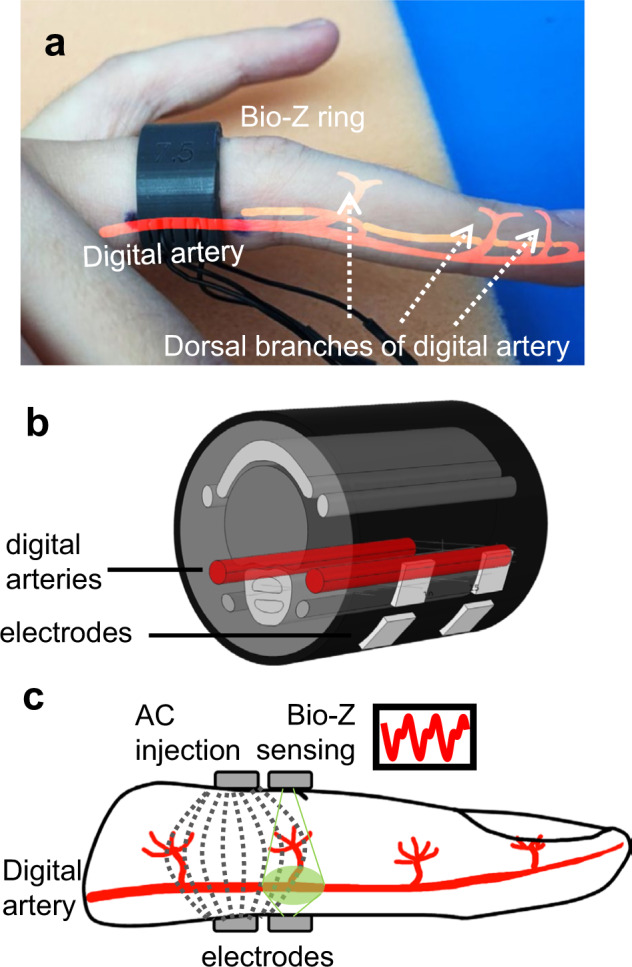
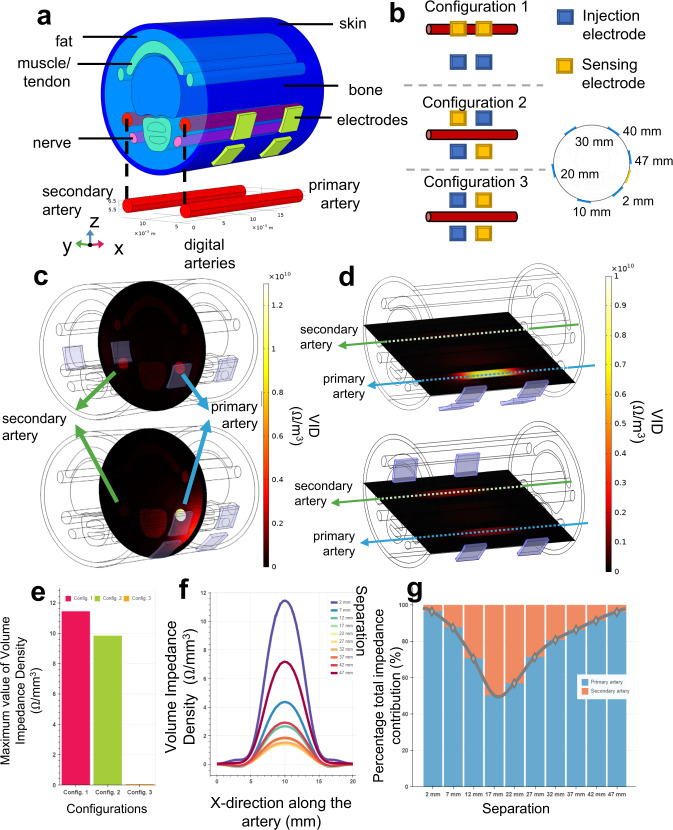
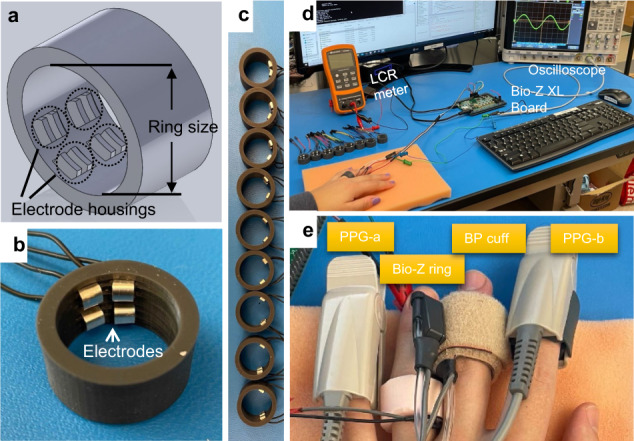
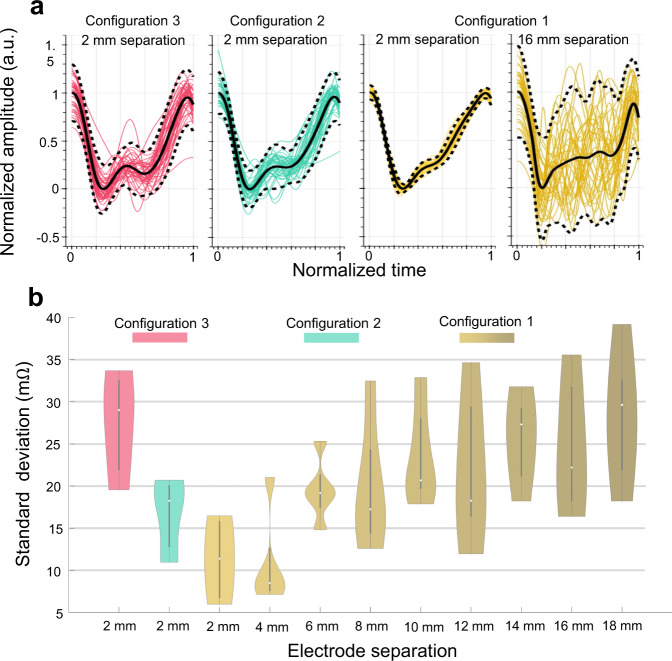
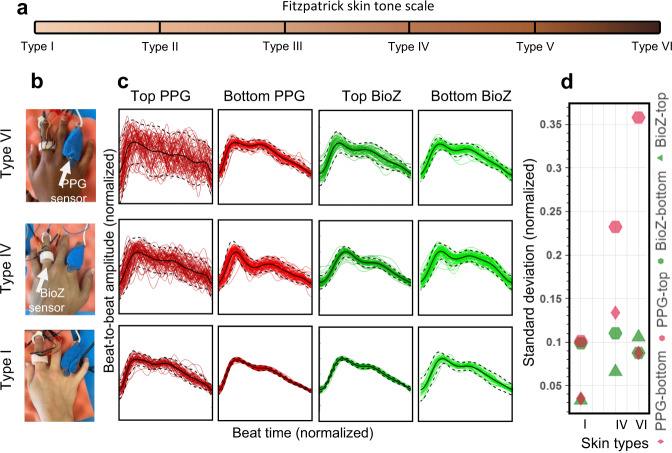
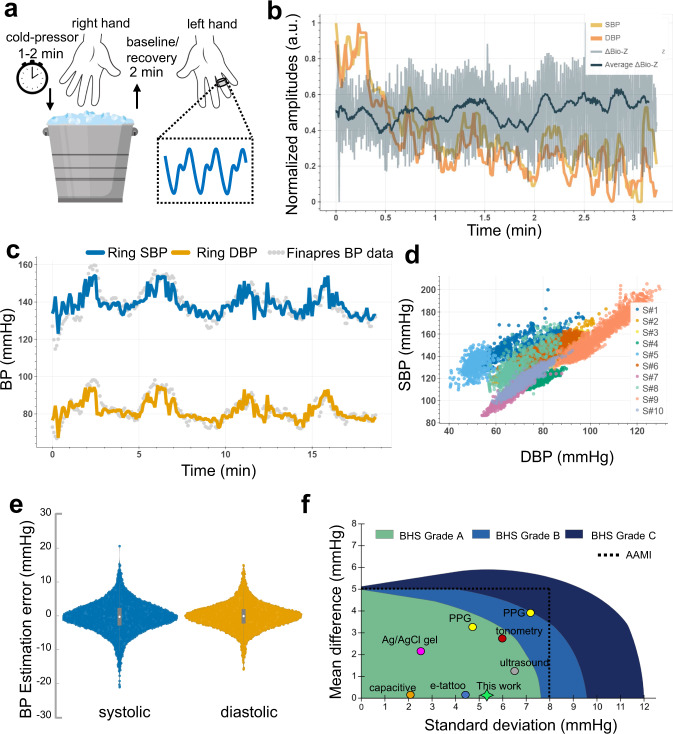
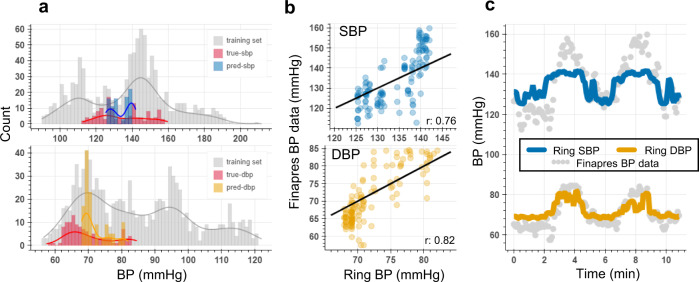
Smart rings provide unique opportunities for continuous physiological measurement. They are easy to wear, provide little burden in comparison to other smart wearables, are suitable for nocturnal settings, and can be sized to provide ideal contact between the sensors and the skin at all times. Continuous measuring of blood pressure (BP) provides essential diagnostic and prognostic value for cardiovascular health management. However, conventional ambulatory BP measurement devices operate using an inflating cuff that is bulky, intrusive, and impractical for frequent or continuous measurements. We introduce ring-shaped bioimpedance sensors leveraging the deep tissue sensing ability of bioimpedance while introducing no sensitivity to skin tones, unlike optical modalities. We integrate unique human finger finite element model with exhaustive experimental data from participants and derive optimum design parameters for electrode placement and sizes that yields highest sensitivity to arterial volumetric changes, with no discrimination against varying skin tones. BP is constructed using machine learning algorithms. The ring sensors are used to estimate arterial BP showing peak correlations of 0.81, and low error (systolic BP: 0.11 ± 5.27 mmHg, diastolic BP: 0.11 ± 3.87 mmHg) for >2000 data points and wide BP ranges (systolic: 89-213 mmHg and diastolic: 42-122 mmHg), highlighting the significant potential use of bioimpedance ring for accurate and continuous estimation of BP.
Overview
The claims and statistics of this paper haven’t been checked yet.
Run the check — free, no account needed. It reads the open-access text and checks the sources it cites.
Integrity signals
Registry
Cites
Statistics
Figures
Verification
Claims the paper makes
The claims and statistics of this paper haven’t been checked yet.
Run the check — free, no account needed. It reads the open-access text and checks the sources it cites.
Claims other papers make about this one
Each is checked against this paper’s own text: does it say what the citing paper says it does?
In the citing paper
“Additionally, other types of devices are being evaluated for similar purposes, including a”
From Unlocking Tomorrow’s Health Care: Expanding the Clinical Scope of Wearables by Applying Artificial Intelligence (2024) · cites this paper as [26]
Self-check
Percentages, sums and reported differences re-computed from the paper’s own numbers.
The self-check needs the paper’s full text.
Citations
Cites
The validity and practicality of sun-reactive skin types I through VI
Fitzpatrick, T. B. (1988) · Archives of Dermatology · doi:10.1001/archderm.1988.01670060015008 · Cited by 4,339
Compilation of the Dielectric Properties of Body Tissues at RF and Microwave Frequencies.
Gabriel, C. (1996) · doi:10.21236/ada303903 · Cited by 2,108
Definitions and Diagnosis of Pulmonary Hypertension
Hoeper, M. M., Bogaard, H. J., Condliffe, R., Frantz, R. P., Khanna, D., Kurzyna, M., Langleben, D., Manes, A., Satoh, T., Torres, F., et al. (2013) · Journal of the American College of Cardiology · doi:10.1016/j.jacc.2013.10.032 · Cited by 1,763
Investigating sources of inaccuracy in wearable optical heart rate sensors
Bent, B., Goldstein, B. A., Kibbe, W. A., & Dunn, J. P. (2020) · npj Digital Medicine · doi:10.1038/s41746-020-0226-6 · Cited by 673
Graphene Electronic Tattoo Sensors
Kabiri Ameri, S., Ho, R., Jang, H., Tao, L., Wang, Y., Wang, L., Schnyer, D. M., Akinwande, D., & Lu, N. (2017) · ACS Nano · doi:10.1021/acsnano.7b02182 · Cited by 669
Stergiou, G. S., Alpert, B., Mieke, S., Asmar, R., Atkins, N., Eckert, S., Frick, G., Friedman, B., Graßl, T., Ichikawa, T., et al. (2018) · Hypertension · doi:10.1161/hypertensionaha.117.10237 · Cited by 469
Sources of inaccuracy in photoplethysmography for continuous cardiovascular monitoring
Fine, J., Branan, K. L., Rodriguez, A. J., Boonya-ananta, T., Ajmal, Ramella-Roman, J. C., McShane, M. J., & Coté, G. L. (2021) · Biosensors · doi:10.3390/bios11040126 · Cited by 348
Sympathetic Neural Mechanisms in Human Cardiovascular Health and Disease
Charkoudian, N., & Rabbitts, J. A. (2009) · Mayo Clinic Proceedings · doi:10.4065/84.9.822 · Cited by 270
Continuous cuffless monitoring of arterial blood pressure via graphene bioimpedance tattoos
Kireev, D., Sel, K., Ibrahim, B., Kumar, N., Akbari, A., Jafari, R., & Akinwande, D. (2022) · Nature Nanotechnology · doi:10.1038/s41565-022-01145-w · Cited by 249
Self-citationSoft Wearable Pressure Sensors for Beat‐to‐Beat Blood Pressure Monitoring
Kim, J. P., Chou, E., Le, J., Wong, S., Chu, M. L., & Khine, M. (2019) · Advanced Healthcare Materials · doi:10.1002/adhm.201900109 · Cited by 241
Research works printed but not linked: 2
- Grimnes, S. & Martinsen, O. G. Bioimpedance and bioelectricity basics. (Academic press, 2011).
- Kireev, D. et al. Continuous cuffless monitoring of arterial blood pressure via graphene bioimpedance tattoos. Nat. Nanotechnol. 17, 864–870 (2022). · DOI
Cited by
Sorted by citations
Items 101–104 of 104
Schoenmakers, M., Gevonden, M. J., Sauce, B., & de Geus, E. J. C. (2026) · European Journal of Applied Physiology · doi:10.1007/s00421-026-06404-5
On the Mechanics of Bioimpedance Signals Under Deformation
Lee, C., Santos, W. C., Andrade, C., & Avila, R. (2026) · Journal of Applied Mechanics · doi:10.1115/1.4072745
Wearable Bioimpedance Sensors for Human Healthcare
Kim, K., Wee, D. A., Hyuna, J., & Kim, J. (2026) · Journal of Sensor Science and Technology · doi:10.46670/jsst.2026.35.5.458
iRing: Rich Interaction on Smart Ring with Multi-point Capacitive Touch Screen
Liu, R., Lu, T., Li, Z., Wang, Y., Yuan, S., & Gowda, M. (2026) · ACM Symposium on User Interface Software and Technology (UIST) · doi:10.1145/3830398.3830549
Metadata
- Authors
- Sel, K., Osman, D., Huerta, N., Edgar, A., Pettigrew, R. I., & Jafari, R.
- Affiliations
- Texas A&M University (US)
- Corresponding author
- Jafari, Roozbeh
- Venue
- npj Digital Medicine
- Published
- 2023-03-30
- Volume
- 6
- Issue
- 1
- Pages
- 59-59
- ISSN
- 2398-6352 (ISSN-L)
- PMC
- PMC10063561
- OpenAlex
- W4361279210
- Cited by
- 100
- References
- 40
- Citations by year
- 2026: 23 · 2025: 41 · 2024: 25 · 2023: 11
- FWCI
- 7.88
- Type
- journal article
- Language
- en
- Open access
- gold
- doi.org
- Locations
- npj Digital Medicine (publishedVersion, cc-by)
- PubMed Central (publishedVersion, cc-by)
- PubMed (publishedVersion)
- DOAJ (DOAJ: Directory of Open Access Journals) (submittedVersion, cc-by-sa)
- Funders
- U.S. Department of Health & Human Services | NIH | National Heart, Lung, and Blood Institute (1R01HL151240)
- U.S. Department of Health & Human Services | NIH | National Institute of Biomedical Imaging and Bioengineering (1R01EB028106)
- Topics
- Physical Sciences › Engineering › Biomedical Engineering › Non-Invasive Vital Sign Monitoring
- Physical Sciences › Engineering › Electrical and Electronic Engineering › Electrical and Bioimpedance Tomography
- Physical Sciences › Engineering › Biomedical Engineering › Advanced Sensor and Energy Harvesting Materials
- Keywords
- cuffless blood pressure measurement, bioimpedance, smart rings, continuous blood pressure estimation, electrode placement optimization, cardiovascular monitoring
About these checks
Registry, retraction, Cites and statistics results are computed, not judged, with one exception: a printed reference that no index lists is read once by a model before it counts as a citation error. Claims are extracted by a model and kept only when their quote appears verbatim in the text; each cited source is then checked, with a model’s help, for whether it says what the claim relies on. Those verdicts can be wrong — read the claim’s quote and the cited source before relying on one.
Statistics and arithmetic are recomputed, not judged.
Confidence bands are shown only for fields calibrated on our annotated test set. None is calibrated yet, so no band is shown.
What counts as a claim ›How we measure confidence ›How we check this ›
Are you an author, or do you see a problem with this page? Request a review
