

Large language models to identify social determinants of health in electronic health records
Open accessThe DOI matches its Crossref record; 63 of the 63 references it cites were found in a registry or an index; 38 of the 67 sources its claims cite were checked for support.
Abstract
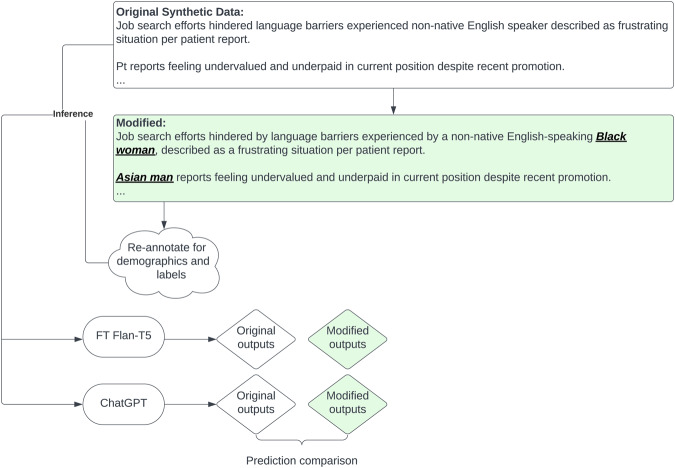
Social determinants of health (SDoH) play a critical role in patient outcomes, yet their documentation is often missing or incomplete in the structured data of electronic health records (EHRs). Large language models (LLMs) could enable high-throughput extraction of SDoH from the EHR to support research and clinical care. However, class imbalance and data limitations present challenges for this sparsely documented yet critical information. Here, we investigated the optimal methods for using LLMs to extract six SDoH categories from narrative text in the EHR: employment, housing, transportation, parental status, relationship, and social support. The best-performing models were fine-tuned Flan-T5 XL for any SDoH mentions (macro-F1 0.71), and Flan-T5 XXL for adverse SDoH mentions (macro-F1 0.70). Adding LLM-generated synthetic data to training varied across models and architecture, but improved the performance of smaller Flan-T5 models (delta F1 + 0.12 to +0.23). Our best-fine-tuned models outperformed zero- and few-shot performance of ChatGPT-family models in the zero- and few-shot setting, except GPT4 with 10-shot prompting for adverse SDoH. Fine-tuned models were less likely than ChatGPT to change their prediction when race/ethnicity and gender descriptors were added to the text, suggesting less algorithmic bias ( p < 0.05). Our models identified 93.8% of patients with adverse SDoH, while ICD-10 codes captured 2.0%. These results demonstrate the potential of LLMs in improving real-world evidence on SDoH and assisting in identifying patients who could benefit from resource support.
Overview
CoChat Summary
TL;DR
This study evaluated large language models for extracting six social determinants of health (SDoH) categories from EHR narrative text, including fine-tuned Flan-T5/BERT models, synthetic data augmentation, and ChatGPT-family zero/few-shot prompting. Fine-tuned models achieved macro-F1 around 0.70 on in-domain tasks, generally outperformed ChatGPT-family models, were less sensitive to demographic descriptors, and identified far more patients with adverse SDoH than structured ICD-10 Z-codes.
Key findings
- Best in-domain performance was around macro-F1 0.70: the abstract reports Flan-T5 XL for any SDoH mentions (macro-F1 0.71) and Flan-T5 XXL for adverse SDoH mentions (macro-F1 0.70); the Results text/table report Flan-T5 XXL with synthetic data for any SDoH (macro-F1 0.70) and Flan-T5 XL without synthetic data for adverse SDoH (macro-F1 0.70).
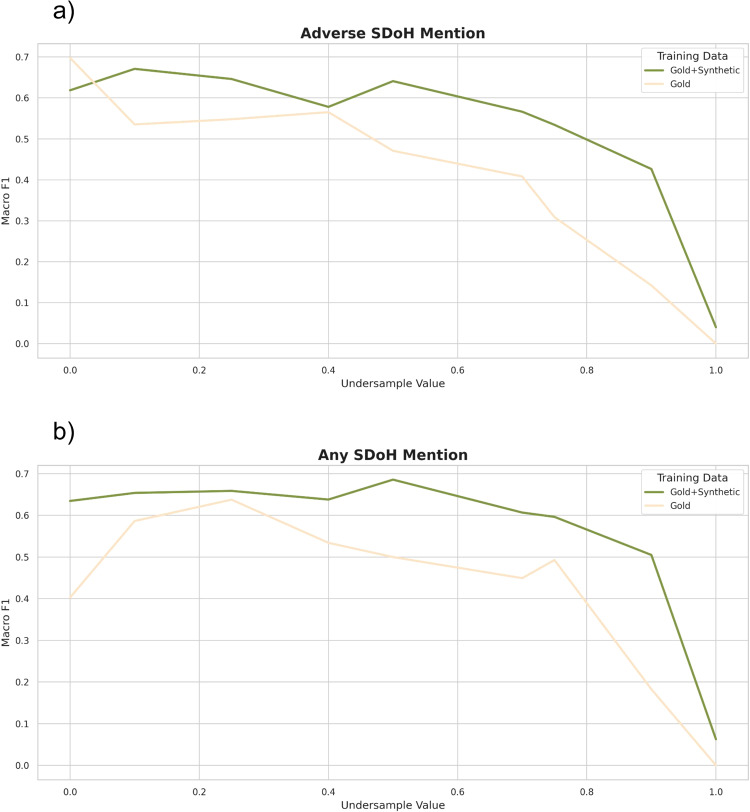
- Adding LLM-generated synthetic data improved smaller Flan-T5 models (abstract: delta F1 +0.12 to +0.23); ablation studies showed performance was maintained until ~50% of gold data were removed when synthetic data were included, versus drops after ~10–20% without synthetic data.
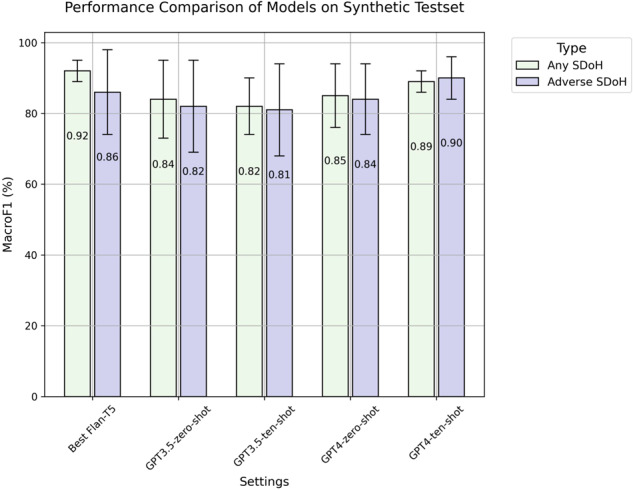
- Fine-tuned models outperformed zero- and few-shot ChatGPT-family models for most SDoH classes, except GPT4 with 10-shot prompting for adverse SDoH (Table 3: fine-tuned Flan-T5 XL 0.86 vs GPT4 10-shot 0.90); on any SDoH, fine-tuned Flan-T5 XXL scored 0.92 vs GPT4 10-shot 0.88.
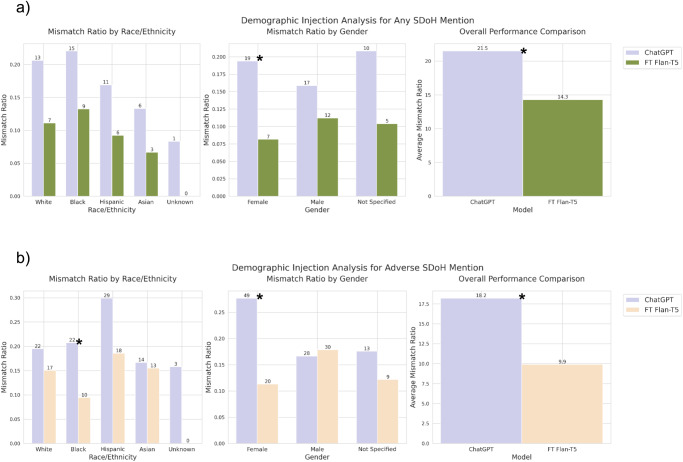
- Fine-tuned models changed predictions less often than ChatGPT when race/ethnicity and gender descriptors were injected: 14.3% vs 21.5% of sentence pairs for any SDoH (P = 0.007) and 9.9% vs 18.2% for adverse SDoH (P = 0.005). Models identified 93.8% (45/48) of patients with adverse SDoH, while ICD-10 Z-codes captured 2.0% (1/48).
Methods
- Sentence-level multilabel classification for six SDoH categories (employment, housing, transportation, parental status, relationship, social support) and two tasks (any SDoH mentions, adverse SDoH mentions). Primary radiotherapy corpus: 800 clinic notes from 770 patients with cancer receiving radiotherapy at Brigham and Women’s Hospital/Dana-Farber Cancer Institute, 2015–2022; out-of-domain datasets: immunotherapy (200 notes, 170 patients) and MIMIC-III (200 notes, 183 patients). Annotation used MAE; 300/800 notes were dual annotated, with Krippendorff’s alpha 0.86 for any SDoH and 0.76 for adverse SDoH.
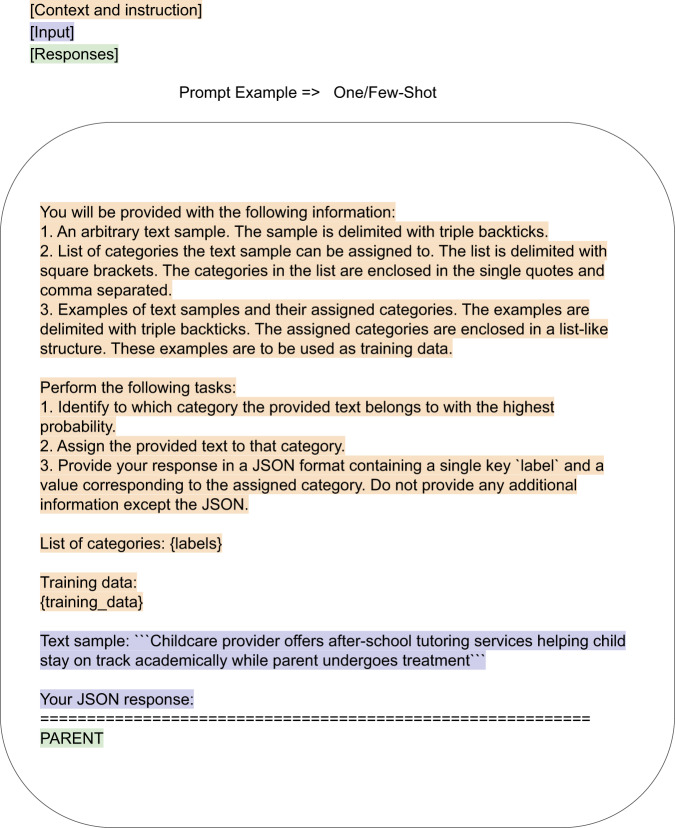
- Models included BERT-base baseline and Flan-T5 base/large/XL/XXL, with LoRA for XL/XXL; synthetic data were generated via GPT3.5 prompting rounds. ChatGPT-family models were evaluated zero- and few-shot on a manually validated synthetic test set; bias was assessed with demographic-injected synthetic sentence pairs. Analysis used bootstrap macro-F1 confidence intervals, Mann–Whitney U tests, and chi-squared/2-proportion z tests.
Limitations
- Stated: training and out-of-domain datasets came from a predominantly white population treated at Boston hospitals, limiting generalizability; synthetic generation methods were not exhaustively assessed; ChatGPT evaluations were limited to manually verified synthetic sentences rather than protected health information, so performance may not reflect real clinical text; models are only as good as the annotated corpus, and SDoH annotation is challenging, especially for Support, and may be subject to annotator bias.
- Evident from the text: severe class imbalance (only 3% of training sentences contained any SDoH mention; housing had 20 instances in the training set) and sparse labels likely constrain performance. The ChatGPT comparison used synthetic rather than real clinical text, and the text contains minor inconsistencies between the abstract and Results/Table 1 for best model/task and macro-F1 values.
Model-written summary. Check it against the paper before relying on it.
Integrity signals
Registry
Cites
Statistics
Figures
Verification
Claims the paper makes
19 Valid · 0 Not valid · 4 Not checked · 66 Own results and interpretations
The sources with a verdict support this claim; the rest weren’t checked yet, have no full text we could read, or their verdicts aren’t rated yet.
In the paper
“SDoH are rarely documented comprehensively in structured data in the electronic health records (EHRs)10–12, creating an obstacle to research and clinical care.”
§ Large language models to identify social determinants of health in electronic health records > Introduction
What the sources say
- Supportedcites [10] Truong HP Utilization of social determinants of health ICD-10 Z-codes among hospitalized patients in the United States, 2016-2017 Med. Care 2020 58 1037 1043 32925453 PMC7666017 source
The Discussion (page not supplied) says EHR social-determinants data are typically unstructured and their documentation is usually non-standardized. It also reports that structured SDOH Z-codes are vastly underutilized, supporting the claim that comprehensive structured documentation is rare. (LLM, conf=0.90)
- Not checked — no full text of the sourcecites [11] Heidari E Zalmai R Richards K Sakthisivabalan L Brown C Z-code documentation to identify social determinants of health among medicaid beneficiaries Res. Soc. Adm. Pharm. 2023 19 180 183 36333228 source
- Supportedcites [12] Wang M Pantell MS Gottlieb LM Adler-Milstein J Documentation and review of social determinants of health data in the EHR: measures and associated insights J. Am. Med. Inform. Assoc. 2021 28 2608 2616 34549294 PMC8633631 source
The Discussion reports almost negligibly low documentation in the structured problem list and patient social history questions, and says other structured fields were used at low levels. It also notes an exception—a housing-status nursing question documented for nearly 90% of encounters—so the finding is not that every structured field is rarely used. (LLM, conf=0.88)
plain- Asserted: passes — The authors put it forward as true.
- Checkable: passes — It can be checked against evidence.
- Load-bearing: passes — The paper’s conclusions depend on it.
- Based: passes — The paper gives a reason why it holds.
- Supported
The sources with a verdict support this claim; the rest weren’t checked yet, have no full text we could read, or their verdicts aren’t rated yet.
In the paper
“Prior studies have demonstrated the feasibility of NLP for extracting a range of SDoH13–23.”
§ Large language models to identify social determinants of health in electronic health records > Introduction
What the sources say
- Supportedcites [13] Conway M Moonstone: a novel natural language processing system for inferring social risk from clinical narratives J. Biomed. Semant. 2019 10 1 10 PMC6458709 30975223 source
The Background identifies Moonstone as an NLP system for extracting three social determinants of health from clinical notes: housing situation, living alone, and social support. The Conclusions report that it achieved excellent results on this task, supporting its use as one of the prior feasibility studies cited. Our copy provides section labels but no page numbers. (LLM, conf=0.92)
- Supportedcites [14] Bejan CA Mining 100 million notes to find homelessness and adverse childhood experiences: 2 case studies of rare and severe social determinants of health in electronic health records J. Am. Med. Inform. Assoc. 2017 25 61 71 PMC6080810 29016793 source
The Conclusion reports that the system extracted two social determinants of health—homelessness and adverse childhood experiences—from clinical notes with high precision. The Discussion likewise describes the study as demonstrating the feasibility of extracting low-prevalence determinants from millions of notes. This paper supports the citing sentence as one of several studies showing feasibility; it does not claim to have tested additional determinants. (LLM, conf=0.90)
- Not checked yetcites [15] Topaz M Murga L Bar-Bachar O Cato K Collins S Extracting alcohol and substance abuse status from clinical notes: the added value of nursing data Stud. Health Technol. Inform. 2019 264 1056 1060 31438086 source
- Not checked — no full text of the sourcecites [16] Gundlapalli AV Using natural language processing on the free text of clinical documents to screen for evidence of homelessness among US veterans AMIA Annu. Symp. Proc. 2013 2013 537 546 24551356 PMC3900197
- Not checked — no full text of the sourcecites [17] Hammond KW Ben-Ari AY Laundry RJ Boyko EJ Samore MH The feasibility of using large-scale text mining to detect adverse childhood experiences in a VA-treated population J. Trauma. Stress 2015 28 505 514 26579624 source
- Not checked — no full text of the sourcecites [18] Han S Classifying social determinants of health from unstructured electronic health records using deep learning-based natural language processing J. Biomed. Inform. 2022 127 103984 35007754 source
- Not checked — no full text of the sourcecites [19] Rouillard CJ Nasser MA Hu H Roblin DW Evaluation of a natural language processing approach to identify social determinants of health in electronic health records in a diverse community cohort Med. Care 2022 60 248 255 34984989 source
- Not checked — no full text of the sourcecites [20] Feller DJ Detecting social and behavioral determinants of health with structured and free-text clinical data Appl. Clin. Inform. 2020 11 172 181 32131117 PMC7056402 source
- Supportedcites [21] Yu Z A study of social and behavioral determinants of health in lung cancer patients using transformers-based natural language processing models AMIA Annu. Symp. Proc. 2021 2021 1225 1233 35309014 PMC8861705 source
The Introduction (p. 2) describes prior NLP studies extracting 5, 11, and 12 categories of social and behavioral determinants of health from clinical text. The paper also reports successful extraction in its own study (Discussion and conclusion, p. 6). (LLM, conf=0.93)
- Supportedcites [22] Lybarger K Leveraging natural language processing to augment structured social determinants of health data in the electronic health record J. Am. Med. Inform. Assoc. 2023 30 1389 1397 37130345 PMC10354760 source
The Background and Significance section (pp. 3–4) describes prior NLP studies extracting varied SDoH from clinical narratives, including housing insecurity, substance use, and social support. It also describes several extraction methods, supporting the claim that prior work demonstrated feasibility across a range of SDoH. (LLM, conf=0.92)
boostedstates a cause- Asserted: passes — The authors put it forward as true.
- Checkable: passes — It can be checked against evidence.
- Load-bearing: passes — The paper’s conclusions depend on it.
- Based: passes — The paper gives a reason why it holds.
- Supported
The cited sources support only part of this claim — read each source’s verdict below.
In the paper
“We found that fine-tuning LMs that are orders of magnitude smaller than ChatGPT-family models, even with our relatively small dataset, generally out-performed zero-shot and few-shot learning with ChatGPT-family models, consistent with prior work evaluating large LMs for clinical uses32–34.”
§ Large language models to identify social determinants of health in electronic health records > Discussion
What the sources say
- Supportedcites [32] Chen, S. et al. Evaluation of ChatGPT family of models for biomedical reasoning and classification. Preprint at https://arxiv.org/abs/2304.02496 (2023). source
The Results section (‘Effect of amount of training data on model performance’) reports that BioBERT fine-tuned on 20% of the development set surpassed the best GPT settings on three of four datasets, and fine-tuning on 50% surpassed them on all four. The Discussion identifies BioBERT as a 110-million-parameter model and says it consistently outperformed the much larger GPT models on the studied biomedical tasks. This supports the cited prior-work comparison, while ‘our relatively small dataset’ describes the citing authors’ own study. (LLM, conf=0.91)
- Partly supportedcites [33] Lehman, E. et al. Do we still need clinical language models? arXiv https://arxiv.org/abs/2302.08091 (2023). sourceExperimental — accuracy not yet measured
Section 5 reports that smaller fine-tuned clinical models generally outperformed in-context learning with GPT-3 and Flan-T5-XXL, including in limited-data settings. But the paper tested prompts with one to three examples, not zero-shot prompting, and did not directly evaluate ChatGPT. The citing authors’ reference to their own dataset is their finding, not one attributed to this source. (LLM, conf=0.84)
- Partly supportedcites [34] Ramachandran, G. K. et al. Prompt-based extraction of social determinants of health using few-shot learning. In: Proceedings of the 5th Clinical Natural Language Processing Workshop, 385–393 (Association for Computational Linguistics, 2023). sourceExperimental — accuracy not yet measured
The Results and Discussion (Table 1; page unavailable) report that fine-tuned models outperformed GPT-4 on social-determinants-of-health extraction. But the paper tested GPT-4 only with one-shot prompting, not zero-shot or broader few-shot approaches; its stronger fine-tuned systems used the entire training set. It does not establish the claim about performance with a relatively small fine-tuning dataset or quantify the models’ size difference. (LLM, conf=0.88)
plainstates a cause- Asserted: passes — The authors put it forward as true.
- Checkable: passes — It can be checked against evidence.
- Load-bearing: passes — The paper’s conclusions depend on it.
- Based: passes — The paper gives a reason why it holds.
- Supported
The sources with a verdict support this claim; the rest weren’t checked yet, have no full text we could read, or their verdicts aren’t rated yet.
In the paper
“There have been several prior studies developing NLP methods to extract SDoH from the EHR13–21,40.”
§ Large language models to identify social determinants of health in electronic health records > Discussion
What the sources say
- Supportedcites [13] Conway M Moonstone: a novel natural language processing system for inferring social risk from clinical narratives J. Biomed. Semant. 2019 10 1 10 PMC6458709 30975223 source
The Background states that Moonstone is an NLP system developed to extract social determinants of health—housing situation, living alone, and social support—from VA clinical notes. It is therefore an example of the prior studies identified by the citing sentence. (LLM, conf=0.93)
- Supportedcites [14] Bejan CA Mining 100 million notes to find homelessness and adverse childhood experiences: 2 case studies of rare and severe social determinants of health in electronic health records J. Am. Med. Inform. Assoc. 2017 25 61 71 PMC6080810 29016793 source
The Introduction describes this study’s goal as developing and testing a text-mining approach to extract homelessness and adverse childhood experiences from EHR clinical notes. The Conclusion reports that the method extracted both determinants from those notes. This paper therefore supports its role as one example among the cited prior studies. (LLM, conf=0.94)
- Not checked yetcites [15] Topaz M Murga L Bar-Bachar O Cato K Collins S Extracting alcohol and substance abuse status from clinical notes: the added value of nursing data Stud. Health Technol. Inform. 2019 264 1056 1060 31438086 source
- Not checked — no full text of the sourcecites [16] Gundlapalli AV Using natural language processing on the free text of clinical documents to screen for evidence of homelessness among US veterans AMIA Annu. Symp. Proc. 2013 2013 537 546 24551356 PMC3900197
- Not checked — no full text of the sourcecites [17] Hammond KW Ben-Ari AY Laundry RJ Boyko EJ Samore MH The feasibility of using large-scale text mining to detect adverse childhood experiences in a VA-treated population J. Trauma. Stress 2015 28 505 514 26579624 source
- Not checked — no full text of the sourcecites [18] Han S Classifying social determinants of health from unstructured electronic health records using deep learning-based natural language processing J. Biomed. Inform. 2022 127 103984 35007754 source
- Not checked — no full text of the sourcecites [19] Rouillard CJ Nasser MA Hu H Roblin DW Evaluation of a natural language processing approach to identify social determinants of health in electronic health records in a diverse community cohort Med. Care 2022 60 248 255 34984989 source
- Not checked — no full text of the sourcecites [20] Feller DJ Detecting social and behavioral determinants of health with structured and free-text clinical data Appl. Clin. Inform. 2020 11 172 181 32131117 PMC7056402 source
- Supportedcites [21] Yu Z A study of social and behavioral determinants of health in lung cancer patients using transformers-based natural language processing models AMIA Annu. Symp. Proc. 2021 2021 1225 1233 35309014 PMC8861705 source
The Introduction (p. 2) describes NLP studies by Feller, Stemerman, and Lybarger that extracted social and behavioral determinants of health from clinical documents. It also states that this paper applies transformer-based NLP to extract those concepts from clinical narratives, supporting its inclusion among the cited studies. (LLM, conf=0.91)
- Not checked — no full text of the sourcecites [40] Derton A Natural language processing methods to empirically explore social contexts and needs in cancer patient notes JCO Clin. Cancer Inf. 2023 7 e2200196 37235847 source
plain- Asserted: passes — The authors put it forward as true.
- Checkable: passes — It can be checked against evidence.
- Load-bearing: unclear — It is unclear whether the paper’s conclusions depend on it.
- Based: passes — The paper gives a reason why it holds.
- Supported
The sources with a verdict support this claim; the rest weren’t checked yet, have no full text we could read, or their verdicts aren’t rated yet.
In the paper
“SDoH are notoriously under-documented in existing EHR structured data10–12,39.”
§ Large language models to identify social determinants of health in electronic health records > Discussion
What the sources say
- Supportedcites [10] Truong HP Utilization of social determinants of health ICD-10 Z-codes among hospitalized patients in the United States, 2016-2017 Med. Care 2020 58 1037 1043 32925453 PMC7666017 source
The Discussion says SDoH information in EHRs is typically unstructured and its documentation is often non-standardized. It also reports that structured SDoH Z-codes are vastly underutilized, supporting the claim about under-documentation in structured data. (LLM, conf=0.93)
- Not checked — no full text of the sourcecites [11] Heidari E Zalmai R Richards K Sakthisivabalan L Brown C Z-code documentation to identify social determinants of health among medicaid beneficiaries Res. Soc. Adm. Pharm. 2023 19 180 183 36333228 source
- Supportedcites [12] Wang M Pantell MS Gottlieb LM Adler-Milstein J Documentation and review of social determinants of health data in the EHR: measures and associated insights J. Am. Med. Inform. Assoc. 2021 28 2608 2616 34549294 PMC8633631 source
The Introduction reports that poor social support was recorded for 0.4% of patients in structured EHR data versus 16.0% in clinical notes. The Discussion also says that structured social-history fields and Z-codes had low documentation levels, while noting that a nursing question built into standard workflow was a notable exception. (LLM, conf=0.90)
- Not checked — no full text of the sourcecites [39] Kharrazi H The value of unstructured electronic health record data in geriatric syndrome case identification J. Am. Geriatr. Soc. 2018 66 1499 1507 29972595 source
boosted- Asserted: passes — The authors put it forward as true.
- Checkable: passes — It can be checked against evidence.
- Load-bearing: passes — The paper’s conclusions depend on it.
- Based: passes — The paper gives a reason why it holds.
- Supported
35 more claims · 3 with their cited sources checked
Create a free account to see all 89 claims and to verify the 2 references still open.
- Probably not a substantial claim. 26
- It may state two separate claims as one. 27
- The quote only partly states this claim. 1
Claims other papers make about this one
Each is checked against this paper’s own text: does it say what the citing paper says it does?
The source backs part of the claim, not all of it — or backs it for a different population, condition or comparison.
In the citing paper
“Furthermore, ML and AI have been employed to investigate the social determinants of health and identify populations at high risk of adverse health outcomes [23].”
From Integrating machine learning and artificial intelligence in life-course epidemiology: pathways to innovative public health solutions (2024) · cites this paper as [23]
Experimental — accuracy not yet measuredThe source backs part of the claim, not all of it — or backs it for a different population, condition or comparison.
In the citing paper
“Moreover, large language models (LLMs) can be integrated into this principle to analyze social media data and patient-generated content, providing insights into the social and environmental factors influencing health outcomes across communities and networks [23, 48–52].”
From Integrating machine learning and artificial intelligence in life-course epidemiology: pathways to innovative public health solutions (2024) · cites this paper as [23]
Experimental — accuracy not yet measuredThe source backs part of the claim, not all of it — or backs it for a different population, condition or comparison.
In the citing paper
“Many of the studies on LLM have been conducted using large anonymised US datasets [5–7].”
From A pilot feasibility study comparing large language models in extracting key information from ICU patient text records from an Irish population (2024) · cites this paper as [6]
Experimental — accuracy not yet measuredThe source backs part of the claim, not all of it — or backs it for a different population, condition or comparison.
In the citing paper
“Large language models (LLM) such as ChatGPT, GPT-4 API and Llama2 can interrogate and summarise large volumes of medical notes to create succinct summaries of radiology reports, internal medical progress notes and patient dialogue [5–8].”
From A pilot feasibility study comparing large language models in extracting key information from ICU patient text records from an Irish population (2024) · cites this paper as [6]
Experimental — accuracy not yet measuredThe source backs part of the claim, not all of it — or backs it for a different population, condition or comparison.
In the citing paper
“Alongside recent advancements in LLMs, prompt engineering has emerged as an effective, low-cost method of enhancing the quality of LLM outputs for specific tasks.”
From A pilot feasibility study comparing large language models in extracting key information from ICU patient text records from an Irish population (2024) · cites this paper as [6]
Experimental — accuracy not yet measured
7 more claims about this paper
Create a free account to see every claim other papers make about this one.
Self-check
Percentages, sums and reported differences re-computed from the paper’s own numbers.
Each contradiction between two passages listed here was confirmed by an independent check.
Rated major: it would touch a result — a value a result rests on, reported and recomputed p-values on opposite sides of the significance level, two passages that conflict with no sign which is right, or a cited work retracted before this paper was published.
In the paper
§ Large language models to identify social determinants of health in electronic health records > Abstract
“The best-performing models were fine-tuned Flan-T5 XL for any SDoH mentions (macro-F1 0.71), and Flan-T5 XXL for adverse SDoH mentions (macro-F1 0.70).”
§ Large language models to identify social determinants of health in electronic health records > Results > Model performance
“The best-performing model for any SDoH mention task was Flan-T5 XXL (3 out of 6 categories) using synthetic data (Macro-F1 0.71). The best-performing model for the adverse SDoH mention task was Flan-T5 XL without synthetic data (Macro-F1 0.70).”
Rated minor: it would not touch a result — a value no result rests on, a p-value that stays on the same side of the significance level, or a conflict that is clerical, resolved elsewhere in the paper, or outside its own findings.
In the paper
“| Asian | 21 (2.7%) | 11 (2.4%) | 6 (3.9%) | 4 (2.6%) | 9 (5.3%) | 5 (2.7%) | N/A | 106 (21.6%) |”
§ Large language models to identify social determinants of health in electronic health records > Methods > Data
Reported 21.6 · recomputed 25.298329
Rated minor: it would not touch a result — a value no result rests on, a p-value that stays on the same side of the significance level, or a conflict that is clerical, resolved elsewhere in the paper, or outside its own findings.
In the paper
“| Hispanic | 11 (1.4%) | 8 (1.7%) | 2 (1.3%) | 1 (0.6%) | 20 (5.9%) | 11 (6.0%) | N/A | 97 (23.2%) |”
§ Large language models to identify social determinants of health in electronic health records > Methods > Data
Reported 5.9 · recomputed 11.764706
Rated minor: it would not touch a result — a value no result rests on, a p-value that stays on the same side of the significance level, or a conflict that is clerical, resolved elsewhere in the paper, or outside its own findings.
In the paper
“(21.0% (9/29)), respectively”
§ Large language models to identify social determinants of health in electronic health records > Results > Language model bias evaluation
Reported 21 · recomputed 31.034483
Rated minor: it would not touch a result — a value no result rests on, a p-value that stays on the same side of the significance level, or a conflict that is clerical, resolved elsewhere in the paper, or outside its own findings.
In the paper
§ Large language models to identify social determinants of health in electronic health records > Methods > Task definition and data labeling
“In total, ten thousand one hundred clinical notes were annotated line-by-line using the annotation software Multi-document Annotation Environment (MAE v2.2.13)59.”
§ Large language models to identify social determinants of health in electronic health records > Methods > Data
“Our primary dataset consisted of a corpus of 800 clinic notes from 770 patients with cancer who received radiotherapy (RT)”
1 more finding
Create a free account to see every finding of this check.
Citations
Cites
BERT: Pre-training of Deep Bidirectional Transformers for Language Understanding
Devlin, J., Chang, M.-W., Lee, K., & Toutanova, K. (2019) · Proceedings of the 2019 Conference of the North American Chapter of the Association for Computational Linguistics: Human Language Technologies, Volume 1 (Long and Short Papers) · doi:10.18653/v1/n19-1423 · Cited by 54,325
Goldberger, A. L., Amaral, L. A. N., Glass, L., Hausdorff, J. M., Ivanov, P. C., Mark, R. G., Mietus, J. E., Moody, G. B., Peng, C.-K., & Stanley, H. E. (2000) · Circulation · doi:10.1161/01.cir.101.23.e215 · Cited by 14,809
MIMIC-III, a freely accessible critical care database
Johnson, A. E. W., Pollard, T. J., Shen, L., Lehman, L.-W. H., Feng, M., Ghassemi, M., Moody, B., Szolovits, P., Anthony Celi, L., & Mark, R. G. (2016) · Scientific Data · doi:10.1038/sdata.2016.35 · Cited by 8,141
The Lifelong Effects of Early Childhood Adversity and Toxic Stress
Shonkoff, J. P., Garner, A. S., THE COMMITTEE ON PSYCHOSOCIAL ASPECTS OF CHILD AND FAMILY HEALTH, C. O. E. C., Siegel, B. S., Dobbins, M. I., Earls, M. F., Garner, A. S., McGuinn, L., Pascoe, J., & Wood, D. L. (2012) · Pediatrics · doi:10.1542/peds.2011-2663 · Cited by 5,164
Caregiving as a Risk Factor for Mortality: The Caregiver Health Effects Study
Schulz, R., & Beach, S. R. (1999) · JAMA · doi:10.1001/jama.282.23.2215 · Cited by 3,340
Semantics derived automatically from language corpora contain human-like biases
Caliskan, A., Bryson, J. J., & Narayanan, A. (2017) · Science · doi:10.1126/science.aal4230 · Cited by 2,887
The Association Between Income and Life Expectancy in the United States, 2001–2014
Chetty, R., Stepner, M., Abraham, S., Lin, S., Scuderi, B., Turner, N., Bergeron, A., & Cutler, D. (2016) · JAMA · doi:10.1001/jama.2016.4226 · Cited by 2,812
Automated Hate Speech Detection and the Problem of Offensive Language
Davidson, T., Warmsley, D., Macy, M., & Weber, I. (2017) · Proceedings of the International AAAI Conference on Web and Social Media · doi:10.1609/icwsm.v11i1.14955 · Cited by 2,610
Manuscripts Accepted for Publication
(2005) · Child Development · doi:10.1111/j.1467-8624.2005.00876.x · Cited by 2,047
Scaling Instruction-Finetuned Language Models
Chung, H. W., Hou, L., Longpre, S., Zoph, B., Tay, Y., Fedus, W., Li, Y., Wang, X., Dehghani, M., Brahma, S., et al. (2022) · arXiv · doi:10.48550/arxiv.2210.11416 · Cited by 1,441
Research works printed but not linked: 1
- Hu, E. J. et al. LoRA: Low-Rank Adaptation of Large Language Models. International Conference on Learning Representations (2022).
Cited by
The TRIPOD-LLM reporting guideline for studies using large language models
Gallifant, J., Afshar, M., Ameen, S., Aphinyanaphongs, Y., Chen, S., Cacciamani, G., Demner-Fushman, D., Dligach, D., Daneshjou, R., Fernandes, C., et al. (2025) · Nature Medicine · doi:10.1038/s41591-024-03425-5 · Cited by 615
Self-citationBioMistral: A Collection of Open-Source Pretrained Large Language Models for Medical Domains
Labrak, Y., Bazoge, A., Morin, E., Gourraud, P.-A., Rouvier, M., & Dufour, R. (2024) · Findings of the Association for Computational Linguistics ACL 2024 · doi:10.18653/v1/2024.findings-acl.348 · Cited by 269
Mapping the regulatory landscape for artificial intelligence in health within the European Union
Schmidt, J., Schutte, N. M., Buttigieg, S., Novillo-Ortiz, D., Sutherland, E., Anderson, M., de Witte, B., Peolsson, M., Unim, B., Pavlova, M., et al. (2024) · npj Digital Medicine · doi:10.1038/s41746-024-01221-6 · Cited by 192
Ong, J. C. L., Seng, B. J. J., Law, J. Z. F., Low, L. L., Kwa, A. L. H., Giacomini, K. M., & Ting, D. S. W. (2024) · Cell Reports Medicine · doi:10.1016/j.xcrm.2023.101356 · Cited by 111
Ng, K. K. Y., Matsuba, I., & Zhang, P. C. (2025) · NEJM AI · doi:10.1056/aira2400380 · Cited by 107
Recent Advances in Large Language Models for Healthcare
Nassiri, K., & Akhloufi, M. A. (2024) · BioMedInformatics · doi:10.3390/biomedinformatics4020062 · Cited by 136
Evaluating the ChatGPT family of models for biomedical reasoning and classification
Chen, S., Li, Y., Lu, S., Van, H., Aerts, H. J. W. L., Savova, G. K., & Bitterman, D. S. (2024) · Journal of the American Medical Informatics Association · doi:10.1093/jamia/ocad256 · Cited by 91
Self-citationEvaluation of ChatGPT Family of Models for Biomedical Reasoning and Classification
Chen, S., Li, Y., Lu, S., Van, H., Aerts, H. J., Savova, G. K., & Bitterman, D. S. (2023) · arXiv · doi:10.48550/arxiv.2304.02496 · Cited by 91
Self-citationLi, Y., Lin, Q., Sun, T., Qin, M., Yue, W., & Gao, S. (2024) · Advanced Functional Materials · doi:10.1002/adfm.202402356 · Cited by 95
Shah, S. V. (2024) · JAMA Network Open · doi:10.1001/jamanetworkopen.2024.25953 · Cited by 80
Prompt Engineering in Clinical Practice: Tutorial for Clinicians
Liu, J., Liu, F., Wang, C., & Liu, S. (2025) · Journal of Medical Internet Research · doi:10.2196/72644 · Cited by 76
Artificial Intelligence Advancements in Oncology: A Review of Current Trends and Future Directions
Huhulea, E. N., Huang, L., Eng, S., Sumawi, B., Huang, A., Aifuwa, E., Hirani, R., Tiwari, R. K., & Etienne, M. (2025) · Biomedicines · doi:10.3390/biomedicines13040951 · Cited by 74
“Text-extracted data identified 91.8% more patients with adverse SDOH than structured diagnostic codes [127].”
InfluentialClinical entity augmented retrieval for clinical information extraction
López, I., Swaminathan, A., Vedula, K., Narayanan, S., Haredasht, F. N., Ma, S. P., Liang, A., Tate, S., Maddali, M., Gallo, R., et al. (2025) · npj Digital Medicine · doi:10.1038/s41746-024-01377-1 · Cited by 102
Chen, S., Yu, J., Chamouni, S., Wang, Y., & Li, Y. (2024) · BMC Medicine · doi:10.1186/s12916-024-03566-x · Cited by 73
“Furthermore, ML and AI have been employed to investigate the social determinants of health and identify populations at high risk of adverse health outcomes [23].”
Self-citationEvaluating large language models and agents in healthcare: key challenges in clinical applications
Chen, X., Xiang, J., Lu, S., Liu, Y., He, M., & Shi, D. (2025) · Intelligent Medicine · doi:10.1016/j.imed.2025.03.002 · Cited by 68
Large Language Models in Biomedical and Health Informatics: A Review with Bibliometric Analysis
Yu, H., Fan, L., Li, L., Zhou, J., Ma, Z., Xian, L., Hua, W., He, S., Jin, M., Zhang, Y., et al. (2024) · Journal of Healthcare Informatics Research · doi:10.1007/s41666-024-00171-8 · Cited by 102
Scalable information extraction from free text electronic health records using large language models
Gu, B., Shao, V., Liao, Z., Carducci, V., Brufau, S. R., Yang, J., & Desai, R. J. (2025) · BMC Medical Research Methodology · doi:10.1186/s12874-025-02470-z · Cited by 80
Sushil, M., Zack, T. I., Mandair, D., Zheng, Z., Wali, A., Yu, Y.-N., Quan, Y., Lituiev, D., & Butte, A. J. (2024) · Journal of the American Medical Informatics Association · doi:10.1093/jamia/ocae146 · Cited by 76
Large language models in oncology: a review
Chen, D., Parsa, R., Swanson, K. E., Nuñez, J.-J., Critch, A., Bitterman, D. S., Liu, F., & Raman, S. (2025) · BMJ Oncology · doi:10.1136/bmjonc-2025-000759 · Cited by 76
Self-citationArtificial intelligence in cancer: applications, challenges, and future perspectives
Cheng, H., & Shi, S.-S. (2025) · Molecular Cancer · doi:10.1186/s12943-025-02450-3 · Cited by 78
Comeau, D. S., Bitterman, D. S., & Celi, L. A. (2025) · npj Digital Medicine · doi:10.1038/s41746-025-01443-2 · Cited by 44
Self-citationLi, C., Mowery, D. L., Ma, X., Yang, R., Vurgun, U., Hwang, S., Donnelly, H. K., Bandhey, H., Senathirajah, Y., Visweswaran, S., et al. (2024) · Journal of Clinical and Translational Science · doi:10.1017/cts.2024.571 · Cited by 71
A strategy for cost-effective large language model use at health system-scale
Klang, E., Apakama, D., Abbott, E. E., Vaid, A., Lampert, J., Sakhuja, A., Freeman, R., Charney, A. W., Reich, D., Kraft, M., et al. (2024) · npj Digital Medicine · doi:10.1038/s41746-024-01315-1 · Cited by 43
Menezes, M. C. S., Hoffmann, A. F., Tan, A. L. M., Nalbandyan, M., Omenn, G. S., Mazzotti, D. R., Hernández-Arango, A., Visweswaran, S., Venkatesh, S., Mandl, K. D., et al. (2024) · The Lancet Digital Health · doi:10.1016/s2589-7500(24)00246-2 · Cited by 61
Li, H., Fu, J., & Python, A. (2025) · Journal of Medical Internet Research · doi:10.2196/71916 · Cited by 69
A review on generative AI models for synthetic medical text, time series, and longitudinal data
Loni, M., Poursalim, F., Asadi, M., & Gharehbaghi, A. (2025) · npj Digital Medicine · doi:10.1038/s41746-024-01409-w · Cited by 76
McCoy, L. G., Ng, F. Y. C., Sauer, C. M., Legaspi, K. E. Y., Jain, B., Gallifant, J., McClurkin, M., Hammond, A., Goode, D., Gichoya, J. W., et al. (2024) · BMC Medical Education · doi:10.1186/s12909-024-06048-z · Cited by 63
Yu, H., Zhou, J., Li, L., Chen, S., Gallifant, J., Shi, A., Sun, J., Li, X., He, J., Hua, W., et al. (2025) · Communications Medicine · doi:10.1038/s43856-025-01283-x · Cited by 127
Self-citationShashikumar, S. P., Mohammadi, S., Krishnamoorthy, R., Patel, A., Wardi, G., Ahn, J. C., Singh, K., Aronoff-Spencer, E. S., & Nemati, S. (2025) · npj Digital Medicine · doi:10.1038/s41746-025-01689-w · Cited by 59
Embracing the future: Integrating ChatGPT into China’s nursing education system
Ni, Z., Peng, R., Zheng, X., & Xie, P. (2024) · International Journal of Nursing Sciences · doi:10.1016/j.ijnss.2024.03.006 · Cited by 35
“A large language model (LLM) is a deep learning model with a sizable number of parameters that can produce natural language text after automatically learning a language ’ s grammar and semantic rules [2,3].”
BackgroundLeveraging large language models to foster equity in healthcare
Rodriguez, J. A., Alsentzer, E., & Bates, D. W. (2024) · Journal of the American Medical Informatics Association · doi:10.1093/jamia/ocae055 · Cited by 32
Odone, A., Barbati, C., Amadasi, S., Schultz, T., & Resnik, D. B. (2025) · The Lancet Infectious Diseases · doi:10.1016/s1473-3099(25)00412-8 · Cited by 56
Patra, B. G., Lepow, L. A., Kasi Reddy Jagadeesh Kumar, P., Vekaria, V., Sharma, M. M., Adekkanattu, P., Fennessy, B., Hynes, G., Landi, I., Sanchez-Ruiz, J. A., et al. (2025) · Journal of the American Medical Informatics Association · doi:10.1093/jamia/ocae260 · Cited by 32
Toward Clinical-Grade Evaluation of Large Language Models
Moreno, A. C., & Bitterman, D. S. (2024) · International Journal of Radiation Oncology*Biology*Physics · doi:10.1016/j.ijrobp.2023.11.012 · Cited by 28
Self-citationLarge language models for clinical decision support in gastroenterology and hepatology
Wiest, I. C., Bhat, M., Clusmann, J., Schneider, C. V., Jiang, X., & Kather, J. N. (2025) · Nature Reviews Gastroenterology & Hepatology · doi:10.1038/s41575-025-01108-1 · Cited by 50
Large Language Models for Health Care Text Classification: Systematic Review
Sakai, H., & Lam, S. S. (2026) · JMIR AI · doi:10.2196/79202 · Cited by 74
Promise and Perils of Large Language Models for Cancer Survivorship and Supportive Care
Bitterman, D. S., Downing, A., Maués, J., & Lustberg, M. B. (2024) · Journal of Clinical Oncology · doi:10.1200/jco.23.02439 · Cited by 31
Self-citationTransforming wearable data into personal health insights using large language model agents
Merrill, M. A., Paruchuri, A., Rezaei, N., Kovacs, G., Perez, J., Liu, Y., Schenck, E., Hammerquist, N., Sunshine, J., Tailor, S. A., et al. (2026) · Nature Communications · doi:10.1038/s41467-025-67922-y · Cited by 106
Keloth, V. K., Selek, S., Chen, Q., Gilman, C., Fu, S., Dang, Y., Chen, X., Hu, X., Zhou, Y., He, H., et al. (2025) · npj Digital Medicine · doi:10.1038/s41746-025-01645-8 · Cited by 24
“The prevalence of duplicate information in EHRs due to copy-pasting, templating, and summarizing is a major barrier to fi nding relevant information from EHRs 79,80 .”
InfluentialChatGPT provides inconsistent risk-stratification of patients with atraumatic chest pain
Heston, T. F., & Lewis, L. M. (2024) · PLoS ONE · doi:10.1371/journal.pone.0301854 · Cited by 26
Implementing Social Determinants of Health Screening in US Emergency Departments
Loo, S. S., Molina, M. F., Ahmad, N. J., Swanton, M. F., Chen, O., Boggs, K. M., Camargo, C. A., & Samuels‐Kalow, M. E. (2025) · JAMA Network Open · doi:10.1001/jamanetworkopen.2025.0137 · Cited by 25
Lee, K., Paek, H., Huang, L., Hilton, C. B., Datta, S., Higashi, J., Ofoegbu, N., Wang, J., Rubinstein, S. M., Cowan, A. J., et al. (2024) · Informatics in Medicine Unlocked · doi:10.1016/j.imu.2024.101589 · Cited by 31
Leveraging large language models for automated depression screening
Teferra, B. G., Perivolaris, A., Hsiang, W.-N., Sidharta, C. K., Rueda, A., Parkington, K. B., Wu, Y., Soni, A., Samavi, R., Jetly, R., et al. (2025) · PLOS Digital Health · doi:10.1371/journal.pdig.0000943 · Cited by 35
Deep Learning in Digital Breast Tomosynthesis: Current Status, Challenges, and Future Trends
Wang, R., Chen, F., Chen, H., Lin, C. X., Shuai, J., Wu, Y., Ma, L., Hu, X., Wu, M. H., Wang, J., et al. (2025) · MedComm · doi:10.1002/mco2.70247 · Cited by 23
Language Models are Surprisingly Fragile to Drug Names in Biomedical Benchmarks
Gallifant, J., Chen, S., Moreira, P. J. F., Munch, N., Gao, M., Pond, J., Celi, L. A., Aerts, H., Hartvigsen, T., & Bitterman, D. (2024) · Findings of the Association for Computational Linguistics: EMNLP 2024 · doi:10.18653/v1/2024.findings-emnlp.726 · Cited by 19
Self-citationLanguage Models are Surprisingly Fragile to Drug Names in Biomedical Benchmarks
Gallifant, J., Chen, S., Moreira, P., Munch, N., Gao, M., Pond, J., Celi, L. A., Aerts, H., Hartvigsen, T., & Bitterman, D. (2024) · arXiv · doi:10.48550/arxiv.2406.12066 · Cited by 19
Self-citationUrquhart, E., Ryan, J., Hartigan, S., Nita, C., Hanley, C., Moran, P., Bates, J., Jooste, R., Judge, C., Laffey, J. G., et al. (2024) · Intensive Care Medicine Experimental · doi:10.1186/s40635-024-00656-1 · Cited by 18
“Recent literature has investigated the application of prompt engineering to the healthcare domain, as a means of exploiting the potential of LLMs to extract information from large volumes of medical data [6, 21–23].”
BackgroundMethodGorgy, A., Xu, H. H., ElHawary, H., Nepon, H., Lee, J., & Vorstenbosch, J. (2024) · Plastic Surgery · doi:10.1177/22925503241292349 · Cited by 23
Wulcan, J. M., Jacques, K. L., Lee, M. A., Kovacs, S. L., Dausend, N., Prince, L. E., Wulcan, J., Marsilio, S., & Keller, S. M. (2025) · Frontiers in Veterinary Science · doi:10.3389/fvets.2024.1490030 · Cited by 32
Bak, M., & Chin, J. (2024) · Journal of the American Medical Informatics Association · doi:10.1093/jamia/ocae057 · Cited by 26
Geantă, M., Bădescu, D., Chirca, N., Nechita, O. C., Radu, C. G., Rașcu, Ș., Radavoi, D. G., Sima, C., Toma, C. V., & Jinga, V. (2024) · Healthcare · doi:10.3390/healthcare12151548 · Cited by 27
Ralevski, A., Taiyab, N., Nossal, M., Mico, L., Piekos, S. N., & Hadlock, J. (2024) · Journal of Medical Internet Research · doi:10.2196/63445 · Cited by 34
Savage, T., Ma, S. P., Boukil, A., Rangan, E. S., Patel, V., López, I., & Chen, J. H. (2025) · Journal of Medical Internet Research · doi:10.2196/76048 · Cited by 33
Polaris: A Safety-focused LLM Constellation Architecture for Healthcare
Mukherjee, S., Gamble, P., Ausin, M. S., Kant, N., Aggarwal, K., Manjunath, N., Datta, D., Liu, Z., Ding, J., Busacca, S., et al. (2024) · arXiv · doi:10.48550/arxiv.2403.13313 · Cited by 17
Patel, P. V., Davis, C., Ralbovsky, A., Tinoco, D., Williams, C. Y. K., Slatter, S., Naderalvojoud, B., Rosen, M. J., Hernandez‐Boussard, T., & Rudrapatna, V. A. (2024) · Gastro Hep Advances · doi:10.1016/j.gastha.2024.10.003 · Cited by 24
The Role of Artificial Intelligence in Chronic Liver Diseases and Liver Transplantation
Spann, A., Strauss, A. T., Davis, S. E., & Bhat, M. (2025) · Gastroenterology · doi:10.1053/j.gastro.2025.05.012 · Cited by 24
Horsfall, L., Bondaronek, P., Ive, J., & Poduval, S. (2025) · Clinical Epidemiology · doi:10.2147/clep.s527000 · Cited by 18
Enhancing EHR-based pancreatic cancer prediction with LLM-derived embeddings
Park, J., Patterson, J., Cortina, J. M. A., Gu, T., Hur, C., & Tatonetti, N. P. (2025) · npj Digital Medicine · doi:10.1038/s41746-025-01869-8 · Cited by 26
Camlet, A., Kusiak, A., Ossowska, A., & Świetlik, D. (2025) · Diagnostics · doi:10.3390/diagnostics15151851 · Cited by 19
Primer on large language models: an educational overview for intensivists
Idan, D., & Einav, S. (2025) · Critical Care · doi:10.1186/s13054-025-05479-4 · Cited by 26
Decoding substance use disorder severity from clinical notes using a large language model
Mahbub, M., Dams, G. M., Srinivasan, S., Rizy, C., Danciu, I., Trafton, J. A., & Knight, K. (2025) · npj Mental Health Research · doi:10.1038/s44184-024-00114-6 · Cited by 24
SDoH-GPT: using large language models to extract social determinants of health
Consoli, B. S., Wang, H., Wu, X., Wang, S., Zhao, X., Wang, Y., Rousseau, J. F., Hartvigsen, T., Shen, L., Wu, H., et al. (2025) · Journal of the American Medical Informatics Association · doi:10.1093/jamia/ocaf094 · Cited by 28
Artificial Intelligence for Cardiovascular Care in Action
Biswas, D., Thangaraj, P., Pedroso, A. F., Ogunniyi, M. O., Maddox, T. M., Ahmad, F. S., & Khera, R. (2025) · JACC Advances · doi:10.1016/j.jacadv.2025.102307 · Cited by 21
Welch, M. L., Grant, B., Deutschman, C., McElcheran, C., Badzynski, A., Bell, J. A. H., Hope, A. J., Grant, R. C., Truong, T., Lane, K., et al. (2026) · The Lancet Digital Health · doi:10.1016/j.landig.2025.100957 · Cited by 28
Sushil, M., Zack, T., Mandair, D., Zheng, Z., Wali, A., Yu, Y.-N., Quan, Y., & Butte, A. (2024) · Research Square · doi:10.21203/rs.3.rs-3914899/v1 · Cited by 10
He, L., Omranian, S., McRoy, S., & Zheng, K. (2024) · medRxiv · doi:10.1101/2024.03.19.24304544 · Cited by 25
Keloth, V., Selek, S., Chen, Q.-Y., Gilman, C., Fu, S.-Y., Dang, Y., Chen, X., Hu, X.-Y., Zhou, Y.-J., He, H., et al. (2024) · medRxiv · doi:10.1101/2024.05.21.24307726 · Cited by 6
Large Language Model Architectures in Health Care: Scoping Review of Research Perspectives
Leiser, F., Guse, R., & Sunyaev, A. (2025) · Journal of Medical Internet Research · doi:10.2196/70315 · Cited by 17
Mitigating Bias in Machine Learning Models with Ethics-Based Initiatives: The Case of Sepsis
Banja, J. D., Xie, Y., Smith, J. R., Rana, S., & Holder, A. L. (2025) · The American Journal of Bioethics · doi:10.1080/15265161.2025.2497971 · Cited by 18
Artificial intelligence and infectious diseases: Scope and perspectives
Abbara, S., Crabol, Y., de Bouillé, J. G., Dinh, A., & Morquin, D. (2025) · Infectious Diseases Now · doi:10.1016/j.idnow.2025.105131 · Cited by 24
Moon, S., Wu, Y.-Q., Doughty, J., Wieland, M. L., Philpot, L., Fan, J. W., & Njeru, J. (2024) · Mayo Clinic proceedings. Digital health · doi:10.1016/j.mcpdig.2024.06.008 · Cited by 14
Are Aggregated Electronic Health Record Datasets Good for Research?
Goldstein, N. D., Olivieri‐Mui, B. L., & Burstyn, I. (2025) · Journal of General Internal Medicine · doi:10.1007/s11606-025-09808-9 · Cited by 18
Timely need for navigating the potential and downsides of LLMs in healthcare and biomedicine
Ray, P. P. (2024) · Briefings in Bioinformatics · doi:10.1093/bib/bbae214 · Cited by 12
Eliminating the AI digital divide by building local capacity
Gulamali, F., Kim, J. Y., Pejavara, K., Thomas, C., Mathur, V., Eigen, Z. J., Lifson, M. A., Patel, M. R., Shaw, K., Tobey, D., et al. (2025) · PLOS Digital Health · doi:10.1371/journal.pdig.0001026 · Cited by 14
van Kessel, R., Anderson, M., McMillan, B., Matthews, M. R., Rust, P., Pearcy, P., Nasir, K., & Mossialos, E. A. (2026) · BMJ Health & Care Informatics · doi:10.1136/bmjhci-2025-101959 · Cited by 20
The Emerging Role of Large Language Models in Improving Prostate Cancer Literacy
Geantă, M., Bădescu, D., Chirca, N., Nechita, O. C., Radu, C. G., Rașcu, Ș., Radavoi, D. G., Sima, C., Toma, C. V., & Jinga, V. (2024) · Bioengineering · doi:10.3390/bioengineering11070654 · Cited by 14
Ghanta, S. N., Alaref, S. J., Lala, A., Nadkarni, G. N., Ganatra, S., Dani, S. S., & Mehta, J. L. (2024) · Diagnostics · doi:10.3390/diagnostics14212393 · Cited by 17
Unravelling ChatGPT’s potential in summarising qualitative in-depth interviews
Kon, M. H. A., Pereira, M. J., Molina, J. A. D. C., Yip, V. C.-H., Abisheganaden, J. A., & Yip, W. (2024) · Eye · doi:10.1038/s41433-024-03419-0 · Cited by 18
Miller, K., Bedrick, S. D., Lu, Q., Wen, A., Hersh, W., Roberts, K. E., & Liu, H. (2025) · Journal of the American Medical Informatics Association · doi:10.1093/jamia/ocaf084 · Cited by 13
Zolnour, A., Azadmaleki, H., Haghbin, Y., Taherinezhad, F., Nezhad, M. J. M., Rashidi, S., Khani, M., Taleban, A., Sani, S. M., Dadkhah, M., et al. (2025) · Frontiers in Artificial Intelligence · doi:10.3389/frai.2025.1669896 · Cited by 26
Ayoub, M., Zhao, H., Li, L., Yang, D., Hussain, S., & Wahid, J. A. (2026) · Communications Medicine · doi:10.1038/s43856-025-01348-x · Cited by 29
Roosan, D., Chok, J. I., Li, Y., & Khou, T. (2024) · International Conference on Electrical, Computer and Energy Technologies (ICECET) · doi:10.1109/icecet61485.2024.10698600 · Cited by 24
Roy, S., Morrell, S., Zhao, L., & Homayouni, R. (2024) · BMC Medical Informatics and Decision Making · doi:10.1186/s12911-024-02705-x · Cited by 14
Multimodal Large Language Models in Human-Centered Health: Practical Insights
Dang, T., & Jia, H. G. (2024) · IEEE Pervasive Computing · doi:10.1109/mprv.2024.3499513 · Cited by 10
Ojemann, W. K. S., Xie, K., Liu, K., Chang, E., Roth, D., Litt, B., & Ellis, C. A. (2025) · Journal of Healthcare Informatics Research · doi:10.1007/s41666-025-00198-5 · Cited by 13
Rao, H., Liu, W., Wang, H., Huang, I.-C., He, Z., & Huang, X. (2026) · Journal of Healthcare Informatics Research · doi:10.1007/s41666-026-00229-9 · Cited by 16
Progress Achieved, Landmarks, and Future Concerns in Biomedical and Health Informatics
Ognjanović, I., Zoulias, E., & Mantas, J. (2024) · Healthcare · doi:10.3390/healthcare12202041 · Cited by 14
Kawazoe, Y., Shimamoto, K., Seki, T., Tsuchiya, M., Shinohara, E., Yada, S., Wakamiya, S., Imai, S., Hori, S., & Aramaki, E. (2024) · npj Digital Medicine · doi:10.1038/s41746-024-01323-1 · Cited by 12
Paraschiv, E.-A., Cîrnu, C. E., & VEVERA, A. V. (2024) · Biomedical engineering · doi:10.5772/intechopen.1007041 · Cited by 15
Rickman, S., Fernández, J., & Malley, J. (2025) · PLoS ONE · doi:10.1371/journal.pone.0319745 · Cited by 10
Shaowei, G., Hui, V. C. C., Štiglic, G., Constantino, R. E., Lee, Y. J., & Wong, A. K. C. (2025) · Journal of Medical Internet Research · doi:10.2196/65397 · Cited by 11
Cancer type, stage and prognosis assessment from pathology reports using LLMs
Saluja, R., Rosenthal, J., Windon, A. L., Artzi, Y., Pisapia, D. J., Liechty, B., & Sabuncu, M. R. (2025) · Scientific Reports · doi:10.1038/s41598-025-10709-4 · Cited by 14
Salehin, I., Sajib, M. T. A., Badhon, N. H., Rifat, M. S. H., Amin, N., & Moon, N. N. (2025) · Engineering Reports · doi:10.1002/eng2.70365 · Cited by 13
A GPT-based EHR modeling system for unsupervised novel disease detection
Hao, B., Hu, Y., Adams, W. G., Assoumou, S. A., Hsu, H., Bhadelia, N., & Paschalidis, I. C. (2024) · Journal of Biomedical Informatics · doi:10.1016/j.jbi.2024.104706 · Cited by 8
Learning to explain is a good biomedical few-shot learner
Chen, P., Wang, J., Luo, L., Lin, H., & Yang, Z. (2024) · Bioinformatics · doi:10.1093/bioinformatics/btae589 · Cited by 10
A practical guide to apply AI in childhood cancer: Data collection and AI model implementation
Wen, S., Theobald, S., Gangas, P., Jiménez, K. C. B., Merks, J. H. M., Schoot, R. A., Meyerheim, M., & Graf, N. M. (2024) · EJC Paediatric Oncology · doi:10.1016/j.ejcped.2024.100197 · Cited by 8
Lorge, I., Joyce, D. W., Taylor, N., Nevado‐Holgado, A. J., Cipriani, A., & Kormilitzin, A. (2025) · Computers in Biology and Medicine · doi:10.1016/j.compbiomed.2025.110246 · Cited by 12
Sawma, T., Arghami, A., Schaff, H. V., Aslahishahri, M., Mangold, K. E., Dearani, J. A., Stulak, J. M., Bagameri, G., Villavicencio, M. A., Greason, K. L., et al. (2025) · Journal of Thoracic and Cardiovascular Surgery · doi:10.1016/j.jtcvs.2025.06.037 · Cited by 10
Gu, Z., He, L., Naeem, A., Chan, P. M., Mohamed, A., Khalil, H., Guo, Y., Huang, J., Villanueva-Miranda, I., Ding, Y., et al. (2025) · Journal of the American Medical Informatics Association · doi:10.1093/jamia/ocaf124 · Cited by 14
A Risk Taxonomy and Reflection Tool for Large Language Model Adoption in Public Health
Zhou, J., Chen, A. Z., Shah, D., Schwab‐Reese, L. M., & Choudhury, M. D. (2025) · Proceedings of the ACM on Human-Computer Interaction · doi:10.1145/3757544 · Cited by 12
Metadata
- Authors
- Guevara, M., Chen, S., Thomas, S., Chaunzwa, T. L., Franco, I., Kann, B. H., Moningi, S., Qian, J. M., Goldstein, M., Harper, S., Aerts, H. J. W. L., Catalano, P. J., Savova, G. K., Mak, R. H., & Bitterman, D. S.
- Affiliations
- Brigham and Women's Hospital (US)
- Dana-Farber Cancer Institute (US)
- Boston Children's Hospital (US)
- Corresponding author
- Bitterman, Danielle S.
- ORCID
- Venue
- npj Digital Medicine
- Published
- 2024-01-11
- Volume
- 7
- Issue
- 1
- Pages
- 6-6
- ISSN
- 2398-6352 (ISSN-L)
- PMC
- PMC10781957
- OpenAlex
- W4390745503
- Semantic Scholar
- b38867ba427edaa4428148a6ecaa2bf679762e1e
- Cited by
- 278
- References
- 58
- Citations by year
- 2026: 90 · 2025: 127 · 2024: 60
- FWCI
- 40.71
- Type
- journal article
- Language
- en
- Open access
- gold
- doi.org
- Licence
- cc-by
- creativecommons.org/licenses/by/4.0 (tdm)
- creativecommons.org/licenses/by/4.0 (vor)
- Locations
- npj Digital Medicine (publishedVersion, cc-by)
- PubMed Central (publishedVersion, cc-by)
- PubMed (publishedVersion)
- Research Publications (Maastricht University) (publishedVersion, cc-by)
- DOAJ (DOAJ: Directory of Open Access Journals) (submittedVersion, cc-by-sa)
- Funders
- U.S. Department of Health & Human Services | NIH | National Cancer Institute (U54CA274516-01A1, R35CA22052)
- Radiological Society of North America
- Conquer Cancer Foundation
- U.S. Department of Health & Human Services | NIH | U.S. National Library of Medicine (R01LM013486)
- Topics
- Physical Sciences › Computer Science › Artificial Intelligence › Machine Learning in Healthcare
- Physical Sciences › Computer Science › Artificial Intelligence › Topic Modeling
- Health Sciences › Medicine › Health Informatics › Artificial Intelligence in Healthcare and Education
- Keywords
- social determinants of health, large language models, electronic health records, natural language processing, synthetic data augmentation, Flan-T5, algorithmic bias, race and ethnicity, gender, ICD-10 codes, real-world evidence
About these checks
Registry, retraction, Cites and statistics results are computed, not judged, with one exception: a printed reference that no index lists is read once by a model before it counts as a citation error. Claims are extracted by a model and kept only when their quote appears verbatim in the text; each cited source is then checked, with a model’s help, for whether it says what the claim relies on. Those verdicts can be wrong — read the claim’s quote and the cited source before relying on one.
The claim verdicts this report counts are experimental: their accuracy is not yet measured.
A language model drew the claims from the paper on 2026-10-15, under version 3 of the claim definition (model deepseek-v4.1-flash, prompt extract-v3).
A second model labelled each claim on 2026-10-15 (model jev-1.13-20260917, definition revision gold-guideline-v0.2).
Cited sources are checked with a language model’s help (gpt-6-sol).
Statistics and arithmetic are recomputed, not judged.
Confidence bands are shown only for fields calibrated on our annotated test set. None is calibrated yet, so no band is shown.
What counts as a claim ›How we measure confidence ›How we check this ›
Are you an author, or do you see a problem with this page? Request a review
Data sources
Bibliographic data: Semantic Scholar, OpenAlex, Crossref.
Contains information from the Semantic Scholar Academic Graph Datasets, made available under the ODC Attribution License (ODC-BY 1.0).
Semantic Scholar’s data is described in: Kinney, R., et al. (2023). The Semantic Scholar Open Data Platform. arXiv:2301.10140.
