

Digital health technologies and machine learning augment patient reported outcomes to remotely characterise rheumatoid arthritis
Open accessPublished version of a preprint
The DOI matches its Crossref record; 76 of the 84 references it cites were found in a registry or an index, and 1 are not checked yet; 3 of the 33 sources its claims cite were checked for support.
Abstract
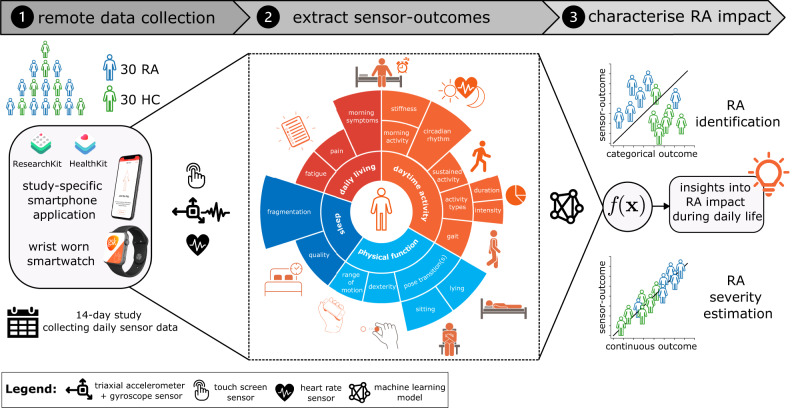
Digital measures of health status captured during daily life could greatly augment current in-clinic assessments for rheumatoid arthritis (RA), to enable better assessment of disease progression and impact. This work presents results from weaRAble-PRO, a 14-day observational study, which aimed to investigate how digital health technologies (DHT), such as smartphones and wearables, could augment patient reported outcomes (PRO) to determine RA status and severity in a study of 30 moderate-to-severe RA patients, compared to 30 matched healthy controls (HC). Sensor-based measures of health status, mobility, dexterity, fatigue, and other RA specific symptoms were extracted from daily iPhone guided tests (GT), as well as actigraphy and heart rate sensor data, which was passively recorded from patients’ Apple smartwatch continuously over the study duration. We subsequently developed a machine learning (ML) framework to distinguish RA status and to estimate RA severity. It was found that daily wearable sensor-outcomes robustly distinguished RA from HC participants (F1, 0.807). Furthermore, by day 7 of the study (half-way), a sufficient volume of data had been collected to reliably capture the characteristics of RA participants. In addition, we observed that the detection of RA severity levels could be improved by augmenting standard patient reported outcomes with sensor-based features (F1, 0.833) in comparison to using PRO assessments alone (F1, 0.759), and that the combination of modalities could reliability measure continuous RA severity, as determined by the clinician-assessed RAPID-3 score at baseline ( r 2 , 0.692; RMSE, 1.33). The ability to measure the impact of the disease during daily life—through objective and remote digital outcomes—paves the way forward to enable the development of more patient-centric and personalised measurements for use in RA clinical trials.
Verified 2026-10-05 · 1 reference not checked yet
Overview
CoChat Summary
TL;DR
In a 14-day observational study, smartphone guided tests and smartwatch passive monitoring distinguished rheumatoid arthritis (RA) participants from healthy controls and augmented patient-reported outcomes to estimate RA severity. Combining active and passive sensor features improved RA identification and severity estimation, with sufficient data by day 7.
Key findings
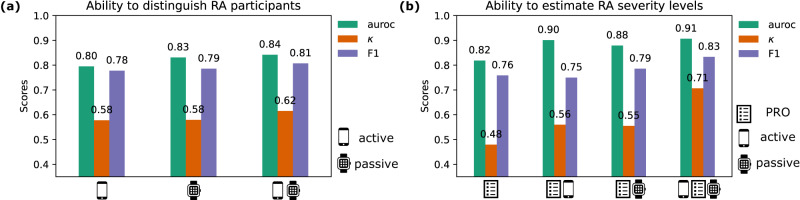
- Combined active + passive wearable sensor features best distinguished RA from healthy controls (F1, 0.807), compared with passive-only (F1, 0.786) or active-only (F1, 0.778) features.
- RA severity level estimation improved when PROs were augmented with both active and passive sensor outcomes (F1, 0.833) versus PRO assessments alone (F1, 0.759).
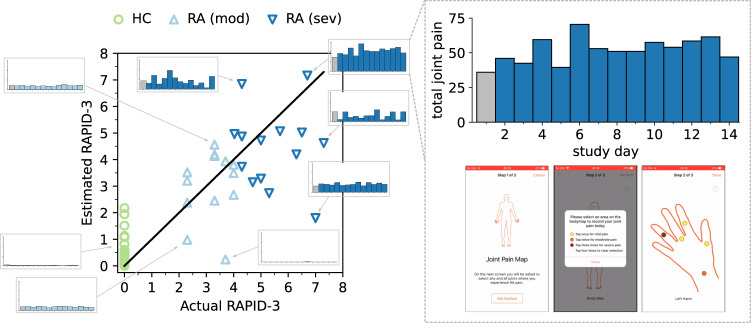
- PRO + sensor-based features estimated continuous clinician-assessed RAPID-3 scores with r² = 0.692 and RMSE = 1.33, improving on PRO measures alone (r² = 0.63; RMSE = 1.45).
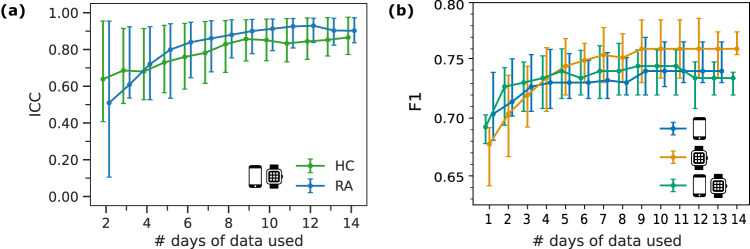
- By day 7 of the 14-day study, enough data had been collected to reliably capture RA characteristics; model performance and feature reliability stabilised after more than 7 days.
Methods
- Design: 14-day observational study (weaRAble-PRO) with 30 moderate-to-severe RA patients and 30 matched healthy controls; after two RA withdrawals, 28 RA participants, 28 matched HCs, and 2 unmatched HCs remained (total 58).
- Data: daily iPhone guided tests (wrist range of motion, 30-second walking, nine-hole peg test, sit-to-stand, lie-to-stand), continuous Apple Watch actigraphy, and PROs recorded on days 1, 7, and 14.
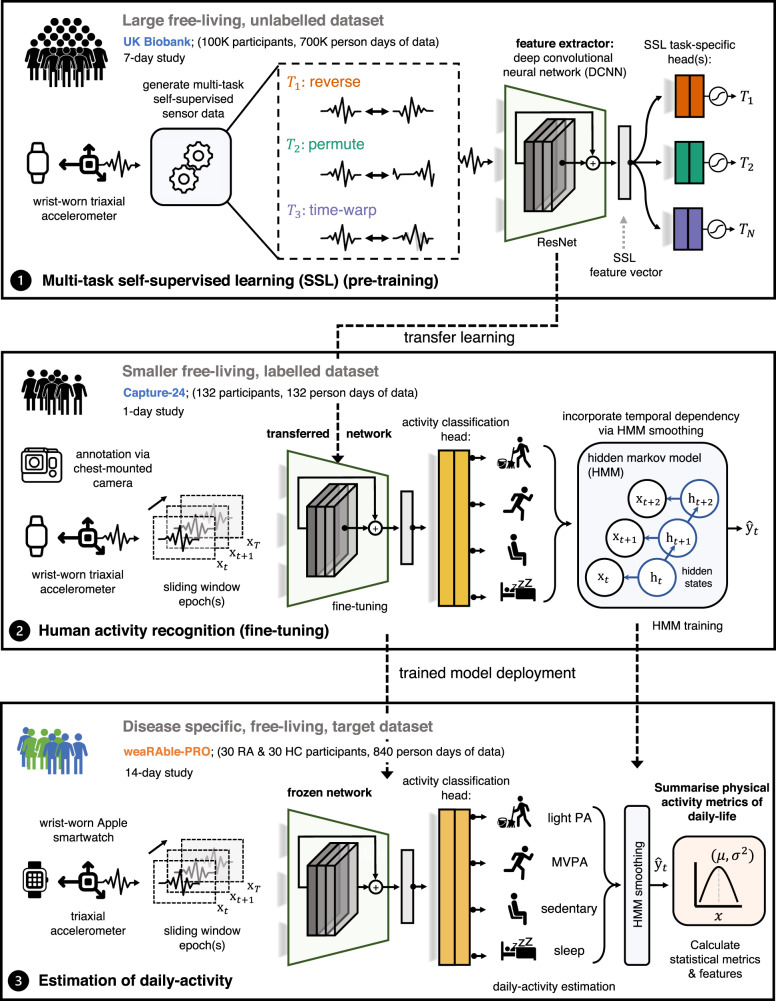
- Analysis: machine learning framework using a DCNN pretrained with self-supervised learning on UK Biobank data and fine-tuned on Capture-24, plus an HMM; regularised logistic regression, random forest, and XGBoost compared with stratified subject-wise 5-fold cross-validation; metrics included F1, AUROC, Cohen’s kappa, r², MAE, RMSE, and ICC.
Limitations
- The paper states a relatively small sample size (HC, n = 30; RA, n = 30), causing variability and uncertainty in cross-validated models; extrapolation to general RA populations requires larger cohorts and further external validation.
- The paper states that only moderate-to-severe RA patients were recruited, so lower disease activity or remission was not characterised.
- The paper notes that RAPID-3 was assessed at baseline with recall of the prior week, while PRO and sensor features were averaged over the subsequent 14 days, and that PRO predictors are subjective; evident from the text, the study is a single cohort without external validation beyond the internal JMAP inspection.
Model-written summary. Check it against the paper before relying on it.
Integrity signals
Registry
Cites
Statistics
Figures
Verification
Claims the paper makes
2 Valid · 1 Not valid · 20 Not checked · 58 Own results and interpretations
The cited sources support only part of this claim — read each source’s verdict below.
In the paper
“It was found that the “DCNN (SSL) + HMM” improved broad activity estimation in Capture-24 (κ, 0.862 ± 0.088; F1, 0.815 ± 0.103) as compared to a baseline random forest (RF) + HMM approach (κ, 0.813 ± 0.108; F1, 0.775 ± 0.117)28.”
§ Digital health technologies and machine learning augment patient reported outcomes to remotely characterise rheumatoid arthritis > Results > Assessing smartwatch-based daily physical activity patterns
What the sources say
- Partly supportedcites [28] Willetts M Hollowell S Aslett L Holmes C Doherty A Statistical machine learning of sleep and physical activity phenotypes from sensor data in 96,220 uk biobank participants Scientific reports 2018 8 1 10 10.1038/s41598-018-26174-1 29784928 PMC5962537 sourceExperimental — accuracy not yet measured
Our copy of Willetts et al. (2018) reports only a balanced random forest with HMM time smoothing evaluated on the 132 Capture-24 participants, achieving mean accuracy 87% and kappa = 0.81 (Results, para. 1; Discussion, 'The overall classification score of kappa = 0.81 for our method'), with base RF kappa 0.69 rising to 0.81 with the HMM (Results/Table S1). That covers the RF + HMM baseline side of the claim (kappa ~0.813), but the paper contains no deep convolutional neural network, no semi-supervised learning, no F1 scores and no per-subject SDs, so the attributed improvement of 'DCNN (SSL) + HMM' over the RF baseline (kappa 0.862, F1 0.815) is not in this source. Searches for 'DCNN', 'deep neural network', 'semi-supervised' and 'F1' returned only random-forest/HMM passages. (LLM, conf=0.72)
plainstates a causen = 150- Asserted: passes — The authors put it forward as true.
- Checkable: passes — It can be checked against evidence.
- Load-bearing: passes — The paper’s conclusions depend on it.
- Based: passes — The paper gives a reason why it holds.
- Partly supported
A result the paper reports from its own data — it cites no other source for it, so there is none to check. The quote shows it is in the paper.
In the paper
“However, it was observed that model performance using weekly-averaged features was often similar to fortnightly averaged (we also refer the reader to Supplementary Table 4).”
§ Digital health technologies and machine learning augment patient reported outcomes to remotely characterise rheumatoid arthritis > Results > Estimating the volume of days and number of sensor-outcomes required to remotely distinguish RA status
hedged- Asserted: passes — The authors put it forward as true.
- Checkable: passes — It can be checked against evidence.
- Load-bearing: unclear — It is unclear whether the paper’s conclusions depend on it.
- Based: passes — The paper gives a reason why it holds.
A result the paper reports from its own data — it cites no other source for it, so there is none to check. The quote shows it is in the paper.
In the paper
“It was observed that the linear combination of PRO assessments could accurately stratify RA symptom severity (F1, 0.759).”
§ Digital health technologies and machine learning augment patient reported outcomes to remotely characterise rheumatoid arthritis > Results > Analysis of sensor-outcomes to distinguish RA status and severity levels
hedgedstates an association- Asserted: passes — The authors put it forward as true.
- Checkable: passes — It can be checked against evidence.
- Load-bearing: passes — The paper’s conclusions depend on it.
- Based: passes — The paper gives a reason why it holds.
A result the paper reports from its own data — it cites no other source for it, so there is none to check. The quote shows it is in the paper.
In the paper
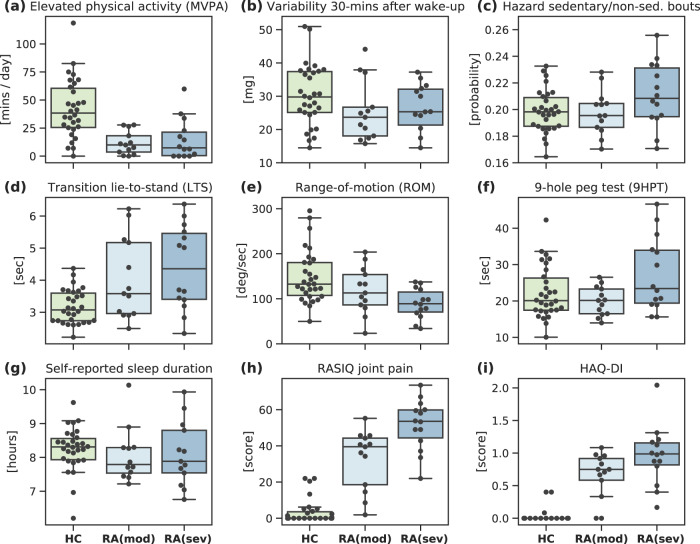
“A further 47 (34%) passive features, compared to 6 (24%) active features, were also significantly different (Mann-Whitney U test, p < 0.05) between healthy and RA participants.”
§ Digital health technologies and machine learning augment patient reported outcomes to remotely characterise rheumatoid arthritis > Results > Analysis of sensor-outcomes to distinguish RA status and severity levels
plainstates an association- Asserted: passes — The authors put it forward as true.
- Checkable: passes — It can be checked against evidence.
- Load-bearing: passes — The paper’s conclusions depend on it.
- Based: passes — The paper gives a reason why it holds.
A result the paper reports from its own data — it cites no other source for it, so there is none to check. The quote shows it is in the paper.
In the paper
“Furthermore, we found that averaging daily feature values over weekly and fortnightly periods improved model performance.”
§ Digital health technologies and machine learning augment patient reported outcomes to remotely characterise rheumatoid arthritis > Results > Estimating the volume of days and number of sensor-outcomes required to remotely distinguish RA status
plainstates a cause- Asserted: passes — The authors put it forward as true.
- Checkable: passes — It can be checked against evidence.
- Load-bearing: passes — The paper’s conclusions depend on it.
- Based: passes — The paper gives a reason why it holds.
43 more claims
Create a free account to see all 81 claims and to verify the 30 references still open.
- Probably not a substantial claim. 22
- It may state two separate claims as one. 18
- The quote only partly states this claim. 1
Claims other papers make about this one
Each is checked against this paper’s own text: does it say what the citing paper says it does?
In the citing paper
“Self-supervised pre-training has been shown to help classify human activity recognition not just in healthy but clinical populations35.”
From Self-supervised learning of accelerometer data provides new insights for sleep and its association with mortality (2024) · cites this paper as [35]
Self-check
Percentages, sums and reported differences re-computed from the paper’s own numbers.
Each contradiction between two passages listed here was confirmed by an independent check.
Rated major: it would touch a result — a value a result rests on, reported and recomputed p-values on opposite sides of the significance level, two passages that conflict with no sign which is right, or a cited work retracted before this paper was published.
In the paper
“Through multivariate modelling, using LR elastic-net, it was determined that PRO and sensor-based features could accurately estimate RAPID-3 scores to within 1 point (r2, 0.69; MAE, 0.94; RMSE, 1.33)”
§ Digital health technologies and machine learning augment patient reported outcomes to remotely characterise rheumatoid arthritis > Results > Estimating in-clinic RA severity scores from PRO and sensor-based outcomes
Reported 0.69 · recomputed 0.36
Rated minor: it would not touch a result — a value no result rests on, a p-value that stays on the same side of the significance level, or a conflict that is clerical, resolved elsewhere in the paper, or outside its own findings.
In the paper
§ Digital health technologies and machine learning augment patient reported outcomes to remotely characterise rheumatoid arthritis > Methods > Dataset
“| RAPID-3 | 0 ± 0 | 3.2 ± 0.7 | 5.3 ± 1.1 | < 0.001 |”
§ Digital health technologies and machine learning augment patient reported outcomes to remotely characterise rheumatoid arthritis > Methods > Dataset
“bRA participants with baseline RAPID-3: 6.1–12. cRA participants with baseline RAPID-3: > 12;”
Rated minor: it would not touch a result — a value no result rests on, a p-value that stays on the same side of the significance level, or a conflict that is clerical, resolved elsewhere in the paper, or outside its own findings.
In the paper
§ Digital health technologies and machine learning augment patient reported outcomes to remotely characterise rheumatoid arthritis > Results > Estimating the volume of days and number of sensor-outcomes required to remotely distinguish RA status
“Intra-rater reliability analyses suggest that feature reliability stabilises to good (ICC=0.75–0.9) and excellent (ICC > 0.9) once more than 7 contiguous days of data were used per participant.”
§ Digital health technologies and machine learning augment patient reported outcomes to remotely characterise rheumatoid arthritis > Results > Estimating the volume of days and number of sensor-outcomes required to remotely distinguish RA status
“ICC’s for HCs ranged from 0.582 to 0.854, while those for RA participants ranged from 0.424 to 0.897.”
Rated minor: it would not touch a result — a value no result rests on, a p-value that stays on the same side of the significance level, or a conflict that is clerical, resolved elsewhere in the paper, or outside its own findings.
In the paper
§ Digital health technologies and machine learning augment patient reported outcomes to remotely characterise rheumatoid arthritis > Results > Analysis of sensor-outcomes to distinguish RA status and severity levels
“The fusion of PRO data and sensor-based outcomes improved RA severity level estimation further with the addition of active (F1, 0.750) or passive (F1, 0.786) sources.”
§ Digital health technologies and machine learning augment patient reported outcomes to remotely characterise rheumatoid arthritis > Results > Analysis of sensor-outcomes to distinguish RA status and severity levels
“It was observed that the linear combination of PRO assessments could accurately stratify RA symptom severity (F1, 0.759).”
Citations
Cites
Breiman, L. (2001) · Machine Learning · doi:10.1023/a:1010933404324 · Cited by 133,538
Controlling the False Discovery Rate: A Practical and Powerful Approach to Multiple Testing
Benjamini, Y., & Hochberg, Y. (1995) · Journal of the Royal Statistical Society Series B: Statistical Methodology · doi:10.1111/j.2517-6161.1995.tb02031.x · Cited by 109,482
XGBoost: A Scalable Tree Boosting System
Chen, T., & Guestrin, C. (2016) · Proceedings of the 22nd ACM SIGKDD International Conference on Knowledge Discovery and Data Mining · doi:10.1145/2939672.2939785 · Cited by 54,569
Regression shrinkage and selection via the lasso
Tibshirani, R. (1996) · Journal of the Royal Statistical Society Series B: Statistical Methodology · doi:10.1111/j.2517-6161.1996.tb02080.x · Cited by 51,482
A Coefficient of Agreement for Nominal Scales
Cohen, J. (1960) · Educational and Psychological Measurement · doi:10.1177/001316446002000104 · Cited by 42,398 · cited 1×
“Multi-class classi fi cation metrics were reported as the observation-wise median and interquartile (IQR) range over one CV, as well as the subject-wise outcome for that CV, using: auroc, area under the receiver operating characteristic curve; k , Cohen ’ s kappa statistic 54,55 ; F 1 , F1-score.”
MethodA guideline of selecting and reporting intraclass correlation coefficients for reliability research
Koo, T. K., & Li, M. Y. (2016) · Journal of Chiropractic Medicine · doi:10.1016/j.jcm.2016.02.012 · Cited by 31,709 · cited 1×
“Reliability was categorised as either poor (ICC < 0.5), moderate (ICC = 0.5 – 0.75), good (ICC = 0.75 – 0.9), or excellent (ICC > 0.9) 46 .”
InfluentialThe Elements of Statistical Learning
Hastie, T., Tibshirani, R., & Friedman, J. (2009) · Springer Series in Statistics · doi:10.1007/978-0-387-84858-7 · Cited by 25,970
Intraclass correlations: Uses in assessing rater reliability.
Shrout, P. E., & Fleiss, J. L. (1979) · Psychological Bulletin · doi:10.1037/0033-2909.86.2.420 · Cited by 24,532 · cited 1×
“In this work, the ICC (3, k ) was calculated 45 – which considers the two-way random average measures with k repeated measurements — for the 14-day session across subjects, where the raters k are the study days.”
MethodOn a Test of Whether one of Two Random Variables is Stochastically Larger than the Other
Mann, H. B., & Whitney, D. R. (1947) · The Annals of Mathematical Statistics · doi:10.1214/aoms/1177730491 · Cited by 14,320
Use of Ranks in One-Criterion Variance Analysis
Kruskal, W. H., & Wallis, W. A. (1952) · Journal of the American Statistical Association · doi:10.1080/01621459.1952.10483441 · Cited by 13,912 · cited 1×
“One-way analysis of variance (ANOVA) tests were also used to assess differences between medians of multiple groups, for example HC vs. RA (mod) vs. RA (sev) were assessed using the Kruskal-Wallis (KWt) test by ranks 41 .”
MethodHosmer, D. W., Lemeshow, S., & Sturdivant, R. X. (2013) · Wiley Series in Probability and Statistics · doi:10.1002/9781118548387 · Cited by 13,861
Identity mappings in deep residual networks
He, K., Zhang, X., Ren, S., & Sun, J. (2016) · Lecture Notes in Computer Science · doi:10.1007/978-3-319-46493-0_38 · Cited by 10,741
Linear Statistical Inference and its Applications: Second Editon
Rao, C. R. (1973) · Wiley Series in Probability and Statistics · doi:10.1002/9780470316436 · Cited by 10,489
He, H., & Garcia, E. A. (2009) · IEEE Transactions on Knowledge and Data Engineering · doi:10.1109/tkde.2008.239 · Cited by 10,359
Statistical Analysis with Missing Data
Little, R. J. A., & Rubin, D. B. (2002) · Wiley Series in Probability and Statistics · doi:10.1002/9781119013563 · Cited by 8,473
2011 Compendium of Physical Activities: A Second Update of Codes and MET Values
AINSWORTH, B. E., HASKELL, W. L., HERRMANN, S. D., MECKES, N., BASSETT, D. R., TUDOR-LOCKE, C., GREER, J. L., VEZINA, J., WHITT-GLOVER, M. C., & LEON, A. S. (2011) · Medicine & Science in Sports & Exercise · doi:10.1249/mss.0b013e31821ece12 · Cited by 6,317
QUANTIFYING TEST-RETEST RELIABILITY USING THE INTRACLASS CORRELATION COEFFICIENT AND THE SEM
WEIR, J. P. (2005) · Journal of Strength and Conditioning Research · doi:10.1519/00124278-200502000-00038 · Cited by 4,842
Ware, J. E. (2000) · Spine · doi:10.1097/00007632-200012150-00008 · Cited by 4,455
Conditional variable importance for random forests
Strobl, C., Boulesteix, A.-L., Kneib, T., Augustin, T., & Zeileis, A. (2008) · BMC Bioinformatics · doi:10.1186/1471-2105-9-307 · Cited by 3,254
Robust Tests for the Equality of Variances
Brown, M. B., & Forsythe, A. B. (1974) · Journal of the American Statistical Association · doi:10.1080/01621459.1974.10482955 · Cited by 3,216 · cited 1×
“The Brown-Forsythe (BF) test by (absolute deviation) of medians was used to investigate if various groups of data have been drawn with equal variances 42 .”
MethodU.S. Department of Health and Human Services FDA Center for Drug Evaluation and Research, U.S. Department of Health and Human Services FDA Center for Biologics Evaluation and Research, & U.S. Department of Health and Human Services FDA Center for Devices and Radiological Health (2006) · Health and Quality of Life Outcomes · doi:10.1186/1477-7525-4-79 · Cited by 2,856
Variable selection using random forests
Genuer, R., Poggi, J.-M., & Tuleau-Malot, C. (2010) · Pattern Recognition Letters · doi:10.1016/j.patrec.2010.03.014 · Cited by 2,619
Statistical Learning with Sparsity: The Lasso and Generalizations
Hastie, T., Tibshirani, R., & Wainwright, M. (2015) · Chapman & Hall/CRC eBooks · doi:10.1201/b18401 · Cited by 2,520
Shaffer, J. P. (1995) · Annual Review of Psychology · doi:10.1146/annurev.ps.46.020195.003021 · Cited by 1,960
Simon, N., Friedman, J., Hastie, T., & Tibshirani, R. (2013) · Journal of Computational and Graphical Statistics · doi:10.1080/10618600.2012.681250 · Cited by 1,380 · cited 1×
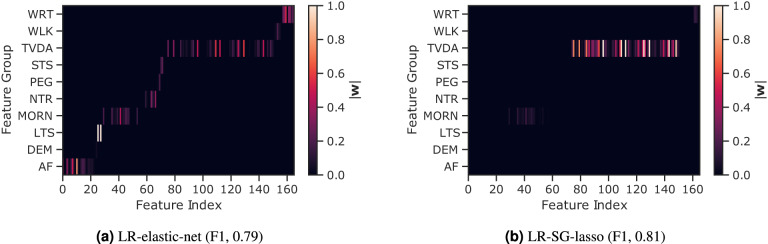
“…lasso (SG-lasso) — an extension of the lasso that promotes both group sparsity and within group parameter-wise ( ℓ 2 ) sparsity, through a group lasso penalty and the lasso penalty — which aims to yield a sparse set of groups and also a sparse set of covariates in each selected group 50,51 .”
BackgroundDevelopment of a PROMIS item bank to measure pain interference
Amtmann, D., Cook, K. F., Jensen, M. P., Chen, W.-H., Choi, S., Revicki, D., Cella, D., Rothrock, N., Keefe, F., Callahan, L., et al. (2010) · Pain · doi:10.1016/j.pain.2010.04.025 · Cited by 1,199
Self-citationMcCullagh, P., & Nelder, J. A. (2019) · doi:10.1201/9780203753736 · Cited by 1,013
Adult Norms for the Nine Hole Peg Test of Finger Dexterity
Mathiowetz, V., Weber, K., Kashman, N., & Volland, G. (1985) · The Occupational Therapy Journal of Research · doi:10.1177/153944928500500102 · Cited by 972 · cited 1×
“Participants were prescribed daily to perform fi ve iPhone-based assessments: WRT, a wrist range of motion (ROM) exercise 12 ; WLK, a 30-second walking exercise 12 ; PEG, a digital 9-hole peg test 34 ; STS, a sit-to-stand transition exercise 31,35 ; and LTS, a lie-to-stand transition exercise 31,35 .”
MethodThe Box-Cox Transformation Technique: A Review
Sakia, R. M. (1992) · The Statistician · doi:10.2307/2348250 · Cited by 945
Smallest real difference, a link between reproducibility and responsiveness
Beckerman, H., Roebroeck, M. E., Lankhorst, G. J., Becher, J. G., Bezemer, P. D., & Verbeek, A. L. M. (2001) · Quality of Life Research · doi:10.1023/a:1013138911638 · Cited by 857
Buysse, D. J., Yu, L., Moul, D. E., Germain, A., Stover, A., Dodds, N. E., Johnston, K. L., Shablesky-Cade, M. A., & Pilkonis, P. A. (2010) · Sleep · doi:10.1093/sleep/33.6.781 · Cited by 850
Mercieca-Bebber, R., King, M. T., Calvert, M. J., Stockler, M. R., & Friedlander, M. (2018) · Patient Related Outcome Measures · doi:10.2147/prom.s156279 · Cited by 659
A note on the group lasso and a sparse group lasso
Friedman, J. H., Hastie, T. J., & Tibshirani, R. J. (2010) · arXiv (Cornell University) · doi:10.48550/arxiv.1001.0736 · Cited by 619
The visual analogue scale: Its use in pain measurement
Langley, G. B., & Sheppeard, H. (1985) · Rheumatology International · doi:10.1007/bf00541514 · Cited by 619
Sit-to-stand test for measuring performance of lower extremity muscles
Bohannon, R. W. (1995) · Perceptual and Motor Skills · doi:10.2466/pms.1995.80.1.163 · Cited by 509 · cited 1×
“Participants were prescribed daily to perform fi ve iPhone-based assessments: WRT, a wrist range of motion (ROM) exercise 12 ; WLK, a 30-second walking exercise 12 ; PEG, a digital 9-hole peg test 34 ; STS, a sit-to-stand transition exercise 31,35 ; and LTS, a lie-to-stand transition exercise 31,35 .”
MethodCella, D. F., Yount, S., Sorensen, M., Chartash, E., Sengupta, N., & Grober, J. (2005) · PubMed · Cited by 496
Hewlett, S., Dures, E., & Almeida, C. (2011) · Arthritis Care & Research · doi:10.1002/acr.20579 · Cited by 393
The clinical features of rheumatoid arthritis
Grassi, W., De Angelis, R., Lamanna, G., & Cervini, C. (1998) · European Journal of Radiology · doi:10.1016/s0720-048x(98)00038-2 · Cited by 389 · cited 3×
“Rheumatoid arthritis (RA) patients follow subtle and unpredictable disease courses, patient-to-patient, with a progressive decline in physical function and quality of life and over time — often leading to disability and dif fi culty to perform many tasks of daily life 1 .”
BackgroundMethodDeveloping and adopting safe and effective digital biomarkers to improve patient outcomes
Coravos, A., Khozin, S., & Mandl, K. D. (2019) · npj Digital Medicine · doi:10.1038/s41746-019-0090-4 · Cited by 361 · cited 3×
“Finally, the application of DHT sensor-outcomes to monitor RA during daily life remains yet to be validated against standard in-clinic administered assessments of RA impact 24 .”
MethodInfluentialSokka, T., Häkkinen, A., Kautiainen, H., Maillefert, J. F., Toloza, S., MØrk hansen, T., Calvo‐Alen, J., Oding, R., Liveborn, M., Huisman, M., et al. (2008) · Arthritis Care & Research · doi:10.1002/art.23255 · Cited by 354
Randomized controlled trial of a 12-week digital care program in improving low back pain
Shebib, R., Bailey, J. F., Smittenaar, P., Perez, D. A., Mecklenburg, G., & Hunter, S. (2019) · npj Digital Medicine · doi:10.1038/s41746-018-0076-7 · Cited by 341
Maska, L., Anderson, J., & Michaud, K. (2011) · Arthritis Care & Research · doi:10.1002/acr.20620 · Cited by 312
Willetts, M., Hollowell, S., Aslett, L., Holmes, C., & Doherty, A. (2018) · Scientific Reports · doi:10.1038/s41598-018-26174-1 · Cited by 250 · cited 6×
“…allowed our model to be pre-trained on 100,000 participants with 700,000 days of diverse, unlabelled wearable sensor data in the uk biobank 27 , which combined with HMM temporal smoothing, signi fi cantly improved activity prediction compared to our previous established RF-HMM based methods 28,30 .”
BackgroundMethodInfluentialSelf-citationWalmsley, R., Chan, S., Smith-Byrne, K., Ramakrishnan, R., Woodward, M., Rahimi, K., Dwyer, T., Bennett, D., & Doherty, A. (2022) · British Journal of Sports Medicine · doi:10.1136/bjsports-2021-104050 · Cited by 238
Self-citationMeasuring fatigue in rheumatoid arthritis: A systematic review of scales in use
Hewlett, S., Hehir, M., & Kirwan, J. R. (2007) · Arthritis Care & Research · doi:10.1002/art.22611 · Cited by 228
Instrumenting gait with an accelerometer: A system and algorithm examination
Godfrey, A., Del Din, S., Barry, G., Mathers, J. C., & Rochester, L. (2015) · Medical Engineering & Physics · doi:10.1016/j.medengphy.2015.02.003 · Cited by 213
Displacement of the pelvis during human walking: experimental data and model predictions
Zijlstra, W., & Hof, A. L. (1997) · Gait & Posture · doi:10.1016/s0966-6362(97)00021-0 · Cited by 195
Campbell, R., Ju, A., King, M. T., & Rutherford, C. (2022) · Quality of Life Research · doi:10.1007/s11136-021-03003-z · Cited by 188
Earhart, G. M., Cavanaugh, J. T., Ellis, T., Ford, M. P., Foreman, K. B., & Dibble, L. (2011) · Journal of Neurologic Physical Therapy · doi:10.1097/npt.0b013e318235da08 · Cited by 187
Piga, M., Cangemi, I., Mathieu, A., & Cauli, A. (2017) · Seminars in Arthritis and Rheumatism · doi:10.1016/j.semarthrit.2017.03.014 · Cited by 178
Circadian variation in disease activity in rheumatoid arthritis.
Harkness, J. A., Richter, M. B., Panayi, G. S., Van de Pette, K., Unger, A., Pownall, R., & Geddawi, M. (1982) · BMJ · doi:10.1136/bmj.284.6315.551 · Cited by 171
Self-supervised learning for human activity recognition using 700,000 person-days of wearable data
Yuan, H., Chan, S., Creagh, A. P., Tong, C., Acquah, A., Clifton, D. A., & Doherty, A. (2024) · npj Digital Medicine · doi:10.1038/s41746-024-01062-3 · Cited by 166
Self-citationPincus, T., Yazici, Y., & Bergman, M. J. (2009) · Rheumatic Disease Clinics of North America · doi:10.1016/j.rdc.2009.10.008 · Cited by 163
Remote smartphone monitoring of Parkinson’s disease and individual response to therapy
Omberg, L., Neto, E. C., Perumal, T. M., Pratap, A., Tediarjo, A., Adams, J., Bloem, B. R., Bot, B. M., Elson, M. J., Goldman, S. M., et al. (2021) · Nature Biotechnology · doi:10.1038/s41587-021-00974-9 · Cited by 151
Gossec, L., Guyard, F., Leroy, D., Lafargue, T., Seiler, M., Jacquemin, C., Molto, A., Sellam, J., Foltz, V., Gandjbakhch, F., et al. (2019) · Arthritis Care & Research · doi:10.1002/acr.23768 · Cited by 143
Patient-reported outcomes and their role in the assessment of rheumatoid arthritis
Lubeck, D. P. (2004) · PharmacoEconomics · doi:10.2165/00019053-200422001-00004 · Cited by 123 · cited 2×
“ICCs were calculated for each feature using n = [2, 3, … , 14] days of data per participant, individually for HC and RA participants.”
BackgroundMethodFlurey, C., Morris, M., Richards, P., Hughes, R., & HEWLETT, S. E. (2013) · Rheumatology · doi:10.1093/rheumatology/ket416 · Cited by 119
Mobile health: the power of wearables, sensors, and apps to transform clinical trials
Munos, B., Baker, P. C., Bot, B. M., Crouthamel, M., de Vries, G., Ferguson, I., Hixson, J. D., Malek, L. A., Mastrototaro, J. J., Misra, V., et al. (2016) · Annals of the New York Academy of Sciences · doi:10.1111/nyas.13117 · Cited by 118
Patient-reported outcomes as end points in clinical trials in rheumatoid arthritis
Gossec, L., Dougados, M., & Dixon, W. (2015) · RMD Open · doi:10.1136/rmdopen-2014-000019 · Cited by 115 · cited 1×
“These have inherent limitations, however, in that they can be subjective and are prone to recall bias 4,5 .”
BackgroundLipsmeier, F., Taylor, K. I., Postuma, R. B., Volkova-Volkmar, E., Kilchenmann, T., Mollenhauer, B., Bamdadian, A., Popp, W. L., Cheng, W.-Y., Zhang, Y.-P., et al. (2022) · Scientific Reports · doi:10.1038/s41598-022-15874-4 · Cited by 109
The clinical utility of accelerometry in patients with rheumatoid arthritis
Prioreschi, A., Hodkinson, B., Avidon, I., Tikly, M., & McVeigh, J. A. (2013) · Rheumatology · doi:10.1093/rheumatology/ket216 · Cited by 86 · cited 3×
“…SSL DCNN + HMM model enabled a more robust and fi ne-grained estimation of daily activity patterns beyond traditional acceleration magnitude levels 13,14 , which we proposed could allow a richer characterisation of PA and sleep in RA activity monitoring revealed distinct differences…”
BackgroundMethodResultInfluentialTaylor, K. I., Staunton, H., Lipsmeier, F., Nobbs, D., & Lindemann, M. (2020) · npj Digital Medicine · doi:10.1038/s41746-020-0305-8 · Cited by 85 · cited 12×
“3b (expanded in Supplementary Table 6).”
BackgroundMethodInfluentialCrouthamel, M., Quattrocchi, E., Watts, S., Wang, S., Berry, P., Garcia-Gancedo, L., Hamy, V., & Williams, R. E. (2018) · JMIR mHealth and uHealth · doi:10.2196/mhealth.9656 · Cited by 76 · cited 2×
“DHT have been shown to measure RA symptoms and functions, such as range of motion (ROM) and gait-speci fi c metrics during prescribed “ active ” assessments 11,12 .”
BackgroundMethodSelf-citationPratap, A., Grant, D., Vegesna, A., Tummalacherla, M., Cohan, S., Deshpande, C., Mangravite, L., & Omberg, L. (2020) · JMIR mHealth and uHealth · doi:10.2196/22108 · Cited by 75 · cited 5×
“vector magnitude during the first n=[15, 30, 45, 60, 120, 240] mins after getting up 36 Morning stiffness: mean - 0:30:00 37 Morning stiffness: mean - 0:45:00 38 Morning stiffness: mean - 1:00:00 39 Morning stiffness: mean - 2:00:00 40 Morning stiffness: mean - 4:00:00 41 Morning stiffness: q(0.”
BackgroundInfluentialten Klooster, P. M., Vonkeman, H. E., Taal, E., Siemons, L., Hendriks, L., de Jong, A. J. L., Dutmer, E. A. J., van Riel, P. L. C. M., & van de Laar, M. A. F. J. (2013) · Health and Quality of Life Outcomes · doi:10.1186/1477-7525-11-77 · Cited by 69
Physical activity and energy expenditure in rheumatoid arthritis patients and matched controls
Henchoz, Y., Bastardot, F., Guessous, I., Theler, J., Dudler, J., Vollenweider, P., & So, A. K. L. (2012) · Rheumatology · doi:10.1093/rheumatology/kes067 · Cited by 66
Pourahmadi, M. R., Ebrahimi Takamjani, I., Sarrafzadeh, J., Bahramian, M., Mohseni‐Bandpei, M. A., Rajabzadeh, F., & Taghipour, M. (2017) · Journal of Anatomy · doi:10.1111/joa.12568 · Cited by 61
Creagh, A. P., Simillion, C., Bourke, A. K., Scotland, A., Lipsmeier, F., Bernasconi, C., van Beek, J., Baker, M., Gossens, C., Lindemann, M., et al. (2020) · IEEE Journal of Biomedical and Health Informatics · doi:10.1109/jbhi.2020.2998187 · Cited by 53
Self-citationSmartphone-Based 3D Indoor Pedestrian Positioning through Multi-Modal Data Fusion
Zhao, H., Cheng, W., Yang, N., Qiu, S., Wang, Z., & Wang, J. (2019) · Sensors · doi:10.3390/s19204554 · Cited by 50 · cited 5×
“vector magnitude during the first n=[15, 30, 45, 60, 120, 240] mins after getting up 36 Morning stiffness: mean - 0:30:00 37 Morning stiffness: mean - 0:45:00 38 Morning stiffness: mean - 1:00:00 39 Morning stiffness: mean - 2:00:00 40 Morning stiffness: mean - 4:00:00 41 Morning stiffness: q(0.”
BackgroundInfluentialEl Miedany, Y., El Gaafary, M., Youssef, S., Bahlas, S., Almedany, S., Ahmed, I., & Palmer, D. (2016) · The Journal of Rheumatology · doi:10.3899/jrheum.151421 · Cited by 47 · cited 1×
“…outcomes (PROs) enable a patient the ability to regularly record their “ subjective ” experience of disease activity in remote settings 23 , it remains unclear how “ objective ” sensor-outcomes could provide additional insights that can augment PROs to better characterise the impact…”
BackgroundDi, J., Leroux, A., Urbanek, J., Varadhan, R., Spira, A. P., Schrack, J., & Zipunnikov, V. (2017) · bioRxiv (Cold Spring Harbor Laboratory) · doi:10.1101/182337 · Cited by 45
Lipsmeier, F., Simillion, C., Bamdadian, A., Tortelli, R., Byrne, L. M., Zhang, Y., Wolf, D., Smith, A. V., Czech, C., Gossens, C., et al. (2022) · Journal of Medical Internet Research · doi:10.2196/32997 · Cited by 44 · cited 1×
“However, there remains a lack of suf fi cient evidence for how DHT can provide objective insights into the impact of therapies for RA, despite progress made in other disease areas 15 – 22 .”
BackgroundCreagh, A. P., Simillion, C., Scotland, A., Lipsmeier, F., Bernasconi, C., Belachew, S. M., van Beek, J., Baker, M., Gossens, C., Lindemann, M., et al. (2020) · Physiological Measurement · doi:10.1088/1361-6579/ab8771 · Cited by 41
Self-citationHamy, V., Garcia-Gancedo, L., Pollard, A., Myatt, A., Liu, J., Howland, A., Beineke, P., Quattrocchi, E., Williams, R., & Crouthamel, M. (2020) · Digital Biomarkers · doi:10.1159/000506860 · Cited by 37 · cited 4×
“DHT have been shown to measure RA symptoms and functions, such as range of motion (ROM) and gait-speci fi c metrics during prescribed “ active ” assessments 11,12 .”
BackgroundMethodResultInfluentialSelf-citationAndreu-Pérez, J., Garcia‐Gancedo, L., McKinnell, J., van der Drift, A., Powell, A., Hamy, V., Keller, T., & Yang, G. (2017) · Sensors · doi:10.3390/s17092113 · Cited by 22
Self-citationYun, H., Nowell, W. B., Curtis, D., H. Willig, J., Yang, S., Auriemma, M., Chen, L., Filby, C., & Curtis, J. R. (2020) · Arthritis Care & Research · doi:10.1002/acr.23888 · Cited by 16 · cited 17×
“3b (expanded in Supplementary Table 6).”
BackgroundInfluentialInertial Sensor Based Analysis of Lie-to-Stand Transfers in Younger and Older Adults
Schwickert, L., Boos, R., Klenk, J., Bourke, A. K., Becker, C., & Zijlstra, W. (2016) · Sensors · doi:10.3390/s16081277 · Cited by 16
Becker, B. D., Bracher, M. G., Chauhan, D., Rendas‐Baum, R., Lin, X., Raymond, K., O’Connor, M., & Kosinski, M. R. (2021) · Journal of Patient-Reported Outcomes · doi:10.1186/s41687-021-00400-3 · Cited by 13
Walmsley, R., Chan, S., Smith-Byrne, K., Ramakrishnan, R., Woodward, M., Rahimi, K., Dwyer, T., Bennett, D., & Doherty, A. (2020) · doi:10.1101/2020.11.10.20227769 · Cited by 12
Self-citationHamy, V., Llop, C., Yee, C. W., Garcia‐Gancedo, L., Maxwell, A. C., Chen, W. H., Tomlinson, R., Bobbili, P. J., Bendelac, J., Landry, J., et al. (2023) · Scientific Reports · doi:10.1038/s41598-023-45387-7 · Cited by 12 · cited 3×
“(212295, weaRAble-PRO) 26 .”
MethodInfluentialSelf-citationBanderas, B., Skup, M., Shields, A. L., Mazar, I., & Ganguli, A. (2017) · Current Medical Research and Opinion · doi:10.1080/03007995.2017.1338562 · Cited by 10
Keogh, A., Sett, N., Donnelly, S. C., Mullan, R. H., Gheta, D., Maher-Donnelly, M., Illiano, V. P., Calvo, F., Dorn, J. F., Namee, B. M., et al. (2020) · Digital Biomarkers · doi:10.1159/000509724 · Cited by 8 · cited 1×
“For example, the mean acceleration value > 30 [mins] after wake-up were lower in RA — also a similar fi nding to Keogh et al. 33 — or that the number of movement episodes during night-time sleep distinguished some speci fi c RA participants.”
ResultWebster, D. E., Haberman, R. H., Perez-Chada, L. M., Tummalacherla, M., Tediarjo, A., Yadav, V., Neto, E. C., MacDuffie, W., DePhillips, M., Sieg, E., et al. (2022) · medRxiv · doi:10.1101/2022.04.13.22273676 · Cited by 6
Self-supervised Learning for Human Activity Recognition Using 700,000 Person-days of Wearable Data
Yuan, H., Chan, S., Creagh, A. P., Tong, C., Acquah, A., Clifton, D. A., & Doherty, A. (2022) · arXiv · doi:10.48550/arxiv.2206.02909
Self-citation
Research works printed but not linked: 3
- Hollander, M., Wolfe, D. A. & Chicken, E. Nonparametric statistical methods, Vol. 751 (John Wiley & Sons, 2013).
- Gibbons, J. D. & Chakraborti, S. Nonparametric Statistical Inference: Revised and Expanded (CRC press, 2014).
- Portney, L. G. & Watkins, M. P. Foundations of clinical research: applications to practice, vol. 892 (Pearson/Prentice Hall Upper Saddle River, NJ, 2009).
Cited by
Self-supervised learning for human activity recognition using 700,000 person-days of wearable data
Yuan, H., Chan, S., Creagh, A. P., Tong, C., Acquah, A., Clifton, D. A., & Doherty, A. (2024) · npj Digital Medicine · doi:10.1038/s41746-024-01062-3 · Cited by 166
“The test performance for the AoT stayed at the random chance level, and the test performance for permutation dropped roughly 10 percentage points without weighted sampling.”
Self-citationArtificial intelligence for personalized nanomedicine; from material selection to patient outcomes
Mazumdar, H., Khondakar, K. R., Das, S., Halder, A., & Kaushik, A. (2025) · Expert Opinion on Drug Delivery · doi:10.1080/17425247.2024.2440618 · Cited by 159
Immune digital twins for complex human pathologies: applications, limitations, and challenges
Niarakis, A., Laubenbacher, R., An, G. C., Ilan, Y., Fisher, J., Flobak, Å., Reiche, K., Martínez, M. R., Geris, L., Ladeira, L., et al. (2024) · npj Systems Biology and Applications · doi:10.1038/s41540-024-00450-5 · Cited by 128
“Biosensors that can measure matrix degradation and bone erosion along with patient-reported outcomes and scores, could be used to assess the patient ’ s joint and bone health and monitor changes over time 84 .”
Olawade, D. B., Fidelis, S. C., Marinze, S., Egbon, E., Osunmakinde, A., & Osborne, A. (2025) · International Journal of Medical Informatics · doi:10.1016/j.ijmedinf.2025.106141 · Cited by 96
Chan, S., Hang, Y., Tong, C., Acquah, A., Schonfeldt, A., Gershuny, J., & Doherty, A. (2024) · Scientific Data · doi:10.1038/s41597-024-03960-3 · Cited by 61
“…convenient, allow us to efficiently obtain an objective and high-resolution picture of a user’s daily activities, enabling new opportunities for real-time precision medicine, digital phenotyping for routine care and clinical trials 1–3 , and large-scale population and epidemiological studies 4–6 .”
Self-citation
Metadata
- Authors
- Creagh, A. P., Hamy, V., Yuan, H., Mertes, G., Tomlinson, R., Chen, W.-H., Williams, R., Llop, C., Yee, C., Duh, M. S., Doherty, A., Garcia-Gancedo, L., & Clifton, D. A.
- Affiliations
- University of Oxford (GB)
- Analysis Group (United States) (US)
- Corresponding author
- Creagh, Andrew P.
- ORCID
- Venue
- npj Digital Medicine
- Published
- 2024-02-12
- Volume
- 7
- Issue
- 1
- Pages
- 33-33
- ISSN
- 2398-6352 (ISSN-L)
- PMC
- PMC10861520
- OpenAlex
- W4391751277
- Cited by
- 64
- References
- 82
- Citations by year
- 2026: 23 · 2025: 23 · 2024: 15
- FWCI
- 19.75
- Type
- journal article
- Language
- en
- Open access
- gold
- doi.org
- Licence
- cc-by
- creativecommons.org/licenses/by/4.0 (tdm)
- creativecommons.org/licenses/by/4.0 (vor)
- Locations
- npj Digital Medicine (publishedVersion, cc-by)
- medRxiv (acceptedVersion, cc-by-nd)
- PubMed Central (publishedVersion, cc-by)
- PubMed (publishedVersion)
- DOAJ (DOAJ: Directory of Open Access Journals) (submittedVersion, cc-by-sa)
- Funders
- GlaxoSmithKline
- Wellcome Trust (223100/Z/21/Z)
- National Institute for Health and Care Research
- Topics
- Health Sciences › Medicine › Rheumatology › Rheumatoid Arthritis Research and Therapies
- Health Sciences › Health Professions › General Health Professions › Mobile Health and mHealth Applications
- Physical Sciences › Computer Science › Computer Vision and Pattern Recognition › Context-Aware Activity Recognition Systems
- Keywords
- rheumatoid arthritis, patient-reported outcomes, digital health technologies, wearable sensors, smartphone health monitoring, actigraphy, heart rate monitoring, remote patient monitoring, fatigue, clinical trial outcome measures
About these checks
Registry, retraction, Cites and statistics results are computed, not judged, with one exception: a printed reference that no index lists is read once by a model before it counts as a citation error. Claims are extracted by a model and kept only when their quote appears verbatim in the text; each cited source is then checked, with a model’s help, for whether it says what the claim relies on. Those verdicts can be wrong — read the claim’s quote and the cited source before relying on one.
The claim verdicts this report counts are experimental: their accuracy is not yet measured.
A language model drew the claims from the paper on 2026-10-05, under version 3 of the claim definition (model deepseek-v4.1-flash, prompt extract-v3).
A second model labelled each claim on 2026-10-05 (model jev-1.13-20260917, definition revision gold-guideline-v0.2).
Cited sources are checked with a language model’s help (qwen3.8-omni-flash).
Statistics and arithmetic are recomputed, not judged.
Confidence bands are shown only for fields calibrated on our annotated test set. None is calibrated yet, so no band is shown.
What counts as a claim ›How we measure confidence ›How we check this ›
Are you an author, or do you see a problem with this page? Request a review
Data sources
Bibliographic data: Semantic Scholar, OpenAlex, Crossref.
Contains information from the Semantic Scholar Academic Graph Datasets, made available under the ODC Attribution License (ODC-BY 1.0).
Semantic Scholar’s data is described in: Kinney, R., et al. (2023). The Semantic Scholar Open Data Platform. arXiv:2301.10140.
