

Self-supervised learning for human activity recognition using 700,000 person-days of wearable data
Open accessThe DOI matches its Crossref record; 73 of the 73 references it cites were found in a registry or an index; 17 of the 20 sources its claims cite were checked for support.
Abstract
A large-scale study leveraging self-supervised learning on 700,000 person-days of unlabeled accelerometer data from the UK Biobank to build generalized activity recognition models that outperform supervised baselines across eight benchmark datasets with a median relative F1 improvement of 24.4%.
Overview
CoChat Summary
TL;DR
This paper applies multi-task self-supervised learning to 700,000 person-days of unlabelled UK Biobank wrist accelerometer data, then transfers the pre-trained model to eight human activity recognition benchmarks. The resulting models consistently outperform random forest and from-scratch deep learning baselines, with F1 relative improvements of 2.5–130.9% (median 24.4%).
Key findings
- Pre-trained models outperformed both random forest and ResNet trained from scratch on all eight downstream datasets; the largest gains were on small datasets, e.g. MJFF-LR F1 0.755 ± 0.109 vs 0.327 ± 0.103 from scratch (130.9% improvement), ADL 0.829 ± 0.101 vs 0.414 ± 0.179 (100.0%), and Opportunity 0.595 ± 0.085 vs 0.383 ± 0.124 (55.4%).
- The smallest relative improvement was on the largest labelled dataset, Capture-24: F1 0.726 ± 0.093 with self-supervised fine-tuning of all layers vs 0.708 ± 0.094 from scratch (2.5%).
- Fine-tuning all layers was better than fine-tuning only the fully connected layers after the Conv layers, and self-supervised pre-training on UK Biobank generally outperformed supervised pre-training on Rowlands or Capture-24 in the transfer-learning comparisons.
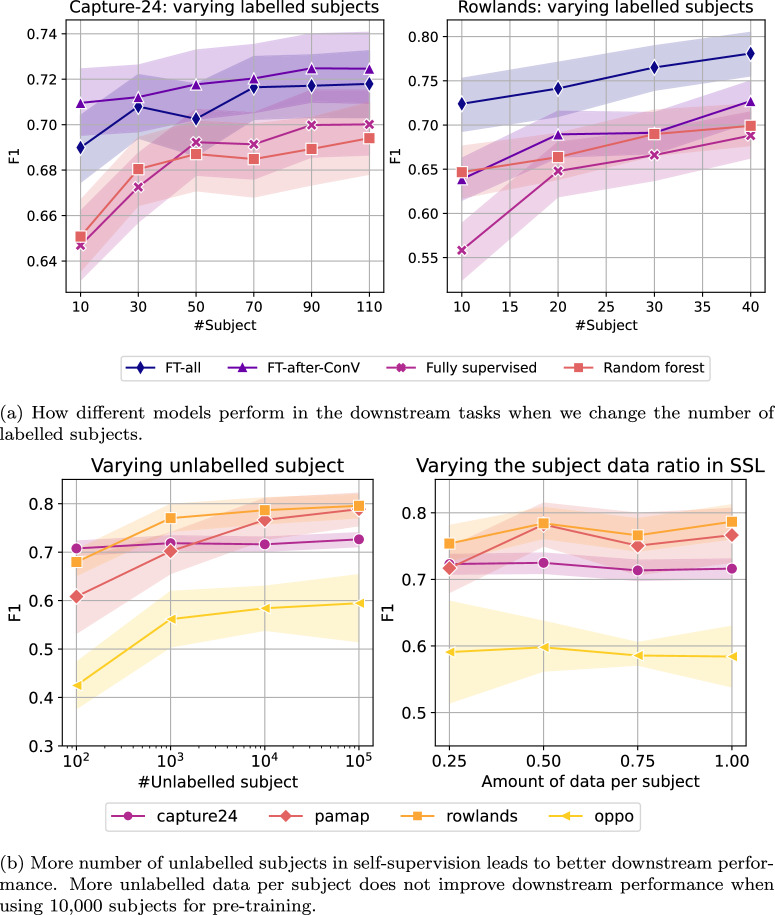
- Downstream performance increased roughly linearly with the number of unlabelled pre-training subjects on a log scale, and reducing data per subject from 100% to 25% did not degrade F1 by more than 10%.
Methods
- Multi-task self-supervised pre-training used unlabelled UK Biobank wrist accelerometer data (~100,000 participants, 7 days, >700,000 person-days), resampled to 30 Hz with 10-second windows. The network was an 18-layer 1D ResNet-V2 with 10M parameters and a 1024-dimensional feature vector; pretext tasks were arrow of time, permutation, and time warping, with weighted sampling by signal standard deviation. Training used Adam with learning rate 1e-3, four Tesla V100-SXM2 GPUs, and about 420 GPU hours for ~20 epochs.
- Evaluation used eight external labelled datasets varying in size (600–600,000 samples), activity classes (4–18), devices (5 brands), placements (4 configurations), and populations. Models were fine-tuned either all layers or only FC layers and compared against random forest and from-scratch ResNet; held-one-subject-out cross-validation was used for datasets with <10 subjects, and five-fold subject-wise cross-validation for datasets with ≥10 subjects, with a 7:1:2 train/validation/test split and early stopping patience of five.
- Ablations varied labelled downstream subjects and unlabelled pre-training participants (100 to 100,000) and data per subject (0.25–1); representation analyses used UMAP projections and layer-wise relevance propagation.
Limitations
- The paper states that the pre-training data (UK Biobank) consists mostly of Caucasians from the UK, due to a current lack of raw accelerometer datasets from different regions of the world. It also notes future work should consider multimodal wearable data, more recent self-supervised approaches, and that Autoencoder and contrastive learning attempts did not yield high-quality representations on UK Biobank, suspected to be due to free-living vs lab-based data differences.
- Evident from the text: evaluation is limited to wrist-worn accelerometer data and eight benchmark datasets, with no external validation in non-UK or non-Caucasian populations. The paper also reports that many open benchmark datasets used lacked suitable licensing or consent information, and small datasets had activity classes removed if not performed by all subjects.
Model-written summary. Check it against the paper before relying on it.
Integrity signals
Registry
Cites
Statistics
Figures



Verification
Claims the paper makes
8 Valid · 3 Not valid · 0 Not checked · 55 Own results and interpretations
At least one cited source doesn’t support this claim or points to a different paper, and none confirmed it — see the verdicts below.
In the paper
“The scale of UK Biobank is several orders of magnitude greater than the largest datasets used by the current state-of-the-art such as the Fenland data9 (n = 160,000).”
§ Self-supervised learning for human activity recognition using 700,000 person-days of wearable data > Discussion
What the sources say
- Disputedcites [9] Lindsay, T. et al. Descriptive epidemiology of physical activity energy expenditure in UK adults (the Fenland study). Int. J. Behav. Nutr. Phys. Activity 16, 1–13 (2019). sourceExperimental — accuracy not yet measured
The Methods (Study population) state that the Fenland Study enrolled 12,435 participants, not 160,000. The Results further report that 12,002 met the sensing criteria for this analysis. The paper does not provide a UK Biobank comparison, so it cannot establish the claimed difference in scale. (LLM, conf=0.90)
Checked by a reasoning model — may be wrong.
plainn = 160,000- Asserted: passes — The authors put it forward as true.
- Checkable: passes — It can be checked against evidence.
- Load-bearing: passes — The paper’s conclusions depend on it.
- Based: passes — The paper gives a reason why it holds.
- Disputed
The cited sources that could be checked couldn’t confirm or dispute this claim.
In the paper
“We attempted to use Autoencoder and contrastive learning for pre-training. However, we could not obtain high-quality representation using the UK Biobank43.”
§ Self-supervised learning for human activity recognition using 700,000 person-days of wearable data > Discussion
What the sources say
- Could not verifycites [43] Tang, C. I. et al. SelfHAR: Improving Human Activity Recognition through Self-training with Unlabeled Data. Proc. ACM Interact. Mob. Wearable Ubiquitous Technol. 5, 30 (2021). sourceExperimental — accuracy not yet measured
The Experimental Protocols (§4.1.8) describe the Fenland Study, and the Results (§5.1.1) name MobiAct and HHAR as unlabeled datasets; neither passage addresses UK Biobank. Searches for UK Biobank, autoencoder and contrastive pre-training found no passage reporting the claimed failure to obtain a high-quality representation. The citing authors describe their own attempt, which this source cannot verify. (LLM, conf=0.76)
plain- Asserted: passes — The authors put it forward as true.
- Checkable: passes — It can be checked against evidence.
- Load-bearing: unclear — It is unclear whether the paper’s conclusions depend on it.
- Based: passes — The paper gives a reason why it holds.
- Could not verify
Every source the paper cites for this claim was checked and supports it.
In the paper
“Differences in experiment setup such as training rates, regularisation and data augmentation can lead to inconsistent results51.”
§ Self-supervised learning for human activity recognition using 700,000 person-days of wearable data > Methods > Evaluation—human activity recognition
What the sources say
- Supportedcites [51] Oliver, A., Odena, A., Raffel, C. A., Cubuk, E. D. & Goodfellow, I. J. Realistic evaluation of deep semi-supervised learning algorithms. In Proceedings of the 32nd International Conference on Neural Information Processing Systems (NIPS'18), Vol. 31, 3239–3250 (Curran Associates Inc., Red Hook, NY, USA, 2018). source
Section 2 'P.1 A Shared Implementation' (p. 2) states that although datasets have standardized, other experimental details vary significantly — parameter initialization, data preprocessing, data augmentation, regularization — and that the training procedure (optimizer, number of training steps, learning rate decay schedule) is not standardized, and that 'these differences prevent direct comparison between approaches'. The Introduction (p. 2) reinforces this: 'minor changes to hyperparameters, model structure, training, etc. can have an outsized impact on results', and Section 4.2 (p. 6) adds that different algorithms must be evaluated on the same model to avoid conflating comparison. The claim's examples (training rates, regularisation, data augmentation) map directly onto these passages; 'inconsistent results' paraphrases the paper's point that results become non-comparable/confounded. (LLM, conf=0.88)
plainstates a cause- Asserted: passes — The authors put it forward as true.
- Checkable: passes — It can be checked against evidence.
- Load-bearing: passes — The paper’s conclusions depend on it.
- Based: passes — The paper gives a reason why it holds.
- Supported
A result the paper reports from its own data — it cites no other source for it, so there is none to check. The quote shows it is in the paper.
In the paper
“Furthermore, if the number of participants is fixed at 10,000 in pre-training, the data ratio included per subject did not significantly influence the downstream performance.”
§ Self-supervised learning for human activity recognition using 700,000 person-days of wearable data > Results > Ablation studies
plain- Asserted: passes — The authors put it forward as true.
- Checkable: passes — It can be checked against evidence.
- Load-bearing: unclear — It is unclear whether the paper’s conclusions depend on it.
- Based: passes — The paper gives a reason why it holds.
A result the paper reports from its own data — it cites no other source for it, so there is none to check. The quote shows it is in the paper.
In the paper
“Nonetheless, with self-supervised pre-training, the median relative F1 improvement was 18.4% when compared to the same network trained from scratch and 8.5% when compared to the random forest model.”
§ Self-supervised learning for human activity recognition using 700,000 person-days of wearable data > Results > Downstream performance—human activity recognition
plainstates a cause- Asserted: passes — The authors put it forward as true.
- Checkable: passes — It can be checked against evidence.
- Load-bearing: passes — The paper’s conclusions depend on it.
- Based: passes — The paper gives a reason why it holds.
39 more claims
Create a free account to see all 66 claims and every source verdict.
- It may state two separate claims as one. 13
- Probably not a substantial claim. 14
Claims other papers make about this one
Each is checked against this paper’s own text: does it say what the citing paper says it does?
The source backs part of the claim, not all of it — or backs it for a different population, condition or comparison.
In the citing paper
“Owing to the relative ease of data collection using wearables, there are now large repositories of datasets, e.g., UK Biobank [212], Capture-24 [21,198], and Fenland [145], but crucially, without annotations.”
From Past, Present, and Future of Sensor-based Human Activity Recognition Using Wearables: A Surveying Tutorial on a Still Challenging Task (2025) · cites this paper as [212]
Experimental — accuracy not yet measuredThe source backs part of the claim, not all of it — or backs it for a different population, condition or comparison.
In the citing paper
“However, the gap between HAR-FM and the other foundation model candidates like UniMTS and YUAN-SSL suggests that incorporating larger datasets (evidenced by the gaps between baseline YUAN-SSL (capture24) and YUAN-SSL w10 ) and more fine-grained activity descriptions (evidenced by the significant performance of UniMTS) could lead to significant performance improvements.”
From Towards Customizable Foundation Models for Human Activity Recognition with Wearable Devices (2025) · cites this paper as [62]
Experimental — accuracy not yet measuredThe source backs part of the claim, not all of it — or backs it for a different population, condition or comparison.
In the citing paper
“Secondly, in the zero-and few-shot experiments, Yuan et al. [62] and Zhang et al. [65] demonstrates either larger volume or more precise annotations could contribute to the model performance”
From Towards Customizable Foundation Models for Human Activity Recognition with Wearable Devices (2025) · cites this paper as [62]
Experimental — accuracy not yet measuredThe cited source says what the claim attributes to it.
In the citing paper
“Its superior performance against HAR-FM and YUAN-SSL [62] that are pretrained with data from wrist only, suggests the benefits in integrating all placement-wise models.”
From Towards Customizable Foundation Models for Human Activity Recognition with Wearable Devices (2025) · cites this paper as [62]
Self-check
Percentages, sums and reported differences re-computed from the paper’s own numbers.
Each contradiction between two passages listed here was confirmed by an independent check.
Rated minor: it would not touch a result — a value no result rests on, a p-value that stays on the same side of the significance level, or a conflict that is clerical, resolved elsewhere in the paper, or outside its own findings.
In the paper
§ Self-supervised learning for human activity recognition using 700,000 person-days of wearable data > Methods > Evaluation—human activity recognition
“In terms of unlabelled data, we experimented with pre-training that had 100 to 100,0000 participants with one order of magnitude increment.”
§ Self-supervised learning for human activity recognition using 700,000 person-days of wearable data > Methods > Datasets
“Our multi-task self-supervised training relied on the unlabelledUK Biobank dataset, which contains roughly 700,000 person-days of free-living activity data (>100,000 participants, 7 days of wear).”
Citations
Cites
Adam: A Method for Stochastic Optimization
Kingma, D. P., & Ba, J. (2014) · arXiv · doi:10.48550/arxiv.1412.6980 · Cited by 98,946
BERT: Pre-training of Deep Bidirectional Transformers for Language Understanding
Devlin, J., Chang, M.-W., Lee, K., & Toutanova, K. (2018) · arXiv · doi:10.48550/arxiv.1810.04805 · Cited by 73,173
BERT: Pre-training of Deep Bidirectional Transformers for Language Understanding
Devlin, J., Chang, M.-W., Lee, K., & Toutanova, K. (2019) · Proceedings of the 2019 Conference of the North American Chapter of the Association for Computational Linguistics: Human Language Technologies, Volume 1 (Long and Short Papers) · doi:10.18653/v1/n19-1423 · Cited by 54,325
Efficient Estimation of Word Representations in Vector Space
Mikolov, T., Chen, K., Corrado, G., & Dean, J. (2013) · arXiv · doi:10.48550/arxiv.1301.3781 · Cited by 26,568
Language Models are Few-Shot Learners
Brown, T. B., Mann, B., Ryder, N., Subbiah, M., Kaplan, J., Dhariwal, P., Neelakantan, A., Shyam, P., Sastry, G., Askell, A., et al. (2020) · arXiv · doi:10.48550/arxiv.2005.14165 · Cited by 23,372
Momentum Contrast for Unsupervised Visual Representation Learning
He, K., Fan, H., Wu, Y., Xie, S., & Girshick, R. (2020) · 2020 IEEE/CVF Conference on Computer Vision and Pattern Recognition (CVPR) · doi:10.1109/cvpr42600.2020.00975 · Cited by 13,347 · cited 1×
“…(SSL) methods to leverage unlabelled data in a similar manner as language models (Mikolov et al., 2013; Devlin et al., 2018; Radford et al., 2018, 2019) and vision models (Doersch et al., 2015; Zhang et al., 2016; Noroozi and Favaro, 2016; Wei et al., 2018; He et al., 2020; Chen et al., 2020).”
Identity mappings in deep residual networks
He, K., Zhang, X., Ren, S., & Sun, J. (2016) · Lecture Notes in Computer Science · doi:10.1007/978-3-319-46493-0_38 · Cited by 10,741 · cited 2×
“We adapted a ResNet-V2 with 18 layers and 1D convolutions (He et al., 2016) for the main trunk (feature extractor), totalling 10M parameters.”
Identity Mappings in Deep Residual Networks
He, K., Zhang, X., Ren, S., & Sun, J. (2016) · arXiv · doi:10.48550/arxiv.1603.05027 · Cited by 10,665 · cited 2×
“We adapted a ResNet-V2 with 18 layers and 1D convolutions (He et al., 2016) for the main trunk (feature extractor), totalling 10M parameters.”
UMAP: Uniform Manifold Approximation and Projection
McInnes, L., Healy, J., Saul, N., & Großberger, L. (2018) · Journal of Open Source Software · doi:10.21105/joss.00861 · Cited by 9,826 · cited 1×
“Cluster analysis We used UMAP (McInnes et al., 2018) with default parameters for low-dimensional projections for visualization.”
UMAP: Uniform Manifold Approximation and Projection for Dimension Reduction
McInnes, L., Healy, J., & Melville, J. (2018) · arXiv · doi:10.48550/arxiv.1802.03426 · Cited by 7,101
Research works printed but not linked: 3
- Chen, T., Kornblith, S., Norouzi, M. & Hinton, G. A simple framework for contrastive learning of visual representations. In International Conference on Machine Learning, 1597–1607 (PMLR, 2020).
- Radford, A. et al. Language models are unsupervised multitask learners. OpenAI Blog 1, 9 (2019).
- Haresamudram, H., Essa, I. & Plötz, T. Contrastive Predictive Coding for Human Activity Recognition. Proc. ACM Interact. Mob. Wearable Ubiquitous Technol. 5, 26 (2021). · DOI · Paper page
Cited by
Items 101–164 of 164
Real-Time Multimodal Student Behavior Analysis in Smart Classroom Environments
Zheng, K., Li, W.-Y., & Liu, K. (2025) · 2025 4th International Conference on Artificial Intelligence, Internet of Things and Cloud Computing Technology (AIoTC) · doi:10.1109/aiotc66747.2025.11198660
Evaluating Time Series Representation Methods for Rehabilitation Exercise Recognition
Florea, V. A., Sorici, A., Saraev, S., Manea, L.-E., & Manea, O. (2025) · IEEE International Conference on Intelligent Computer Communication and Processing (ICCP) · doi:10.1109/iccp68926.2025.11427120
Burchard, R., Ali, H., & Laerhoven, K. V. (2026) · Lecture notes in computer science · doi:10.1007/978-3-032-13312-0_18 · Cited by 2
Xu, X., Chang, P., Liu, G., Feng, J., Wen, J., Chen, X.-Y., & Zhang, G. (2026) · Biomedical Signal Processing and Control · doi:10.1016/j.bspc.2026.109471
Doherty, A., Yuan, H., Plekhanova, T., Walmsley, R., Reynolds, A., Maddison, K., Bucan, M., Gehrman, P., Rowlands, A., Ray, D., et al. (2023) · doi:10.21203/rs.3.rs-3275989/v1
Self-citationOnly Speaking FACTs: Foundation Models for Activity-Centric Timeline Description
Lee, D. Y., Patil, T., Pan, S., & Weakley, A. M. (2026) · International Workshop on Human-Centered Sensing, Modeling, and Intelligent Systems · doi:10.1145/3842436.3843810
Contrastive Learning Based Deep Convolutional Transform Learning for Multi-Sensor Fusion
Sahu, S., Kumar, K., Kumar, A. A., & Chandra, M. G. (2025) · European Signal Processing Conference (EUSIPCO) · doi:10.23919/eusipco63237.2025.11226381
yang, Z., Li, L., Cai, Y., Sun, Z., Tao, L., Bao, C., Meng, Q., Li, X., Xue, Y., Xiong, K., et al. (2026) · Medical Engineering & Physics · doi:10.1088/1873-4030/aea226
HART: A Pretrained Time-Series Foundation Model and Benchmark for Human Activity Recognition
Jare, S., Kajeeth Kumar, G., Srivastava, N., & Arjunan, P. (2026) · IEEE International Workshop on Foundation Models for Cyber-Physical Systems & Internet of Things (FMSys) · doi:10.1109/fmsys72110.2026.00021
Hou, Q., Yin, R., Li, K., Han, Z., & Huang, Y. (2026) · Biomedical Signal Processing and Control · doi:10.1016/j.bspc.2026.111293
Xie, H., Xue, F., & Wang, X. (2026) · Lifetime Data Analysis · doi:10.1007/s10985-026-09721-1 · Cited by 1
Zhang, T., Yi, C.-Z., Song, Y.-H., Wei, B.-C., & Chen, Z.-B. (2026) · IEEE Sensors Journal · doi:10.1109/jsen.2026.3680607
Challenges and future directions in medical image analysis
Ashayeri, H., Sobhi, N., Vahedi, H., Alizadehsani, R., & Jafarizadeh, A. (2026) · Elsevier eBooks · doi:10.1016/b978-0-443-33082-7.00007-3
Liang, W., Zhang, Z., Cheng, X., Xi, G., Jin, J., Jiang, S., Gusso, S., & Zhang, Y. (2026) · Research Square · doi:10.21203/rs.3.rs-11197962/v1
Chen, Y., Zheng, M., Lv, S.-J., Yu, X., Sun, C.-T., Shen, T., Sun, L.-N., & Liu, D.-S. (2026) · Applied Physics Letters · doi:10.1063/5.0348612
Transport Mode Recognition Data Collection Campaign and Model Training
Martini, D., Longo, M., Leva, S., Vaccarini, S., & Foiadelli, F. (2025) · Conference on Algebraic Informatics · doi:10.1109/cai64502.2025.00187 · Cited by 2
“Techniques such as self-supervised learning further strengthen HAR’s role, leveraging unlabeled datasets for robust pre-training, thereby improving generalization in transportation contexts [18].”
Curation and analysis of an article dataset for ambient assisted living and active aging
Zdravevski, E., Mitrevski, V., Panev, S., Lameski, P., Pires, I. M., Kampel, M., & Flórez‐Revuelta, F. (2026) · International Journal of Data Science and Analytics · doi:10.1007/s41060-026-01226-2
Güner, O. O., Consoli, S., Gómez, V., & Ceresa, M. (2026) · Communications in computer and information science · doi:10.1007/978-3-032-16708-8_1
What Does AI See through Animals' Eyes? Zero-Shot Activity Recognition from Bio-loggers
Yonekura, H., Tanigaki, K., & Kuroiwa, T. (2025) · UbiComp Companion · doi:10.1145/3714394.3750589
Jin, J. (2026) · Discover Artificial Intelligence · doi:10.1007/s44163-026-01904-x
Artificial Intelligence in Exercise Programming and Coaching: Opportunities and Limitations.
Reiner, S. L., Pearson, R., Reed, R. A., Olenick, A., & Pojednic, R. (2026) · Current sports medicine reports · doi:10.1249/jsr.0000000000001357
Biomechanics-Informed Masked Autoencoder With Anchor Alignment for Robust Human Activity Recognition
Guo, T., Hou, F., Pang, Y., & Wang, Z. (2026) · IEEE Access · doi:10.1109/access.2026.3713236
An Eye Rubbing Detection Using Smartwatch and Machine Learning
Wu, J., & Han, P. (2026) · IETE Journal of Research · doi:10.1080/03772063.2026.2680576
Schwendinger, F., Iaquinto, S., Waibl, V. J., Nittas, V., Gruebner, O., & von Wyl, V. (2026) · International Journal of Public Health · doi:10.3389/ijph.2026.1609200
Multimorbidity Measurement Strategies for Predicting Hospital Visits
Neves, B., Moreira, J. M., Gonçalves, S., Cerejo, J., Mota, I., Silva, N. A., Leite, F., & Silva, M. J. (2025) · doi:10.21203/rs.3.rs-6515465/v1
Liu, X., & Wang, G. (2026) · Mathematics · doi:10.3390/math14111932
Backes, A., Eckelt, M., Fayad, J., Serchi, V., Solignac, T., Meyer, T., Grimm, B., Mouton, C., Seil, R., & Malisoux, L. (2026) · PLoS ONE · doi:10.1371/journal.pone.0357961
Feature representation learning for human activity recognition
Khaertdinov, B. (2024) · Research Publications (Maastricht University) · doi:10.26481/dis.20240618bk · Cited by 1
Self-Supervised Learning for Action Recognition: Trends, Models, and Applications
Al-Qaisieh, M. S. A. (2025) · Journal of Information Systems Engineering & Management · doi:10.52783/jisem.v10i48s.9738 · Cited by 1
“More recent works like [18], [19], and [21] expanded this discussion to human activity recognition using wearable sensors, such as accelerometers and gyroscopes [22].”
Recent Advances in Human Activity Recognition for Healthcare (2019–2025)
Yu, H.-N., Wang, Q., Cang, S., He, Z., Wang, Y., & Nguyễn, L. V. (2026) · 2026 6th International Symposium on Intelligent Robotics and Systems (ISoIRS) · doi:10.1109/isoirs70157.2026.11545278
Islam, A., Rahman, A., Salgado, A. A. V., Scharf, R. J., Blemker, S. S., & Barnes, L. E. (2026) · IEEE International Conference on Healthcare Informatics (ICHI) · doi:10.1109/ichi69079.2026.00045
Tanigaki, K., Maekawa, T., & Hara, T. (2026) · 2026 ACM/IEEE International Conference on Embedded Artificial Intelligence and Sensing Systems - Posters and Demos (SenSys-Adjunct) · doi:10.1109/sensys-adjunct71932.2026.00038
Sun, T., Zhang, C., Meng, D., Lv, X., & Zhao, Y. (2026) · Measurement · doi:10.1016/j.measurement.2026.122635
Park, Y., Bold, B., & Cha, W. (2026) · Sensors · doi:10.3390/s26196073
Heart2act: Activity State Clustering for Longitudinal Heart Rate Data with Few Labels
Li, W., Park, I., Xie, Z., Schoenfeld, E. R., & Ye, F. (2026) · IEEE/ACM Conference on Connected Health: Applications, Systems and Engineering Technologies · doi:10.1109/chase69719.2026.00081
AtomGID: An Atomic Gesture Identifier for Qualitative Spatial Reasoning
Bouchard, K., & Bouchard, B. (2024) · Applied Sciences · doi:10.3390/app14125301
A Gear-Driven Plantar Energy Harvester with Integrated Self-Sensing for Human Locomotion Recognition
Wang, X.-R., Lin, W.-Q., Wang, W.-D., Yu, Y., Cong, M.-Y., Gao, Y.-Z., & Dong, W. (2026) · Italian National Conference on Sensors · doi:10.3390/s26165296
Hua, R., Wang, Y., Wang, A., Zou, Y., Lu, C., Zheng, G., & Bian, G. (2026) · Expert Systems with Applications · doi:10.1016/j.eswa.2026.134367
Gundler, C., Wiederhold, A. J., & Poetter-Nerger, M. (2025) · Italian National Conference on Sensors · doi:10.3390/s25175523
Shu, Y., Li, Q., Liang, L., Liu, J., Zuli, Z., Li, T., Huang, S., Chen, J., Wen, J., & Tan, J. (2026) · Frontiers in Psychiatry · doi:10.3389/fpsyt.2026.1898444 · Cited by 1
Toward Wearable Sensor-Based Human Activity Recognition: A Survey
Zou, H., Chen, Z., Pan, Y., & Li, J. (2026) · IEEE Internet of Things Journal · doi:10.1109/jiot.2026.3702134 · Cited by 3
Sigcha, L., Swenne, A., Hayes, G., Kühnová, J., Cimler, R., Elavsky, S., Větrovský, T., Fezeu, L., Bouchan, J., Oppert, J., et al. (2026) · JMIR mhealth and uhealth · doi:10.2196/94302 · Cited by 2
Zhao, Z., He, C., Jiang, X., & Xu, X. (2025) · Computers & Electrical Engineering · doi:10.1016/j.compeleceng.2025.110583 · Cited by 3
Physical activity monitoring using wearable devices based on machine learning algorithms
Zhang, Z., Ren, Y., Zeng, J., & Ma, Q.-C. (2026) · Frontiers in Sports and Active Living · doi:10.3389/fspor.2026.1817383
Personalized Human Activity Recognition with Transfer Learning
Mishra, A., Dhanda, N., & Gupta, K. K. (2025) · Information systems engineering and management · doi:10.1007/978-3-031-97713-8_3
AI Agent-Driven Personalized Health Management Using Wearable Devices
Wang, Y.-X., Kaur, M., Valderrama, C. E., & Liu, Q. (2026) · 2026 9th International Conference on Artificial Intelligence and Big Data (ICAIBD) · doi:10.1109/icaibd69640.2026.11637369
Scenario-Controlled Synthetic Data Augmentation: In Application of Agitation Monitoring
Najem, A., Deters, J. K., Sedighi, M., & Wörtche, H. J. (2026) · Lecture notes in computer science · doi:10.1007/978-3-032-13312-0_12
A Categorical Kalman Filter for Human Activity Recognition
de França, D. S., Neto, A. R. P., Cruz, L. A., & Macedo, J. A. F. (2026) · Lecture notes in computer science · doi:10.1007/978-3-032-15987-8_1
Perinatal Mental Health Detection and Prediction Using Mobile Sensing Data: Systematic Review
Sun, Y., Che, K., Lantta, T., Axelin, A., Azimi, I., & Liljeberg, P. (2026) · JMIR Mental Health · doi:10.2196/101677
UniMoRe : Uni fied Mo tion Re presentation via Gait IMU Pretraining
Chakraborty, S., Kumar, A., & Nigam, A. (2026) · IEEE Sensors Journal · doi:10.1109/jsen.2026.3718949
Pathak, A., Tiwari, V., & Arya, K. (2025) · 2025 IEEE 1st International Conference on Recent Trends in Computing and Smart Mobility (RCSM) · doi:10.1109/rcsm67767.2025.11507235
Sigcha, L., Swenne, A., Hayes, G., Kühnová, J., Cimler, R., Elavsky, S., Větrovský, T., Fezeu, L., Bouchan, J., Oppert, J., et al. (2026) · doi:10.2196/preprints.94302
Wang, L., Luo, Z., & Zhang, T. (2024) · doi:10.21203/rs.3.rs-4696057/v1 · Cited by 8
Zhao, J., Liu, X., & Liu, J. (2026) · Frontiers in Public Health · doi:10.3389/fpubh.2026.1756723 · Cited by 1
Alanazi, M., Alsharif, B., Altaher, A. S., Altaher, A., & Ilyas, M. (2026) · Franklin Open · doi:10.1016/j.fraope.2026.100728
da Luz, G. P. C. P., Napoli, O. O., Delgado, J. V., Rocha, A. R., Boccato, L., & Borin, E. (2025) · Lecture notes in computer science · doi:10.1007/978-3-031-79035-5_6 · Cited by 2
A Real-World Dataset for detecting Handwashing in daily Life using Wrist Motion Data from Wearables
Burchard, R., Kirsten, K., Miché, M., Scholl, P., Arnrich, B., Laerhoven, K. V., Lieb, R., & Wahl, K. (2026) · Scientific Data · doi:10.1038/s41597-026-06698-2 · Cited by 3
Stamatakis, E., Koemel, N. A., Milton, K. E., Keadle, S. K., Florindo, A. A., Hamer, M., Hallal, P. C., & Ahmadi, M. N. (2026) · Journal of Physical Activity and Health · doi:10.1123/jpah.2026-0466 · Cited by 4
Automatic self-supervised learning for social recommendations
He, X.-B., Fan, W., Wang, Y., Sun, M., & Wang, X. (2024) · Neurocomputing · doi:10.1016/j.neucom.2026.133024 · Cited by 1
“In this work, we make the first attempt to fill this gap by introducing an automatic self-supervised learning framework for social recommendations.”
Calcagno, S., Laganá, F., Pratticò, D., Bibbò, L., Cotroneo, F., Versaci, M., & Angiulli, G. (2025) · 2025 International Workshop on Biomedical Applications, Technologies and Sensors (BATS) · doi:10.1109/bats67559.2025.11336185 · Cited by 1
Ymeri, G., Caramaschi, S., Haton, A., Olsson, C. M., Wassenburg, M., Svenningsson, P., & Salvi, D. (2026) · Frontiers in Digital Health · doi:10.3389/fdgth.2026.1876052
Augmentation of Human Activity Data: Convert, Generate, Transform
Nair, N. R., Matei, A., Krön, D., Rueda, F. M., Reining, C., & Fink, G. A. (2024) · Lecture notes in computer science · doi:10.1007/978-3-031-78192-6_5
Miękisiak, G., Szczepański, T., & Palczewska, A. (2026) · Italian National Conference on Sensors · doi:10.3390/s26196102
Haresamudram, H., Tang, C. I., Suh, S., Lukowicz, P., & Ploetz, T. (2024) · arXiv · Cited by 31
“More convolutional architectures have since been evaluated, typically involving deeper networks and residual connections [103, 161, 204].”
Metadata
- Authors
- Yuan, H., Chan, S., Creagh, A. P., Tong, C., Acquah, A., Clifton, D. A., & Doherty, A.
- Affiliations
- University of Oxford (GB)
- Corresponding author
- Doherty, Aiden
- Venue
- npj Digital Medicine
- Published
- 2024-04-12
- Volume
- 7
- Issue
- 1
- Pages
- 91-91
- ISSN
- 2398-6352 (ISSN-L)
- PMC
- PMC11015005
- OpenAlex
- W4394757986
- Cited by
- 166
- References
- 56
- Citations by year
- 2026: 78 · 2025: 57 · 2024: 26
- FWCI
- 22.43
- Type
- journal article
- Language
- en
- Open access
- gold
- doi.org
- Licence
- cc-by
- creativecommons.org/licenses/by/4.0 (tdm)
- creativecommons.org/licenses/by/4.0 (vor)
- Locations
- npj Digital Medicine (publishedVersion, cc-by)
- PubMed Central (publishedVersion, cc-by)
- PubMed (publishedVersion)
- arXiv (Cornell University) (submittedVersion)
- DOAJ (DOAJ: Directory of Open Access Journals) (submittedVersion, cc-by-sa)
- arXiv (Cornell University) (cc-by)
- Funders
- Wellcome Trust ([223100/Z/21/Z])
- British Heart Foundation
- Novo Nordisk
- GlaxoSmithKline
- DH | National Institute for Health Research
- Topics
- Physical Sciences › Computer Science › Computer Vision and Pattern Recognition › Context-Aware Activity Recognition Systems
- Health Sciences › Medicine › Public Health, Environmental and Occupational Health › Physical Activity and Health
- Physical Sciences › Computer Science › Artificial Intelligence › Domain Adaptation and Few-Shot Learning
- Keywords
- human activity recognition, self-supervised learning, wearable accelerometers, UK Biobank, physical activity monitoring, unlabeled data, pre-trained models, cross-dataset generalization, sensors, limited labeled data
About these checks
Registry, retraction, Cites and statistics results are computed, not judged, with one exception: a printed reference that no index lists is read once by a model before it counts as a citation error. Claims are extracted by a model and kept only when their quote appears verbatim in the text; each cited source is then checked, with a model’s help, for whether it says what the claim relies on. Those verdicts can be wrong — read the claim’s quote and the cited source before relying on one.
The claim verdicts this report counts are experimental: their accuracy is not yet measured.
A language model drew the claims from the paper on 2026-10-10, under version 3 of the claim definition (model deepseek-v4.1-flash, prompt extract-v3).
A second model labelled each claim on 2026-10-10 (model jev-1.13-20260917, definition revision gold-guideline-v0.2).
Cited sources are checked with a language model’s help (gpt-6-sol and qwen3.8-omni-flash).
Statistics and arithmetic are recomputed, not judged.
Confidence bands are shown only for fields calibrated on our annotated test set. None is calibrated yet, so no band is shown.
What counts as a claim ›How we measure confidence ›How we check this ›
Are you an author, or do you see a problem with this page? Request a review
Data sources
Bibliographic data: Semantic Scholar, OpenAlex, Crossref.
Contains information from the Semantic Scholar Academic Graph Datasets, made available under the ODC Attribution License (ODC-BY 1.0).
Semantic Scholar’s data is described in: Kinney, R., et al. (2023). The Semantic Scholar Open Data Platform. arXiv:2301.10140.
