

Self-supervised learning for human activity recognition using 700,000 person-days of wearable data
Open accessThe DOI matches its Crossref record; 73 of the 73 references it cites were found in a registry or an index; 17 of the 20 sources its claims cite were checked for support.
Abstract
A large-scale study leveraging self-supervised learning on 700,000 person-days of unlabeled accelerometer data from the UK Biobank to build generalized activity recognition models that outperform supervised baselines across eight benchmark datasets with a median relative F1 improvement of 24.4%.
Overview
CoChat Summary
TL;DR
This paper applies multi-task self-supervised learning to 700,000 person-days of unlabelled UK Biobank wrist accelerometer data, then transfers the pre-trained model to eight human activity recognition benchmarks. The resulting models consistently outperform random forest and from-scratch deep learning baselines, with F1 relative improvements of 2.5–130.9% (median 24.4%).
Key findings
- Pre-trained models outperformed both random forest and ResNet trained from scratch on all eight downstream datasets; the largest gains were on small datasets, e.g. MJFF-LR F1 0.755 ± 0.109 vs 0.327 ± 0.103 from scratch (130.9% improvement), ADL 0.829 ± 0.101 vs 0.414 ± 0.179 (100.0%), and Opportunity 0.595 ± 0.085 vs 0.383 ± 0.124 (55.4%).
- The smallest relative improvement was on the largest labelled dataset, Capture-24: F1 0.726 ± 0.093 with self-supervised fine-tuning of all layers vs 0.708 ± 0.094 from scratch (2.5%).
- Fine-tuning all layers was better than fine-tuning only the fully connected layers after the Conv layers, and self-supervised pre-training on UK Biobank generally outperformed supervised pre-training on Rowlands or Capture-24 in the transfer-learning comparisons.
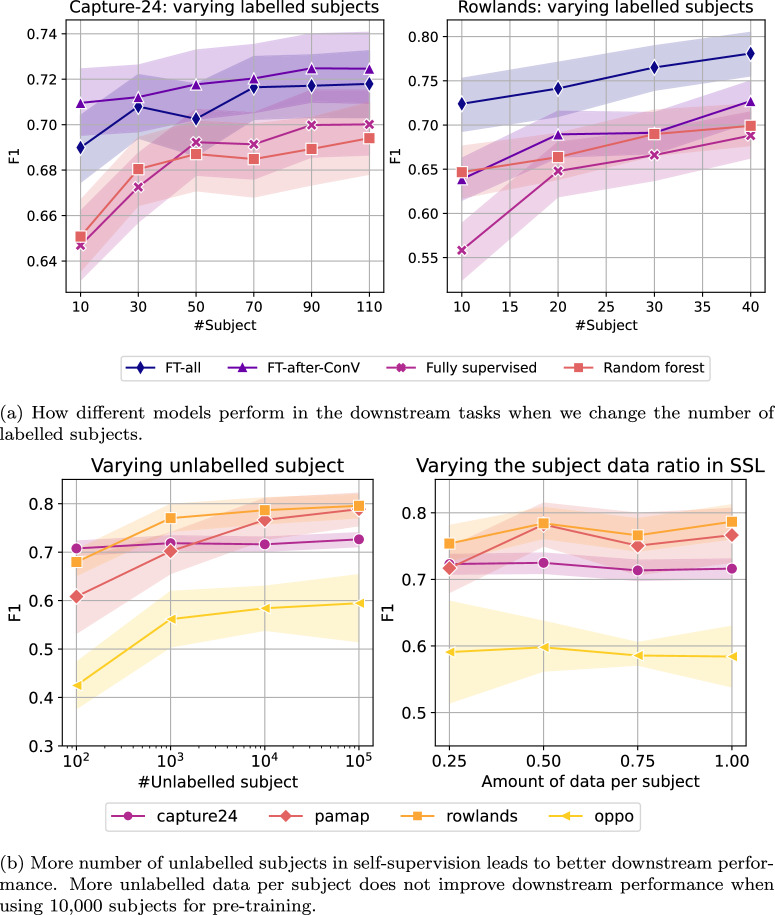
- Downstream performance increased roughly linearly with the number of unlabelled pre-training subjects on a log scale, and reducing data per subject from 100% to 25% did not degrade F1 by more than 10%.
Methods
- Multi-task self-supervised pre-training used unlabelled UK Biobank wrist accelerometer data (~100,000 participants, 7 days, >700,000 person-days), resampled to 30 Hz with 10-second windows. The network was an 18-layer 1D ResNet-V2 with 10M parameters and a 1024-dimensional feature vector; pretext tasks were arrow of time, permutation, and time warping, with weighted sampling by signal standard deviation. Training used Adam with learning rate 1e-3, four Tesla V100-SXM2 GPUs, and about 420 GPU hours for ~20 epochs.
- Evaluation used eight external labelled datasets varying in size (600–600,000 samples), activity classes (4–18), devices (5 brands), placements (4 configurations), and populations. Models were fine-tuned either all layers or only FC layers and compared against random forest and from-scratch ResNet; held-one-subject-out cross-validation was used for datasets with <10 subjects, and five-fold subject-wise cross-validation for datasets with ≥10 subjects, with a 7:1:2 train/validation/test split and early stopping patience of five.
- Ablations varied labelled downstream subjects and unlabelled pre-training participants (100 to 100,000) and data per subject (0.25–1); representation analyses used UMAP projections and layer-wise relevance propagation.
Limitations
- The paper states that the pre-training data (UK Biobank) consists mostly of Caucasians from the UK, due to a current lack of raw accelerometer datasets from different regions of the world. It also notes future work should consider multimodal wearable data, more recent self-supervised approaches, and that Autoencoder and contrastive learning attempts did not yield high-quality representations on UK Biobank, suspected to be due to free-living vs lab-based data differences.
- Evident from the text: evaluation is limited to wrist-worn accelerometer data and eight benchmark datasets, with no external validation in non-UK or non-Caucasian populations. The paper also reports that many open benchmark datasets used lacked suitable licensing or consent information, and small datasets had activity classes removed if not performed by all subjects.
Model-written summary. Check it against the paper before relying on it.
Integrity signals
Registry
Cites
Statistics
Figures



Verification
Claims the paper makes
8 Valid · 3 Not valid · 0 Not checked · 55 Own results and interpretations
At least one cited source doesn’t support this claim or points to a different paper, and none confirmed it — see the verdicts below.
In the paper
“The scale of UK Biobank is several orders of magnitude greater than the largest datasets used by the current state-of-the-art such as the Fenland data9 (n = 160,000).”
§ Self-supervised learning for human activity recognition using 700,000 person-days of wearable data > Discussion
What the sources say
- Disputedcites [9] Lindsay, T. et al. Descriptive epidemiology of physical activity energy expenditure in UK adults (the Fenland study). Int. J. Behav. Nutr. Phys. Activity 16, 1–13 (2019). sourceExperimental — accuracy not yet measured
The Methods (Study population) state that the Fenland Study enrolled 12,435 participants, not 160,000. The Results further report that 12,002 met the sensing criteria for this analysis. The paper does not provide a UK Biobank comparison, so it cannot establish the claimed difference in scale. (LLM, conf=0.90)
Checked by a reasoning model — may be wrong.
plainn = 160,000- Asserted: passes — The authors put it forward as true.
- Checkable: passes — It can be checked against evidence.
- Load-bearing: passes — The paper’s conclusions depend on it.
- Based: passes — The paper gives a reason why it holds.
- Disputed
The cited sources that could be checked couldn’t confirm or dispute this claim.
In the paper
“We attempted to use Autoencoder and contrastive learning for pre-training. However, we could not obtain high-quality representation using the UK Biobank43.”
§ Self-supervised learning for human activity recognition using 700,000 person-days of wearable data > Discussion
What the sources say
- Could not verifycites [43] Tang, C. I. et al. SelfHAR: Improving Human Activity Recognition through Self-training with Unlabeled Data. Proc. ACM Interact. Mob. Wearable Ubiquitous Technol. 5, 30 (2021). sourceExperimental — accuracy not yet measured
The Experimental Protocols (§4.1.8) describe the Fenland Study, and the Results (§5.1.1) name MobiAct and HHAR as unlabeled datasets; neither passage addresses UK Biobank. Searches for UK Biobank, autoencoder and contrastive pre-training found no passage reporting the claimed failure to obtain a high-quality representation. The citing authors describe their own attempt, which this source cannot verify. (LLM, conf=0.76)
plain- Asserted: passes — The authors put it forward as true.
- Checkable: passes — It can be checked against evidence.
- Load-bearing: unclear — It is unclear whether the paper’s conclusions depend on it.
- Based: passes — The paper gives a reason why it holds.
- Could not verify
Every source the paper cites for this claim was checked and supports it.
In the paper
“Differences in experiment setup such as training rates, regularisation and data augmentation can lead to inconsistent results51.”
§ Self-supervised learning for human activity recognition using 700,000 person-days of wearable data > Methods > Evaluation—human activity recognition
What the sources say
- Supportedcites [51] Oliver, A., Odena, A., Raffel, C. A., Cubuk, E. D. & Goodfellow, I. J. Realistic evaluation of deep semi-supervised learning algorithms. In Proceedings of the 32nd International Conference on Neural Information Processing Systems (NIPS'18), Vol. 31, 3239–3250 (Curran Associates Inc., Red Hook, NY, USA, 2018). source
Section 2 'P.1 A Shared Implementation' (p. 2) states that although datasets have standardized, other experimental details vary significantly — parameter initialization, data preprocessing, data augmentation, regularization — and that the training procedure (optimizer, number of training steps, learning rate decay schedule) is not standardized, and that 'these differences prevent direct comparison between approaches'. The Introduction (p. 2) reinforces this: 'minor changes to hyperparameters, model structure, training, etc. can have an outsized impact on results', and Section 4.2 (p. 6) adds that different algorithms must be evaluated on the same model to avoid conflating comparison. The claim's examples (training rates, regularisation, data augmentation) map directly onto these passages; 'inconsistent results' paraphrases the paper's point that results become non-comparable/confounded. (LLM, conf=0.88)
plainstates a cause- Asserted: passes — The authors put it forward as true.
- Checkable: passes — It can be checked against evidence.
- Load-bearing: passes — The paper’s conclusions depend on it.
- Based: passes — The paper gives a reason why it holds.
- Supported
A result the paper reports from its own data — it cites no other source for it, so there is none to check. The quote shows it is in the paper.
In the paper
“Furthermore, if the number of participants is fixed at 10,000 in pre-training, the data ratio included per subject did not significantly influence the downstream performance.”
§ Self-supervised learning for human activity recognition using 700,000 person-days of wearable data > Results > Ablation studies
plain- Asserted: passes — The authors put it forward as true.
- Checkable: passes — It can be checked against evidence.
- Load-bearing: unclear — It is unclear whether the paper’s conclusions depend on it.
- Based: passes — The paper gives a reason why it holds.
A result the paper reports from its own data — it cites no other source for it, so there is none to check. The quote shows it is in the paper.
In the paper
“Nonetheless, with self-supervised pre-training, the median relative F1 improvement was 18.4% when compared to the same network trained from scratch and 8.5% when compared to the random forest model.”
§ Self-supervised learning for human activity recognition using 700,000 person-days of wearable data > Results > Downstream performance—human activity recognition
plainstates a cause- Asserted: passes — The authors put it forward as true.
- Checkable: passes — It can be checked against evidence.
- Load-bearing: passes — The paper’s conclusions depend on it.
- Based: passes — The paper gives a reason why it holds.
39 more claims
Create a free account to see all 66 claims and every source verdict.
- It may state two separate claims as one. 13
- Probably not a substantial claim. 14
Claims other papers make about this one
Each is checked against this paper’s own text: does it say what the citing paper says it does?
The source backs part of the claim, not all of it — or backs it for a different population, condition or comparison.
In the citing paper
“Owing to the relative ease of data collection using wearables, there are now large repositories of datasets, e.g., UK Biobank [212], Capture-24 [21,198], and Fenland [145], but crucially, without annotations.”
From Past, Present, and Future of Sensor-based Human Activity Recognition Using Wearables: A Surveying Tutorial on a Still Challenging Task (2025) · cites this paper as [212]
Experimental — accuracy not yet measuredThe source backs part of the claim, not all of it — or backs it for a different population, condition or comparison.
In the citing paper
“However, the gap between HAR-FM and the other foundation model candidates like UniMTS and YUAN-SSL suggests that incorporating larger datasets (evidenced by the gaps between baseline YUAN-SSL (capture24) and YUAN-SSL w10 ) and more fine-grained activity descriptions (evidenced by the significant performance of UniMTS) could lead to significant performance improvements.”
From Towards Customizable Foundation Models for Human Activity Recognition with Wearable Devices (2025) · cites this paper as [62]
Experimental — accuracy not yet measuredThe source backs part of the claim, not all of it — or backs it for a different population, condition or comparison.
In the citing paper
“Secondly, in the zero-and few-shot experiments, Yuan et al. [62] and Zhang et al. [65] demonstrates either larger volume or more precise annotations could contribute to the model performance”
From Towards Customizable Foundation Models for Human Activity Recognition with Wearable Devices (2025) · cites this paper as [62]
Experimental — accuracy not yet measuredThe cited source says what the claim attributes to it.
In the citing paper
“Its superior performance against HAR-FM and YUAN-SSL [62] that are pretrained with data from wrist only, suggests the benefits in integrating all placement-wise models.”
From Towards Customizable Foundation Models for Human Activity Recognition with Wearable Devices (2025) · cites this paper as [62]
Self-check
Percentages, sums and reported differences re-computed from the paper’s own numbers.
Each contradiction between two passages listed here was confirmed by an independent check.
Rated minor: it would not touch a result — a value no result rests on, a p-value that stays on the same side of the significance level, or a conflict that is clerical, resolved elsewhere in the paper, or outside its own findings.
In the paper
§ Self-supervised learning for human activity recognition using 700,000 person-days of wearable data > Methods > Evaluation—human activity recognition
“In terms of unlabelled data, we experimented with pre-training that had 100 to 100,0000 participants with one order of magnitude increment.”
§ Self-supervised learning for human activity recognition using 700,000 person-days of wearable data > Methods > Datasets
“Our multi-task self-supervised training relied on the unlabelledUK Biobank dataset, which contains roughly 700,000 person-days of free-living activity data (>100,000 participants, 7 days of wear).”
Citations
Cites
Adam: A Method for Stochastic Optimization
Kingma, D. P., & Ba, J. (2014) · arXiv · doi:10.48550/arxiv.1412.6980 · Cited by 98,946
BERT: Pre-training of Deep Bidirectional Transformers for Language Understanding
Devlin, J., Chang, M.-W., Lee, K., & Toutanova, K. (2018) · arXiv · doi:10.48550/arxiv.1810.04805 · Cited by 73,173
BERT: Pre-training of Deep Bidirectional Transformers for Language Understanding
Devlin, J., Chang, M.-W., Lee, K., & Toutanova, K. (2019) · Proceedings of the 2019 Conference of the North American Chapter of the Association for Computational Linguistics: Human Language Technologies, Volume 1 (Long and Short Papers) · doi:10.18653/v1/n19-1423 · Cited by 54,325
Efficient Estimation of Word Representations in Vector Space
Mikolov, T., Chen, K., Corrado, G., & Dean, J. (2013) · arXiv · doi:10.48550/arxiv.1301.3781 · Cited by 26,568
Language Models are Few-Shot Learners
Brown, T. B., Mann, B., Ryder, N., Subbiah, M., Kaplan, J., Dhariwal, P., Neelakantan, A., Shyam, P., Sastry, G., Askell, A., et al. (2020) · arXiv · doi:10.48550/arxiv.2005.14165 · Cited by 23,372
Momentum Contrast for Unsupervised Visual Representation Learning
He, K., Fan, H., Wu, Y., Xie, S., & Girshick, R. (2020) · 2020 IEEE/CVF Conference on Computer Vision and Pattern Recognition (CVPR) · doi:10.1109/cvpr42600.2020.00975 · Cited by 13,347 · cited 1×
“…(SSL) methods to leverage unlabelled data in a similar manner as language models (Mikolov et al., 2013; Devlin et al., 2018; Radford et al., 2018, 2019) and vision models (Doersch et al., 2015; Zhang et al., 2016; Noroozi and Favaro, 2016; Wei et al., 2018; He et al., 2020; Chen et al., 2020).”
Identity mappings in deep residual networks
He, K., Zhang, X., Ren, S., & Sun, J. (2016) · Lecture Notes in Computer Science · doi:10.1007/978-3-319-46493-0_38 · Cited by 10,741 · cited 2×
“We adapted a ResNet-V2 with 18 layers and 1D convolutions (He et al., 2016) for the main trunk (feature extractor), totalling 10M parameters.”
Identity Mappings in Deep Residual Networks
He, K., Zhang, X., Ren, S., & Sun, J. (2016) · arXiv · doi:10.48550/arxiv.1603.05027 · Cited by 10,665 · cited 2×
“We adapted a ResNet-V2 with 18 layers and 1D convolutions (He et al., 2016) for the main trunk (feature extractor), totalling 10M parameters.”
UMAP: Uniform Manifold Approximation and Projection
McInnes, L., Healy, J., Saul, N., & Großberger, L. (2018) · Journal of Open Source Software · doi:10.21105/joss.00861 · Cited by 9,826 · cited 1×
“Cluster analysis We used UMAP (McInnes et al., 2018) with default parameters for low-dimensional projections for visualization.”
UMAP: Uniform Manifold Approximation and Projection for Dimension Reduction
McInnes, L., Healy, J., & Melville, J. (2018) · arXiv · doi:10.48550/arxiv.1802.03426 · Cited by 7,101
Research works printed but not linked: 3
- Chen, T., Kornblith, S., Norouzi, M. & Hinton, G. A simple framework for contrastive learning of visual representations. In International Conference on Machine Learning, 1597–1607 (PMLR, 2020).
- Radford, A. et al. Language models are unsupervised multitask learners. OpenAI Blog 1, 9 (2019).
- Haresamudram, H., Essa, I. & Plötz, T. Contrastive Predictive Coding for Human Activity Recognition. Proc. ACM Interact. Mob. Wearable Ubiquitous Technol. 5, 26 (2021). · DOI · Paper page
Cited by
Creagh, A. P., Hamy, V., Yuan, H., Mertes, G., Tomlinson, R., Chen, W.-H., Williams, R., Llop, C., Yee, C., Duh, M. S., et al. (2024) · npj Digital Medicine · doi:10.1038/s41746-024-01013-y · Cited by 64
Self-citationCreagh, A. P., Hamy, V., Yuan, H., Mertes, G., Tomlinson, R., Chen, W.-H., Williams, R., Llop, C., Yee, C., Duh, M. S., et al. (2022) · doi:10.1101/2022.11.18.22282305 · Cited by 64
Self-citationChan, S., Hang, Y., Tong, C., Acquah, A., Schonfeldt, A., Gershuny, J., & Doherty, A. (2024) · Scientific Data · doi:10.1038/s41597-024-03960-3 · Cited by 61
“Our existing benchmark incorporates common methods used for HAR, future work could also benefit from leveraging more recent modeling techniques using DeepConvLSTM 40,41 , transformers 42 , and self-supervised learning 43–46 .”
Self-citationYuan, H., Plekhanova, T., Walmsley, R., Reynolds, A. C., Maddison, K. J., Bucan, M., Gehrman, P., Rowlands, A., Ray, D. W., Bennett, D., et al. (2024) · npj Digital Medicine · doi:10.1038/s41746-024-01065-0 · Cited by 40
“See Supplementary Section 1.3.1 for the full speci fi cation of the analysis.”
BackgroundInfluentialSelf-citationA Comprehensive Survey on Wearable Computing for Mental and Physical Health Monitoring
Elfouly, T., & Alouani, A. T. (2025) · Electronics · doi:10.3390/electronics14173443 · Cited by 71
“[17] [18] This bipolar disorder management using wearable technologies”.”
Chandramouli, N. A., Natarajan, S., Alharbi, A. H., Kannan, S., Khafaga, D. S. R., Raju, S. K., Eid, M. M., & El-kenawy, E. (2024) · Scientific Reports · doi:10.1038/s41598-024-82045-y · Cited by 36
“Examples are prescriptive medication, health surveillance and physical fitness, thereby expanding the prospects of wearable technology 8 .”
RetractedSpathis, D., & Kawsar, F. (2024) · Journal of the American Medical Informatics Association · doi:10.1093/jamia/ocae090 · Cited by 102
Haresamudram, H., Tang, C. I., Suh, S., Lukowicz, P., & Plötz, T. (2025) · Proceedings of the ACM on Interactive Mobile Wearable and Ubiquitous Technologies · doi:10.1145/3729467 · Cited by 33
Human-centred artificial intelligence for mobile health sensing: challenges and opportunities
Dang, T., Spathis, D., Ghosh, A., & Mascolo, C. (2023) · Royal Society Open Science · doi:10.1098/rsos.230806 · Cited by 30
“In the context of health signals, these tasks can range from predicting the arrow of time, to contrastive learning and masking [145,146].”
BackgroundEssahraui, S., Lamaakal, I., Maleh, Y., Makkaoui, K. E., Bouami, M. F., Ouahbi, I., El‐Latif, A. A. A., Almousa, M., & Rodrigues, J. J. P. C. (2025) · IEEE Access · doi:10.1109/access.2025.3589938 · Cited by 44
“Additionally, hybrid models combining RNNs with CNNs or attention mechanisms have been explored in works such as [257], [258], and [259], where self-supervised learning combined with multi-task learning led to an Acc of 82.9%.”
InfluentialGiurgiu, M., von Haaren‐Mack, B., Fiedler, J., Woll, S., Burchartz, A., Kolb, S., Ketelhut, S., Kubica, C., Nigg, C., Timm, I., et al. (2024) · Journal of sport and health science/Journal of Sport and Health Science · doi:10.1016/j.jshs.2024.101006 · Cited by 44
Detection of human activities using multi-layer convolutional neural network
Abdellatef, E., Al‐Makhlasawy, R. M., & Shalaby, W. A. (2025) · Scientific Reports · doi:10.1038/s41598-025-90307-6 · Cited by 34
“…conducted by Yuan et al. addressed the deficiency of extensive labeled datasets in the realm of human activity recognition (HAR) by implementing self-supervised learning (SSL) techniques on the UK Biobank dataset, which encompasses over 700,000 person-days of unlabeled wearable sensor data 24 .”
Large Language Models are Zero-Shot Recognizers for Activities of Daily Living
Civitarese, G., Fiori, M., Choudhary, P., & Bettini, C. (2024) · arXiv · doi:10.48550/arxiv.2407.01238 · Cited by 28
Small, S. R., Chan, S., Walmsley, R., von Fritsch, L., Acquah, A., Mertes, G., Feakins, B. G., Creagh, A. P., Strange, A., Matthews, C. E., et al. (2024) · Medicine & Science in Sports & Exercise · doi:10.1249/mss.0000000000003478 · Cited by 57
Self-citationA foundation model for continuous glucose monitoring data
Lutsker, G., Sapir, G., Shilo, S., Merino, J., Godneva, A., Greenfield, J. R., Samocha‐Bonet, D., Dhir, R., Gude, F., Mannor, S., et al. (2026) · Nature · doi:10.1038/s41586-025-09925-9 · Cited by 82
Self-supervised Learning for Accelerometer-based Human Activity Recognition: A Survey
Logacjov, A. (2024) · Proceedings of the ACM on Interactive Mobile Wearable and Ubiquitous Technologies · doi:10.1145/3699767 · Cited by 40
A benchmark for computational analysis of animal behavior, using animal-borne tags
Hoffman, B., Cusimano, M., Baglione, V., Canestrari, D., Chevallier, D., DeSantis, D. L., Jeantet, L., Ladds, M., Maekawa, T., Mata‐Silva, V., et al. (2024) · Movement Ecology · doi:10.1186/s40462-024-00511-8 · Cited by 37
Giurgiu, M., Timm, I., Ebner-Priemer, U. W., Schmiedek, F., & Neubauer, A. B. (2024) · npj Mental Health Research · doi:10.1038/s44184-024-00113-7 · Cited by 21
Small, S. R., Chan, S., Walmsley, R., Fritsch, L. V., Acquah, A., Mertes, G., Feakins, B. G., Creagh, A., Strange, A., Matthews, C. E., et al. (2023) · doi:10.1101/2023.02.20.23285750 · Cited by 22
“Activity classification was performed using a self-supervised deep learning model developed by Yuan et al 20 incorporating an 18-layer ResNet-V2 21 pre-trained using self-144 supervised tasks on the UK Biobank accelerometer dataset.”
Self-citationSelfPAB: large-scale pre-training on accelerometer data for human activity recognition
Logacjov, A., Herland, S., Ustad, A., & Bach, K. (2024) · Applied Intelligence · doi:10.1007/s10489-024-05322-3 · Cited by 35
“A similar observation was made for single-accelerometer-based HAR [49].”
InfluentialConvBoost: Boosting ConvNets for Sensor-based Activity Recognition
Shao, S., Guan, Y., Zhai, B., Missier, P., & Plötz, T. (2023) · Proceedings of the ACM on Interactive Mobile Wearable and Ubiquitous Technologies · doi:10.1145/3596234 · Cited by 30
“Most recently, SSL was performed on a large-scale unlabeled activity dataset [43] for pre-trained model development, which demonstrated improved performance on other downstream HAR tasks.”
Large Language Models Are Zero-Shot Recognizers for Activities of Daily Living
Civitarese, G., Fiori, M., Choudhary, P., & Bettini, C. (2025) · ACM Transactions on Intelligent Systems and Technology · doi:10.1145/3725856 · Cited by 67
“Existing approaches for self-supervised learning have been proposed for data obtained by wearable and mobile devices, since large datasets (e.g., Biobank [50], Capture-24 [12]) are available in this domain for model pre-training.”
Brand, Y. E., Kluge, F., Palmerini, L., Paraschiv-Ionescu, A., Becker, C., Cereatti, A., Maetzler, W., Sharrack, B., Vereijken, B., Yarnall, A. J., et al. (2024) · Scientific Reports · doi:10.1038/s41598-024-71491-3 · Cited by 19
“The first stage involved the training of an SSL model, utilizing the pre-trained UK Biobank model of Yuan et al. 38 .”
InfluentialDeep-Learning-Based Analysis of Electronic Skin Sensing Data
Guo, Y., Sun, X., Li, L., Shi, Y., Cheng, W. M., & Pan, L. (2025) · Sensors · doi:10.3390/s25051615 · Cited by 26
“Self-supervised learning has also been applied to pre-training tasks to construct latent feature distributions of unlabeled data, enhancing signals and suppressing artifacts [98,99].”
Ekambaram, D., & Ponnusamy, V. (2024) · Electronics · doi:10.3390/electronics13183782 · Cited by 21
Lee, S. I., Liu, Y., Vergara-Diaz, G. P., Pugliese, B. L., Black‐Schaffer, R. M., Stoykov, M. E., & Bonato, P. (2024) · Neurorehabilitation and neural repair · doi:10.1177/15459683241270066 · Cited by 20
“55 Finally, the proposed method does not offer detailed information about the quality of performed movements, such as inter-joint coordination or compensatory movements, which could be clinically important.”
A survey on self-supervised learning: Recent advances and open problems
Zhang, J., Yang, L., Mohammadabadi, S. M. S., & Yan, F. (2025) · Neurocomputing · doi:10.1016/j.neucom.2025.131409 · Cited by 32
McGagh, D., Song, K., Yuan, H., Creagh, A. P., Fenton, S. A. M., Ng, W., Goldsack, J. C., Dixon, W. G., Doherty, A., & Coates, L. C. (2024) · The Lancet Rheumatology · doi:10.1016/s2665-9913(24)00186-3 · Cited by 17
Self-citationRavanelli, N., Lefebvre, K., Brough, A., Paquette, S., & Lin, W. (2025) · Sensors · doi:10.3390/s25092926 · Cited by 11
“In substitution to step counting, raw accelerometry data may glean insights into physical activity patterns [31], or be used for human activity recognition [32,33].”
Chen, Q., Lu, D., Feng, W., Ye, C., Qiu, L., Pan, J., & Li, J. (2025) · IEEE Transactions on Instrumentation and Measurement · doi:10.1109/tim.2025.3584138 · Cited by 14
“Masked reconstruction methods [8], [31] and contrastive approaches [7], [32] have shown that meaningful motion representations can be learned from unlabeled sensor data.”
Anguita-Molina, M. Á., Cardoso, P. J. S., Rodrigues, J. M. F., Medina-Quero, J., & Polo-Rodríguez, A. (2025) · IEEE Internet of Things Journal · doi:10.1109/jiot.2025.3531316 · Cited by 15
“For instance, Naser et al. [18] showed that heat maps could effectively visualize occupancy patterns and behavior changes, while Hiley et al. [19] and Yuan et al. [20] highlighted their utility in real-time adjustments of activity recognition algorithms.”
Wang, L., Luo, Z., & Zhang, T. (2025) · BMC Biomedical Engineering · doi:10.1186/s42490-025-00088-2 · Cited by 8
UniMTS: Unified Pre-training for Motion Time Series
Zhang, X., Teng, D., Chowdhury, R., Li, S., Hong, D., Gupta, R., & Shang, J. (2024) · Advances in Neural Information Processing Systems 37 · doi:10.52202/079017-3414 · Cited by 8
Ma, H., Zhang, F., & Liang, N. (2025) · IEEE Access · doi:10.1109/access.2025.3563302 · Cited by 9
Khayami, H., Wang, L., Kim, Y., Lee, B., Conroy, D. E., Lazar, A., Choe, E. K., & Kacorri, H. (2025) · Proceedings of the ACM on Interactive Mobile Wearable and Ubiquitous Technologies · doi:10.1145/3731749 · Cited by 8
“…will remain in the user device while collaborating in training a global model and build up a personalized model locally, as well as data augmentation [60, 91, 99], self-supervised [70, 84, 97], and semi-supervised [69, 100] methods to leverage unlabeled data effectively with few or no labeled data.”
Azghan, R. R., Glodosky, N. C., Sah, R. K., Cuttler, C., McLaughlin, R. J., Cleveland, M. J., & Ghasemzadeh, H. G. (2025) · IEEE Sensors Journal · doi:10.1109/jsen.2025.3528030 · Cited by 15
“Recent advancements in self-supervised learning for mobile health applications have used large-scale unlabeled data and achieved high performance [10], [11], [12].”
Artificial Intelligence-Enhanced Flexible Sensors for Human Motion and Posture Sensing
Jiang, Y., & He, T. (2026) · Sensors · doi:10.3390/s26051562 · Cited by 10
“Furthermore, while self-supervised learning (SSL) has gained prominence for addressing label scarcity, it fundamentally requires a substantial volume of unlabeled data for pre-text tasks to learn robust representations before fine-tuning on small labeled subsets [96,97].”
Liu, X., Chau, K., Zheng, J.-X., Deng, D., & Tang, Y.-M. (2024) · Journal of Rehabilitation and Assistive Technologies Engineering · doi:10.1177/20556683241288459 · Cited by 6
“Differentiating these behaviours based on acceleration data is crucial for developing effective monitoring systems for older adults, as emphasized in the literature 45 .”
BackgroundArrotta, L., Civitarese, G., Chen, X., Cumin, J., & Bettini, C. (2024) · Expert Systems with Applications · doi:10.1016/j.eswa.2024.126178 · Cited by 17
Utility of synthetic musculoskeletal gaits for generalizable healthcare applications
Yamada, Y., Kobayashi, M., Shinkawa, K., Bilal, E., Liao, J., Nemoto, M., Ota, M., Nemoto, K., & Arai, T. (2025) · Nature Communications · doi:10.1038/s41467-025-61292-1 · Cited by 13
Powering and Sensing Advances in TENGs for Self‐Powered Sensing Systems Design
Ye, C., Zhang, R., Sun, H., & Liu, S. (2026) · Small · doi:10.1002/smll.202514433 · Cited by 10
Assessment of physical activity patterns in patients with rheumatoid arthritis using the UK Biobank
Hamy, V., Creagh, A. P., & Garcia-Gancedo, L. (2025) · PLoS ONE · doi:10.1371/journal.pone.0319908 · Cited by 4
“It includes a large sample of actigraphy data which is actively used by researchers from around the world for public health-related investigations and also for the development of novel data analysis tools [54] or as a benchmark for further analysis.”
Self-citationToward Foundation Model for Multivariate Wearable Sensing of Physiological Signals
Luo, Y., Chen, Y., Salekin, A., & Rahman, T. (2026) · ACM Transactions on Computing for Healthcare · doi:10.1145/3803808 · Cited by 52
“To ensure fair comparison, we use a unified evaluation protocol with identical hyperparameter settings and implementation across all models and the dataset (Yuan et al., 2024).”
Dong, G., Tan, X., Yuan, P., & Li, Y. (2026) · Annals of Medicine · doi:10.1080/07853890.2026.2658879 · Cited by 14
“To mitigate this, Self-Supervised Learning (SSL) techniques have been adopted to pretrain DL models on unlabeled data using pretext tasks such as temporal order prediction or masked signal reconstruction [59].”
Self-Supervised Federated Learning for Personalized Human Activity Recognition
Deng, S., Teng, D., Guo, Z., Chen, J., Chen, D., Jia, T., & Wang, H. (2024) · IEEE International Conference on Multimedia and Expo (ICME) · doi:10.1109/icme57554.2024.10687970 · Cited by 6
“In recent years, these eight forms of signal transformations are crucial for HAR based on SSL. Yuan et al [11] take three of the eight signal transformations The second category is SSL based on mask prediction [13]– [15].”
BackgroundNshimyimana, D., Rey, V. F., Suh, S., Zhou, B., & Lukowicz, P. (2025) · International Conference on Activity and Behavior Computing (ABC) · doi:10.1109/abc64332.2025.11118365 · Cited by 7
“Following previous work [22], the pretraining tasks included horizontal flipping, axis permutation, and time warping.”
Denoise yourself: Self-supervised point cloud upsampling with pretrained denoising
Hur, J.-H., Kwon, S., & Kim, H. (2025) · Expert Systems with Applications · doi:10.1016/j.eswa.2025.126638 · Cited by 7
Sheng, T., & Huber, M. (2025) · Sensors · doi:10.3390/s25134032 · Cited by 5
“Yuan et al. [60] leverage large-scale wearable data to train generalizable representations using self-supervision.”
Multilevel Transfer Learning for Complex Work Activity Recognition in Logistic Domain
Morales, J., Xia, Q., Yoshimura, N., Oshima, H., Fukuda, M., Namioka, Y., & Maekawa, T. (2025) · IEEE International Conference on Pervasive Computing and Communications · doi:10.1109/percom64205.2025.00036 · Cited by 6
“5) Self-supervised Learning: • SSL : We evaluated a model consisting of a publicly available encoder (feature extractor) pre-trained on 700,000 days of unlabeled data via self-supervised learning [33].”
Long-term self-supervised learning for accelerometer-based sleep–wake recognition
Logacjov, A., Bach, K., & Mork, P. J. (2024) · Engineering Applications of Artificial Intelligence · doi:10.1016/j.engappai.2024.109758 · Cited by 8
Leveraging dataset integration and continual learning for human activity recognition
Amrani, H., Micucci, D., Mobilio, M., & Napoletano, P. (2025) · International Journal of Machine Learning and Cybernetics · doi:10.1007/s13042-025-02569-1 · Cited by 6
Rey, V. F., Rezende, P. M. B., Zhou, B., Suh, S., & Lukowicz, P. (2025) · Expert Systems with Applications · doi:10.1016/j.eswa.2025.129288 · Cited by 14
Gonçalves, H. R., Martins, L., Ribeiro, N. F., Abreu, L., Rodrigues, A. M., & Santos, C. P. (2025) · Engineering applications of artificial intelligence · doi:10.1016/j.engappai.2025.110706 · Cited by 6
PRimuS: Pretraining IMU Encoders with Multimodal Self-Supervision
Das, A. M., Tang, C. I., Kawsar, F., & Malekzadeh, M. (2025) · IEEE International Conference on Acoustics Speech and Signal Processing · doi:10.1109/icassp49660.2025.10888874 · Cited by 19
“However, obtaining large amounts of labeled IMU data remains a major challenge, as IMU time series are inherently difficult to interpret and annotate, even for experts [7].”
On convex decision regions in deep network representations
Tětková, L., Brüsch, T., Dorszewski, T., Mager, F. M., Aagaard, R. Ø., Foldager, J., Alstrøm, T. S., & Hansen, L. K. (2025) · Nature Communications · doi:10.1038/s41467-025-60809-y · Cited by 18
“In the human domain, we used the pretrained model from Yuan et al. (2022) to extract the latent representations.”
Bhatti, F. A., Riaz, Q., & Krüger, B. (2025) · IEEE Access · doi:10.1109/access.2025.3641198 · Cited by 7
Yoshida, Y., Miwa, H., Nakae, S., Ogiso, S., Ichikari, R., & Okuma, T. (2025) · IEEE Access · doi:10.1109/access.2025.3550579 · Cited by 3
Yan, Y. M. (2025) · Scientific Reports · doi:10.1038/s41598-025-94613-x · Cited by 9
Yuan, H., Plekhanova, T., Walmsley, R., Reynolds, A. C., Maddison, K. J., Bucan, M., Gehrman, P., Rowlands, A., Ray, D. W., Bennett, D., et al. (2023) · doi:10.1101/2023.07.07.23292251 · Cited by 3
“Even for sleep/wake classification, SleepNet achieved compa337 rable results to a systematic evaluation of eight state-of-the-art sleep algorithms [8] 338 in the Newcastle dataset.”
BackgroundMethodSelf-citationTowards Customizable Foundation Models for Human Activity Recognition with Wearable Devices
Qiu, M., Weng, C., Fan, M., & Wu, K. (2025) · Proceedings of the ACM on Interactive Mobile Wearable and Ubiquitous Technologies · doi:10.1145/3749479 · Cited by 4
Ma, T., Fan, T., Xu, X., & Sun, T. (2025) · IEEE Transactions on Neural Systems and Rehabilitation Engineering · doi:10.1109/tnsre.2025.3540062 · Cited by 5
“Extensive research has revealed that intra-subject training yields superior prediction performance compared to inter-subject training [41], [47].”
Wang, Z.-Y., Mo, L.-F., & Zhu, Y.-J. (2025) · Measurement science and technology · doi:10.1088/1361-6501/ae03de · Cited by 3
“Unsupervised methods are more scalable and practical for HAR applications [8].”
Brand, Y. E., Kluge, F., Palmerini, L., Paraschiv-Ionescu, A., Becker, C., Cereatti, A., Maetzler, W., Sharrack, B., Vereijken, B., Yarnall, A. J., et al. (2024) · doi:10.21203/rs.3.rs-4102403/v1 · Cited by 19
Tanigaki, K., Maekawa, T., & Hara, T. (2026) · IEEE International Conference on Pervasive Computing and Communications · doi:10.1109/percom67906.2026.11524533 · Cited by 3
“HAR Foundation Models: We include four state-of-the-art HAR foundation models in our evaluation: (1) HARNet [7], pretrained on 700,000 person-days of wrist-worn accelerometer data from the UK Biobank, using three multi-task self-supervised objectives: arrow-of-time prediction, permutation, and time…”
InfluentialFrom Vision to Motion: Translating Large-Scale Knowledge for Data-Scarce IMU Applications
Yoon, H., Cha, H., Nguyen, H. C., Gong, T., & Lee, S.-J. (2025) · IEEE Transactions on Mobile Computing · doi:10.1109/tmc.2025.3556998 · Cited by 10
“Aspublicallyavailablelarge-scalesensor datasets [13], [24] are centered on HAR, the pre-trained model for sensing has poor generalizability.”
Sher, A., & Akanyeti, O. (2024) · Pervasive and Mobile Computing · doi:10.1016/j.pmcj.2024.101994 · Cited by 3
Machine Learning-Empowered Depression Detection With Wearable Skin Electronics: A Review
Xu, Y., Zhao, Z., Zhu, H., Lai, S., Jia, Y., & Liu, G. (2026) · IEEE Sensors Journal · doi:10.1109/jsen.2026.3660322 · Cited by 3
“Pretrained on large-scale unlabeled wearable data, these models learn generalizable representations that transfer effectively to depression detection with limited labeled samples [62].”
Reducing annotation burden in physical activity research using vision language models
Schönfeldt, A., Maylor, B. D., Chen, X., Clark, R., & Doherty, A. (2025) · Scientific Reports · doi:10.1038/s41598-025-21350-6 · Cited by 7
“The most realistic setting for validating behaviour measurement approaches and developing novel machine learning approaches (Logacjov et al., 2024; Yuan et al., 2024; Walmsley et al., 2022; Willetts et al., 2018; Doherty et al., 2017) is in diverse populations of people living their everyday lives,…”
Self-citationFrequency-Aware Masked Autoencoders for Human Activity Recognition using Accelerometers
Lorenzen, N. R., Jennum, P. J., Mignot, E., & Brink-Kjaer, A. (2025) · 2025 47th Annual International Conference of the IEEE Engineering in Medicine and Biology Society (EMBC) · doi:10.1109/embc58623.2025.11252605 · Cited by 2
“However, since the arrival of foundation models for images and time-series relying on self-supervised pretraining [13], [14], multiple studies have employed different methods of self-supervised learning to wearable accelerometry data [2], [15], [16], [1], [4], [5].”
InfluentialChaudhary, V., Saichaemchan, S., Bhadola, P., & Kaushik, A. K. (2026) · Advances in Colloid and Interface Science · doi:10.1016/j.cis.2026.103970 · Cited by 2
Abdulrazzaq, M. M., Ramaha, N. T. A., & Hameed, A. A. (2025) · IEEE Access · doi:10.1109/access.2025.3617338 · Cited by 2
“Reference [20] leverages a large-scale unlabeled dataset from the UK Biobank (700,000 person-days of accelerometer data) for human activity recognition.”
Oishi, N., Birch, P., Lago, P., & Roggen, D. (2026) · Knowledge-Based Systems · doi:10.1016/j.knosys.2026.116367 · Cited by 1
Human Activity Recognition on Embedded Devices: CNN-Based Walking Detection and Step Counting
Pascale, R., Tudose, D., & Alexandru, N. (2025) · Computer Science in Cars Symposium · doi:10.1109/cscs66924.2025.00058 · Cited by 1
“Additionally, Yuan et al. [4] have published a study that leverages advancements in SSL (self-supervised learning) on a large accelerometer dataset.”
Timing of Physical Activity and Cardiovascular Health
Ma, T. (2024) · JACC Advances · doi:10.1016/j.jacadv.2024.101325 · Cited by 1
Toward a Foundation Model for Healthcare Applications on Single-Camera Gait Analysis
Yamada, Y., Kobayashi, M., Nemoto, M., Ota, M., Nemoto, K., & Arai, T. (2025) · IEEE International Conference on Digital Health (ICDH) · doi:10.1109/icdh67620.2025.00011 · Cited by 2
Human Activity Recognition via a Categorical Kalman Filter Using Inertial Sensors
Pitombeira-Neto, A. R., de França, D. S., Cruz, L. A., & de Macêdo, J. A. D. (2026) · IEEE Sensors Journal · doi:10.1109/jsen.2026.3678199
“Noteworthy models have been proposed in the literature, including multilayer perceptrons (MLPs) [23], [24], convolutional NNs (CNNs) [25], [26], [27], deep recurrent NNs (RNNs) [28], [29], NN with attention mechanism [30], and ResNet [31].”
Ciuffreda, I., Sartini, G., Casaccia, S., Cosoli, G., Arnesano, M., & Revel, G. M. (2025) · 2025 IEEE International Workshop on Metrology for Living Environment (MetroLivEnv) · doi:10.1109/metrolivenv64961.2025.11107114 · Cited by 1
“Wearable sensors, such as accelerometers in smartwatches and mobile devices, provide detailed motion data and are widely used due to their ease of implementation [8], [9], [10].”
Intelligent routing for human activity recognition in wireless body area networks
Elmosallamy, E. S., & Soliman, M. F. (2025) · Scientific Reports · doi:10.1038/s41598-025-12114-3 · Cited by 1
“The study in 33 demonstrates the development of self-supervised learning for human activity recognition in wearable data, introducing a scalable and efficient solution for making use of unlabeled data.”
The PhasED Framework: A Measurement Theory-Based Approach to Algorithm Development and Evaluation
Keadle, S. K., Strath, S. J., Giurgiu, M., Fuller, D., Martinez, J., Doherty, A., Ahmadi, M., Hyde, E. T., Troiano, R. P., & Matthews, C. E. (2026) · Journal for the Measurement of Physical Behaviour · doi:10.1123/jmpb.2025-0074 · Cited by 2
Self-citationSummary of the Unusual Activity Recognition Challenge for Developmental Disability Support
Garcia, C., Le, N. T., Fujioka, T., Dobhal, U., Shoumi, M. N., Nguyen, T., & Inoue, S. (2026) · Journal of Physics, Conference Series · doi:10.1088/1742-6596/3180/1/012020 · Cited by 6
“However, these methods often face issues such as oversimplification, redundancy, unrealistic distributions, or high computational costs [20].”
A Deep Learning Approach for Parkinsonian Tremor Assessment Using Wearables
Chatzis, T., Grammalidis, N., & Dimitropoulos, K. (2025) · IEEE International Conference on e-Health Networking, Applications and Services (Healthcom) · doi:10.1109/healthcom60686.2025.11342654 · Cited by 1
“Subse-quently, we pass each window w j through a 1D Resnet-V2 encoder f resnet ( · ) with 18 layers, which has been pre-trained by self-supervised learning [16] on the UK-Biobank dataset [17], producing embeddings , where D is the dimensionality of the embeddings of the Resnet encoder.”
Lapointe, Y., Kapur, A., Sharma, A., Panter, J., Fuller, D., & Mamiya, H. (2026) · Preventive Medicine · doi:10.1016/j.ypmed.2026.108603
Real world performance of an RNN model for sustainable mobility metrics
Martini, D., Longo, M., & Foiadelli, F. (2025) · Sustainable Energy Technologies and Assessments · doi:10.1016/j.seta.2025.104645 · Cited by 1
Artificial intelligence-empowered multi-scale data integration for precision exercise biomedicine
Li, J., Song, H., Ge, Z., & Luo, S. (2026) · Translational Exercise Biomedicine · doi:10.1515/teb-2026-0009 · Cited by 1
“…strengthen exercise relevance, analogous large-scale pretraining on wearable time series (e.g., accelerometry or PPG at biobank scale) and multi-omics cohorts could provide transferable representations for downstream tasks such as response prediction, adherence modeling, and safety monitoring [6].”
InfluentialDuan, F., Zhu, T., Chen, L., Ning, H., Liu, C., & Wan, Y. (2025) · IEEE Sensors Journal · doi:10.1109/jsen.2025.3543928 · Cited by 1
“Researchers have made considerable efforts to develop robust activity recognition models using various modalities, including videos [1], [2], images [3], [4], wearable sensors [5], [6], [7], and others.”
Incept-LSTM: deep learning model for action recognition
Verma, U., Tyagi, P., & Aneja, M. K. (2025) · Journal of Instrumentation · doi:10.1088/1748-0221/20/10/t10002 · Cited by 2
“A different approach, where unlabelled data was utilized to pre-train a ResNet deep learning model via multitask self-supervised learning, was also considered: after that, eight benchmark datasets were used for testing using transfer learning [37].”
An Analysis of Time-Frequency Consistency in Human Activity Recognition
Hecker, N., Napoli, O. O., Delgado, J., Rocha, A. R., Boccato, L., & Borin, E. (2025) · Lecture notes in computer science · doi:10.1007/978-3-031-79035-5_5 · Cited by 4
Ye, Z., Huang, Y., Yu, C., Wang, Y., Luo, Y., & Shi, Y. (2026) · CHI Conference on Human Factors in Computing Systems · doi:10.1145/3772318.3791014 · Cited by 1
Gobbetti, A., Gjoreski, M., Gjoreski, H., Lane, N. D., & Langheinrich, M. (2024) · IEEE pervasive computing · doi:10.1109/mprv.2024.3475473 · Cited by 2
“20,21 These methods can help models generalize better across different domains and reduce the reliance on labeled datasets, which are often expensive and time-consuming to obtain.”
Vago, N. O. P., Martínez-Galarza, J. R., & Amato, R. (2026) · Astronomy and Astrophysics · doi:10.1051/0004-6361/202557384 · Cited by 2
Hou, Z., Han, J., Wu, S., Wang, Z., Zhang, M., & Xu, D. (2026) · Annals of the New York Academy of Sciences · doi:10.1111/nyas.70222 · Cited by 1
“Yuan et al. [ 11 ] developed a multitask SSL framework incorporating temporal arrows, per-mutation, and time warping operations, enhancing the original sequences through inversion, random shuffling, and compression to significantly boost the generalization capability of model.”
Maylor, B. D., Small, S. R., Plekhanova, T., Brocklebank, L. A., van Duijvenboden, S., Sharman, R. L., Hill, E. A., Karpe, F., Kyle, S. D., & Doherty, A. (2025) · JMIR Research Protocols · doi:10.2196/78779 · Cited by 1
“These annotations will serve as the basis for retraining machine learning behavior classification models to better identify periods of sedentary, light, moderate, and vigorous physical activity [9,32].”
Self-citationSpatio-temporal feature discrimination for self-supervised skeleton action representation learning
Chen, H., Xu, Z., Zong, X., & Lin, C. (2026) · Multimedia Systems · doi:10.1007/s00530-026-02421-8 · Cited by 2
“Human action recognition is a core task in computer vision, with diverse applications in areas like security monitor - ing, human-computer interaction, and virtual reality [ 1–4 ].”
Multi-modal semi-supervised approach to domain adaptive human activity recognition
Noormohammadzadehmaleki, D., Oskouei, M. B., Farhadi, A., & Zamanifar, A. (2026) · Discover Computing · doi:10.1007/s10791-026-10279-7 · Cited by 1
Shoaib, H. A., Eva, A. A., Khatun, M. M., Ishraq, A., Firdaus, S., & Mridha, M. F. (2024) · International Conference on Computing Advancements (ICCA) · doi:10.1145/3723178.3723226 · Cited by 1
“These systems frequently require fixed sensor placements or orientations, which may be impractical in dynamic situations, resulting in lower accuracy [49].”
UniMTS: Unified Pre-training for Motion Time Series
Zhang, X., Teng, D., Chowdhury, R. R., Li, S., Hong, D., Gupta, R. K., & Shang, J. (2024) · arXiv · Cited by 9
“…we compare UniMTS with a few ablations by removing rotation-invariant augmentation (w/o rot aug), removing text augmentation (w/o text aug) and by replacing the graph encoder with a CNN-based encoder that directly concatenates joints without modeling their spatial relationships (w/o graph).”
InfluentialZabolotnii, S., Хотунов, В., Chepynoha, A. V., et al. (2026) · Lecture notes in electrical engineering · doi:10.1007/978-3-032-18415-3_4
Swamy, S. R., & Prasad, N. K. (2025) · doi:10.21203/rs.3.rs-7949557/v1
Rohl, A. L., Fang, U., Rasmussen, C. L., Hendry, D., Doherty, A., Straker, L. M., & Campbell, A. (2026) · Journal for the Measurement of Physical Behaviour · doi:10.1123/jmpb.2026-0009
Self-citationRest Tremor and Dyskinesia Assessment in Parkinson’s Disease Using Wearable Sensors
Chatzis, T., Grammalidis, N., & Dimitropoulos, K. (2026) · IEEE Internet of Things Magazine · doi:10.1109/miot.2026.3703551
Metadata
- Authors
- Yuan, H., Chan, S., Creagh, A. P., Tong, C., Acquah, A., Clifton, D. A., & Doherty, A.
- Affiliations
- University of Oxford (GB)
- Corresponding author
- Doherty, Aiden
- Venue
- npj Digital Medicine
- Published
- 2024-04-12
- Volume
- 7
- Issue
- 1
- Pages
- 91-91
- ISSN
- 2398-6352 (ISSN-L)
- PMC
- PMC11015005
- OpenAlex
- W4394757986
- Cited by
- 166
- References
- 56
- Citations by year
- 2026: 78 · 2025: 57 · 2024: 26
- FWCI
- 22.43
- Type
- journal article
- Language
- en
- Open access
- gold
- doi.org
- Licence
- cc-by
- creativecommons.org/licenses/by/4.0 (tdm)
- creativecommons.org/licenses/by/4.0 (vor)
- Locations
- npj Digital Medicine (publishedVersion, cc-by)
- PubMed Central (publishedVersion, cc-by)
- PubMed (publishedVersion)
- arXiv (Cornell University) (submittedVersion)
- DOAJ (DOAJ: Directory of Open Access Journals) (submittedVersion, cc-by-sa)
- arXiv (Cornell University) (cc-by)
- Funders
- Wellcome Trust ([223100/Z/21/Z])
- British Heart Foundation
- Novo Nordisk
- GlaxoSmithKline
- DH | National Institute for Health Research
- Topics
- Physical Sciences › Computer Science › Computer Vision and Pattern Recognition › Context-Aware Activity Recognition Systems
- Health Sciences › Medicine › Public Health, Environmental and Occupational Health › Physical Activity and Health
- Physical Sciences › Computer Science › Artificial Intelligence › Domain Adaptation and Few-Shot Learning
- Keywords
- human activity recognition, self-supervised learning, wearable accelerometers, UK Biobank, physical activity monitoring, unlabeled data, pre-trained models, cross-dataset generalization, sensors, limited labeled data
About these checks
Registry, retraction, Cites and statistics results are computed, not judged, with one exception: a printed reference that no index lists is read once by a model before it counts as a citation error. Claims are extracted by a model and kept only when their quote appears verbatim in the text; each cited source is then checked, with a model’s help, for whether it says what the claim relies on. Those verdicts can be wrong — read the claim’s quote and the cited source before relying on one.
The claim verdicts this report counts are experimental: their accuracy is not yet measured.
A language model drew the claims from the paper on 2026-10-10, under version 3 of the claim definition (model deepseek-v4.1-flash, prompt extract-v3).
A second model labelled each claim on 2026-10-10 (model jev-1.13-20260917, definition revision gold-guideline-v0.2).
Cited sources are checked with a language model’s help (gpt-6-sol and qwen3.8-omni-flash).
Statistics and arithmetic are recomputed, not judged.
Confidence bands are shown only for fields calibrated on our annotated test set. None is calibrated yet, so no band is shown.
What counts as a claim ›How we measure confidence ›How we check this ›
Are you an author, or do you see a problem with this page? Request a review
Data sources
Bibliographic data: Semantic Scholar, OpenAlex, Crossref.
Contains information from the Semantic Scholar Academic Graph Datasets, made available under the ODC Attribution License (ODC-BY 1.0).
Semantic Scholar’s data is described in: Kinney, R., et al. (2023). The Semantic Scholar Open Data Platform. arXiv:2301.10140.
