

A framework for human evaluation of large language models in healthcare derived from literature review.
Open accessThe DOI matches its Crossref record; 107 of the 107 references it cites were found in a registry or an index.
Abstract
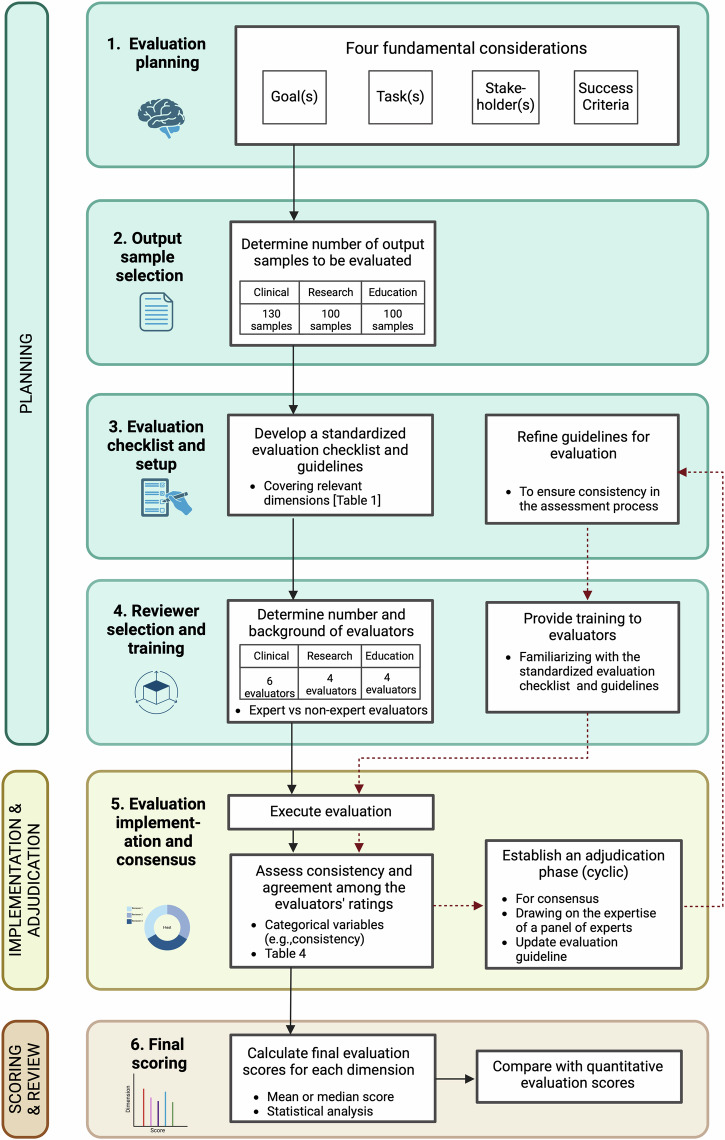
With generative artificial intelligence (GenAI), particularly large language models (LLMs), continuing to make inroads in healthcare, assessing LLMs with human evaluations is essential to assuring safety and effectiveness. This study reviews existing literature on human evaluation methodologies for LLMs in healthcare across various medical specialties and addresses factors such as evaluation dimensions, sample types and sizes, selection, and recruitment of evaluators, frameworks and metrics, evaluation process, and statistical analysis type. Our literature review of 142 studies shows gaps in reliability, generalizability, and applicability of current human evaluation practices. To overcome such significant obstacles to healthcare LLM developments and deployments, we propose QUEST, a comprehensive and practical framework for human evaluation of LLMs covering three phases of workflow: Planning, Implementation and Adjudication, and Scoring and Review. QUEST is designed with five proposed evaluation principles: Quality of Information, Understanding and Reasoning, Expression Style and Persona, Safety and Harm, and Trust and Confidence.
Overview
The claims and statistics of this paper haven’t been checked yet.
Free: it reads the open-access text and checks the first 5 claims that cite a source we can check. Create a free account to check every claim.
Integrity signals
Registry
Cites
Statistics
Figures
Verification
Claims the paper makes
The claims and statistics of this paper haven’t been checked yet.
Free: it reads the open-access text and checks the first 5 claims that cite a source we can check. Create a free account to check every claim.
Claims other papers make about this one
Each is checked against this paper’s own text: does it say what the citing paper says it does?
The cited source says what the claim attributes to it.
In the citing paper
“Healthcare evaluation frameworks already stress reliability, generalizability, human evaluation, safety, harm, trust, and confidence [24].”
From Machine Psychometrics: A Mathematical Psychology of Artificial Intelligence (2026) · cites this paper as [24]
In the citing paper
“Tam et al. 168 reviewed 142 papers on the human evaluation of LLM application in healthcare in general and find that generalizability, applicability, and reliability are lacking in current evaluation practices”
From Data extraction methods for systematic review (semi)automation: Update of a living systematic review (2025) · cites this paper as [168]
Self-check
Percentages, sums and reported differences re-computed from the paper’s own numbers.
The self-check needs the paper’s full text.
Citations
Cites
BLEU: a method for automatic evaluation of machine translation
Papineni, K., Roukos, S., Ward, T., & Zhu, W.-J. (2001) · Proceedings of the 40th Annual Meeting on Association for Computational Linguistics - ACL '02 · doi:10.3115/1073083.1073135 · Cited by 21,344
RoBERTa: A Robustly Optimized BERT Pretraining Approach
Liu, Y., Ott, M., Goyal, N., Du, J., Joshi, M., Chen, D., Levy, O., Lewis, M., Zettlemoyer, L., & Stoyanov, V. (2019) · arXiv · doi:10.48550/arxiv.1907.11692 · Cited by 16,515 · cited 1×
“Wealsoexcludedstudieswhichexamine onlynon-generativepretrainedlanguagemodelslikeBERT 59 , RoBERTa 60 , etc. and multimodal studies such as image-to-text or text-to-image application of generative LLMs.”
BackgroundLearning Transferable Visual Models From Natural Language Supervision
Radford, A., Kim, J. W., Hallacy, C., Ramesh, A., Goh, G., Agarwal, S., Sastry, G., Askell, A., Mishkin, P., Clark, J., et al. (2021) · arXiv · doi:10.48550/arxiv.2103.00020 · Cited by 15,293 · cited 1×
“There are also technical advancements of multimodal LLMs and text-to-image foundational models such as CLIP 58 .”
BackgroundBeyond Accuracy: What Data Quality Means to Data Consumers
Wang, R. Y., & Strong, D. M. (1996) · Journal of Management Information Systems · doi:10.1080/07421222.1996.11518099 · Cited by 4,672
Training language models to follow instructions with human feedback
Ouyang, L., Wu, J., Jiang, X., Almeida, D., Wainwright, C. L., Mishkin, P., Zhang, C., Agarwal, S., Slama, K., Ray, A., et al. (2022) · arXiv · doi:10.48550/arxiv.2203.02155 · Cited by 4,208
Large language models encode clinical knowledge
Singhal, K., Azizi, S., Tu, T., Mahdavi, S. S., Wei, J., Chung, H. W., Scales, N., Tanwani, A., Cole-Lewis, H., Pfohl, S., et al. (2023) · Nature · doi:10.1038/s41586-023-06291-2 · Cited by 4,083
Large Language Models Encode Clinical Knowledge
Singhal, K., Azizi, S., Tu, T., Mahdavi, S. S., Wei, J., Chung, H. W., Scales, N., Tanwani, A., Cole-Lewis, H., Pfohl, S., et al. (2022) · arXiv · doi:10.48550/arxiv.2212.13138 · Cited by 4,083
Charnock, D., Shepperd, S., Needham, G., & Gann, R. (1999) · Journal of Epidemiology and Community Health · doi:10.1136/jech.53.2.105 · Cited by 3,329
Ayers, J. W., Poliak, A., Dredze, M., Leas, E. C., Zhu, Z., Kelley, J. B., Faix, D. J., Goodman, A. M., Longhurst, C. A., Hogarth, M., et al. (2023) · JAMA Internal Medicine · doi:10.1001/jamainternmed.2023.1838 · Cited by 2,613
Llama 2: Open Foundation and Fine-Tuned Chat Models
Touvron, H., Martin, L., Stone, K., Albert, P., Almahairi, A., Babaei, Y., Bashlykov, N., Batra, S., Bhargava, P., Bhosale, S., et al. (2023) · arXiv · doi:10.48550/arxiv.2307.09288 · Cited by 2,604
Research works printed but not linked: 4
- 8. Lin, C.-Y. ROUGE: a package for automatic evaluation of summaries. Text Summarization Branches Out (Association for Computational Linguistics, Barcelona, Spain, 2004).
- 59. Devlin, J., Chang, M.-W., Lee, K. & Toutanova, K. Bert: pre-training of deep bidirectional transformers for language understanding. Proceedings of the 2019 Conference of the North {A}merican Chapter of the Association for Computational Linguistics: Human Language Technologies, Vol. 1 (Long and Short Papers) (eds Burstein, J Doran, C & Solorio, T.) 4171–4186 (Association for Computational Linguistics, 2019).
- 94. Parasuraman, A., Berry, L. L. & Zeithaml, V. A. Refinement and reassessment of the SERVQUAL scale. J. Retail. 67, 420 (1991).
- 97. Biggs, J. B. & Collis, K. F. Evaluating the Quality of Learning: The SOLO Taxonomy (Structure of the Observed Learning Outcome) (Academic Press, 2014).
Cited by
Items 401–495 of 495
LLM-assisted evidence audit of late-stage cancer incidence as a screening trial endpointPreprint
Li, S., Zhang, W., Xing, X., Shen, Z., Wang, Y., Chen, Z., Leal-Neto, O. B., Yu, Y., Wu, C., & Lin, L. (2026) · medRxiv · doi:10.64898/2026.08.29.26361733
Self-citationMa, Y., Liu, S., Song, J., Song, X., Yang, X., Zhao, Q., Xiao, M., & Wang, J. (2026) · Journal of Nursing Management · doi:10.1155/jonm/9524014 · Cited by 2
“For example, QUEST covers information quality, understanding and reasoning, expression, safety, and trust across the planning, implementation, and review stages of evaluation [16].”
Evaluation of LLMs for Automated Dental-to-Medical Consult Letter Generation: Comparative Study
Eom, D., Koh, K., Chung, H., Kim, K., & Lee, S. H. (2026) · International Dental Journal · doi:10.1016/j.identj.2026.111088
Süzer, N. Ü., & Büker, N. (2026) · Research Square · doi:10.21203/rs.3.rs-10776810/v1
BAYAT, S., Işık, G., Paçal, İ., & Keleş, A. (2026) · Intelligence-Based Medicine · doi:10.1016/j.ibmed.2026.100469
Wang, X., & Lu, J. (2026) · Frontiers in Public Health · doi:10.3389/fpubh.2026.1937335
Yuan, S., Wu, H., Yao, J., Lian, X., Zhuo, L., Li, K., Cao, D., Lü, A., & Xia, J. (2026) · International Journal of Biological Macromolecules · doi:10.1016/j.ijbiomac.2026.154371
“Therefore, clinical expert assessment provides an important complement to automated evaluation of biomedical AI models [23].”
Ardila, C. M. (2026) · International Journal of Oral and Maxillofacial Surgery · doi:10.1016/j.ijom.2026.08.034
Anderson, C. (2026) · medRxiv · doi:10.64898/2026.09.01.26361960
Jain, P., Raza, F. B., Kumar, A., V, Kulkarni, S., & Maheshwaran, K. S. (2026) · Journal of Prosthetic Dentistry · doi:10.1016/j.prosdent.2026.08.008
Shi, P., Zhou, T., Nie, Q., Tao, B., Li, X., & Zhu, M. (2026) · Frontiers in Pediatrics · doi:10.3389/fped.2026.1927624
Governing medical AI under the EU AI Act: an integrated compliance-by-design framework
Khan, Q., & Saeed, A. R. (2026) · Frontiers in Digital Health · doi:10.3389/fdgth.2026.1932256
Verdoodt, J., Zhang, C., Sloover, L. D., Huang, H., & de Weghe, N. V. (2026) · DROPS (Schloss Dagstuhl – Leibniz Center for Informatics) · doi:10.4230/lipics.cosit.2026.16
Суриков, А. В., Зайнудинова, Н. В., Яшеня, Д. Н., & Жолнерчик, В. В. (2026) · Journal of Civil Protection · doi:10.33408/2519-237x.2026.10-3.393
Clinical warrant in medical LLM evaluation
Sariyar, M. (2026) · Frontiers in Digital Health · doi:10.3389/fdgth.2026.1918724
The Core Levers of LLM Evaluation: Sets, Templates, and Raters
Robsky, A., Lavitas, L., & Wang, Y. (2026) · Springer eBooks · doi:10.1007/978-3-032-26749-8_3
Self-citationCreeden, J., Olivecrona, M., Benavent, N., Hladun, R., Valero‐Arrese, L., Torres, A. C., & Soriano, A. (2026) · medRxiv · doi:10.64898/2026.09.10.26362656
Liu, X., Zhuang, Y., Wang, Y., Gong, Z., & Wu, D. (2026) · Research Square · doi:10.21203/rs.3.rs-10847421/v1
Self-citationLi, J., Zhou, P., Yang, M., Yang, K., Ren, L., Qi, J., & Ouyang, H. (2026) · Frontiers in Public Health · doi:10.3389/fpubh.2026.1962232
Wen, Y., Chen, L., Deng, X., Lan, J., Huang, X., Liu, Y., Chen, L., & Li, L. (2026) · Frontiers in Endocrinology · doi:10.3389/fendo.2026.1977377
Praestegaard, L., & Paja, E. (2026) · IEEE International Requirements Engineering Conference Workshops (REW) · doi:10.1109/rew72749.2026.00084 · Cited by 1
“Although physician evaluation remains the reference standard for healthcare LLM assessment [7], it is difficult to scale, motivating automated approaches such as LLM-as-a-judge [18].”
Joachim, M. V., Rushinek, H., & Laviv, A. (2026) · International Journal of Oral and Maxillofacial Surgery · doi:10.1016/j.ijom.2026.08.035
Xin, W., Li, X., Qu, W., Nie, W., Zhao, Y., Wang, H., Yi, H., & Tan, S. (2026) · doi:10.2196/preprints.110943
Evaluating the role of ChatGPT in patient questions regarding drug allergies
Tat, T. S., & Altıner, S. (2026) · World Allergy Organization Journal · doi:10.1016/j.waojou.2026.101465
Xu, L., Qiu, X., Deng, J., Dong, C., Liang, D., Wu, K., Dong, X., Mei, T., Chen, S., Wu, Y., et al. (2026) · Neurology Asia · doi:10.54029/2026css
Clinicians vs. Artificial Intelligence in Predicting 28-day ICU Mortality: A Vignette Study
Siriseth, S., & Vattanavanit, V. (2026) · Journal of Pain and Symptom Management · doi:10.1016/j.jpainsymman.2026.09.019
Large Language Models for NiTi File‐Group Selection in Endodontics: A Two‐Stage Comparative Study
Erkal, D., Çakmak, Y. E., & Er, K. (2026) · Australian Endodontic Journal · doi:10.1111/aej.70129
Parikh, A., & Kohli, P. (2026) · The Lancet Digital Health · doi:10.1016/j.landig.2026.101072
La Nueva Taxonomía del Aprendizaje con Inteligencia Artificial
Guevara, D. P. S., Romo, M. S. S., Michuy, A. B. C., & Pereira, W. I. S. (2026) · doi:10.63415/saga.2026.132
Diya, S., & Edgcomb, J. B. (2026) · JMIR Mental Health · doi:10.2196/97498
“Zero-shot inference can overinterpret ambiguous language, and intermediate Likert scores in particular should be interpreted cautiously [26,27].”
Lin, C., Xu, Z., Wu, K., & Bai, O. (2026) · IEEE Access · doi:10.1109/access.2026.3736407
“2 [13], [14], [15].”
Collaço, B. G., Wood, N. G., Yu, Y., Malena, C. R., Srinivasagam, P., Boon, A. L., Fang, Z., Bhagra, A., Leibovich, B. C., & Forte, A. J. (2026) · Bioengineering · doi:10.3390/bioengineering13101115
“These physician classifications served as the reference standard for assessment of AIVA performance, in accordance with established Human–LLM evaluation approaches [5].”
InfluentialSituational Context Embedding and Knowledge-Based Grounding for LLMs in Surgical Training Assistance
Malayeri, A. B., Seibold, M., Oettl, F. C., Cavalcanti, N., Gerth, T., Lekar, R., Hoch, A., Zingg, P., & Fürnstahl, P. (2026) · Lecture notes in computer science · doi:10.1007/978-3-032-38233-7_47
Boone, E., Loban, K., Daskalo, C., Rajasegaran, S., Guadagno, E., Haggerty, J. L., Lambert, S., & Poenaru, D. (2026) · JMIR Formative Research · doi:10.2196/96901
An auditable conditional-strategy framework for open-ended decision-making in complex lung cancerPreprint
Wang, D., Huang, Z., Sun, H., Xu, J., Xu, X., Zheng, Z., Bing, Z., Lin, Y., Liang, Y., Gao, C., et al. (2026) · arXiv (Cornell University) · doi:10.48550/arxiv.2609.29381
Self-citationCastano-Villegas, N., Barrientos, K. M., Villa, M. C., Gómez, O. I. Q., Velásquez, L., & Zea, J. (2026) · medRxiv · doi:10.64898/2026.09.23.26363806
Nobel, M. N. A., Matar, M. G. S., Hemal, M. A. K. P., Contreras, K. A. Z., Mamun, A. A., & Uddin, R. (2026) · Technology and Innovation Conference (TIC) · doi:10.1109/tic68483.2026.11702858
“Implementation depends on leadership, change management, training, workflow redesign, infrastructure, legal and ethical clarity, and ongoing evaluation [3], [17], [31], [32], [39], [42].”
InfluentialToward a Framework for Assessing Patient-Facing Gen AI Tools in Mental Healthcare
Durneva, P., & Ghorbanie, H. (2026) · International Journal of Medical Informatics · doi:10.1016/j.ijmedinf.2026.106741
Xu, Q., Amjad, N. A., Giles, G., Cumming, A., Hermesky, D., Wen, A., Kwak, M. J., & Kim, Y. (2026) · Journal of Medical Internet Research · doi:10.2196/90872
“To understand junior investigators’ perceptions of CoTI’s outputs and their experience, we implemented a survey guided by the quality, understanding, expression, safety, and trust (QUEST) framework [26] (see detailed questionnaire in Section B in Multimedia Appendix 1).”
Uso de NotebookLM en el análisis comparativo de evidencia científica
del Rio, M. P., Aguilar-Medrano, F., & Castedo, L. (2026) · doi:10.62486/978-9915-9928-3-9.ch19
Ismail, N. A. S., Azman, A. H. A., Zafira, A., Faiz, M. F. A., Shaharir, S. S., Mustafar, R., Shamsuddin, C. M., Ma’arof, D. Z., & Sahran, S. (2026) · Frontiers in Medicine · doi:10.3389/fmed.2026.1895321
“However, its educational value depends on the clinical accuracy, linguistic appropriateness, and authenticity of the simulated interactions (12, 13).”
Liu, L., Du, X., Yang, G., Xiang, S., Guo, H., Huang, L., Li, Y., & Yu, H. (2026) · Frontiers in Public Health · doi:10.3389/fpubh.2026.1862627
Hu, G., Lai, Q., Liu, S., Xie, B., Wu, Z., Zhuang, Q., Tang, H., & Xu, J. (2026) · Frontiers in Public Health · doi:10.3389/fpubh.2026.1961597
Aydemir, N. G., Yapar, D., Avcı, Y. D., Sonuvar, E. T., & Aydemir, M. (2026) · BMC Gastroenterology · doi:10.1186/s12876-026-05345-9
Systematic Technical Survey on LLMOps: Lifecycle, Tools, Challenges, and Emerging Practices
Özer, F. (2025) · UEF eRepo (University of Eastern Finland) · Cited by 3
Kalengkongan, I. S. G., Sasmoko, Faisal, B., & Hermanus, D. R. (2026) · International Conference on ICT for Smart Society (ICISS) · doi:10.1109/iciss71466.2026.11715439
Lim, E. Y. P., Chen, F., & Lim, C. E. D. (2026) · Journal of Mind and Medical Sciences · doi:10.3390/jmms13040024
“[17,19,26,30] Trust is calibrated rather than inflated.”
InfluentialGenerative Artificial Intelligence in Rehabilitation: A Systematic Mapping Review
Coraci, D., Regazzo, G., Santilli, G., & Masiero, S. (2026) · Applied Sciences · doi:10.3390/app16199784
Quality of Machine Translation for Human Phenotype Ontology Terms into Portuguese
Souza, J., Fontanelli, L., Cassão, V., Yamada, D. B., Bernardi, F. A., Marreiros, G., Freitas, A., & Alves, D. (2026) · Lecture notes in computer science · doi:10.1007/978-3-032-21373-0_6
Suh, P. S., Shim, W. H., Heo, H., & Suh, C. H. (2026) · Journal of the Korean Society of Radiology · doi:10.3348/jksr.2026.0080
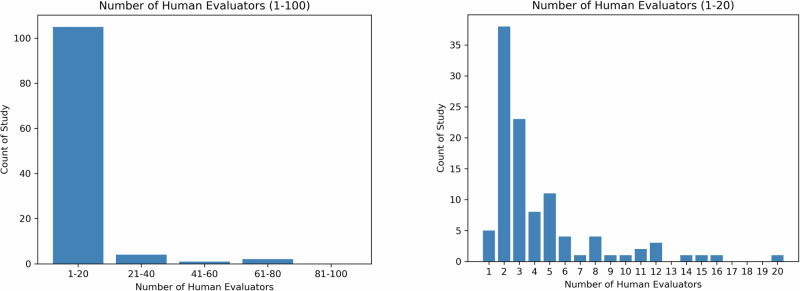
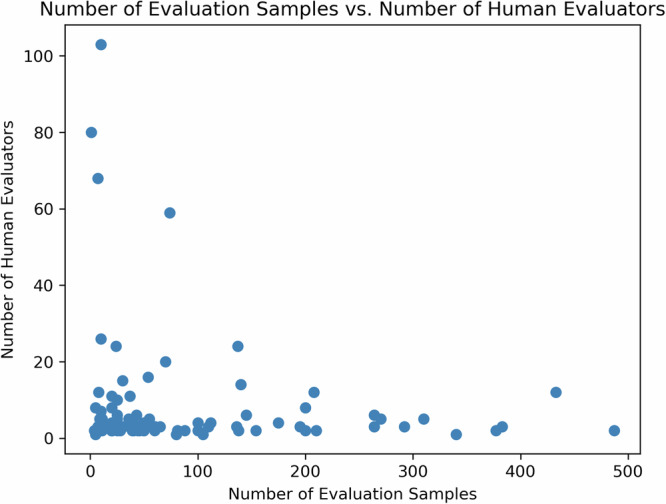
“Consequently, optimizing the balance between the number of human evaluators and evaluation samples is an important methodological consideration (86).”
Choudhury, M. R., Chowdhury, S. R., Sahoo, S., Khan, M. A., Khakwani, K. Z. R., Sonbol, M. B., Riaz, I., & Gupta, V. (2026) · bioRxiv (Cold Spring Harbor Laboratory) · doi:10.64898/2026.10.01.756098
“…step is a prospective study in which reviewers of a living evidence resource pose their own questions, inspect the recorded steps and approve or reject learned rules, with time and agreement as outcomes and with structured human evaluation of the kind proposed for healthcare language models [29].”
Sulaima, M. F., Jyotsna, A., Herout, L., Gálvez, I. P., Krejcar, O., & Namazi, H. (2026) · Energy Nexus · doi:10.1016/j.nexus.2026.100870 · Cited by 1
Zhang, H., Zhao, S., Yan, B., Sun, H., & Wang, P. (2026) · Research Square · doi:10.21203/rs.3.rs-11009605/v1
Gandini, S., Lindskog, J., Yu, Y., Oettl, F. C., Willy, R. W., Adami, P. E., Villa, F. D., Paolo, S. D., Bonsanto, F., Mazzoni, S., et al. (2026) · Journal of Experimental Orthopaedics · doi:10.1002/jeo2.70939
“De fi nition from the QUEST Human Evaluation Framework [40].”
InfluentialNedal, N., El‐Dalahmeh, A., & Li, J. (2026) · Authorea · doi:10.22541/authorea.15010000/v1
Gökmen, E., Kahveci, Ş., & Öztürk, Y. E. (2026) · Work · doi:10.1177/10519815261494548
Shen, Y., Ju, X., Sun, Y., & Cui, J. (2026) · International Journal of Medical Informatics · doi:10.1016/j.ijmedinf.2026.106767
Alharbi, M., & Alhargan, A. (2026) · IEEE Access · doi:10.1109/access.2026.3742992
“The qualitative component involves structured evaluation by mental health professionals using a rubric informed by the QUEST framework [22].”
InfluentialKo, J. S., Jung, W., Suh, P. S., Heo, H., Shim, W. H., Kim, D.-H., Lee, S. H., Kim, M., Lee, N., Kim, S., et al. (2026) · Academic Radiology · doi:10.1016/j.acra.2026.09.056
Torabinejad, M., Tordik, P. A., Alenezi, M., Parirokh, M., Dianat, O., Foroughi, M. R., Zegar, Z., Oyoyo, U. E., & Law, A. (2026) · Journal of Endodontics · doi:10.1016/j.joen.2026.10.003
Xu, J., Xing, W., Jia, L., Li, X., Zhang, Q., & Yang, W. (2026) · Frontiers in Nutrition · doi:10.3389/fnut.2026.1957211
“Adjudicators should score observable behavior, preserve ratings before consensus, report inter-rater agreement, and present severe individual failures separately from aggregate performance (37–41, 60–63, 65, 66).”
InfluentialReply to Reference Authenticity and Citation Validity in AI-Generated Medical Writing
Aydin, M. O. (2026) · Uludağ Üniversitesi Tıp Fakültesi Dergisi · doi:10.32708/uutfd.2058194
Qin, N., Shao, X., Wang, J., Lei, J., Wen, R., Wu, W., Liu, F., Wang, H., & Zhu, Y. (2026) · Frontiers in Public Health · doi:10.3389/fpubh.2026.1966612
“Effective management requires long-term self-care, adherence to complex treatment regimens, and sustained patient education, which may improve self-care behaviors, quality of life, and clinical outcomes in patients with HF (11–13).”
Nahid, K., Anam, M., Hossain, M. S., Any, O. H., Hassan, K. M. R., & Anwar, M. M. (2026) · medRxiv · doi:10.64898/2026.10.14.26365587
AI Augmented Student Advising: A Comparative Study of LLMs and Advisor-Based Course Recommendations
Srinivasan, S., Alabsi, H. Z., Mangle, A., Obeidat, R., Zenebe, A., & Kapur, K. (2026) · Journal of Educational Technology Systems · doi:10.1177/00472395261498055
Albeshri, S. (2026) · The Saudi Dental Journal · doi:10.1007/s44445-026-00247-8
Yang, X., Cao, Y., Wang, H., Li, H., Jiang, X., Xu, H., Yao, T., Zhang, X., Chen, Y., Li, J., et al. (2026) · Frontiers in Psychiatry · doi:10.3389/fpsyt.2026.1942164
ChikungunyaQA: A Clinical Dataset of Questions and Answers on Chikungunya
dos Santos, D. A., Moreira, R., da Costa, A. C. V., de Barros, G. M., Santos, B., Teixeira, S. S., & Teles, A. S. (2026) · Data · doi:10.3390/data11100279
Medical Reasoning in Large Language Models: Development and Evaluation of the MedEvalArena Benchmark
Prem, P., Kuppa, V., Shidara, K., Wheeler, E., Chang, G., Liu, F., Alaa, A. M., & Bernardo, D. (2026) · Journal of Medical Internet Research · doi:10.2196/96885
Qi, X. (2026) · Transactions on Computational Modeling and Intelligent Systems · doi:10.65112/tcmis.10088
Barbaric, A., Benseler, S. M., Lalloo, C., Liu, X. C., Mariakakis, A. T., Phạm, Q., Vastert, S. J., Yeung, R. S. M., Cafazzo, J. A., & Swart, J. F. (2026) · PLOS Digital Health · doi:10.1371/journal.pdig.0001655
Lee, J., Shin, J., & Cho, B. (2026) · Journal of Korean Medical Science · doi:10.3346/jkms.2026.41.e339
Gong, S., Yang, J., & Duan, Y. (2026) · Applied Sciences · doi:10.3390/app162110534
Horvath, K., Longani, S., Brill, S., Ballantyne, H. A., Schaefert, R., Tegethoff, M., Schirmer, L., Boerner, E., Timm, I. J., Elyoseph, Z., et al. (2026) · medRxiv · doi:10.64898/2026.10.22.26366245
Zhang, F., Tong, P., & Yang, H. (2026) · Frontiers in Public Health · doi:10.3389/fpubh.2026.1961492
Kremer, P., Haase, I., Boyadzhieva, Z., & Krusche, M. (2026) · RMD Open · doi:10.1136/rmdopen-2026-007538
Lindskog, J., Oettl, F. C., Yu, Y., Paterno, M. V., Giordano, A. O., Rambaud, A. J. M., Prill, R., Królikowska, A., Samuelsson, K., & Senorski, E. H. (2026) · Journal of Experimental Orthopaedics · doi:10.1002/jeo2.70964
“Each 300 ‐ word summary was evaluated across fi ve prede fi ned categories according to the QUEST framework: (1) Quality of information, (2) Understanding and reasoning, (3) Expression style and persona, (4) Safety and harm and (5) Trust and con fi - dence (Table 1) [23].”
Triantafyllopoulos, I., Rodriguez, D. V., Mastrianni, A., Andreadis, K., Xu, L., Chen, J., Mann, D., & Sedoc, J. (2026) · doi:10.2196/preprints.115705
Zandian, S., & Jololian, L. (2026) · Network Modeling Analysis in Health Informatics and Bioinformatics · doi:10.1007/s13721-026-00892-3
“Frameworks for clinical hallucination assess - ment and standardized human evaluation, such as CREOLA and QUEST, provide useful directions for future validation (Asgari et al. 2025, Tam et al. 2024).”
Jo, E., Lee, Y., Cho, E., Kim, S., Park, E., Ryu, H., Joo, H. J., & Song, S. (2026) · Journal of Medical Systems · doi:10.1007/s10916-026-02483-1
“The evaluation criteria were derived with reference to human evaluation frameworks used in prior studies on LLMs in the medical domain and were adapted for this study [29, 40, 41 ].”
Carra, G., Boillat‐Blanco, N., Hügle, T., Bastardot, F., Banerjee, S., McFadden, B. R., Hartley, M., Meystre, S. M., & Raisaro, J. L. (2026) · Methods of Information in Medicine · doi:10.1055/a-2979-8775
Comprehensive evaluation of large language models for pediatric pectus excavatum education
Shi, H., Tang, Q., Xiong, J., Tseng, H.-C., Chang, T.-H., Chen, X., Peng, L., & Hong, H. (2026) · Frontiers in Public Health · doi:10.3389/fpubh.2026.1990753
Zaman, I.-R., Zanfir, A.-G., Trăușan-Matu, Ș., Popa-Velea, O., & Trifu, S. C. (2026) · Psychiatry International · doi:10.3390/psychiatryint7060240
Routing Patient Messages in Primary Care Using Explainable Ontology-Guided Large Language Models
Younis, M., Levy, M., Cohen, D. A., Moshe, E., & Solomon, A. (2026) · ACM International Conference on Information and Knowledge Management (CIKM) · doi:10.1145/3799682.3840107
Xieyi, W., & Wang, H. (2026) · Frontiers in Medicine · doi:10.3389/fmed.2026.1980325
Montgomery‐Taylor, S., Subramaniam, H., Brisk, R., Foster, L., Ching, J., Marshall, A., Taylor, J., Hernandez, J., McKay, J., Obika, D., et al. (2026) · arXiv (Cornell University) · doi:10.48550/arxiv.2611.05127
Xie, Y., Gao, Y., Peng, J., Tao, Y., Xu, S., Cui, Z., Zhou, B., Wang, E., & Cui, L. (2026) · Frontiers in Pharmacology · doi:10.3389/fphar.2026.1958826
Russ, P. G., Einloft, J., Bedenbender, S., Armbruster, N.-L., Wenzel, L. T., Ganser, A., Hirsch, M. C., & Grgic, I. (2026) · Scientific Reports · doi:10.1038/s41598-026-78493-3
Patel, J. S., Wang, H., Zanwar, P., Shen, C., Wiener, R. C., Badi, M., Rajadhyaksha, A. M., & Sambamoorthi, U. (2026) · Frontiers in Oral Health · doi:10.3389/froh.2026.1937908
Chu, X., Ye, W., Zhang, Y., Li, W., Liu, W., Li, Z., Niu, J., Wang, S., Li, W., Zhang, M., et al. (2026) · Research Square · doi:10.21203/rs.3.rs-11390227/v1
Ota, K., & Tsuda, K. (2026) · Lecture notes in computer science · doi:10.1007/978-981-92-7708-7_13
Peng, K., Lin, S., Chen, J., Liu, X., Huang, Z., & 常玉苗 (2026) · Lecture notes in computer science · doi:10.1007/978-981-92-7708-7_9
Metadata
- Authors
- Tam, T. Y. C., Sivarajkumar, S., Kapoor, S., Stolyar, A. V., Polanska, K., McCarthy, K. R., Osterhoudt, H., Wu, X., Visweswaran, S., Fu, S., Mathur, P., Cacciamani, G. E., Sun, C., Peng, Y., & Wang, Y.
- Affiliations
- University of Pittsburgh (US)
- University of Pittsburgh Medical Center (US)
- The University of Texas Health Science Center at Houston (US)
- Cleveland Clinic (US)
- University of Southern California (US)
- Weill Cornell Medicine (US)
- Corresponding author
- Wang, Yanshan
- ORCID
- Venue
- npj Digital Medicine
- Published
- 2024-09-28
- Volume
- 7
- Issue
- 1
- Pages
- 258-258
- ISSN
- 2398-6352 (ISSN-L)
- PMC
- PMC11437138
- OpenAlex
- W4402909345
- Cited by
- 424
- References
- 102
- Citations by year
- 2026: 270 · 2025: 149 · 2024: 5
- FWCI
- 39.64
- Type
- journal article
- Language
- en
- Open access
- gold
- doi.org
- Licence
- cc-by
- creativecommons.org/licenses/by/4.0 (tdm)
- creativecommons.org/licenses/by/4.0 (vor)
- Locations
- npj Digital Medicine (publishedVersion, cc-by)
- PubMed Central (publishedVersion, cc-by)
- PubMed (publishedVersion)
- arXiv (Cornell University) (submittedVersion)
- Digital Commons-TMC (Texas Medical Center) (submittedVersion)
- DOAJ (DOAJ: Directory of Open Access Journals) (submittedVersion, cc-by-sa)
- arXiv (Cornell University)
- Funders
- U.S. Department of Health & Human Services | National Institutes of Health (UL1TR001857, U24TR004111, R01LM014306)
- Topics
- Health Sciences › Medicine › Health Informatics › Artificial Intelligence in Healthcare and Education
- Physical Sciences › Computer Science › Artificial Intelligence › Explainable Artificial Intelligence (XAI)
- Physical Sciences › Computer Science › Artificial Intelligence › Ethics and Social Impacts of AI
- Keywords
- large language models, human evaluation, health care, generative AI, evaluation framework, evaluation metrics, assessment reliability, trust and confidence, evaluation principles
About these checks
Registry, retraction, Cites and statistics results are computed, not judged, with one exception: a printed reference that no index lists is read once by a model before it counts as a citation error. Claims are extracted by a model and kept only when their quote appears verbatim in the text; each cited source is then checked, with a model’s help, for whether it says what the claim relies on. Those verdicts can be wrong — read the claim’s quote and the cited source before relying on one.
Statistics and arithmetic are recomputed, not judged.
Confidence bands are shown only for fields calibrated on our annotated test set. None is calibrated yet, so no band is shown.
What counts as a claim ›How we measure confidence ›How we check this ›
Are you an author, or do you see a problem with this page? Request a review
Data sources
Bibliographic data: Semantic Scholar, OpenAlex, Crossref.
Contains information from the Semantic Scholar Academic Graph Datasets, made available under the ODC Attribution License (ODC-BY 1.0).
Semantic Scholar’s data is described in: Kinney, R., et al. (2023). The Semantic Scholar Open Data Platform. arXiv:2301.10140.
