

Opportunities and risks of artificial intelligence in patient portal messaging in primary care
Open accessThe DOI matches its Crossref record; 21 of the 22 references it cites were found in a registry or an index.
Abstract
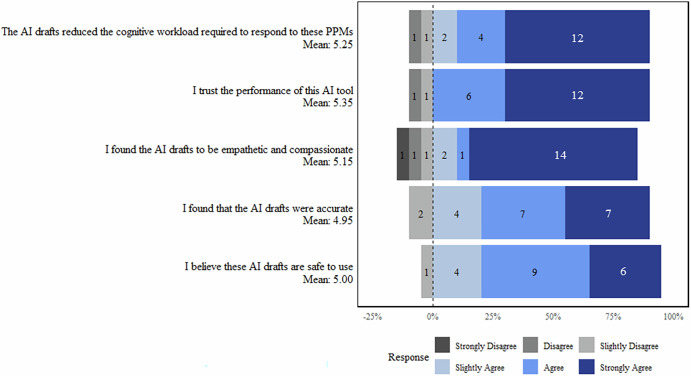
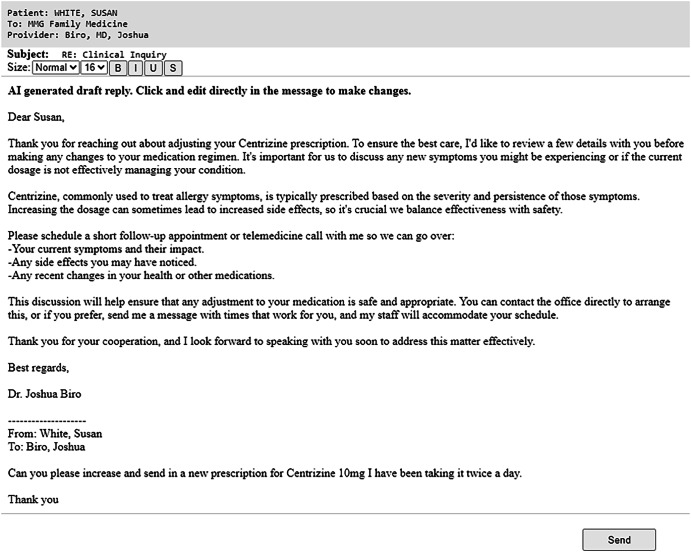
The rapid increase in patient portal messaging has heightened the workload for primary care physicians (PCPs), contributing to burnout. The use of generative artificial intelligence (AI) to draft responses to patient messages has shown promise in reducing cognitive burden, yet there is still much unknown about the safety and perceptions of using AI drafts. This cross-sectional simulation study assessed whether PCPs could identify and correct errors in AI-generated draft responses to patient portal messages. Twenty practicing PCPs reviewed 18 patient portal messages, four of which contained errors categorized as objective inaccuracies or potentially harmful omissions. Each error was insufficiently addressed by 13-15 participants, and 35-45% of erroneous drafts were submitted entirely unedited. While 80% of participants agreed AI drafts reduced cognitive workload and 75% found them safe, uncorrected errors highlight patient safety risks, underscoring the need for improved design, training, and error-detection mechanisms for AI tools.
Overview
The claims and statistics of this paper haven’t been checked yet.
Free: it reads the open-access text and checks the first 5 claims that cite a source we can check. Create a free account to check every claim.
Integrity signals
Registry
Cites
Statistics
Figures
Verification
Claims the paper makes
The claims and statistics of this paper haven’t been checked yet.
Free: it reads the open-access text and checks the first 5 claims that cite a source we can check. Create a free account to check every claim.
Claims other papers make about this one
Each is checked against this paper’s own text: does it say what the citing paper says it does?
The source backs part of the claim, not all of it — or backs it for a different population, condition or comparison.
In the citing paper
“In a cross-sectional simulation study evaluating provider editing of AI-generated draft responses to patient portal messages, participants frequently failed to recognize clinically relevant note errors.15”
From Evaluating the Quality and Safety of Ambient Digital Scribe Platforms Using Simulated Ambulatory Encounters (2025) · cites this paper as [15]
Experimental — accuracy not yet measuredThe cited source says what the claim attributes to it.
In the citing paper
“Although clinician proofreading remains the de jure safeguard against ADS-generated errors, early simulation studies suggest this may not be an effective safeguard.15”
From Evaluating the Quality and Safety of Ambient Digital Scribe Platforms Using Simulated Ambulatory Encounters (2025) · cites this paper as [15]
Self-check
Percentages, sums and reported differences re-computed from the paper’s own numbers.
The self-check needs the paper’s full text.
Citations
Cites
Automation bias: a systematic review of frequency, effect mediators, and mitigators
Goddard, K., Roudsari, A., & Wyatt, J. C. (2012) · Journal of the American Medical Informatics Association · doi:10.1136/amiajnl-2011-000089 · Cited by 1,162 · cited 1×
“Fourth, providers may have succumbed to automation bias 23 , the tendency to over-rely on automation, which can be exacerbated under increasedworkload 24 .”
Does automation bias decision-making?
SKITKA, L. J., MOSIER, K. L., & BURDICK, M. (1999) · International Journal of Human-Computer Studies · doi:10.1006/ijhc.1999.0252 · Cited by 1,139 · cited 1×
“Fourth, providers may have succumbed to automation bias 23 , the tendency to over-rely on automation, which can be exacerbated under increasedworkload 24 .”
Arndt, B. G., Beasley, J. W., Watkinson, M. D., Temte, J. L., Tuan, W.-J., Sinsky, C. A., & Gilchrist, V. J. (2017) · The Annals of Family Medicine · doi:10.1370/afm.2121 · Cited by 972 · cited 1×
“This increase in patient portal messaging has been speci fi cally burdensome on primary care physicians (PCPs) 4 , who spend over half their workday on EHR-related tasks, 1.4 h of which occurs after clinical hours 5 .”
InfluentialPerformance Consequences of Automation-Induced 'Complacency'
Parasuraman, R., Molloy, R., & Singh, I. L. (1993) · The International Journal of Aviation Psychology · doi:10.1207/s15327108ijap0301_1 · Cited by 875 · cited 1×
“Third, automation complacency 21 , the tendency to monitor automated systems poorly, may have played a role.”
Varieties of Confirmation Bias
Klayman, J. (1995) · Psychology of Learning and Motivation · doi:10.1016/s0079-7421(08)60315-1 · Cited by 755
Shanafelt, T. D., West, C. P., Sinsky, C., Trockel, M., Tutty, M., Wang, H., Carlasare, L. E., & Dyrbye, L. N. (2022) · Mayo Clinic Proceedings · doi:10.1016/j.mayocp.2021.11.021 · Cited by 434 · cited 1×
“This in fl ated time spent on inbox management and other tasksisamajorcontributortoburnout 6 – 9 ,andhasledtoapproximately50% of PCPs in the United States reporting experiencing burnout, which is among the highest rates across clinical specialties 10 .”
Adler-Milstein, J., Zhao, W., Willard-Grace, R., Knox, M., & Grumbach, K. (2020) · Journal of the American Medical Informatics Association · doi:10.1093/jamia/ocz220 · Cited by 356
Monitoring an Automated System for a Single Failure: Vigilance and Task Complexity Effects
MOLLOY, R., & PARASURAMAN, R. (1996) · Human Factors: The Journal of the Human Factors and Ergonomics Society · doi:10.1177/001872089606380211 · Cited by 321 · cited 1×
“As the occurrence of automation compla-cency increases with reliability 22 , the fact that most AI-generated drafts did not contain an error or patient safety risk may have resulted in vigilance decrement.”
Artificial Intelligence–Generated Draft Replies to Patient Inbox Messages
Garcia, P., Ma, S. P., Shah, S., Smith, M., Jeong, Y., Devon-Sand, A., Tai-Seale, M., Takazawa, K., Clutter, D., Vogt, K., et al. (2024) · JAMA Network Open · doi:10.1001/jamanetworkopen.2024.3201 · Cited by 266
Functional fixedness as related to problem solving: a repetition of three experiments.
Adamson, R. E. (1952) · Journal of Experimental Psychology · doi:10.1037/h0062487 · Cited by 250 · cited 1×
“First, it is possible that providers fell into a functional fi xedness 19 trap, a cognitive bias limiting the ability to innovate on an expected solution.”
Cited by
AI, Health, and Health Care Today and Tomorrow: The JAMA Summit Report on Artificial Intelligence
Angus, D. C., Khera, R., Lieu, T., Liu, V., Ahmad, F. S., Anderson, B., Bhavani, S. V., Bindman, A., Brennan, T., Celi, L. A., et al. (2025) · JAMA · doi:10.1001/jama.2025.18490 · Cited by 195
Ethical Obligations to Inform Patients About Use of AI Tools
Mello, M. M., Char, D., & Xu, S. H. (2025) · JAMA · doi:10.1001/jama.2025.11417 · Cited by 57
Brewster, R., Tse, G., Fan, A. L., Elborki, M., Newell, M., Gonzalez, P., Hoq, A., Chang, C. T., Chowdhury, M., Geeti, A., et al. (2025) · npj Digital Medicine · doi:10.1038/s41746-025-02055-6 · Cited by 24
A Dataset for Addressing Patient’s Information Needs related to Clinical Course of Hospitalization
Soni, S., & Fushman, D. D. (2026) · Scientific Data · doi:10.1038/s41597-026-06639-z · Cited by 19
“However, although studies using portal messages exist, the corresponding datasets are not publicly available 16,17,48,49 .”
Anderson, T. N., Mohan, V., Dorr, D. A., Ratwani, R. M., Biro, J. M., & Gold, J. A. (2025) · Mayo Clinic proceedings. Digital health · doi:10.1016/j.mcpdig.2025.100292 · Cited by 17
“15 Because of ADS licensing costs, providers may experience explicit or implicit organizational pressure to increase their clinical output, which could further compound this problem.”
Self-citationEthical considerations for clinical adoption of ambient digital scribe technology
Anderson, T. N., Mohan, V., & Gold, J. A. (2025) · Journal of the American Medical Informatics Association · doi:10.1093/jamia/ocaf227 · Cited by 15
Reis, F., Agha-Mir-Salim, L., Hickstein, R., Reis, M., Piper, S. K., Balzer, F., & Boie, S. D. (2026) · Journal of Medical Internet Research · doi:10.2196/84668 · Cited by 10
“The adaptive inclusion of disclaimers and referrals in LLM-generated responses carries significant clinical implications, as incorrect advice could exacerbate patient safety risks [32,33].”
Patient Health Record Smart Network Challenges and Trends for a Smarter World
Vicoveanu, D. I., Gherman, O., Șoldănescu, I., & Lavric, A. (2025) · Sensors · doi:10.3390/s25123710 · Cited by 9
“Consequently, the integration of AI within PHRs must be accompanied by the implementation of comprehensive control frameworks, enhanced transparency measures, and rigorous validation processes to ensure the safety and fairness of its utilization [31].”
Dullabh, P., Zott, C., Gauthreaux, N. A., Peterson, C., Aronoff, A., Monkhouse, K., & Sittig, D. F. (2026) · Journal of Medical Internet Research · doi:10.2196/81628 · Cited by 9
“…a sample of primary care physicians reviewing AI-generated patient portal messages containing errors did not identify and remedy all the errors and 35% to 45% of physicians submitted erroneous messages entirely unedited, indicating the need for additional guardrails beyond physician oversight [47].”
Zabala, G., Pruitt, Z. M., Fairbanks, R. J. T., & Ratwani, R. M. (2025) · Journal of Patient Safety · doi:10.1097/pts.0000000000001428 · Cited by 5
Self-citationFox, S., Markham, L., Lail, R., & Karotsieris, M. (2026) · arXiv (Cornell University) · doi:10.48550/arxiv.2608.31016 · Cited by 8
Chen, W., Haredasht, F. N., Black, K. C., Grolleau, F., Alsentzer, E., Chen, J. H., & Ma, S. P. (2025) · Pacific Symposium on Biocomputing (PSB) · doi:10.1142/9789819824755_0014 · Cited by 4
Zaher, A., Prikshat, V., Vinot, D., Malik, A., & el aziz, J. A. (2026) · Technological Forecasting and Social Change · doi:10.1016/j.techfore.2026.124645 · Cited by 3
Kobyakova, O. S., Kanev, A. F., Kurakova, N. G., & Леонидовна, К. Р. (2026) · Vrach i informacionnye tehnologii · doi:10.25881/18110193_2026_1_38 · Cited by 3
Guardrails for GenAI drafted replies in patient portal messaging
Sakr, J. (2026) · npj Digital Medicine · doi:10.1038/s41746-026-02621-6 · Cited by 3
Seegmiller, P., Gatto, J., Greer, S. E., Isingizwe, G. B., Ray, R., Burdick, T. E., & Preum, S. M. (2026) · Proceedings of the conference - Association for Computational Linguistics. Meeting · doi:10.18653/v1/2026.acl-long.1505 · Cited by 3
Lingam, V., Lee, J., & Perkins, R. M. (2025) · Medical Clinics of North America · doi:10.1016/j.mcna.2025.07.006 · Cited by 2
Chen, S.-H., Chang, R., Lien, C.-E., Yang, D.-J., Yao, P., Wu, M., & Chen, K.-H. (2026) · npj Digital Medicine · doi:10.1038/s41746-026-02484-x · Cited by 2
Guo, Y., Hu, D., Zhou, Y., Lyu, T., Yang, Z., Reynolds, T. L., & Zheng, K. (2026) · npj Health Systems · doi:10.1038/s44401-026-00091-2 · Cited by 2
“While disclosure of AI involvement slightly reduced patient satisfaction, transparency was widely viewed as necessary for trust and accountability 323,332,344,345 .”
Physician Edits to AI-Drafted Patient Messages and Their Impact on Clinical Workload
Poursoltan, L., Cao, J., Chen, W., Kim, E., Nakai, T. K., Boussina, A. E., Chua, A., Pan, J., Millen, M. M., Tai‐Seale, M., et al. (2026) · NEJM AI · doi:10.1056/aioa2501034 · Cited by 2
A new approach to artificial intelligence safety in primary care
Biro, J., Jabbarpour, Y., & Ratwani, R. M. (2026) · The Lancet Primary Care · doi:10.1016/j.lanprc.2026.100115 · Cited by 1
Self-citationA Novel Workflow for Artificial Intelligence-Enhanced Patient Messaging Services
Allen, M. R., Tiyyala, V. M., Ramesh, K. K., Desai, N., Shiach, J., Dredze, M. H., & Ayers, J. W. (2026) · Applied Clinical Informatics · doi:10.1055/a-2852-9026 · Cited by 1
Kim, S., Foote, M., Zhang, S., Twyford, A., Fox, A., & Rosen, J. E. (2026) · Journal of Surgical Oncology · doi:10.1002/jso.70341 · Cited by 1
Weinreb, G., Holmgren, A. J., Apathy, N. C., Bates, D. W., Landon, B. E., & Rotenstein, L. S. (2026) · Health Affairs · doi:10.1377/hlthaff.2025.00734 · Cited by 1
Barrison, P., Platt, J. E., Ackerman, M. S., Friedman, C. P., & Vinson, A. H. (2026) · International Journal of Medical Informatics · doi:10.1016/j.ijmedinf.2026.106507 · Cited by 1
Lange, F., Mardi, S., Binder, T., Reich, M. M., Odorfer, T., & Volkmann, J. (2026) · The Lancet Regional Health - Europe · doi:10.1016/j.lanepe.2026.101866 · Cited by 1
“15–18 Here we address this gap in three nested contributions.”
Patient journey evaluation for consumer AI health assistants
Yao, Z., & Yu, H. (2026) · npj Digital Medicine · doi:10.1038/s41746-026-03251-8 · Cited by 1
Human oversight of erroneous clinical AI and decision support a systematic review and meta analysis
Zeng, D., Lei, J., & Li, Z. (2026) · npj Digital Medicine · doi:10.1038/s41746-026-03408-5 · Cited by 1
Editing with AI: How Doctors Refine LLM-Generated Answers to Patient QueriesPreprint
Sharma, R., Ramjee, P., Murali, K., & Jain, M. (2025) · arXiv (Cornell University) · doi:10.48550/arxiv.2511.19940 · Cited by 1
“While LLMs often produced drafts that were accurate and complete, occasional inaccuracies, omissions, or overly generic advice highlighted the risks of unchecked automation, consistent with prior work [3, 5, 20].”
InfluentialVoorheis, P., Dombrowski, S. U., Bruno, F., & Gray, C. S. (2026) · Journal of Medical Internet Research · doi:10.2196/87521
“For example, AI-generated plain-language summaries, contextual explanations of test results, and tailored guidance on urgency and next steps could help users better interpret their health information, particularly those with lower digital literacy or limited access to primary care [43-45].”
Hoekman, A. H., Mehri, T., Doornberg, J. N., Plantinga, M., van der Laan, T. P., Bootsma-Robroeks, C. M., & Schoonbeek, R. C. (2026) · JMIR Medical Informatics · doi:10.2196/preprints.94586
The Jevons trap: When artificial intelligence in healthcare creates endless work
Shankar, R. (2026) · The American Journal of Medicine · doi:10.1016/j.amjmed.2026.05.010
SAIMSARA (2026) · SAIMSARA Journal · doi:10.62487/saimsara35d5dc3f
Crowley, A. P., Hanish, A., Lubken, J., Becker, M., Rosen, C., Moon, J., & Regli, S. H. (2026) · Applied Clinical Informatics · doi:10.1055/a-2893-7363
Diálogos Interdisciplinares sobre o Direito do Paciente
Albuquerque, A., de Oliveira, C. D. B., Antunes, C. M. T. B., França, C. M., Ortiz, C., Leal, E., Martins, G. H., Silva, J. B. P., Eler, K. C. G., Musse, L. B., et al. (2026) · doi:10.22533/at.ed.728262506
DIREITO AO CUIDADO SEGURO E SAÚDE DIGITAL: desafios na garantia de direito do paciente
de Oliveira, C. D. B., França, C. M., & Albuquerque, A. (2026) · doi:10.22533/at.ed.7282625064
Soni, S., Bittner, M., & Demner‐Fushman, D. (2026) · doi:10.18653/v1/2026.bionlp-1.38
Stein, M., Gerischer, L. M., Campman, Y. J. M., Punga, A. R., Narayanaswami, P., Meisel, A., Tannemaat, M. R., & Lehnerer, S. (2026) · Muscle & Nerve · doi:10.1002/mus.70341
Wec, A., Reiff, J. S., Gleason, K. T., Fabius, C. D., McGready, J., & Wolff, J. L. (2026) · Journal of Medical Internet Research · doi:10.2196/93641
Artificial Intelligence and Clinician Burnout in the United States: A Narrative Review
Sucharitrak, C. (2026) · Cureus · doi:10.7759/cureus.112814
“Systematic reviews found that AI-generated drafts were comparable to human responses in terms of empathy while also identifying potential issues, including incorrect drafts [51-54].”
A Safety-First Approach to Health AI
Economou-Zavlanos, N., Garwood, E. R., Saria, S., Bates, D. W., Wong, A.-K. I., Elmore, M., Weir, R., Ford, T., Gormley, K., Jackson, C., et al. (2026) · The American Journal of Bioethics · doi:10.1080/15265161.2026.2699622
Allen, M. R., Tiyyala, V. M., Johal, A., Chekuri, A., Conner, E., Desai, N., Dykes, K., Jain, T., Jeong, A., Mitchell, W., et al. (2026) · Journal of Health Communication · doi:10.1080/10810730.2026.2707323
A Sentiment-Based Comparison of AI- and Physician-Generated Empathic Statements in Palliative Care
Gharavi, A., Luonuansuu, T., Rogers, K., & Christensen, A. R. (2026) · Journal of Pain and Symptom Management · doi:10.1016/j.jpainsymman.2026.05.011
Differences in tone of AI and care team responses to patient messages by patient demographics
Mastrianni, A., Small, W. R., Cui, Y. B., Shunk, A., Mandal, S., Jones, S., Redfern, N., Szerencsy, A. C., Aphinyanaphongs, Y., & Richardson, S. I. (2026) · npj Digital Medicine · doi:10.1038/s41746-026-03185-1
Hugo, V., Cruz, D., & Salazar, J. (2026) · Journal of Health Informatics and Digital Systems · doi:10.68159/r981397343
Telemedical communication patterns in myasthenia gravis in a remote monitoring study
Herdick, M. L., Lehnerer, S., Mönch, M., Gerischer, L. M., Legg, D., Sun, H., Narayanaswami, P., Meisel, A., & Stein, M. (2026) · Neurological Research and Practice · doi:10.1186/s42466-026-00535-y
“Patient portal communication may include both clinical and organizational concerns and generate additional workflow demands; AI-assisted message management is currently being explored as one potential response to increasing communication volumes [ 53–55 ].”
Purohit, I., Kammer-Kerwick, M., Spandikow, E., Pogue, G., & Watkins, S. C. (2026) · medRxiv · doi:10.64898/2026.09.29.26364281
Waeiss, Q., Chang, L. J., Lutley, K., & Magnus, D. C. (2026) · doi:10.2196/preprints.114409
From clinician review to measurable human oversight of AI-drafted paediatric discharge documentsPreprint
Morquin, D., Bochu, G., Robert, L., Loi, Z., Buhnila, I., Ferreira, R., Jeziorski, É., Messaoui, L., Piarroux, R., & Yauy, K. (2026) · medRxiv · doi:10.64898/2026.10.20.26365977
Hoekman, A. H., Bootsma-Robroeks, C. M., Mehri, T., Doornberg, J. N., van der Laan, T. P., Schuit, S. C. E., & Schoonbeek, R. C. (2026) · BMJ Open · doi:10.1136/bmjopen-2026-119071
A decision-only model as a low-cost judge of medical AI answersPreprint
Omar, M., Glicksberg, B. S., Sakhuja, A., Barash, Y., Charney, A. W., Klang, E., & Nadkarni, G. N. (2026) · medRxiv · doi:10.64898/2026.10.30.26366939
If AI advice is wrong, will we recognize it?
Kotabhattara, K. C., Siroha, A., Pal, P., Surya, K., Dhara, V. S., Prabhakar, P., Honkote, N., Marreddy, M., Namita, Athmica Kishore, K., et al. (2026) · Diagnosis · doi:10.1515/dx-2026-0217
Challenges for human oversight in detecting system malfunctions in AI-assisted medical diagnostics
Schlicker, N., Tepohl, C., Kholmovaia, A., Steffens, N., van Berkel, N., Mayr, A. J., Grgic, I., Hirsch, M. C., & Langer, M. (2026) · npj Digital Medicine · doi:10.1038/s41746-026-03410-x
Metadata
- Authors
- Biro, J. M., Handley, J. L., Malcolm McCurry, J., Visconti, A., Weinfeld, J., Gregory Trafton, J., & Ratwani, R. M.
- Affiliations
- MedStar Health (US)
- Georgetown University Medical Center (US)
- Georgetown University (US)
- Corresponding author
- Biro, Joshua M.
- Venue
- npj Digital Medicine
- Published
- 2025-04-24
- Volume
- 8
- Issue
- 1
- Pages
- 222-222
- ISSN
- 2398-6352 (ISSN-L)
- PMC
- PMC12022076
- OpenAlex
- W4409772336
- Cited by
- 35
- References
- 22
- Citations by year
- 2026: 27 · 2025: 8
- FWCI
- 8.42
- Type
- journal article
- Language
- en
- Open access
- gold
- doi.org
- Licence
- cc-by-nc-nd
- creativecommons.org/licenses/by-nc-nd/4.0 (tdm)
- creativecommons.org/licenses/by-nc-nd/4.0 (vor)
- Locations
- npj Digital Medicine (publishedVersion, cc-by-nc-nd)
- Europe PMC (PubMed Central) (publishedVersion, cc-by-nc-nd)
- PubMed Central (publishedVersion, cc-by-nc-nd)
- PubMed (publishedVersion)
- DOAJ (DOAJ: Directory of Open Access Journals) (submittedVersion, cc-by-sa)
- Funders
- Agency for Healthcare Research and Quality (1r03hs030307-01, R03 HS030307)
- Topics
- Health Sciences › Medicine › Health Informatics › Artificial Intelligence in Healthcare and Education
- Health Sciences › Health Professions › Health Information Management › Electronic Health Records Systems
- Health Sciences › Medicine › Family Practice › Clinical Reasoning and Diagnostic Skills
- Keywords
- generative AI, patient portal messaging, primary care physicians, error detection, patient safety, physician burnout, mental workload, physician perceptions
About these checks
Registry, retraction, Cites and statistics results are computed, not judged, with one exception: a printed reference that no index lists is read once by a model before it counts as a citation error. Claims are extracted by a model and kept only when their quote appears verbatim in the text; each cited source is then checked, with a model’s help, for whether it says what the claim relies on. Those verdicts can be wrong — read the claim’s quote and the cited source before relying on one.
Statistics and arithmetic are recomputed, not judged.
Confidence bands are shown only for fields calibrated on our annotated test set. None is calibrated yet, so no band is shown.
What counts as a claim ›How we measure confidence ›How we check this ›
Are you an author, or do you see a problem with this page? Request a review
Data sources
Bibliographic data: Semantic Scholar, OpenAlex, Crossref.
Contains information from the Semantic Scholar Academic Graph Datasets, made available under the ODC Attribution License (ODC-BY 1.0).
Semantic Scholar’s data is described in: Kinney, R., et al. (2023). The Semantic Scholar Open Data Platform. arXiv:2301.10140.
