

AI-assisted multi-modal information for the screening of depression: a systematic review and meta-analysis
Open accessThe DOI matches its Crossref record; 146 of the 152 references it cites were found in a registry or an index; 5 of the 13 sources its claims cite were checked for support.
Abstract
Depression is a prevalent and costly mental disorder across all ages. Artificial intelligence (AI)-assisted physiological and behavioral information-such as electroencephalography (EEG), eye movement, video or audio monitoring, and gait analysis-offers a promising tool for depression screening. We systematically reviewed the classification performance of these AI-assisted measures in depression screening. A comprehensive literature search was conducted in Google Scholar, Web of Science, and IEEE Xplore, with the search date up to June 7, 2025. The reported AUC values are pooled estimates calculated from all results of eligible studies. AI-assisted multi-modal methods achieved a pooled AUC of 0.95 (95% CI: 0.92-0.96), outperforming uni-modal methods (pooled AUC: 0.84-0.92). Subgroup analysis indicated deep learning models showed higher performance, with an AUC of 0.95 (95% CI: 0.93-0.97). These findings highlight the potential of AI-based multi-modal information in depression screening and emphasize the need to establish standardized databases and improve research design.
Overview
CoChat Summary
## TL;DR
This systematic review and meta-analysis found that AI-assisted multi-modal approaches for depression screening performed better than uni-modal approaches, with pooled AUC up to 0.95 and 0.96 for the highest-performing multi-modal results. The authors conclude that multi-modal AI is promising, but larger standardized datasets and stronger study designs are needed.
## Key findings
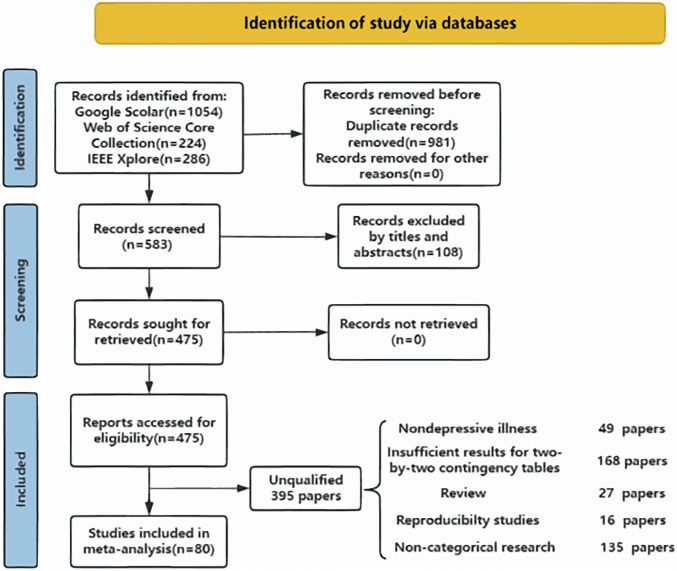
- The search identified 1,564 records; after removing 981 duplicates and excluding 108 by title/abstract and 397 at full text, 80 studies were included in the qualitative synthesis and meta-analysis.
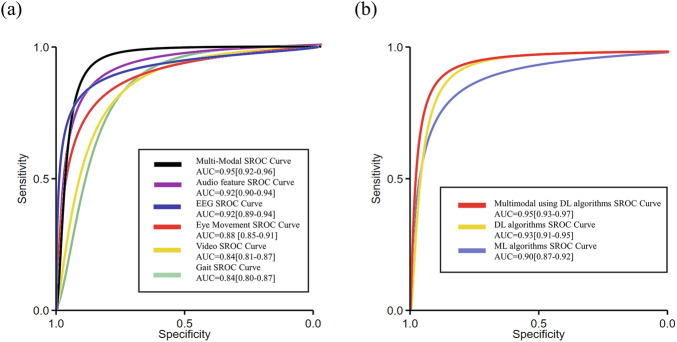
- For all multi-modal depression screening studies, the pooled performance was sensitivity 0.88, specificity 0.90, and AUC 0.95 (95% CI: 0.92–0.96); selecting the highest-performing contingency tables gave sensitivity 0.89, specificity 0.91, and AUC 0.96 (95% CI: 0.94–0.97).
- Uni-modal pooled AUCs were lower: EEG 0.92, eye movement 0.88, video 0.86, audio 0.92, and gait 0.84; the corresponding highest-performing contingency tables ranged up to AUC 0.95 for audio and 0.94 for EEG.
- Deep learning showed higher performance than traditional machine learning in subgroup analysis, with an AUC of 0.95 (95% CI: 0.93–0.97); the abstract states multi-modal methods outperformed uni-modal methods, which had pooled AUCs of 0.84–0.92.
## Methods
- Systematic review and meta-analysis conducted according to PRISMA and registered in PROSPERO (CRD420251049107).
- Searches were run in Google Scholar, Web of Science Core Collection, and IEEE Xplore up to June 7, 2025; only English-language technical studies on AI/ML/DL-based depression classification with extractable classification outcomes were included.
- The authors extracted or derived 2 × 2 contingency tables from reported accuracy/sensitivity/specificity/recall/precision/confusion matrices, then used random-effects meta-analysis, SROC curves, forest plots, and I² heterogeneity statistics.
## Limitations
- The paper states several limitations: only English-language articles were included; many pooled estimates were based on a limited number of studies and small samples; subgroup analyses still had heterogeneity; few studies examined cross-ethnic or cross-age generalizability; studies reporting only continuous metrics or only F1 scores without TP/TN/FP/FN were excluded.
- Evident from the text: all included studies used retrospective data, and nearly half of the studies (n = 38) had high or unclear risk of bias in patient selection, which may limit confidence in the pooled estimates.
- Evident from the text: most public and private datasets had no more than 280 subjects (range 24–275), which likely constrains model robustness and generalizability.
Model-written summary. Check it against the paper before relying on it.
Integrity signals
Registry
Cites
Statistics
Figures
Verification
Claims the paper makes
4 Valid · 1 Not valid · 5 Not checked · 39 Own results and interpretations
A result the paper reports from its own data — it cites no other source for it, so there is none to check. The quote shows it is in the paper.
In the paper
“However, moderate to high heterogeneity was observed across studies based on video, audio, and gait.”
§ AI-assisted multi-modal information for the screening of depression: a systematic review and meta-analysis > Results > Heterogeneity analysis
plain- Asserted: passes — The authors put it forward as true.
- Checkable: passes — It can be checked against evidence.
- Load-bearing: unclear — It is unclear whether the paper’s conclusions depend on it.
- Based: passes — The paper gives a reason why it holds.
A result the paper reports from its own data — it cites no other source for it, so there is none to check. The quote shows it is in the paper.
In the paper
“Notably, AI-assisted multiple modalities can classify patients with and without depression in up to 96% of cases (Table 2).”
§ AI-assisted multi-modal information for the screening of depression: a systematic review and meta-analysis > Discussion
plainstates a cause- Asserted: passes — The authors put it forward as true.
- Checkable: passes — It can be checked against evidence.
- Load-bearing: passes — The paper’s conclusions depend on it.
- Based: passes — The paper gives a reason why it holds.
A result the paper states — it cites no source for it, so there is none to check. The quote shows it is in the paper.
In the paper
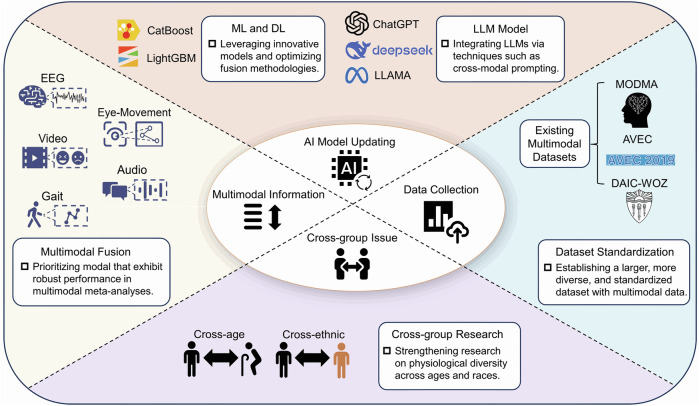
“For instance, due to the significant differences in data formats between input modalities, 89% of the multi-modal DL investigations included employ a late fusion strategy (n = 9).”
§ AI-assisted multi-modal information for the screening of depression: a systematic review and meta-analysis > Discussion
plainn = 9- Asserted: passes — The authors put it forward as true.
- Checkable: passes — It can be checked against evidence.
- Load-bearing: unclear — It is unclear whether the paper’s conclusions depend on it.
- Based: passes — The paper gives a reason why it holds.
A result the paper reports from its own data — it cites no other source for it, so there is none to check. The quote shows it is in the paper.
In the paper
“Using EEG technology, low to moderate heterogeneity was observed when distinguishing depression from NC, with an I2 of 32.64% (95% CI: 14.76–50.51) for SE and an I2 of 56.14% (95% CI: 45.67–66.61) for SP.”
§ AI-assisted multi-modal information for the screening of depression: a systematic review and meta-analysis > Results > Heterogeneity analysis
plain- Asserted: passes — The authors put it forward as true.
- Checkable: passes — It can be checked against evidence.
- Load-bearing: unclear — It is unclear whether the paper’s conclusions depend on it.
- Based: passes — The paper gives a reason why it holds.
A result the paper reports from its own data — it cites no other source for it, so there is none to check. The quote shows it is in the paper.
In the paper
“A total of 24 contingency tables from six studies on eye movement depression screening, all utilizing the ML algorithm. The pooled estimates for this group were 0.77 SE (95% CI: 0.72–0.81), 0.86 SP (95% CI: 0.83–0.89), and an AUC of 0.88 (95% CI: 0.85–0.91) (Fig. 3).”
§ AI-assisted multi-modal information for the screening of depression: a systematic review and meta-analysis > Results > Pooled performance of AI algorithms for classifying Depression from NC
plain- Asserted: passes — The authors put it forward as true.
- Checkable: passes — It can be checked against evidence.
- Load-bearing: passes — The paper’s conclusions depend on it.
- Based: passes — The paper gives a reason why it holds.
21 more claims
Create a free account to see all 49 claims and to verify the 2 references still open.
- Probably not a substantial claim. 13
- It may state two separate claims as one. 14
Citations
Cites
Vaswani, A., Shazeer, N., Parmar, N., Uszkoreit, J., Jones, L., Gomez, A. N., Kaiser, L., & Polosukhin, I. (2017) · arXiv · doi:10.48550/arxiv.1706.03762 · Cited by 120,404
The PRISMA 2020 statement: An updated guideline for reporting systematic reviews
Page, M. J., McKenzie, J. E., Bossuyt, P. M., Boutron, I., Hoffmann, T. C., Mulrow, C. D., Shamseer, L., Tetzlaff, J. M., Akl, E. A., Brennan, S. E., et al. (2021) · BMJ · doi:10.1136/bmj.n71 · Cited by 108,283
XGBoost: A Scalable Tree Boosting System
Chen, T., & Guestrin, C. (2016) · Proceedings of the 22nd ACM SIGKDD International Conference on Knowledge Discovery and Data Mining · doi:10.1145/2939672.2939785 · Cited by 54,569
Vos, T., Lim, S. S., Abbafati, C., Abbas, K. M., Abbasi, M., Abbasifard, M., Abbasi-Kangevari, M., Abbastabar, H., Abd-Allah, F., Abdelalim, A., et al. (2020) · The Lancet · doi:10.1016/s0140-6736(20)30925-9 · Cited by 19,358 · cited 1×
“Depression is a leading global mental health disorder and a major contributor to the worldwide burden of disability 1 .”
A survey on deep learning in medical image analysis
Litjens, G., Kooi, T., Bejnordi, B. E., Setio, A. A. A., Ciompi, F., Ghafoorian, M., van der Laak, J. A. W. M., van Ginneken, B., & Sánchez, C. I. (2017) · Medical Image Analysis · doi:10.1016/j.media.2017.07.005 · Cited by 15,332
QUADAS-2: a revised tool for the quality assessment of diagnostic accuracy studies
Whiting, P. F., Rutjes, A. W. S., Westwood, M. E., Mallett, S., Deeks, J. J., Reitsma, J. B., Leeflang, M. M. G., Sterne, J. A. C., Bossuyt, P. M. M., & the QUADAS-2 Group* (2011) · Annals of Internal Medicine · doi:10.7326/0003-4819-155-8-201110180-00009 · Cited by 14,199 · cited 1×
“TheriskofbiasandapplicabilityofallselectedstudieswereassessedbyusingtheQUADAS-2criteria 137 .”
Control of goal-directed and stimulus-driven attention in the brain
Corbetta, M., & Shulman, G. L. (2002) · Nature Reviews Neuroscience · doi:10.1038/nrn755 · Cited by 12,881
LightGBM: A Highly Efficient Gradient Boosting Decision Tree
(2017) · HAL · Cited by 10,512
Multimodal Machine Learning: A Survey and Taxonomy
Baltrusaitis, T., Ahuja, C., & Morency, L.-P. (2019) · IEEE Transactions on Pattern Analysis and Machine Intelligence · doi:10.1109/tpami.2018.2798607 · Cited by 5,018 · cited 1×
“However, each of these public datasets, as well as the private datasets used in included studies, contains no more than 280 subjects (with sample sizes ranging from 24 to 275), which hampers the ability to identify clinical biomarkers universally and reliably, especially with DL approaches 132,133 .”
Subgenual prefrontal cortex abnormalities in mood disorders
Drevets, W. C., Price, J. L., Simpson, J. R., Todd, R. D., Reich, T., Vannier, M., & Raichle, M. E. (1997) · Nature · doi:10.1038/386824a0 · Cited by 2,693
Mayberg, H. S., Liotti, M., Brannan, S. K., McGinnis, S., Mahurin, R. K., Jerabek, P. A., Silva, J. A., Tekell, J. L., Martin, C. C., Lancaster, J. L., et al. (1999) · American Journal of Psychiatry · doi:10.1176/ajp.156.5.675 · Cited by 2,416 · cited 1×
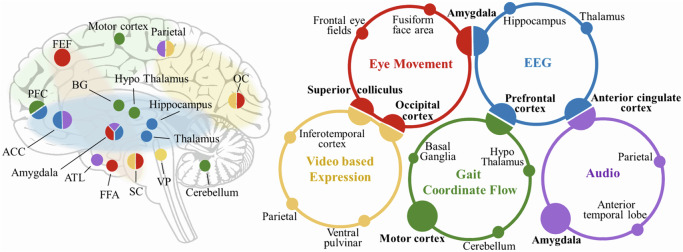
“Based on EEG facial recognition task or attention task, researchers detected abnormal brain activation in emotional networks in depression patients, including the dorsolateral prefrontal cortex (DLPFC), anterior cingulate cortex (ACC), orbitofrontal cortex (OFC), and amygdala 8 – 11 .”
A review on time series data mining
Fu, T.-C. (2011) · Engineering Applications of Artificial Intelligence · doi:10.1016/j.engappai.2010.09.007 · Cited by 1,500 · cited 1×
“In addition to the model framework, proper standardization and preprocessing of data are also important to remove noise and format dif-ferencesbetweendatasetsandmodalities 120,121 .”
Rajkowska, G., Miguel-Hidalgo, J. J., Wei, J., Dilley, G., Pittman, S. D., Meltzer, H. Y., Overholser, J. C., Roth, B. L., & Stockmeier, C. A. (1999) · Biological Psychiatry · doi:10.1016/s0006-3223(99)00041-4 · Cited by 1,477
Multimodal Data Fusion: An Overview of Methods, Challenges, and Prospects
Lahat, D., Adali, T., & Jutten, C. (2015) · Proceedings of the IEEE · doi:10.1109/jproc.2015.2460697 · Cited by 1,296 · cited 1×
“Whilelatefusionrequireslessdataandallowsfor easierintegrationofmultiplesensingstrategiesandalgorithms,itmaynot fullyleveragethecomplementarystrengthsofdifferentmodalities 115 .”
Clinical diagnosis of depression in primary care: a meta-analysis
Mitchell, A. J., Vaze, A., & Rao, S. (2009) · The Lancet · doi:10.1016/s0140-6736(09)60879-5 · Cited by 1,251 · cited 1×
“The potential pathogenesis of depression remains unclear, and reliable screening in clinical practice is challenging, as current assessments rely primarily on patient history and self-reports 2 .”
Multimodal deep learning for biomedical data fusion: a review
Stahlschmidt, S. R., Ulfenborg, B., & Synnergren, J. (2022) · Briefings in Bioinformatics · doi:10.1093/bib/bbab569 · Cited by 766
Psychomotor symptoms of depression
(1997) · American Journal of Psychiatry · doi:10.1176/ajp.154.1.4 · Cited by 662 · cited 1×
“However, due to the multifaceted nature of the symptoms of depression, a uni-modal physiological or behavioral information may not be suf fi cient to capture enough of them for effective screening 19 .”
Automated EEG-based screening of depression using deep convolutional neural network
Acharya, U. R., Oh, S. L., Hagiwara, Y., Tan, J. H., Adeli, H., & Subha, D. P. (2018) · Computer Methods and Programs in Biomedicine · doi:10.1016/j.cmpb.2018.04.012 · Cited by 650
Depression, anxiety, and resting frontal EEG asymmetry: A meta-analytic review.
Thibodeau, R., Jorgensen, R. S., & Kim, S. (2006) · Journal of Abnormal Psychology · doi:10.1037/0021-843x.115.4.715 · Cited by 620 · cited 1×
“This suggests that patients with depression may exhibit abnormally increased right frontal activity at rest, providing important insights for futureresearchinthisarea 109 .”
Power analysis for random-effects meta-analysis
Jackson, D., & Turner, R. (2017) · Research Synthesis Methods · doi:10.1002/jrsm.1240 · Cited by 619
Pathophysiology of depression: do we have any solid evidence of interest to clinicians?
HASLER, G. (2010) · World Psychiatry · doi:10.1002/j.2051-5545.2010.tb00298.x · Cited by 604 · cited 1×
“Depressionisaclinicallyandetiologicallyheterogeneousdisorder 7 ,and this heterogeneity is re fl ected in the variability of objectively measurable biological markers detected through physiological and behavioral assessments.”
AVEC 2013: the continuous audio/visual emotion and depression recognition challenge
Valstar, M., Schuller, B., Smith, K., Eyben, F., Jiang, B., Bilakhia, S., Schnieder, S., Cowie, R., & Pantic, M. (2013) · Proceedings of the 3rd ACM international workshop on Audio/visual emotion challenge · doi:10.1145/2512530.2512533 · Cited by 581
Multimodal machine learning in precision health: A scoping review
Kline, A., Wang, H., Li, Y., Dennis, S., Hutch, M., Xu, Z., Wang, F., Cheng, F., & Luo, Y. (2022) · npj Digital Medicine · doi:10.1038/s41746-022-00712-8 · Cited by 528 · cited 1×
“Multi-modal AI-assisted screening methods have already achieved signi fi cant breakthroughs in other areas of medicine 23,24 , which suggests promising potential for mental health applications as well.”
AVEC 2016: Depression, Mood, and Emotion Recognition Workshop and Challenge
Valstar, M., Gratch, J., Schuller, B., Ringeval, F., Lalanne, D., Torres Torres, M., Scherer, S., Stratou, G., Cowie, R., & Pantic, M. (2016) · Proceedings of the 6th International Workshop on Audio/Visual Emotion Challenge · doi:10.1145/2988257.2988258 · Cited by 503
Detecting depression from facial actions and vocal prosody
Cohn, J. F., Kruez, T. S., Matthews, I., Yang, Y., Nguyen, M. H., Padilla, M. T., Zhou, F., & De la Torre, F. (2009) · 2009 3rd International Conference on Affective Computing and Intelligent Interaction and Workshops · doi:10.1109/acii.2009.5349358 · Cited by 494
AVEC 2014: 3D Dimensional Affect and Depression Recognition Challenge
Valstar, M., Schuller, B., Smith, K., Almaev, T., Eyben, F., Krajewski, J., Cowie, R., & Pantic, M. (2014) · Proceedings of the 4th International Workshop on Audio/Visual Emotion Challenge · doi:10.1145/2661806.2661807 · Cited by 472
Depression biomarkers using non-invasive EEG: A review
de Aguiar Neto, F. S., & Rosa, J. L. G. (2019) · Neuroscience & Biobehavioral Reviews · doi:10.1016/j.neubiorev.2019.07.021 · Cited by 451 · cited 1×
“Recently, with advances in medical technology, cost-effective, non-invasive,andeasytocollecttechniques — suchasEEG,eyemovement,video or audio monitoring, and gait analysis — have been increasingly implemented in depression screening 3 – 6 .”
If it's not left, it's right: Electroencephalograph asymmetry and the development of emotion.
Fox, N. A. (1991) · American Psychologist · doi:10.1037/0003-066x.46.8.863 · Cited by 438 · cited 2×
“Several EEG studies have identi fi ed a link between hemispheric asymmetry in the cortical frontal regions and depressive symptoms 108 .”
Ringeval, F., Schuller, B., Valstar, M., Cummins, N., Cowie, R., Tavabi, L., Schmitt, M., Alisamir, S., Amiriparian, S., Messner, E.-M., et al. (2019) · Proceedings of the 9th International on Audio/Visual Emotion Challenge and Workshop · doi:10.1145/3347320.3357688 · Cited by 409 · cited 1×
“…EEG data) 122 ; the AVEC 2011 – 2021 datasets (e.g., DAIC-WOZ and E-DAIC, featuring video, audio, and text modalitiesmainlyinEnglish) 123 – 130 ;theMODMAdataset(offeringEEGand audio modalities in Chinese) 131 ; the BlackDog database (providing video and audio modalities in English); the…”
Is social network site usage related to depression? A meta-analysis of Facebook–depression relations
Yoon, S., Kleinman, M., Mertz, J., & Brannick, M. (2019) · Journal of Affective Disorders · doi:10.1016/j.jad.2019.01.026 · Cited by 355 · cited 1×
“Although prior meta-analyses has explored digital signals from wearable devices(such as physical activity data, location data, etc.) 21 and social media platforms (including tweets and communication logs) 25,26 as potential indicators of depression.”
Detecting Depression with Audio/Text Sequence Modeling of Interviews
Al Hanai, T., Ghassemi, M., & Glass, J. (2018) · Interspeech 2018 · doi:10.21437/interspeech.2018-2522 · Cited by 343
AVEC 2017: Real-life Depression, and Affect Recognition Workshop and Challenge
Ringeval, F., Schuller, B., Valstar, M., Gratch, J., Cowie, R., Scherer, S., Mozgai, S., Cummins, N., Schmitt, M., & Pantic, M. (2017) · Proceedings of the 7th Annual Workshop on Audio/Visual Emotion Challenge · doi:10.1145/3133944.3133953 · Cited by 332
Social media and depression symptoms: a meta-analysis
Cunningham, S., Hudson, C. C., & Harkness, K. (2021) · Research on Child and Adolescent Psychopathology · doi:10.1007/s10802-020-00715-7 · Cited by 308 · cited 1×
“Although prior meta-analyses has explored digital signals from wearable devices(such as physical activity data, location data, etc.) 21 and social media platforms (including tweets and communication logs) 25,26 as potential indicators of depression.”
A multi-modal open dataset for mental-disorder analysis
Cai, H., Yuan, Z., Gao, Y., Sun, S., Li, N., Tian, F., Xiao, H., Li, J., Yang, Z., Li, X., et al. (2022) · Scientific Data · doi:10.1038/s41597-022-01211-x · Cited by 293 · cited 2×
“Among the studies included in this meta-analysis (the dataset used in each studyislistedinSupplementaryTable1),sixpublicdatasetsarehighlighted: thePRED + CT dataset (providing EEG data) 122 ; the AVEC 2011 – 2021 datasets (e.g., DAIC-WOZ and E-DAIC, featuring video, audio, and text modalitiesmainlyinEnglish) 123 – 130…”
Somatosensory-Motor Dysconnectivity Spans Multiple Transdiagnostic Dimensions of PsychopathologyPreprint
Kebets, V., Holmes, A., Orbán, C., Tang, S.-Y., Li, J.-W., Sun, N.-B., Kong, R., Poldrack, R., & Yeo, B. T. T. (2019) · bioRxiv · doi:10.1101/637827 · Cited by 290 · cited 1×
“Furthermore, there is a bidirectional interaction between sensorimotor system and brain networks related to emotions and higher cognitive function 16,17 .”
Somatosensory-Motor Dysconnectivity Spans Multiple Transdiagnostic Dimensions of Psychopathology
Kebets, V., Holmes, A. J., Orban, C., Tang, S., Li, J., Sun, N., Kong, R., Poldrack, R. A., & Yeo, B. T. T. (2019) · Biological Psychiatry · doi:10.1016/j.biopsych.2019.06.013 · Cited by 283
Multiple Kernel Learning for Visual Object Recognition: A Review
(2014) · IEEE Transactions on Pattern Analysis and Machine Intelligence · doi:10.1109/tpami.2013.212 · Cited by 274 · cited 1×
“Multi-kernel learning allows the integration of multiple kernels 113 , each tailored to a speci fi c modality, to better synthesize heterogeneous data 114 .”
AVEC 2011–The First International Audio/Visual Emotion Challenge
Schuller, B., Valstar, M., Eyben, F., McKeown, G., Cowie, R., & Pantic, M. (2011) · Lecture Notes in Computer Science · doi:10.1007/978-3-642-24571-8_53 · Cited by 271 · cited 1×
“…(providing EEG data) 122 ; the AVEC 2011 – 2021 datasets (e.g., DAIC-WOZ and E-DAIC, featuring video, audio, and text modalitiesmainlyinEnglish) 123 – 130 ;theMODMAdataset(offeringEEGand audio modalities in Chinese) 131 ; the BlackDog database (providing video and audio modalities in English);…”
DeprNet: A Deep Convolution Neural Network Framework for Detecting Depression Using EEG
Seal, A., Bajpai, R., Agnihotri, J., Yazidi, A., Herrera-Viedma, E., & Krejcar, O. (2021) · IEEE Transactions on Instrumentation and Measurement · doi:10.1109/tim.2021.3053999 · Cited by 265
Nonverbal social withdrawal in depression: Evidence from manual and automatic analyses
Girard, J. M., Cohn, J. F., Mahoor, M. H., Mavadati, S. M., Hammal, Z., & Rosenwald, D. P. (2014) · Image and Vision Computing · doi:10.1016/j.imavis.2013.12.007 · Cited by 255 · cited 1×
“Additionally, depression patients exhibit slow audio rates and increased negative facial expressions 15 .”
Deep learning for depression recognition with audiovisual cues: A review
He, L., Niu, M., Tiwari, P., Marttinen, P., Su, R., Jiang, J., Guo, C., Wang, H., Ding, S., Wang, Z., et al. (2022) · Information Fusion · doi:10.1016/j.inffus.2021.10.012 · Cited by 253 · cited 2×
“Although numerous studies have employed various AI algorithms 20 – 22 , comprehensive meta-analyses using multiple modalitiesfor depression screening within digital healthcare is still insuf fi cient.”
Self-citationPsychomotor symptoms in depression: A diagnostic, pathophysiological and therapeutic tool
Schrijvers, D., Hulstijn, W., & Sabbe, B. G. C. (2008) · Journal of Affective Disorders · doi:10.1016/j.jad.2007.10.019 · Cited by 236
AVEC 2012: the continuous audio/visual emotion challenge
Schuller, B., Valster, M., Eyben, F., Cowie, R., & Pantic, M. (2012) · Proceedings of the 14th ACM international conference on Multimodal interaction · doi:10.1145/2388676.2388776 · Cited by 226
EEG-based mild depressive detection using feature selection methods and classifiers
Li, X., Hu, B., Sun, S., & Cai, H. (2016) · Computer Methods and Programs in Biomedicine · doi:10.1016/j.cmpb.2016.08.010 · Cited by 189
Audio based depression detection using Convolutional Autoencoder
Sardari, S., Nakisa, B., Rastgoo, M. N., & Eklund, P. (2021) · Expert Systems with Applications · doi:10.1016/j.eswa.2021.116076 · Cited by 188
Automatic Depression Detection: an Emotional Audio-Textual Corpus and A Gru/Bilstm-Based Model
Shen, Y., Yang, H., & Lin, L. (2022) · ICASSP 2022 - 2022 IEEE International Conference on Acoustics, Speech and Signal Processing (ICASSP) · doi:10.1109/icassp43922.2022.9746569 · Cited by 185 · cited 2×
“Among the studies included in this meta-analysis (the dataset used in each studyislistedinSupplementaryTable1),sixpublicdatasetsarehighlighted: thePRED + CT dataset (providing EEG data) 122 ; the AVEC 2011 – 2021 datasets (e.g., DAIC-WOZ and E-DAIC, featuring video, audio, and text modalitiesmainlyinEnglish) 123 – 130…”
Multimodal assistive technologies for depression diagnosis and monitoring
Joshi, J., Goecke, R., Alghowinem, S., Dhall, A., Wagner, M., Epps, J., Parker, G., & Breakspear, M. (2013) · Journal on Multimodal User Interfaces · doi:10.1007/s12193-013-0123-2 · Cited by 179
Depression recognition using machine learning methods with different feature generation strategies
Li, X., Zhang, X., Zhu, J., Mao, W., Sun, S., Wang, Z., Xia, C., & Hu, B. (2019) · Artificial Intelligence in Medicine · doi:10.1016/j.artmed.2019.07.004 · Cited by 175
An Improved Empirical Mode Decomposition of Electroencephalogram Signals for Depression Detection
Shen, J. G., Zhang, X., Wang, G., Ding, Z., & Hu, B. (2019) · IEEE Transactions on Affective Computing · doi:10.1109/taffc.2019.2934412 · Cited by 173
Automatic Detection of Depression in Speech Using Ensemble Convolutional Neural Networks
Vázquez-Romero, A., & Gallardo-Antolín, A. (2020) · Entropy · doi:10.3390/e22060688 · Cited by 157
Zou, B., Han, J., Wang, Y., Liu, R., Zhao, S., Feng, L., Lyu, X., & Ma, H. (2022) · IEEE Transactions on Affective Computing · doi:10.1109/taffc.2022.3181210 · Cited by 153
AVEC 2018 Workshop and Challenge: Bipolar Disorder and Cross-Cultural Affect Recognition
Ringeval, F., Schuller, B., Valstar, M., Cowie, R., Kaya, H., Schmitt, M., Amiriparian, S., Cummins, N., Lalanne, D., Michaud, A., et al. (2018) · Proceedings of the 2018 on Audio/Visual Emotion Challenge and Workshop · doi:10.1145/3266302.3266316 · Cited by 148
Click Here to Consent Forever: Expiry Dates for Informed Consent
Custers, B. H. M. (2016) · Big Data & Society · doi:10.1177/2053951715624935 · Cited by 145 · cited 1×
“Continuousethical oversightisessentialto safeguardindividuals ’ rightsand promote the responsible application of these technologies 134 .”
Abd-Alrazaq, A., AlSaad, R., Shuweihdi, F., Ahmed, A., Aziz, S., & Sheikh, J. (2023) · npj Digital Medicine · doi:10.1038/s41746-023-00828-5 · Cited by 138 · cited 2×
“Although prior meta-analyses has explored digital signals from wearable devices(such as physical activity data, location data, etc.) 21 and social media platforms (including tweets and communication logs) 25,26 as potential indicators of depression.”
Lazarov, A., Ben‐Zion, Z., Shamai‐Leshem, D., Pine, D. S., & Bar‐Haim, Y. (2018) · Journal of Affective Disorders · doi:10.1016/j.jad.2018.05.047 · Cited by 136 · cited 1×
“In addition, researches of eye movement tracking reveal that depression patients tend to focus more on negative stimuli while ignoring positive interactionswhenviewingemotionalimages 12 – 14 .”
Han, S., Li, X., Wei, S., Zhao, D., Ding, J., Xu, Y., Yu, C., Chen, Z., Zhou, D., & Yuan, T. (2023) · Cell Reports Medicine · doi:10.1016/j.xcrm.2023.101060 · Cited by 131 · cited 1×
“Based on EEG facial recognition task or attention task, researchers detected abnormal brain activation in emotional networks in depression patients, including the dorsolateral prefrontal cortex (DLPFC), anterior cingulate cortex (ACC), orbitofrontal cortex (OFC), and amygdala 8 – 11 .”
Towards Automatic Depression Detection: A BiLSTM/1D CNN-Based Model
Lin, L., Chen, X., Shen, Y., & Zhang, L. (2020) · Applied Sciences · doi:10.3390/app10238701 · Cited by 126
Automatically detecting pain using facial actions
Lucey, P., Cohn, J., Lucey, S., Matthews, I., Sridharan, S., & Prkachin, K. M. (2009) · 2009 3rd International Conference on Affective Computing and Intelligent Interaction and Workshops · doi:10.1109/acii.2009.5349321 · Cited by 125
Integrating Deep and Shallow Models for Multi-Modal Depression Analysis—Hybrid Architectures
Yang, L., Jiang, D., & Sahli, H. (2021) · IEEE Transactions on Affective Computing · doi:10.1109/taffc.2018.2870398 · Cited by 118
Chen, J., Hu, Y., Lai, Q., Wang, W. W., Chen, J., Liu, H., Srivastava, G., Bashir, A. K., & Hu, X. (2023) · Information Fusion · doi:10.1016/j.inffus.2023.102017 · Cited by 116
Chen, T., Guo, Y., Hao, S., & Hong, R. (2022) · IEEE Transactions on Affective Computing · doi:10.1109/taffc.2022.3210958 · Cited by 115
Muzammel, M., Salam, H., & Othmani, A. (2021) · Computer Methods and Programs in Biomedicine · doi:10.1016/j.cmpb.2021.106433 · Cited by 114
Detection of Depression and Scaling of Severity Using Six Channel EEG Data
Mahato, S., Goyal, N., Ram, D., & Paul, S. (2020) · Journal of Medical Systems · doi:10.1007/s10916-020-01573-y · Cited by 113
Data mining EEG signals in depression for their diagnostic value
Mohammadi, M., Al-Azab, F., Raahemi, B., Richards, G., Jaworska, N., Smith, D., de la Salle, S., Blier, P., & Knott, V. (2015) · BMC Medical Informatics and Decision Making · doi:10.1186/s12911-015-0227-6 · Cited by 111
From Emotions to Mood Disorders: A Survey on Gait Analysis Methodology
Deligianni, F., Guo, Y., & Yang, G. (2019) · IEEE Journal of Biomedical and Health Informatics · doi:10.1109/jbhi.2019.2938111 · Cited by 109 · cited 1×
“Furthermore, there is a bidirectional interaction between sensorimotor system and brain networks related to emotions and higher cognitive function 16,17 .”
Evaluating multimodal AI in medical diagnostics
Kaczmarczyk, R., Wilhelm, T. I., Martin, R., & Roos, J. (2024) · npj Digital Medicine · doi:10.1038/s41746-024-01208-3 · Cited by 107 · cited 1×
“Multi-modal AI-assisted screening methods have already achieved signi fi cant breakthroughs in other areas of medicine 23,24 , which suggests promising potential for mental health applications as well.”
MS²-GNN: Exploring GNN-Based Multimodal Fusion Network for Depression Detection
Chen, T., Hong, R., Guo, Y., Hao, S., & Hu, B. (2023) · IEEE Transactions on Cybernetics · doi:10.1109/tcyb.2022.3197127 · Cited by 106
Taşçı, G., Loh, H. W., Barua, P. D., Bayğın, M., Taşçı, B., Doğan, Ş., Tuncer, T., Palmer, E. E., Tan, R., & Acharya, U. R. (2022) · Knowledge-Based Systems · doi:10.1016/j.knosys.2022.110190 · Cited by 105
AVEC 2016 - Depression, Mood, and Emotion Recognition Workshop and Challenge
Valstar, M., Gratch, J. S., Schuller, B. W., Ringeval, F., Lalanne, D., Torres, M. T., Scherer, S. J., Stratou, G., Cowie, R., & Pantić, M. (2016) · arXiv (Cornell University) · doi:10.48550/arxiv.1605.01600 · Cited by 104
AudiBERT: A Deep Transfer Learning Multimodal Classification Framework for Depression Screening
Toto, E., Tlachac, M., & Rundensteiner, E. A. (2021) · ACM International Conference on Information and Knowledge Management (CIKM) · doi:10.1145/3459637.3481895 · Cited by 104
Rafiei, A., Zahedifar, R., Sitaula, C., & Marzbanrad, F. (2022) · IEEE Access · doi:10.1109/access.2022.3190502 · Cited by 103
Changing Anesthesia Block Allocations Improves Endoscopy Suite Efficiency
Tsai, M. H., Hall, M. A., Cardinal, M. S., Breidenstein, M. W., Abajian, M. J., & Zubarik, R. S. (2019) · Journal of Medical Systems · doi:10.1007/s10916-019-1451-x · Cited by 102
The Patient Repository for EEG Data + Computational Tools (PRED+CT)
Cavanagh, J. F., Napolitano, A., Wu, C. L., & Mueen, A. (2017) · Frontiers in Neuroinformatics · doi:10.3389/fninf.2017.00067 · Cited by 101 · cited 1×
“…(the dataset used in each studyislistedinSupplementaryTable1),sixpublicdatasetsarehighlighted: thePRED + CT dataset (providing EEG data) 122 ; the AVEC 2011 – 2021 datasets (e.g., DAIC-WOZ and E-DAIC, featuring video, audio, and text modalitiesmainlyinEnglish) 123 – 130…”
Morphometric evidence for neuronal and glial prefrontal cell pathology in major depression
Dilley, G. E., Rajkowska, G., Overholser, J. C., Meltzer, H. Y., Miguel-Hidalgo, J. J., Stockmeier, C. A., Wei, J., Roth, B. L., & Pittman, S. D. (2019) · Carolina Digital Repository (University of North Carolina at Chapel Hill) · doi:10.17615/ey62-1r56 · Cited by 101
Proceedings IEEE International Conference on Image Processing (ICIP)
Antoszczyszyn, P. M., Hannah, J. M., & Grant, P. M. (1996) · Cited by 99
Zhang, X., Shen, J. G., Din, Z. U., Liu, J., Wang, G., & Hu, B. (2019) · IEEE Journal of Biomedical and Health Informatics · doi:10.1109/jbhi.2019.2938247 · Cited by 98
Machine Learning Approaches for MDD Detection and Emotion Decoding Using EEG Signals
Duan, L., Duan, H., Qiao, Y., Sha, S., Qi, S., Zhang, X., Huang, J., Huang, X., & Wang, C. (2020) · Frontiers in Human Neuroscience · doi:10.3389/fnhum.2020.00284 · Cited by 98
Self-citationLSDD-EEGNet: An efficient end-to-end framework for EEG-based depression detection
Song, X., Yan, D., Zhao, L., & Yang, L. (2022) · Biomedical Signal Processing and Control · doi:10.1016/j.bspc.2022.103612 · Cited by 98
Attention guided learnable time-domain filterbanks for speech depression detection
Yang, W., Liu, J., Cao, P., Zhu, R., Wang, Y., Liu, J. K., Wang, F., & Zhang, X. (2023) · Neural Networks · doi:10.1016/j.neunet.2023.05.041 · Cited by 82
Investigation of Speech Landmark Patterns for Depression Detection
Huang, Z., Epps, J., & Joachim, D. (2019) · IEEE Transactions on Affective Computing · doi:10.1109/taffc.2019.2944380 · Cited by 76
Esterman, M. S., Liu, G., Okabe, H., Reagan, A., Thai, M., & DeGutis, J. (2015) · NeuroImage · doi:10.1016/j.neuroimage.2015.01.044 · Cited by 75
Tian, F., Zhu, L., Shi, Q., Wang, R., Zhang, L., Dong, Q., Qian, K., Zhao, Q., & Hu, B. (2023) · IEEE Transactions on Biomedical Circuits and Systems · doi:10.1109/tbcas.2023.3292237 · Cited by 74
Facial expression video analysis for depression detection in Chinese patients
Wang, Q., Yang, H., & Yu, Y. (2018) · Journal of Visual Communication and Image Representation · doi:10.1016/j.jvcir.2018.11.003 · Cited by 71
Wang, Y., Wang, J., Liu, X., & Zhu, T. (2021) · Frontiers in Psychiatry · doi:10.3389/fpsyt.2021.661213 · Cited by 71
Huang, Z., Epps, J., Joachim, D., & Sethu, V. (2019) · IEEE Journal of Selected Topics in Signal Processing · doi:10.1109/jstsp.2019.2949419 · Cited by 70
Qayyum, A., Razzak, I., Tanveer, M., Mazher, M., & Alhaqbani, B. (2023) · IEEE Transactions on Computational Biology and Bioinformatics · doi:10.1109/tcbb.2023.3257175 · Cited by 67
A Gait Assessment Framework for Depression Detection Using Kinect Sensors
Wang, T., Li, C., Wu, C., Zhao, C., Sun, J., Peng, H., Hu, X., & Hu, B. (2020) · IEEE Sensors Journal · doi:10.1109/jsen.2020.3022374 · Cited by 64
Self-citationA Multi-Modal Gait Analysis-Based Detection System of the Risk of Depression
Shao, W., You, Z., Liang, L., Hu, X., Li, C., Wang, W. W., & Hu, B. (2021) · IEEE Journal of Biomedical and Health Informatics · doi:10.1109/jbhi.2021.3122299 · Cited by 63
Self-citationPrediction of depression symptoms in individual subjects with face and eye movement tracking
Stolicyn, A., Steele, J. D., & Seriès, P. (2020) · Psychological Medicine · doi:10.1017/s0033291720003608 · Cited by 62
A novel study for depression detecting using audio signals based on graph neural network
Sun, C., Jiang, M., Gao, L., Xin, Y., & Dong, Y. (2023) · Biomedical Signal Processing and Control · doi:10.1016/j.bspc.2023.105675 · Cited by 61
Crossmodal Representation Learning for Zero-shot Action Recognition
Lin, C.-C., Lin, K., Wang, L., Liu, Z., & Li, L. (2022) · IEEE Computer Society Conference on Computer Vision and Pattern Recognition/Proceedings - IEEE Computer Society Conference on Computer Vision and Pattern Recognition/Proceedings · doi:10.1109/cvpr52688.2022.01935 · Cited by 59
Self-citationSoni, S., Seal, A., Yazidi, A., & Krejcar, O. (2022) · Computers in Biology and Medicine · doi:10.1016/j.compbiomed.2022.105420 · Cited by 55
EDT: An EEG-based attention model for feature learning and depression recognition
Ying, M., Shao, X., Zhu, J., Zhao, Q., Li, X., & Hu, B. (2024) · Biomedical Signal Processing and Control · doi:10.1016/j.bspc.2024.106182 · Cited by 52
Dual-Stream Multiple Instance Learning for Depression Detection With Facial Expression Videos
Shangguan, Z., Liu, Z., Li, G., Chen, Q., Ding, Z., & Hu, B. (2022) · IEEE Transactions on Neural Systems and Rehabilitation Engineering · doi:10.1109/tnsre.2022.3204757 · Cited by 51
Proceedings of 2014 IEEE International Conference on Bioinformatics and Biomedicine (BIBM 2014)
Zheng, H., Hu, X. T., Callejas, Z., Schmidt, H. H. H. W., Griol, D., Baumbach, J., Haiying, Wang, H., Dickerson, J. A., & Zhang, L. (2014) · Cited by 49
An End-to-End Depression Recognition Method Based on EEGNet
Liu, B., Chang, H., Peng, K., & Wang, X. (2022) · Frontiers in Psychiatry · doi:10.3389/fpsyt.2022.864393 · Cited by 49
Yang, M., Ma, Y., Liu, Z., Cai, H., Hu, X., & Hu, B. (2021) · IEEE Wireless Communications · doi:10.1109/mwc.001.2000394 · Cited by 48
Othmani, A., Zeghina, A. O., & Muzammel, M. (2022) · Computer Methods and Programs in Biomedicine · doi:10.1016/j.cmpb.2022.107132 · Cited by 48
Zhang, D., Liu, X., Xu, L., Li, Y., Xu, Y., Xia, M., Qian, Z., Tang, Y., Liu, Z., Chen, T., et al. (2022) · Journal of Affective Disorders · doi:10.1016/j.jad.2022.03.077 · Cited by 47
Detecting depression based on facial cues elicited by emotional stimuli in video
Hu, B., Tao, Y., & Yang, M. (2023) · Computers in Biology and Medicine · doi:10.1016/j.compbiomed.2023.107457 · Cited by 46
Enhancing multimodal depression diagnosis through representation learning and knowledge transfer
Yang, S., Cui, L., Wang, L., Wang, T., & You, J. (2024) · Heliyon · doi:10.1016/j.heliyon.2024.e25959 · Cited by 46
Self-citationCombined cognitive, psychomotor and electrophysiological biomarkers in major depressive disorder
Koo, P. C., Berger, C., Kronenberg, G., Bartz, J., Wybitul, P., Reis, O., & Hoeppner, J. (2019) · European Archives of Psychiatry and Clinical Neuroscience · doi:10.1007/s00406-018-0952-9 · Cited by 45 · cited 1×
“The current research on left and right frontal lobe electrodes consistently shows that, during eye-open/eye-closed task 29,41,56 , the EEG collected by electrodes in the right frontal lobe contains more depression-related information than the electrodes in the left frontal lobe.”
Electroencephalogram (EEG) and Its Background
Siuly, S., Li, Y. H. M., & Zhang, Y. (2016) · Health information science · doi:10.1007/978-3-319-47653-7_1 · Cited by 44 · cited 2×
“Due to decades of rapid development, EEG and audio signals have becomeacrucialmethodforscreeningandtreatingmentaldisorders 107 .”
Cross-Subject Classification of Depression by Using Multiparadigm EEG Feature Fusion
Yang, J., Zhang, Z., Fu, Z., Li, B., Xiong, P., & Liu, X. (2022) · Computer Methods and Programs in Biomedicine · doi:10.1016/j.cmpb.2023.107360 · Cited by 44
Attention-based acoustic feature fusion network for depression detection
Xu, X. D., Wang, Y., Wei, X., Wang, F., & Zhang, X. (2024) · Neurocomputing · doi:10.1016/j.neucom.2024.128209 · Cited by 44
Interpreting Depression From Question-Wise Long-Term Video Recording of SDS Evaluation
Xie, W., Liang, L., Lu, Y., Wang, C., Shen, J., Luo, H., & Liu, X. (2021) · IEEE Journal of Biomedical and Health Informatics · doi:10.1109/jbhi.2021.3092628 · Cited by 43
Self-citationFeature-level fusion based on spatial-temporal of pervasive EEG for depression recognition
Zhang, B., Wei, D., Yan, G., Lei, T., Cai, H., & Yang, Z. (2022) · Computer Methods and Programs in Biomedicine · doi:10.1016/j.cmpb.2022.107113 · Cited by 43
Soni, S., Seal, A., Mohanty, S. K., & Sakurai, K. (2023) · Biomedical Signal Processing and Control · doi:10.1016/j.bspc.2023.104873 · Cited by 42
Speech Landmark Bigrams for Depression Detection from Naturalistic Smartphone Speech
Huang, Z., Epps, J., & Joachim, D. (2019) · IEEE International Conference on Acoustics Speech and Signal Processing · doi:10.1109/icassp.2019.8682916 · Cited by 41
Ahmed, S., Yousuf, M. A., Monowar, M. M., Hamid, M. A., & Alassafi, M. O. (2023) · IEEE Access · doi:10.1109/access.2023.3315243 · Cited by 40
Classification study on eye movement data: Towards a new approach in depression detection
Li, X., Cao, T., Sun, S., Hu, B., & Ratcliffe, M. (2016) · IEEE Congress on Evolutionary Computation (CEC) · doi:10.1109/cec.2016.7743927 · Cited by 38
Comparison of read and spontaneous speech in case of automatic detection of depression
Kiss, G., & Vicsi, K. (2017) · IEEE International Conference on Cognitive Infocommunications · doi:10.1109/coginfocom.2017.8268245 · Cited by 38
Robust language-based mental health assessments in time and space through social media
Mangalik, S., Eichstaedt, J. C., Giorgi, S., Mun, J., Ahmed, F., Gill, G., Ganesan, A. V., Subrahmanya, S., Soni, N., Clouston, S., et al. (2024) · npj Digital Medicine · doi:10.1038/s41746-024-01100-0 · Cited by 35
Depression Detection by Analysing Eye Movements on Emotional Images
Shen, R., Zhan, Q., Wang, Y., & Ma, H. (2021) · IEEE International Conference on Acoustics Speech and Signal Processing · doi:10.1109/icassp39728.2021.9414663 · Cited by 32
Simple action for depression detection: using kinect-recorded human kinematic skeletal data
Li, W., Wang, Q., Liu, X., & Yu, Y. (2021) · BMC Psychiatry · doi:10.1186/s12888-021-03184-4 · Cited by 31
Chen, X., Kong, Y., Chang, H., Gao, Y., Liu, Z., Coatrieux, J.-L., & Shu, H. (2024) · Biomedical Signal Processing and Control · doi:10.1016/j.bspc.2024.106051 · Cited by 30
Audio-based Depression Screening using Sliding Window Sub-clip Pooling
Toto, E., Tlachac, M., Stevens, F. L., & Rundensteiner, E. A. (2020) · International Conference on Machine Learning and Applications · doi:10.1109/icmla51294.2020.00129 · Cited by 29
Depression Detection Based on Reaction Time and Eye Movement
Pan, Z., Ma, H., Zhang, L., & Wang, Y. (2019) · Proceedings - International Conference on Image Processing · doi:10.1109/icip.2019.8803181 · Cited by 27
A novel computer-aided diagnosis framework for EEG-based identification of neural diseases
Sadiq, M. T., Akbari, H., Siuly, S., Yousaf, A., & Rehman, A. U. (2021) · Computers in Biology and Medicine · doi:10.1016/j.compbiomed.2021.104922 · Cited by 27
Lin, H., Jian, C., Cao, Y., Ma, X., Wang, H., Miao, F., Fan, X., Yang, J., Zhao, G., & Zhou, H. D. (2021) · Computers in Biology and Medicine · doi:10.1016/j.compbiomed.2021.105039 · Cited by 25
A New Skeletal Representation Based on Gait for Depression Detection
Lu, H., Shao, W., Ngai, E. C. ‐., Hu, X., & Hu, B. (2021) · IEEE International Conference on e-Health Networking, Applications and Services (Healthcom) · doi:10.1109/healthcom49281.2021.9399002 · Cited by 24
Content-based multiple evidence fusion on EEG and eye movements for mild depression recognition
Zhu, J., Wei, S., Xie, X., Yang, C., Li, Y., Li, X., & Hu, B. (2022) · Computer Methods and Programs in Biomedicine · doi:10.1016/j.cmpb.2022.107100 · Cited by 24
Ding, H., Du, Z., Wang, Z., Xue, J., Wei, Z., Yang, K., Jin, S., Zhang, Z., & Wang, J. (2024) · Frontiers in Physics · doi:10.3389/fphy.2024.1430035 · Cited by 23
Detecting Depression Using Single-Channel EEG and Graph Methods
Zhu, G., Qiu, T., Ding, Y., Gao, S., Zhao, N., Liu, F., Zhou, X., & Gururajan, R. (2022) · Mathematics · doi:10.3390/math10224177 · Cited by 21
Emotion detection for supporting depression screening
Francese, R., & Attanasio, P. (2022) · Multimedia Tools and Applications · doi:10.1007/s11042-022-14290-0 · Cited by 21 · cited 1×
“Recently, with advances in medical technology, cost-effective, non-invasive,andeasytocollecttechniques — suchasEEG,eyemovement,video or audio monitoring, and gait analysis — have been increasingly implemented in depression screening 3 – 6 .”
Achieving EEG-based depression recognition using Decentralized-Centralized structure
Shao, X., Ying, M., Zhu, J., Li, X., & Hu, B. (2024) · Biomedical Signal Processing and Control · doi:10.1016/j.bspc.2024.106402 · Cited by 21
An EEG-Based Depression Detection Method Using Machine Learning Model
Bai, R., Guo, Y., Tan, X., Feng, L., & Xie, H. (2021) · International Journal of Pharma Medicine and Biological Sciences · doi:10.18178/ijpmbs.10.1.17-22 · Cited by 20
EEG-based mild depression recognition using multi-kernel convolutional and spatial-temporal Feature
Fan, Y., Yu, R., Li, J., Zhu, J., & Li, X. (2020) · IEEE International Conference on Bioinformatics and Biomedicine (BIBM) · doi:10.1109/bibm49941.2020.9313499 · Cited by 19
Nassibi, A., Papavassiliou, C., & Atashzar, S. F. (2022) · Medical & Biological Engineering & Computing · doi:10.1007/s11517-022-02647-4 · Cited by 19
AMG: A Depression Detection Model with Autoencoder and Multi-Head Graph Convolutional Network
Wang, H.-G., Meng, Q., Jin, L.-C., Wang, J., & Hou, H.-R. (2023) · Chinese Control Conference (CCC) · doi:10.23919/ccc58697.2023.10240138 · Cited by 19
Depression detection based on linear and nonlinear speech features in I-vector/SVDA framework
Mobram, S., & Vali, M. (2022) · Computers in Biology and Medicine · doi:10.1016/j.compbiomed.2022.105926 · Cited by 17
In the Spotlight: Biomedical Signal Processing
Cerutti, S. (2010) · IEEE Reviews in Biomedical Engineering · doi:10.1109/rbme.2010.2082710 · Cited by 16
Depression Detection using Resting State Three-channel EEG SignalPreprint
Shi, Q., Liu, A., Chen, R., Shen, J. G., Zhao, Q., & Hu, B. (2020) · arXiv (Cornell University) · doi:10.48550/arxiv.2002.09175 · Cited by 15
Deep Learning for Depression Recognition with Audiovisual Cues: A ReviewPreprint
He, L., Niu, M., Tiwari, P., Marttinen, P., Su, R., Jiang, J., Guo, C., Wang, H., Ding, S., Wang, Z., et al. (2021) · arXiv (Cornell University) · doi:10.48550/arxiv.2106.00610 · Cited by 15 · cited 2×
“Although numerous studies have employed various AI algorithms 20 – 22 , comprehensive meta-analyses using multiple modalitiesfor depression screening within digital healthcare is still insuf fi cient.”
Self-citationDiao, Y., Geng, M., Fu, Y., Wang, H., Liu, C., Gu, J., Dong, J., Mu, J., Liu, X., & Wang, C. (2021) · Journal of Affective Disorders · doi:10.1016/j.jad.2021.10.028 · Cited by 14
Self-citationEEG-Based Subject-Independent Depression Detection Using Dynamic Convolution and Feature Adaptation
Jiang, W., Su, N., Pan, T., Miao, Y., Lv, X., Jiang, T., & Zuo, N. (2023) · Lecture notes in computer science · doi:10.1007/978-3-031-36625-3_22 · Cited by 14
Chen, D., Wang, P., Zhang, X., Qiao, R., Li, N., Zhang, X., Zhang, H., & Wang, G. (2025) · JMIR Formative Research · doi:10.2196/56057 · Cited by 13
In the Spotlight: Biomedical Signal Processing
Cerutti, S. (2008) · IEEE Reviews in Biomedical Engineering · doi:10.1109/rbme.2008.2008224 · Cited by 12
Yu, Y., Li, W., Zhao, Y., Ye, J., Zheng, Y., Liu, X., & Wang, Q. (2022) · Frontiers in Neurology · doi:10.3389/fneur.2022.905917 · Cited by 12
EEG Based Machine Learning Models for Automated Depression Detection
Shivcharan, M., Boby, K., & Sridevi, V. (2023) · IEEE International Conference on Electronics, Computing and Communication Technologies (CONECCT) · doi:10.1109/conecct57959.2023.10234686 · Cited by 10
Classification of resting state EEG data in patients with depression
Li, D., Tang, J., Deng, Y., & Yang, L. (2021) · IEEE International Conference on e-Health Networking, Applications and Services (Healthcom) · doi:10.1109/healthcom49281.2021.9398920 · Cited by 7
A Method for Extracting Eye Movement and Response Characteristics to Distinguish Depressed People
Le, C., Ma, H., & Wang, Y. (2017) · Lecture notes in computer science · doi:10.1007/978-3-319-71607-7_43 · Cited by 6
mDRA: A Multimodal Depression Risk Assessment Model Using Audio and Text
Zhou, L., Hu, B., & Guan, Z. (2025) · IEEE Signal Processing Letters · doi:10.1109/lsp.2025.3567028 · Cited by 5
Interpreting Depression From Question-wise Long-term Video Recording of SDS EvaluationPreprint
Xie, W., Liang, L., Lu, Y., Wang, C., Shen, J., Luo, H., & Liu, X. (2021) · arXiv (Cornell University) · doi:10.48550/arxiv.2106.13393 · Cited by 3
Self-citationCross-Subject Classification of Depression by Using Multiparadigm EEG Feature FusionPreprint
Yang, J., Zhang, Z., Fu, Z., et al. (2022) · SSRN Electronic Journal · doi:10.2139/ssrn.4082861 · Cited by 2
Attention-Based Acoustic Feature Fusion Network For Depression Detection
Xu, X., Wang, Y., Wei, X., Wang, F., & Zhang, X. (2024) · doi:10.2139/ssrn.4719912
Research works printed but not linked: 4
- Prokhorenkova, L., Gusev, G., Vorobev, A., Dorogush, A. V. & Gulin, A. CatBoost: unbiased boosting with categorical features. Adv. Neural Inf. Process. Syst.31 (2018).
- Gönen, M. & Alpaydın, E. Multiple kernel learning algorithms. J. Mach. Learn. Res. 12, 2211–2268 (2011).
- Lundberg, S. M. & Lee, S.-I. A unified approach to interpreting model predictions. Adv. Neural Inf. Process. Syst.30 (2017).
- Flores, R., Tlachac, M., Toto, E. & Rundensteiner, E. Audiface: multimodal deep learning for depression screening. In Proceedings Machine Learning for Healthcare Conference 609–630 (2022).
Cited by
Jin, Y., Chen, X., Hong, X., Wang, M., Niu, W., Liu, A., Li, Y., Bu, Y., & Wang, Y. (2025) · Journal of Affective Disorders · doi:10.1016/j.jad.2025.120644 · Cited by 6
Anuj, M. D., & Golden Nancy, R. (2025) · International Conference on Electronics, Communication and Aerospace Technology (ICECA) · doi:10.1109/iceca66444.2025.11383126 · Cited by 3
“These results demonstrate that the system has sub-second response times , which meet the requirements for the operational practicality of real-time telehealth monitoring and sustained mental state evaluation.”
Du, X., Chen, Q., Lü, M., Hu, J., Chen, C., Huang, K., Ji, C., Zhou, Z., Zou, J., & Ruan, H. (2025) · Frontiers in Medicine · doi:10.3389/fmed.2025.1726606 · Cited by 5
A review of multimodal depression detection methods using smartphone usage and audio-visual clues
Prasad, T. R., & Kumar, P. (2026) · Iran Journal of Computer Science · doi:10.1007/s42044-025-00359-0 · Cited by 2
“Observation of these elements provides useful insights into an individual’s mental well-being and contributes to the diagnostic process [17, 221].”
Integrating Artificial Intelligence in Systemic Therapy: Strategies for Effective Clinical Practice
Hertlein, K. M., & Rajaei, A. (2026) · International Journal of Systemic Therapy · doi:10.1080/2692398x.2026.2633648 · Cited by 2
Metadata
- Authors
- Wang, L., Wang, C., Li, C., Murai, T., Bai, Y., Song, Z., Zhang, S., Zhang, Q., Huang, Y., Bi, X., & Jiang, J.
- Affiliations
- Shanghai University (CN)
- Kyoto University (JP)
- Second Military Medical University (CN)
- Corresponding author
- Jiang, Jiehui
- ORCID
- Venue
- npj Digital Medicine
- Published
- 2025-08-16
- Volume
- 8
- Issue
- 1
- Pages
- 523-523
- ISSN
- 2398-6352 (ISSN-L)
- PMC
- PMC12357865
- OpenAlex
- W4413270591
- Cited by
- 33
- References
- 152
- Citations by year
- 2026: 28 · 2025: 5
- FWCI
- 5.44
- Type
- journal article
- Language
- en
- Open access
- gold
- doi.org
- Licence
- cc-by-nc-nd
- creativecommons.org/licenses/by-nc-nd/4.0 (tdm)
- creativecommons.org/licenses/by-nc-nd/4.0 (vor)
- Locations
- npj Digital Medicine (publishedVersion, cc-by-nc-nd)
- PubMed Central (publishedVersion, cc-by-nc-nd)
- PubMed (publishedVersion)
- DOAJ (DOAJ: Directory of Open Access Journals) (submittedVersion, cc-by-sa)
- Funders
- Shanghai Industrial Collaborative Innovation Project (No. XTCX KJ-2023-37)
- Science and Technology Innovation 2030 - Major Projects (2022ZD021600)
- National Natural Science Foundation of China (No. 62376150)
- Topics
- Physical Sciences › Computer Science › Artificial Intelligence › Emotion and Mood Recognition
- Health Sciences › Health Professions › Health Information Management › Artificial Intelligence in Healthcare
- Life Sciences › Neuroscience › Cognitive Neuroscience › EEG and Brain-Computer Interfaces
- Keywords
- depression screening, artificial intelligence, multimodal data, EEG, eye movement analysis, gait analysis, deep learning, classification performance, AUC
About these checks
Registry, retraction, Cites and statistics results are computed, not judged, with one exception: a printed reference that no index lists is read once by a model before it counts as a citation error. Claims are extracted by a model and kept only when their quote appears verbatim in the text; each cited source is then checked, with a model’s help, for whether it says what the claim relies on. Those verdicts can be wrong — read the claim’s quote and the cited source before relying on one.
The claim verdicts this report counts are experimental: their accuracy is not yet measured.
A language model drew the claims from the paper on 2026-10-10, under version 3 of the claim definition (model deepseek-v4.1-flash, prompt extract-v3).
A second model labelled each claim on 2026-10-10 (model jev-1.13-20260917, definition revision gold-guideline-v0.2).
Statistics and arithmetic are recomputed, not judged.
Confidence bands are shown only for fields calibrated on our annotated test set. None is calibrated yet, so no band is shown.
What counts as a claim ›How we measure confidence ›How we check this ›
Are you an author, or do you see a problem with this page? Request a review
Data sources
Bibliographic data: Semantic Scholar, OpenAlex, Crossref.
Contains information from the Semantic Scholar Academic Graph Datasets, made available under the ODC Attribution License (ODC-BY 1.0).
Semantic Scholar’s data is described in: Kinney, R., et al. (2023). The Semantic Scholar Open Data Platform. arXiv:2301.10140.
