

The environmental costs and benefits of high-yield farming
Open accessThe DOI matches its Crossref record; 104 of the 105 references it cites were found in a registry or an index.
Abstract
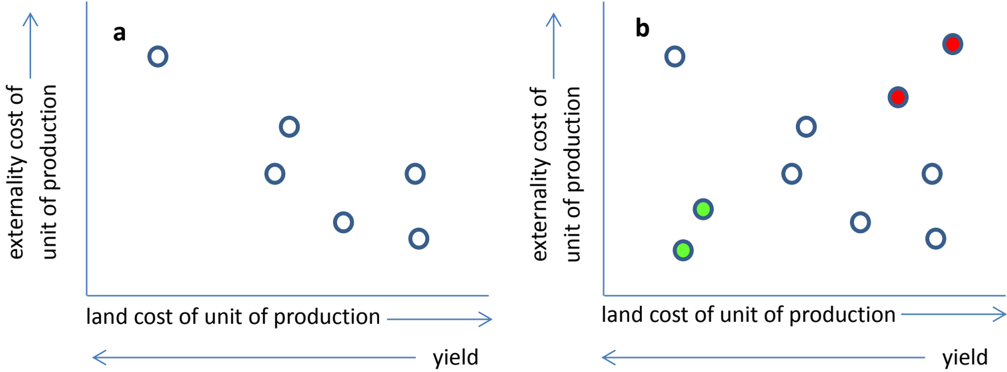
How we manage farming and food systems to meet rising demand is pivotal to the future of biodiversity. Extensive field data suggest impacts on wild populations would be greatly reduced through boosting yields on existing farmland so as to spare remaining natural habitats. High-yield farming raises other concerns because expressed per unit area it can generate high levels of externalities such as greenhouse gas (GHG) emissions and nutrient losses. However, such metrics underestimate the overall impacts of lower-yield systems, so here we develop a framework that instead compares externality and land costs per unit production. Applying this to diverse datasets describing the externalities of four major farm sectors reveals that, rather than involving trade-offs, the externality and land costs of alternative production systems can co-vary positively: per unit production, land-efficient systems often produce lower externalities. For GHG emissions these associations become more strongly positive once forgone sequestration is included. Our conclusions are limited: remarkably few studies report externalities alongside yields; many important externalities and farming systems are inadequately measured; and realising the environmental benefits of high-yield systems typically requires additional measures to limit farmland expansion. Yet our results nevertheless suggest that trade-offs among key cost metrics are not as ubiquitous as sometimes perceived.
Overview
The claims and statistics of this paper haven’t been checked yet.
Free: it reads the open-access text and checks the first 5 claims that cite a source we can check. Create a free account to check every claim.
Integrity signals
Registry
Cites
Statistics
Figures
Verification
Claims the paper makes
The claims and statistics of this paper haven’t been checked yet.
Free: it reads the open-access text and checks the first 5 claims that cite a source we can check. Create a free account to check every claim.
Claims other papers make about this one
Each is checked against this paper’s own text: does it say what the citing paper says it does?
The source backs part of the claim, not all of it — or backs it for a different population, condition or comparison.
In the citing paper
“Although agricultural intensification can have detrimental effects on climate, biodiversity and human health 2,[35][36][37][38][39] , yields can often be increased without incurring these costs 37 .”
From Global priority areas for ecosystem restoration (2020) · cites this paper as [37]
Experimental — accuracy not yet measuredThe check wasn’t confident either way, so it gives no verdict — never disputed.
In the citing paper
“Existing global comparisons of pasture-finished and grain-finished systems are incomplete as they do not account for both carbon opportunity cost and soil carbon sequestration.”
From Carbon opportunity cost increases carbon footprint advantage of grain-finished beef (2023) · cites this paper as [15]
Experimental — accuracy not yet measured
Self-check
Percentages, sums and reported differences re-computed from the paper’s own numbers.
The self-check needs the paper’s full text.
Citations
Cites
Fitting Linear Mixed-Effects Models Using lme4
Bates, D., Mächler, M., Bolker, B., & Walker, S. (2015) · Journal of Statistical Software · doi:10.18637/jss.v067.i01 · Cited by 86,835
Food Security: The Challenge of Feeding 9 Billion People
Godfray, H. C. J., Beddington, J. R., Crute, I. R., Haddad, L., Lawrence, D., Muir, J. F., Pretty, J., Robinson, S., Thomas, S. M., & Toulmin, C. (2010) · Science · doi:10.1126/science.1185383 · Cited by 11,943
Solutions for a cultivated planet
Foley, J. A., Ramankutty, N., Brauman, K. A., Cassidy, E. S., Gerber, J. S., Johnston, M., Mueller, N. D., O’Connell, C., Ray, D. K., West, P. C., et al. (2011) · Nature · doi:10.1038/nature10452 · Cited by 8,476
Agricultural sustainability and intensive production practices
Tilman, D., Cassman, K. G., Matson, P. A., Naylor, R., & Polasky, S. (2002) · Nature · doi:10.1038/nature01014 · Cited by 7,957
Global food demand and the sustainable intensification of agriculture
Tilman, D., Balzer, C., Hill, J., & Befort, B. L. (2011) · Proceedings of the National Academy of Sciences · doi:10.1073/pnas.1116437108 · Cited by 7,692
Reducing food's environmental impacts through producers and consumers
Poore, J., & Nemecek, T. (2018) · Science · doi:10.1126/science.aaq0216 · Cited by 6,085
Soil carbon stocks and land use change: a meta analysis
Guo, L. B., & Gifford, R. M. (2002) · Global Change Biology · doi:10.1046/j.1354-1013.2002.00486.x · Cited by 3,972
Global land use change, economic globalization, and the looming land scarcity
Lambin, E. F., & Meyfroidt, P. (2011) · Proceedings of the National Academy of Sciences · doi:10.1073/pnas.1100480108 · Cited by 3,160
Agricultural Intensification and Ecosystem Properties
Matson, P. A., Parton, W. J., Power, A. G., & Swift, M. J. (1997) · Science · doi:10.1126/science.277.5325.504 · Cited by 3,160
Global diets link environmental sustainability and human health
Tilman, D., & Clark, M. (2014) · Nature · doi:10.1038/nature13959 · Cited by 3,026
Research works printed but not linked: 1
- 109. Anthony, S., Quinn, P. & Lord, E. Catchment scale modelling of nitrate leaching. Asp. Appl. Biol. 46, 23-32 (1996).
Cited by
Items 101–200 of 343
Susanti, W. I., Cholidah, S. N., & Agus, F. (2024) · Sustainability · doi:10.3390/su16020845 · Cited by 86
Could bovine livestock intensification in Pantanal be neutral regarding enteric methane emissions?
Bergier, I., Silva, A. P. S., de Abreu, U. G. P., de Oliveira, L. O. F., Tomazi, M., Dias, F. R. T., Urbanetz, C., Nogueira, É., & Borges-Silva, J. C. (2018) · The Science of The Total Environment · doi:10.1016/j.scitotenv.2018.11.178 · Cited by 34
Schneider, J. M., Zabel, F., Schuenemann, F., Delzeit, R., & Mauser, W. (2022) · PLoS ONE · doi:10.1371/journal.pone.0263063 · Cited by 34
Sensing Technologies for Outdoor/Indoor Farming
Wang, L., Xiao, M., Guo, X., Yang, Y., Zhang, Z., & Lee, C. (2024) · Biosensors · doi:10.3390/bios14120629 · Cited by 34
Root uptake under mismatched distributions of water and nutrients in the root zone
Yan, J., Bogie, N. A., & Ghezzehei, T. A. (2020) · Biogeosciences · doi:10.5194/bg-17-6377-2020 · Cited by 28
Why don't consumers buy organic lamb meat? A Spanish case study
Rabadán, A., Díaz, M., Mollá-Bauza, M. M. B., & Cañete, R. B. (2019) · Meat Science · doi:10.1016/j.meatsci.2019.108024 · Cited by 31
Canaj, K., Mehmeti, A., & Berbel, J. (2021) · Resources · doi:10.3390/resources10090090 · Cited by 29
“The analysis confirms that a high-yielding system has a lower impact per unit of the product obtained because it requires less land to produce a given amount of food [37].”
BackgroundGirardi, E. A., Sola, J. G. P., Scapin, M. D. S., Moreira, A. S., Bassanezi, R. B., Ayres, A. J., & Peña, L. (2021) · Agronomy · doi:10.3390/agronomy11122569 · Cited by 27
“By considering this, it is more likely to meet the rising food demand of the increasing population while liberating land for other non-agricultural uses as well as conservation [42,43].”
BackgroundA safe agricultural space for biodiversity
García-Vega, D., Dumas, P., Prudhomme, R., Kremen, C., & Aubert, P. (2024) · Frontiers in Sustainable Food Systems · doi:10.3389/fsufs.2024.1328800 · Cited by 39
Alkemade, J., Hawkins, N. J., Baraldi, E., Buddie, A. G., Cockerton, H. M., Corkley, I., FRAAIJE, B. A., Gaya, E., Gifford, D. R., Hartig, F., et al. (2025) · Fungal Biology Reviews · doi:10.1016/j.fbr.2025.100443 · Cited by 33
“To mitigate these losses and minimize agricultural land use expansion, resistance breeding and effective crop protection are essential (Balmford et al., 2018).”
Ribeiro, J. C. T., Nunes‐Freitas, A. F., Fidalgo, E. C. C., & Uzêda, M. C. (2019) · PLoS ONE · doi:10.1371/journal.pone.0212725 · Cited by 37
“Thus, agricultural landscapes are today seen as areas of extreme importance for studying and developing strategies that integrate biodiversity conservation and ecosystem services with food production [2,6].”
BackgroundSustainability in the Sardinian sheep sector: A systems perspective, from good practices to policy
Atzori, A. S., Bayer, L., Molle, G., Arca, P., Franca, A., Vannini, M., Cocco, G., Usai, D., Duce, P., & Vagnoni, E. (2022) · Integrated Environmental Assessment and Management · doi:10.1002/ieam.4593 · Cited by 26
“It is well known that the mitigation of emission intensities is highly positively correlated with increasing production system efficiency and profitability per unit of product (Balmford et al., 2018; Capper et al., 2009; Jones et al., 2014).”
BackgroundLi, X., Shah, F., Zhao, Y., Li, Z., Zha, X., Ye, M., & Wu, W. (2024) · Journal of Cleaner Production · doi:10.1016/j.jclepro.2024.141423 · Cited by 25
Bocean, C. G. (2025) · Agronomy · doi:10.3390/agronomy15010198 · Cited by 36
Multi-objective optimization as a tool to identify possibilities for future agricultural landscapes
Todman, L., Coleman, K., Milne, A. E., Gil, J., Reidsma, P., Schwoob, M.-H., Treyer, S., & Whitmore, A. P. (2019) · The Science of The Total Environment · doi:10.1016/j.scitotenv.2019.06.070 · Cited by 33
Self-citationTrade-offs in the externalities of pig production are not inevitable
Bartlett, H., Zanella, M. I. G., Kaori, B., Sabei, L., Araújo, M. S., de Paula, T. M. C. G., Zanella, A. J., Holmes, M. A., Wood, J. L. N., & Balmford, A. P. (2024) · Nature Food · doi:10.1038/s43016-024-00921-2 · Cited by 30
“Importantly, none has included both environmental costs and animal welfare 9,22–24 .”
InfluentialSelf-citationde Boer, J., & Aiking, H. (2021) · Ecological Economics · doi:10.1016/j.ecolecon.2021.107141 · Cited by 28
Deng, X., Lian, P., Zeng, M., Xu, D., & Qi, Y. (2021) · Journal of Land Use Science · doi:10.1080/1747423x.2021.1954707 · Cited by 27
“Mueller et al. (2012), Balmford et al. (2018), and Osei-Owusu et al. (2019) demonstrated that intensive farmland management improved agricultural productivity and became a viable way to meet food demand.”
BackgroundDakpo, K. H., Latruffe, L., Desjeux, Y., & Jeanneaux, P. (2021) · Journal of Agricultural Economics · doi:10.1111/1477-9552.12422 · Cited by 29
Technical efficiency and farmland expansion: Evidence from oil palm smallholders in Indonesia
Dalheimer, B., Kubitza, C., & Brümmer, B. (2022) · American Journal of Agricultural Economics · doi:10.1111/ajae.12267 · Cited by 21
“Empirical evidence shows that increasing productivity—one component of TFP—can lead to sizable land-sparing effects in the long term (Balmford et al., 2005; Balmford et al., 2018; Feniuk et al., 2019; Folberth et al., 2020; Phalan et al., 2014; Villoria, 2019). However, most studies on land sparing effects of innovati…”
BackgroundInfluentialBalancing Economic and Environmental Performance for Small-Scale Rice Farmers in Peru
White, M., Heros-Aguilar, E. C., Graterol, E., Chirinda, N., & Pittelkow, C. M. (2020) · Frontiers in Sustainable Food Systems · doi:10.3389/fsufs.2020.564418 · Cited by 29
“Consistent with our findings, previous studies have shown that measuring the efficiencies of farm systems by per unit area of farmland underestimates the fact that lower-yield systems require more land per unit yield (Balmford et al., 2018).”
ResultBiocultural heritage of transhumant territories
Easdale, M. H., Michel, C. L., & Perri, D. V. (2022) · Agriculture and Human Values · doi:10.1007/s10460-022-10361-y · Cited by 24
Hydroponics: The Future of Sustainable Farming
Meselmani, M. A. A. (2024) · Encyclopedia of sustainability science and technology series · doi:10.1007/978-1-0716-3993-1_6 · Cited by 29
The unrealized potential of agroforestry for an emissions-intensive agricultural commodity
Becker, A., Wegner, J. D., Dawoe, E., Schindler, K., Thompson, W. J., Bunn, C., Garrett, R. D., Castro-Llanos, F., Hart, S. P., & Blaser, W. J. (2025) · Nature Sustainability · doi:10.1038/s41893-025-01608-7 · Cited by 35
“The highest average cover occurred in the moderate–very dry zone (type 1) in the northern cocoa-growing area, with cover levels gradually declining through the dry and wet zones, reaching the lowest average cover in the very hot–very wet coastal zone (type 5).”
Regenerative Agriculture: Insights and Challenges in Farmer Adoption
Moisés, C., Arrobas, M., Tsitos, D., Pinho, D., Rezende, R. F., & Rodrigues, M. Â. (2025) · Sustainability · doi:10.3390/su17167235 · Cited by 25
Optimising nature conservation outcomes for a given region‐wide level of food production
Finch, T., Green, R. E., Massimino, D., Peach, W. J., & Balmford, A. P. (2020) · Journal of Applied Ecology · doi:10.1111/1365-2664.13594 · Cited by 19
Self-citationAdvancing the quantitative characterization of farm animal welfare
Bartlett, H., Balmford, A. P., Holmes, M. A., & Wood, J. L. N. (2023) · Proceedings of the Royal Society B Biological Sciences · doi:10.1098/rspb.2023.0120 · Cited by 24
“These should be described explicitly and should be inclusive to allow quantification of overall welfare [22], and to avoid problem-shifting [23].”
BackgroundSelf-citationLi, S., Jiao, J., Degen, A. A., Wang, W., Qi, T., Huang, M., Xu, S., & Shang, Z. (2024) · Agriculture Ecosystems & Environment · doi:10.1016/j.agee.2024.109057 · Cited by 23
Collins, A. L., Zhang, Y., Upadhayay, H. R., Pulley, S., Granger, S. J., Harris, P., Sint, H., & Griffith, B. A. (2020) · Environmental Science & Policy · doi:10.1016/j.envsci.2020.11.004 · Cited by 19
Self-citationCharacterising the spatial distribution of opportunities and constraints for land sparing in Brazil
dos Santos, J. S., Feltran‐Barbieri, R., Fonte, E. S., Balmford, A. P., Maioli, V., Latawiec, A. E., Strassburg, B. B. N., & Phalan, B. (2020) · Scientific Reports · doi:10.1038/s41598-020-58770-5 · Cited by 20
Self-citationArnott, D., Chadwick, D. R., Wynne‐Jones, S., & Jones, D. L. (2019) · Land Use Policy · doi:10.1016/j.landusepol.2019.104154 · Cited by 22
Self-citationCarbon opportunity cost increases carbon footprint advantage of grain-finished beef
Blaustein-Rejto, D., Soltis, N., & Blomqvist, L. (2023) · PLOS ONE · doi:10.1371/journal.pone.0295035 · Cited by 22
ENVIRONMENTAL IMPACTS OF HERBICIDE TOLERANT CROPS AND GLYPHOSATE-BASED HERBICIDES – A REVIEW
Velmourougane, K., Blaise, D., Manikandan, A., SAVITHA, S., & Waghmare, V. N. (2021) · Applied Ecology and Environmental Research · doi:10.15666/aeer/1905_34813504 · Cited by 18
“These essential requirements have further worsened the need for lands for intensive agriculture due to recent soil quality loss, land degradation and climatic changes (Balmford et al., 2018).”
BackgroundCarmenta, R., Steward, A. M., da Silva, A. A., Carneiro, R. D. V., Vira, B., & Estrada-Carmona, N. (2022) · People and Nature · doi:10.1002/pan3.10384 · Cited by 21
Venn, T. J. (2023) · Forest Policy and Economics · doi:10.1016/j.forpol.2023.102979 · Cited by 24
Montalba, R., Vieli, L., Spirito, F., & Muñoz, E. (2019) · Scientia Horticulturae · doi:10.1016/j.scienta.2019.108592 · Cited by 22
A global analysis of factors predicting conservationists' values
Luque‐Lora, R., Keane, A. M., Fisher, J., Holmes, G., & Sandbrook, C. G. (2022) · People and Nature · doi:10.1002/pan3.10391 · Cited by 25
Environmental footprints of farmed chicken and salmon bridge the land and sea
Kuempel, C. D., Frazier, M. R., Verstaen, J., Rayner, P.-E., Blanchard, J. L., Cottrell, R. S., Froehlich, H. E., Gephart, J. A., Jacobsen, N. S., McIntyre, P. B., et al. (2023) · Current Biology · doi:10.1016/j.cub.2023.01.037 · Cited by 18
Potential unintended consequences of agricultural land use change driven by dietary transitions
Blackwell, M. S. A., Takahashi, T., Cardenas, L. M., Collins, A. L., Enríquez-Hidalgo, D., Griffith, B. A., Hunt, J. W., Lee, M. R. F., Misselbrook, T. H., Neal, A. L., et al. (2024) · npj Sustainable Agriculture · doi:10.1038/s44264-023-00008-8 · Cited by 17
Self-citationEnergy, economic, and environmental (3E) assessment of the major greenhouse crops: MFCA-LCA approach
Dekamin, M., Sadeghimofrad, T., & Ahmadloo, A. (2024) · Environmental Science and Pollution Research · doi:10.1007/s11356-024-32576-8 · Cited by 15
“This very high level of cultivation represents a threat to other species (Balmford et al. 2018).”
Organic farming expansion and food security: A review of foresight modeling studies
Borghino, N., Wissinger, L., Erb, K., Mouël, C. L., & Nesme, T. (2024) · Global Food Security · doi:10.1016/j.gfs.2024.100765 · Cited by 30
Matsuzaki, Y., Watanabe, S., Harada, T., & Iwahashi, F. (2019) · Pest Management Science · doi:10.1002/ps.5652 · Cited by 15
Habitat percolation transition undermines sustainability in social‐ecological agricultural systems
Paz, D. B., Henderson, K. A., & Loreau, M. (2021) · Ecology Letters · doi:10.1111/ele.13914 · Cited by 22
The consequences of land sparing for birds in the United Kingdom
Lamb, A., Finch, T., Pearce‐Higgins, J. W., Ausden, M., Balmford, A. P., Feniuk, C., Hirons, G. J. M., Massimino, D., & Green, R. E. (2019) · Journal of Applied Ecology · doi:10.1111/1365-2664.13362 · Cited by 17
Self-citationOECD Food and Agricultural Reviews
OECD (2015) · OECD food and agricultural reviews · doi:10.1787/24114278 · Cited by 15
Fernández, P. D., Gasparri, I., Rojas, T. N., Banegas, N., Nasca, J., Jobbagy, E. G., & Kuemmerle, T. (2023) · The Science of The Total Environment · doi:10.1016/j.scitotenv.2023.168973 · Cited by 18
When Will Controlled Environment Agriculture in Its Vertical Form Fulfill Its Potential?
Burritt, M., de Souza, S. V., & Peterson, H. C. (2025) · Sustainability · doi:10.3390/su17072957 · Cited by 25
Salek, F., Guest, A., Johnson, C., Kastelic, J. P., & Thundathil, J. C. (2025) · Animals · doi:10.3390/ani15030344 · Cited by 27
“…livestock production contributes to climate change through methane, carbon dioxide, and nitrous oxide emissions; therefore, selective breeding and genetic advancements to improve productivity per animal are effective strategies to reduce greenhouse gas emissions per unit of food produced [4,5].”
Xi, M., Xu, Y., Zhou, Y., Wu, C., Tu, D., Li, Z., Sun, X., & Wu, W. (2024) · Energy · doi:10.1016/j.energy.2024.131408 · Cited by 15
Data-driven nitrogen management benchmarks support China’s wheat self-sufficiency by 2030
Mi, X., Gang, H., Qiu, W., Zhang, Q., Yin, Y., Liu, J., Shi, M., Wang, Z., & Cui, Z. (2025) · Nature Food · doi:10.1038/s43016-025-01197-w · Cited by 21
“In parallel, excessive N surplus results in more N loss to the environment, threatening water and air quality 5,6 .”
Environmental performance of crop cultivation at different sites and nitrogen rates in Sweden
Henryson, K., Hansson, P., Kätterer, T., Tidåker, P., & Sundberg, C. (2019) · Nutrient Cycling in Agroecosystems · doi:10.1007/s10705-019-09997-w · Cited by 19
“Different methodologies and degrees of spatial specificity limit intercomparability (Bessou et al. 2013), and it is often unclear whether differences in results between studies can be attributed to spatial or methodological variations.”
BackgroundAbeygunawardane, D., García, A. K., Sun, Z., Müller, D., Sitoe, A. A., & Meyfroidt, P. (2022) · AMBIO · doi:10.1007/s13280-021-01682-z · Cited by 19
“…to generate economic and environmental gains through increased production (Deininger et al., 2011; Collier & Dercon, 2014) and land-efficient farming (Green et al., 2005; Balmford et al., 2018; Phalan et al., 2011), balancing these against social and environmental costs has remained a challenge.”
BackgroundUpcycling biomass in a circular food system : The role of livestock and fish
van Hal, O. (2020) · doi:10.18174/524412 · Cited by 21
Land‐use change from market responses to oil palm intensification in Indonesia
Lim, F. K. S., Carrasco, L. R., Edwards, D. P., & McHardy, J. (2023) · Conservation Biology · doi:10.1111/cobi.14149 · Cited by 25
“In seeking to reduce forest loss from agricultural expansion and the associated impacts on biodiversity, intensification to improve crop yields is often promoted as a means of meeting expanding agricultural demands with minimal land-use impact (Balmford et al., 2018; Phalan et al., 2016).”
BackgroundSelf-citationEthnobiology! Until when will the colonialist legacy be reinforced?
Zank, S., Julião, C. G., de Lima, A. D. S., da Silva, M. T., Levis, C., Hanazaki, N., & Peroni, N. (2025) · Journal of Ethnobiology and Ethnomedicine · doi:10.1186/s13002-024-00750-4 · Cited by 12
Kirk, N., Duncan, R., Booth, P. L., & Robson-Williams, M. (2022) · Frontiers in Agronomy · doi:10.3389/fagro.2022.991853 · Cited by 13
“However, these industries also generate externalities that can degrade ecosystem services (Green et al., 2005; Balmford et al., 2018).”
BackgroundBullock, J. M., Jarvis, S. G., Fincham, W. N. W., Risser, H. A., Schultz, C. L., Spurgeon, D. J., Redhead, J. W., Storkey, J., & Pywell, R. F. (2023) · The Science of The Total Environment · doi:10.1016/j.scitotenv.2023.168491 · Cited by 14
Wang, X., Zhang, W., Lakshmanan, P., Qian, C., Ge, X., Hao, Y., Wang, J., Liu, Y., Yang, H., Zhang, Z., et al. (2021) · Food and Energy Security · doi:10.1002/fes3.317 · Cited by 13
Identifying Farming Strategies Associated With Achieving Global Agricultural Sustainability
Smith, O. M., Jocson, D. M. I., Lee, B. W., Orpet, R. J., Taylor, J. M., Davis, A. G., Rieser, C. J., Clarke, A. E., Cohen, A. L., Hayes, A. M., et al. (2022) · Frontiers in Sustainable Food Systems · doi:10.3389/fsufs.2022.882503 · Cited by 15
“, feed production), which are also known to be large contributors to agricultural greenhouse gas emissions (Snyder et al., 2009; Balmford et al., 2018).”
BackgroundInfluentialCastillo, A. M. R., Alavez, V., Castro-Porras, L. V., Martínez, Y., & Cerritos, R. (2020) · Frontiers in Sustainable Food Systems · doi:10.3389/fsufs.2020.00005 · Cited by 12
Human, Animal and Planet Health for Complete Sustainability
Bertoni, G. (2021) · Animals · doi:10.3390/ani11051301 · Cited by 11
“[32], suggesting that the additional externalities resulting from the different land requirements of contrasting systems to generate the same quantity of agricultural product are higher for low-yield systems: they require more land (with a reduction of natural habitat) and increase GHG emissions, soil losses etc.”
BackgroundErasmus, L.-M., & van Marle-Köster, E. (2021) · Tropical Animal Health and Production · doi:10.1007/s11250-021-02914-w · Cited by 11
“2019), resulting in greater financial incentives for the farmer, as well as decreased pressure on the environment as less land and fewer cattle are required per unit of milk produced (Balmford et al. 2018).”
BackgroundYan, P., Lu, X., Liang, G., Tang, Q., & Ding, S. (2024) · Ecological Indicators · doi:10.1016/j.ecolind.2024.111795 · Cited by 10
Huang, Y.-Z., Lee, Y.-Y., & Fan, C. (2024) · Agricultural Water Management · doi:10.1016/j.agwat.2024.109270 · Cited by 10
Holman, J. D., Diaz, D. A. R., Obour, A. K., & Assefa, Y. (2024) · Agrosystems Geosciences & Environment · doi:10.1002/agg2.20469 · Cited by 12
Understanding barriers to agricultural technology adoption: Evidence from U.S. agribusiness firms
Ulucak, Z. Ş., Sivashankar, P., Huseynov, S., & Ulucak, R. (2025) · Technological Forecasting and Social Change · doi:10.1016/j.techfore.2025.124448 · Cited by 12
Gérard, M., de Cara, S., & Meunier, G. (2024) · American Journal of Agricultural Economics · doi:10.1111/ajae.12485 · Cited by 13
Nature-based agriculture for an adequate human microbiome
Erisman, J. W. (2020) · Organic Agriculture · doi:10.1007/s13165-020-00304-4 · Cited by 12
Milheiras, S. G., Sallu, S. M., Marshall, A. R., Shirima, D. D., Kioko, E. N., Loveridge, R., Moore, E., Olivier, P. I., Teh, Y. A., Rushton, S. P., et al. (2022) · Frontiers in Forests and Global Change · doi:10.3389/ffgc.2022.709971 · Cited by 12
Catalyzing Holistic Agriculture Innovation Through Industrial Biotechnology
Walker, L. P., & Buhler, D. D. (2020) · Industrial Biotechnology · doi:10.1089/ind.2020.29222.lpw · Cited by 10
“24–28 Water availability and quality, excess nutrient flows into various agro-industrial and natural eco-systems, and compromised soil health are just some of the challenges that need innovative solutions.”
Conflicting Temporalities and the Ecomodernist Vision of Rewilding
Karlsson, R. (2020) · Frontiers in international relations · doi:10.1007/978-3-030-49496-4_6 · Cited by 14
Sela, S., Dobermann, A., Cerri, C. E. P., Svoray, T., van Es, H. M., Amsili, J. P., Biradar, S., Luzon, U., & Katz, S. (2024) · npj Sustainable Agriculture · doi:10.1038/s44264-024-00031-3 · Cited by 12
Wang, C., Fu, Y., Wang, H., Ren, Y., Zhang, Y., Yh, M., Qiao, Y., Dong, B., & ZHANG, Y. (2025) · Agricultural Water Management · doi:10.1016/j.agwat.2025.109697 · Cited by 8
The Carbon Cycle of Terrestrial Ecosystems
Schlesinger, W. H., & Bernhardt, E. S. (2020) · Elsevier eBooks · doi:10.1016/b978-0-12-814608-8.00005-0 · Cited by 12
Abbate, S. L., Madeira, F., Silva, H., Altier, N., & Pons, X. (2022) · Agriculture Ecosystems & Environment · doi:10.1016/j.agee.2022.108027 · Cited by 11
Bartlett, H., Balmford, A. P., Wood, J. L. N., & Holmes, M. A. (2023) · Scientific Reports · doi:10.1038/s41598-023-29480-5 · Cited by 9
Self-citationExplaining the Limitations of Agricultural Intensification Initiatives in Sulawesi, Indonesia
Kelley, L. C. (2020) · Frontiers in Sustainable Food Systems · doi:10.3389/fsufs.2020.529074 · Cited by 10
“, 2017) while ‘sparing land’ for nature and biodiversity conservation (Green et al., 2005; Balmford et al., 2018; Pretty et al., 2018).”
BackgroundElayadeth‐Meethal, M., & Kolathingal-Thodika, N. (2024) · International Journal of Biometeorology · doi:10.1007/s00484-024-02845-9 · Cited by 10
“The production loss from climate change threat - ens to meet the rising human population’s food needs, par - ticularly in animal-origin foods (Cavicchioli et al. 2019; Balmford et al. 2018 ).”
New-generative agriculture – based on science, informed by research and honed by New Zealand farmers
Rowarth, J. S., Manning, M., Roberts, A. H. C., & King, W. M. (2021) · Journal of New Zealand Grasslands · doi:10.33584/jnzg.2020.82.430 · Cited by 16
Zhao, J., Cao, Y., Yu, L., Liu, X., Shi, Y., Liu, X., Yang, R., & Gong, P. (2021) · Land · doi:10.3390/land10070704 · Cited by 7
Davies, R. W., Morton, O., Lawson, D., Mallord, J. W., Nelson, L. S., Boafo, K., Lamb, I., & Edwards, D. P. (2021) · Environmental Research Letters · doi:10.1088/1748-9326/ac3030 · Cited by 8
Self-citationMolpeceres, C., Rito, M. V. D., Zulaica, L., & Mikkelsen, C. A. (2021) · Local Development & Society · doi:10.1080/26883597.2021.1950514 · Cited by 7
“Intensive activities are understood as those that demand high levels of external inputs and that achieve high yields (Balmford et al., 2018).”
BackgroundWang, C., Zhang, X., Ren, C., Xuan, X., Cheng, L., Zou, Y., Xu, J. M., & Gu, B. (2026) · Nature Food · doi:10.1038/s43016-026-01373-6 · Cited by 6
Potential to improve nitrogen use efficiency (NUE) by use of perennial mobile green manures
Ward, C. R., Chadwick, D. R., & Hill, P. W. (2022) · Nutrient Cycling in Agroecosystems · doi:10.1007/s10705-022-10253-x · Cited by 9
Self-citationZhang, Y., Zeng, Y., Zong, R., & Fang, N. (2024) · Land Degradation and Development · doi:10.1002/ldr.5353 · Cited by 6
Zhao, J., Cao, Y., & Yu, L. (2021) · Remote Sensing · doi:10.3390/rs13245090 · Cited by 5
Using modern portfolio theory to enhance ecosystem service delivery: A case study from China
Zhang, X., Jin, X., Fuller, R. A., Liang, X., Fan, Y., & Zhou, Y. (2023) · Journal of Environmental Management · doi:10.1016/j.jenvman.2023.119064 · Cited by 6
“Research focusing on biodiversity conservation of rare species generally prefers "land sparing" (Phalan et al., 2011, 2016; Balmford et al., 2018; Phalan, 2018), while studies focusing on farmland biodiversity, ecosystem services, and cost-benefit tend to favor "land sharing" (Bousfield et al.,…”
BackgroundImproving the estimation of grazing pressure in tropical rangelands
Fernández, P. D., Baumann, M., Blanco, L. J., Murray, F., Nasca, J., Piipponen, J., Tasquer, M., & Kuemmerle, T. (2025) · Environmental Research Letters · doi:10.1088/1748-9326/adb445 · Cited by 11
“However, they are still connected to major environmental impacts in terms of emissions, pollution, and water use and are seen as problematic from an animal welfare perspective (Smit and Heederik 2017, Balmford et al 2018).”
Biodiversity–food trade‐offs when agricultural land is spared from production
Palmer, C. E., Groom, B., Sileci, L., & Langton, S. (2025) · American Journal of Agricultural Economics · doi:10.1111/ajae.12530 · Cited by 10
“Higher yields are likely more achievable - and have the potential to generate fewer negative externalities than lower-yield systems (Balmford et al. , 2018) - in settings where the agricultural landscape is still dominated by low yields.”
A New Paradigm for Plant Nutrition
Dobermann, A., Bruulsema, T. W., Çakmak, İ., Gerard, B. G., Majumdar, K., McLaughlin, M., Reidsma, P., Vanlauwe, B., Wollenberg, L., Zhang, F. S., et al. (2021) · CGSPace A Repository of Agricultural Research Outputs (Consultative Group for International Agricultural Research) · doi:10.48565/scfss2021-hg55 · Cited by 6
Firm-specific responses to energy policies in Dutch horticulture
Los, E., Gardebroek, C., & Huirne, R. B. M. (2021) · European Review of Agricultural Economics · doi:10.1093/erae/jbab004 · Cited by 5
Food and nutrition security: challenges for farming, procurement, and consumption
Avermaete, T., Keulemans, W., Honnay, O., Govers, G., Coninck, B. D., & Zwart, T. A. (2022) · Elsevier eBooks · doi:10.1016/b978-0-12-819470-6.00016-0 · Cited by 5
McGinlay, J., Holtvoeth, J., Begley, A., Doerstel, J., Kockelmann, A., Lammertz, M., Malesios, C., & Jones, N. (2023) · Sustainability · doi:10.3390/su151410848 · Cited by 8
Environmental and economic sustainability of protein-rich crop cultivation in Europe
Degieter, M., Goyal, S., Gellynck, X., Brinks, H., García, L. S., Tobia, L., Ott, D., & Steur, H. D. (2025) · Outlook on Agriculture · doi:10.1177/00307270251371067 · Cited by 4
“…friendly, however, ignores other important bene fi ts related to organic agriculture such as local soil bene fi ts for soil health and biodiversity (Balmford et al., 2018; van der Werf et al., 2020), which could be taken into account by using other environmental indicators than climate change…”
Mainar, A., & Martínez, Y. (2025) · Agricultural and Food Economics · doi:10.1186/s40100-025-00354-w · Cited by 8
“This means that more land may be required to produce the same amount of food, potentially leading to greater forest clearing and biodiversity loss, which undermines the environmental benefits usually associated with organic practices (Balmford et al. 2018; Seufert and Ramankutty 2017).”
Kumar, A. (2022) · Elsevier eBooks · doi:10.1016/b978-0-12-815025-2.00009-5 · Cited by 5
Decoding the relationship between farmland transfer and crop diversity: Insights from China
Chen, H., Meng, F., Li, G., Guo, J., Xiong, W., Li, X., & Zou, Y. (2025) · Journal of Environmental Management · doi:10.1016/j.jenvman.2025.125588 · Cited by 4
Reilly, J. A., Dawson, T. P., Matthews, R., Smith, P., Musk, C. C., Potts, J. M., & Polhill, G. J. (2021) · International Journal of Agricultural Sustainability · doi:10.1080/14735903.2021.1907991 · Cited by 5
Self-citationMerging Traditions and Innovation for Sustainability and Multifunctionality of Cultural Landscapes
Zerbe, S. (2022) · Landscape series · doi:10.1007/978-3-030-95572-4_12 · Cited by 4
A New Paradigm for Plant Nutrition
Dobermann, A., Bruulsema, T. W., Çakmak, İ., Gerard, B. G., Majumdar, K., McLaughlin, M., Reidsma, P., Vanlauwe, B., Wollenberg, E. K., Zhang, F. S., et al. (2023) · Springer eBooks · doi:10.1007/978-3-031-15703-5_19 · Cited by 5
Metadata
- Authors
- Balmford, A., Amano, T., Bartlett, H., Chadwick, D., Collins, A., Edwards, D., Field, R., Garnsworthy, P., Green, R., Smith, P., Waters, H., Whitmore, A., Broom, D. M., Chara, J., Finch, T., Garnett, E., Gathorne-Hardy, A., Hernandez-Medrano, J., Herrero, M., Hua, F., Latawiec, A., Misselbrook, T., Phalan, B., Simmons, B. I., Takahashi, T., Vause, J., zu Ermgassen, E., & Eisner, R.
- Affiliations
- University of Cambridge (GB)
- Rothamsted Research (GB)
- University of Sheffield (GB)
- Royal Society for the Protection of Birds (GB)
- University of Nottingham (GB)
- University of Aberdeen (GB)
- Universidad Nacional Autónoma de México (MX)
- Commonwealth Scientific and Industrial Research Organisation (AU)
- Pontifícia Universidade Católica do Rio de Janeiro (BR)
- Universidade Federal da Bahia (BR)
- UN Environment Programme World Conservation Monitoring Centre (GB)
- Corresponding author
- Balmford, Andrew
- ORCID
- Balmford, Andrew
- Amano, Tatsuya
- Bartlett, Harriet
- Collins, Adrian
- Edwards, David
- Field, Rob
- Garnsworthy, Philip
- Green, Rhys
- Smith, Pete
- Waters, Helen
- Whitmore, Andrew
- Broom, Donald M.
- Finch, Tom
- Garnett, Emma
- Hernandez-Medrano, Juan
- Herrero, Mario
- Hua, Fangyuan
- Latawiec, Agnieszka
- Misselbrook, Tom
- Phalan, Ben
- Simmons, Benno I.
- Takahashi, Taro
- Vause, James
- Eisner, Rowan
- Venue
- Nature Sustainability
- Published
- 2018-09-14
- Volume
- 1
- Issue
- 9
- Pages
- 477-485
- ISSN
- 2398-9629 (ISSN-L)
- PMC
- PMC6237269
- OpenAlex
- W2889602878
- Cited by
- 343
- References
- 105
- Citations by year
- 2026: 38 · 2025: 37 · 2024: 37 · 2023: 26 · 2022: 40 · 2021: 45 · 2020: 52 · 2019: 45 · 2018: 20
- FWCI
- 21.19
- Type
- journal article
- Language
- en
- Update notices
- correction (2019-03-26)
- Open access
- bronze
- doi.org
- Licence
- www.springernature.com/gp/researchers/text-and-data-mining (tdm)
- www.springernature.com/gp/researchers/text-and-data-mining (vor)
- Locations
- Nature Sustainability (publishedVersion)
- PubMed (publishedVersion)
- Explore Bristol Research (publishedVersion, other-oa)
- White Rose Research Online (University of Leeds, The University of Sheffield, University of York) (acceptedVersion)
- Europe PMC (PubMed Central) (acceptedVersion)
- PubMed Central (acceptedVersion)
- Edinburgh Research Explorer (University of Edinburgh) (submittedVersion, other-oa)
- Bristol Research (University of Bristol) (submittedVersion, other-oa)
- Apollo (University of Cambridge) (submittedVersion)
- RePEc: Research Papers in Economics (submittedVersion)
- Aberdeen University Research Archive (Aberdeen University) (submittedVersion)
- Repository@Nottingham (University of Nottingham) (submittedVersion, cc-by)
- Rothamsted Repository (Rothamsted Repository) (submittedVersion)
- Bangor University Research Portal (Bangor University) (submittedVersion, other-oa)
- Apollo
- Funders
- Grantham Foundation for the Protection of the Environment
- Arcadia Fund (NE/L002507/1)
- Cambridge Conservation Initiative (NE/L002507/1)
- Biotechnology and Biological Sciences Research Council (BBS/E/C/000J0300, BB/N013468/, BB/N013484/1, BB/N013468/1, BBS/E/C/000I0320, BBS/E/C/000I0330, BBS/E/C/00005198)
- Natural Environment Research Council (NE/M016714/1, L002507/1, NE/M021327/1, NE/P019455/1, NE/L002507/1, NE/J011568/1, NE/N018125/1, 1796601, BB/N013468/1, NE/M016900/1, BB/N013484/1, BBS/E/C/000I0330)
- Topics
- Life Sciences › Agricultural and Biological Sciences › Agronomy and Crop Science › Sustainable Agricultural Systems Analysis
- Physical Sciences › Environmental Science › Ecology › Agriculture Sustainability and Environmental Impact
- Physical Sciences › Environmental Science › Global and Planetary Change › Land Use and Ecosystem Services
- Keywords
- high-yield cultivation, agricultural externalities, greenhouse gas emissions, nutrient loss, land use efficiency, biodiversity conservation, cropland expansion, carbon sequestration, food system sustainability
About these checks
Registry, retraction, Cites and statistics results are computed, not judged, with one exception: a printed reference that no index lists is read once by a model before it counts as a citation error. Claims are extracted by a model and kept only when their quote appears verbatim in the text; each cited source is then checked, with a model’s help, for whether it says what the claim relies on. Those verdicts can be wrong — read the claim’s quote and the cited source before relying on one.
Statistics and arithmetic are recomputed, not judged.
Confidence bands are shown only for fields calibrated on our annotated test set. None is calibrated yet, so no band is shown.
What counts as a claim ›How we measure confidence ›How we check this ›
Are you an author, or do you see a problem with this page? Request a review
Data sources
Bibliographic data: Semantic Scholar, OpenAlex, Crossref.
Contains information from the Semantic Scholar Academic Graph Datasets, made available under the ODC Attribution License (ODC-BY 1.0).
Semantic Scholar’s data is described in: Kinney, R., et al. (2023). The Semantic Scholar Open Data Platform. arXiv:2301.10140.
