

The environmental costs and benefits of high-yield farming
Open accessThe DOI matches its Crossref record; 104 of the 105 references it cites were found in a registry or an index.
Abstract
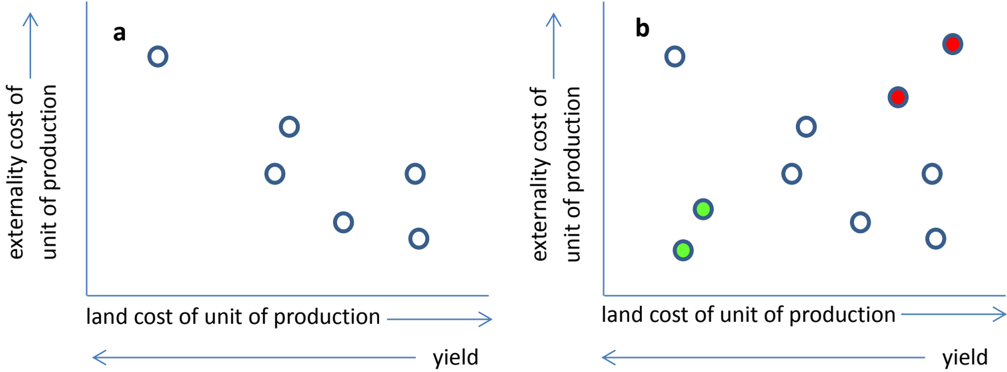
How we manage farming and food systems to meet rising demand is pivotal to the future of biodiversity. Extensive field data suggest impacts on wild populations would be greatly reduced through boosting yields on existing farmland so as to spare remaining natural habitats. High-yield farming raises other concerns because expressed per unit area it can generate high levels of externalities such as greenhouse gas (GHG) emissions and nutrient losses. However, such metrics underestimate the overall impacts of lower-yield systems, so here we develop a framework that instead compares externality and land costs per unit production. Applying this to diverse datasets describing the externalities of four major farm sectors reveals that, rather than involving trade-offs, the externality and land costs of alternative production systems can co-vary positively: per unit production, land-efficient systems often produce lower externalities. For GHG emissions these associations become more strongly positive once forgone sequestration is included. Our conclusions are limited: remarkably few studies report externalities alongside yields; many important externalities and farming systems are inadequately measured; and realising the environmental benefits of high-yield systems typically requires additional measures to limit farmland expansion. Yet our results nevertheless suggest that trade-offs among key cost metrics are not as ubiquitous as sometimes perceived.
Overview
The claims and statistics of this paper haven’t been checked yet.
Free: it reads the open-access text and checks the first 5 claims that cite a source we can check. Create a free account to check every claim.
Integrity signals
Registry
Cites
Statistics
Figures
Verification
Claims the paper makes
The claims and statistics of this paper haven’t been checked yet.
Free: it reads the open-access text and checks the first 5 claims that cite a source we can check. Create a free account to check every claim.
Claims other papers make about this one
Each is checked against this paper’s own text: does it say what the citing paper says it does?
The source backs part of the claim, not all of it — or backs it for a different population, condition or comparison.
In the citing paper
“Although agricultural intensification can have detrimental effects on climate, biodiversity and human health 2,[35][36][37][38][39] , yields can often be increased without incurring these costs 37 .”
From Global priority areas for ecosystem restoration (2020) · cites this paper as [37]
Experimental — accuracy not yet measuredThe check wasn’t confident either way, so it gives no verdict — never disputed.
In the citing paper
“Existing global comparisons of pasture-finished and grain-finished systems are incomplete as they do not account for both carbon opportunity cost and soil carbon sequestration.”
From Carbon opportunity cost increases carbon footprint advantage of grain-finished beef (2023) · cites this paper as [15]
Experimental — accuracy not yet measured
Self-check
Percentages, sums and reported differences re-computed from the paper’s own numbers.
The self-check needs the paper’s full text.
Citations
Cites
Fitting Linear Mixed-Effects Models Using lme4
Bates, D., Mächler, M., Bolker, B., & Walker, S. (2015) · Journal of Statistical Software · doi:10.18637/jss.v067.i01 · Cited by 86,835
Food Security: The Challenge of Feeding 9 Billion People
Godfray, H. C. J., Beddington, J. R., Crute, I. R., Haddad, L., Lawrence, D., Muir, J. F., Pretty, J., Robinson, S., Thomas, S. M., & Toulmin, C. (2010) · Science · doi:10.1126/science.1185383 · Cited by 11,943
Solutions for a cultivated planet
Foley, J. A., Ramankutty, N., Brauman, K. A., Cassidy, E. S., Gerber, J. S., Johnston, M., Mueller, N. D., O’Connell, C., Ray, D. K., West, P. C., et al. (2011) · Nature · doi:10.1038/nature10452 · Cited by 8,476
Agricultural sustainability and intensive production practices
Tilman, D., Cassman, K. G., Matson, P. A., Naylor, R., & Polasky, S. (2002) · Nature · doi:10.1038/nature01014 · Cited by 7,957
Global food demand and the sustainable intensification of agriculture
Tilman, D., Balzer, C., Hill, J., & Befort, B. L. (2011) · Proceedings of the National Academy of Sciences · doi:10.1073/pnas.1116437108 · Cited by 7,692
Reducing food's environmental impacts through producers and consumers
Poore, J., & Nemecek, T. (2018) · Science · doi:10.1126/science.aaq0216 · Cited by 6,085
Soil carbon stocks and land use change: a meta analysis
Guo, L. B., & Gifford, R. M. (2002) · Global Change Biology · doi:10.1046/j.1354-1013.2002.00486.x · Cited by 3,972
Global land use change, economic globalization, and the looming land scarcity
Lambin, E. F., & Meyfroidt, P. (2011) · Proceedings of the National Academy of Sciences · doi:10.1073/pnas.1100480108 · Cited by 3,160
Agricultural Intensification and Ecosystem Properties
Matson, P. A., Parton, W. J., Power, A. G., & Swift, M. J. (1997) · Science · doi:10.1126/science.277.5325.504 · Cited by 3,160
Global diets link environmental sustainability and human health
Tilman, D., & Clark, M. (2014) · Nature · doi:10.1038/nature13959 · Cited by 3,026
Research works printed but not linked: 1
- 109. Anthony, S., Quinn, P. & Lord, E. Catchment scale modelling of nitrate leaching. Asp. Appl. Biol. 46, 23-32 (1996).
Cited by
Global priority areas for ecosystem restoration
Strassburg, B. B. N., Iribarrem, A., Beyer, H. L., Cordeiro, C. L., Crouzeilles, R., Jakovac, C. C., Braga Junqueira, A., Lacerda, E., Latawiec, A. E., Balmford, A., et al. (2020) · Nature · doi:10.1038/s41586-020-2784-9 · Cited by 1,175
Self-citationBending the curve of terrestrial biodiversity needs an integrated strategy
Leclère, D., Obersteiner, M., Barrett, M., Butchart, S. H. M., Chaudhary, A., De Palma, A., DeClerck, F. A. J., Di Marco, M., Doelman, J. C., Dürauer, M., et al. (2020) · Nature · doi:10.1038/s41586-020-2705-y · Cited by 922
Self-citationNewton, P., Civita, N., Frankel-Goldwater, L., Bartel, K., & Johns, C. (2020) · Frontiers in Sustainable Food Systems · doi:10.3389/fsufs.2020.577723 · Cited by 516
“But these outcomes may also be achieved by using high-yield, relatively intensive farming processes that spare land for conservation and ecosystem restoration (Phalan et al., 2011; Balmford et al., 2018).”
BackgroundResponses of soil carbon sequestration to climate‐smart agriculture practices: A meta‐analysis
Bai, X., Huang, Y., Ren, W., Coyne, M., Jacinthe, P., Tao, B., Hui, D., Yang, J., & Matocha, C. (2019) · Global Change Biology · doi:10.1111/gcb.14658 · Cited by 501
Towards food supply chain resilience to environmental shocks
Davis, K. F., Downs, S., & Gephart, J. A. (2020) · Nature Food · doi:10.1038/s43016-020-00196-3 · Cited by 501
Sustainable intensification for a larger global rice bowl
Yuan, S., Linquist, B. A., Wilson, L. T., Cassman, K. G., Stuart, A. M., Pede, V., Miro, B., Saito, K., Agustiani, N., Aristya, V. E., et al. (2021) · Nature Communications · doi:10.1038/s41467-021-27424-z · Cited by 368
Kargbo, H., Harris, J. S., & Phan, A. N. (2021) · Renewable and Sustainable Energy Reviews · doi:10.1016/j.rser.2020.110168 · Cited by 333
The global cropland-sparing potential of high-yield farming
Folberth, C., Khabarov, N., Balkovič, J., Skalský, R., Visconti, P., Ciais, P., Janssens, I. A., Peñuelas, J., & Obersteiner, M. (2020) · Nature Sustainability · doi:10.1038/s41893-020-0505-x · Cited by 257
Actions to halt biodiversity loss generally benefit the climate
Shin, Y., Midgley, G. F., Archer, E. R. M., Arneth, A., Barnes, D. K. A., Chan, L., Hashimoto, S., Hoegh‐Guldberg, O., Insarov, G., Leadley, P., et al. (2022) · Global Change Biology · doi:10.1111/gcb.16109 · Cited by 232
Self-citationCropland redistribution to marginal lands undermines environmental sustainability
Kuang, W., Liu, J., Tian, H., Shi, H., Dong, J., Song, C., Li, X., Du, G., Hou, Y., Lu, D., et al. (2022) · National Science Review · doi:10.1093/nsr/nwab091 · Cited by 221
“The trade-offbetween grain production and environmental sustainability is pivotal at local, regional and global scales [19,20].”
BackgroundProceedings of the British Society of Animal Science
(2020) · Advances in Animal Biosciences · doi:10.1017/s2040470020000011 · Cited by 178
Conservation of Tropical Forests in the Anthropocene
Edwards, D. P., Socolar, J. B., Mills, S. C., Burivalova, Z., Koh, L. P., & Wilcove, D. S. (2019) · Current Biology · doi:10.1016/j.cub.2019.08.026 · Cited by 169
Self-citationGebresenbet, G., Bosona, T., Patterson, D., Persson, H., Fischer, B., Mandaluniz, N., Chirici, G., Zacepins, A., Komasilovs, V., Pitulac, T., et al. (2023) · Smart Agricultural Technology · doi:10.1016/j.atech.2023.100255 · Cited by 166
“Agricultural data is scarce and individual data makes the accounting of agricultural stocks and fluxes challenging, leading to uncertainties in agricultural performance indicators and the environmental footprint [31].”
BackgroundOutlook of China's agriculture transforming from smallholder operation to sustainable production
Zhang, Q., Chu, Y., Xue, Y., Ying, H., Chen, X., Zhao, Y., Ma, W., Ma, L., Zhang, J., Yin, Y., et al. (2020) · Global Food Security · doi:10.1016/j.gfs.2020.100444 · Cited by 163
(2022) · Climate Change and Land · doi:10.1017/9781009157988.007 · Cited by 163
The Ecology of Tropical East Asia
Corlett, R. T. (2019) · doi:10.1093/oso/9780198817017.001.0001 · Cited by 164
Human Relationships with Domestic and Other Animals: One Health, One Welfare, One Biology
Tarazona, A. M., Ceballos, M. C., & Broom, D. M. (2019) · Animals · doi:10.3390/ani10010043 · Cited by 192
“There is a trade‐off here between what is best for welfare and the desirability of use of efficient production systems so that environmental impact is reduced [42,47].”
BackgroundSelf-citationvan Hal, O., de Boer, I. J. M., Muller, A., de Vries, S., Erb, K.-H., Schader, C., Gerrits, W. J. J., & van Zanten, H. H. E. (2019) · Journal of Cleaner Production · doi:10.1016/j.jclepro.2019.01.329 · Cited by 145
Species-independent analytical tools for next-generation agriculture
Lew, T. T. S., Sarojam, R., Jang, I., Park, B. S., Naqvi, N. I., Wong, M. H., Singh, G., Ram, R. J., Shoseyov, O., Saito, K., et al. (2020) · Nature Plants · doi:10.1038/s41477-020-00808-7 · Cited by 154
Options for reforming agricultural subsidies from health, climate, and economic perspectives
Springmann, M., & Freund, F. (2022) · Nature Communications · doi:10.1038/s41467-021-27645-2 · Cited by 144
Theurl, M. C., Lauk, C., Kalt, G., Mayer, A., Kaltenegger, K., Morais, T. G., Teixeira, R. F. M., Domingos, T., Winiwarter, W., Erb, K., et al. (2020) · The Science of The Total Environment · doi:10.1016/j.scitotenv.2020.139353 · Cited by 173
Agriculture is the main driver of deforestation in Tanzania
Doggart, N. H., Morgan-Brown, T., Lyimo, E., Mbilinyi, B. P., Meshack, C. K., Sallu, S. M., & Spracklen, D. V. (2020) · Environmental Research Letters · doi:10.1088/1748-9326/ab6b35 · Cited by 153
“Many authors agree that sustainable intensification of agriculture can play an important role in reducing deforestation provided that a deliberate commitment to protecting forests runs alongside the shift in agricultural practices (Ngoma et al 2018, Balmford et al 2018).”
BackgroundBetts, M. G., Phalan, B., Wolf, C., Baker, S. C., Messier, C., Puettmann, K. J., Green, R. E., Harris, S. H., Edwards, D. P., Lindenmayer, D. B., et al. (2021) · Biological reviews/Biological reviews of the Cambridge Philosophical Society · doi:10.1111/brv.12703 · Cited by 148
“…approach should concentrate not only on biodiversity and wood growth responses, but also attempt rigorously to quantify externalities, social needs, and economic outcomes across the spectrum from extensive to intensive management; frameworks are already in place do so (Balmford et al., 2018, 2019).”
BackgroundSelf-citationGlyphosate: environmental fate and impact
Duke, S. O. (2020) · Weed Science · doi:10.1017/wsc.2019.28 · Cited by 132
“Sustainable, intensive agriculture is the only clear future alternative to removing more land from its natural state for crops in order to fulfill humanity’s growing food needs (Balmford et al. 2018).”
BackgroundSaber, Z., van Zelm, R., Pirdashti, H., Schipper, A. M., Esmaeili, M., Motevali, A., Nabavi‐Pelesaraei, A., & Huijbregts, M. A. J. (2021) · Sustainable Production and Consumption · doi:10.1016/j.spc.2021.02.033 · Cited by 126
Achieving global food security by focusing on nitrogen efficiency potentials and local production
He, G., Liu, X., & Cui, Z. (2021) · Global Food Security · doi:10.1016/j.gfs.2021.100536 · Cited by 126
Science-based intensive agriculture: Sustainability, food security, and the role of technology
Gaffney, J., Bing, J., Byrne, P. F., Cassman, K. G., Ciampitti, I. A., Delmer, D. P., Habben, J. E., Lafitte, H. R., Lidström, U. E., Porter, D., et al. (2019) · Global Food Security · doi:10.1016/j.gfs.2019.08.003 · Cited by 126
Environmental and social consequences of the increase in the demand for ‘superfoods’ world‐wide
Magrach, A., & Sanz, M. J. (2020) · People and Nature · doi:10.1002/pan3.10085 · Cited by 129
“…productivity (Wessel & Quist-Wessel, 2015), with the associated impacts this might bring (e.g. an increased use of pesticides and chemical fertilizers, increased pest resistance, increased GHG emissions, soil erosion, freshwater depletion or eutrophication; Balmford et al., 2018; IPES Food, 2016).”
BackgroundImpacts of the global food system on terrestrial biodiversity from land use and climate change
Boakes, E. H., Dalin, C., Etard, A., & Newbold, T. (2024) · Nature Communications · doi:10.1038/s41467-024-49999-z · Cited by 143
“The GLOBIO 3.5 biodiversity model 30 , on which Wilting et al. 29 analysis was based, assumes that the effects of land use and climate change are even across all terrestrial regions; in reality, biodiversity tends to be more sensitive to land use and climate change in tropical regions 31,32 .”
InfluentialConcentrating vs. spreading our footprint: how to meet humanity's needs at least cost to nature
Balmford, A. P. (2021) · Journal of Zoology · doi:10.1111/jzo.12920 · Cited by 123
Self-citationHalf Earth: promises, pitfalls, and prospects of dedicating Half of Earth’s land to conservation
Ellis, E. C., & Mehrabi, Z. (2019) · Current Opinion in Environmental Sustainability · doi:10.1016/j.cosust.2019.04.008 · Cited by 92
Making protected areas effective for biodiversity, climate and food
Arneth, A., Leadley, P., Claudet, J., Coll, M., Rondinini, C., Rounsevell, M., Shin, Y., Alexander, P., & Fuchs, R. (2023) · Global Change Biology · doi:10.1111/gcb.16664 · Cited by 119
“…these areas: proposals include relatively strict protection from human activities, while others suggest an approach that would allow for sustainable use of biodiversity alongside agricultural activities (Balmford et al., 2018; Dinerstein et al., 2019; Dudley et al., 2018; Rasmussen et al., 2018).”
BackgroundWade, J., Culman, S. W., Logan, J. A. R., Poffenbarger, H., Demyan, M. S., Grove, J. H., Mallarino, A. P., McGrath, J. M., Ruark, M. D., & West, J. R. (2020) · Scientific Reports · doi:10.1038/s41598-020-60987-3 · Cited by 104
Tang, Q., Xia, Y., Ti, C., Shan, J., Zhou, W. J., Li, C., Yan, X., & Xiaoyuan, Y. A. N. (2022) · Pedosphere · doi:10.1016/j.pedsph.2022.06.044 · Cited by 91
Coscieme, L., Hyldmo, H. D. S., Fernández‐Llamazares, Á., Palomo, I., Mwampamba, T. H., Selomane, O., Sitas, N., Jaureguiberry, P., Takahashi, Y., Lim, M., et al. (2019) · Environmental Science & Policy · doi:10.1016/j.envsci.2019.10.018 · Cited by 108
“Policy debates around ‘land sharing’ and ‘land sparing’ (e.g., Phalan et al., 2011, 2016; Balmford et al., 2018; Lamb et al., 2016) or around the ‘Nature Needs Half’ Initiative (e.”
BackgroundBiodiversity and yield trade‐offs for organic farming
Gong, S., Hodgson, J. A., Tscharntke, T., Liu, Y., van der Werf, W., Batáry, P., Knops, J. M. H., & Zou, Y. (2022) · Ecology Letters · doi:10.1111/ele.14017 · Cited by 110
Unc, A., Altdorff, D., Abakumov, E. V., Adl, S. M., Baldursson, S., Bechtold, M., Cattani, D. J., Firbank, L. G., Grand, S., Guðjónsdóttir, M., et al. (2021) · Frontiers in Sustainable Food Systems · doi:10.3389/fsufs.2021.663448 · Cited by 113
Global synthesis of cover crop impacts on main crop yield
Peng, Y., Wang, L., Jacinthe, P.-A., & Ren, W. (2024) · Field Crops Research · doi:10.1016/j.fcr.2024.109343 · Cited by 102
A method for assessing sustainability, with beef production as an example
Broom, D. M. (2021) · Biological reviews/Biological reviews of the Cambridge Philosophical Society · doi:10.1111/brv.12726 · Cited by 91
“Green & Phalan, 2012; Balmford et al., 2018) can be used to assess sustainability.”
BackgroundSelf-citationConsidering how farm animal welfare concerns may contribute to more sustainable diets
de Boer, J., & Aiking, H. (2021) · Appetite · doi:10.1016/j.appet.2021.105786 · Cited by 85
Change, I. P. O. C. (2022) · Cambridge University Press eBooks · doi:10.1017/9781009157988.008 · Cited by 84
Grazing management for soil carbon in Australia: A review
McDonald, S. E., Badgery, W., Clarendon, S., Orgill, S., Sinclair, K., Meyer, R., Butchart, D. B., Eckard, R., Rowlings, D., Grace, P., et al. (2023) · Journal of Environmental Management · doi:10.1016/j.jenvman.2023.119146 · Cited by 73
“These off-site impacts tend to outweigh the local effects for grazing management by a factor of 6 – 8 (Balmford et al., 2018).”
Self-citationGeographies of conservation III: Nature’s spaces
Adams, W. M. (2019) · Progress in Human Geography · doi:10.1177/0309132519837779 · Cited by 86
Malaquias, A. C. T., Netto, N. A. D., Filho, F. A. R., da Costa, R. B. R., Langeani, M., & Baêta, J. G. C. (2019) · Journal of the Brazilian Society of Mechanical Sciences and Engineering · doi:10.1007/s40430-019-2076-1 · Cited by 74
“Contrarily to what is usually believed, a recent study suggests that low-yield systems, such as beef production in Brazil, may have a worse impact on the environment than high-yield systems [73].”
ResultAnimal welfare complementing or conflicting with other sustainability issues
Broom, D. M. (2019) · Applied Animal Behaviour Science · doi:10.1016/j.applanim.2019.06.010 · Cited by 99
Self-citationGarnett, E. E., Balmford, A. P., Marteau, T. M., Pilling, M. A., & Sandbrook, C. G. (2021) · Journal of Environmental Psychology · doi:10.1016/j.jenvp.2021.101589 · Cited by 86
Self-citationVilloria, N. B. (2019) · Environmental Research Letters · doi:10.1088/1748-9326/ab4f57 · Cited by 88
“The social and environmental trade-offs between input intensification and land extensification are central to the debates about how to increase the sustainability of global farming (Phalan and Green 2016, Balmford et al 2018, Pretty et al 2018).”
Backgroundde Boer, J., & Aiking, H. (2021) · Appetite · doi:10.1016/j.appet.2021.105880 · Cited by 84
“Also, there is still a serious lack of knowledge about many sustainability issues, for instance, regarding the benefits and costs of organic agriculture when controlling for lower organic yields (Seufert & Ramankutty, 2017), and, more generally, the trade-offs and co-benefits of high-vs lower-yield systems (Balmford e…”
Lal, R. (2023) · Farming System · doi:10.1016/j.farsys.2023.100002 · Cited by 99
Horrillo, A., Gaspar, P., & Escribano, M. (2020) · Animals · doi:10.3390/ani10010162 · Cited by 80
“Other papers compare organic sustainable production systems and high-performance farming with the purpose of meeting the increasing food demand, with the conclusion that high-performance farming is as sustainable as organic farming and the choice of system will be fundamental for the future of biodiversity [5].”
Backgroundvan Hal, O., Weijenberg, A., de Boer, I. J. M., & van Zanten, H. H. E. (2019) · Journal of Cleaner Production · doi:10.1016/j.jclepro.2019.118241 · Cited by 82
van Grinsven, H. J. M., van Eerdt, M. M., Westhoek, H., & Kruitwagen, S. (2019) · Frontiers in Sustainable Food Systems · doi:10.3389/fsufs.2019.00013 · Cited by 74
“But these metrics also underestimate the overall impacts of lower-yield systems (Balmford et al., 2018).”
BackgroundDorninger, C., von Wehrden, H., Krausmann, F., Brückner, M., Feng, K., Hubacek, K., Erb, K., & Abson, D. J. (2021) · Global Environmental Change · doi:10.1016/j.gloenvcha.2021.102311 · Cited by 66
Gislon, G., Ferrero, F., Bava, L., Borreani, G., Prà, A. D., Pacchioli, M. T., Sandrucci, A., Zucali, M., & Tabacco, E. (2020) · Journal of Cleaner Production · doi:10.1016/j.jclepro.2020.121012 · Cited by 79
Li, Y., Ábalos, D., Arthur, E., Feng, H., Siddique, K. H. M., & Chen, J. (2024) · Soil and Tillage Research · doi:10.1016/j.still.2023.105992 · Cited by 64
Land sparing to make space for species dependent on natural habitats and high nature value farmland
Feniuk, C., Balmford, A. P., & Green, R. E. (2019) · Proceedings of the Royal Society B Biological Sciences · doi:10.1098/rspb.2019.1483 · Cited by 76
Self-citationMulti-Functional Land Use Is Not Self-Evident for European Farmers: A Critical Review
Schröder, J. J., ten Berge, H. F. M., Bampa, F., Creamer, R., Cervera, J. V. G., Henriksen, C. B., Olesen, J. E., Rutgers, M., Sandén, T., & Spiegel, H. (2020) · Frontiers in Environmental Science · doi:10.3389/fenvs.2020.575466 · Cited by 61
“The above considerations are related to the sharing-sparing debate (Balmford et al., 2018; Phalan, 2018).”
BackgroundBalancing the trade-offs between land productivity, labor productivity and labor intensity
Chiarella, C., Meyfroidt, P., Abeygunawardane, D., & Conforti, P. (2023) · AMBIO · doi:10.1007/s13280-023-01887-4 · Cited by 81
“…for reducing environmental impacts linked to natural habitat destruction, but developing environmentally-sustainable land uses requires to account for dimensions that go well beyond a simple focus on land productivity (Balmford et al. 2018; Kremen and Merenlender 2018; Meyfroidt et al. 2022).”
BackgroundConventional and organic farms with more intensive management have lower soil functionality
van Rijssel, S. Q., Koorneef, G. J., Veen, G. F., Pulleman, M., de Goede, R. G. M., Comans, R. N. J., van der Putten, W. H., & Mason‐Jones, K. (2025) · Science · doi:10.1126/science.adr0211 · Cited by 62
Land and Water Usage in Beef Production Systems
Broom, D. M. (2019) · Animals · doi:10.3390/ani9060286 · Cited by 71
“There are impacts of the systems on greenhouse gas production and some other externalities [51].”
BackgroundSelf-citationReview: Perspective on high-performing dairy cows and herds
Britt, J. H., Cushman, R. A., Dechow, C. D., Dobson, H., Humblot, P., Hutjens, M. F., Jones, G. A., Mitloehner, F. M., Ruegg, P. L., Sheldon, I. M., et al. (2021) · animal · doi:10.1016/j.animal.2021.100298 · Cited by 65
Zhang, X., Jin, X., Liang, X., Ren, J., Han, B., Liu, J., Fan, Y., & Zhou, Y. (2022) · The Science of The Total Environment · doi:10.1016/j.scitotenv.2022.153330 · Cited by 59
Forest pattern, not just amount, influences dietary quality in five African countries
Rasmussen, L. V., Fagan, M. E., Ickowitz, A., Wood, S. L. R., Kennedy, G., Powell, B., Baudron, F., Gergel, S. E., Jung, S., Smithwick, E. A. H., et al. (2019) · Global Food Security · doi:10.1016/j.gfs.2019.100331 · Cited by 63
OECD (2019) · OECD food and agricultural reviews · doi:10.1787/c9c4ec1d-en · Cited by 118
Chiriacò, M. V., Castaldi, S., & Valentini, R. (2022) · Journal of Cleaner Production · doi:10.1016/j.jclepro.2022.134937 · Cited by 67
Finch, T., Gillings, S., Green, R. E., Massimino, D., Peach, W. J., & Balmford, A. P. (2019) · Conservation Biology · doi:10.1111/cobi.13316 · Cited by 64
Self-citationCharacterizing and Evaluating Integrated Landscape Initiatives
Carmenta, R., Coomes, D. A., DeClerck, F., Hart, A. K., Harvey, C. A., Milder, J. C., Reed, J., Vira, B., & Estrada-Carmona, N. (2020) · One Earth · doi:10.1016/j.oneear.2020.01.009 · Cited by 66
“However, the relationship between intensification and reduced demand for new land is inconclusive,(22) and potential perverse outcomes include incentivized agricultural expansion into forest areas,(23) higher costs of conservation,(24) negative impacts on farmers,(25) and contested externalities that detract from envi…”
BackgroundD'Annolfo, R., Gemmill-Herren, B., Amudavi, D., Shiraku, H. W., Piva, M., & Garibaldi, L. A. (2021) · International Journal of Agricultural Sustainability · doi:10.1080/14735903.2020.1822639 · Cited by 49
Chen, J., Manevski, K., Lærke, P. E., & Jørgensen, U. (2022) · Soil and Tillage Research · doi:10.1016/j.still.2022.105397 · Cited by 48
Increasing agricultural risk to hydro-climatic extremes in India
Sharma, T., Hari, V., Karmakar, S., & Ghosh, S. (2020) · Environmental Research Letters · doi:10.1088/1748-9326/ab63e1 · Cited by 53
Hansen, P. J. (2023) · animal · doi:10.1016/j.animal.2023.100745 · Cited by 53
“Increasing yield per animal reduces the production of greenhouse gasses per unit of food produced (Balmford et al., 2018; Food and Agriculture Organization of the United Nations and Global Dairy Platform, 2019).”
BackgroundCarbon sequestration offsets a large share of GHG emissions in dehesa cattle production
Reyes-Palomo, C., Aguilera, E., Llorente, M., Díaz-Gaona, C., Moreno, G., & Rodríguez‐Estévez, V. (2022) · Journal of Cleaner Production · doi:10.1016/j.jclepro.2022.131918 · Cited by 55
Manzano, P., & White, S. (2019) · Climate Research · doi:10.3354/cr01555 · Cited by 60
Current status, challenges, and opportunities for sustainable crop production in Xinjiang
Zhao, X., Zhu, A. L., Liu, X., Li, H., Tao, H., Guo, X., & Liu, J. (2025) · iScience · doi:10.1016/j.isci.2025.112114 · Cited by 55
“66 Multi-objective coordination requires the engagement of various stakeholders in decision-making processes, which is the linchpin toward achieving sustainable agriculture.”
Josefsson, J., Hiron, M., Arlt, D., Auffret, A. G., Berg, Å., Chevalier, M., Glimskär, A., Hartman, G., Kačergytė, I., Klein, J., et al. (2020) · Conservation Letters · doi:10.1111/conl.12726 · Cited by 51
Morais, T. G., Teixeira, R. F. M., Lauk, C., Theurl, M. C., Winiwarter, W., Mayer, A. C. R., Kaufmann, L., Haberl, H., Domingos, T., & Erb, K. (2021) · Global Environmental Change · doi:10.1016/j.gloenvcha.2021.102313 · Cited by 59
Climate mitigation efficacy of anaerobic digestion in a decarbonising economy
Styles, D., Yesufu, J., Bowman, M., Williams, A. P., Duffy, C. P., & Luyckx, K. (2022) · Journal of Cleaner Production · doi:10.1016/j.jclepro.2022.130441 · Cited by 48
França, F., Solar, R., Lees, A. C., Martins, L. P., Berenguer, E., & Barlow, J. (2021) · Land Use Policy · doi:10.1016/j.landusepol.2020.105195 · Cited by 44
Guo, X., Wang, L., Jin, Z., & Lee, C. (2024) · Nano-Micro Letters · doi:10.1007/s40820-024-01587-y · Cited by 59
Gibin, D., Simonetto, A., Zanini, B., & Gilioli, G. (2022) · Environmental Impact Assessment Review · doi:10.1016/j.eiar.2022.106735 · Cited by 51
Verduna, T., Blanc, S., Merlino, V. M., Cornale, P., & Battaglini, L. M. (2020) · Frontiers in Veterinary Science · doi:10.3389/fvets.2020.569167 · Cited by 51
“However, these values are below the average emissions recorded in other works (65, 66), given the high self-sufficiency and the low dependence on purchased feed in the Toma di Lanzo production process.”
BackgroundIdentifying and characterizing pesticide use on 9,000 fields of organic agriculture
Larsen, A., Powers, L. C., & McComb, S. (2021) · Nature Communications · doi:10.1038/s41467-021-25502-w · Cited by 47
Bragança, A. A., Newton, P., Cohn, A. S., Assunção, J. J., Camboim, C. E., Lima, D. D. F. P., Farinelli, B., Perego, V. M. E., Tavares, M., Resende, J., et al. (2022) · Proceedings of the National Academy of Sciences · doi:10.1073/pnas.2114913119 · Cited by 53
Ecological restoration of agricultural land can improve its contribution to economic development
Newton, A. C., Evans, P. M., Watson, S. C. L., Ridding, L. E., Brand, S., McCracken, M. E., Gosal, A. S., & Bullock, J. M. (2021) · PLoS ONE · doi:10.1371/journal.pone.0247850 · Cited by 59
The global cropland footprint of Denmark's food supply 2000–2013
Osei-Owusu, A. K., Kästner, T., de Ruiter, H., Thomsen, M., & Caro, D. (2019) · Global Environmental Change · doi:10.1016/j.gloenvcha.2019.101978 · Cited by 40
Does agricultural intensification cause tipping points in ecosystem services?
Watson, S. C. L., Newton, A. C., Ridding, L. E., Evans, P. M., Brand, S., McCracken, M. E., Gosal, A. S., & Bullock, J. M. (2021) · Landscape Ecology · doi:10.1007/s10980-021-01321-8 · Cited by 49
Song, X., Wang, X., Hu, S., Xiao, R., & Scheffran, J. (2022) · Land Use Policy · doi:10.1016/j.landusepol.2022.106195 · Cited by 41
Morales‐Jerrett, E., Mancilla-Leytón, J. M., Delgado-Pertíñez, M., & Guerrero, Y. M. (2020) · Sustainability · doi:10.3390/su12031181 · Cited by 46
“Pastoral goat husbandry is a production system that can positively contribute to the implementation of mitigation strategies, although some authors advocate the intensification of farming as the best solution, favoring specialized and more productive breeds rather than the rustic and traditional ones [69].”
BackgroundEvaluating spatially explicit sharing‐sparing scenarios for multiple environmental outcomes
Finch, T., Day, B., Massimino, D., Redhead, J. W., Field, R. H., Balmford, A. P., Green, R. E., & Peach, W. J. (2020) · Journal of Applied Ecology · doi:10.1111/1365-2664.13785 · Cited by 45
“…in crop yield and stocking density result in proportional increases in agricultural emissions; this assumption may be optimistic, though conversely it could be argued that efficiency gains could reduce the environmental costs of higher-yield farming (Balmford et al. 2018; The Royal Society 2019).”
BackgroundSelf-citationOpen access to genetic sequence data maximizes value to scientists, farmers, and society
Gaffney, J., Tibebu, R., Bart, R. S., Beyene, G., Girma, D., Kane, N. A., Mace, E., Mockler, T. C., Nickson, T. E., Taylor, N. J., et al. (2020) · Global Food Security · doi:10.1016/j.gfs.2020.100411 · Cited by 40
How to manage cows yielding 20,000 kg of milk: technical challenges and environmental implications
Pulina, G., Tondo, A., Danieli, P. P., Primi, R., Crovetto, G. M., Fantini, A., Macciotta, N. P. P., & Atzori, A. S. (2020) · Italian Journal of Animal Science · doi:10.1080/1828051x.2020.1805370 · Cited by 33
“Sustainable intensification is the main way to cope with this challenge (Pulina et al. 2017), as suggested for the most important crops and livestock productions (Balmford et al. 2018).”
BackgroundAssessing ambitious nature conservation strategies in a below 2-degree and food-secure world
Kok, M., Meijer, J. R., van Zeist, W., Hilbers, J. P., Immovilli, M., Janse, J. H., Stehfest, E., Bakkenes, M., Tabeau, A., Schipper, A. M., et al. (2023) · Biological Conservation · doi:10.1016/j.biocon.2023.110068 · Cited by 71
Does participation in agri-environmental schemes increase eco-efficiency?
Baráth, L., Bakucs, Z., Benedek, Z., Fertő, I., Nagy, Z., Vigh, E. Z., Debrenti, E., & Fogarasi, J. (2023) · The Science of The Total Environment · doi:10.1016/j.scitotenv.2023.167518 · Cited by 37
Sustainable high-yield farming is essential for bending the curve of biodiversity loss
Balmford, A. P., Bateman, I. J., Eyres, A., Swinfield, T., & Ball, T. (2025) · Philosophical Transactions of the Royal Society B Biological Sciences · doi:10.1098/rstb.2023.0216 · Cited by 39
“…are very sizeable, and others (e.g. [ 183]) that they are extremely small. b ) One framework for assessing the potential harms of higher yielding production methods is to plot externalities or other costs of a tonne of production under contrasting systems against how much land each requires [27].”
Self-citationContext is key to understand and improve livestock production systems
Kazanski, C. E., Balehegn, M., Jones, K., Bartlett, H., Calle, A., Garcia, É., Hawkins, H., Mayberry, D., McDonald‐Madden, E., Odadi, W. O., et al. (2025) · Global Food Security · doi:10.1016/j.gfs.2025.100840 · Cited by 41
Self-citationBrain, R. A., & Anderson, J. C. (2019) · Environmental Science and Pollution Research · doi:10.1007/s11356-019-05305-9 · Cited by 36
“Continued efforts to improve the agronomic and toxicological profiles of pesticides will be important for ensuring habitat viability as high-yield agriculture comparatively requires less land for production (Balmford et al. 2018).”
BackgroundThe future of plant biotechnology in a globalized and environmentally endangered world
MONTAGU, M. V. (2020) · Genetics and Molecular Biology · doi:10.1590/1678-4685-gmb-2019-0040 · Cited by 49
“Intensification also produces fewer pollutants, causes less soil loss, and consumes less water (Balmford et al., 2018).”
BackgroundMaintaining production while reducing local and global environmental emissions in dairy farming
Soteriades, A. D., Foskolos, A., Styles, D., & Gibbons, J. (2020) · Journal of Environmental Management · doi:10.1016/j.jenvman.2020.111054 · Cited by 31
Bartlett, H., Holmes, M. A., Petrovan, S. O., Williams, D., Wood, J. L. N., & Balmford, A. P. (2022) · Royal Society Open Science · doi:10.1098/rsos.211573 · Cited by 39
“High yields are often associated with ‘factory farms’ but this need not be the case—as illustrated by the similarly high yields of some Brazilian silvopasture and feedlot beef systems [32].”
BackgroundResultSelf-citationEvaluating the holistic costs and benefits of corn production systems in Minnesota, US
Sandhu, H., Scialabba, N. E., Warner, C., Behzadnejad, F., Keohane, K., Houston, R., & Fujiwara, D. (2020) · Scientific Reports · doi:10.1038/s41598-020-60826-5 · Cited by 48
Metadata
- Authors
- Balmford, A., Amano, T., Bartlett, H., Chadwick, D., Collins, A., Edwards, D., Field, R., Garnsworthy, P., Green, R., Smith, P., Waters, H., Whitmore, A., Broom, D. M., Chara, J., Finch, T., Garnett, E., Gathorne-Hardy, A., Hernandez-Medrano, J., Herrero, M., Hua, F., Latawiec, A., Misselbrook, T., Phalan, B., Simmons, B. I., Takahashi, T., Vause, J., zu Ermgassen, E., & Eisner, R.
- Affiliations
- University of Cambridge (GB)
- Rothamsted Research (GB)
- University of Sheffield (GB)
- Royal Society for the Protection of Birds (GB)
- University of Nottingham (GB)
- University of Aberdeen (GB)
- Universidad Nacional Autónoma de México (MX)
- Commonwealth Scientific and Industrial Research Organisation (AU)
- Pontifícia Universidade Católica do Rio de Janeiro (BR)
- Universidade Federal da Bahia (BR)
- UN Environment Programme World Conservation Monitoring Centre (GB)
- Corresponding author
- Balmford, Andrew
- ORCID
- Balmford, Andrew
- Amano, Tatsuya
- Bartlett, Harriet
- Collins, Adrian
- Edwards, David
- Field, Rob
- Garnsworthy, Philip
- Green, Rhys
- Smith, Pete
- Waters, Helen
- Whitmore, Andrew
- Broom, Donald M.
- Finch, Tom
- Garnett, Emma
- Hernandez-Medrano, Juan
- Herrero, Mario
- Hua, Fangyuan
- Latawiec, Agnieszka
- Misselbrook, Tom
- Phalan, Ben
- Simmons, Benno I.
- Takahashi, Taro
- Vause, James
- Eisner, Rowan
- Venue
- Nature Sustainability
- Published
- 2018-09-14
- Volume
- 1
- Issue
- 9
- Pages
- 477-485
- ISSN
- 2398-9629 (ISSN-L)
- PMC
- PMC6237269
- OpenAlex
- W2889602878
- Cited by
- 343
- References
- 105
- Citations by year
- 2026: 38 · 2025: 37 · 2024: 37 · 2023: 26 · 2022: 40 · 2021: 45 · 2020: 52 · 2019: 45 · 2018: 20
- FWCI
- 21.19
- Type
- journal article
- Language
- en
- Update notices
- correction (2019-03-26)
- Open access
- bronze
- doi.org
- Licence
- www.springernature.com/gp/researchers/text-and-data-mining (tdm)
- www.springernature.com/gp/researchers/text-and-data-mining (vor)
- Locations
- Nature Sustainability (publishedVersion)
- PubMed (publishedVersion)
- Explore Bristol Research (publishedVersion, other-oa)
- White Rose Research Online (University of Leeds, The University of Sheffield, University of York) (acceptedVersion)
- Europe PMC (PubMed Central) (acceptedVersion)
- PubMed Central (acceptedVersion)
- Edinburgh Research Explorer (University of Edinburgh) (submittedVersion, other-oa)
- Bristol Research (University of Bristol) (submittedVersion, other-oa)
- Apollo (University of Cambridge) (submittedVersion)
- RePEc: Research Papers in Economics (submittedVersion)
- Aberdeen University Research Archive (Aberdeen University) (submittedVersion)
- Repository@Nottingham (University of Nottingham) (submittedVersion, cc-by)
- Rothamsted Repository (Rothamsted Repository) (submittedVersion)
- Bangor University Research Portal (Bangor University) (submittedVersion, other-oa)
- Apollo
- Funders
- Grantham Foundation for the Protection of the Environment
- Arcadia Fund (NE/L002507/1)
- Cambridge Conservation Initiative (NE/L002507/1)
- Biotechnology and Biological Sciences Research Council (BBS/E/C/000J0300, BB/N013468/, BB/N013484/1, BB/N013468/1, BBS/E/C/000I0320, BBS/E/C/000I0330, BBS/E/C/00005198)
- Natural Environment Research Council (NE/M016714/1, L002507/1, NE/M021327/1, NE/P019455/1, NE/L002507/1, NE/J011568/1, NE/N018125/1, 1796601, BB/N013468/1, NE/M016900/1, BB/N013484/1, BBS/E/C/000I0330)
- Topics
- Life Sciences › Agricultural and Biological Sciences › Agronomy and Crop Science › Sustainable Agricultural Systems Analysis
- Physical Sciences › Environmental Science › Ecology › Agriculture Sustainability and Environmental Impact
- Physical Sciences › Environmental Science › Global and Planetary Change › Land Use and Ecosystem Services
- Keywords
- high-yield cultivation, agricultural externalities, greenhouse gas emissions, nutrient loss, land use efficiency, biodiversity conservation, cropland expansion, carbon sequestration, food system sustainability
About these checks
Registry, retraction, Cites and statistics results are computed, not judged, with one exception: a printed reference that no index lists is read once by a model before it counts as a citation error. Claims are extracted by a model and kept only when their quote appears verbatim in the text; each cited source is then checked, with a model’s help, for whether it says what the claim relies on. Those verdicts can be wrong — read the claim’s quote and the cited source before relying on one.
Statistics and arithmetic are recomputed, not judged.
Confidence bands are shown only for fields calibrated on our annotated test set. None is calibrated yet, so no band is shown.
What counts as a claim ›How we measure confidence ›How we check this ›
Are you an author, or do you see a problem with this page? Request a review
Data sources
Bibliographic data: Semantic Scholar, OpenAlex, Crossref.
Contains information from the Semantic Scholar Academic Graph Datasets, made available under the ODC Attribution License (ODC-BY 1.0).
Semantic Scholar’s data is described in: Kinney, R., et al. (2023). The Semantic Scholar Open Data Platform. arXiv:2301.10140.
