

The environmental costs and benefits of high-yield farming
Open accessThe DOI matches its Crossref record; 104 of the 105 references it cites were found in a registry or an index.
Abstract
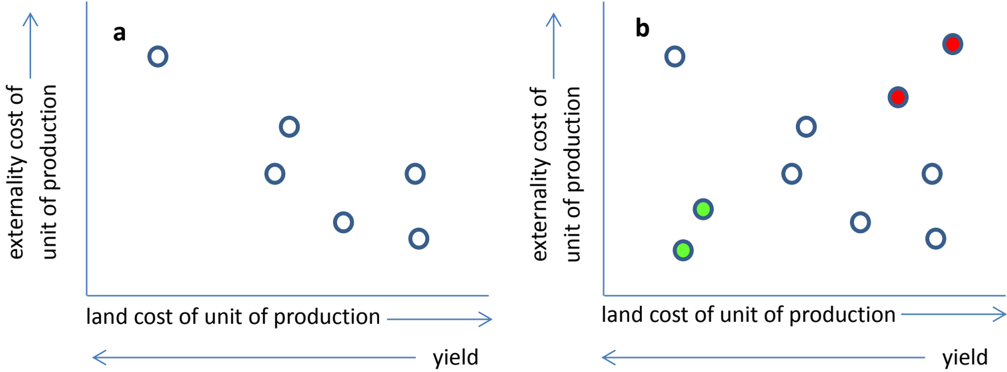
How we manage farming and food systems to meet rising demand is pivotal to the future of biodiversity. Extensive field data suggest impacts on wild populations would be greatly reduced through boosting yields on existing farmland so as to spare remaining natural habitats. High-yield farming raises other concerns because expressed per unit area it can generate high levels of externalities such as greenhouse gas (GHG) emissions and nutrient losses. However, such metrics underestimate the overall impacts of lower-yield systems, so here we develop a framework that instead compares externality and land costs per unit production. Applying this to diverse datasets describing the externalities of four major farm sectors reveals that, rather than involving trade-offs, the externality and land costs of alternative production systems can co-vary positively: per unit production, land-efficient systems often produce lower externalities. For GHG emissions these associations become more strongly positive once forgone sequestration is included. Our conclusions are limited: remarkably few studies report externalities alongside yields; many important externalities and farming systems are inadequately measured; and realising the environmental benefits of high-yield systems typically requires additional measures to limit farmland expansion. Yet our results nevertheless suggest that trade-offs among key cost metrics are not as ubiquitous as sometimes perceived.
Overview
The claims and statistics of this paper haven’t been checked yet.
Free: it reads the open-access text and checks the first 5 claims that cite a source we can check. Create a free account to check every claim.
Integrity signals
Registry
Cites
Statistics
Figures
Verification
Claims the paper makes
The claims and statistics of this paper haven’t been checked yet.
Free: it reads the open-access text and checks the first 5 claims that cite a source we can check. Create a free account to check every claim.
Claims other papers make about this one
Each is checked against this paper’s own text: does it say what the citing paper says it does?
The source backs part of the claim, not all of it — or backs it for a different population, condition or comparison.
In the citing paper
“Although agricultural intensification can have detrimental effects on climate, biodiversity and human health 2,[35][36][37][38][39] , yields can often be increased without incurring these costs 37 .”
From Global priority areas for ecosystem restoration (2020) · cites this paper as [37]
Experimental — accuracy not yet measuredThe check wasn’t confident either way, so it gives no verdict — never disputed.
In the citing paper
“Existing global comparisons of pasture-finished and grain-finished systems are incomplete as they do not account for both carbon opportunity cost and soil carbon sequestration.”
From Carbon opportunity cost increases carbon footprint advantage of grain-finished beef (2023) · cites this paper as [15]
Experimental — accuracy not yet measured
Self-check
Percentages, sums and reported differences re-computed from the paper’s own numbers.
The self-check needs the paper’s full text.
Citations
Cites
Fitting Linear Mixed-Effects Models Using lme4
Bates, D., Mächler, M., Bolker, B., & Walker, S. (2015) · Journal of Statistical Software · doi:10.18637/jss.v067.i01 · Cited by 86,835
Food Security: The Challenge of Feeding 9 Billion People
Godfray, H. C. J., Beddington, J. R., Crute, I. R., Haddad, L., Lawrence, D., Muir, J. F., Pretty, J., Robinson, S., Thomas, S. M., & Toulmin, C. (2010) · Science · doi:10.1126/science.1185383 · Cited by 11,943
Solutions for a cultivated planet
Foley, J. A., Ramankutty, N., Brauman, K. A., Cassidy, E. S., Gerber, J. S., Johnston, M., Mueller, N. D., O’Connell, C., Ray, D. K., West, P. C., et al. (2011) · Nature · doi:10.1038/nature10452 · Cited by 8,476
Agricultural sustainability and intensive production practices
Tilman, D., Cassman, K. G., Matson, P. A., Naylor, R., & Polasky, S. (2002) · Nature · doi:10.1038/nature01014 · Cited by 7,957
Global food demand and the sustainable intensification of agriculture
Tilman, D., Balzer, C., Hill, J., & Befort, B. L. (2011) · Proceedings of the National Academy of Sciences · doi:10.1073/pnas.1116437108 · Cited by 7,692
Reducing food's environmental impacts through producers and consumers
Poore, J., & Nemecek, T. (2018) · Science · doi:10.1126/science.aaq0216 · Cited by 6,085
Soil carbon stocks and land use change: a meta analysis
Guo, L. B., & Gifford, R. M. (2002) · Global Change Biology · doi:10.1046/j.1354-1013.2002.00486.x · Cited by 3,972
Global land use change, economic globalization, and the looming land scarcity
Lambin, E. F., & Meyfroidt, P. (2011) · Proceedings of the National Academy of Sciences · doi:10.1073/pnas.1100480108 · Cited by 3,160
Agricultural Intensification and Ecosystem Properties
Matson, P. A., Parton, W. J., Power, A. G., & Swift, M. J. (1997) · Science · doi:10.1126/science.277.5325.504 · Cited by 3,160
Global diets link environmental sustainability and human health
Tilman, D., & Clark, M. (2014) · Nature · doi:10.1038/nature13959 · Cited by 3,026
Research works printed but not linked: 1
- 109. Anthony, S., Quinn, P. & Lord, E. Catchment scale modelling of nitrate leaching. Asp. Appl. Biol. 46, 23-32 (1996).
Cited by
Items 201–300 of 343
Agricultural lands key to mitigation and adaptation—Response
Morecroft, M. D., Duffield, S. J., Harley, M., Pearce‐Higgins, J. W., Stevens, N., Watts, O., & Whitaker, J. (2020) · Science · doi:10.1126/science.aba7577 · Cited by 4
Carbon and other environmental footprint food labels: potential and pitfallsPreprint
Garnett, E. E. (2023) · OSF Preprints (OSF Preprints) · doi:10.31219/osf.io/tk9uh · Cited by 5
Self-citationGenomic Insights into Historical Adaptation of Three Key Fungal Plant Pathogens
Alkemade, J., Wong, E. L. Y., Buddie, A. G., Ryan, M. J., & Barraclough, T. G. (2025) · Genome Biology and Evolution · doi:10.1093/gbe/evaf241 · Cited by 4
Feeding ducks in ratoon rice field reduces weed competition with ratoon rice in central China
Du, C., Yang, D., Hu, L., Zhu, J., Wang, W., Zhao, W., Peng, S., Yuan, S., & Huang, J. (2025) · Field Crops Research · doi:10.1016/j.fcr.2025.110147 · Cited by 3
Tailoring Australian carbon farming can realise greater co-benefits
Bhattarai, G., Christie, K., Drake, A., Chen, C., Mokany, K., Roberts, G., Burley, H., Garcia, F. C., Doran-Browne, N. A., Ash, R., et al. (2026) · Nature Communications · doi:10.1038/s41467-026-68628-5 · Cited by 7
“Were the model simulations not conducted to predict intervention effects, which were then compared with the baseline condition?”
A brief history of primate research in the Ndoki forest
Morgan, D., Malonga, R., Agnagna, M., Onononga, J. R., Yako, V., Ikonga, J. M., Stokes, E. J., Ayina, C. E., Funkhouser, J. A., Judson, K., et al. (2024) · Primates · doi:10.1007/s10329-024-01158-0 · Cited by 3
Zhang, Y., Yang, Y., Shao, Y., Wang, J., Chen, Z., Roß‐Nickoll, M., & Schäffer, A. (2024) · Environmental Management · doi:10.1007/s00267-024-02064-3 · Cited by 6
“…studies have mainly focused on single tillage approaches, little attention has been paid to the conversion of tillage, for instance, to what extent the EA model promotes to the healthy development of rice ecosystems (Hole et al. 2005; Balmford et al. 2018; Eyhorn et al. 2019; Grass et al. 2021).”
An enhanced genetics × environment × management framework for yield intensification
Moss, R. E., Fairhurst, T., & Grassini, P. (2025) · Nature Food · doi:10.1038/s43016-025-01121-2 · Cited by 4
Mehmeti, A., Canaj, K., Boari, F., Cantore, V., Todorović, M., & Calabrese, N. (2022) · Agronomy · doi:10.3390/agronomy12071605 · Cited by 4
The Sustainability of Cattle Production Systems
Broom, D. M. (2023) · Animal welfare · doi:10.1007/978-3-031-21020-4_13 · Cited by 6
Self-citationSrifitriani, A., Soeprobowati, T. R., & Puryono, S. (2025) · E3S Web of Conferences · doi:10.1051/e3sconf/202560503039 · Cited by 4
Land-sparing vs land-sharing with incomplete policies
Meunier, G. (2019) · European Review of Agricultural Economics · doi:10.1093/erae/jbz011 · Cited by 6
“5 They conclude that land-sparing is the optimal strategy (see also Balmford et al., 2005; Kleijn et al., 2009; Teillard et al., 2015). In the environmental economics literature, Ruijs et al. (2017) propose a semi-parametric technique to estimate production possibility frontiers between agricultural production, biodiv…”
InfluentialAnimal welfare in relation to human welfare and sustainability – a review paper
Broom, D. M. (2022) · Veterinarski arhiv · doi:10.24099/vet.arhiv.2011 · Cited by 6
Self-citationEl cambio climático y la producción agrícola familiar y empresarial en América Latina
Cartay, R., Poveda, E., & Buzetta, M. (2023) · Agroalimentaria · doi:10.53766/agroalim/2023.28.55.11 · Cited by 2
Lenné, J. M., & Wood, D. M. (2025) · Plants · doi:10.3390/plants14050681 · Cited by 3
“More intensive agriculture might be the “least bad” option for feeding the world while saving its species— provided the use of “land-efficient” systems prevents the further conversion of wilderness into farmland [78], which would occur if organic farming were expanded.”
Francois, J. R., Nelson, K. S., Burchfield, E., & Rissing, A. (2025) · Agriculture and Human Values · doi:10.1007/s10460-025-10764-7 · Cited by 2
Towards a unifying theory of conservation in production systems
Erm, P., Holden, M. H., Cerullo, G. R., Green, R. E., & Balmford, A. P. (2025) · Biological Conservation · doi:10.1016/j.biocon.2025.111623 · Cited by 3
Self-citationShinoda, Y., Kadoya, T., Takeuchi, Y., & Nansai, K. (2025) · Resources Conservation and Recycling · doi:10.1016/j.resconrec.2025.108696 · Cited by 2
Bending the curve of agricultural expansion offers a new era for biodiversity and climate
Borrell, J. S. (2026) · Philosophical Transactions of the Royal Society B Biological Sciences · doi:10.1098/rstb.2024.0427 · Cited by 4
Sustainability Trade-Offs Between Crop Rotation and Monoculture in Agricultural Systems
Machado, R. L. S., Dutra, D. A., Schneider, A. T., Machado, E. F., Deprá, M. C., Zepka, L. Q., & Lopes, E. J. (2026) · International Journal of Plant Production · doi:10.1007/s42106-026-00435-w · Cited by 2
“Monocultures, by concentrating production in a single high-yield cycle, show lower apparent LU values when compared per ton (Balmford et al., 2018 ; Loconto et al., 2020 ; Câmara-Salim et al., 2021 ).”
Liu, L., Hu, Z., Feng, X., Pan, W., Dai, T., Sun, T., Wang, H., Yang, K., Xiao, T., Kitahama, Y., et al. (2026) · ACS Sensors · doi:10.1021/acssensors.6c01956 · Cited by 3
Liu, B., Behrens, P., Sun, Z., & Scherer, L. (2026) · Nature Food · doi:10.1038/s43016-026-01387-0 · Cited by 5
Reduction in global habitat loss from fossil‐fuel‐dependent increases in cropland productivity
Goklany, I. M. (2020) · Conservation Biology · doi:10.1111/cobi.13611 · Cited by 3
“Onshore, nonnuclear substitutes (solar, wind, hydro, and biomass) have larger footprints than FFs per energy unit produced (Ausubel 2015).”
BackgroundLiao, L., Gao, N., Guo, H., Hameed, F., Liao, Q., Li, Y., & Xu, J. (2021) · Archives of Agronomy and Soil Science · doi:10.1080/03650340.2021.2018132 · Cited by 2
“…field partially lost in the forms of ammonia volatilization, leaching, runoff and nitrification-denitrification (Ju et al. 2009; Le et al. 2010; Balmford et al. 2018; Yu et al. 2019; Liang et al. 2021), but the ORYZA v3 model does not output the nitrogen loss in each specific pathway…”
BackgroundUsing food democracy to overcome the commodification-driven tragedy of the EU’s food system commons
Tonello, S., & Jani, A. R. (2025) · Open Research Europe · doi:10.12688/openreseurope.19096.1 · Cited by 4
Whelan, M. P. (2025) · Cambridge University Press eBooks · doi:10.1017/9781009158213 · Cited by 1
Reducing Energy in Transport, Building, and Agriculture Through Social Efficiency
Moriarty, P., & Honnery, D. (2021) · Springer eBooks · doi:10.1007/978-1-4614-6431-0_73-2 · Cited by 2
Corlett, R. T. (2019) · Oxford University Press eBooks · doi:10.1093/oso/9780198817017.003.0001 · Cited by 2
Rural Women Farmers’ Grassroots Networks in Africa
Berhane-Selassie, T. (2021) · Springer eBooks · doi:10.1007/978-3-030-28099-4_14 · Cited by 2
Combating Fungicide Resistant Crop Pathogens: Discovery of Metyltetraprole
Matsuzaki, Y., Yoshimoto, Y., Arimori, S., Harada, T., & Iwahashi, F. (2020) · Outlooks on Pest Management · doi:10.1564/v31_apr_05 · Cited by 2
Garnett, E. E. (2020) · Apollo (University of Cambridge) · doi:10.17863/cam.63644 · Cited by 5
Self-citationTerefe, D. (2025) · Research Square · doi:10.21203/rs.3.rs-6107661/v1 · Cited by 2
The Royal Society Environmental Prize lecture on feeding the world without costing the earth
Madhavapeddy, A. (2026) · doi:10.59350/fzfw0-0g424 · Cited by 2
Impacto del cambio climático sobre los sistemas de gestión de malas hierbas
Fernández‐Quintanilla, C., & Barroso, J. (2020) · Informacion Tecnica Economica Agraria · doi:10.12706/itea.2020.034 · Cited by 1
Bogen, C., Mayer, C. J., Davies, J., & Ducrot, V. (2021) · Integrated Environmental Assessment and Management · doi:10.1002/ieam.4420 · Cited by 1
“On the other hand, considering the relationship between land use, agricultural activities, and biodiversity from a broader perspective, agricultural intensification also enables high‐yield farming, which provides new opportunities for landscape management solutions in favor of wild species by sparing remaining natural…”
BackgroundBroom, D. M. (2022) · Elsevier eBooks · doi:10.1016/b978-0-12-823960-5.00073-1 · Cited by 2
Self-citationTrayectoria hacia una producción agrícola sustentable en la provincia de Buenos Aires (1990-2020)
Molpeceres, C. (2022) · Cuadernos del CLAEH · doi:10.29192/claeh.41.2.7 · Cited by 1
Spatio-Temporal Modeling of Land and Pasture Vulnerability in Dairy Basins in Northeastern Brazil
da Silva, J. B. A., de Almeida, G. L. P., da Silva, M. V., de Oliveira‐Júnior, J. F., Pandorfi, H., Giongo, P. R., de Almeida, G. A. P., Guiselini, C., Marinho, G. T. B., Bakke, I. A., et al. (2024) · AgriEngineering · doi:10.3390/agriengineering6030171 · Cited by 1
“Given this scenario, it can be asserted that the sustainability of livestock farming depends on multiple factors and there is no definition of sustainability that fits all production worldwide, nor is there a single agricultural system that is more sustainable than alternative systems [17,18].”
BackgroundFernández‐Quintanilla, C., Lechón, Y., Lago, C., Peña, J. M., & Dorado, J. (2024) · European Journal of Agronomy · doi:10.1016/j.eja.2024.127354 · Cited by 1
Dorado, J., Barroso, J., Peña, J. M., Luna, I. M., & Fernández‐Quintanilla, C. (2025) · Weed Science · doi:10.1017/wsc.2025.10052 · Cited by 2
“Despite these benefits, organic systems are often criticized for lower productivity, which may require greater land use, potentially leading to deforestation and biodiversity loss (Balmford et al. 2018; Seufert and Ramankutty 2017; Seufert et al. 2012; Trewavas 2001).”
Li, Y., Ru, Y., Liao, C., Zhang, X., Xie, H., Wang, H., & Liu, Y. (2025) · Environmental Science Nano · doi:10.1039/d5en00605h · Cited by 5
Fartassi, I. E., Sharp, R. T., Bell, V. A., Whitmore, A. P., Metcalfe, H., Missault, N., Redhead, J. W., Cooper, D. M., Storkey, J., Davies, H., et al. (2025) · Journal of Environmental Management · doi:10.1016/j.jenvman.2025.128389 · Cited by 2
Self-citationSPATIAL DEVELOPMENT OF AGRO-INDUSTRIAL PRODUCTION OF THE COUNTRY
(2018) · doi:10.33049/11.052718.5 · Cited by 1
Pulina, G., & Bertoni, G. (2022) · Elsevier eBooks · doi:10.1016/b978-0-323-85838-0.00011-0 · Cited by 2
DeFi and Investing in Entrepreneurial Ventures
Aggarwal, J. (2024) · Financial innovation and technology · doi:10.1007/978-3-031-49515-1_2 · Cited by 1
Morris, R., Davis, S. G., Grelet, G., & Gregorini, P. (2024) · Journal of Sustainable Agriculture and Environment · doi:10.1002/sae2.12097 · Cited by 2
Ingineering and technological problems of improving the environmental safety of crop production
Shirokov, Y., & Tikhnenko, V. G. (2024) · BIO Web of Conferences · doi:10.1051/bioconf/20249302014 · Cited by 1
Ensuring the security and sustainability of the food system in the face of climate change
Golovina, S. G., Кузнецова, А. Р., Zubareva, L., Шарамеева, О. А., & Zholdoyakova, G. (2024) · BIO Web of Conferences · doi:10.1051/bioconf/202410825010 · Cited by 1
Intensive Farming and Its Effects on Natural Ecosystems
Nulkar, G. V. (2024) · Springer eBooks · doi:10.1007/978-981-99-7379-8_1 · Cited by 3
Niekerk, J. A. V., Venter, P., & Watt, E. V. D. (2024) · Suid-Afrikaanse tydskrif vir landbouvoorligting/South African journal of agricultural extension · doi:10.17159/2413-3221/2024/v52n3a15635 · Cited by 4
Rural Women Farmers’ Grassroots Networks in Africa
Berhane-Selassie, T. (2020) · Springer eBooks · doi:10.1007/978-3-319-77030-7_14-1 · Cited by 1
The Multiple Dimensions of Social Justice Affected by Agricultural Innovation
Timmermann, C. (2020) · The international library of environmental, agricultural and food ethics/The International library of environmental, agricultural and food ethics · doi:10.1007/978-3-030-56193-2_1 · Cited by 3
Growing organic prawns : in inland saline waters.
Slattery, S. L., & Palmer, P. J. (2008) · Queensland Department of Agriculture and Fisheries archive of scientific and research publications (Queensland Department of Agriculture and Fisheries) · Cited by 1
Broudiscou, L.-P., Quinsac, A., Berthelot, V., Carré, P., Dauguet, S., & Peyronnet, C. (2022) · Italian Journal of Animal Science · doi:10.1080/1828051x.2022.2052367 · Cited by 3
“…components such as protein sources (Brizga et al. 2021), the question of the oil origin has recently emerged, with a growing preference for local sources and shortened supply chains in an effort to reduce the environmental impact of ruminant husbandry (Herrero et al. 2009; Balmford et al. 2018).”
BackgroundPerkins, R. (2019) · Veterinary Record · doi:10.1136/vr.l6240 · Cited by 1
Economic Policy in Global Commodity Markets - Methods, Efficiency and Trade-offs
Dalheimer, B. (2020) · eDiss (Georg-August-Universität Göttingen) · doi:10.53846/goediss-8253 · Cited by 2
Biodiversity-food trade-offs when agricultural land is spared from productionPreprint
Palmer, C. E., Groom, B., & Langton, S. (2022) · Research Square · doi:10.21203/rs.3.rs-1661628/v1 · Cited by 1
Biodiversity-food trade-offs when agricultural land is spared from productionPreprint
Palmer, C. E., Groom, B., Sileci, L., & Langton, S. (2023) · Research Square · doi:10.21203/rs.3.rs-1661628/v3 · Cited by 1
Exploring organic food consumption, within the context of Uruguay.
Gonzalez-Triay, M. (2022) · doi:10.46289/9l4p7f2m · Cited by 1
Zhu, Q., Ren, T., Fu, X., Ros, G. H., VRIES, W. D., & Zhang, F. S. (2025) · Research Square · doi:10.21203/rs.3.rs-5461656/v1 · Cited by 1
Threats to terrestrial biodiversity
Corlett, R. T. (2019) · Oxford University Press eBooks · doi:10.1093/oso/9780198817017.003.0007
Conservation in the Anthropocene
Corlett, R. T. (2019) · Oxford University Press eBooks · doi:10.1093/oso/9780198817017.003.0008
The Area of Farms and their Influence on Generating Negative Externalities
Pajewski, T., Gołębiewska, B., & Sobolewska, A. (2019) · EUROPEAN RESEARCH STUDIES JOURNAL · doi:10.35808/ersj/1493
“Balmford et al. (2018), however, have indicated that little research exists on the correlation between farm size, yield and external effects generated.”
BackgroundKisić, I. (2020) · Disputatio philosophica · doi:10.32701/dp.21.1.4
McKay-Valentine, A. (2020) · Open Access Victoria University of Wellington | Te Herenga Waka (Figshare) · doi:10.26686/wgtn.17147768.v1
Eyre, R. (2020) · The Atrium (University of Guelph) · Cited by 1
Maltais, A., Gardner, T. A., Godar, J., Lazarus, M., & Mete, G. (2021) · doi:10.51414/sei2021.023 · Cited by 2
Exposing Hidden Migrant Farmscapes
Haedicke, S. C. (2021) · Springer eBooks · doi:10.1007/978-3-030-82434-1_5
(2020) · Elsevier eBooks · doi:10.1016/b978-0-12-814608-8.09992-8
The ecology of plants: from seed to seed
Corlett, R. T. (2019) · Oxford University Press eBooks · doi:10.1093/oso/9780198817017.003.0004
The ecology of animals: Foods and feeding
Corlett, R. T. (2019) · Oxford University Press eBooks · doi:10.1093/oso/9780198817017.003.0005
Corlett, R. T. (2019) · Oxford University Press eBooks · doi:10.1093/oso/9780198817017.003.0003
Corlett, R. T. (2019) · Oxford University Press eBooks · doi:10.1093/oso/9780198817017.003.0002
Corlett, R. T. (2019) · Oxford University Press eBooks · doi:10.1093/oso/9780198817017.003.0006
Reducing Energy in Transport, Building, and Agriculture Through Social Efficiency
Moriarty, P., & Honnery, D. (2022) · Springer eBooks · doi:10.1007/978-3-030-72579-2_73
Biodiversity-food trade-offs when agricultural land is spared from productionPreprint
Palmer, C. E., Groom, B., & Langton, S. (2022) · Research Square · doi:10.21203/rs.3.rs-1661628/v2
Ruggiero, M. H., Bentos, A. B., Paganeli, B., Adorno, H. A., Lorandi, R., de Lollo, J. A., & Moschini, L. E. (2022) · Cuadernos de Geografía Revista Colombiana de Geografía · doi:10.15446/rcdg.v31n2.88995
Impacts of global food supply on biodiversity via land use and climate changePreprint
Boakes, E., Dalin, C., Etard, A., & Newbold, T. (2024) · bioRxiv · doi:10.1101/2023.05.03.539201 · Cited by 2
Agricultura biológica e outras coisas
Salema, R., & Porto, U. (2023) · Revista de Ciência Elementar · doi:10.24927/rce2023.020
Cullen, S., Keeffe, G., & Campbell, E. (2023) · Contemporary urban design thinking · doi:10.1007/978-3-031-37861-4_8
Metadata
- Authors
- Balmford, A., Amano, T., Bartlett, H., Chadwick, D., Collins, A., Edwards, D., Field, R., Garnsworthy, P., Green, R., Smith, P., Waters, H., Whitmore, A., Broom, D. M., Chara, J., Finch, T., Garnett, E., Gathorne-Hardy, A., Hernandez-Medrano, J., Herrero, M., Hua, F., Latawiec, A., Misselbrook, T., Phalan, B., Simmons, B. I., Takahashi, T., Vause, J., zu Ermgassen, E., & Eisner, R.
- Affiliations
- University of Cambridge (GB)
- Rothamsted Research (GB)
- University of Sheffield (GB)
- Royal Society for the Protection of Birds (GB)
- University of Nottingham (GB)
- University of Aberdeen (GB)
- Universidad Nacional Autónoma de México (MX)
- Commonwealth Scientific and Industrial Research Organisation (AU)
- Pontifícia Universidade Católica do Rio de Janeiro (BR)
- Universidade Federal da Bahia (BR)
- UN Environment Programme World Conservation Monitoring Centre (GB)
- Corresponding author
- Balmford, Andrew
- ORCID
- Balmford, Andrew
- Amano, Tatsuya
- Bartlett, Harriet
- Collins, Adrian
- Edwards, David
- Field, Rob
- Garnsworthy, Philip
- Green, Rhys
- Smith, Pete
- Waters, Helen
- Whitmore, Andrew
- Broom, Donald M.
- Finch, Tom
- Garnett, Emma
- Hernandez-Medrano, Juan
- Herrero, Mario
- Hua, Fangyuan
- Latawiec, Agnieszka
- Misselbrook, Tom
- Phalan, Ben
- Simmons, Benno I.
- Takahashi, Taro
- Vause, James
- Eisner, Rowan
- Venue
- Nature Sustainability
- Published
- 2018-09-14
- Volume
- 1
- Issue
- 9
- Pages
- 477-485
- ISSN
- 2398-9629 (ISSN-L)
- PMC
- PMC6237269
- OpenAlex
- W2889602878
- Cited by
- 343
- References
- 105
- Citations by year
- 2026: 38 · 2025: 37 · 2024: 37 · 2023: 26 · 2022: 40 · 2021: 45 · 2020: 52 · 2019: 45 · 2018: 20
- FWCI
- 21.19
- Type
- journal article
- Language
- en
- Update notices
- correction (2019-03-26)
- Open access
- bronze
- doi.org
- Licence
- www.springernature.com/gp/researchers/text-and-data-mining (tdm)
- www.springernature.com/gp/researchers/text-and-data-mining (vor)
- Locations
- Nature Sustainability (publishedVersion)
- PubMed (publishedVersion)
- Explore Bristol Research (publishedVersion, other-oa)
- White Rose Research Online (University of Leeds, The University of Sheffield, University of York) (acceptedVersion)
- Europe PMC (PubMed Central) (acceptedVersion)
- PubMed Central (acceptedVersion)
- Edinburgh Research Explorer (University of Edinburgh) (submittedVersion, other-oa)
- Bristol Research (University of Bristol) (submittedVersion, other-oa)
- Apollo (University of Cambridge) (submittedVersion)
- RePEc: Research Papers in Economics (submittedVersion)
- Aberdeen University Research Archive (Aberdeen University) (submittedVersion)
- Repository@Nottingham (University of Nottingham) (submittedVersion, cc-by)
- Rothamsted Repository (Rothamsted Repository) (submittedVersion)
- Bangor University Research Portal (Bangor University) (submittedVersion, other-oa)
- Apollo
- Funders
- Grantham Foundation for the Protection of the Environment
- Arcadia Fund (NE/L002507/1)
- Cambridge Conservation Initiative (NE/L002507/1)
- Biotechnology and Biological Sciences Research Council (BBS/E/C/000J0300, BB/N013468/, BB/N013484/1, BB/N013468/1, BBS/E/C/000I0320, BBS/E/C/000I0330, BBS/E/C/00005198)
- Natural Environment Research Council (NE/M016714/1, L002507/1, NE/M021327/1, NE/P019455/1, NE/L002507/1, NE/J011568/1, NE/N018125/1, 1796601, BB/N013468/1, NE/M016900/1, BB/N013484/1, BBS/E/C/000I0330)
- Topics
- Life Sciences › Agricultural and Biological Sciences › Agronomy and Crop Science › Sustainable Agricultural Systems Analysis
- Physical Sciences › Environmental Science › Ecology › Agriculture Sustainability and Environmental Impact
- Physical Sciences › Environmental Science › Global and Planetary Change › Land Use and Ecosystem Services
- Keywords
- high-yield cultivation, agricultural externalities, greenhouse gas emissions, nutrient loss, land use efficiency, biodiversity conservation, cropland expansion, carbon sequestration, food system sustainability
About these checks
Registry, retraction, Cites and statistics results are computed, not judged, with one exception: a printed reference that no index lists is read once by a model before it counts as a citation error. Claims are extracted by a model and kept only when their quote appears verbatim in the text; each cited source is then checked, with a model’s help, for whether it says what the claim relies on. Those verdicts can be wrong — read the claim’s quote and the cited source before relying on one.
Statistics and arithmetic are recomputed, not judged.
Confidence bands are shown only for fields calibrated on our annotated test set. None is calibrated yet, so no band is shown.
What counts as a claim ›How we measure confidence ›How we check this ›
Are you an author, or do you see a problem with this page? Request a review
Data sources
Bibliographic data: Semantic Scholar, OpenAlex, Crossref.
Contains information from the Semantic Scholar Academic Graph Datasets, made available under the ODC Attribution License (ODC-BY 1.0).
Semantic Scholar’s data is described in: Kinney, R., et al. (2023). The Semantic Scholar Open Data Platform. arXiv:2301.10140.
