

Vitamin D status modulates mitochondrial oxidative capacities in skeletal muscle: role in sarcopenia
Open accessThe DOI matches its Crossref record; 41 of the 41 references it cites were found in a registry or an index.
Abstract
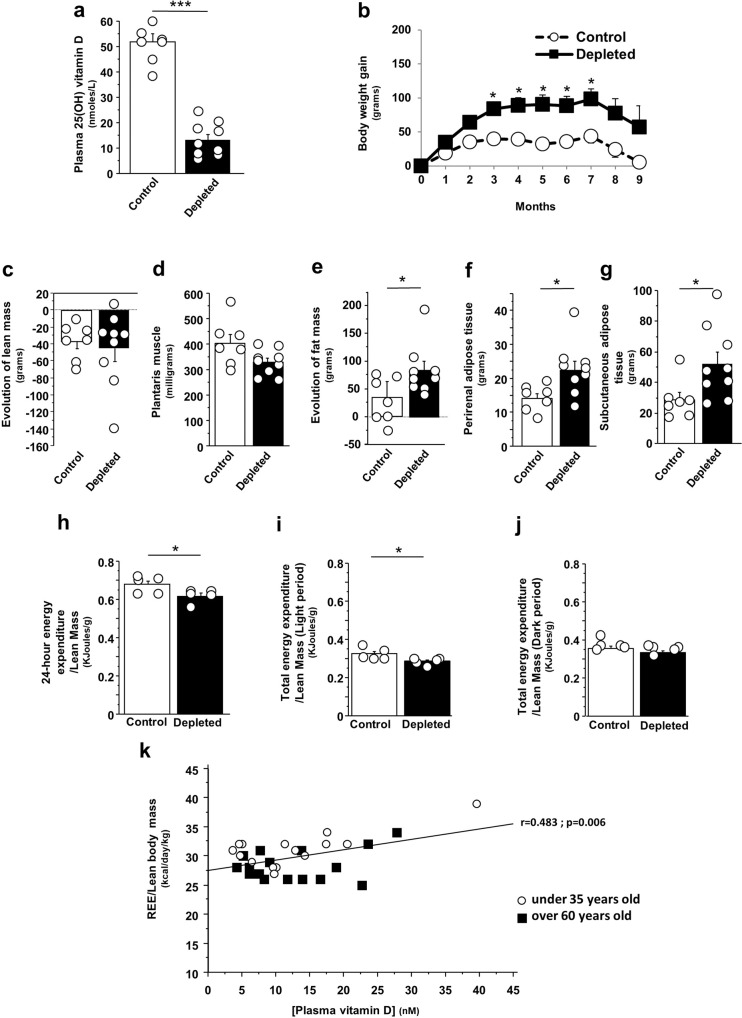
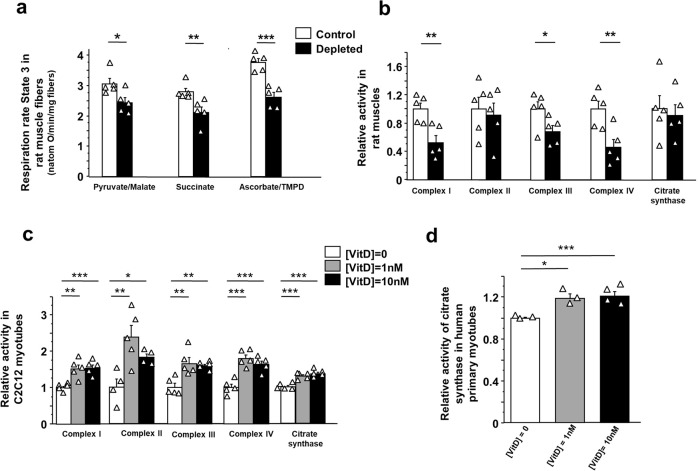
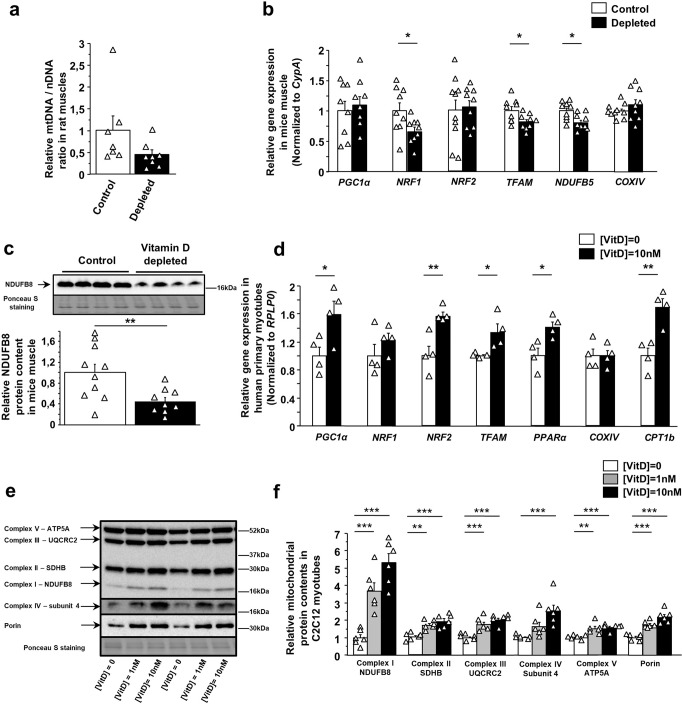
Skeletal muscle mitochondrial function is the biggest component of whole-body energy output. Mitochondrial energy production during exercise is impaired in vitamin D-deficient subjects. In cultured myotubes, loss of vitamin D receptor (VDR) function decreases mitochondrial respiration rate and ATP production from oxidative phosphorylation. We aimed to examine the effects of vitamin D deficiency and supplementation on whole-body energy expenditure and muscle mitochondrial function in old rats, old mice, and human subjects. To gain further insight into the mechanisms involved, we used C2C12 and human muscle cells and transgenic mice with muscle-specific VDR tamoxifen-inducible deficiency. We observed that in vivo and in vitro vitamin D fluctuations changed mitochondrial biogenesis and oxidative activity in skeletal muscle. Vitamin D supplementation initiated in older people improved muscle mass and strength. We hypothesize that vitamin D supplementation is likely to help prevent not only sarcopenia but also sarcopenic obesity in vitamin D-deficient subjects.
Overview
The claims and statistics of this paper haven’t been checked yet.
Free: it reads the open-access text and checks the first 5 claims that cite a source we can check. Create a free account to check every claim.
Integrity signals
Registry
Cites
Statistics
Figures
Verification
Claims the paper makes
The claims and statistics of this paper haven’t been checked yet.
Free: it reads the open-access text and checks the first 5 claims that cite a source we can check. Create a free account to check every claim.
Claims other papers make about this one
Each is checked against this paper’s own text: does it say what the citing paper says it does?
The cited source says what the claim attributes to it.
In the citing paper
“the binding of the vitamin D receptor to its ligand 1,25 (OH)2D3 triggers gene transcription associated with muscle function (83).”
From Sarcopenic obesity: epidemiology, pathophysiology, cardiovascular disease, mortality, and management (2023) · cites this paper as [83]
Self-check
Percentages, sums and reported differences re-computed from the paper’s own numbers.
The self-check needs the paper’s full text.
Citations
Cites
New methods for calculating metabolic rate with special reference to protein metabolism
Weir, J. B. D. V. (1949) · The Journal of Physiology · doi:10.1113/jphysiol.1949.sp004363 · Cited by 5,603 · cited 1×
“Energy expenditure was calculated using Weir’s equation(31).”
Raudvere, U., Kolberg, L., Kuzmin, I., Arak, T., Adler, P., Peterson, H., & Vilo, J. (2019) · Nucleic Acids Research · doi:10.1093/nar/gkz369 · Cited by 5,045
Decreased bioavailability of vitamin D in obesity
Wortsman, J., Matsuoka, L. Y., Chen, T. C., Lu, Z., & Holick, M. F. (2000) · The American Journal of Clinical Nutrition · doi:10.1093/ajcn/72.3.690 · Cited by 3,204
Enrichment Map: A Network-Based Method for Gene-Set Enrichment Visualization and Interpretation
Merico, D., Isserlin, R., Stueker, O., Emili, A., & Bader, G. D. (2010) · PLoS ONE · doi:10.1371/journal.pone.0013984 · Cited by 2,235
Vimaleswaran, K. S., Berry, D. J., Lu, C., Tikkanen, E., Pilz, S., Hiraki, L. T., Cooper, J. D., Dastani, Z., Li, R., Houston, D. K., et al. (2013) · PLoS Medicine · doi:10.1371/journal.pmed.1001383 · Cited by 1,046
Metabolic Differentiation of Distinct Muscle Types at the Level of Enzymatic Organization
Bass, A., Brdiczka, D., Eyer, P., Hofer, S., & Pette, D. (1969) · European Journal of Biochemistry · doi:10.1111/j.1432-1033.1969.tb00674.x · Cited by 668
Duodenal calcium absorption in vitamin D receptor–knockout mice: Functional and molecular aspects
Van Cromphaut, S. J., Dewerchin, M., Hoenderop, J. G. J., Stockmans, I., Van Herck, E., Kato, S., Bindels, R. J. M., Collen, D., Carmeliet, P., Bouillon, R., et al. (2001) · Proceedings of the National Academy of Sciences · doi:10.1073/pnas.231474698 · Cited by 591
Vitamin D Receptor Expression in Human Muscle Tissue Decreases with Age
Bischoff-Ferrari, H., Borchers, M., Gudat, F., Dürmüller, U., Stähelin, H., & Dick, W. (2004) · Journal of Bone and Mineral Research · doi:10.1359/jbmr.2004.19.2.265 · Cited by 585
Vitamin D Deficiency: Defining, Prevalence, Causes, and Strategies of Addressing
Cashman, K. D. (2020) · Calcified Tissue International · doi:10.1007/s00223-019-00559-4 · Cited by 384
Sinha, A., Hollingsworth, K. G., Ball, S., & Cheetham, T. (2013) · The Journal of Clinical Endocrinology & Metabolism · doi:10.1210/jc.2012-3592 · Cited by 226
Mitochondrial abnormalities are more frequent in muscles undergoing sarcopenia
Bua, E. A., McKiernan, S. H., Wanagat, J., McKenzie, D., & Aiken, J. M. (2002) · Journal of Applied Physiology · doi:10.1152/japplphysiol.01102.2001 · Cited by 223
Ryan, Z. C., Craig, T. A., Folmes, C. D., Wang, X., Lanza, I. R., Schaible, N. S., Salisbury, J. L., Nair, K. S., Terzic, A., Sieck, G. C., et al. (2016) · Journal of Biological Chemistry · doi:10.1074/jbc.m115.684399 · Cited by 212
Medja, F., Allouche, S., Frachon, P., Jardel, C., Malgat, M., de Camaret, B. M., Slama, A., Lunardi, J., Mazat, J. P., & Lombès, A. (2009) · Mitochondrion · doi:10.1016/j.mito.2009.05.001 · Cited by 210
Vitamin D Storage in Adipose Tissue of Obese and Normal Weight Women
Carrelli, A., Bucovsky, M., Horst, R., Cremers, S., Zhang, C., Bessler, M., Schrope, B., Evanko, J., Blanco, J., Silverberg, S. J., et al. (2017) · Journal of Bone and Mineral Research · doi:10.1002/jbmr.2979 · Cited by 204
Inducible Cre transgenic mouse strain for skeletal muscle-specific gene targeting
McCarthy, J. J., Srikuea, R., Kirby, T. J., Peterson, C. A., & Esser, K. A. (2012) · Skeletal Muscle · doi:10.1186/2044-5040-2-8 · Cited by 194
Salles, J., Chanet, A., Giraudet, C., Patrac, V., Pierre, P., Jourdan, M., Luiking, Y. C., Verlaan, S., Migné, C., Boirie, Y., et al. (2013) · Molecular Nutrition & Food Research · doi:10.1002/mnfr.201300074 · Cited by 168
Self-citationPsarra, A. G., Solakidi, S., & Sekeris, C. E. (2006) · Molecular and Cellular Endocrinology · doi:10.1016/j.mce.2005.11.025 · Cited by 164
Obesity and hypovitaminosis D: causality or casualty?
on behalf of Obesity Programs of nutrition, E., Migliaccio, S., Di Nisio, A., Mele, C., Scappaticcio, L., Savastano, S., & Colao, A. (2019) · International Journal of Obesity Supplements · doi:10.1038/s41367-019-0010-8 · Cited by 159
Chemokine Expression in Inflamed Adipose Tissue Is Mainly Mediated by NF-κB
Tourniaire, F., Romier-Crouzet, B., Lee, J. H., Marcotorchino, J., Gouranton, E., Salles, J., Malezet, C., Astier, J., Darmon, P., Blouin, E., et al. (2013) · PLoS ONE · doi:10.1371/journal.pone.0066515 · Cited by 152
Self-citationMitochondrial Myopathy Studies on Permeabilized Muscle Fibers1
Letellier, T., Malgat, M., Coquet, M., Moretto, B., Parrot-Roulaud, F., & Mazat, J. (1992) · Pediatric Research · doi:10.1203/00006450-199207000-00004 · Cited by 114
Calcium and Dairy Product Modulation of Lipid Utilization and Energy Expenditure
Teegarden, D., White, K. M., Lyle, R. M., Zemel, M. B., Van Loan, M. D., Matkovic, V., Craig, B. A., & Schoeller, D. A. (2008) · Obesity · doi:10.1038/oby.2008.232 · Cited by 107
El Hajj, C., Fares, S., Chardigny, J. M., Boirie, Y., & Walrand, S. (2019) · Archives of Osteoporosis · doi:10.1007/s11657-018-0553-2 · Cited by 89
Self-citationBassatne, A., Chakhtoura, M., Saad, R., & Fuleihan, G. E.-H. (2019) · Metabolism · doi:10.1016/j.metabol.2018.12.010 · Cited by 81
Zangarelli, A., Chanseaume, E., Morio, B., Brugère, C., Mosoni, L., Rousset, P., Giraudet, C., Patrac, V., Gachon, P., Boirie, Y., et al. (2006) · The FASEB Journal · doi:10.1096/fj.05-4544com · Cited by 71
Self-citationKim, J., Lee, Y., Kye, S., Chung, Y., & Lee, O. (2017) · Journal of Cachexia, Sarcopenia and Muscle · doi:10.1002/jcsm.12154 · Cited by 71
The vitamin D receptor regulates mitochondrial function in C2C12 myoblasts
Ashcroft, S. P., Bass, J. J., Kazi, A. A., Atherton, P. J., & Philp, A. (2020) · American Journal of Physiology-Cell Physiology · doi:10.1152/ajpcell.00568.2019 · Cited by 69
Landrier, J., Kasiri, E., Karkeni, E., Mihály, J., Béke, G., Weiss, K., Lucas, R., Aydemir, G., Salles, J., Walrand, S., et al. (2017) · The FASEB Journal · doi:10.1096/fj.201600263rr · Cited by 61
Self-citationChanet, A., Salles, J., Guillet, C., Giraudet, C., Berry, A., Patrac, V., Domingues-Faria, C., Tagliaferri, C., Bouton, K., Bertrand‐Michel, J., et al. (2017) · The Journal of Nutritional Biochemistry · doi:10.1016/j.jnutbio.2017.02.024 · Cited by 59
Self-citationNovel mitochondrial DNA mutations responsible for maternally inherited nonsyndromic hearing loss
Gutiérrez Cortés, N., Pertuiset, C., Dumon, E., Börlin, M., Hebert-Chatelain, E., Pierron, D., Feldmann, D., Jonard, L., Marlin, S., Letellier, T., et al. (2012) · Human Mutation · doi:10.1002/humu.22023 · Cited by 39
Self-citationCalcium and Vitamin D in the Regulation of Energy Balance: Where Do We Stand?
Soares, M. J., Pathak, K., & Calton, E. K. (2014) · International Journal of Molecular Sciences · doi:10.3390/ijms15034938 · Cited by 39
Pereira, M. E., Costa, P. R. D. F., Pereira, E. M., Lago, I. R. D. L., & Oliveira, A. M. (2021) · Public Health · doi:10.1016/j.puhe.2020.04.031 · Cited by 37
Vitamin D and muscle trophicity
Domingues-Faria, C., Boirie, Y., & Walrand, S. (2017) · Current Opinion in Clinical Nutrition & Metabolic Care · doi:10.1097/mco.0000000000000358 · Cited by 36
Self-citationDiet-induced vitamin D deficiency reduces skeletal muscle mitochondrial respiration
Ashcroft, S. P., Fletcher, G., Philp, A. M., Jenkinson, C., Das, S., Hansbro, P. M., Atherton, P. J., & Philp, A. (2021) · Journal of Endocrinology · doi:10.1530/joe-20-0233 · Cited by 32
Hajj, C. E., Chardigny, J., Boirie, Y., Yammine, K., Helou, M. C., & Walrand, S. (2018) · The journal of nutrition health & aging · doi:10.1007/s12603-018-1083-8 · Cited by 28
Self-citationRana, P., Marwaha, R. K., Kumar, P., Narang, A., Devi, M. M., Tripathi, R. P., & Khushu, S. (2014) · Endocrine Research · doi:10.3109/07435800.2013.865210 · Cited by 23
Salles, J., Chanet, A., Berry, A., Giraudet, C., Patrac, V., Domingues-Faria, C., Rocher, C., Guillet, C., Denis, P., Pouyet, C., et al. (2017) · Molecular Nutrition & Food Research · doi:10.1002/mnfr.201700287 · Cited by 22
Self-citationRevelle, L. K., Solan, V. C., Londowski, J. M., Bollman, S., & Kumar, R. (1984) · Biochemistry · doi:10.1021/bi00304a016 · Cited by 20
Vitamin D Toxicity; Stored and Released from Adipose Tissue?
Ziaie, H., Razmjou, S., Jomhouri, R., & Jenabi, A. (2016) · PubMed · Cited by 13
Effect of vitamin D2 on hormone-stimulated lipolysis in vitro
Fassina, G., Maragno, I., Dorigo, P., & Contessa, A. R. (1969) · European Journal of Pharmacology · doi:10.1016/0014-2999(69)90150-2 · Cited by 12
Bénard, G., & Rossignol, R. (2008) · American Journal of Physiology-Cell Physiology · doi:10.1152/ajpcell.00143.2008 · Cited by 8
Hanks, L. J., Casazza, K., Ashraf, A. P., Ramanadham, S., Ard, J. D., Bray, M. S., Beasley, T. M., & Fernández, J. R. (2013) · Journal of Bone and Mineral Metabolism · doi:10.1007/s00774-013-0454-9 · Cited by 2
Cited by
Sarcopenic obesity: epidemiology, pathophysiology, cardiovascular disease, mortality, and management
Wei, S., Nguyen, T. T., Zhang, Y., Ryu, D., & Gariani, K. (2023) · Frontiers in Endocrinology · doi:10.3389/fendo.2023.1185221 · Cited by 291
Li, X., He, J., & Sun, Q. (2024) · Clinical Nutrition · doi:10.1016/j.clnu.2024.07.006 · Cited by 74
Golubnitschaja, O., Kapinová, A., Sargheini, N., Bojková, B., Kapalla, M., Heinrich, L., Gkika, E., & Kubatka, P. (2024) · The EPMA Journal · doi:10.1007/s13167-024-00358-4 · Cited by 65
“Decreased vitamin D levels reduce mitochondrial activity and ATP production from oxidative phosphorylation and increase oxidative stress and inflammation [205, 206].”
BackgroundFeng, Z., Xia, J., Yu, J., Wang, J. P., Yin, S., Yang, H. J., Wu, T., Zhang, Z., Yan, W., Wang, S., et al. (2025) · International Journal of Molecular Sciences · doi:10.3390/ijms26115113 · Cited by 55
“This compromised mitochondrial function results in diminished energy metabolism efficiency, characterized by reduced overall energy expenditure, further aggravating muscle wasting and fat deposition [126].”
Cochet, C., Belloni, G., Buondonno, I., Chiara, F., & D’Amelio, P. (2023) · Nutrients · doi:10.3390/nu15173703 · Cited by 53
“Even though several authors showed that active vitamin D supplementation (calcitriol) significantly improves mitochondrial function, biogenesis and decreases oxidative stress [35,36,74], and, clinically, hypovitaminosis D induces muscle atrophy, clinical trials on vitamin D supplementation were not effective in provin…”
Background
Metadata
- Authors
- Salles, J., Chanet, A., Guillet, C., Vaes, A. M., Brouwer-Brolsma, E. M., Rocher, C., Giraudet, C., Patrac, V., Meugnier, E., Montaurier, C., Denis, P., Le Bacquer, O., Blot, A., Jourdan, M., Luiking, Y., Furber, M., Van Dijk, M., Tardif, N., Yves Boirie, Y., & Walrand, S.
- Affiliations
- Université Clermont Auvergne (FR)
- Wageningen University & Research (NL)
- Centre National de la Recherche Scientifique (FR)
- Lyon 1 Université (FR)
- Centre de Recherche en Nutrition Humaine d'Auvergne (FR)
- Nutricia Research (Netherlands) (NL)
- Karolinska University Hospital (SE)
- Corresponding author
- Walrand, Stéphane
- ORCID
- Venue
- Communications Biology
- Published
- 2022-11-24
- Volume
- 5
- Issue
- 1
- Pages
- 1288-1288
- ISSN
- 2399-3642 (ISSN-L)
- PMC
- PMC9700804
- OpenAlex
- W4310056597
- Cited by
- 73
- References
- 41
- Citations by year
- 2026: 24 · 2025: 19 · 2024: 23 · 2023: 7
- FWCI
- 8.30
- Type
- journal article
- Language
- en
- Open access
- gold
- doi.org
- Licence
- cc-by
- creativecommons.org/licenses/by/4.0 (tdm)
- creativecommons.org/licenses/by/4.0 (vor)
- Locations
- Communications Biology (publishedVersion, cc-by)
- PubMed Central (publishedVersion, cc-by)
- PubMed (publishedVersion)
- HAL (submittedVersion, other-oa)
- Socio-Environmental Systems Modeling (submittedVersion, cc-by)
- HAL (submittedVersion)
- DOAJ (DOAJ: Directory of Open Access Journals) (submittedVersion, cc-by-sa)
- Oskar-Bordeaux (Universite de Bordeaux) (submittedVersion, cc-by)
- Data Archiving and Networked Services (DANS) (submittedVersion, cc-by)
- Funders
- Institut National de Recherche pour l'Agriculture, l'Alimentation et l'Environnement
- Topics
- Health Sciences › Medicine › Endocrinology, Diabetes and Metabolism › Vitamin D Research Studies
- Life Sciences › Biochemistry, Genetics and Molecular Biology › Molecular Biology › Muscle Physiology and Disorders
- Life Sciences › Biochemistry, Genetics and Molecular Biology › Molecular Biology › Mitochondrial Function and Pathology
- Keywords
- vitamin D status, vitamin D deficiency, vitamin D supplementation, sarcopenia, sarcopenic obesity, skeletal muscle, mitochondrial function, mitochondrial biogenesis, oxidative phosphorylation, mitochondrial respiration, vitamin D receptor, aging, muscle mass and strength, energy expenditure
- MeSH terms
- Aged, Animals, Humans, Mitochondria, Vitamin D, Vitamin D Deficiency, Oxidative Stress, Muscle, Skeletal, Mice, Rats, Sarcopenia
About these checks
Registry, retraction, Cites and statistics results are computed, not judged, with one exception: a printed reference that no index lists is read once by a model before it counts as a citation error. Claims are extracted by a model and kept only when their quote appears verbatim in the text; each cited source is then checked, with a model’s help, for whether it says what the claim relies on. Those verdicts can be wrong — read the claim’s quote and the cited source before relying on one.
Statistics and arithmetic are recomputed, not judged.
Confidence bands are shown only for fields calibrated on our annotated test set. None is calibrated yet, so no band is shown.
What counts as a claim ›How we measure confidence ›How we check this ›
Are you an author, or do you see a problem with this page? Request a review
Data sources
Bibliographic data: Semantic Scholar, OpenAlex, Crossref.
Contains information from the Semantic Scholar Academic Graph Datasets, made available under the ODC Attribution License (ODC-BY 1.0).
Semantic Scholar’s data is described in: Kinney, R., et al. (2023). The Semantic Scholar Open Data Platform. arXiv:2301.10140.
