

Probabilistic projections of increased heat stress driven by climate change
Open accessThe DOI matches its Crossref record; 22 of the 22 references it cites were found in a registry or an index.
Abstract
The Heat Index is a metric that quantifies heat exposure in human beings. Here, using probabilistic emission projections, we show that changes in the Heat Index driven by anthropogenic CO 2 emissions will increase global exposure to dangerous environments in the coming decades. Even if the Paris Agreement goal of limiting global warming to 2 °C is met, the exposure to dangerous Heat Index levels will likely increase by 50–100% across much of the tropics and increase by a factor of 3–10 in many regions throughout the midlatitudes. Without emissions reductions more aggressive than those considered possible by our statistical projection, it is likely that by 2100, many people living in tropical regions will be exposed to dangerously high Heat Index values during most days of each typical year, and that the kinds of deadly heat waves that have been rarities in the midlatitudes will become annual occurrences.
Overview
The claims and statistics of this paper haven’t been checked yet.
Free: it reads the open-access text and checks the first 5 claims that cite a source we can check. Create a free account to check every claim.
Integrity signals
Registry
Cites
Statistics
Figures
Verification
Claims the paper makes
The claims and statistics of this paper haven’t been checked yet.
Free: it reads the open-access text and checks the first 5 claims that cite a source we can check. Create a free account to check every claim.
Claims other papers make about this one
Each is checked against this paper’s own text: does it say what the citing paper says it does?
The source backs part of the claim, not all of it — or backs it for a different population, condition or comparison.
In the citing paper
“All of these aspects of climate change threaten food, water, and other resource security and dramatically increase the risk of heat-related illness and death.71, 75, 76, 77, 78”
From Global fertility in 204 countries and territories, 1950–2021, with forecasts to 2100: a comprehensive demographic analysis for the Global Burden of Disease Study 2021 (2024) · cites this paper as [76]
Experimental — accuracy not yet measured
Self-check
Percentages, sums and reported differences re-computed from the paper’s own numbers.
The self-check needs the paper’s full text.
Citations
Cites
The NCEP/NCAR 40-Year Reanalysis Project
Kalnay, E., Kanamitsu, M., Kistler, R., Collins, W., Deaven, D., Gandin, L., Iredell, M., Saha, S., White, G., Woollen, J., et al. (1996) · Bulletin of the American Meteorological Society · doi:10.1175/1520-0477(1996)077<0437:tnyrp>2.0.co;2 · Cited by 28,360
Climate Extremes: Observations, Modeling, and Impacts
Easterling, D. R., Meehl, G. A., Parmesan, C., Changnon, S. A., Karl, T. R., & Mearns, L. O. (2000) · Science · doi:10.1126/science.289.5487.2068 · Cited by 4,867 · cited 1×
“Given the interest in temperature extremes driven by climate change 7-9 and new research showing that warming has already caused some populations to experience heat stress that approaches the limit of survivability 10 , this paper will quantify the extent to which different regions across Earth’s…”
Friedlingstein, P., O'Sullivan, M., Jones, M. W., Andrew, R. M., Hauck, J., Olsen, A., Peters, G. P., Peters, W., Pongratz, J., Sitch, S., et al. (2020) · Earth System Science Data · doi:10.5194/essd-12-3269-2020 · Cited by 2,544
Heat Stress and Public Health: A Critical Review
Kovats, R. S., & Hajat, S. (2008) · Annual Review of Public Health · doi:10.1146/annurev.publhealth.29.020907.090843 · Cited by 1,896 · cited 3×
“We calculated the global mean temperature for each year from 2015 to 2100 using output from 23 models that participated in the Coupled Model Intercomparison Project Phase 6 (CMIP6) and were forced by four different emissions scenarios (SSP1-2.”
InfluentialRobustness and uncertainties in the new CMIP5 climate model projections
Knutti, R., & Sedláček, J. (2013) · Nature Climate Change · doi:10.1038/nclimate1716 · Cited by 1,569 · cited 2×
“While the mean warming pattern is known to be relatively consistent across climate models 17 and the relationship between relative humidity changes over land and global mean temperature change has been detailed from observations 18 , there is still uncertainty in these pattern effects that is not…”
An Assessment of Earth's Climate Sensitivity Using Multiple Lines of Evidence
Sherwood, S. C., Webb, M. J., Annan, J. D., Armour, K. C., Forster, P. M., Hargreaves, J. C., Hegerl, G., Klein, S. A., Marvel, K. D., Rohling, E. J., et al. (2020) · Reviews of Geophysics · doi:10.1029/2019rg000678 · Cited by 1,254 · cited 1×
“The uncertainty in transient climate sensitivity is similar to that reported in other studies 13 and reflects the different model physics and parameterizations that lead to various amounts of global warming across climate models forced by the same amount of anthropogenic emissions.”
An adaptability limit to climate change due to heat stress
Sherwood, S. C., & Huber, M. (2010) · Proceedings of the National Academy of Sciences · doi:10.1073/pnas.0913352107 · Cited by 1,236
The emergence of heat and humidity too severe for human tolerance
Raymond, C., Matthews, T., & Horton, R. M. (2020) · Science Advances · doi:10.1126/sciadv.aaw1838 · Cited by 839 · cited 2×
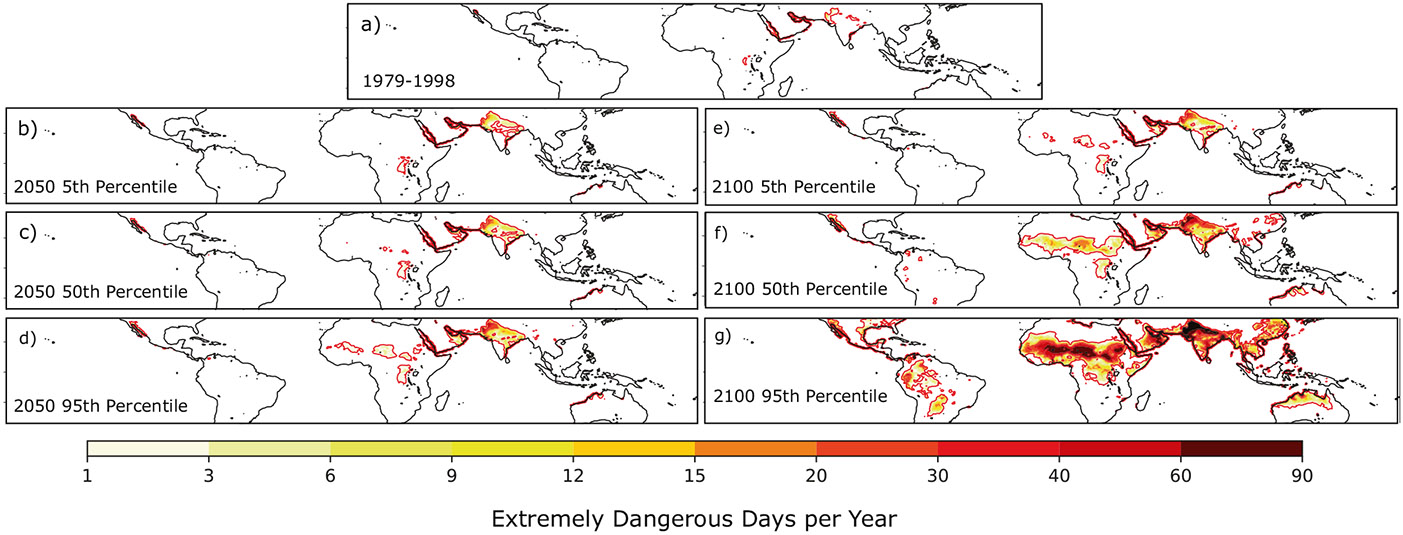
“…7-9 and new research showing that warming has already caused some populations to experience heat stress that approaches the limit of survivability 10 , this paper will quantify the extent to which different regions across Earth’s land surface will experience “dangerous” and “extremely dangerous”…”
Less than 2 °C warming by 2100 unlikely
Raftery, A. E., Zimmer, A., Frierson, D. M. W., Startz, R., & Liu, P. (2017) · Nature Climate Change · doi:10.1038/nclimate3352 · Cited by 711
Self-citationReductions in labour capacity from heat stress under climate warming
Dunne, J. P., Stouffer, R. J., & John, J. G. (2013) · Nature Climate Change · doi:10.1038/nclimate1827 · Cited by 660
Origins of the 1988 North American Drought
Trenberth, K. E., Branstator, G. W., & Arkin, P. A. (1988) · Science · doi:10.1126/science.242.4886.1640 · Cited by 373 · cited 2×
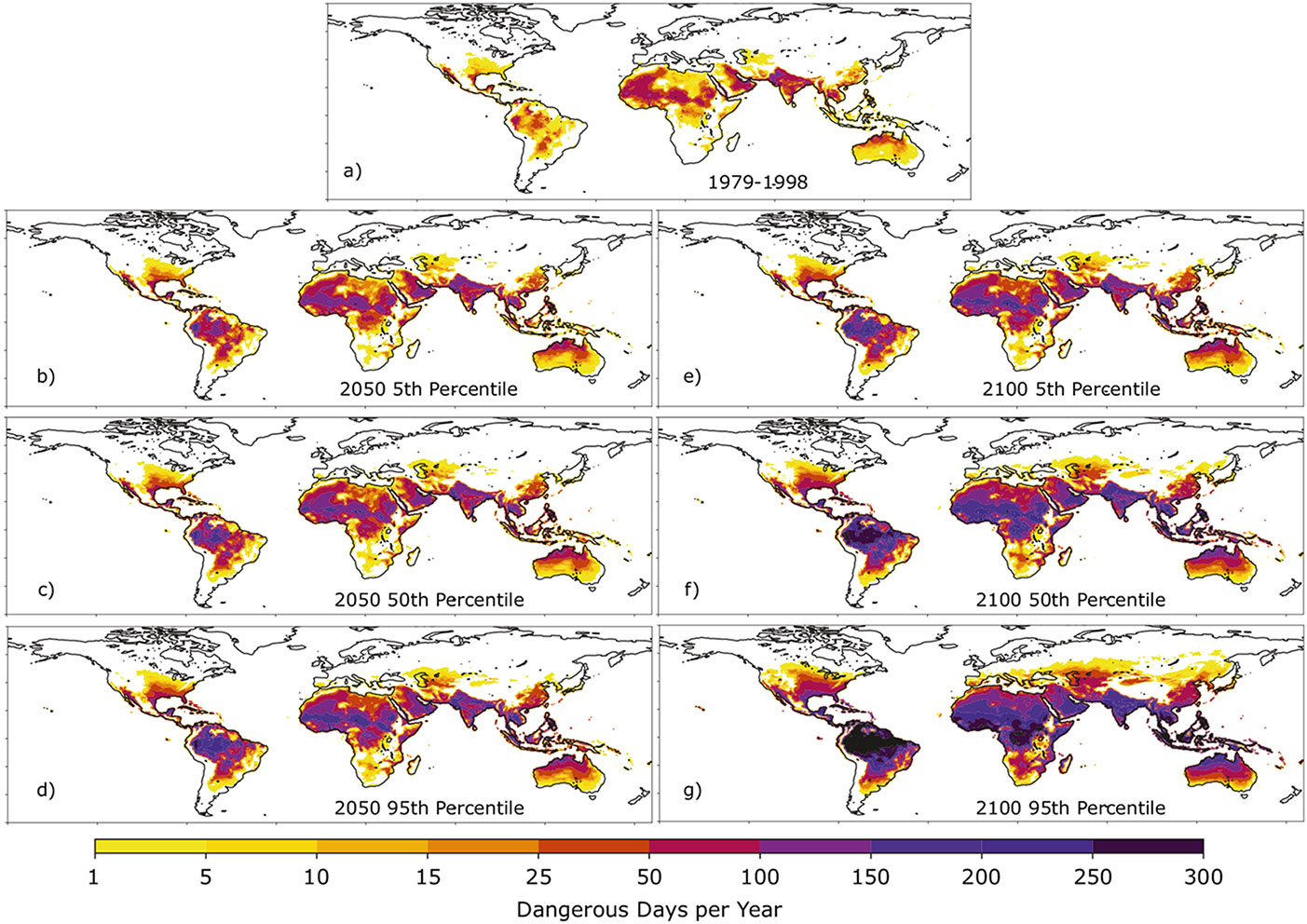
“A Heat Index above 103°F is classified by the United States’ National Weather Service as “dangerous” because of the likely onset of heat cramps and heat exhaustion.”
Trends in continental temperature and humidity directly linked to ocean warming
Byrne, M. P., & O’Gorman, P. A. (2018) · Proceedings of the National Academy of Sciences · doi:10.1073/pnas.1722312115 · Cited by 371 · cited 3×
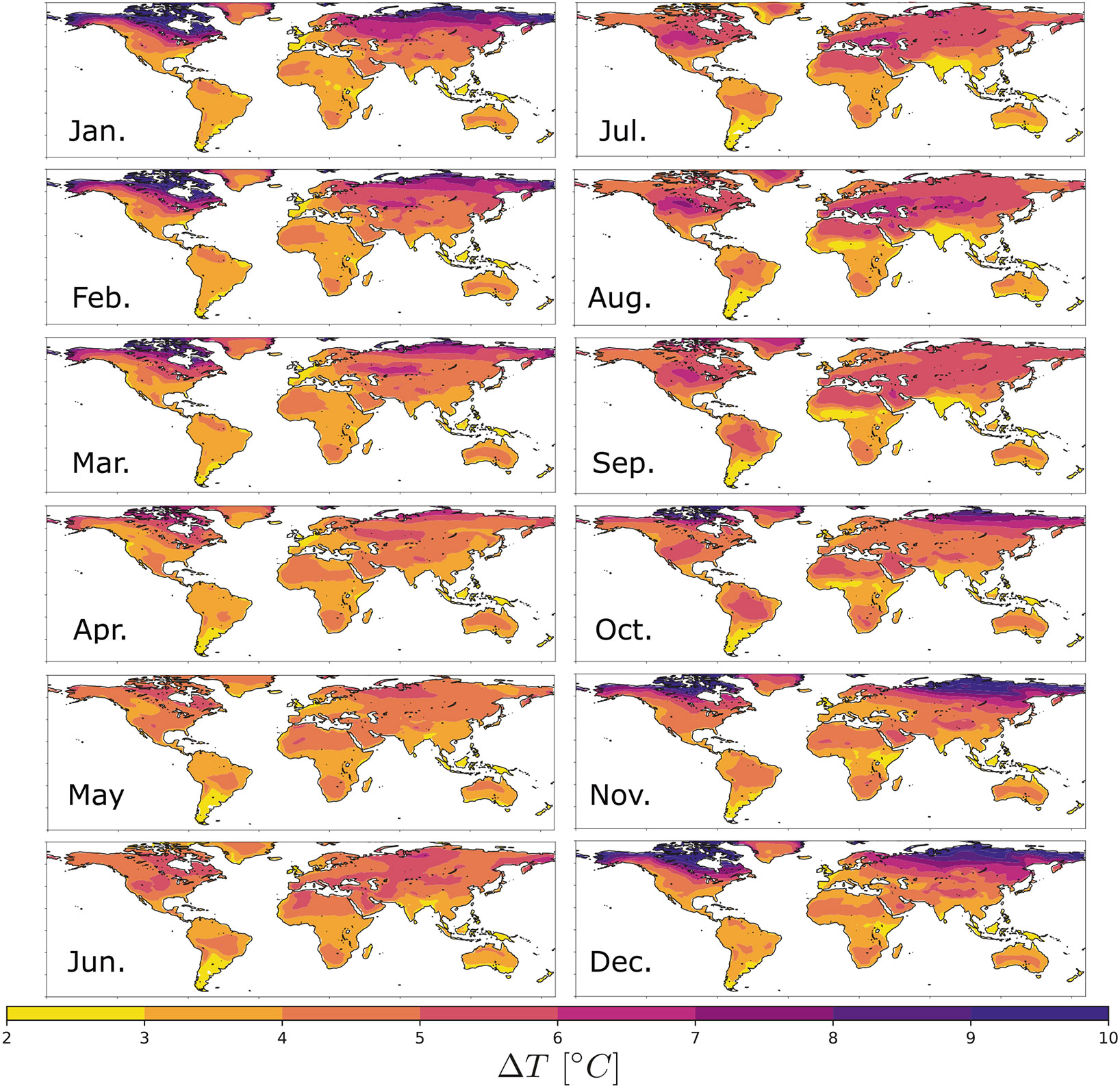
“This method of relating global to local mean temperature change takes advantage of a well-known pattern of temperature change seen across several generations of climate model ensembles 17 and the (negative) correlation between global temperature and terrestrial relative humidity change 18 .”
Willett, K. M., & Sherwood, S. (2012) · International Journal of Climatology · doi:10.1002/joc.2257 · Cited by 303 · cited 1×
“While several studies have estimated the projected increase in heat exposure due to climate change 3-5 , probabilistic projections have not been published, partly because estimates of climate change impacts usually depend on deterministic climate models run with only a handful of greenhouse gas…”
Liu, P. R., & Raftery, A. E. (2021) · Communications Earth & Environment · doi:10.1038/s43247-021-00097-8 · Cited by 220
Self-citationSchwingshackl, C., Sillmann, J., Vicedo‐Cabrera, A. M., Sandstad, M., & Aunan, K. (2021) · Earth's Future · doi:10.1029/2020ef001885 · Cited by 190 · cited 3×
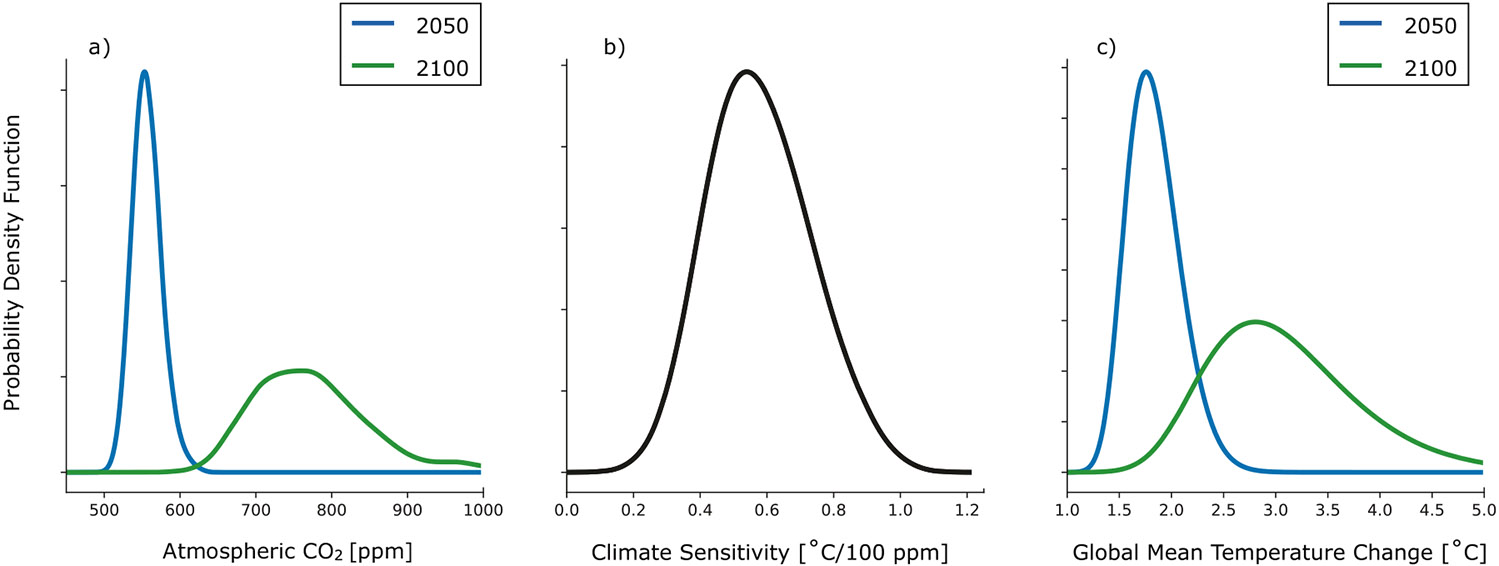
“We then use six different scenarios of global mean temperature change that correspond to the [5,50,95] percentiles in 2050 and 2100 calculated from the PDF shown in Fig.”
InfluentialRegional warming of hot extremes accelerated by surface energy fluxes
Donat, M. G., Pitman, A. J., & Seneviratne, S. I. (2017) · Geophysical Research Letters · doi:10.1002/2017gl073733 · Cited by 132 · cited 1×
“Given the interest in temperature extremes driven by climate change 7-9 and new research showing that warming has already caused some populations to experience heat stress that approaches the limit of survivability 10 , this paper will quantify the extent to which different regions across Earth’s…”
van Heerwaarden, C. C., Vilà-Guerau de Arellano, J., Gounou, A., Guichard, F., & Couvreux, F. (2010) · Journal of Hydrometeorology · doi:10.1175/2010jhm1272.1 · Cited by 113
Re-evaluating Occupational Heat Stress in a Changing Climate
(2014) · The Annals of Occupational Hygiene · doi:10.1093/annhyg/meu073 · Cited by 73
U.S. Daily Temperatures: The Meaning of Extremes in the Context of Nonnormality
Huybers, P., McKinnon, K. A., Rhines, A. N., & Tingley, M. P. (2014) · Journal of Climate · doi:10.1175/jcli-d-14-00216.1 · Cited by 56
The Origin of Soil Moisture Evaporation “Regimes”
Zeppetello, L. R. V., Battisti, D. S., & Baker, M. B. (2019) · Journal of Climate · doi:10.1175/jcli-d-19-0209.1 · Cited by 52
Self-citationZarakas, C. M., Swann, A. L. S., Laguë, M. M., Armour, K. C., & Randerson, J. T. (2020) · Journal of Climate · doi:10.1175/jcli-d-20-0078.1 · Cited by 51
Zeppetello, L. R. V., & Battisti, D. S. (2020) · Geophysical Research Letters · doi:10.1029/2020gl090197 · Cited by 20
Self-citation
Research works printed but not linked: 2
- IPCC. Climate Change 2021: The Physical Science Basis. Contribution of Working Group I to the Sixth Assessment Report of the Intergovernmental Panel on Climate Change (Cambridge University Press, 2021).
- Changnon SA, Kunkel KE & Reinke BC Impacts and responses to the 1995 heat wave: a call to action. Bull. Am. Meteorol. Soc 77, 1497– 1506 (1996). · doi:10.1175/1520-0477(1996)077
Cited by
Bhattacharjee, N. V., Schumacher, A. E., Aali, A., Abate, Y. H., Abbasgholizadeh, R., Abbasian, M., Abbasi-Kangevari, M., Abbastabar, H., Abd ElHafeez, S., Abd-Elsalam, S., et al. (2024) · The Lancet · doi:10.1016/s0140-6736(24)00550-6 · Cited by 629
Mahesh, A., Collins, W. D., Bonev, B., Brenowitz, N., Cohen, Y., Elms, J., Harrington, P., Kashinath, K., Kurth, T., North, J. S., et al. (2025) · Geoscientific model development · doi:10.5194/gmd-18-5575-2025 · Cited by 81
Impacts of warming on outdoor worker well-being in the tropics and adaptation options
Masuda, Y. J., Parsons, L. A., Spector, J. T., Battisti, D. S., Castro, B., Erbaugh, J. T., Game, E. T., Garg, T., Kalmus, P. M., Kroeger, T., et al. (2024) · One Earth · doi:10.1016/j.oneear.2024.02.001 · Cited by 72
Self-citationHeat waves accelerate the spread of infectious diseases
Lian, X., Huang, J., Li, H., He, Y., Ouyang, Z., Fu, S., Zhao, Y., Wang, D., Wang, R., & Guan, X. (2023) · Environmental Research · doi:10.1016/j.envres.2023.116090 · Cited by 62
Daily rainfall variability controls humid heatwaves in the global tropics and subtropics
Jackson, L., Birch, C. E., Chagnaud, G., Marsham, J. H., & Taylor, C. M. (2025) · Nature Communications · doi:10.1038/s41467-025-58694-6 · Cited by 60
Metadata
- Authors
- Vargas Zeppetello, L. R., Raftery, A. E., & Battisti, D. S.
- Affiliations
- University of Washington (US)
- Venue
- Communications Earth & Environment
- Published
- 2022-08-25
- Volume
- 3
- Issue
- 1
- ISSN
- 2662-4435 (ISSN-L)
- PMC
- PMC11485542
- OpenAlex
- W4293237588
- Cited by
- 140
- References
- 22
- Citations by year
- 2026: 27 · 2025: 41 · 2024: 42 · 2023: 29 · 2022: 1
- FWCI
- 11.09
- Type
- journal article
- Language
- en
- Open access
- gold
- doi.org
- Licence
- cc-by
- creativecommons.org/licenses/by/4.0 (tdm)
- creativecommons.org/licenses/by/4.0 (vor)
- Locations
- Communications Earth & Environment (publishedVersion, cc-by)
- PubMed (publishedVersion)
- PubMed Central (acceptedVersion, cc-by)
- HAL (submittedVersion, cc-by-nc-nd)
- DOAJ (DOAJ: Directory of Open Access Journals) (submittedVersion, cc-by-sa)
- Funders
- James S. McDonnell Foundation
- Topics
- Physical Sciences › Environmental Science › Health, Toxicology and Mutagenesis › Climate Change and Health Impacts
- Physical Sciences › Environmental Science › Global and Planetary Change › Climate variability and models
- Physical Sciences › Environmental Science › Global and Planetary Change › Climate Change and Environmental Impact
- Keywords
- heat stress, heat index, climate change projections, anthropogenic CO2 emissions, heat waves, tropical regions, mid-latitudes, human health exposure
About these checks
Registry, retraction, Cites and statistics results are computed, not judged, with one exception: a printed reference that no index lists is read once by a model before it counts as a citation error. Claims are extracted by a model and kept only when their quote appears verbatim in the text; each cited source is then checked, with a model’s help, for whether it says what the claim relies on. Those verdicts can be wrong — read the claim’s quote and the cited source before relying on one.
Statistics and arithmetic are recomputed, not judged.
Confidence bands are shown only for fields calibrated on our annotated test set. None is calibrated yet, so no band is shown.
What counts as a claim ›How we measure confidence ›How we check this ›
Are you an author, or do you see a problem with this page? Request a review
Data sources
Bibliographic data: Semantic Scholar, OpenAlex, Crossref.
Contains information from the Semantic Scholar Academic Graph Datasets, made available under the ODC Attribution License (ODC-BY 1.0).
Semantic Scholar’s data is described in: Kinney, R., et al. (2023). The Semantic Scholar Open Data Platform. arXiv:2301.10140.
