

Strategy evolution on dynamic networks
Open accessThe DOI matches its Crossref record; 69 of the 70 references it cites were found in a registry or an index; 24 of the 64 sources its claims cite were checked for support.
Abstract
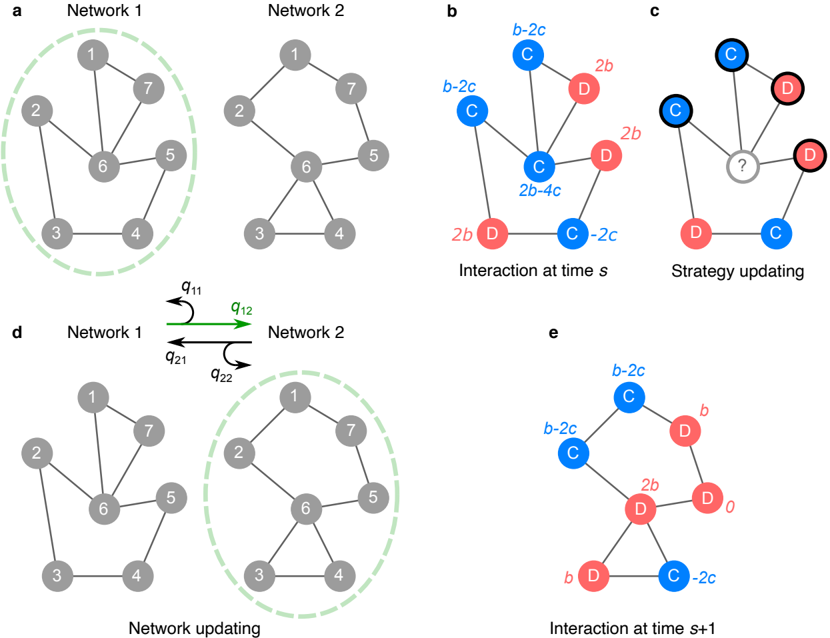
Models of strategy evolution on static networks help us understand how population structure can promote the spread of traits like cooperation. One key mechanism is the formation of altruistic spatial clusters, where neighbors of a cooperative individual are likely to reciprocate, which protects prosocial traits from exploitation. However, most real-world interactions are ephemeral and subject to exogenous restructuring, so that social networks change over time. Strategic behavior on dynamic networks is difficult to study, and much less is known about the resulting evolutionary dynamics. Here we provide an analytical treatment of cooperation on dynamic networks, allowing for arbitrary spatial and temporal heterogeneity. We show that transitions among a large class of network structures can favor the spread of cooperation, even if each individual social network would inhibit cooperation when static. Furthermore, we show that spatial heterogeneity tends to inhibit cooperation, whereas temporal heterogeneity tends to promote it. Dynamic networks can have profound effects on the evolution of prosocial traits, even when individuals have no agency over network structures.
Overview
CoChat Summary
TL;DR
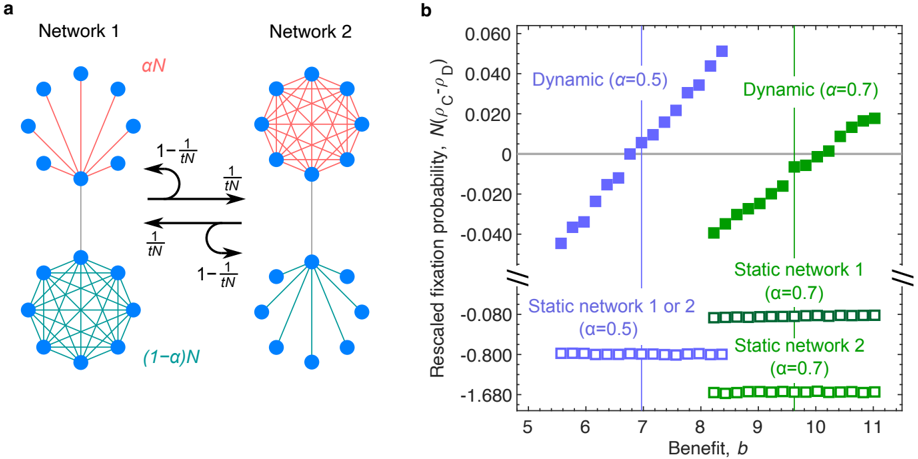
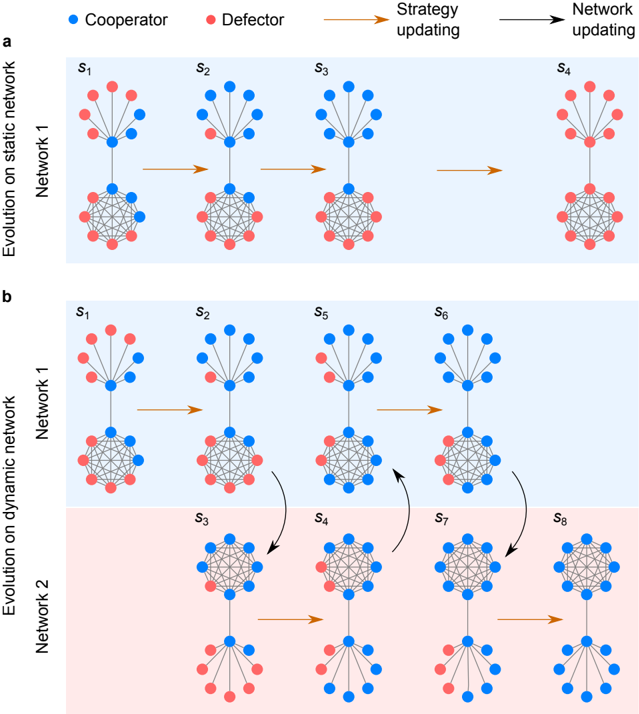
The paper develops an analytical theory for strategy evolution on dynamic networks with exogenous, stochastic transitions among arbitrary network structures. It shows that transitions among community-structured networks can favor cooperation even when every static network disfavors it, while spatial burstiness inhibits and temporal burstiness promotes cooperation.
Key findings
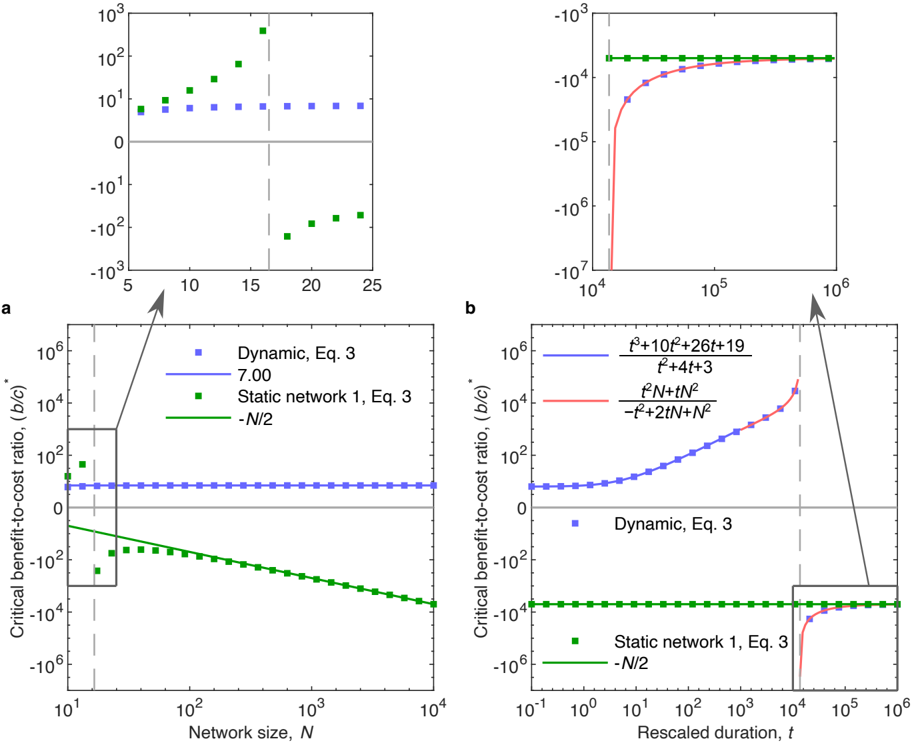
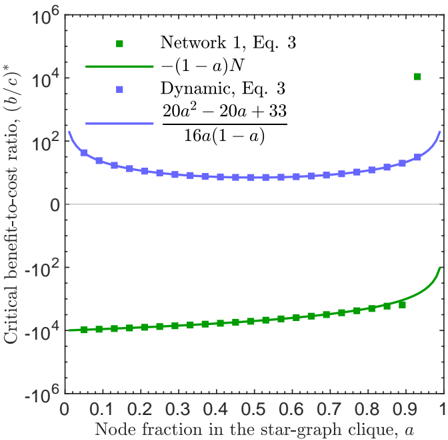
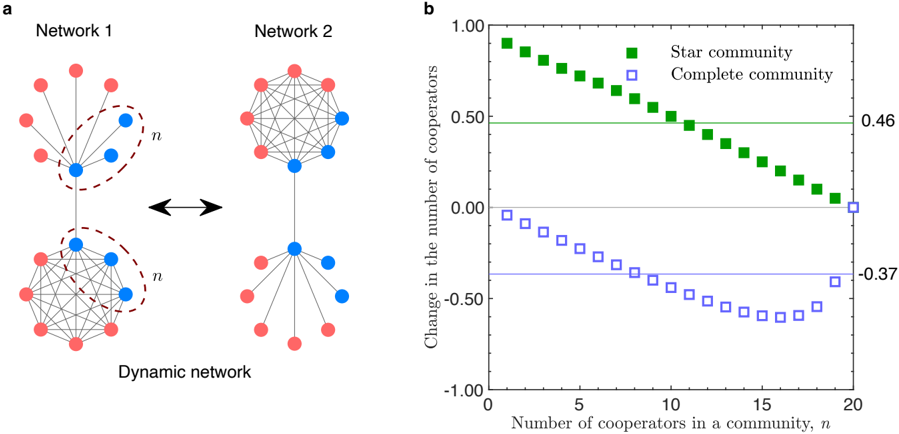
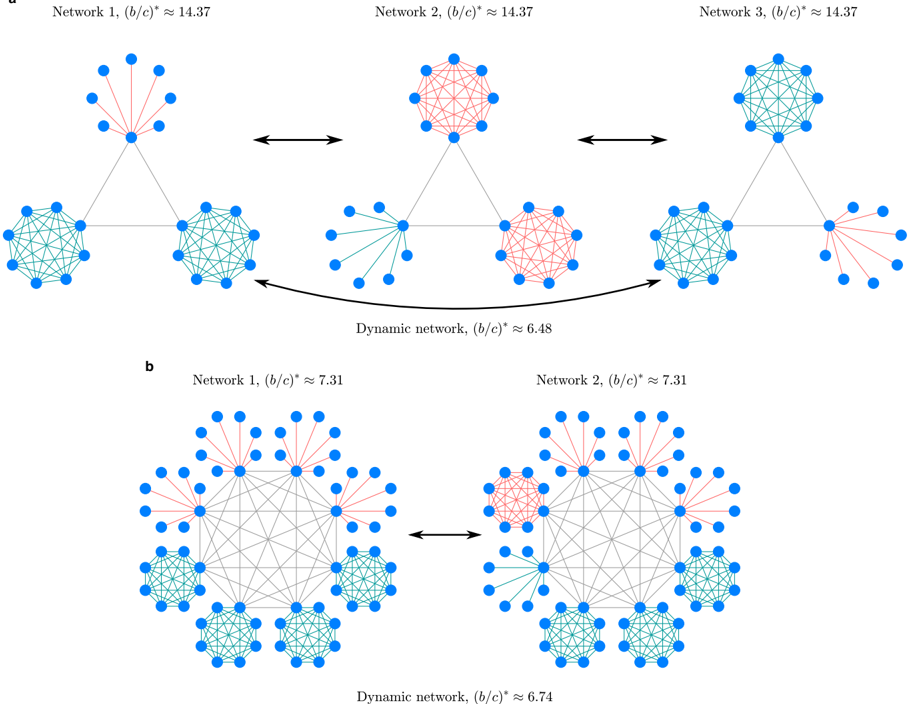
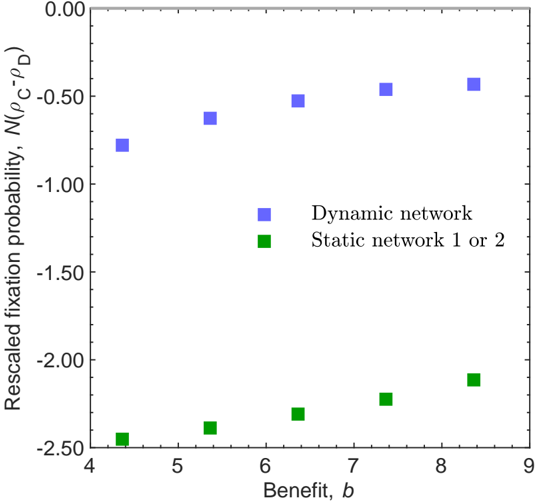
- For a dynamic pair of dense/sparse community networks, cooperation is disfavored on either static network for all benefit-to-cost ratios, but dynamic transitions favor cooperation when \(b/c\) exceeds \((b/c)^* \approx 7\).
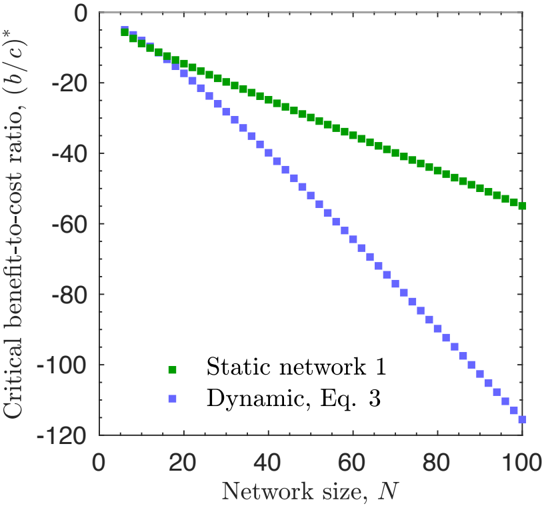
- In the same example, static networks favor cooperation only for very small populations (\(N < 17\)); for \(N \ge 17\), the static critical ratio is negative, \((b/c)^* < 0\), favoring spite, whereas the dynamic critical ratio approaches a positive constant, \((b/c)^* = 7\), for large \(N\).
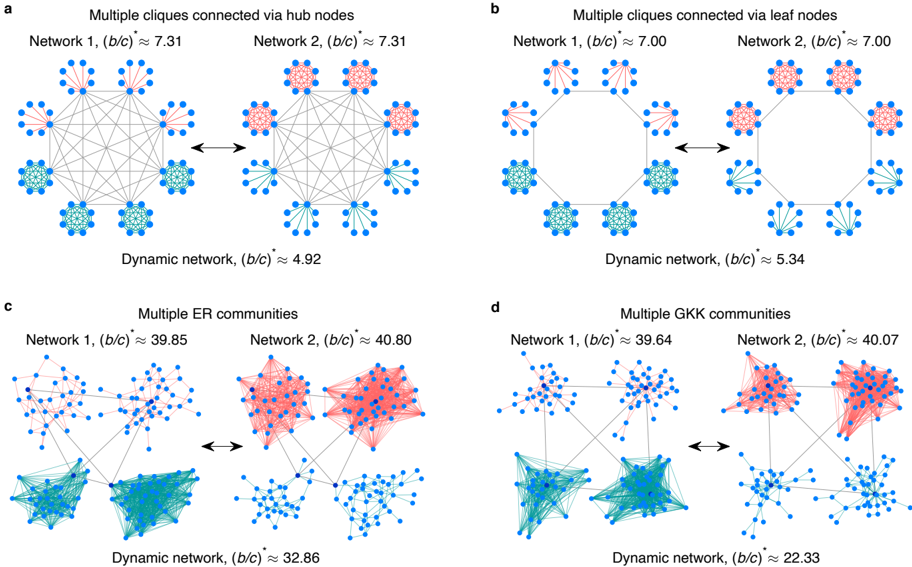
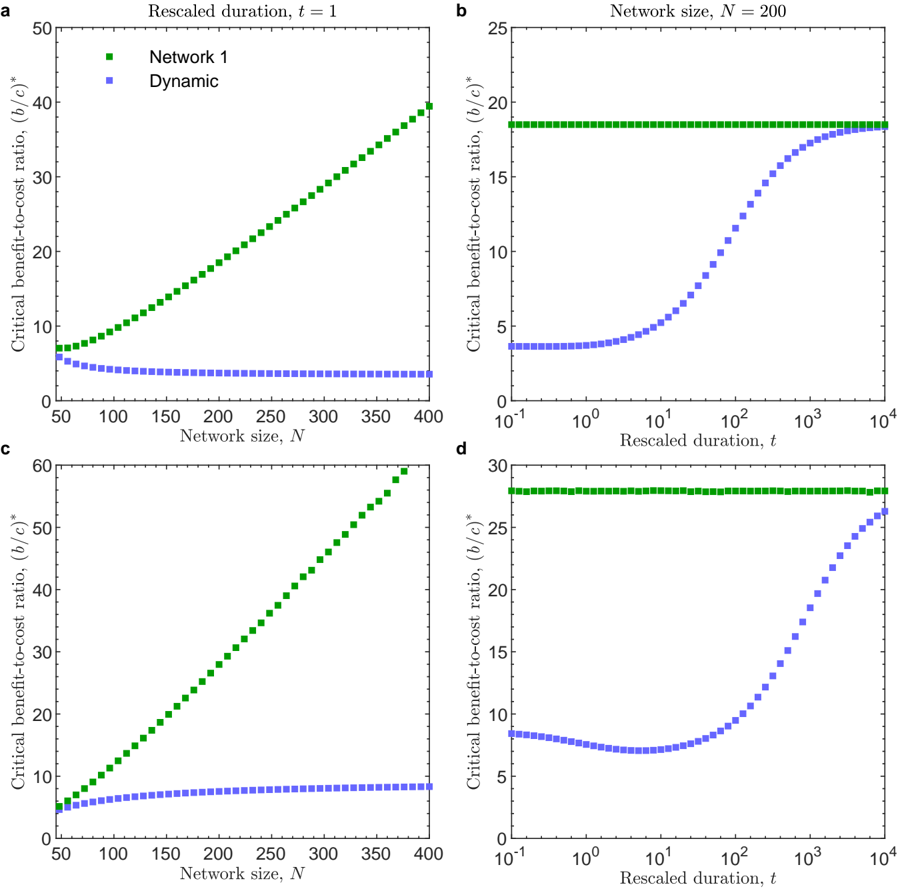
- In multi-community networks with \(N = 1{,}200\), the critical benefit-to-cost ratio is \((b/c)^* \approx 188.1\) when static but reduced to \((b/c)^* \approx 3.49\) when dynamic.
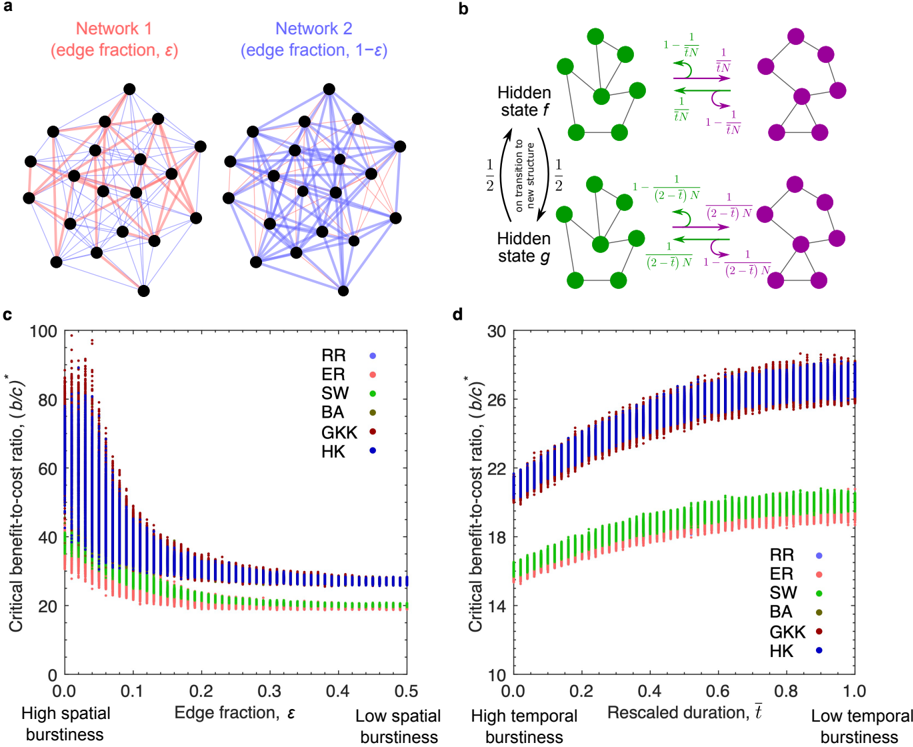
- Spatial burstiness tends to inhibit cooperation, roughly doubling the required \((b/c)^*\) as \(\varepsilon \to 0\) compared with the spatially homogeneous regime \(\varepsilon = 1/2\); temporal burstiness tends to promote cooperation, reducing \((b/c)^*\) typically by 20% when large (\(\bar t = 0\)) versus absent (\(\bar t = 1\)).
Methods
- The model uses a finite population of size \(N\), with \(L\) weighted undirected networks, pairwise donation games, weak selection \(\delta \ll 1\), and an imitation/update process in which an individual copies a neighbor with probability proportional to fecundity; network transitions follow an exogenous Markov chain \(Q\) independent of strategy composition.
- The analysis derives a general weak-selection condition for cooperation using neutral quantities: reproductive value \(\pi\), coalescence times \(\tau\), and \(T\), yielding the critical benefit-to-cost ratio \((b/c)^* = (\nu_2 - \nu_0)/(\mu_2 - \mu_0)\).
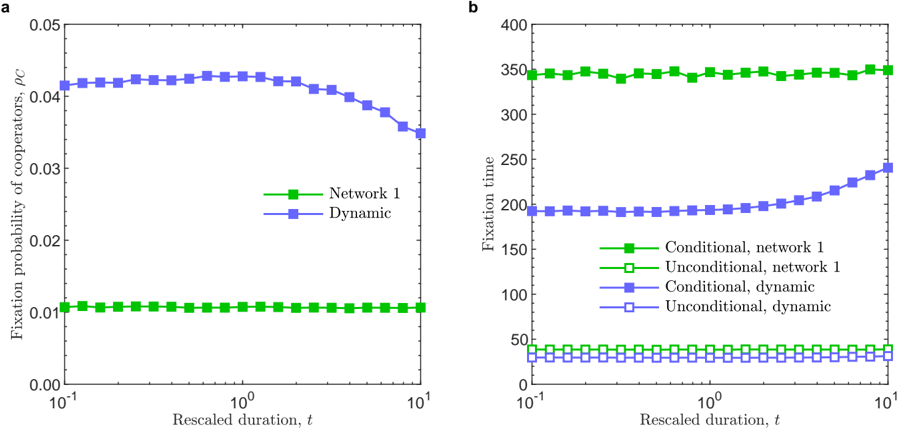
- Examples focus mainly on transitions between two networks (\(L=2\)) with \(t_1=t_2=t\), using analytical calculations and Monte Carlo simulations; Figure 2 simulations use \(N=40\), \(t=1\), \(c=1.0\), \(\delta=0.002\), and \(10^7\) runs. Spatial/temporal burstiness analyses use six network classes, 1,000 networks each, with 100 nodes and average degree 20.
Limitations
- Stated: the study assumes mutation-free dynamics; all results are based on exogenous network transitions, so individuals cannot selectively engineer neighborhoods based on traits; and the analyzed networks are a limited set of representative examples compared with the vast space of possible structures and transitions.
- Stated: future work is needed on fluctuating resources, varying timescales of network change relative to reproductive events, other exogenous changes favoring cooperation, and environments with both endogenous and exogenous transitions.
- Evident from the text: the main analytical results rely on weak selection (\(\delta \ll 1\)), undirected networks, and an irreducible transition chain \(Q\) for a unique stationary distribution; the donation-game framing may not directly cover all prosocial domains.
Model-written summary. Check it against the paper before relying on it.
Integrity signals
Registry
Cites
Statistics
Figures
Verification
Claims the paper makes
11 Valid · 10 Not valid · 26 Not checked · 79 Own results and interpretations
The cited sources that could be checked couldn’t confirm or dispute this claim.
In the paper
“Even if every such network individually disfavors cooperators, transitions between them can facilitate the evolution of cooperation - a result that is reminiscent of Parrondo's paradox [50].”
What the sources say
- Could not verifycites [50] [50] G. Harmer and D. Abbott. Losing strategies can win by Parrondo's paradox. Nature , 402: 864, 1999. doi: 10.1038/47220. - sourceExperimental — accuracy not yet measured
The paper’s Introduction (p. 1) and Example applications (pp. 5–6) discuss detecting community structure in networks, not the evolution of cooperation. Searches for Parrondo’s paradox, cooperators, and transitions between networks found no passage addressing the cited claim. (LLM, conf=0.78)
plainstates a cause- Asserted: passes — The authors put it forward as true.
- Checkable: passes — It can be checked against evidence.
- Load-bearing: passes — The paper’s conclusions depend on it.
- Based: passes — The paper gives a reason why it holds.
- Rests on 2 assumptions not shown here.
- Could not verify
The cited sources support only part of this claim — read each source’s verdict below.
In the paper
“Furthermore, weak-mutation dynamics do not necessarily predict what happens when mutation rates are larger [36, 58].”
What the sources say
- Supportedcites [36] [36] A. McAvoy and J. Wakeley. Evaluating the structure-coefficient theorem of evolutionary game theory. Proceedings of the National Academy of Sciences of the United States of America , 119(28):e2119656119, 2022. doi: 10.1073/pnas.2119656119. - source
The Abstract says fixation probabilities faithfully approximate trait frequencies only when mutations occur sufficiently infrequently. The Discussion reports that increasing mutation probability can reverse the direction of selection, directly supporting the claim that weak-mutation dynamics need not predict outcomes at higher mutation rates. (LLM, conf=0.93)
- Partly supportedcites [58] [58] F. D´ ebarre. Imperfect Strategy Transmission Can Reverse the Role of Population Viscosity on the Evolution of Altruism. Dynamic Games and Applications , 10(3):732-763, 2019. doi: 10.1007/s13235-019-00326-y. - sourceExperimental — accuracy not yet measured
Section 5 (p. 9) describes its results as asymptotic relationships under low mutation. Section 5.3 (p. 10) says a similar relationship applies at larger mutation rates only when rates are constant across sites and independent of parentage. This supports caution about extending low-mutation results, but the cited passages do not show that weak-mutation dynamics fail to predict dynamics at larger rates. (LLM, conf=0.76)
plain- Asserted: passes — The authors put it forward as true.
- Checkable: passes — It can be checked against evidence.
- Load-bearing: passes — The paper’s conclusions depend on it.
- Based: passes — The paper gives a reason why it holds.
- Supported
The cited sources support only part of this claim — read each source’s verdict below.
In the paper
“Broadly speaking, our work highlights the significance of integrating multiple communities into one system, since treating communities individually and independently may lead to erroneous conclusions about behavioral dynamics in the population as a whole [53].”
What the sources say
- Partly supportedcites [53] [53] B. Blonder, T. W. Wey, A. Dornhaus, R. James, and A. Sih. Temporal dynamics and network analysis. Methods in Ecology and Evolution , 3:958-972, 2012. ISSN 2041210X. doi: 10.1111/j.2041-210X.2012.00236.x. - sourceExperimental — accuracy not yet measured
The Conclusion (page unavailable) says population structure affects which strategy is selected, supporting the general importance of modeling interactions across a population. But the paper does not establish that analyzing communities individually and independently leads to erroneous conclusions about the population as a whole. (LLM, conf=0.77)
hedgedstates a possible cause- Asserted: passes — The authors put it forward as true.
- Checkable: passes — It can be checked against evidence.
- Load-bearing: passes — The paper’s conclusions depend on it.
- Based: passes — The paper gives a reason why it holds.
- Partly supported
The cited sources that could be checked couldn’t confirm or dispute this claim.
In the paper
“Spatio-temporal heterogeneity of interaction density within a given community also leads to time-varying connection densities, from sparse to dense and vice versa [2].”
What the sources say
- Could not verifycites [2] [2] P. Holme and J. Saram¨ aki. Temporal networks. Physics Reports , 519(3):97-125, 2012. ISSN 03701573. doi: 10.1016/j.physrep.2012.03.001. - sourceExperimental — accuracy not yet measured
The supplied passages and both searches for changing interaction density within a community return text labeled as a different paper, “FastMinTC+,” despite the index identifying the source as “Temporal networks.” Its Introduction defines time-stamped interactions, while its Conclusion discusses separate sparse and dense graph datasets; neither establishes that a community’s connection density changes from sparse to dense over time. The available copy therefore cannot verify the claim against the cited paper. (LLM, conf=0.72)
plainstates a cause- Asserted: passes — The authors put it forward as true.
- Checkable: passes — It can be checked against evidence.
- Load-bearing: unclear — It is unclear whether the paper’s conclusions depend on it.
- Based: passes — The paper gives a reason why it holds.
- Could not verify
The cited sources that could be checked couldn’t confirm or dispute this claim.
In the paper
“Although prosocial behaviors in different strategic domains may manifest in different ways, such as trust games or dictator games, the desire to pay costs to benefit others has a substantial degree of domain generality [49].”
What the sources say
- Could not verifycites [49] [49] A. Peysakhovich, M. A. Nowak, and D. G. Rand. Humans display a 'cooperative phenotype' that is domain general and temporally stable. Nature Communications , 5:4939, 2014. ISSN 20411723. doi: 10.1038/ncomms5939. - sourceExperimental — accuracy not yet measured
The Introduction (p. 1) discusses community structure in networks, and the Conclusions (p. 7) discuss applications of the authors’ network-analysis methods. Searches for paying costs to benefit others, domain generality, and prosocial behavior across trust and dictator games found no passage addressing the claim. (LLM, conf=0.78)
plain- Asserted: passes — The authors put it forward as true.
- Checkable: passes — It can be checked against evidence.
- Load-bearing: passes — The paper’s conclusions depend on it.
- Based: passes — The paper gives a reason why it holds.
- Could not verify
72 more claims · 3 with their cited sources checked
Create a free account to see all 126 claims and to verify the 2 references still open.
- Probably not a substantial claim. 25
- It may state two separate claims as one. 26
- The quote only partly states this claim. 3
Self-check
Percentages, sums and reported differences re-computed from the paper’s own numbers.
Each contradiction between two passages listed here was confirmed by an independent check.
Rated minor: it would not touch a result — a value no result rests on, a p-value that stays on the same side of the significance level, or a conflict that is clerical, resolved elsewhere in the paper, or outside its own findings.
In the paper
§ 4.2 Specific examples · p. 22
“The expected durations in networks 1 and 2 are q / ( p + q ) and p / ( p + q ) , respectively.”
§ 2.2 Selection condition for the evolution of cooperation · p. 6
“For a given network transition matrix Q , the value 1/ q 12 (resp. 1/ q 21 ) gives the expected time during which the population remains in network 1 (resp. network 2 ) before transitioning to network 2 (resp. network 1 ).”
Citations
Cites
Collective dynamics of ‘small-world’ networks
Watts, D. J., & Strogatz, S. H. (1998) · Nature · doi:10.1038/30918 · Cited by 43,060 · cited 2×
“Erdos-Reyni random networks [37], Watts-Strogatz small-world networks [40], Barabási-Albert scale free networks [41], etc.”
BackgroundEmergence of Scaling in Random Networks
Barabási, A.-L., & Albert, R. (1999) · Science · doi:10.1126/science.286.5439.509 · Cited by 36,135 · cited 2×
“…random regular networks (RR), ER networks 38 , Watts–Strogatz small-world networks (SW) 39 with rewiring probability 0.1, Barabási–Albert scale-free networks (BA) 40 , GKK scale-free networks 60 with exponent 2.5, and Holme–Kim scale-free networks (HK) 61 with triad formation probability 0.1.”
MethodInfluentialThe genetical theory of natural selection
Fisher, R. A. (1930) · doi:10.5962/bhl.title.27468 · Cited by 17,617
Community structure in social and biological networks
Girvan, M., & Newman, M. E. J. (2002) · Proceedings of the National Academy of Sciences · doi:10.1073/pnas.122653799 · Cited by 15,502 · cited 1×
“Groups and communities are more likely to form among people with close geographical locations and similar religion, culture and affiliations 49,50 , but connection densities will be altered over time.”
BackgroundModularity and community structure in networks
Newman, M. E. J. (2006) · Proceedings of the National Academy of Sciences · doi:10.1073/pnas.0601602103 · Cited by 12,256 · cited 1×
“Groups and communities are more likely to form among people with close geographical locations and similar religion, culture and affiliations 49,50 , but connection densities will be altered over time.”
BackgroundHolme, P., & Saramäki, J. (2012) · Physics Reports · doi:10.1016/j.physrep.2012.03.001 · Cited by 2,736 · cited 3×
“In contrast, empirical networks frequently vary over time 2 .”
BackgroundInfluentialA simple rule for the evolution of cooperation on graphs and social networks
Ohtsuki, H., Hauert, C., Lieberman, E., & Nowak, M. A. (2006) · Nature · doi:10.1038/nature04605 · Cited by 2,208 · cited 2×
“A well-known and illustrative finding 1 is that population structure can favor cooperation provided that the ratio of the benefit from cooperative behavior ( b ) to its cost ( c ) exceeds the average number of neighbors ( d ).”
BackgroundStructure and tie strengths in mobile communication networks
Onnela, J.-P., Saramäki, J., Hyvönen, J., Szabó, G., Lazer, D., Kaski, K., Kertész, J., & Barabási, A.-L. (2007) · Proceedings of the National Academy of Sciences · doi:10.1073/pnas.0610245104 · Cited by 1,926 · cited 1×
“Representative examples include communication networks involving telephone calls or emails 3,4 ; networks of physical proximity, where individuals encounter different people as they move through space 5,6 ; and ecological networks that change with the seasons as organisms go through different…”
BackgroundPlant-Animal Mutualistic Networks: The Architecture of Biodiversity
Bascompte, J., & Jordano, P. (2007) · Annual Review of Ecology, Evolution, and Systematics · doi:10.1146/annurev.ecolsys.38.091206.095818 · Cited by 1,720
Networks, Dynamics, and the Small‐World Phenomenon
Watts, D. J. (1999) · American Journal of Sociology · doi:10.1086/210318 · Cited by 1,510
Research works printed but not linked: 1
- Erdös, P. & Rényi, A. On the evolution of random graphs. Publ. Math. Institute Hung. Acad. Sci. 5, 17–61 (1960).
Cited by
Reinforcement learning and collective cooperation on higher-order networks
Xu, Y., Wang, J., Chen, J., Zhao, D., Özer, M., Xia, C., & Perc, M. (2024) · Knowledge-Based Systems · doi:10.1016/j.knosys.2024.112326 · Cited by 119
“Secondly, the duration of interactions in dynamic networks is limited and varies over time, which is a factor known to facilitate group cooperation [30–33].”
BackgroundEvolutionary dynamics of any multiplayer game on regular graphs
Wang, C., Perc, M., & Szolnoki, A. (2024) · Nature Communications · doi:10.1038/s41467-024-49505-5 · Cited by 117
“That allows a calculation of the statistical mean payoffs of players in regular graphs.”
BackgroundEvolutionary dynamics in stochastic nonlinear public goods games
Zhu, W., Wang, X., Wang, C., Liu, L., Hu, J., Zheng, Z. M., Tang, S., Zheng, H., & Dong, J. (2024) · Communications Physics · doi:10.1038/s42005-024-01865-6 · Cited by 37
Information sharing promotes cooperation among mobile individuals in multiplex networks
Li, W., Chen, Z., Jiang, L.-L., & Perc, M. (2024) · Nonlinear Dynamics · doi:10.1007/s11071-024-10100-4 · Cited by 24
“Considering network structure, individuals tend to migrate to sites with high degrees to gain advantages, leading to shifts in population and dynamics in link formation [39,58,59].”
BackgroundWu, C., Deng, H., Wu, H., & Tu, C. (2025) · Reliability Engineering & System Safety · doi:10.1016/j.ress.2025.110951 · Cited by 24
Deterministic theory of evolutionary games on temporal networks
Wang, X., Fu, F., & Wang, L. (2024) · Journal of The Royal Society Interface · doi:10.1098/rsif.2024.0055 · Cited by 21
Dynamic evolution of cooperation based on adaptive reputation threshold and game transition
Yue, H., Xiong, X., Feng, M., & Szolnoki, A. (2025) · Chaos Solitons & Fractals · doi:10.1016/j.chaos.2025.116693 · Cited by 27
“Over the years, scholars gradually realized that static network structures cannot fully capture the dynamic and heterogeneous nature of individual interactions observed in real societies [22, 23, 24].”
Evolutionary dynamics of behavioral motivations for cooperation
Su, Q., & Stewart, A. J. (2025) · Nature Communications · doi:10.1038/s41467-025-59366-1 · Cited by 24
Self-citationBursty switching dynamics promotes the collapse of network topologies
Zeng, Z., Feng, M., Perc, M., & Kurths, J. (2025) · Proceedings of the Royal Society A Mathematical Physical and Engineering Sciences · doi:10.1098/rspa.2024.0936 · Cited by 21
“[55] successfully proposed a framework for calculating the conditions for cooperation in dynamic networks by computing the transition matrix of all potential network states.”
Adaptive payoff-driven interaction in networked snowdrift games
Xiong, X., Yao, Y., Feng, M., & Chica, M. (2024) · Chaos Solitons & Fractals · doi:10.1016/j.chaos.2024.115187 · Cited by 18
“Taking into account the arbitrary spatial and temporal heterogeneity, a recent study showed that transitions among a large class of network structures favor the spread of cooperation, even if each social network would inhibit cooperation when static [37].”
The coalescent in finite populations with arbitrary, fixed structure
Allen, B., & McAvoy, A. (2024) · Theoretical Population Biology · doi:10.1016/j.tpb.2024.06.004 · Cited by 17
Self-citationNonlinear social evolution and the emergence of collective action
Allen, B., Khwaja, A.-R., Donahue, J. L., Kelly, T. J., Hyacinthe, S. R., Proulx, J., Lattanzio, C., Dementieva, Y. A., & Sample, C. (2024) · PNAS Nexus · doi:10.1093/pnasnexus/pgae131 · Cited by 15
Su, Q., Wang, H., Xia, Y., & Wang, L. (2025) · Nature Communications · doi:10.1038/s41467-025-67178-6 · Cited by 25
“Over the past decades, numerous studies have explored this topic, proposing various mechanisms to explain cooperation, such as network reciprocity 4 – 9 , direct reciprocity 1,2,10 , indirect reciprocity 11 – 13 , and kin selection 14,15 .”
Self-citationEvolution of cooperation and competition in multilayer networks
Zhu, W., Wang, X., Wang, C., Xing, W., Liu, L., Zheng, H., Jingwu, Z., & Tang, S. (2025) · Nonlinear Dynamics · doi:10.1007/s11071-025-11693-0 · Cited by 18
“Future studies can extend our model by considering more realistic features such as dynamic network structures [72], mutation-driven strategy diver-sification [73], and stochastic [15].”
The coalescent in finite populations with arbitrary, fixed structure
Allen, B., & McAvoy, A. (2022) · arXiv · doi:10.48550/arxiv.2207.02880 · Cited by 12
Self-citationThe impact of dynamic linking on cooperation on complex networks
Zhao, X., Hu, K., Tao, Y., Jin, L., & Ши, Л. (2024) · Chaos An Interdisciplinary Journal of Nonlinear Science · doi:10.1063/5.0221942 · Cited by 9
Evolution of trust in structured populations
Wang, C. (2024) · Applied Mathematics and Computation · doi:10.1016/j.amc.2024.128595 · Cited by 16
“This framework has spurred significant findings recently, including [36, 37, 38, 39, 40, 41, 42, 43].”
BackgroundBursts of communication increase opinion diversity in the temporal Deffuant model
Zarei, F., Gandica, Y., & Rocha, L. E. C. (2024) · Scientific Reports · doi:10.1038/s41598-024-52458-w · Cited by 18
Emotion-driven switching game environments facilitates general cooperation
Xie, N., Bai, X., Wang, L., Ye, Y., & Szolnoki, A. (2025) · Chaos Solitons & Fractals · doi:10.1016/j.chaos.2025.117524 · Cited by 10
Emergence of cooperation promoted by higher-order strategy updates
Wang, D., Yi, P., Hong, Y., Chen, J., & Yan, G. (2025) · PLoS Computational Biology · doi:10.1371/journal.pcbi.1012891 · Cited by 14
Zhou, Z., Rong, Z., Yang, W. D., & Wu, Z.-X. (2024) · Chaos Solitons & Fractals · doi:10.1016/j.chaos.2024.115541 · Cited by 11
Dasgupta, N., & Musolesi, M. (2025) · Autonomous Agents and Multi-Agent Systems · doi:10.1007/s10458-025-09698-5 · Cited by 8
“…provide a comprehensive and systematic analysis of the learning dynamics and behaviours associated with the use of direct and third-party punishment in societies of artificial agents and how these dynamics change when combined with the related social mechanisms of partner selection and reputation.”
Liu, Z., Zhu, S., & He, C. (2025) · Nature Cities · doi:10.1038/s44284-024-00181-y · Cited by 11
“This is in line with previous studies, which have documented that tacit knowledge does not spread evenly across space; rather, it diffuses primarily following the movements of human actors 24–28 .”
A brief review on evolutionary game models for the emergence of fairness
Zhang, Y., Li, Y., & Xiao, F. (2024) · Europhysics Letters (EPL) · doi:10.1209/0295-5075/ad9860 · Cited by 10
Quan, J., Yang, H., & Wang, X. (2025) · Chaos Solitons & Fractals · doi:10.1016/j.chaos.2025.116499 · Cited by 8
A k-shell decomposition structural entropy of complex networks
Xian, Y., Li, M., & Zhang, Q. (2025) · Physica A Statistical Mechanics and its Applications · doi:10.1016/j.physa.2025.130859 · Cited by 7
Cooperation dynamics in multi-issue repeated social dilemma games with correlated strategy
Quan, J., Cui, S., & Wang, X. (2024) · Physical review. E · doi:10.1103/physreve.110.024307 · Cited by 6
Fixation probability in evolutionary dynamics on switching temporal networks
Bhaumik, J., & Masuda, N. (2023) · Journal of Mathematical Biology · doi:10.1007/s00285-023-01987-5 · Cited by 7
The paradox of intervention: Resilience in adaptive multirole coordination networks
van Elteren, C., de Vasconcelos, V. V. L., & Lees, M. (2025) · Proceedings of the National Academy of Sciences · doi:10.1073/pnas.2509856122 · Cited by 5
Cooperation dynamics of social dilemmas on an opinion-dependent weighted network
Quan, J., Tao, L., & Wang, X. (2025) · Applied Mathematics and Computation · doi:10.1016/j.amc.2025.129476 · Cited by 7
A Parrondo paradox in susceptible-infectious-susceptible dynamics over periodic temporal networks
Sejunti, M. I., Taylor, D., & Masuda, N. (2024) · Mathematical Biosciences · doi:10.1016/j.mbs.2024.109336 · Cited by 5
When multi-group selection meets mystery of cooperation in structured public goods games
Liu, X., Yang, B., Hu, Z.-L., Al‐qaness, M. A. A., & Tang, C. (2024) · Chaos An Interdisciplinary Journal of Nonlinear Science · doi:10.1063/5.0234041 · Cited by 4
Dragicevic, A. Z. (2024) · Dynamic Games and Applications · doi:10.1007/s13235-024-00560-z · Cited by 6
Xie, Y., Li, J., Yankun, Z., et al. (2025) · Chaos Solitons & Fractals · doi:10.1016/j.chaos.2025.116820 · Cited by 3
Replicator dynamics on heterogeneous networks
Li, J., Wang, X., Li, C., & Zhang, B. (2025) · Journal of Mathematical Biology · doi:10.1007/s00285-024-02177-7 · Cited by 4
“It has been shown that temporal or dynamic networks play crucial roles in promoting cooperation, both from the perspectives of the fixation probability and the fraction of cooperators (Li et al. 2017, 2020, 2023; Su et al. 2023).”
Evolution of cooperation in a mixed cooperative–competitive structured population
Lyu, D., Liu, H., Wang, L., & Wang, X. (2024) · Physica A Statistical Mechanics and its Applications · doi:10.1016/j.physa.2024.130035 · Cited by 4
Wang, X., Tu, L., Wang, X., Pan, Y., Yu, X., & Huang, Y. (2026) · Information Processing & Management · doi:10.1016/j.ipm.2026.104713 · Cited by 6
Strategy evolution on temporal hypergraphs
Wang, X., Zhou, L., McAvoy, A., Tian, Z., & Li, A. (2026) · Proceedings of the National Academy of Sciences · doi:10.1073/pnas.2516380123 · Cited by 20
“Such more persistent and stronger connections can promote cooperation (11, 37).”
Self-citationQ-learning-driven adaptive rewiring for cooperative control in heterogeneous networks
Weng, Y.-N., & Lee, H. (2026) · Engineering Applications of Artificial Intelligence · doi:10.1016/j.engappai.2026.114024 · Cited by 4
Accelerated Nash equilibrium seeking algorithm with local memory for two-subnetwork zero-sum games
Gao, J., Lei, D., Qin, M., Xi, J., & Zheng, Y. (2025) · Chaos Solitons & Fractals · doi:10.1016/j.chaos.2025.117103 · Cited by 3
The evolution of cooperation under falsified payoff information
Dai, W., Wang, J., Yu, F., Xu, W., & Li, B. (2025) · Chaos Solitons & Fractals · doi:10.1016/j.chaos.2025.116463 · Cited by 2
Equalizing payoffs of a structured population in repeated Prisoner’s Dilemma game
Zhou, B., Rong, Z., & Yu, X. M. (2025) · Chaos Solitons & Fractals · doi:10.1016/j.chaos.2025.116024 · Cited by 2
A general network complexity reduction method for cooperative evolution in structured populations
Wu, C., Deng, H., & Tu, C. (2024) · Chaos Solitons & Fractals · doi:10.1016/j.chaos.2024.115494 · Cited by 4
The synergy of elimination and zero-determinant strategy on dynamic games
Wang, J., & Shen, A. (2024) · Chaos Solitons & Fractals · doi:10.1016/j.chaos.2024.114699 · Cited by 2
Symmetry in models of natural selection
Allen, B. (2023) · Journal of The Royal Society Interface · doi:10.1098/rsif.2023.0306 · Cited by 4
Understanding large-scale cooperation in a nonlinear, interconnected world
Allen, B. (2026) · Nature Computational Science · doi:10.1038/s43588-026-00951-9 · Cited by 4
Offer of a reward does not always promote trust in spatial games
Zhang, H., Wang, C., Liu, S., del Genio, C. I., Boccaletti, S., & Lu, X. B. (2026) · Physical Review Research · doi:10.1103/8992-hzsq · Cited by 3
Park, C. (2026) · Scientific Reports · doi:10.1038/s41598-025-34645-5 · Cited by 3
Kroumi, D. (2025) · Physical review. E · doi:10.1103/6gmx-95w9 · Cited by 3
“Our model connects a static group structure with dynamic behavioral responses, and aligns with findings from cooperation on graphs [34], dynamic social networks [36], and ecological models with local competition [37].”
Localized seeding for triggering the global social contagion in higher-order spatial networks
Liu, A., Xiao, D., Li, W., Yang, T., Yang, C., Fan, J., & Wang, W. (2025) · Chaos Solitons & Fractals · doi:10.1016/j.chaos.2025.117141 · Cited by 1
Networked Evolutionary Games With Intergroup Conflict: Modeling and Collective Interest Analysis
Liu, A., Wang, L., Chen, G., & Guan, X. (2025) · IEEE Transactions on Circuits and Systems I Regular Papers · doi:10.1109/tcsi.2025.3599068 · Cited by 2
“emergence in static network configurations [5], [6], while subsequent extensions addressed temporally evolving networks, investigating the co-evolution of topological adaptations and strategic dynamics [7], [8], [9].”
The Structure-Coefficient Theorem for Evolutionary Games on Temporal Networks
Zhang, Z., Yu, X., & Su, Q. (2025) · Chinese Control Conference (CCC) · doi:10.23919/ccc64809.2025.11178752 · Cited by 1
“Recent studies have begun to explore evolutionary game theory on temporal networks, revealing that tem-porality can alter or even reverse evolutionary outcomes [27, 28].”
Self-citationEvolution of cooperation guided by the coexistence of imitation learning and reinforcement learning
Tang, W., Wang, G., & Xing, Z. (2025) · Scientific Reports · doi:10.1038/s41598-025-11557-y · Cited by 1
“Within this field, five evolutionary mechanisms-kin selection 6–8 , direct reciprocity 9,10 , indirect reciprocity 11 , group selection 12,13 , and network reciprocity 14–17 have been identified as pivotal contributors.”
STPE-MARL: Spatio-Temporal Multi-Agent Population Evolution Reinforcement Learning
Peng, K., Zhu, S., & Ma, T. (2025) · ACM Transactions on Intelligent Systems and Technology · doi:10.1145/3742479 · Cited by 1
A novel route for saving cooperation on dynamical networks: Enhancing rationality
Liu, Y., & Wu, B. (2026) · Chaos An Interdisciplinary Journal of Nonlinear Science · doi:10.1063/5.0354201
How to foster information sharing in dynamic supply chain networks: From a co-evolution perspective
Zhou, Z., & Li, T. (2026) · Computers & Industrial Engineering · doi:10.1016/j.cie.2026.112412
Coupling with opinion dynamics promotes prosocial behavior in multilayer networks
Bhaumik, J., & Masuda, N. (2026) · PLoS Computational Biology · doi:10.1371/journal.pcbi.1014810
Evolutionary multiobjective opinion maximization in social networks
Teng, X., Wu, R., Liu, Y., et al. (2026) · Chaos Solitons & Fractals · doi:10.1016/j.chaos.2026.119006
Evolutionary Dynamics of Cumulative Reciprocity in Complex Networks
Luo, S., Tian, Z., Li, J., & Xia, H. (2026) · Journal of Systems Science and Systems Engineering · doi:10.1007/s11518-026-5761-5
Learning partner-selection policies for cooperation in multichannel games with opting out
Shi, J., Zhang, Y., You, K., et al. (2026) · Chaos Solitons & Fractals · doi:10.1016/j.chaos.2026.118964
Hyperedge approximation for stochastic processes on higher-order networks
Sheng, A., McAvoy, A., Tian, Y., Zhang, S., Fontan, A., & Plotkin, J. B. (2026) · Proceedings of the National Academy of Sciences · doi:10.1073/pnas.2619078123 · Cited by 2
“[ 34 ] In the case of = 3, the condition becomes [ 35 ] Neutral Complex Contagion.”
Self-citationA game-theoretic attack-defense framework for the study of network resilience
Zhao, K., Gao, J., & Su, Q. (2026) · Nature Communications · doi:10.1038/s41467-026-75293-1
Self-citationStrategy evolution on interdependent networks
Li, M.-Y., Shi, Z., Xie, J., Su, Q., & Duan, G. (2026) · Cell Reports Physical Science · doi:10.1016/j.xcrp.2026.103440 · Cited by 1
Self-citationReputation-Driven Q-Learning: A Solution to the Bidding Dilemma in Heterogeneous Generation Groups
Guo, S., Zhang, Y., & Li, Z. (2026) · Journal of Systems Science and Complexity · doi:10.1007/s11424-026-6224-2
Conformist filtering reshapes cooperation in heterogeneous populations
Zeng, Z. (2026) · Chaos An Interdisciplinary Journal of Nonlinear Science · doi:10.1063/5.0340353 · Cited by 1
Liu, Y., & Chen, X. (2026) · Information Fusion · doi:10.1016/j.inffus.2026.104568 · Cited by 1
“In this section, we further explore the collective decision-making outcomes in dynamic networks as the population structure evolves over time [36].”
InfluentialFan, K., Zhang, L., Chen, Z., Zhang, Y., & Dui, H. (2026) · Reliability Engineering & System Safety · doi:10.1016/j.ress.2026.113049 · Cited by 1
Network reciprocity reshaped by environmental knowledge and feedbackPreprint
Basak, A., Kleshnina, M., & Sengupta, S. (2026) · bioRxiv (Cold Spring Harbor Laboratory) · doi:10.64898/2026.05.15.725397
Li, B., Abinova, A., & Li, S. (2026) · Journal of the Knowledge Economy · doi:10.1007/s13132-026-03299-7
“Particularly relevant are studies examining how firms’ strategic responses to technological opportunities feed back into the knowledge network, potentially altering its structure and the distribution of future opportunities (Su et al., 2023).”
Influence of complex network topologies on nash equilibria in static games under dynamic simulations
Shafaati, S., Azimi, M., Mohammadzadeh, J., Khaibary, H. G., & Hakhamanesh, R. (2026) · The Journal of Supercomputing · doi:10.1007/s11227-026-08421-9
Dynamic analysis of evolutionary game considering individual cognition
Li, S., Hu, Y., & Zhang, Y. (2026) · Physica A Statistical Mechanics and its Applications · doi:10.1016/j.physa.2026.131546
Li, H., Li, H., Wei, X., et al. (2026) · Systems & Control Letters · doi:10.1016/j.sysconle.2026.106453
Social context and the evolution of empathy
Garrison, J. (2026) · Evolution and Human Behavior · doi:10.1016/j.evolhumbehav.2026.106838 · Cited by 1
Evolution of cooperation under consensual punishment in complex networks
Xia, K., Yu, X., & Gao, S. (2025) · Physics Letters A · doi:10.1016/j.physleta.2025.131148
ATOMS: An Action Theory Of Moran System
Huang, E. A., & Tan, X. (2025) · ACM International Conference on Bioinformatics, Computational Biology, and Health Informatics (ACM-BCB) · doi:10.1145/3765612.3767799
Liu, A., Gu, W., Yang, T., Deng, L., Chen, F., & Wang, W. (2025) · Physica A Statistical Mechanics and its Applications · doi:10.1016/j.physa.2025.130877
The Impact of Inequity Aversion on the Evolution of Cooperation
Mao, X., Li, X., Meng, M., Wang, Q., & Deng, F. (2025) · Chinese Control Conference (CCC) · doi:10.23919/ccc64809.2025.11179750 · Cited by 1
Wang, J., Sun, J., & Chen, Y. (2025) · Chaos Solitons & Fractals · doi:10.1016/j.chaos.2025.116796
Quan, J., Lv, R., Cui, S., & Wang, X. (2025) · Applied Mathematics and Computation · doi:10.1016/j.amc.2025.129509 · Cited by 1
Network switching can improve system order
Ye, Y., Zhai, Z.-Y., Wen, T., Wang, L., Cheong, K. H., & Xie, N. (2025) · Chaos Solitons & Fractals · doi:10.1016/j.chaos.2025.116399
Li, C., Yang, Y., & Chen, X. (2025) · Symmetry · doi:10.3390/sym17020282
xie, Y., Li, J., Zhang, Y., et al. (2025) · SSRN Electronic Journal · doi:10.2139/ssrn.5251642
Evolution of Cumulative Reciprocity in Structured Populations
Luo, S., Tian, Z., Li, J., & Xia, H. (2024) · Communications in computer and information science · doi:10.1007/978-981-96-0178-3_4
Evolutionary Dynamics of Cooperation on Coupled Networks
Shi, Z., & Su, Q. (2024) · IEEE International Conference on Control Theory and Applications (ICoCTA) · doi:10.1109/icocta64736.2024.00064
Self-citationPark, C. (2024) · Research Square · doi:10.21203/rs.3.rs-4197398/v1
Flipping the intuition for games on dynamic networks
Allen, B. (2023) · Nature Computational Science · doi:10.1038/s43588-023-00513-3 · Cited by 2
Fixation probability in evolutionary dynamics on switching temporal networks
Bhaumik, J., & Masuda, N. (2023) · Institutional Repositories DataBase (IRDB) · doi:10.48550/arxiv.2304.00170
Metadata
- Authors
- Su, Q., McAvoy, A., & Plotkin, J. B.
- Affiliations
- Shanghai Jiao Tong University (CN)
- University of North Carolina at Chapel Hill (US)
- University of Pennsylvania (US)
- Corresponding author
- Su, Qi
- McAvoy, Alex
- Venue
- Nature Computational Science
- Published
- 2023-09-11
- Volume
- 3
- Issue
- 9
- Pages
- 763-776
- ISSN
- 2662-8457 (ISSN-L)
- OpenAlex
- W4386609747
- Cited by
- 97
- References
- 63
- Citations by year
- 2026: 34 · 2025: 37 · 2024: 22 · 2023: 4
- FWCI
- 28.88
- Type
- journal article
- Language
- en
- Open access
- green
- arxiv.org
- Licence
- cc-by
- www.springernature.com/gp/researchers/text-and-data-mining (tdm)
- www.springernature.com/gp/researchers/text-and-data-mining (vor)
- Locations
- Nature Computational Science (publishedVersion)
- PubMed (publishedVersion)
- arXiv (Cornell University) (submittedVersion, cc-by)
- arXiv (Cornell University) (cc-by)
- Funders
- John Templeton Foundation (62281)
- University of Pennsylvania
- Topics
- Social Sciences › Sociology and Political Science › Evolutionary Game Theory and Cooperation
- Physical Sciences › Physics and Astronomy › Statistical and Nonlinear Physics › Complex Network Analysis Techniques
- Physical Sciences › Mathematics › Applied Mathematics › Mathematical and Theoretical Epidemiology and Ecology Models
- Keywords
- evolution of cooperation, dynamic networks, network reorganization, spatial heterogeneity, temporal heterogeneity, prosocial behavior, network transition, population structure
- MeSH terms
- Altruism, Cooperative Behavior, Humans, Social Change, Social Networking
About these checks
Registry, retraction, Cites and statistics results are computed, not judged, with one exception: a printed reference that no index lists is read once by a model before it counts as a citation error. Claims are extracted by a model and kept only when their quote appears verbatim in the text; each cited source is then checked, with a model’s help, for whether it says what the claim relies on. Those verdicts can be wrong — read the claim’s quote and the cited source before relying on one.
The claim verdicts this report counts are experimental: their accuracy is not yet measured.
A language model drew the claims from the paper on 2026-10-10, under version 3 of the claim definition (model deepseek-v4.1-flash, prompt extract-v3).
A second model labelled each claim on 2026-10-10 (model jev-1.13-20260917, definition revision gold-guideline-v0.2).
Cited sources are checked with a language model’s help (gpt-6-sol).
Statistics and arithmetic are recomputed, not judged.
Confidence bands are shown only for fields calibrated on our annotated test set. None is calibrated yet, so no band is shown.
What counts as a claim ›How we measure confidence ›How we check this ›
Are you an author, or do you see a problem with this page? Request a review
Data sources
Bibliographic data: Semantic Scholar, OpenAlex, Crossref.
Contains information from the Semantic Scholar Academic Graph Datasets, made available under the ODC Attribution License (ODC-BY 1.0).
Semantic Scholar’s data is described in: Kinney, R., et al. (2023). The Semantic Scholar Open Data Platform. arXiv:2301.10140.
