

Strategy evolution on dynamic networks
Open accessThe DOI matches its Crossref record; 69 of the 70 references it cites were found in a registry or an index; 24 of the 64 sources its claims cite were checked for support.
Abstract
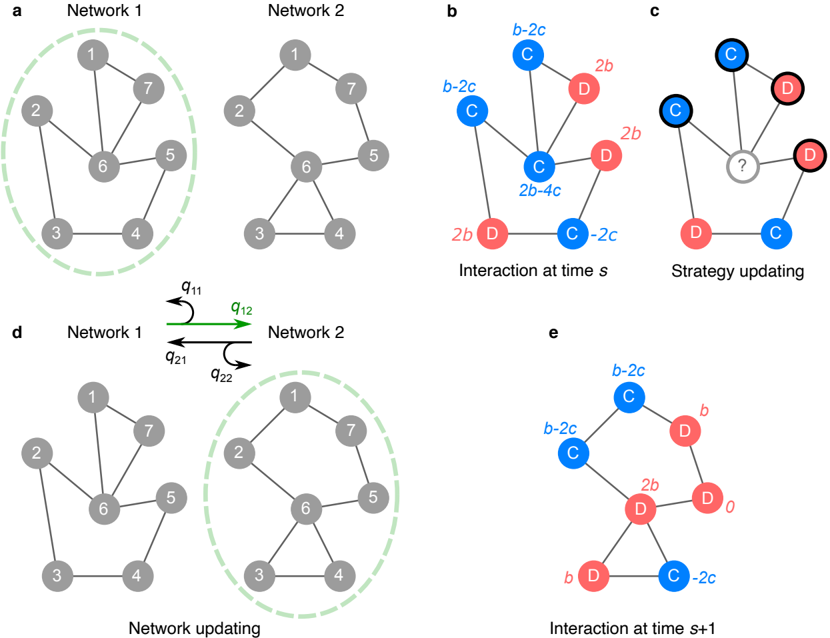
Models of strategy evolution on static networks help us understand how population structure can promote the spread of traits like cooperation. One key mechanism is the formation of altruistic spatial clusters, where neighbors of a cooperative individual are likely to reciprocate, which protects prosocial traits from exploitation. However, most real-world interactions are ephemeral and subject to exogenous restructuring, so that social networks change over time. Strategic behavior on dynamic networks is difficult to study, and much less is known about the resulting evolutionary dynamics. Here we provide an analytical treatment of cooperation on dynamic networks, allowing for arbitrary spatial and temporal heterogeneity. We show that transitions among a large class of network structures can favor the spread of cooperation, even if each individual social network would inhibit cooperation when static. Furthermore, we show that spatial heterogeneity tends to inhibit cooperation, whereas temporal heterogeneity tends to promote it. Dynamic networks can have profound effects on the evolution of prosocial traits, even when individuals have no agency over network structures.
Overview
CoChat Summary
TL;DR
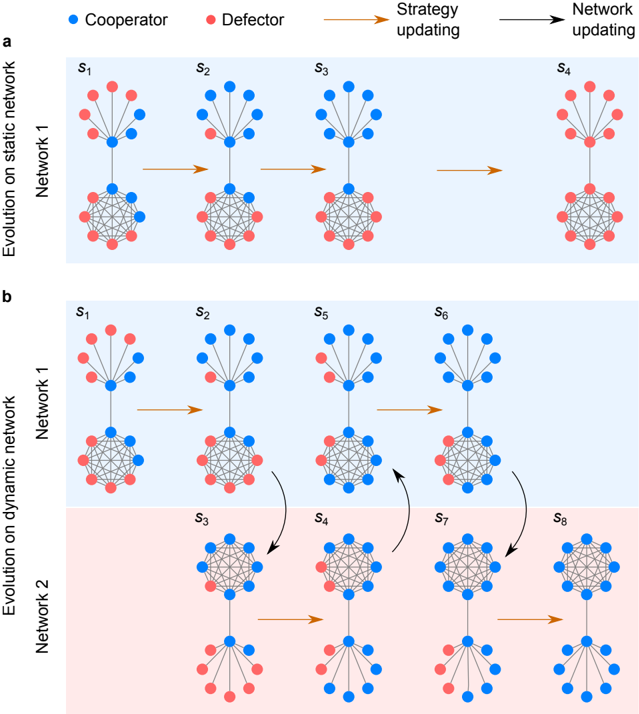
The paper develops an analytical theory for strategy evolution on dynamic networks with exogenous, stochastic transitions among arbitrary network structures. It shows that transitions among community-structured networks can favor cooperation even when every static network disfavors it, while spatial burstiness inhibits and temporal burstiness promotes cooperation.
Key findings
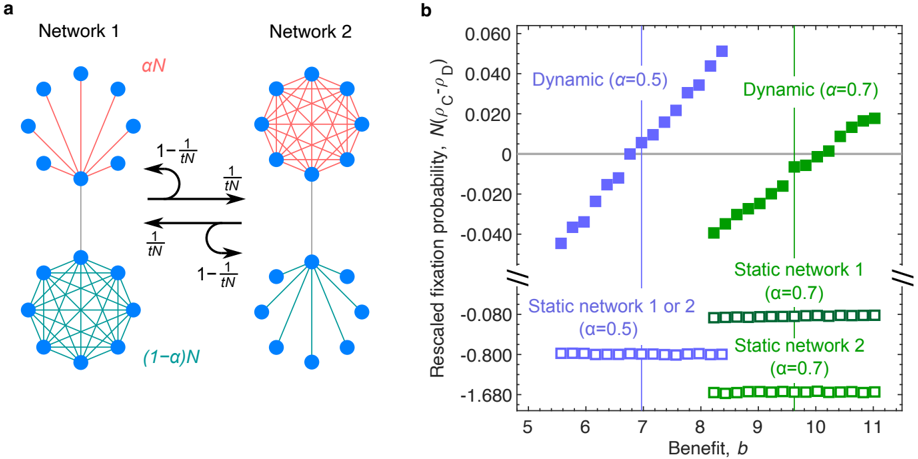
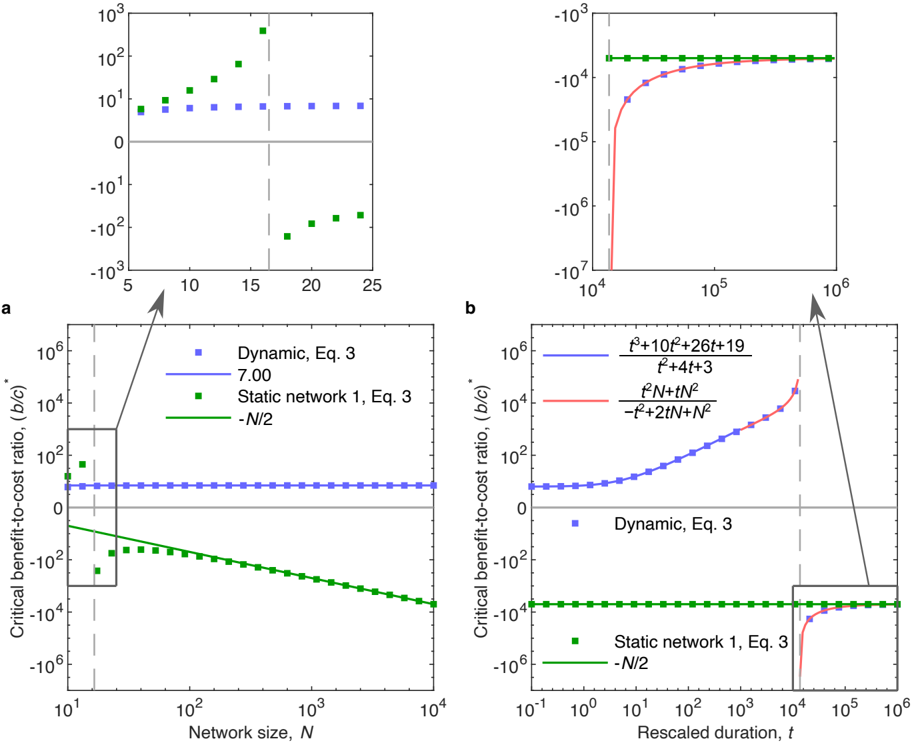
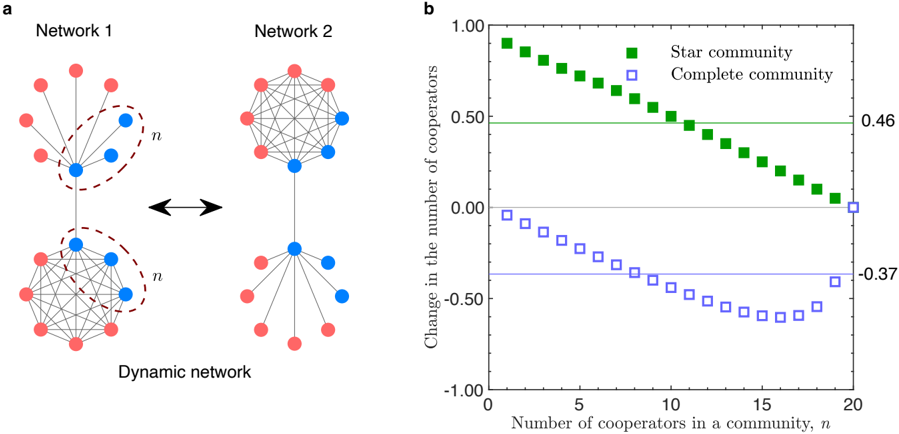
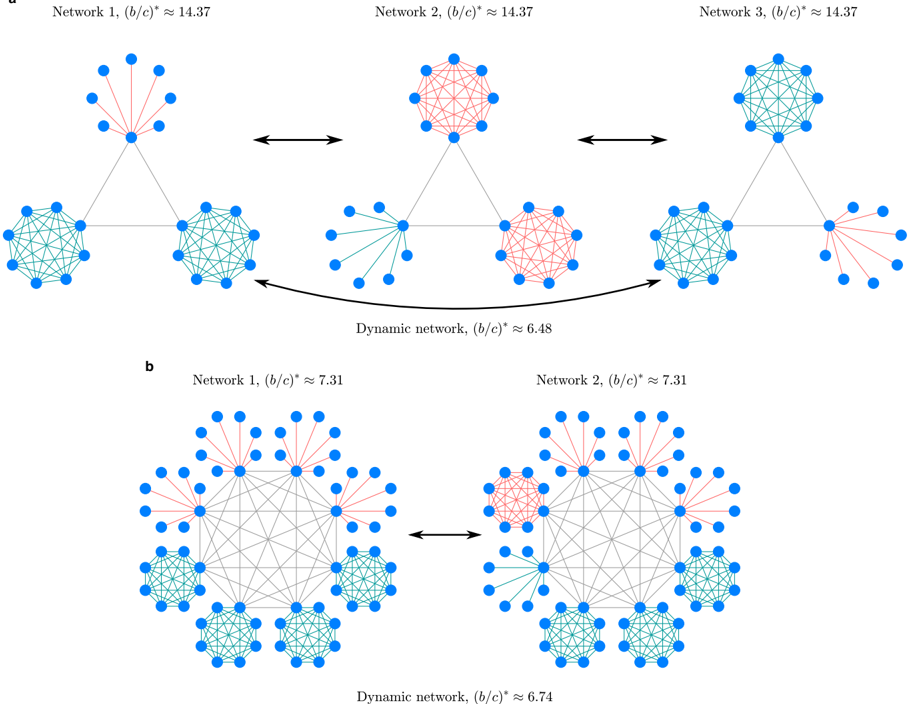
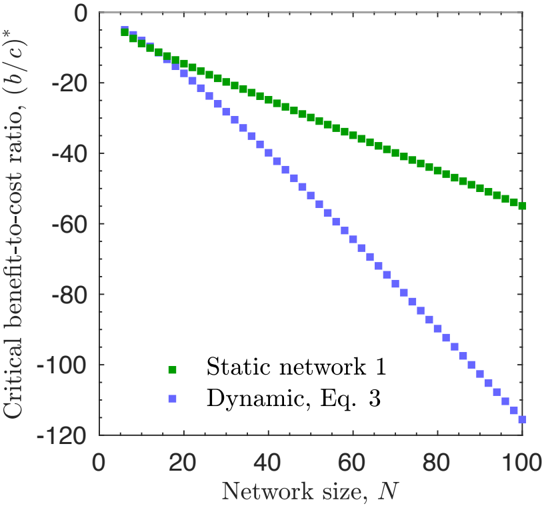
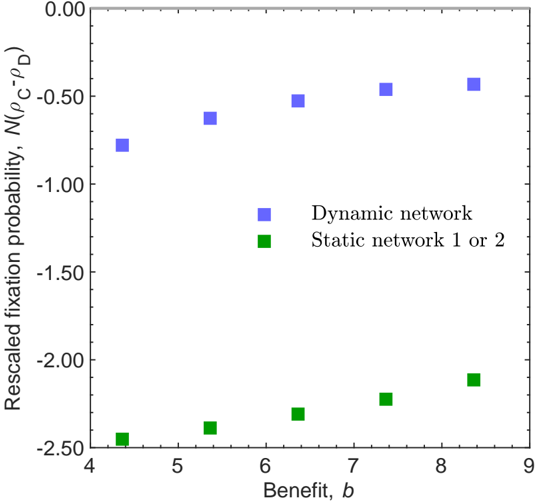
- For a dynamic pair of dense/sparse community networks, cooperation is disfavored on either static network for all benefit-to-cost ratios, but dynamic transitions favor cooperation when \(b/c\) exceeds \((b/c)^* \approx 7\).
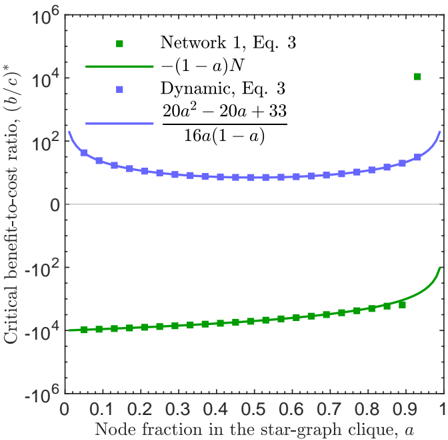
- In the same example, static networks favor cooperation only for very small populations (\(N < 17\)); for \(N \ge 17\), the static critical ratio is negative, \((b/c)^* < 0\), favoring spite, whereas the dynamic critical ratio approaches a positive constant, \((b/c)^* = 7\), for large \(N\).
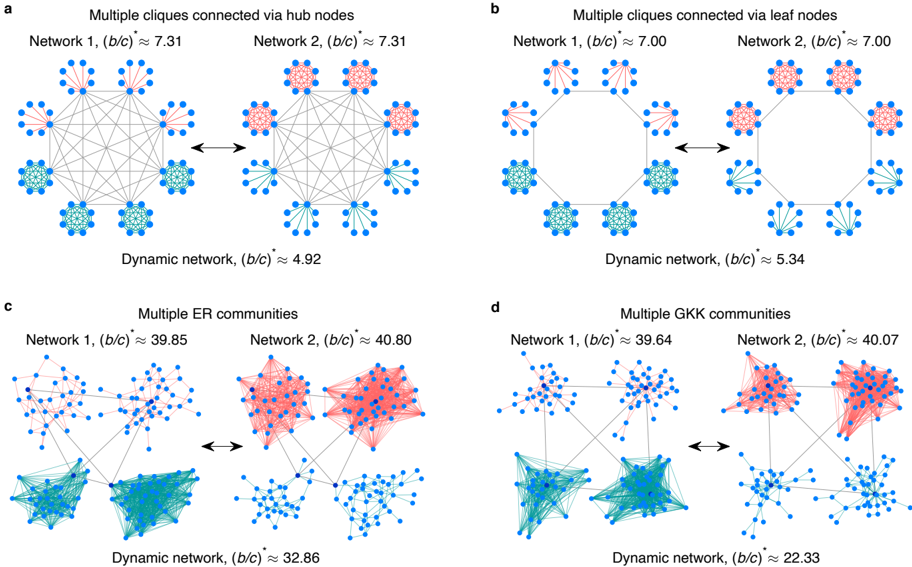
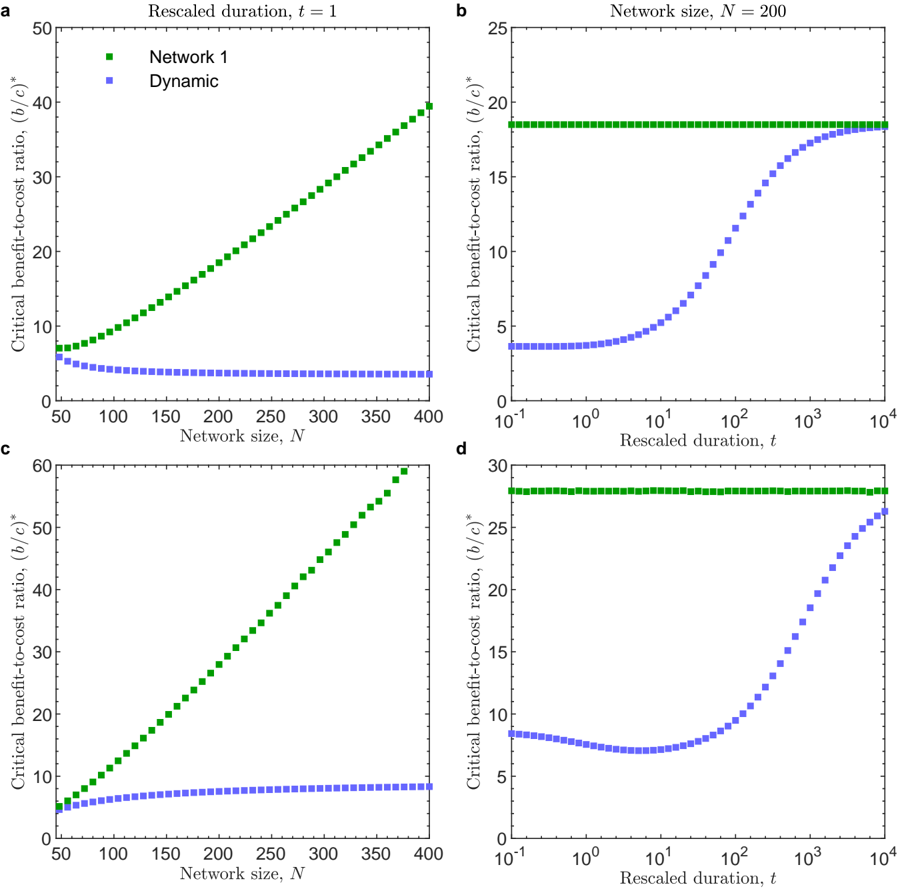
- In multi-community networks with \(N = 1{,}200\), the critical benefit-to-cost ratio is \((b/c)^* \approx 188.1\) when static but reduced to \((b/c)^* \approx 3.49\) when dynamic.
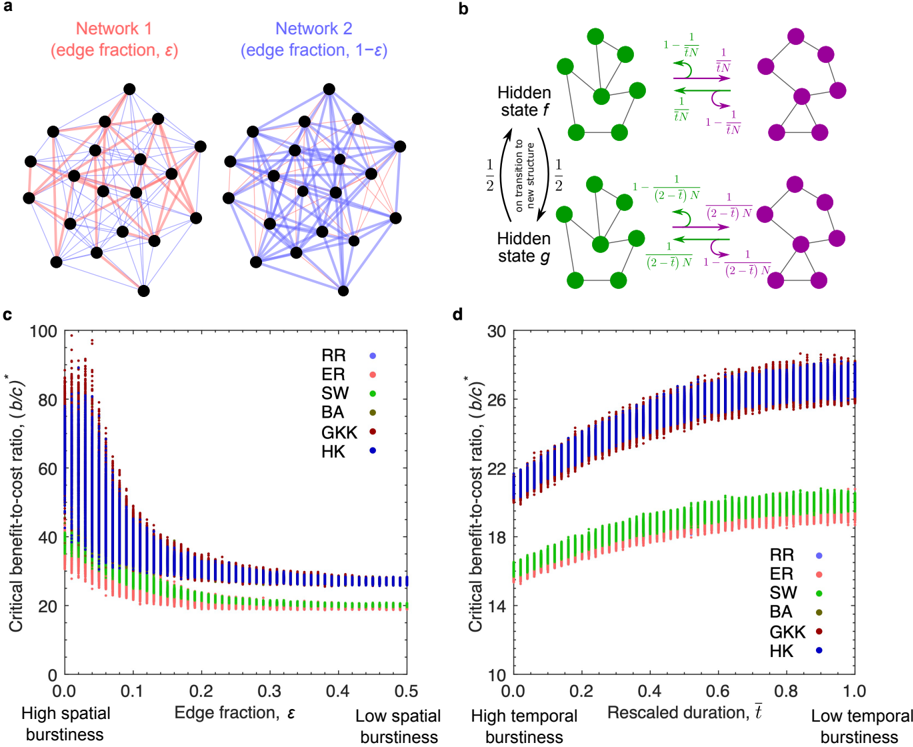
- Spatial burstiness tends to inhibit cooperation, roughly doubling the required \((b/c)^*\) as \(\varepsilon \to 0\) compared with the spatially homogeneous regime \(\varepsilon = 1/2\); temporal burstiness tends to promote cooperation, reducing \((b/c)^*\) typically by 20% when large (\(\bar t = 0\)) versus absent (\(\bar t = 1\)).
Methods
- The model uses a finite population of size \(N\), with \(L\) weighted undirected networks, pairwise donation games, weak selection \(\delta \ll 1\), and an imitation/update process in which an individual copies a neighbor with probability proportional to fecundity; network transitions follow an exogenous Markov chain \(Q\) independent of strategy composition.
- The analysis derives a general weak-selection condition for cooperation using neutral quantities: reproductive value \(\pi\), coalescence times \(\tau\), and \(T\), yielding the critical benefit-to-cost ratio \((b/c)^* = (\nu_2 - \nu_0)/(\mu_2 - \mu_0)\).
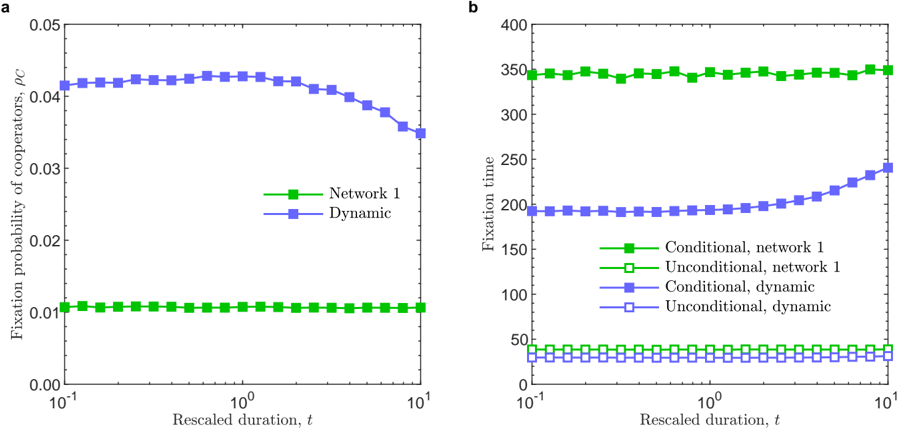
- Examples focus mainly on transitions between two networks (\(L=2\)) with \(t_1=t_2=t\), using analytical calculations and Monte Carlo simulations; Figure 2 simulations use \(N=40\), \(t=1\), \(c=1.0\), \(\delta=0.002\), and \(10^7\) runs. Spatial/temporal burstiness analyses use six network classes, 1,000 networks each, with 100 nodes and average degree 20.
Limitations
- Stated: the study assumes mutation-free dynamics; all results are based on exogenous network transitions, so individuals cannot selectively engineer neighborhoods based on traits; and the analyzed networks are a limited set of representative examples compared with the vast space of possible structures and transitions.
- Stated: future work is needed on fluctuating resources, varying timescales of network change relative to reproductive events, other exogenous changes favoring cooperation, and environments with both endogenous and exogenous transitions.
- Evident from the text: the main analytical results rely on weak selection (\(\delta \ll 1\)), undirected networks, and an irreducible transition chain \(Q\) for a unique stationary distribution; the donation-game framing may not directly cover all prosocial domains.
Model-written summary. Check it against the paper before relying on it.
Integrity signals
Registry
Cites
Statistics
Figures
Verification
Claims the paper makes
11 Valid · 10 Not valid · 26 Not checked · 79 Own results and interpretations
The cited sources that could be checked couldn’t confirm or dispute this claim.
In the paper
“Even if every such network individually disfavors cooperators, transitions between them can facilitate the evolution of cooperation - a result that is reminiscent of Parrondo's paradox [50].”
What the sources say
- Could not verifycites [50] [50] G. Harmer and D. Abbott. Losing strategies can win by Parrondo's paradox. Nature , 402: 864, 1999. doi: 10.1038/47220. - sourceExperimental — accuracy not yet measured
The paper’s Introduction (p. 1) and Example applications (pp. 5–6) discuss detecting community structure in networks, not the evolution of cooperation. Searches for Parrondo’s paradox, cooperators, and transitions between networks found no passage addressing the cited claim. (LLM, conf=0.78)
plainstates a cause- Asserted: passes — The authors put it forward as true.
- Checkable: passes — It can be checked against evidence.
- Load-bearing: passes — The paper’s conclusions depend on it.
- Based: passes — The paper gives a reason why it holds.
- Rests on 2 assumptions not shown here.
- Could not verify
The cited sources support only part of this claim — read each source’s verdict below.
In the paper
“Furthermore, weak-mutation dynamics do not necessarily predict what happens when mutation rates are larger [36, 58].”
What the sources say
- Supportedcites [36] [36] A. McAvoy and J. Wakeley. Evaluating the structure-coefficient theorem of evolutionary game theory. Proceedings of the National Academy of Sciences of the United States of America , 119(28):e2119656119, 2022. doi: 10.1073/pnas.2119656119. - source
The Abstract says fixation probabilities faithfully approximate trait frequencies only when mutations occur sufficiently infrequently. The Discussion reports that increasing mutation probability can reverse the direction of selection, directly supporting the claim that weak-mutation dynamics need not predict outcomes at higher mutation rates. (LLM, conf=0.93)
- Partly supportedcites [58] [58] F. D´ ebarre. Imperfect Strategy Transmission Can Reverse the Role of Population Viscosity on the Evolution of Altruism. Dynamic Games and Applications , 10(3):732-763, 2019. doi: 10.1007/s13235-019-00326-y. - sourceExperimental — accuracy not yet measured
Section 5 (p. 9) describes its results as asymptotic relationships under low mutation. Section 5.3 (p. 10) says a similar relationship applies at larger mutation rates only when rates are constant across sites and independent of parentage. This supports caution about extending low-mutation results, but the cited passages do not show that weak-mutation dynamics fail to predict dynamics at larger rates. (LLM, conf=0.76)
plain- Asserted: passes — The authors put it forward as true.
- Checkable: passes — It can be checked against evidence.
- Load-bearing: passes — The paper’s conclusions depend on it.
- Based: passes — The paper gives a reason why it holds.
- Supported
The cited sources support only part of this claim — read each source’s verdict below.
In the paper
“Broadly speaking, our work highlights the significance of integrating multiple communities into one system, since treating communities individually and independently may lead to erroneous conclusions about behavioral dynamics in the population as a whole [53].”
What the sources say
- Partly supportedcites [53] [53] B. Blonder, T. W. Wey, A. Dornhaus, R. James, and A. Sih. Temporal dynamics and network analysis. Methods in Ecology and Evolution , 3:958-972, 2012. ISSN 2041210X. doi: 10.1111/j.2041-210X.2012.00236.x. - sourceExperimental — accuracy not yet measured
The Conclusion (page unavailable) says population structure affects which strategy is selected, supporting the general importance of modeling interactions across a population. But the paper does not establish that analyzing communities individually and independently leads to erroneous conclusions about the population as a whole. (LLM, conf=0.77)
hedgedstates a possible cause- Asserted: passes — The authors put it forward as true.
- Checkable: passes — It can be checked against evidence.
- Load-bearing: passes — The paper’s conclusions depend on it.
- Based: passes — The paper gives a reason why it holds.
- Partly supported
The cited sources that could be checked couldn’t confirm or dispute this claim.
In the paper
“Spatio-temporal heterogeneity of interaction density within a given community also leads to time-varying connection densities, from sparse to dense and vice versa [2].”
What the sources say
- Could not verifycites [2] [2] P. Holme and J. Saram¨ aki. Temporal networks. Physics Reports , 519(3):97-125, 2012. ISSN 03701573. doi: 10.1016/j.physrep.2012.03.001. - sourceExperimental — accuracy not yet measured
The supplied passages and both searches for changing interaction density within a community return text labeled as a different paper, “FastMinTC+,” despite the index identifying the source as “Temporal networks.” Its Introduction defines time-stamped interactions, while its Conclusion discusses separate sparse and dense graph datasets; neither establishes that a community’s connection density changes from sparse to dense over time. The available copy therefore cannot verify the claim against the cited paper. (LLM, conf=0.72)
plainstates a cause- Asserted: passes — The authors put it forward as true.
- Checkable: passes — It can be checked against evidence.
- Load-bearing: unclear — It is unclear whether the paper’s conclusions depend on it.
- Based: passes — The paper gives a reason why it holds.
- Could not verify
The cited sources that could be checked couldn’t confirm or dispute this claim.
In the paper
“Although prosocial behaviors in different strategic domains may manifest in different ways, such as trust games or dictator games, the desire to pay costs to benefit others has a substantial degree of domain generality [49].”
What the sources say
- Could not verifycites [49] [49] A. Peysakhovich, M. A. Nowak, and D. G. Rand. Humans display a 'cooperative phenotype' that is domain general and temporally stable. Nature Communications , 5:4939, 2014. ISSN 20411723. doi: 10.1038/ncomms5939. - sourceExperimental — accuracy not yet measured
The Introduction (p. 1) discusses community structure in networks, and the Conclusions (p. 7) discuss applications of the authors’ network-analysis methods. Searches for paying costs to benefit others, domain generality, and prosocial behavior across trust and dictator games found no passage addressing the claim. (LLM, conf=0.78)
plain- Asserted: passes — The authors put it forward as true.
- Checkable: passes — It can be checked against evidence.
- Load-bearing: passes — The paper’s conclusions depend on it.
- Based: passes — The paper gives a reason why it holds.
- Could not verify
72 more claims · 3 with their cited sources checked
Create a free account to see all 126 claims and to verify the 2 references still open.
- Probably not a substantial claim. 25
- It may state two separate claims as one. 26
- The quote only partly states this claim. 3
Self-check
Percentages, sums and reported differences re-computed from the paper’s own numbers.
Each contradiction between two passages listed here was confirmed by an independent check.
Rated minor: it would not touch a result — a value no result rests on, a p-value that stays on the same side of the significance level, or a conflict that is clerical, resolved elsewhere in the paper, or outside its own findings.
In the paper
§ 4.2 Specific examples · p. 22
“The expected durations in networks 1 and 2 are q / ( p + q ) and p / ( p + q ) , respectively.”
§ 2.2 Selection condition for the evolution of cooperation · p. 6
“For a given network transition matrix Q , the value 1/ q 12 (resp. 1/ q 21 ) gives the expected time during which the population remains in network 1 (resp. network 2 ) before transitioning to network 2 (resp. network 1 ).”
Citations
Cites
Collective dynamics of ‘small-world’ networks
Watts, D. J., & Strogatz, S. H. (1998) · Nature · doi:10.1038/30918 · Cited by 43,060 · cited 2×
“Erdos-Reyni random networks [37], Watts-Strogatz small-world networks [40], Barabási-Albert scale free networks [41], etc.”
BackgroundEmergence of Scaling in Random Networks
Barabási, A.-L., & Albert, R. (1999) · Science · doi:10.1126/science.286.5439.509 · Cited by 36,135 · cited 2×
“…random regular networks (RR), ER networks 38 , Watts–Strogatz small-world networks (SW) 39 with rewiring probability 0.1, Barabási–Albert scale-free networks (BA) 40 , GKK scale-free networks 60 with exponent 2.5, and Holme–Kim scale-free networks (HK) 61 with triad formation probability 0.1.”
MethodInfluentialThe genetical theory of natural selection
Fisher, R. A. (1930) · doi:10.5962/bhl.title.27468 · Cited by 17,617
Community structure in social and biological networks
Girvan, M., & Newman, M. E. J. (2002) · Proceedings of the National Academy of Sciences · doi:10.1073/pnas.122653799 · Cited by 15,502 · cited 1×
“Groups and communities are more likely to form among people with close geographical locations and similar religion, culture and affiliations 49,50 , but connection densities will be altered over time.”
BackgroundModularity and community structure in networks
Newman, M. E. J. (2006) · Proceedings of the National Academy of Sciences · doi:10.1073/pnas.0601602103 · Cited by 12,256 · cited 1×
“Groups and communities are more likely to form among people with close geographical locations and similar religion, culture and affiliations 49,50 , but connection densities will be altered over time.”
BackgroundHolme, P., & Saramäki, J. (2012) · Physics Reports · doi:10.1016/j.physrep.2012.03.001 · Cited by 2,736 · cited 3×
“In contrast, empirical networks frequently vary over time 2 .”
BackgroundInfluentialA simple rule for the evolution of cooperation on graphs and social networks
Ohtsuki, H., Hauert, C., Lieberman, E., & Nowak, M. A. (2006) · Nature · doi:10.1038/nature04605 · Cited by 2,208 · cited 2×
“A well-known and illustrative finding 1 is that population structure can favor cooperation provided that the ratio of the benefit from cooperative behavior ( b ) to its cost ( c ) exceeds the average number of neighbors ( d ).”
BackgroundStructure and tie strengths in mobile communication networks
Onnela, J.-P., Saramäki, J., Hyvönen, J., Szabó, G., Lazer, D., Kaski, K., Kertész, J., & Barabási, A.-L. (2007) · Proceedings of the National Academy of Sciences · doi:10.1073/pnas.0610245104 · Cited by 1,926 · cited 1×
“Representative examples include communication networks involving telephone calls or emails 3,4 ; networks of physical proximity, where individuals encounter different people as they move through space 5,6 ; and ecological networks that change with the seasons as organisms go through different…”
BackgroundPlant-Animal Mutualistic Networks: The Architecture of Biodiversity
Bascompte, J., & Jordano, P. (2007) · Annual Review of Ecology, Evolution, and Systematics · doi:10.1146/annurev.ecolsys.38.091206.095818 · Cited by 1,720
Networks, Dynamics, and the Small‐World Phenomenon
Watts, D. J. (1999) · American Journal of Sociology · doi:10.1086/210318 · Cited by 1,510
Emergence of cooperation and evolutionary stability in finite populations
Nowak, M. A., Sasaki, A., Taylor, C., & Fudenberg, D. (2004) · Nature · doi:10.1038/nature02414 · Cited by 1,399
Evolutionary dynamics on graphs
Lieberman, E., Hauert, C., & Nowak, M. A. (2005) · Nature · doi:10.1038/nature03204 · Cited by 1,337 · cited 1×
“Such periodic transitions are widely used to model temporal networks 41–44 .”
MethodUniversal Behavior of Load Distribution in Scale-Free Networks
Goh, K.-I., Kahng, B., & Kim, D. (2001) · Physical Review Letters · doi:10.1103/physrevlett.87.278701 · Cited by 1,246 · cited 2×
“1, Barabási-Albert scale-free networks (BA) [41], Goh-Kahng-Kim scale-free networks (GKK) [38] with exponent 2.”
BackgroundGrowing scale-free networks with tunable clustering
Holme, P., & Kim, B. J. (2002) · Physical Review E · doi:10.1103/physreve.65.026107 · Cited by 1,088 · cited 1×
“5, and Holme–Kim scale-free networks (HK) [42] with triad formation probability 0.”
BackgroundBehavioral responses to changing environments
Wong, B. B. M., & Candolin, U. (2015) · Behavioral Ecology · doi:10.1093/beheco/aru183 · Cited by 1,065 · cited 1×
“There is also substantial evidence for the prevalence of exogenous network transitions in nature, ranging from weather fluctuations to human-induced changes in ecosystems 30 .”
BackgroundCollective dynamics of 'small-world' networks
Watts, D. J., & Strogatz, S. H. (2011) · The Structure and Dynamics of Networks · doi:10.1515/9781400841356.301 · Cited by 988
What's in a crowd? Analysis of face-to-face behavioral networks
Isella, L., Stehlé, J., Barrat, A., Cattuto, C., Pinton, J.-F., & Van den Broeck, W. (2011) · Journal of Theoretical Biology · doi:10.1016/j.jtbi.2010.11.033 · Cited by 825 · cited 2×
“…communication networks involving telephone calls or emails 3,4 ; networks of physical proximity, where individuals encounter different people as they move through space 5,6 ; and ecological networks that change with the seasons as organisms go through different phases of their life cycles 7–9 .”
BackgroundModern temporal network theory: a colloquium
Holme, P. (2015) · The European Physical Journal B · doi:10.1140/epjb/e2015-60657-4 · Cited by 734
Coevolution of Strategy and Structure in Complex Networks with Dynamical Linking
Pacheco, J. M., Traulsen, A., & Nowak, M. A. (2006) · Physical Review Letters · doi:10.1103/physrevlett.97.258103 · Cited by 697 · cited 2×
“In such models, cooperation can flourish when structure transitions are rapid enough 17–29 , for the simple reason that this endogenous dynamic establishes cooperative clusters.”
BackgroundDynamic social networks promote cooperation in experiments with humans
Rand, D. G., Arbesman, S., & Christakis, N. A. (2011) · Proceedings of the National Academy of Sciences · doi:10.1073/pnas.1108243108 · Cited by 653
Mastrandrea, R., Fournet, J., & Barrat, A. (2015) · PLOS ONE · doi:10.1371/journal.pone.0136497 · Cited by 588
Quantitative methods for ecological network analysis
Ulanowicz, R. E. (2004) · Computational Biology and Chemistry · doi:10.1016/j.compbiolchem.2004.09.001 · Cited by 573 · cited 1×
“…communication networks involving telephone calls or emails 3,4 ; networks of physical proximity, where individuals encounter different people as they move through space 5,6 ; and ecological networks that change with the seasons as organisms go through different phases of their life cycles 7–9 .”
BackgroundCooperation Prevails When Individuals Adjust Their Social Ties
Santos, F. C., Pacheco, J. M., & Lenaerts, T. (2006) · PLoS Computational Biology · doi:10.1371/journal.pcbi.0020140 · Cited by 556
Evolutionary dynamics on any population structure
Allen, B., Lippner, G., Chen, Y.-T., Fotouhi, B., Momeni, N., Yau, S.-T., & Nowak, M. A. (2017) · Nature · doi:10.1038/nature21723 · Cited by 534 · cited 2×
“For dB updating, it suffices to calculate expected remeeting times of random walks on the network 16 .”
BackgroundHumans display a ‘cooperative phenotype’ that is domain general and temporally stable
Peysakhovich, A., Nowak, M. A., & Rand, D. G. (2014) · Nature Communications · doi:10.1038/ncomms5939 · Cited by 426
(2014) · Royal Society Open Science · doi:10.1098/rsos · Cited by 423
The evolution of random graphs
Bollobás, B. (1984) · Transactions of the American Mathematical Society · doi:10.1090/s0002-9947-1984-0756039-5 · Cited by 415
Path lengths, correlations, and centrality in temporal networks
Pan, R. K., & Saramäki, J. (2011) · Physical Review E · doi:10.1103/physreve.84.016105 · Cited by 351
Losing strategies can win by Parrondo's paradox
Harmer, G. P., & Abbott, D. (1999) · Nature · doi:10.1038/47220 · Cited by 348 · cited 1×
“Even if every such network individually disfavors cooperators, transitions between them can facilitate the evolution of cooperation—a result that is reminiscent of Parrondo’s paradox 48 .”
BackgroundImpact of Non-Poissonian Activity Patterns on Spreading Processes
Vazquez, A., Rácz, B., Lukács, A., & Barabási, A.-L. (2007) · Physical Review Letters · doi:10.1103/physrevlett.98.158702 · Cited by 338 · cited 1×
“Representative examples include communication networks involving telephone calls or emails [3, 4]; networks of physical proximity, where individuals encounter different people as they move through space [5, 6]; and ecological networks that change with the seasons as organisms go through different phases of their life…”
BackgroundEvolutionary games with environmental feedbacks
Tilman, A. R., Plotkin, J. B., & Akçay, E. (2020) · Nature Communications · doi:10.1038/s41467-020-14531-6 · Cited by 337
Self-citationImitation processes with small mutations
Fudenberg, D., & Imhof, L. A. (2006) · Journal of Economic Theory · doi:10.1016/j.jet.2005.04.006 · Cited by 335 · cited 1×
“In line with many studies on evolutionary dynamics, we have assumed that mutations appear infrequently, which justifies the study of fixation probabilities to quantify evolutionary dynamics 52 .”
BackgroundEvolution of cooperation in a finite homogeneous graph
Taylor, P. D., Day, T., & Wild, G. (2007) · Nature · doi:10.1038/nature05784 · Cited by 302 · cited 1×
“In static networks, mathematical approaches provide general conditions for how structure affects evolutionary dynamics [14, 15].”
BackgroundStrategy selection in structured populations
Tarnita, C. E., Ohtsuki, H., Antal, T., Fu, F., & Nowak, M. A. (2009) · Journal of Theoretical Biology · doi:10.1016/j.jtbi.2009.03.035 · Cited by 281 · cited 1×
“Within static networks 53 (and certain kinds of dynamic network 54 ), positive mutation rates lead to what is called a ‘ σ -rule’ for selection to favor cooperators in mean abundance.”
BackgroundAnalytical computation of the epidemic threshold on temporal networksPreprint
Valdano, E., Ferreri, L., Poletto, C., & Colizza, V. (2016) · Cited by 278
Evolutionary dynamics in set structured populations
Tarnita, C. E., Antal, T., Ohtsuki, H., & Nowak, M. A. (2009) · Proceedings of the National Academy of Sciences · doi:10.1073/pnas.0903019106 · Cited by 264 · cited 1×
“Within static networks 53 (and certain kinds of dynamic network 54 ), positive mutation rates lead to what is called a ‘ σ -rule’ for selection to favor cooperators in mean abundance.”
BackgroundComprehension of role reversal in chimpanzees: evidence of empathy?
Povinelli, D. J., Nelson, K. E., & Boysen, S. T. (1992) · Animal Behaviour · doi:10.1016/s0003-3472(05)81022-x · Cited by 256 · cited 1×
“Stochastic transitions in social structures can arise from the effects of weather, animal migration and movement, and role reversal [47].”
BackgroundAllele-Frequency Change in a Class-Structured Population
Taylor, P. D. (1990) · The American Naturalist · doi:10.1086/285034 · Cited by 255 · cited 1×
“The version of reproductive value that we use is a generalization of Fisher’s classical notion 34,35 that also takes into account environmental changes.”
MethodTemporal dynamics and network analysis
Blonder, B., Wey, T. W., Dornhaus, A., James, R., & Sih, A. (2012) · Methods in Ecology and Evolution · doi:10.1111/j.2041-210x.2012.00236.x · Cited by 254 · cited 1×
“Broadly speaking, our work highlights the significance of integrating multiple communities into one system, since treating communities individually and independently may lead to erroneous conclusions about behavioral dynamics in the population as a whole [53].”
BackgroundEmergence of Scaling in Random Networks
Barabási, A.-L., & Albert, R. (2011) · The Structure and Dynamics of Networks · doi:10.1515/9781400841356.349 · Cited by 221
Fehl, K., van der Post, D. J., & Semmann, D. (2011) · Ecology Letters · doi:10.1111/j.1461-0248.2011.01615.x · Cited by 220
Cooperation and assortativity with dynamic partner updating
Wang, J., Suri, S., & Watts, D. J. (2012) · Proceedings of the National Academy of Sciences · doi:10.1073/pnas.1120867109 · Cited by 198
Evolution of Cooperation on Stochastic Dynamical Networks
Wu, B., Zhou, D., Fu, F., Luo, Q., Wang, L., & Traulsen, A. (2010) · PLoS ONE · doi:10.1371/journal.pone.0011187 · Cited by 193
Analytical Computation of the Epidemic Threshold on Temporal Networks
Valdano, E., Ferreri, L., Poletto, C., & Colizza, V. (2015) · Physical Review X · doi:10.1103/physrevx.5.021005 · Cited by 187 · cited 1×
“Such periodic transitions are widely used to model temporal networks 41–44 .”
MethodReacting Differently to Adverse Ties Promotes Cooperation in Social Networks
Van Segbroeck, S., Santos, F. C., Lenaerts, T., & Pacheco, J. M. (2009) · Physical Review Letters · doi:10.1103/physrevlett.102.058105 · Cited by 170 · cited 1×
“For each such class, we generate 1,000 networks, each with 100 nodes and average degree 20.”
MethodRepeated games and direct reciprocity under active linking
Pacheco, J. M., Traulsen, A., Ohtsuki, H., & Nowak, M. A. (2008) · Journal of Theoretical Biology · doi:10.1016/j.jtbi.2007.10.040 · Cited by 162
Gernat, T., Rao, V. D., Middendorf, M., Dankowicz, H. J., Goldenfeld, N. D., & Robinson, G. E. (2018) · Proceedings of the National Academy of Sciences · doi:10.1073/pnas.1713568115 · Cited by 141 · cited 1×
“Empirical networks of both human and non-human (for example, honeybee) interactions are known to exhibit both spatial and temporal burstiness 10,37 , but the effect of these two forms of over-dispersion for behavior remains an active area of current research.”
BackgroundMultiple strategies in structured populations
Tarnita, C. E., Wage, N., & Nowak, M. A. (2011) · Proceedings of the National Academy of Sciences · doi:10.1073/pnas.1016008108 · Cited by 106 · cited 1×
“Such results involve inequalities based on (generally) at most three coefficients (for example, σ 1 , σ 2 and σ 3 ), all related to the population’s structure, update rule and mutation rate 55 .”
BackgroundEvolution of cooperation with asymmetric social interactions
Su, Q., Allen, B., & Plotkin, J. B. (2022) · Proceedings of the National Academy of Sciences · doi:10.1073/pnas.2113468118 · Cited by 104 · cited 1×
“…analysis also applies to other scenarios for changing structures, such as when the direction of public goods or information flow changes over time 46 ; the number of active nodes or edges varies; or the population size fluctuates (in fact, the results in the Supplementary Information allow for…”
BackgroundSelf-citationSocial goods dilemmas in heterogeneous societies
McAvoy, A., Allen, B., & Nowak, M. A. (2020) · Nature Human Behaviour · doi:10.1038/s41562-020-0881-2 · Cited by 94 · cited 1×
“The class of models we are interested in here involve social goods 57 in which, on network β , an individual of type A at i pays a cost of ij to the individual at j .”
BackgroundSelf-citationTrust and partner selection in social networks: An experimentally grounded model
Bravo, G., Squazzoni, F., & Boero, R. (2012) · Social Networks · doi:10.1016/j.socnet.2012.03.001 · Cited by 85
Fixation probabilities in evolutionary dynamics under weak selection
McAvoy, A., & Allen, B. (2021) · Journal of Mathematical Biology · doi:10.1007/s00285-021-01568-4 · Cited by 74
Self-citationSocial goods dilemmas in heterogeneous societies
McAvoy, A., Allen, B., & Nowak, M. A. (2020) · RePEc: Research Papers in Economics · Cited by 73
Self-citationEvolutionary Dynamics of Time-Resolved Social Interactions
Cardillo, A., Petri, G., Nicosia, V., Sinatra, R., Gómez‐Gardeñes, J., & Latora, V. (2014) · Physical Review E · doi:10.1103/physreve.90.052825 · Cited by 58
Costs for switching partners reduce network dynamics but not cooperative behaviour
Bednarik, P., Fehl, K., & Semmann, D. (2014) · Proceedings of the Royal Society B: Biological Sciences · doi:10.1098/rspb.2014.1661 · Cited by 49
Collapse and rescue of cooperation in evolving dynamic networks
Akçay, E. (2018) · Nature Communications · doi:10.1038/s41467-018-05130-7 · Cited by 47
Spite is contagious in dynamic networks
Fulker, Z., Forber, P., Smead, R., & Riedl, C. (2021) · Nature Communications · doi:10.1038/s41467-020-20436-1 · Cited by 47 · cited 1×
“…fundamental neutral quantity is the reproductive value of individual i in network β , which can be interpreted as the probability network, we might expect that exogenous network transitions will tend to break up these clusters, leading to diminished reciprocity and exploitation by defectors 12,13 .”
BackgroundConcurrency-Induced Transitions in Epidemic Dynamics on Temporal Networks
Onaga, T., Gleeson, J. P., & Masuda, N. (2017) · Physical Review Letters · doi:10.1103/physrevlett.119.108301 · Cited by 46 · cited 1×
“d dδ ∣∣∣∣ δ=0 ρC > d dδ ∣∣∣∣ δ=0 ρD ⇐⇒ bμ2 − cν2 > bμ0 − cν0, (11)”
A mathematical formalism for natural selection with arbitrary spatial and genetic structure
Allen, B., & McAvoy, A. (2019) · Journal of Mathematical Biology · doi:10.1007/s00285-018-1305-z · Cited by 37 · cited 3×
“In static networks, mathematical approaches provide general conditions for how structure affects evolutionary dynamics 14,15 .”
BackgroundInfluentialSelf-citationDiffusion in networks and the virtue of burstiness
Akbarpour, M., & Jackson, M. O. (2018) · Proceedings of the National Academy of Sciences · doi:10.1073/pnas.1722089115 · Cited by 33
Revealing the hidden structure of dynamic ecological networks
Miele, V., & Matias, C. (2017) · Royal Society Open Science · doi:10.1098/rsos.170251 · Cited by 31 · cited 1×
“…communication networks involving telephone calls or emails 3,4 ; networks of physical proximity, where individuals encounter different people as they move through space 5,6 ; and ecological networks that change with the seasons as organisms go through different phases of their life cycles 7–9 .”
BackgroundEvolution of cooperation on dynamical graphs
Kun, Á., & Scheuring, I. (2009) · Biosystems · doi:10.1016/j.biosystems.2008.11.009 · Cited by 29 · cited 3×
“For example, switching between two random networks tends to impede cooperation relative to each separate network 12 .”
BackgroundResultEvaluating the structure-coefficient theorem of evolutionary game theory
McAvoy, A., & Wakeley, J. (2022) · Proceedings of the National Academy of Sciences · doi:10.1073/pnas.2119656119 · Cited by 23 · cited 2×
“Calculating these coefficients is not straightforward, and only recently has a method been proposed for doing so on static networks 36 .”
BackgroundMethodSelf-citationHarrell, A., Melamed, D., & Simpson, B. (2018) · Science Advances · doi:10.1126/sciadv.aau9109 · Cited by 22
The coalescent in finite populations with arbitrary, fixed structure
Allen, B., & McAvoy, A. (2024) · Theoretical Population Biology · doi:10.1016/j.tpb.2024.06.004 · Cited by 17
Self-citationThe coalescent in finite populations with arbitrary, fixed structure
Allen, B., & McAvoy, A. (2022) · arXiv · doi:10.48550/arxiv.2207.02880 · Cited by 12
Self-citationDébarre, F. (2020) · Dynamic Games and Applications · doi:10.1007/s13235-019-00326-y · Cited by 2
Qisu1991 (2023) · Zenodo (CERN European Organization for Nuclear Research) · doi:10.5281/zenodo.8215242 · Cited by 1
(2014) · Institutional Repository University of Antioquia (University of Antioquia) · doi:10.1371/journal.pone
Research works printed but not linked: 1
- Erdös, P. & Rényi, A. On the evolution of random graphs. Publ. Math. Institute Hung. Acad. Sci. 5, 17–61 (1960).
Cited by
Reinforcement learning and collective cooperation on higher-order networks
Xu, Y., Wang, J., Chen, J., Zhao, D., Özer, M., Xia, C., & Perc, M. (2024) · Knowledge-Based Systems · doi:10.1016/j.knosys.2024.112326 · Cited by 119
“Secondly, the duration of interactions in dynamic networks is limited and varies over time, which is a factor known to facilitate group cooperation [30–33].”
BackgroundEvolutionary dynamics of any multiplayer game on regular graphs
Wang, C., Perc, M., & Szolnoki, A. (2024) · Nature Communications · doi:10.1038/s41467-024-49505-5 · Cited by 117
“That allows a calculation of the statistical mean payoffs of players in regular graphs.”
BackgroundEvolutionary dynamics in stochastic nonlinear public goods games
Zhu, W., Wang, X., Wang, C., Liu, L., Hu, J., Zheng, Z. M., Tang, S., Zheng, H., & Dong, J. (2024) · Communications Physics · doi:10.1038/s42005-024-01865-6 · Cited by 37
Information sharing promotes cooperation among mobile individuals in multiplex networks
Li, W., Chen, Z., Jiang, L.-L., & Perc, M. (2024) · Nonlinear Dynamics · doi:10.1007/s11071-024-10100-4 · Cited by 24
“Considering network structure, individuals tend to migrate to sites with high degrees to gain advantages, leading to shifts in population and dynamics in link formation [39,58,59].”
BackgroundWu, C., Deng, H., Wu, H., & Tu, C. (2025) · Reliability Engineering & System Safety · doi:10.1016/j.ress.2025.110951 · Cited by 24
Metadata
- Authors
- Su, Q., McAvoy, A., & Plotkin, J. B.
- Affiliations
- Shanghai Jiao Tong University (CN)
- University of North Carolina at Chapel Hill (US)
- University of Pennsylvania (US)
- Corresponding author
- Su, Qi
- McAvoy, Alex
- Venue
- Nature Computational Science
- Published
- 2023-09-11
- Volume
- 3
- Issue
- 9
- Pages
- 763-776
- ISSN
- 2662-8457 (ISSN-L)
- OpenAlex
- W4386609747
- Semantic Scholar
- 8a5a56369ce0428bf9ea94ce0be350e93fc34e9a
- Cited by
- 97
- References
- 63
- Citations by year
- 2026: 34 · 2025: 37 · 2024: 22 · 2023: 4
- FWCI
- 28.88
- Type
- journal article
- Language
- en
- Open access
- green
- arxiv.org
- Licence
- cc-by
- www.springernature.com/gp/researchers/text-and-data-mining (tdm)
- www.springernature.com/gp/researchers/text-and-data-mining (vor)
- Locations
- Nature Computational Science (publishedVersion)
- PubMed (publishedVersion)
- arXiv (Cornell University) (submittedVersion, cc-by)
- arXiv (Cornell University) (cc-by)
- Funders
- John Templeton Foundation (62281)
- University of Pennsylvania
- Topics
- Social Sciences › Sociology and Political Science › Evolutionary Game Theory and Cooperation
- Physical Sciences › Physics and Astronomy › Statistical and Nonlinear Physics › Complex Network Analysis Techniques
- Physical Sciences › Mathematics › Applied Mathematics › Mathematical and Theoretical Epidemiology and Ecology Models
- Keywords
- evolution of cooperation, dynamic networks, network reorganization, spatial heterogeneity, temporal heterogeneity, prosocial behavior, network transition, population structure
- MeSH terms
- Altruism, Cooperative Behavior, Humans, Social Change, Social Networking
About these checks
Registry, retraction, Cites and statistics results are computed, not judged, with one exception: a printed reference that no index lists is read once by a model before it counts as a citation error. Claims are extracted by a model and kept only when their quote appears verbatim in the text; each cited source is then checked, with a model’s help, for whether it says what the claim relies on. Those verdicts can be wrong — read the claim’s quote and the cited source before relying on one.
The claim verdicts this report counts are experimental: their accuracy is not yet measured.
A language model drew the claims from the paper on 2026-10-10, under version 3 of the claim definition (model deepseek-v4.1-flash, prompt extract-v3).
A second model labelled each claim on 2026-10-10 (model jev-1.13-20260917, definition revision gold-guideline-v0.2).
Cited sources are checked with a language model’s help (gpt-6-sol).
Statistics and arithmetic are recomputed, not judged.
Confidence bands are shown only for fields calibrated on our annotated test set. None is calibrated yet, so no band is shown.
What counts as a claim ›How we measure confidence ›How we check this ›
Are you an author, or do you see a problem with this page? Request a review
Data sources
Bibliographic data: Semantic Scholar, OpenAlex, Crossref.
Contains information from the Semantic Scholar Academic Graph Datasets, made available under the ODC Attribution License (ODC-BY 1.0).
Semantic Scholar’s data is described in: Kinney, R., et al. (2023). The Semantic Scholar Open Data Platform. arXiv:2301.10140.
