

Beyond bendy joints: number of variant connective tissue features predicts neurodivergent characteristics in hypermobile individuals with anxiety
Open accessThe DOI matches its Crossref record; 61 of the 64 references it cites were found in a registry or an index; 23 of the 43 sources its claims cite were checked for support.
Abstract
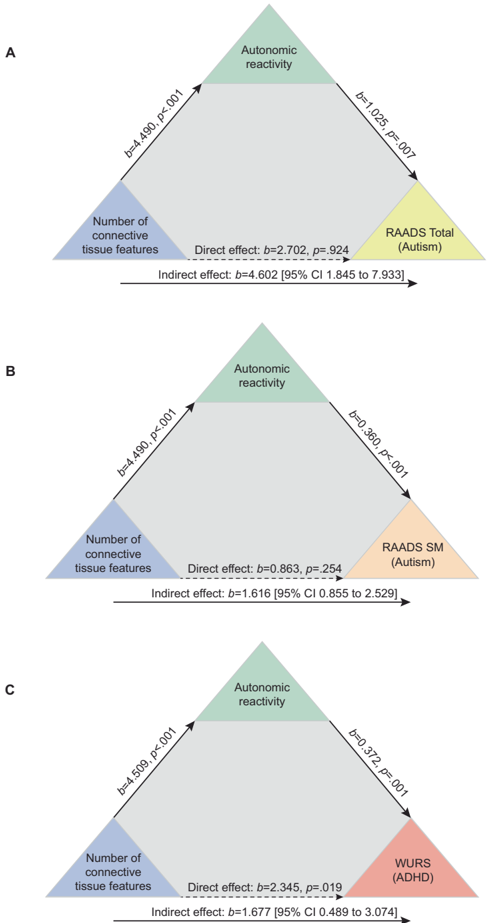
The goal of this study was to determine whether the number of connective tissue features in hypermobility is associated with the level of neurodivergent characteristics and establish whether autonomic reactivity may be an explanatory factor in the relationship between variant connective tissue and neurodivergent characteristics. 99 adult participants were assessed for joint hypermobility syndrome/hypermobile Ehlers–Danlos-Syndrome and filled out screening questionnaires for autism and ADHD. 99% of participants met criteria for generalised joint hypermobility, and 57% for hypermobile Ehlers–Danlos–Syndrome. 47% of participants scored above the screening threshold for autism, and 20% for ADHD. All measures were significantly correlated. Level of autonomic reactivity (as measured by the Body Perception Questionnaire) mediated the relationship between the number of connective tissue features and neurodivergence, even after controlling for anxiety level. This shows that autonomic reactivity has a potential mechanistic role in the established link between variant connective tissue and neurodivergence, opening novel pathways for research and clinical care.
Overview
CoChat Summary
TL;DR
In 99 adults with joint hypermobility and anxiety, the number of variant connective tissue features predicted autistic and ADHD characteristics, with autonomic reactivity as a significant mediator. These mediation effects remained significant after controlling for anxiety, psychiatric medication use, and demographic variables.
Key findings
- Almost all participants met criteria for generalised joint hypermobility (99%), 57% met criteria for hEDS, and 43% had HSD; 47% scored above the autism screening threshold (RAADS-R ≥65) and 20% above the ADHD screening threshold (WURS ≥46). Clinical psychologists recommended 34% for full autism assessments, 14% for full ADHD assessments, and 7% for both.
- Number of connective tissue features (hEDS Criterion 2A) positively correlated with autistic characteristics (RAADS total r = 0.270, p < 0.01), sensory sensitivities (RAADS sensory motor r = 0.332, p < 0.01), ADHD characteristics (WURS total r = 0.413, p < 0.001), and autonomic reactivity (BPQ r = 0.451, p < 0.001).
- Autonomic reactivity significantly mediated the relationship between number of connective tissue features and sensory sensitivities, autism characteristics, and ADHD characteristics; these effects remained significant when correcting for anxiety level, psychiatric medication use, and demographic variables.
- Mean scores were RAADS-R total 73.4 (SD 51.5), WURS total 30.4 (SD 18.2), BPQ autonomic reactivity 59.3 (SD 19.2), and average number of connective tissue features 4.6 (SD 1.9).
Methods
- Secondary analysis of screening data from the ADAPT randomised controlled trial (ISRCTN17018615); 99 adults aged ≥18 with anxiety (Beck Anxiety Inventory ≥16) and hypermobility (5-part questionnaire ≥2 or hypermobility-related diagnosis) were assessed, excluding major psychiatric disorders and previously confirmed neurodevelopmental conditions.
- Variant connective tissue was assessed with the 5-part questionnaire, Brighton Criteria, and 2017 hEDS criteria; number of connective tissue features was the sum of hEDS Criterion 2A items met. Autistic characteristics were measured with RAADS-R, ADHD characteristics with WURS, and autonomic reactivity with the Body Perception Questionnaire Autonomic Nervous System Reactivity subscale.
- Analyses included bivariate correlations and separate mediation analyses using PROCESS macro v3.5 with 5000 bootstrapped samples; predictor was number of connective tissue features, mediator was autonomic reactivity, and outcomes were RAADS sensory motor scores and WURS scores, with covariates added in repeat models.
Limitations
- Stated: the cross-sectional design precludes strong causal inference, and alternative models—such as neurodivergent characteristics influencing autonomic regulation and sensory processing, bidirectional relationships, or shared developmental factors—are plausible.
- Stated: participants were recruited specifically for marked anxiety and joint hypermobility, so the sample reflects more complex or intense symptom profiles than the wider population; no comparison group without anxiety was included, and other clinically relevant factors (e.g., mood, medication effects, chronic pain, sleep difficulties, autonomic conditions) were not fully captured.
- Stated and evident: the sample was mostly female, screening tools may not capture all likely neurodivergent participants, RAADS-R may have limited predictive validity for autism diagnosis, RAADS-R items may overlap with anxiety symptoms, COVID-19 restrictions meant RAADS-R was completed online, and it was beyond scope to assess whether participants screening positively subsequently received diagnoses.
Model-written summary. Check it against the paper before relying on it.
Integrity signals
Registry
Cites
Statistics
Figures
Verification
Claims the paper makes
17 Valid · 0 Not valid · 8 Not checked · 54 Own results and interpretations
Every source the paper cites for this claim was checked and supports it.
In the paper
“A population-based matched cohort study (nationwide registry) in Sweden (n = 1771) showed that individuals with EDS are 7.4 times more likely to be autistic than a comparison group, and 5.6 times more likely to have an ADHD diagnosis than those without EDS5.”
§ Beyond bendy joints: number of variant connective tissue features predicts neurodivergent characteristics in hypermobile individuals with anxiety > Introduction
What the sources say
- Supportedcites [5] Cederlöf, M. et al. Nationwide population-based cohort study of psychiatric disorders in individuals with Ehlers–Danlos syndrome or hypermobility syndrome and their siblings. BMC Psychiatry 10.1186/s12888-016-0922-6 (2016). PMC4932739 27377649 source
The Results table, “EDS vs. comparison individuals,” reports an autism spectrum disorder risk ratio of 7.4 (95% CI 5.2–10.7) for 1,771 individuals with EDS versus 17,710 matched comparison individuals. This supports the cited 7.4-fold comparison. (LLM, conf=0.95)
plainstates an association- Asserted: passes — The authors put it forward as true.
- Checkable: passes — It can be checked against evidence.
- Load-bearing: unclear — It is unclear whether the paper’s conclusions depend on it.
- Based: passes — The paper gives a reason why it holds.
- Supported
The sources with a verdict support this claim; the rest weren’t checked yet, have no full text we could read, or their verdicts aren’t rated yet.
In the paper
“and psychological health difficulties, particularly anxiety5,18,19.”
§ Beyond bendy joints: number of variant connective tissue features predicts neurodivergent characteristics in hypermobile individuals with anxiety > Introduction
What the sources say
- Supportedcites [5] Cederlöf, M. et al. Nationwide population-based cohort study of psychiatric disorders in individuals with Ehlers–Danlos syndrome or hypermobility syndrome and their siblings. BMC Psychiatry 10.1186/s12888-016-0922-6 (2016). PMC4932739 27377649 source
The Background reports a meta-analysis finding increased anxiety risk and higher anxiety scores among people with joint hypermobility. The Discussion, under “Comparison with the previous literature,” also describes a significant association between hypermobility syndrome and anxiety. The paper notes that the underlying studies were small and their estimates varied. (LLM, conf=0.90)
- Not checked — no full text of the sourcecites [18] Bulbena, A. et al. Psychiatric and psychological aspects in the Ehlers-Danlos syndromes. Am. J. Med. Genet. Part C Semin. Med. Genet. 175, 237–245 (2017). 28186381 source
- Supportedcites [19] Sharp, H. E. C., Critchley, H. D. & Eccles, J. A. Connecting brain and body: transdiagnostic relevance of connective tissue variants to neuropsychiatric symptom expression. World J. Psychiatry 11, 805 (2021). PMC8546774 34733643 source
The Results section (‘Anxiety’) says research has repeatedly demonstrated an association between joint hypermobility and anxiety. The Introduction also describes links with other psychiatric conditions, supporting the broader reference to psychological health difficulties. (LLM, conf=0.94)
plainstates an association- Asserted: passes — The authors put it forward as true.
- Checkable: passes — It can be checked against evidence.
- Load-bearing: passes — The paper’s conclusions depend on it.
- Based: passes — The paper gives a reason why it holds.
- Supported
The cited sources support only part of this claim — read each source’s verdict below.
In the paper
“Variant connective tissue also affects the function of the autonomic nervous system, and has been shown to link neurodivergence and dysautonomia mechanistically9.”
§ Beyond bendy joints: number of variant connective tissue features predicts neurodivergent characteristics in hypermobile individuals with anxiety > Introduction
What the sources say
- Partly supportedcites [9] Csecs, J. L. L. et al. Joint hypermobility links neurodivergence to dysautonomia and pain. Front. Psychiatry 10.3389/fpsyt.2021.786916 (2022). PMC8847158 35185636 sourceExperimental — accuracy not yet measured
The Results (Orthostatic Intolerance; page not provided) associate joint hypermobility with orthostatic intolerance symptoms. The Discussion (page not provided) proposes that connective-tissue differences may contribute to autonomic cardiovascular dysregulation, but it does not establish that variant connective tissue affects autonomic nervous system function as a causal fact. (LLM, conf=0.85)
boostedstates a cause- Asserted: passes — The authors put it forward as true.
- Checkable: passes — It can be checked against evidence.
- Load-bearing: passes — The paper’s conclusions depend on it.
- Based: passes — The paper gives a reason why it holds.
- Partly supported
The cited sources support only part of this claim — read each source’s verdict below.
In the paper
“One potential factor is the overrepresentation of hereditary connective tissue disorders in this population5–7.”
§ Beyond bendy joints: number of variant connective tissue features predicts neurodivergent characteristics in hypermobile individuals with anxiety > Introduction
What the sources say
- Partly supportedcites [5] Cederlöf, M. et al. Nationwide population-based cohort study of psychiatric disorders in individuals with Ehlers–Danlos syndrome or hypermobility syndrome and their siblings. BMC Psychiatry 10.1186/s12888-016-0922-6 (2016). PMC4932739 27377649 sourceExperimental — accuracy not yet measured
The Background identifies Ehlers–Danlos syndrome (EDS) as an inherited connective-tissue disorder, and the Abstract Results report higher rates of autism spectrum disorder and ADHD among people with EDS. This supports an association, but the study examines EDS and hypermobility syndrome, not hereditary connective-tissue disorders generally or the neurodivergent population as a whole. (LLM, conf=0.83)
- Not checked — no full text of the sourcecites [6] Dogan, ŞK., Taner, Y. & Evcik, D. Benign joint hypermobility syndrome in patients with attention deficit/hyperactivity disorders. Arch. Rheumatol. 26, 187–192 (2011). source
- Partly supportedcites [7] Casanova, E. L., Baeza-Velasco, C., Buchanan, C. B. & Casanova, M. F. The Relationship between autism and Ehlers-Danlos Syndromes/hypermobility spectrum disorders. J. Pers. Med. 10.3390/jpm10040260 (2020). PMC7711487 33271870 sourceExperimental — accuracy not yet measured
Section 2 reports population-level evidence of an association between autism and EDS/HSD, and the Conclusions propose that hereditary connective tissue disorders may account for a significant minority of autism cases. But the review says that prevalence is unknown; it does not establish overrepresentation across the broader neurodivergent population or across hereditary connective tissue disorders generally. Page numbers are not available in our copy. (LLM, conf=0.84)
hedgedstates an association- Asserted: passes — The authors put it forward as true.
- Checkable: passes — It can be checked against evidence.
- Load-bearing: passes — The paper’s conclusions depend on it.
- Based: passes — The paper gives a reason why it holds.
- Partly supported
Every source the paper cites for this claim was checked and supports it.
In the paper
“A population-based matched cohort study (nationwide registry) in Sweden (n = 1771) showed that individuals with EDS are 7.4 times more likely to be autistic than a comparison group, and 5.6 times more likely to have an ADHD diagnosis than those without EDS5.”
§ Beyond bendy joints: number of variant connective tissue features predicts neurodivergent characteristics in hypermobile individuals with anxiety > Introduction
What the sources say
- Supportedcites [5] Cederlöf, M. et al. Nationwide population-based cohort study of psychiatric disorders in individuals with Ehlers–Danlos syndrome or hypermobility syndrome and their siblings. BMC Psychiatry 10.1186/s12888-016-0922-6 (2016). PMC4932739 27377649 source
The Abstract’s Results report an ADHD risk ratio of 5.6 (95% CI 4.2–7.4) for individuals with EDS. The Abstract’s Methods identify the comparison as matched individuals without an EDS diagnosis, so the claimed comparison and magnitude match. (LLM, conf=0.94)
plainstates an association- Asserted: passes — The authors put it forward as true.
- Checkable: passes — It can be checked against evidence.
- Load-bearing: unclear — It is unclear whether the paper’s conclusions depend on it.
- Based: passes — The paper gives a reason why it holds.
- Supported
35 more claims · 1 with their cited sources checked
Create a free account to see all 79 claims and to verify the 4 references still open.
- Probably not a substantial claim. 37
- It may state two separate claims as one. 9
- The quote only partly states this claim. 1
Self-check
Percentages, sums and reported differences re-computed from the paper’s own numbers.
Each contradiction between two passages listed here was confirmed by an independent check.
Rated minor: it would not touch a result — a value no result rests on, a p-value that stays on the same side of the significance level, or a conflict that is clerical, resolved elsewhere in the paper, or outside its own findings.
In the paper
§ Beyond bendy joints: number of variant connective tissue features predicts neurodivergent characteristics in hypermobile individuals with anxiety > Methods > Statistical analyses
“We ran two separate mediation analyses with RAADS sensory motor scores and WURS scores as outcome variables.”
§ Beyond bendy joints: number of variant connective tissue features predicts neurodivergent characteristics in hypermobile individuals with anxiety > Results > Mediation analyses
“A Shows that autonomic reactivity mediates the relationship between the number of connective tissue features and scores on autistic characteristics (RAADS total).”
Rated minor: it would not touch a result — a value no result rests on, a p-value that stays on the same side of the significance level, or a conflict that is clerical, resolved elsewhere in the paper, or outside its own findings.
In the paper
“The scale contains 27 items of sensations related to autonomic nervous system reactivity, e.g., “My heart often beats irregularly”, that are rated in terms of frequency on a five-point scale ranging from ‘never’ to ‘always’. Scores range between 27 and 108.”
§ Beyond bendy joints: number of variant connective tissue features predicts neurodivergent characteristics in hypermobile individuals with anxiety > Methods > Outcomes
Reported 108 · recomputed 135
Rated minor: it would not touch a result — a value no result rests on, a p-value that stays on the same side of the significance level, or a conflict that is clerical, resolved elsewhere in the paper, or outside its own findings.
In the paper
§ Beyond bendy joints: number of variant connective tissue features predicts neurodivergent characteristics in hypermobile individuals with anxiety > Results > Participants
“Most participants identified as female (n = 90, 91%)”
§ Beyond bendy joints: number of variant connective tissue features predicts neurodivergent characteristics in hypermobile individuals with anxiety > Results > Participants
“| Female | 89 | 91% |”
Citations
Cites
(2013) · Cited by 44,563
Baron-Cohen, S., Wheelwright, S., Skinner, R., Martin, J., & Clubley, E. (2001) · Journal of Autism and Developmental Disorders · doi:10.1023/a:1005653411471 · Cited by 6,450 · cited 1×
“While theRAADS-Risusuallyconsideredbetteratpicking up femaleautismtraits than traditional screening measures such as the Autism Quotient 43 , a recent study suggests that the RAADS-R may have limited predictive validity for receiving an autism diagnosis 44 .”
Neural systems supporting interoceptive awareness
Critchley, H. D., Wiens, S., Rotshtein, P., Öhman, A., & Dolan, R. J. (2004) · Nature Neuroscience · doi:10.1038/nn1176 · Cited by 3,406
Self-citationInteroception: the sense of the physiological condition of the body
(Bud) Craig, A. (2003) · Current Opinion in Neurobiology · doi:10.1016/s0959-4388(03)00090-4 · Cited by 2,556 · cited 1×
“Within the brain, the insular cortex is often termed a ‘ hub ’ for interoception 20,45,46 , receiving afferent bodily information and contributing to efferent autonomic control 47 .”
The 2017 international classification of the Ehlers–Danlos syndromes
Malfait, F., Francomano, C., Byers, P., Belmont, J., Berglund, B., Black, J., Bloom, L., Bowen, J. M., Brady, A. F., Burrows, N. P., et al. (2017) · American Journal of Medical Genetics Part C: Seminars in Medical Genetics · doi:10.1002/ajmg.c.31552 · Cited by 1,936 · cited 1×
“…joint hypermobility is experienced in combination with medical symptoms, a diagnosis of hypermobility spectrum disorder (HSD) (previously known as joint hypermobility syndrome (JHS)) or Ehlers – Danlos Syndrome (EDS), of which hypermobile EDS (hEDS) is by far the most common, may be present 10 .”
Self-citation(1993) · American Journal of Psychiatry · doi:10.1176/ajp.150.6.885 · Cited by 1,421
Paulus, M. P., & Stein, M. B. (2006) · Biological Psychiatry · doi:10.1016/j.biopsych.2006.03.042 · Cited by 1,325
A common role of insula in feelings, empathy and uncertainty
Singer, T., Critchley, H. D., & Preuschoff, K. (2009) · Trends in Cognitive Sciences · doi:10.1016/j.tics.2009.05.001 · Cited by 1,270
Self-citationNeural mechanisms of autonomic, affective, and cognitive integration
Critchley, H. D. (2005) · Journal of Comparative Neurology · doi:10.1002/cne.20749 · Cited by 1,214 · cited 1×
“Within the brain, the insular cortex is often termed a ‘ hub ’ for interoception 20,45,46 , receiving afferent bodily information and contributing to efferent autonomic control 47 .”
Self-citationPremature mortality in autism spectrum disorder
Hirvikoski, T., Mittendorfer-Rutz, E., Boman, M., Larsson, H., Lichtenstein, P., & Bölte, S. (2016) · British Journal of Psychiatry · doi:10.1192/bjp.bp.114.160192 · Cited by 1,011 · cited 1×
“Neurodivergent individuals have a decreased life expectancy of up to 30 years 3 , and experience substantial barriers to effective healthcare 4 .”
Song, P., Zha, M., Yang, Q., Zhang, Y., Li, X., & Rudan, I. (2021) · Journal of Global Health · doi:10.7189/jogh.11.04009 · Cited by 896
A framework for the classification of joint hypermobility and related conditions
Castori, M., Tinkle, B., Levy, H., Grahame, R., Malfait, F., & Hakim, A. (2017) · American Journal of Medical Genetics Part C: Seminars in Medical Genetics · doi:10.1002/ajmg.c.31539 · Cited by 602
Self-citationOverlapping activity in anterior insula during interoception and emotional experience
Zaki, J., Davis, J. I., & Ochsner, K. N. (2012) · NeuroImage · doi:10.1016/j.neuroimage.2012.05.012 · Cited by 462 · cited 1×
“The region is also implicated in normal affective processing 48 – 51 , and emotional symptomatology in psychiatric disorders 52 – 54 , notably anxiety 55 – 57 .”
Interoception and psychopathology: A developmental neuroscience perspective
Murphy, J., Brewer, R., Catmur, C., & Bird, G. (2017) · Developmental Cognitive Neuroscience · doi:10.1016/j.dcn.2016.12.006 · Cited by 404 · cited 1×
“The region is also implicated in normal affective processing 48 – 51 , and emotional symptomatology in psychiatric disorders 52 – 54 , notably anxiety 55 – 57 .”
Dysautonomia in the joint hypermobility syndrome
Gazit, Y., Nahir, A. M., Grahame, R., & Jacob, G. (2003) · The American Journal of Medicine · doi:10.1016/s0002-9343(03)00235-3 · Cited by 390 · cited 1×
“Although our mediation analyses were theoretically motivated by research indicating autonomic differences in hereditary connective tissue disorders 38 – 40 , the cross ‑ sectional design of this study precludes any strong inference about causal direction.”
National and State Estimates of Adults with Autism Spectrum Disorder
Dietz, P. M., Rose, C. E., McArthur, D., & Maenner, M. (2020) · Journal of Autism and Developmental Disorders · doi:10.1007/s10803-020-04494-4 · Cited by 351
Ritvo, R. A., Ritvo, E. R., Guthrie, D., Ritvo, M. J., Hufnagel, D. H., McMahon, W., Tonge, B., Mataix-Cols, D., Jassi, A., Attwood, T., et al. (2011) · Journal of Autism and Developmental Disorders · doi:10.1007/s10803-010-1133-5 · Cited by 344 · cited 2×
“30 .”
Hakim, A., & Grahame, R. (2003) · International Journal of Clinical Practice · doi:10.1111/j.1742-1241.2003.tb10455.x · Cited by 312 · cited 2×
“Initial inclusion criteria were a score of ≥ 2 points on a fi ve-part joint hypermobility questionnaire 27 at screening, or having a hypermobility-related diagnosis: Joint Hypermobility Syndrome (JHS), Hypermobility Spectrum Disorder (HSD), Ehlers – Danlos Syndrome (EDS), and having anxiety (scored…”
Self-citationFunctions of interoception: From energy regulation to experience of the self
Quigley, K. S., Kanoski, S., Grill, W. M., Barrett, L. F., & Tsakiris, M. (2021) · Trends in Neurosciences · doi:10.1016/j.tins.2020.09.008 · Cited by 286 · cited 1×
“Within the brain, the insular cortex is often termed a ‘ hub ’ for interoception 20,45,46 , receiving afferent bodily information and contributing to efferent autonomic control 47 .”
Diseases, Disorders, and Comorbidities of Interoception
Bonaz, B., Lane, R. D., Oshinsky, M. L., Kenny, P. J., Sinha, R., Mayer, E. A., & Critchley, H. D. (2021) · Trends in Neurosciences · doi:10.1016/j.tins.2020.09.009 · Cited by 260 · cited 1×
“Furthermore, altered insular function may itself re fl ect the underlying noisy integration of imprecise interoceptive signals in neurodivergent people 58 , perhaps leading to dys-autonomic symptoms.”
Self-citationDoherty, M., Neilson, S., O'Sullivan, J., Carravallah, L., Johnson, M., Cullen, W., & Shaw, S. C. K. (2022) · BMJ Open · doi:10.1136/bmjopen-2021-056904 · Cited by 257 · cited 1×
“Neurodivergent individuals have a decreased life expectancy of up to 30 years 3 , and experience substantial barriers to effective healthcare 4 .”
A systematic review of quality of life of adults on the autism spectrum
Ayres, M., Parr, J. R., Rodgers, J., Mason, D., Avery, L., & Flynn, D. (2018) · Autism · doi:10.1177/1362361317714988 · Cited by 230 · cited 1×
“Neurodivergence (e.g., autism, attention de fi cit hyperactivity disorder (ADHD)) frequently co-occurs withpoormental and physical health, with potentially devastating consequences forthe well-being and quality of lifeof neurodivergent individuals of all ages 1,2 .”
Interaction between cognition, emotion, and the autonomic nervous system
(2013) · Handbook of Clinical Neurology · doi:10.1016/b978-0-444-53491-0.00006-7 · Cited by 230
Self-citationDisrupted Dorsal Mid-Insula Activation During Interoception Across Psychiatric Disorders
Nord, C. L., Lawson, R. P., & Dalgleish, T. (2021) · American Journal of Psychiatry · doi:10.1176/appi.ajp.2020.20091340 · Cited by 171
Modulation of Emotional Appraisal by False Physiological Feedback during fMRI
Gray, M. A., Harrison, N. A., Wiens, S., & Critchley, H. D. (2007) · PLoS ONE · doi:10.1371/journal.pone.0000546 · Cited by 170
Self-citationDysautonomia and its underlying mechanisms in the hypermobility type of Ehlers-Danlos syndrome
De Wandele, I., Rombaut, L., Leybaert, L., Van de Borne, P., De Backer, T., Malfait, F., De Paepe, A., & Calders, P. (2014) · Seminars in Arthritis and Rheumatism · doi:10.1016/j.semarthrit.2013.12.006 · Cited by 168
Ernst, J., Böker, H., Hättenschwiler, J., Schüpbach, D., Northoff, G., Seifritz, E., & Grimm, S. (2014) · Social Cognitive and Affective Neuroscience · doi:10.1093/scan/nst058 · Cited by 161 · cited 1×
“The region is also implicated in normal affective processing 48 – 51 , and emotional symptomatology in psychiatric disorders 52 – 54 , notably anxiety 55 – 57 .”
Gastrointestinal involvement in the Ehlers–Danlos syndromes
Fikree, A., Chelimsky, G., Collins, H., Kovacic, K., & Aziz, Q. (2017) · American Journal of Medical Genetics Part C: Seminars in Medical Genetics · doi:10.1002/ajmg.c.31546 · Cited by 159 · cited 1×
“Variant connective tissue often underlies poor physical and mental health, including chronicpainandfatigue 8,13,14 , gastrointestinal dif fi culties 15 , gynaecological and obstetric problems 16,17 and psychological health dif fi - culties, particularly anxiety 5,18,19 .”
Abnormalities of joint mobility and gait in children with autism spectrum disorders
Shetreat-Klein, M., Shinnar, S., & Rapin, I. (2014) · Brain and Development · doi:10.1016/j.braindev.2012.02.005 · Cited by 153 · cited 1×
“…autistic children have a greater frequency of presence of generalised joint hyper-mobility compared to a matched group of non-autistic children 11 , and the frequency of presence of generalised joint hypermobility in children with ADHD ( n = 86) is 74% compared to 13% of a comparison group 12…”
Psychiatric and psychological aspects in the Ehlers–Danlos syndromes
Bulbena, A., Baeza‐Velasco, C., Bulbena‐Cabré, A., Pailhez, G., Critchley, H., Chopra, P., Mallorquí‐Bagué, N., Frank, C., & Porges, S. (2017) · American Journal of Medical Genetics Part C: Seminars in Medical Genetics · doi:10.1002/ajmg.c.31544 · Cited by 149
Self-citationCederlöf, M., Larsson, H., Lichtenstein, P., Almqvist, C., Serlachius, E., & Ludvigsson, J. F. (2016) · BMC Psychiatry · doi:10.1186/s12888-016-0922-6 · Cited by 144 · cited 14×
“Variantconnectivetissuewasassessedusingthe5-partquestionnaire(5PQ) forjointhypermobility 27 , (scores of ≥ 2), the Brighton Criteria for JHS, and the 2017 hEDS criteria 28 .”
InfluentialChronic fatigue in Ehlers–Danlos syndrome—Hypermobile type
Hakim, A., De Wandele, I., O'Callaghan, C., Pocinki, A., & Rowe, P. (2017) · American Journal of Medical Genetics Part C: Seminars in Medical Genetics · doi:10.1002/ajmg.c.31542 · Cited by 142 · cited 1×
“Variant connective tissue often underlies poor physical and mental health, including chronicpainandfatigue 8,13,14 , gastrointestinal dif fi culties 15 , gynaecological and obstetric problems 16,17 and psychological health dif fi - culties, particularly anxiety 5,18,19 .”
Self-citationCognition, emotion, and the central autonomic network
Quadt, L., Critchley, H., & Nagai, Y. (2022) · Autonomic Neuroscience · doi:10.1016/j.autneu.2022.102948 · Cited by 139
Self-citationQuadt, L., Garfinkel, S. N., Mulcahy, J. S., Larsson, D. E., Silva, M., Jones, A.-M., Strauss, C., & Critchley, H. D. (2021) · EClinicalMedicine · doi:10.1016/j.eclinm.2021.101042 · Cited by 128
Self-citationColombi, M., Dordoni, C., Chiarelli, N., & Ritelli, M. (2015) · American Journal of Medical Genetics Part C: Seminars in Medical Genetics · doi:10.1002/ajmg.c.31429 · Cited by 127
MallorquÃ-Bagué, N., Garfinkel, S. N., Engels, M., Eccles, J. A., Pailhez, G., Bulbena, A., & Critchley, H. D. (2014) · Frontiers in Psychology · doi:10.3389/fpsyg.2014.01162 · Cited by 126
Self-citationJoint Hypermobility Links Neurodivergence to Dysautonomia and Pain
Csecs, J. L. L., Iodice, V., Rae, C. L., Brooke, A., Simmons, R., Quadt, L., Savage, G. K., Dowell, N. G., Prowse, F., Themelis, K., et al. (2022) · Frontiers in Psychiatry · doi:10.3389/fpsyt.2021.786916 · Cited by 119 · cited 3×
“Variant connective tissue, often expressed as joint hypermobility, may be present in approximately 20% of thegeneralpopulation 8 ,andinupto51%oftheneurodivergentpopulation 9 .”
Self-citationMulvey, M. R., Macfarlane, G. J., Beasley, M., Symmons, D. P. M., Lovell, K., Keeley, P., Woby, S., & McBeth, J. (2013) · Arthritis Care & Research · doi:10.1002/acr.21979 · Cited by 115 · cited 2×
“Variant connective tissue, often expressed as joint hypermobility, may be present in approximately 20% of thegeneralpopulation 8 ,andinupto51%oftheneurodivergentpopulation 9 .”
The Relationship between Autism and Ehlers-Danlos Syndromes/Hypermobility Spectrum Disorders
Casanova, E. L., Baeza-Velasco, C., Buchanan, C. B., & Casanova, M. F. (2020) · Journal of Personalized Medicine · doi:10.3390/jpm10040260 · Cited by 109 · cited 1×
“One potential factor is the overrepresentation of hereditary connective tissue disorders in this population 5 – 7 .”
Sinibaldi, L., Ursini, G., & Castori, M. (2015) · American Journal of Medical Genetics Part C: Seminars in Medical Genetics · doi:10.1002/ajmg.c.31430 · Cited by 87 · cited 2×
“…has 61 self-report items, which are rated in relation to presence and severity during childhood (e.g. ‘ acting without thinking, impulsive ’ is rated on a 5-point Likert scale from ‘ 0 = not at all or very slightly ’ to ‘ 4 = very much ’ ), 25 of the items are totalled to produce an overall score.”
Voermans, N. C., & Knoop, H. (2011) · Disability and Rehabilitation · doi:10.3109/09638288.2010.531373 · Cited by 81 · cited 1×
“Variant connective tissue often underlies poor physical and mental health, including chronicpainandfatigue 8,13,14 , gastrointestinal dif fi culties 15 , gynaecological and obstetric problems 16,17 and psychological health dif fi - culties, particularly anxiety 5,18,19 .”
Hugon-Rodin, J., Lebègue, G., Becourt, S., Hamonet, C., & Gompel, A. (2016) · Orphanet Journal of Rare Diseases · doi:10.1186/s13023-016-0511-2 · Cited by 78 · cited 1×
“Variant connective tissue often underlies poor physical and mental health, including chronicpainandfatigue 8,13,14 , gastrointestinal dif fi culties 15 , gynaecological and obstetric problems 16,17 and psychological health dif fi - culties, particularly anxiety 5,18,19 .”
Sensory processing in autism across exteroceptive and interoceptive domains.
Proff, I., Williams, G. L., Quadt, L., & Garfinkel, S. N. (2022) · Psychology & Neuroscience · doi:10.1037/pne0000262 · Cited by 69 · cited 1×
“Ahallmarkofneurodivergenceisadifferencein sensory processing, and this includes interoceptive differences 21 .”
Self-citationPrevalence of Autism Spectrum Disorders in Adult Outpatient Psychiatry
Nyrenius, J., Eberhard, J., Ghaziuddin, M., Gillberg, C., & Billstedt, E. (2022) · Journal of Autism and Developmental Disorders · doi:10.1007/s10803-021-05411-z · Cited by 62 · cited 1×
“…interview with Clinical Psychologists as part of the trial eligibility assessment; autistic characteristics which warranted further investigation (i.e. total RAADS-R score ≥ 65) 32,33 were explored and, if appropriate, participants were recommended to be referred for full autism assessments.”
Heim, N., Bobou, M., Tanzer, M., Jenkinson, P. M., Steinert, C., & Fotopoulou, A. (2023) · Psychiatry and Clinical Neurosciences · doi:10.1111/pcn.13576 · Cited by 61
Eccles, J. A., Thompson, B., Themelis, K., Amato, M. L., Stocks, R., Pound, A., Jones, A.-M., Cipinova, Z., Shah-Goodwin, L., Timeyin, J., et al. (2021) · Clinical Medicine · doi:10.7861/clinmed.2020-0743 · Cited by 55 · cited 2×
“The sum of hEDS Criterion 2Aitems that were met by each participant was used to quantify the number of connective tissue features 29 .”
Self-citationShaw, S. C. K., Doherty, M., McCowan, S., & Eccles, J. (2022) · Journal of Autism and Developmental Disorders · doi:10.1007/s10803-022-05670-4 · Cited by 44 · cited 1×
“…interview with Clinical Psychologists as part of the trial eligibility assessment; autistic characteristics which warranted further investigation (i.e. total RAADS-R score ≥ 65) 32,33 were explored and, if appropriate, participants were recommended to be referred for full autism assessments.”
Self-citationBenign Joint Hypermobility Syndrome in Patients with Attention Deficit/Hyperactivity Disorders
DOĞAN, Ş. K., TANER, Y., & EVCİK1, D. (2011) · Archives of Rheumatology · doi:10.5606/tjr.2011.029 · Cited by 42
Benign joint hypermobility syndrome in patients with attention deficit / hyperactivity disorders
Sebnem (2011) · DOAJ (DOAJ: Directory of Open Access Journals) · doi:10.5152/tjr.2011.029 · Cited by 42
Sharp, H. E. C., Critchley, H. D., & Eccles, J. A. (2021) · World Journal of Psychiatry · doi:10.5498/wjp.v11.i10.805 · Cited by 32 · cited 1×
“Variant connective tissue often underlies poor physical and mental health, including chronicpainandfatigue 8,13,14 , gastrointestinal dif fi culties 15 , gynaecological and obstetric problems 16,17 and psychological health dif fi - culties, particularly anxiety 5,18,19 .”
Self-citationHypermobile Ehlers-Danlos Syndrome during pregnancy, birth and beyond
Pezaro, S., Pearce, G., & Reinhold, E. J. (2018) · British Journal of Midwifery · doi:10.12968/bjom.2018.26.4.217 · Cited by 29 · cited 1×
“Variant connective tissue often underlies poor physical and mental health, including chronicpainandfatigue 8,13,14 , gastrointestinal dif fi culties 15 , gynaecological and obstetric problems 16,17 and psychological health dif fi - culties, particularly anxiety 5,18,19 .”
The Effectiveness of RAADS-R as a Screening Tool for Adult ASD Populations
Jones, S. L., Johnson, M., Alty, B., & Adamou, M. (2021) · Autism Research and Treatment · doi:10.1155/2021/9974791 · Cited by 28 · cited 1×
“While theRAADS-Risusuallyconsideredbetteratpicking up femaleautismtraits than traditional screening measures such as the Autism Quotient 43 , a recent study suggests that the RAADS-R may have limited predictive validity for receiving an autism diagnosis 44 .”
Shiari, R., Saeidifard, F., & Zahed, G. (2013) · Annals of Paediatric Rheumatology · doi:10.5455/apr.032420131219 · Cited by 26
A connective tissue disorder may underlie ESSENCE problems in childhood
Baeza-Velasco, C., Grahame, R., & Bravo, J. F. (2017) · Research in Developmental Disabilities · doi:10.1016/j.ridd.2016.10.011 · Cited by 26 · cited 1×
“Joint hypermobility is also associated with differences in sensory processing, which include paraesthesia, hyperaesthesia, hyperacusis and hyperosmia 22 – 24 .”
Tran The, J., Magistretti, P. J., & Ansermet, F. (2021) · Frontiers in Psychology · doi:10.3389/fpsyg.2021.628355 · Cited by 16 · cited 1×
“The region is also implicated in normal affective processing 48 – 51 , and emotional symptomatology in psychiatric disorders 52 – 54 , notably anxiety 55 – 57 .”
Eccles, J., Quadt, L., Garfinkel, S. N., & Critchley, H. (2024) · Philosophical Transactions of the Royal Society B Biological Sciences · doi:10.1098/rstb.2023.0247 · Cited by 13 · cited 1×
“A recent study from our group further highlights the role of sensory processing 37 in the relationship between neurodiver-gence, hypermobility and emotion regulation.”
Self-citationHamonet, C., Gompel, A., Raffray, Y., Zeitoun, J. D., Delarue, M., Vlamynck, E., Haidar, R., & Mazaltarine, G. (2014) · Douleurs : Evaluation - Diagnostic - Traitement · doi:10.1016/j.douler.2014.09.003 · Cited by 11
Davies, G., Csecs, J. L. L., Ball, H., Dare, J., Bremner, S. A., Hosking, R., Critchley, H., Grey, N., & Eccles, J. (2021) · Trials · doi:10.1186/s13063-021-05555-4 · Cited by 10 · cited 5×
“For the ADAPT trial, a Lived Experience Advisory Panel (LEAP) was formed via Sussex Partnership NHS Trust to engage patients and the public in the design of the study, design of materials for ethical approval,andstrategiesforrecruitmentanddissemination 26 .”
InfluentialSelf-citationAsherson, P. J. (2020) · Medicine · doi:10.1016/j.mpmed.2020.08.013 · Cited by 1
NICE. Autism spectrum disorder in adults: diagnosis and management (Clinical guideline [CG142]), https://www.nice.org.uk/guidance/CG142/chapter/recommendations (2021).
(n.d.)
UnresolvedPorges, S. Body Perception Questionnaire (Laboratory of Developmental Assessment, University of Maryland, 1993).
(n.d.)
UnresolvedHayes, A. F. Introduction to Mediation, Moderation, and Conditional Process Analysis: A Regression-Based Approach 2nd edn (Guilford Publications, 2017).
(n.d.)
UnresolvedCritchley, H. D., Eccles, J. & Garfinkel, S. N. in Handbook of Clinical Neurology Vol. 117 (eds Buijs, R. M. & Swaab, D. F.) Ch. 6, 59–77 (Elsevier, 2013).
(n.d.)
UnresolvedMallorqui-Bague, N. et al. Neuroimaging and psychophysiological investigation of the link between anxiety, enhanced affective reactivity and interoception in people with joint hypermobility. Front. Psychol. 5, 1162 (2014).
Mallorqui-Bague, N. (2014) · Front. Psychol.
Unresolved
Research works printed but not linked: 1
- Csecs, J. L. L. et al. in Frontiers in Psychiatry Vol. 12 1–13 (Frontiers, 2022). · DOI · Paper page
Metadata
- Authors
- Quadt, L., Csecs, J., Savage, G., Davies, G., Ramanuj, P., Hakim, A. J., Grey, N., Critchley, H. D., & Eccles, J. A.
- Affiliations
- Brighton and Sussex Medical School (GB)
- Royal National Orthopaedic Hospital (GB)
- Pennsylvania State University (US)
- Sussex Partnership NHS Foundation Trust (GB)
- Corresponding author
- Eccles, Jessica A.
- Venue
- npj Mental Health Research
- Published
- 2026-06-10
- Volume
- 5
- Issue
- 1
- ISSN
- 2731-4251 (ISSN-L)
- PMC
- PMC13601541
- OpenAlex
- W7164207325
- Semantic Scholar
- a556cc8a01f45f42bced1c54bb7c7cd8708ad89d
- Cited by
- 0
- References
- 61
- FWCI
- 0.00
- Type
- journal article
- Language
- en
- Open access
- gold
- doi.org
- Licence
- cc-by
- creativecommons.org/licenses/by/4.0 (tdm)
- creativecommons.org/licenses/by/4.0 (vor, 106 d)
- Locations
- npj Mental Health Research (publishedVersion, cc-by)
- Research Square (submittedVersion, cc-by)
- PubMed Central (publishedVersion, cc-by)
- PubMed (publishedVersion)
- DOAJ (DOAJ: Directory of Open Access Journals) (submittedVersion)
- Figshare (submittedVersion, cc-by)
- Funders
- MQ: Transforming Mental Health (MQF 17/19)
- Topics
- Life Sciences › Biochemistry, Genetics and Molecular Biology › Genetics › Connective tissue disorders research
- Life Sciences › Neuroscience › Cognitive Neuroscience › Autism Spectrum Disorder Research
- Health Sciences › Medicine › Psychiatry and Mental health › Attention Deficit Hyperactivity Disorder
- Keywords
- joint hypermobility, hypermobile Ehlers-Danlos syndrome, neurodivergence, autism spectrum disorder, attention deficit hyperactivity disorder, anxiety, autonomic reactivity, mediation, joint hypermobility syndrome
About these checks
Registry, retraction, Cites and statistics results are computed, not judged, with one exception: a printed reference that no index lists is read once by a model before it counts as a citation error. Claims are extracted by a model and kept only when their quote appears verbatim in the text; each cited source is then checked, with a model’s help, for whether it says what the claim relies on. Those verdicts can be wrong — read the claim’s quote and the cited source before relying on one.
The claim verdicts this report counts are experimental: their accuracy is not yet measured.
A language model drew the claims from the paper on 2026-10-04, under version 3 of the claim definition (model deepseek-v4.1-flash, prompt extract-v3).
A second model labelled each claim on 2026-10-04 (model jev-1.13-20260917, definition revision gold-guideline-v0.2).
Cited sources are checked with a language model’s help (gpt-6-sol).
Statistics and arithmetic are recomputed, not judged.
Confidence bands are shown only for fields calibrated on our annotated test set. None is calibrated yet, so no band is shown.
What counts as a claim ›How we measure confidence ›How we check this ›
Are you an author, or do you see a problem with this page? Request a review
Data sources
Bibliographic data: Semantic Scholar, OpenAlex, Crossref.
Contains information from the Semantic Scholar Academic Graph Datasets, made available under the ODC Attribution License (ODC-BY 1.0).
Semantic Scholar’s data is described in: Kinney, R., et al. (2023). The Semantic Scholar Open Data Platform. arXiv:2301.10140.
