

The influence of mental state attributions on trust in large language models
Open accessThe DOI matches its Crossref record; 31 of the 31 references it cites were found in a registry or an index; 7 of the 21 sources its claims cite were checked for support.
Abstract
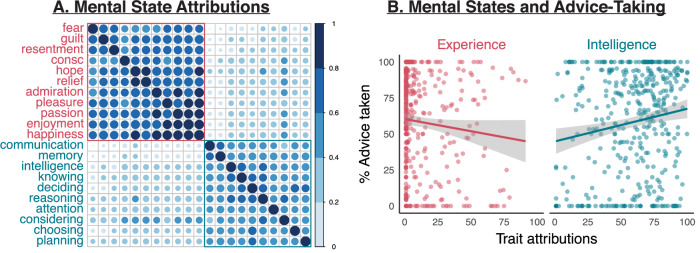
Rapid advances in artificial intelligence (AI) have led users to believe that systems such as large language models (LLMs) have mental states, including the capacity for ‘experience’ (e.g., emotions and consciousness). These folk-psychological attributions often diverge from expert opinion and are distinct from attributions of ‘intelligence’ (e.g., reasoning, planning), and yet may affect trust in AI systems. While past work provides some support for a link between anthropomorphism and trust, the impact of attributions of consciousness and other aspects of mentality on user trust remains unclear. We explored this in a preregistered experiment (N = 410) in which participants rated the capacity of an LLM to exhibit consciousness and a variety of other mental states. They then completed a decision-making task where they could revise their choices based on the advice of an LLM. Bayesian analyses revealed strong evidence against a positive correlation between attributions of consciousness and advice-taking; indeed, a dimension of mental states related to experience showed a negative relationship with advice-taking, while attributions of intelligence were strongly correlated with advice acceptance. These findings highlight how users’ attitudes and behaviours are shaped by sophisticated intuitions about the capacities of LLMs—with different aspects of mental state attribution predicting people’s trust in these systems.
Overview
CoChat Summary
TL;DR
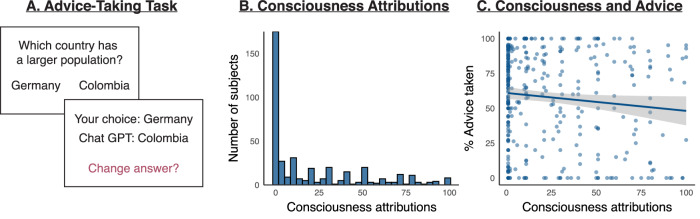
In a preregistered experiment (N = 410), attributions of intelligence to ChatGPT strongly predicted greater advice-taking, while attributions of experience showed a weak negative relationship. Attributions of consciousness were not positively associated with advice-taking, despite being positively correlated with self-reported general trust.
Key findings
- Advice acceptance was strongly positively related to intelligence attributions (B = 0.31, SE = 0.08, t(406) = 3.92, p < 0.001; Bayesian BFinclusion = 635.49) and negatively related to experience attributions (B = −1.04, SE = 0.51, t(406) = −2.04, p = 0.042; BFinclusion = 108.29).
- Consciousness attributions were skewed: 42.68% (N = 175) selected no consciousness at all, while the majority (57%) attributed some possibility; mean = 21.51, median = 6, SD = 27.71. The preregistered consciousness–advice-taking correlation was small and negative (r(407) = −0.10, p = 0.043), with Bayesian evidence against a positive correlation (BF+0 = 0.02).
- Participants attributed more intelligence-related traits (M = 59.39, SD = 24.99) than experience-related traits (M = 12.25, SD = 19.06; t(409) = −39.28, p < 0.001, Cohen’s d = 1.94).
- Self-reported trust diverged from behaviour: consciousness attributions correlated positively with general trust (r(407) = 0.25, p < 0.001, BF10 = 43,808.62), but not with advice-taking.
Methods
- Preregistered online experiment with 410 US adults recruited via Prolific in July–August 2024, stratified by age and gender; exclusions left 410 analysed (204 women, 199 men, 7 others; mean age = 47.19).
- Participants completed two randomized-order tasks: an advice-taking task with 40 general-knowledge trials where advice was labelled as ChatGPT’s but was predetermined from previous participants, and mental state ratings of ChatGPT’s consciousness (1–100) and 20 intelligence/experience traits (1–100).
- Analyses included frequentist and Bayesian correlations, linear/logistic regressions, and principal component analysis in JASP with default priors; trial-wise generalized linear models included random slopes for subjects.
Limitations
- Stated: advice-taking was operationalized as reversals in a general-knowledge task, and the relative influence of intelligence versus experience may differ in personal or emotion-involving domains; advice was sometimes incorrect and comparable in accuracy to participants, and the 40-trial task was not designed to detect learning effects.
- Stated: consciousness attributions were measured with a single self-report question, and implicit behavioural markers may reveal more nuanced attitudes; effects of inaccurate advice may emerge in longer, repeated, or high-stakes interactions.
- Evident from the text: the design is correlational, so it cannot establish causal direction between mental state attributions and trust; the sample was collected at a specific time (July–August 2024), and race/ethnicity data were not collected.
Model-written summary. Check it against the paper before relying on it.
Integrity signals
Registry
Cites
Statistics
Figures
Verification
Claims the paper makes
7 Valid · 0 Not valid · 8 Not checked · 73 Own results and interpretations
Every source the paper cites for this claim was checked and supports it.
In the paper
“This dissociation is supported by factor analyses of ratings of a variety of mental states, which reveal two fundamental factors: agency, or the capacity for high-level reasoning and planning, and experience, or the capacity for sensations and emotions19”
§ The influence of mental state attributions on trust in large language models > Introduction
What the sources say
- Supportedcites [19] Gray, H. M., Gray, K. & Wegner, D. M. Dimensions of mind perception. Science 315, 619–619 (2007). 17272713 source
The 'Dimensions of Mind Perception' section reports a factor analysis of ratings for 18 mental capacities that yielded two factors, Experience and Agency. It lists sensations and emotions such as pain, fear, and joy under Experience, and planning and thought under Agency. (LLM, conf=0.94)
boosted- Asserted: passes — The authors put it forward as true.
- Checkable: passes — It can be checked against evidence.
- Load-bearing: passes — The paper’s conclusions depend on it.
- Based: passes — The paper gives a reason why it holds.
- Supported
Every source the paper cites for this claim was checked and supports it.
In the paper
“recent surveys have revealed that the majority of a representative sample of the public attributes some possibility of human-like consciousness to large language models (LLMs)6”
§ The influence of mental state attributions on trust in large language models > Introduction
What the sources say
- Supportedcites [6] Colombatto, C. & Fleming, S. M. Folk psychological attributions of consciousness to large language models. Neurosci. Conscious. 1, niae013 (2024). PMC11008499 38618488 source
The Introduction describes a nationally representative sample of 300 US adults. The Discussion reports that 67% attributed some possibility of phenomenal consciousness to ChatGPT, an LLM. The paper distinguishes this from the smaller share who considered human-like experience more likely than not; the claim says only 'some possibility.' (LLM, conf=0.90)
plain- Asserted: passes — The authors put it forward as true.
- Checkable: passes — It can be checked against evidence.
- Load-bearing: unclear — It is unclear whether the paper’s conclusions depend on it.
- Based: passes — The paper gives a reason why it holds.
- Supported
Every source the paper cites for this claim was checked and supports it.
In the paper
“exposure to as few as three answers from these systems leads to an increase in attributions of mental capacities7.”
§ The influence of mental state attributions on trust in large language models > Introduction
What the sources say
- Supportedcites [7] Jacobs, O., Pazhoohi, F., & Kingstone, A. Brief exposure increases mind perception to ChatGPT and is moderated by the individual propensity to anthropomorphize. 10.31234/osf.io/pn29d (2023). source
The Discussion states that mind perception increased in both agency and experience 'after only a very brief exposure (i.e. the presentation of 3 examples)', and the Procedure confirms those examples were three real prompts given to ChatGPT (GPT-4) and its responses. The Results (Influence of Exposure) report the significant pre-to-post increases (agency t(147) = -6.95, p < .001; experience t(147) = -3.57, p < .001), and the Abstract/Discussion frame the systems under study as large language models. Minor qualification: exposure was passive viewing of three GPT-4 outputs by 148 MTurk adults, not interactive use across multiple LLMs, so the generalization to 'LLMs' is the paper's own framing rather than a multi-system comparison. (LLM, conf=0.85)
plainstates a cause- Asserted: passes — The authors put it forward as true.
- Checkable: passes — It can be checked against evidence.
- Load-bearing: unclear — It is unclear whether the paper’s conclusions depend on it.
- Based: passes — The paper gives a reason why it holds.
- Supported
Every source the paper cites for this claim was checked and supports it.
In the paper
“Attributions of consciousness were lower in the current survey compared to data from the previous year using the same dependent measure (July 2023 M = 25.56; August 2024 M = 21.51)6.”
§ The influence of mental state attributions on trust in large language models > Discussion
What the sources say
- Supportedcites [6] Colombatto, C. & Fleming, S. M. Folk psychological attributions of consciousness to large language models. Neurosci. Conscious. 1, niae013 (2024). PMC11008499 38618488 source
The Results report a mean consciousness-attribution rating of 25.56, and Method and materials dates that survey to July 2023. The cited paper supplies the prior-year figure used in the comparison; the August 2024 figure belongs to the citing paper's current survey. (LLM, conf=0.90)
plain- Asserted: passes — The authors put it forward as true.
- Checkable: passes — It can be checked against evidence.
- Load-bearing: unclear — It is unclear whether the paper’s conclusions depend on it.
- Based: passes — The paper gives a reason why it holds.
- Supported
A result the paper reports from its own data — it cites no other source for it, so there is none to check. The quote shows it is in the paper.
In the paper
“Attributions of intelligence were similar for participants who completed the advice-taking task first (M = 60.28, SD = 24.38) compared to those who completed the ratings first (M = 58.46, SD = 25.63, Welch two-tailed t(405) = −0.74, p = 0.463, CI = [−6.68, 3.04], Cohen’s d = 0.07; BF10 = 0.14, error = 0.12%).”
- Also stated in: § Limitations · hedged
“Importantly, attributions of intelligence and experience were similar in participants who provided their ratings before and after the advice-taking task, suggesting that exposure to incorrect choices did not significantly influence their beliefs about the system.”
§ The influence of mental state attributions on trust in large language models > Results > Mental state attributions
plain- Asserted: passes — The authors put it forward as true.
- Checkable: passes — It can be checked against evidence.
- Load-bearing: unclear — It is unclear whether the paper’s conclusions depend on it.
- Based: passes — The paper gives a reason why it holds.
- Also stated in: § Limitations · hedged
48 more claims
Create a free account to see all 88 claims and to verify the 2 references still open.
- Probably not a substantial claim. 20
- It may state two separate claims as one. 19
Claims other papers make about this one
Each is checked against this paper’s own text: does it say what the citing paper says it does?
In the citing paper
“Chatbots create a powerful illusion of being your friend, assistant or romantic partner, leading more than half of users to believe there is some chance they are sentient (Colombatto et al. 2025).”
From Précis of The Edge of Sentience: Risk and Precaution in Humans, Other Animals, and AI (2025) · cites this paper as Colombatto et al. 2025
Statistics recomputed
Every reported test result, recomputed from its test statistic and degrees of freedom. A result shows as not adding up only once an independent check has confirmed it.
- Consistentt(409) = -0.84reported p = .404 · recomputed p = .401
“t(409) = −0.84, p = .404”
- Consistentr(408) = 0.58reported p < .001 · recomputed p < .001
“r(408) = 0.58, p < .001”
- Consistentr(408) = 0.41reported p < .001 · recomputed p < .001
“r(408) = 0.41, p < .001”
- Consistentt(404) = -2.01reported p = .045 · recomputed p = .045
“t(404) = −2.01, p = .045”
- Consistentr(407) = -0.1reported p = .043 · recomputed p = .043
“r(407) = −0.10, p = .043”
30 more recomputed tests
Create a free account to see every test the Stats check recomputed.
Self-check
Percentages, sums and reported differences re-computed from the paper’s own numbers.
Self-check results appear here once an independent check has confirmed them.
Citations
Cites
Prolific.ac—A subject pool for online experiments
Palan, S., & Schitter, C. (2018) · Journal of Behavioral and Experimental Finance · doi:10.1016/j.jbef.2017.12.004 · Cited by 3,450 · cited 1×
“Participants were recruited in July and August 2024 through Proli fi c Academic (Proli fi c.com) 21 in exchange for monetary compensation.”
Gray, H. M., Gray, K., & Wegner, D. M. (2007) · Science · doi:10.1126/science.1134475 · Cited by 2,342
A Meta-Analysis of Factors Affecting Trust in Human-Robot Interaction
Hancock, P. A., Billings, D. R., Schaefer, K. E., Chen, J. Y. C., de Visser, E. J., & Parasuraman, R. (2011) · Human Factors: The Journal of the Human Factors and Ergonomics Society · doi:10.1177/0018720811417254 · Cited by 2,051 · cited 1×
“User attributions of mental states are but one determinant of trust, which is in fl uenced by multiple factors including user characteristics, system characteristics, and interactive context 31 .”
jsPsych: A JavaScript library for creating behavioral experiments in a Web browser
de Leeuw, J. R. (2015) · Behavior Research Methods · doi:10.3758/s13428-014-0458-y · Cited by 1,778 · cited 1×
“Participants were redirected to a website where stimulus presentation and data collection were controlled via custom software written in HTML, CSS, and JavaScript, using the jsPsych library 24 and the JATOS server 25 .”
The mind in the machine: Anthropomorphism increases trust in an autonomous vehicle
Waytz, A., Heafner, J., & Epley, N. (2014) · Journal of Experimental Social Psychology · doi:10.1016/j.jesp.2014.01.005 · Cited by 1,439
Who Sees Human?: The Stability and Importance of Individual Differences in Anthropomorphism
Waytz, A., Cacioppo, J., & Epley, N. (2010) · Perspectives on Psychological Science · doi:10.1177/1745691610369336 · Cited by 1,228 · cited 1×
“20).”
Kaya, F., Aydin, F., Schepman, A., Rodway, P., Yetişensoy, O., & Demir Kaya, M. (2024) · International Journal of Human–Computer Interaction · doi:10.1080/10447318.2022.2151730 · Cited by 688 · cited 1×
“Each point represents one participant (total N = 410), and error bands represent 95% con fi dence intervals. systems may shape attributions of speci fi c mental capacities, users ’ beliefs may also depend on characteristics of the users themselves, such as demo-graphics or personality traits 27 – 29 .”
Almost human: Anthropomorphism increases trust resilience in cognitive agents.
de Visser, E. J., Monfort, S. S., McKendrick, R., Smith, M. A. B., McKnight, P. E., Krueger, F., & Parasuraman, R. (2016) · Journal of Experimental Psychology: Applied · doi:10.1037/xap0000092 · Cited by 614 · cited 1×
“Anthro-pomorphism is also associated with greater trust resilience, as people are more resistant to updating their trust in anthropomorphic agents when seeing them err 14 .”
Cheng, X., Zhang, X., Cohen, J., & Mou, J. (2022) · Information Processing & Management · doi:10.1016/j.ipm.2022.102940 · Cited by 536 · cited 1×
“Pastworkhasprovided somesupport for this notion: anthropomorphism is positively correlated with trust in robots solving arithmetic problems 11 , in chatbots on e-commerce platforms 12 , and in AI solutions to an image classi fi cation task 13 .”
Lange, K., Kühn, S., & Filevich, E. (2015) · PLOS ONE · doi:10.1371/journal.pone.0130834 · Cited by 474 · cited 1×
“Participants were redirected to a website where stimulus presentation and data collection were controlled via custom software written in HTML, CSS, and JavaScript, using the jsPsych library 24 and the JATOS server 25 .”
Ly, A., Verhagen, J., & Wagenmakers, E.-J. (2016) · Journal of Mathematical Psychology · doi:10.1016/j.jmp.2015.06.004 · Cited by 384
Talking about Large Language Models
Shanahan, M. (2024) · Communications of the ACM · doi:10.1145/3624724 · Cited by 381 · cited 1×
“Thetendency toassignmentalstatestoAIsystemsisindependentfromwhetherthese systemstrulypossessthem — and indeed, the extent to which current AI systems possess consciousness remains contentious in scienti fi c analysis 1 – 5 .”
Effects of Anthropomorphism and Accountability on Trust in Human Robot Interaction
Natarajan, M., & Gombolay, M. (2020) · Proceedings of the 2020 ACM/IEEE International Conference on Human-Robot Interaction · doi:10.1145/3319502.3374839 · Cited by 248 · cited 1×
“Pastworkhasprovided somesupport for this notion: anthropomorphism is positively correlated with trust in robots solving arithmetic problems 11 , in chatbots on e-commerce platforms 12 , and in AI solutions to an image classi fi cation task 13 .”
Do We Trust in AI? Role of Anthropomorphism and Intelligence
Troshani, I., Rao Hill, S., Sherman, C., & Arthur, D. (2021) · Journal of Computer Information Systems · doi:10.1080/08874417.2020.1788473 · Cited by 228 · cited 1×
“These positive effects of 10 .”
Distortions of mind perception in psychopathology
Gray, K., Jenkins, A. C., Heberlein, A. S., & Wegner, D. M. (2011) · Proceedings of the National Academy of Sciences · doi:10.1073/pnas.1015493108 · Cited by 205
Consciousness in Artificial Intelligence: Insights from the Science of Consciousness
Butlin, P., Long, R., Elmoznino, E., Bengio, Y., Birch, J., Constant, A., Deane, G., Fleming, S. M., Frith, C., Ji, X., et al. (2023) · arXiv · doi:10.48550/arxiv.2308.08708 · Cited by 196
Self-citationCould a Large Language Model be Conscious?
Chalmers, D. J. (2023) · arXiv · doi:10.48550/arxiv.2303.07103 · Cited by 143
Increasing anthropomorphism and trust in automated driving functions by adding speech output
Forster, Y., Naujoks, F., & Neukum, A. (2017) · 2017 IEEE Intelligent Vehicles Symposium (IV) · doi:10.1109/ivs.2017.7995746 · Cited by 114
Folk psychological attributions of consciousness to large language models
Colombatto, C., & Fleming, S. M. (2024) · Neuroscience of Consciousness · doi:10.1093/nc/niae013 · Cited by 96 · cited 7×
“First, they were asked to rate ChatGPT ’ s capacity for phenomenal consciousness, on a scale from 1 ( ‘ clearly does not have conscious experiences ’ ) to 100 ( ‘ clearly has conscious experiences ’ 6 ).”
InfluentialSelf-citationFolk Psychological Attributions of Consciousness to Large Language Models
Colombatto, C., & Fleming, S. M. (2023) · doi:10.31234/osf.io/5cnrv · Cited by 96
Self-citationAnthropomorphizing information to enhance trust in autonomous vehicles
Niu, D., Terken, J., & Eggen, B. (2018) · Human Factors and Ergonomics in Manufacturing & Service Industries · doi:10.1002/hfm.20745 · Cited by 90
Large, D. R., Harrington, K., Burnett, G., Luton, J., Thomas, P., & Bennett, P. (2019) · Proceedings of the 11th International Conference on Automotive User Interfaces and Interactive Vehicular Applications · doi:10.1145/3342197.3344545 · Cited by 74 · cited 1×
“These effects can have important consequences: in the context of autonomous driving, people trust vehicles more when they display anthropomorphic cues (e.g., name, gender, voice), even when these super fi cial cues are unrelated to the underlying abilities of the vehicle 15 – 18 .”
Kulms, P., & Kopp, S. (2019) · Proceedings of Mensch und Computer 2019 · doi:10.1145/3340764.3340793 · Cited by 68 · cited 1×
“This is consistent with previousevidencethatagentanthropomorphismhasagreatereffectonself-reportedtrustthanactualtrustbehaviour,whichisrathermoresensitiveto adviceaccuracy 30 .”
Consciousness beyond the human case
LeDoux, J., Birch, J., Andrews, K., Clayton, N. S., Daw, N. D., Frith, C., Lau, H., Peters, M. A. K., Schneider, S., Seth, A., et al. (2023) · Current Biology · doi:10.1016/j.cub.2023.06.067 · Cited by 67
Self-citationSchneider, S., Häßler, A., Habermeyer, T., Beege, M., & Rey, G. D. (2019) · Journal of Educational Psychology · doi:10.1037/edu0000273 · Cited by 54 · cited 1×
“For example, learning in educational contexts is enhanced by anthropomorphic features such as face-like appearance 8 , and ratings of human-likeness in AI are correlated with more positive impressions of the systems and overall social health 9 .”
Guingrich, R. E., & Graziano, M. S. A. (2025) · Oxford Intersections: AI in Society · doi:10.1093/9780198945215.003.0011 · Cited by 28 · cited 1×
“For example, learning in educational contexts is enhanced by anthropomorphic features such as face-like appearance 8 , and ratings of human-likeness in AI are correlated with more positive impressions of the systems and overall social health 9 .”
Mind Perception and Individual Differences: A Replication and Extension
Tharp, M., Holtzman, N. S., & Eadeh, F. R. (2016) · Basic and Applied Social Psychology · doi:10.1080/01973533.2016.1256287 · Cited by 27
Jensen, T., Khan, M. M. H., Fahim, M. A. A., & Albayram, Y. (2021) · Designing Interactive Systems Conference 2021 · doi:10.1145/3461778.3462102 · Cited by 26 · cited 1×
“Pastworkhasprovided somesupport for this notion: anthropomorphism is positively correlated with trust in robots solving arithmetic problems 11 , in chatbots on e-commerce platforms 12 , and in AI solutions to an image classi fi cation task 13 .”
Jacobs, O., Pazhoohi, F., & Kingstone, A. (2023) · doi:10.31234/osf.io/pn29d · Cited by 16
Deanthropomorphising NLP: Can a language model be conscious?
Shardlow, M., & Przybyła, P. (2024) · PLoS ONE · doi:10.1371/journal.pone.0307521 · Cited by 16 · cited 1×
“Thetendency toassignmentalstatestoAIsystemsisindependentfromwhetherthese systemstrulypossessthem — and indeed, the extent to which current AI systems possess consciousness remains contentious in scienti fi c analysis 1 – 5 .”
Illusions of Confidence in Artificial SystemsPreprint
Colombatto, C., & Fleming, S. M. (2023) · PsyArXiv (OSF Preprints) · doi:10.31234/osf.io/mjx2v · Cited by 9
Self-citation
Cited by
Technological folie à deux: feedback loops between AI chatbots and mental health
Dohnány, S., Kurth-Nelson, Z., Spens, E., Luettgau, L., Reid, A., Gabriel, I., Summerfield, C., Shanahan, M., & Nour, M. M. (2026) · Nature Mental Health · doi:10.1038/s44220-026-00595-8 · Cited by 51
“For example, as chatbots become ubiquitous, their influence on beliefs in the broader population may increasingly operate through their perceived impartiality and access to knowledge, rather than companionship-reinforcement 88 .”
Do generative AI chatbots increase psychosis risk?
Keshavan, M., Torous, J., & Yassin, W. (2026) · World Psychiatry · doi:10.1002/wps.70017 · Cited by 26
Technological folie à deux: Feedback Loops Between AI Chatbots and Mental Illness
Dohnány, S., Kurth-Nelson, Z., Spens, E., Luettgau, L., Reid, A., Gabriel, I., Summerfield, C., Shanahan, M., & Nour, M. M. (2025) · arXiv · doi:10.48550/arxiv.2507.19218 · Cited by 26
“To study and mitigate these concerns, we need coordinated action across clinical practice, AI development, and regulatory frameworks.”
Précis of The Edge of Sentience: Risk and Precaution in Humans, Other Animals, and AI
Birch, J. (2025) · Animal Sentience · doi:10.51291/2377-7478.1893 · Cited by 18
Self-citationAI Consciousness: A Centrist Manifesto
Birch, J. (2025) · doi:10.31234/osf.io/af7c9_v1 · Cited by 10
Self-citation
Metadata
- Authors
- Colombatto, C., Birch, J., & Fleming, S. M.
- Affiliations
- University of Waterloo (CA)
- London School of Economics and Political Science (GB)
- University College London (GB)
- Corresponding author
- Colombatto, Clara
- Venue
- Communications Psychology
- Published
- 2025-05-25
- Volume
- 3
- Issue
- 1
- Pages
- 84-84
- ISSN
- 2731-9121 (ISSN-L)
- PMC
- PMC12104094
- OpenAlex
- W4410717268
- Semantic Scholar
- 982968f097a0ea761e7db89ce8da8afb80dedea8
- Cited by
- 34
- References
- 28
- Citations by year
- 2026: 31 · 2025: 3
- FWCI
- 37.23
- Type
- journal article
- Language
- en
- Open access
- gold
- doi.org
- Licence
- cc-by
- creativecommons.org/licenses/by/4.0 (tdm)
- creativecommons.org/licenses/by/4.0 (vor)
- Locations
- Communications Psychology (publishedVersion, cc-by)
- Europe PMC (PubMed Central) (publishedVersion, cc-by)
- PubMed Central (publishedVersion, cc-by)
- PubMed (publishedVersion)
- London School of Economics and Political Science Theses Online (London School of Economics and Political Science) (acceptedVersion, cc-by)
- London School of Economics and Political Science Research Online (London School of Economics and Political Science) (acceptedVersion)
- DOAJ (DOAJ: Directory of Open Access Journals) (submittedVersion, cc-by-sa)
- MPG.PuRe (Max Planck Society) (submittedVersion)
- Funders
- Microsoft Research
- RCUK | Engineering and Physical Sciences Research Council (EP/V000748/1)
- Topics
- Social Sciences › Psychology › Social Psychology › Social Robot Interaction and HRI
- Social Sciences › Human Factors and Ergonomics › Human-Automation Interaction and Safety
- Physical Sciences › Computer Science › Artificial Intelligence › Ethics and Social Impacts of AI
- Keywords
- large language models, trust in AI, mental state attribution, anthropomorphism, consciousness, folk psychology, experience, advice taking, decision-making
About these checks
Registry, retraction, Cites and statistics results are computed, not judged, with one exception: a printed reference that no index lists is read once by a model before it counts as a citation error. Claims are extracted by a model and kept only when their quote appears verbatim in the text; each cited source is then checked, with a model’s help, for whether it says what the claim relies on. Those verdicts can be wrong — read the claim’s quote and the cited source before relying on one.
The claim verdicts this report counts are experimental: their accuracy is not yet measured.
A language model drew the claims from the paper on 2026-10-10, under version 3 of the claim definition (model deepseek-v4.1-flash, prompt extract-v3).
A second model labelled each claim on 2026-10-10 (model jev-1.13-20260917, definition revision gold-guideline-v0.2).
Cited sources are checked with a language model’s help (gpt-6-sol and qwen3.8-omni-flash).
Statistics and arithmetic are recomputed, not judged.
Confidence bands are shown only for fields calibrated on our annotated test set. None is calibrated yet, so no band is shown.
What counts as a claim ›How we measure confidence ›How we check this ›
Are you an author, or do you see a problem with this page? Request a review
Data sources
Bibliographic data: Semantic Scholar, OpenAlex, Crossref.
Contains information from the Semantic Scholar Academic Graph Datasets, made available under the ODC Attribution License (ODC-BY 1.0).
Semantic Scholar’s data is described in: Kinney, R., et al. (2023). The Semantic Scholar Open Data Platform. arXiv:2301.10140.
