

Cellular assembly and functional resilience of the mammalian RNA exosome
Open accessThe DOI matches its Crossref record; 104 of the 104 references it cites were found in a registry or an index; 4 of the 74 sources its claims cite were checked for support.
Abstract
Most eukaryotic proteins assemble into multisubunit complexes that coordinate essential cellular functions, yet the principles governing their assembly and proteostatic control remain largely undefined. Here, we systematically dissect the cellular assembly and functional organization of the RNA exosome, an essential ribonucleolytic complex, using an inducible dual-guide CRISPR/Cas9 system in mouse embryonic stem cells. We reveal a sequential assembly pathway where Exosc2, Exosc4, and Exosc7 initiate complex formation, facilitating the incorporation of barrel and cap subunits in a defined hierarchy. Unlike other structural subunits, the terminally incorporated cap subunit Exosc1 is dispensable for cell viability, revealing a modular, functionally resilient architecture. We demonstrate that orphan subunits are selectively degraded via the ubiquitin-proteasome system, enforcing stringent quality control over RNA exosome biogenesis. These findings define an assembly logic of of the mammalian exosome and uncover previously unrecognized plasticity in the composition and function of this essential ribonucleolytic complex.
Overview
CoChat Summary
TL;DR
Using inducible dual-guide CRISPR/Cas9 and acute degron depletion in mouse embryonic stem cells, this study defines a stepwise cellular assembly pathway for the mammalian RNA exosome and shows that orphan subunits are degraded by the ubiquitin-proteasome system. It further finds that the terminal cap subunit Exosc1 is largely dispensable for RNA exosome function and mESC viability.
Key findings
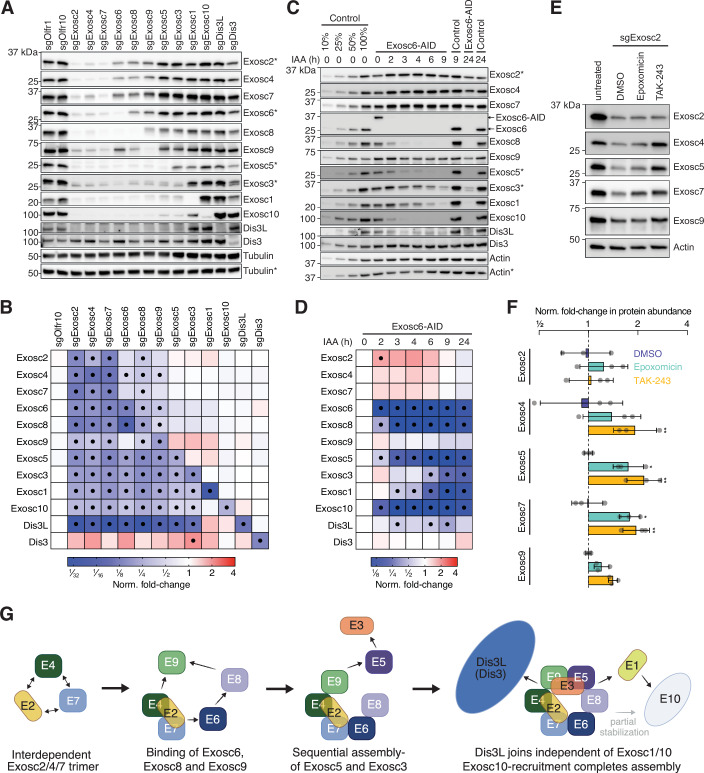
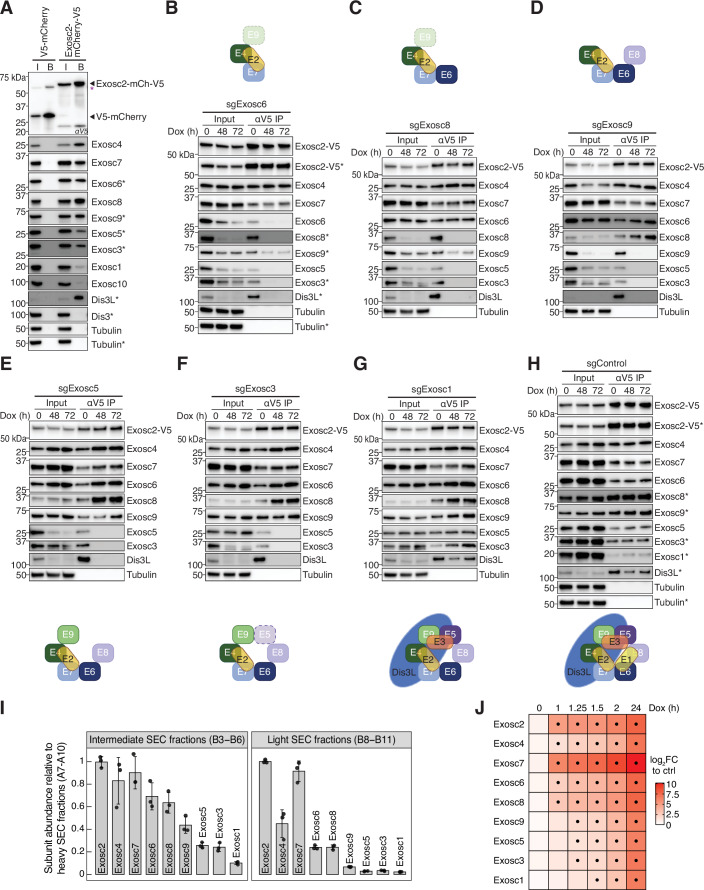
- RNA exosome core assembly is ordered: Exosc2, Exosc4, and Exosc7 form an initiating heterotrimer, followed by Exosc6, Exosc8, Exosc9, Exosc5, Exosc3, and finally Exosc1. Depletion of Exosc2/4/7 co-destabilized all core components, whereas Exosc1 depletion affected no other core subunit. Orphan Exosc4, Exosc5, Exosc7, and Exosc9 were stabilized by Epoxomicin or TAK-243 after Exosc2 depletion, implicating ubiquitin-proteasome degradation.
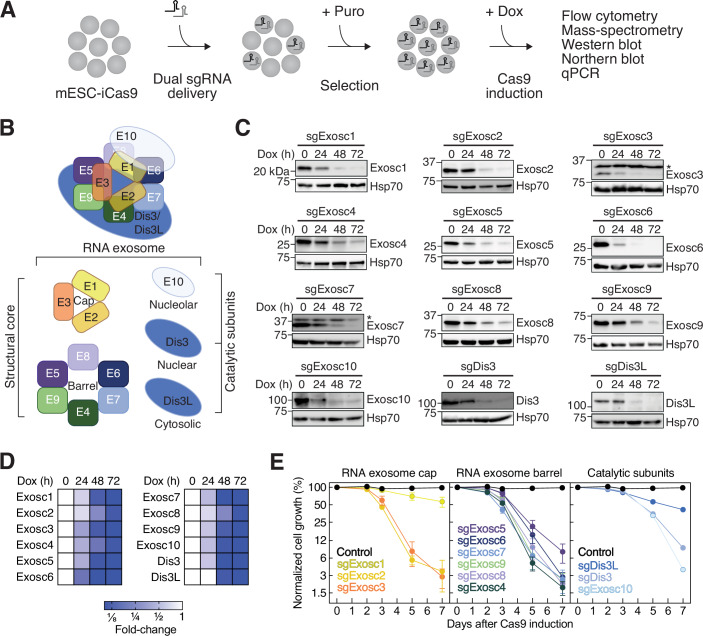
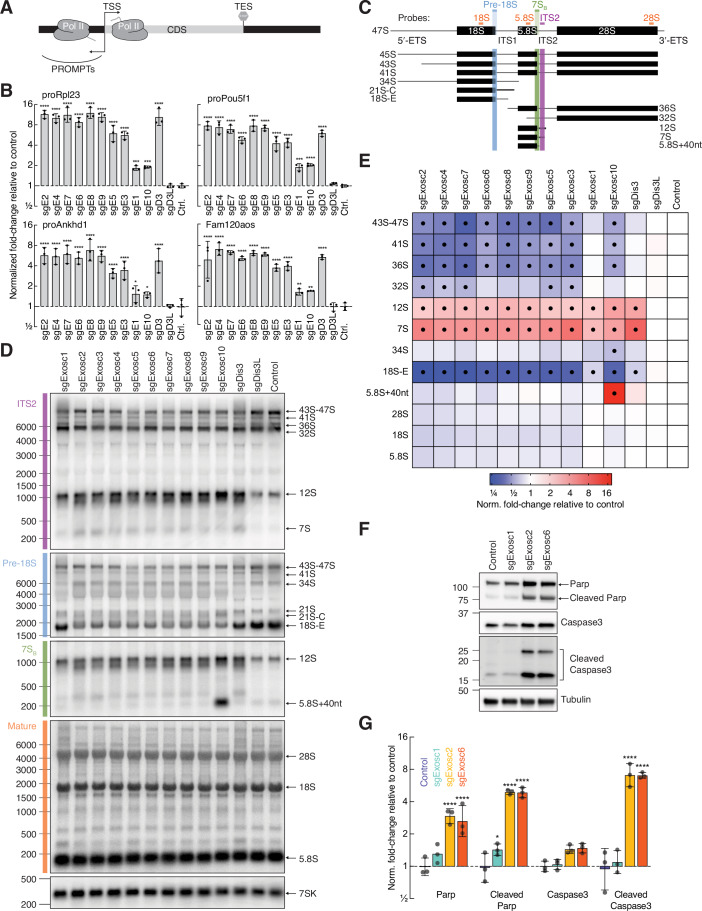
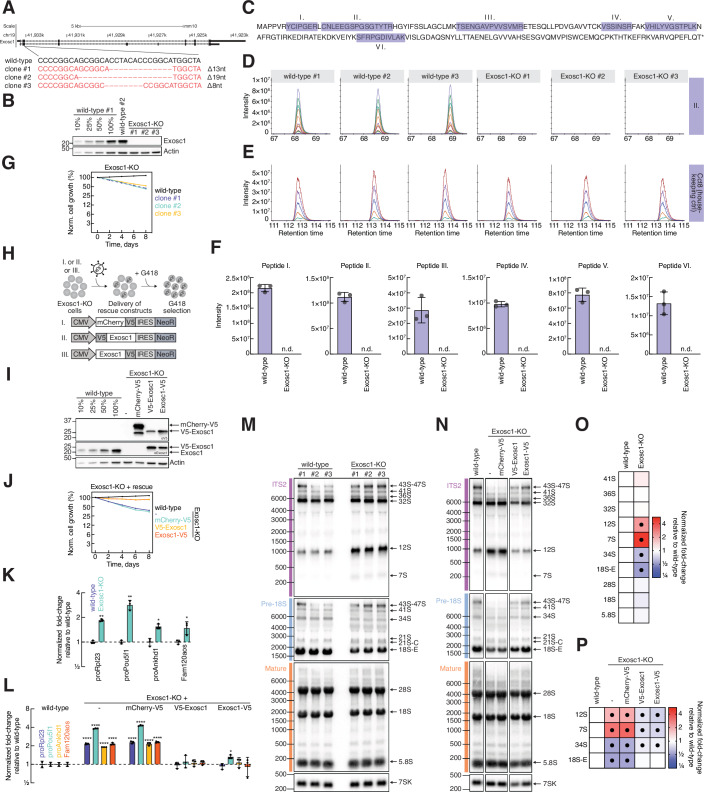
- Most core subunits are required for proliferation, but Exosc1 is largely dispensable: after 7 days of Cas9 induction, Exosc1-depleted cells dropped only to ~50%, versus <10% remaining for other core components. Exosc1-KO mESCs were viable with moderate growth defects, rescued by V5-tagged Exosc1. Exosc1 depletion caused weaker PROMPT stabilization and rRNA processing defects; Exosc2 or Exosc6 depletion upregulated cleaved PARP and cleaved Caspase3, but Exosc1 depletion did not.
- Catalytic subunit dependencies differ: Dis3L and Exosc10 undergo orphan decay, while Dis3 remains stable except upon direct depletion. Exosc10 stability depends on a fully assembled core including Exosc1; Dis3L depends on Exosc5 and Exosc3 but not Exosc1.
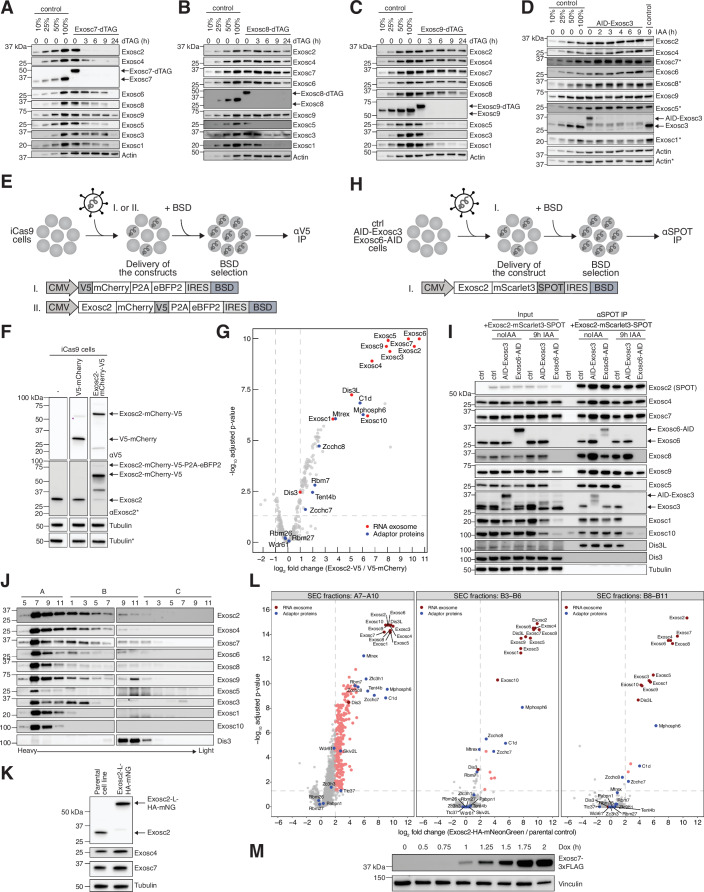
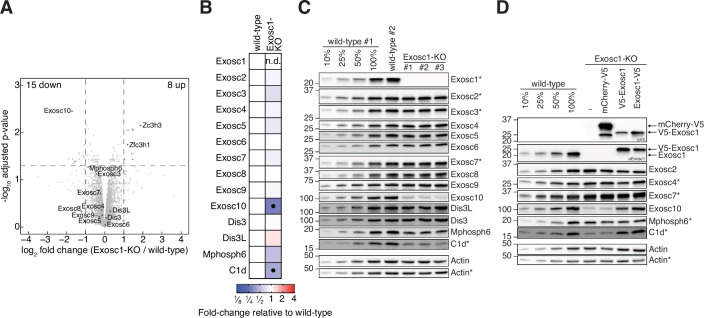
- Assembly intermediates are detectable in wild-type cells: SEC and IP-MS recovered distinct subcomplexes, and inducible Exosc7-3xFLAG enriched Exosc2/4/7/6/8 at 60 min, then Exosc9/5/3 at 75 min, with all core subunits enriched by 90 min. In Exosc1-KO proteomes, among 5877 detected proteins, only 15 were down and eight upregulated; Exosc10 was among the downregulated proteins.
Methods
- mESCs (AN3-12) were engineered with doxycycline-inducible Cas9 (iCas9v1/v2) and dual sgRNAs, plus AID- or dTAG-degron lines. Treatments included Dox 500 ng/ml, IAA 250 µM, dTAGv-1 500 nM, Epoxomicin 1 µM, and TAK-243 2.5 µM.
- Readouts included competitive proliferation assays, Western blotting, RT-qPCR for PROMPTs, Northern blotting for rRNA processing intermediates, size-exclusion chromatography, immunoprecipitation, shotgun LC-MS/MS, and targeted PRM mass spectrometry.
- Statistical analyses used two-way ANOVA with Holm–Šídák correction, limma with Benjamini–Hochberg correction, and biological replicates as indicated in figure legends.
Limitations
- The paper states that SEC resolution limits definitive assignment of minimal assemblies; early heterogeneity is possible, such as Exosc2/7 dimers before the Exosc2/4/7 trimer, and the precise molecular nature of the post-Exosc3 rearrangement remains unresolved.
- The paper notes that AID-tagging of Exosc3 caused a modest reduction in Exosc3 protein levels; one replicate was excluded as an outlier for sgExosc5 and the 90-min Exosc7 pull-down; and Dis3L was set to maximum observed co-depletion when no signal was detected in some samples.
- Evident from the text: the assembly model is inferred from co-depletion, IP/SEC-MS, and kinetic enrichment in mESCs without structural validation of the intermediates; Exosc1-KO rRNA defects were more pronounced than with iCas9, attributed to terminal depletion effects.
Model-written summary. Check it against the paper before relying on it.
Integrity signals
Registry
Cites
Statistics
Figures
Verification
Claims the paper makes
1 Valid · 1 Not valid · 44 Not checked · 137 Own results and interpretations
The cited sources that could be checked couldn’t confirm or dispute this claim.
In the paper
“CRISPR-based viability screens in human cancer cell lines indicate that Exosc1 knockout has a much lower impact on cell survival than other core subunits (Meyers et al, 2017; Dempster et al, 2019; Pacini et al, 2021), confirming its subordinate role in sustaining cellular proliferation (Fig. EV1C,D).”
§ Cellular assembly and functional resilience of the mammalian RNA exosome > Results > A dual-guide iCas9 system probes the essential cellular function of RNA exosome subunits in mESCs
What the sources say
- Could not verifycites Meyers et al, 2017 matched to “Computational correction of copy number effect improves specificity of CRISPR-Cas9 essentiality screens in cancer cells” (2017) sourceExperimental — accuracy not yet measured
Our copy of Meyers et al. (2017) describes genome-scale CRISPR-Cas9 loss-of-function screens in 342 cancer cell lines and the CERES correction of copy-number effects (Abstract; Online Methods, 'CRISPR-Cas9 essentiality screening assay'), so it does provide the type of dataset the citing sentence invokes, but no passage addresses Exosc1 or the exosome complex subunits. Searches for 'Exosc1', 'EXOSC1 exosome RNA complex subunit gene dependency score', 'exosome complex core subunit dependency' and 'common core essential genes gold list pan-essential' returned only methodology and copy-number passages; the per-gene dependency values are deposited in Supplementary Tables 3-5, which are not part of our copy. Nothing in our copy supports or contradicts the specific statement that Exosc1 knockout has a much lower impact on cell survival than other core subunits. (LLM, conf=0.65)
- Could not verifycites Dempster et al, 2019 matched to “Extracting Biological Insights from the Project Achilles Genome-Scale CRISPR Screens in Cancer Cell Lines” (2019) sourceExperimental — accuracy not yet measured
Our copy of Dempster et al. (2019) is a description of the Project Achilles pipeline (readcount → log fold change → CERES gene effect → dependency probability) and never mentions EXOSC1 or any per-subunit comparison within the exosome; searched 'EXOSC1', 'Exosc1 exosome subunit essentiality lower fitness effect', and 'subunit with weaker essentiality effect within complex'. The exosome appears only as one of four complexes in a correlation-network illustration of ncPCA confounding (Correlation network visualization / Comparison with Alternate Methods, Fig. 9: 'Network visualization of the top 400 strongest correlations within the splicesome, exosome, proteasome and polymerase complexes. Nodes are colored by mean gene essentiality'), with no reported ranking of subunit viability effects. The paper does supply the CRISPR viability-screen data and the CERES gene-effect framework the claim invokes (Introduction; Estimation of gene effect scores), but the specific EXOSC1-versus-other-core-subunits finding is not stated anywhere in our copy, so it can be neither confirmed nor contradicted from this source. (LLM, conf=0.70)
- Could not verifycites Pacini et al, 2021 matched to “Integrated cross-study datasets of genetic dependencies in cancer” (2021) sourceExperimental — accuracy not yet measured
Our copy of Pacini et al. (2021) is a methods/data-integration resource: it describes the merged Broad + Sanger CRISPR-Cas9 screens over 908 cancer cell lines (Results, 'Overview of the integrated CRISPR-Cas9 screens') and evaluates pre-processing/batch-correction pipelines via NNMD, false-positive rates and recall of prior-known essential vs non-essential genes (Results, 'Identification of essential and non-essential genes'; Fig. 4). No passage anywhere in our copy mentions EXOSC1, the RNA exosome, or any comparison of one core subunit's knockout effect against its partners; searches for 'Exosc1 / EXOSC1 EXOSC2 EXOSC3 core subunit knockout cell survival' and 'RNA exosome complex subunit essentiality' returned only generic essential/non-essential gene separation text. So the Exosc1-specific part of the claim is not addressed by this source, though the source is indeed one of the integrated CRISPR screen datasets the citing sentence could be identifying. (LLM, conf=0.62)
hedgedstates a cause- Asserted: passes — The authors put it forward as true.
- Checkable: passes — It can be checked against evidence.
- Load-bearing: passes — The paper’s conclusions depend on it.
- Based: passes — The paper gives a reason why it holds.
- Could not verify
The cited sources support only part of this claim — read each source’s verdict below.
In the paper
“Consistently, Exosc5 shares substantial interaction surfaces with Exosc9 (3800 Å2) and Exosc8 (2400 Å2) (Liu et al, 2006).”
§ Cellular assembly and functional resilience of the mammalian RNA exosome > Results > Selective decay of orphan exosome subunits by the ubiquitin-proteasome system reveals an ordered cellular assembly of the RNA exosome core complex
What the sources say
- Partly supportedcites Liu et al, 2006 matched to “Reconstitution, Activities, and Structure of the Eukaryotic RNA Exosome” (2006) sourceExperimental — accuracy not yet measured
The Structure Determination section identifies hRrp46/hRrp43 as a heterodimer, and the Asymmetry and Conserved Surfaces section describes an interface between hRrp46 and hRrp45. The Figure 2 caption says buried surface areas are shown numerically in the figure, but the passages in our copy do not give the claimed 3800 Ų and 2400 Ų values, so those measurements cannot be verified. (LLM, conf=0.82)
plainstates an association- Asserted: passes — The authors put it forward as true.
- Checkable: passes — It can be checked against evidence.
- Load-bearing: passes — The paper’s conclusions depend on it.
- Based: passes — The paper gives a reason why it holds.
- Partly supported
None of the sources cited for this claim have been checked yet.
In the paper
“Consistent with previous reports, Dis3, unlike Dis3L, was hardly detectable upon Exosc2-V5 immunoprecipitation”
§ Cellular assembly and functional resilience of the mammalian RNA exosome > Results > RNA exosome assembly intermediates form biochemically tractable subcomplexes
plain- Asserted: passes — The authors put it forward as true.
- Checkable: passes — It can be checked against evidence.
- Load-bearing: unclear — It is unclear whether the paper’s conclusions depend on it.
- Based: passes — The paper gives a reason why it holds.
A result the paper reports from its own data — it cites no other source for it, so there is none to check. The quote shows it is in the paper.
In the paper
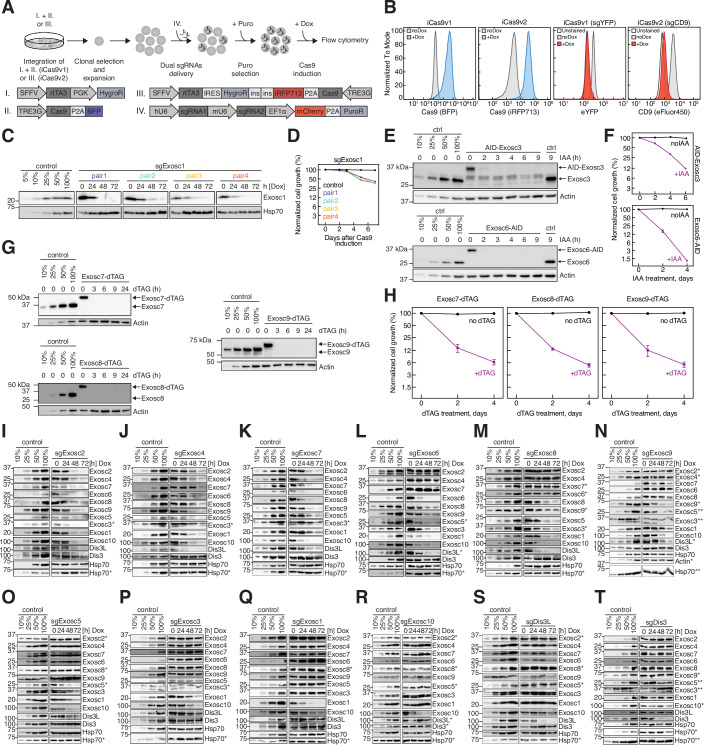
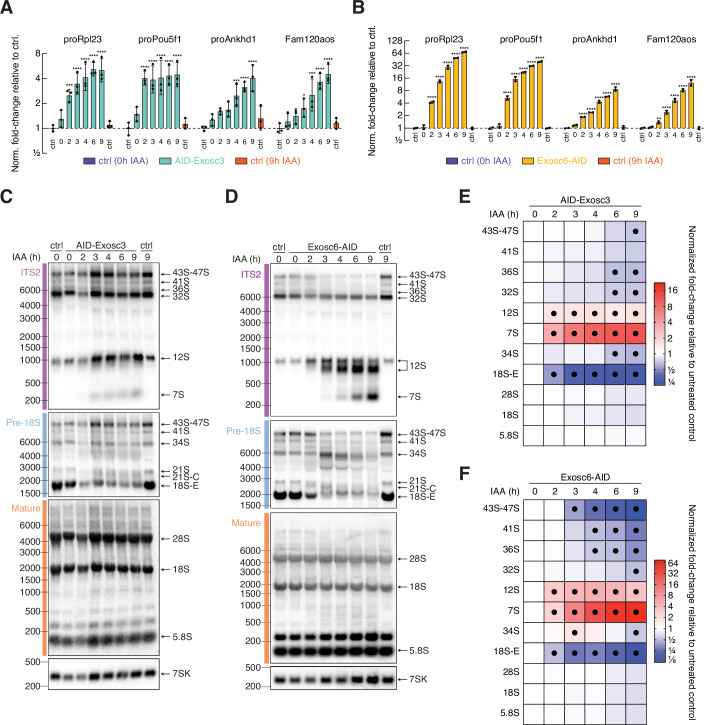
“Acute administration of IAA or dTAGv-1 resulted in rapid depletion of the tagged proteins (Fig. EV1E,G) and ultimately induced pronounced growth defects, closely mirroring the proliferation phenotypes observed upon inducible knockout using iCas9 (Fig. 1E).”
§ Cellular assembly and functional resilience of the mammalian RNA exosome > Results > A dual-guide iCas9 system probes the essential cellular function of RNA exosome subunits in mESCs
plainstates a cause- Asserted: passes — The authors put it forward as true.
- Checkable: passes — It can be checked against evidence.
- Load-bearing: passes — The paper’s conclusions depend on it.
- Based: passes — The paper gives a reason why it holds.
A result the paper reports from its own data — it cites no other source for it, so there is none to check. The quote shows it is in the paper.
In the paper
“while Exosc5 was not destabilized upon the loss of Exosc3 (Fig. EV1P)”
§ Cellular assembly and functional resilience of the mammalian RNA exosome > Results > RNA exosome assembly intermediates form biochemically tractable subcomplexes
plain- Asserted: passes — The authors put it forward as true.
- Checkable: passes — It can be checked against evidence.
- Load-bearing: passes — The paper’s conclusions depend on it.
- Based: passes — The paper gives a reason why it holds.
110 more claims
Create a free account to see all 183 claims and to verify the 68 references still open.
- It may state two separate claims as one. 37
- Probably not a substantial claim. 35
Citations
Cites
Analysis of Relative Gene Expression Data Using Real-Time Quantitative PCR and the 2−ΔΔCT Method
Livak, K. J., & Schmittgen, T. D. (2001) · Methods · doi:10.1006/meth.2001.1262 · Cited by 180,860
Fiji: an open-source platform for biological-image analysis
Schindelin, J., Arganda-Carreras, I., Frise, E., Kaynig, V., Longair, M., Pietzsch, T., Preibisch, S., Rueden, C., Saalfeld, S., Schmid, B., et al. (2012) · Nature Methods · doi:10.1038/nmeth.2019 · Cited by 66,890
clusterProfiler: an R Package for Comparing Biological Themes Among Gene Clusters
Yu, G., Wang, L.-G., Han, Y., & He, Q.-Y. (2012) · OMICS: A Journal of Integrative Biology · doi:10.1089/omi.2011.0118 · Cited by 36,259 · cited 1×
“GO-term enrichment analysis was done with the clusterPro fi ler R package (Yu et al, 2012).”
Smyth, G. K. (2004) · Statistical Applications in Genetics and Molecular Biology · doi:10.2202/1544-6115.1027 · Cited by 11,829
Global quantification of mammalian gene expression control
Schwanhäusser, B., Busse, D., Li, N., Dittmar, G., Schuchhardt, J., Wolf, J., Chen, W., & Selbach, M. (2011) · Nature · doi:10.1038/nature10098 · Cited by 6,566 · cited 2×
“This was consistent with previously reported RNA exosome protein half-life measurements in murine cells (Schwanhäusser et al, 2011).”
The PRIDE database resources in 2022: a hub for mass spectrometry-based proteomics evidences
Perez-Riverol, Y., Bai, J., Bandla, C., García-Seisdedos, D., Hewapathirana, S., Kamatchinathan, S., Kundu, D. J., Prakash, A., Frericks-Zipper, A., Eisenacher, M., et al. (2022) · Nucleic Acids Research · doi:10.1093/nar/gkab1038 · Cited by 6,125
Cox, J., Hein, M. Y., Luber, C. A., Paron, I., Nagaraj, N., & Mann, M. (2014) · Molecular & Cellular Proteomics · doi:10.1074/mcp.m113.031591 · Cited by 5,180
Skyline: an open source document editor for creating and analyzing targeted proteomics experiments
MacLean, B., Tomazela, D. M., Shulman, N., Chambers, M., Finney, G. L., Frewen, B., Kern, R., Tabb, D. L., Liebler, D. C., & MacCoss, M. J. (2010) · Bioinformatics · doi:10.1093/bioinformatics/btq054 · Cited by 4,697
Semi-supervised learning for peptide identification from shotgun proteomics datasets
Käll, L., Canterbury, J. D., Weston, J., Noble, W. S., & MacCoss, M. J. (2007) · Nature Methods · doi:10.1038/nmeth1113 · Cited by 2,424 · cited 1×
“Results were fi ltered for a minimum peptide length of seven amino acids and 1% FDR at the peptide spectrum match (PSM) and the protein level using the Percolator algorithm (Käll et al, 2007) integrated in Proteome Discoverer.”
CHOPCHOP v3: expanding the CRISPR web toolbox beyond genome editing
Labun, K., Montague, T. G., Krause, M., Torres Cleuren, Y. N., Tjeldnes, H., & Valen, E. (2019) · Nucleic Acids Research · doi:10.1093/nar/gkz365 · Cited by 2,054
Meyers, R. M., Bryan, J. G., McFarland, J. M., Weir, B. A., Sizemore, A. E., Xu, H., Dharia, N. V., Montgomery, P. G., Cowley, G. S., Pantel, S., et al. (2017) · Nature Genetics · doi:10.1038/ng.3984 · Cited by 1,952
Single-pot, solid-phase-enhanced sample preparation for proteomics experiments
Hughes, C. S., Moggridge, S., Müller, T., Sorensen, P. H., Morin, G. B., & Krijgsveld, J. (2019) · Nature Protocols · doi:10.1038/s41596-018-0082-x · Cited by 1,941
An auxin-based degron system for the rapid depletion of proteins in nonplant cells
Nishimura, K., Fukagawa, T., Takisawa, H., Kakimoto, T., & Kanemaki, M. (2009) · Nature Methods · doi:10.1038/nmeth.1401 · Cited by 1,663
Architecture of the human interactome defines protein communities and disease networks
Huttlin, E. L., Bruckner, R. J., Paulo, J. A., Cannon, J. R., Ting, L., Baltier, K., Colby, G., Gebreab, F., Gygi, M. P., Parzen, H., et al. (2017) · Nature · doi:10.1038/nature22366 · Cited by 1,437
The dTAG system for immediate and target-specific protein degradation
Nabet, B., Roberts, J. M., Buckley, D. L., Paulk, J., Dastjerdi, S., Yang, A., Leggett, A. L., Erb, M. A., Lawlor, M. A., Souza, A., et al. (2018) · Nature Chemical Biology · doi:10.1038/s41589-018-0021-8 · Cited by 1,118
Epoxomicin, a potent and selective proteasome inhibitor, exhibits in vivo antiinflammatory activity
Meng, L., Mohan, R., Kwok, B. H. B., Elofsson, M., Sin, N., & Crews, C. M. (1999) · Proceedings of the National Academy of Sciences · doi:10.1073/pnas.96.18.10403 · Cited by 920
Universal and Confident Phosphorylation Site Localization Using phosphoRS
Taus, T., Köcher, T., Pichler, P., Paschke, C., Schmidt, A., Henrich, C., & Mechtler, K. (2011) · Journal of Proteome Research · doi:10.1021/pr200611n · Cited by 870
A Census of Human Soluble Protein Complexes
Havugimana, P. C., Hart, G. T., Nepusz, T., Yang, H., Turinsky, A. L., Li, Z., Wang, P. I., Boutz, D. R., Fong, V., Phanse, S., et al. (2012) · Cell · doi:10.1016/j.cell.2012.08.011 · Cited by 860
Quality and quantity control of gene expression by nonsense-mediated mRNA decay
Kurosaki, T., Popp, M. W., & Maquat, L. E. (2019) · Nature Reviews Molecular Cell Biology · doi:10.1038/s41580-019-0126-2 · Cited by 826
Controlled expression of transgenes introduced by in vivo electroporation
Matsuda, T., & Cepko, C. L. (2007) · Proceedings of the National Academy of Sciences · doi:10.1073/pnas.0610155104 · Cited by 663
Thiol-linked alkylation for the metabolic sequencing of RNA
Herzog, V. A., Reichholf, B., Neumann, T., Rescheneder, P., Bhat, P., Burkard, T. R., Wlotzka, W., von Haeseler, A., Zuber, J., & Ameres, S. L. (2017) · doi:10.1101/177642 · Cited by 622
Self-citationThiol-linked alkylation of RNA to assess expression dynamics
Herzog, V. A., Reichholf, B., Neumann, T., Rescheneder, P., Bhat, P., Burkard, T. R., Wlotzka, W., von Haeseler, A., Zuber, J., & Ameres, S. L. (2017) · Nature Methods · doi:10.1038/nmeth.4435 · Cited by 622
Self-citationFunctions of the exosome in rRNA, snoRNA and snRNA synthesis
Allmang, C. (1999) · The EMBO Journal · doi:10.1093/emboj/18.19.5399 · Cited by 618
An overview of pre‐ribosomal RNA processing in eukaryotes
Henras, A. K., Plisson‐Chastang, C., O'Donohue, M., Chakraborty, A., & Gleizes, P. (2015) · WIREs RNA · doi:10.1002/wrna.1269 · Cited by 594
Molecular mechanisms of proteasome assembly
Murata, S., Yashiroda, H., & Tanaka, K. (2009) · Nature Reviews Molecular Cell Biology · doi:10.1038/nrm2630 · Cited by 546
Reconstitution, Activities, and Structure of the Eukaryotic RNA Exosome
Liu, Q., Greimann, J. C., & Lima, C. D. (2006) · Cell · doi:10.1016/j.cell.2006.10.037 · Cited by 543
Tafforeau, L., Zorbas, C., Langhendries, J.-L., Mullineux, S.-T., Stamatopoulou, V., Mullier, R., Wacheul, L., & Lafontaine, D. L. J. (2013) · Molecular Cell · doi:10.1016/j.molcel.2013.08.011 · Cited by 491
MS Amanda, a Universal Identification Algorithm Optimized for High Accuracy Tandem Mass Spectra
Dorfer, V., Pichler, P., Stranzl, T., Stadlmann, J., Taus, T., Winkler, S., & Mechtler, K. (2014) · Journal of Proteome Research · doi:10.1021/pr500202e · Cited by 490
Interaction profiling identifies the human nuclear exosome targeting complex
Lubas, M., Christensen, M. S., Kristiansen, M. S., Domanski, M., Falkenby, L. G., Lykke-Andersen, S., Andersen, J. S., Dziembowski, A., & Jensen, T. H. (2011) · Molecular Cell · doi:10.1016/j.molcel.2011.06.028 · Cited by 460
A small-molecule inhibitor of the ubiquitin activating enzyme for cancer treatment
Hyer, M. L., Milhollen, M. A., Ciavarri, J., Fleming, P., Traore, T., Sappal, D., Huck, J., Shi, J., Gavin, J., Brownell, J., et al. (2018) · Nature Medicine · doi:10.1038/nm.4474 · Cited by 447 · cited 1×
“To do so, we depleted Exosc2 by iCas9 for 42 h, followed by proteasome inhibition with Epoxomicin (Meng et al, 1999) or inhibition of the main E1-ubiquitin ligase (Uba1) through TAK-243 for 6 h (Hyer et al, 2018).”
A single subunit, Dis3, is essentially responsible for yeast exosome core activity
Dziembowski, A., Lorentzen, E., Conti, E., & Séraphin, B. (2007) · Nature Structural & Molecular Biology · doi:10.1038/nsmb1184 · Cited by 420
Programmed cell death detection methods: a systematic review and a categorical comparison
Kari, S., Subramanian, K., Altomonte, I. A., Murugesan, A., Yli-Harja, O., & Kandhavelu, M. (2022) · Apoptosis · doi:10.1007/s10495-022-01735-y · Cited by 415
A systematic approach to quantitative Western blot analysis
Pillai-Kastoori, L., Schutz-Geschwender, A. R., & Harford, J. A. (2020) · Analytical Biochemistry · doi:10.1016/j.ab.2020.113608 · Cited by 407
Structure-Based Assembly of Protein Complexes in Yeast
Aloy, P., Böttcher, B., Ceulemans, H., Leutwein, C., Mellwig, C., Fischer, S., Gavin, A.-C., Bork, P., Superti-Furga, G., Serrano, L., et al. (2004) · Science · doi:10.1126/science.1092645 · Cited by 383
Dempster, J. M., Rossen, J., Kazachkova, M., Pan, J., Kugener, G., Root, D. E., & Tsherniak, A. (2019) · bioRxiv (Cold Spring Harbor Laboratory) · doi:10.1101/720243 · Cited by 370
Polycomb complexes act redundantly to repress genomic repeats and genes
Leeb, M., Pasini, D., Novatchkova, M., Jaritz, M., Helin, K., & Wutz, A. (2010) · Genes & Development · doi:10.1101/gad.544410 · Cited by 335
Cotranslational assembly of protein complexes in eukaryotes revealed by ribosome profiling
Shiber, A., Döring, K., Friedrich, U., Klann, K., Merker, D., Zedan, M., Tippmann, F., Kramer, G., & Bukau, B. (2018) · Nature · doi:10.1038/s41586-018-0462-y · Cited by 324
Integrated cross-study datasets of genetic dependencies in cancer
Pacini, C., Dempster, J. M., Boyle, I., Gonçalves, E., Najgebauer, H., Karakoc, E., van der Meer, D., Barthorpe, A., Lightfoot, H., Jaaks, P., et al. (2021) · Nature Communications · doi:10.1038/s41467-021-21898-7 · Cited by 307
Post-translational Regulation of Cas9 during G1 Enhances Homology-Directed Repair
Gutschner, T., Haemmerle, M., Genovese, G., Draetta, G. F., & Chin, L. (2016) · Cell Reports · doi:10.1016/j.celrep.2016.01.019 · Cited by 299
The human core exosome interacts with differentially localized processive RNases: hDIS3 and hDIS3L
Tomecki, R., Kristiansen, M. S., Lykke‐Andersen, S., Chlebowski, A., Larsen, K. M., Szczesny, R. J., Drazkowska, K., Pastula, A., Andersen, J. S., Stepien, P. P., et al. (2010) · The EMBO Journal · doi:10.1038/emboj.2010.121 · Cited by 271
Smits, A. H., Jansen, P. W. T. C., Poser, I., Hyman, A. A., & Vermeulen, M. (2013) · Nucleic Acids Research · doi:10.1093/nar/gks941 · Cited by 258 · cited 1×
“3I, iBAQ values were used according to the previously described procedure and presented relative to the heavy A7 – A10 fractions (Smits et al, 2013).”
Wan, J., Yourshaw, M., Mamsa, H., Rudnik-Schöneborn, S., Menezes, M. P., Hong, J. E., Leong, D. W., Senderek, J., Salman, M. S., Chitayat, D., et al. (2012) · Nature Genetics · doi:10.1038/ng.2254 · Cited by 257 · cited 1×
“…that govern RNA exosome assembly, homeostasis, and function (Zaki et al, 2023; Burns et al, 2018; Saramago et al, 2019; Boczonadi et al, 2014; Di Donato et al, 2016; Wan et al, 2012; Morton et al, 2018; Slavotinek et al, 2020; Somashekar et al, 2021; Damseh et al, 2023; Fasken et al, 2024).”
RNA decay machines: The exosome
Chlebowski, A., Lubas, M., Jensen, T. H., & Dziembowski, A. (2013) · Biochimica et Biophysica Acta (BBA) - Gene Regulatory Mechanisms · doi:10.1016/j.bbagrm.2013.01.006 · Cited by 245
Eukaryotic ribosome assembly, transport and quality control
Peña, C., Hurt, E., & Panse, V. G. (2017) · Nature Structural & Molecular Biology · doi:10.1038/nsmb.3454 · Cited by 243
The Yeast Exosome Functions as a Macromolecular Cage to Channel RNA Substrates for Degradation
Bonneau, F., Basquin, J., Ebert, J., Lorentzen, E., & Conti, E. (2009) · Cell · doi:10.1016/j.cell.2009.08.042 · Cited by 243
Crystal structure of an RNA-bound 11-subunit eukaryotic exosome complex
Makino, D. L., Baumgärtner, M., & Conti, E. (2013) · Nature · doi:10.1038/nature11870 · Cited by 238
Rebendenne, A., Chaves Valadão, A. L., Tauziet, M., Maarifi, G., Bonaventure, B., McKellar, J., Planès, R., Nisole, S., Arnaud-Arnould, M., Moncorgé, O., et al. (2021) · Journal of Virology · doi:10.1128/jvi.02415-20 · Cited by 229
The exosome of Trypanosoma brucei
Estevez, A. M. (2001) · The EMBO Journal · doi:10.1093/emboj/20.14.3831 · Cited by 203
Drew, K., Lee, C., Huizar, R. L., Tu, F., Borgeson, B., McWhite, C. D., Ma, Y., Wallingford, J. B., & Marcotte, E. M. (2017) · Molecular Systems Biology · doi:10.15252/msb.20167490 · Cited by 190
Lorentzen, E., Basquin, J., Tomecki, R., Dziembowski, A., & Conti, E. (2008) · Molecular Cell · doi:10.1016/j.molcel.2008.02.018 · Cited by 179
Quality Control of Orphaned Proteins
Juszkiewicz, S., & Hegde, R. S. (2018) · Molecular Cell · doi:10.1016/j.molcel.2018.07.001 · Cited by 165 · cited 2×
“…exosome subunits by the ubiquitin-proteasome system reveals an ordered cellular assembly of the RNA exosome core complex During cellular assembly, protein complexes are frequently surveilled to detect and remove unassembled orphan subunits (Juszkiewicz and Hegde, 2018; Pla-Prats and Thomä, 2022).”
Sloan, K. E., Mattijssen, S., Lebaron, S., Tollervey, D., Pruijn, G. J. M., & Watkins, N. J. (2013) · Journal of Cell Biology · doi:10.1083/jcb.201207131 · Cited by 165
Phulera, S., Zhu, H., Yu, J., Claxton, D. P., Yoder, N., Yoshioka, C., & Gouaux, E. (2018) · eLife · doi:10.7554/elife.39383 · Cited by 156
Multilayered VBC score predicts sgRNAs that efficiently generate loss-of-function alleles
Michlits, G., Jude, J., Hinterndorfer, M., de Almeida, M., Vainorius, G., Hubmann, M., Neumann, T., Schleiffer, A., Burkard, T. R., Fellner, M., et al. (2020) · Nature Methods · doi:10.1038/s41592-020-0850-8 · Cited by 154 · cited 4×
“For gRNA design, we utilized the VBC score, which integrates predicted gRNA activity, indel formation frequency, as well as amino acid composition and conservation of the targeted region to increase knockout ef fi ciency (Michlits et al, 2020).”
InfluentialSelf-citationWeick, E.-M., Puno, M. R., Januszyk, K., Zinder, J. C., DiMattia, M. A., & Lima, C. D. (2018) · Cell · doi:10.1016/j.cell.2018.05.041 · Cited by 153 · cited 9×
“However, both Exosc5 and Exosc3 are essential for rRNA processing, which largely depends on Exosc10, recruited to the RNA exosome core via Exosc6 and Exosc8, beyond Exosc1 (Weick et al, 2018; Makino et al, 2013).”
InfluentialStructure of an Rrp6–RNA exosome complex bound to poly(A) RNA
Wasmuth, E. V., Januszyk, K., & Lima, C. D. (2014) · Nature · doi:10.1038/nature13406 · Cited by 150
Boczonadi, V., Müller, J. S., Pyle, A., Munkley, J., Dor, T., Quartararo, J., Ferrero, I., Karcagi, V., Giunta, M., Polvikoski, T., et al. (2014) · Nature Communications · doi:10.1038/ncomms5287 · Cited by 149 · cited 3×
“…of proteostatic mechanisms that govern RNA exosome assembly, homeostasis, and function (Zaki et al, 2023; Burns et al, 2018; Saramago et al, 2019; Boczonadi et al, 2014; Di Donato et al, 2016; Wan et al, 2012; Morton et al, 2018; Slavotinek et al, 2020; Somashekar et al, 2021; Damseh et al,…”
Dis3‐like 1: a novel exoribonuclease associated with the human exosome
Staals, R. H. J., Bronkhorst, A. W., Schilders, G., Slomovic, S., Schuster, G., Heck, A. J. R., Raijmakers, R., & Pruijn, G. J. (2010) · The EMBO Journal · doi:10.1038/emboj.2010.122 · Cited by 143
The RNA exosome and RNA exosome-linked disease
Morton, D. J., Kuiper, E. G., Jones, S. K., Leung, S. W., Corbett, A. H., & Fasken, M. B. (2018) · RNA · doi:10.1261/rna.064626.117 · Cited by 143
AKIRIN2 controls the nuclear import of proteasomes in vertebrates
de Almeida, M., Hinterndorfer, M., Brunner, H. L., Grishkovskaya, I., Singh, K., Schleiffer, A., Jude, J., Deswal, S., Kalis, R., Vunjak, M., et al. (2021) · Nature · doi:10.1038/s41586-021-04035-8 · Cited by 127
Self-citationStructure of the nuclear exosome captured on a maturing preribosome
Schuller, J. M., Falk, S., Fromm, L., Hurt, E., & Conti, E. (2018) · Science · doi:10.1126/science.aar5428 · Cited by 123
The exosome‐binding factors Rrp6 and Rrp47 form a composite surface for recruiting the Mtr4 helicase
Schuch, B., Feigenbutz, M., Makino, D. L., Falk, S., Basquin, C., Mitchell, P., & Conti, E. (2014) · The EMBO Journal · doi:10.15252/embj.201488757 · Cited by 113
apQuant: Accurate Label-Free Quantification by Quality Filtering
Doblmann, J., Dusberger, F., Imre, R., Hudecz, O., Stanek, F., Mechtler, K., & Dürnberger, G. (2018) · Journal of Proteome Research · doi:10.1021/acs.jproteome.8b00113 · Cited by 103
Davidson, L., Francis, L., Cordiner, R. A., Eaton, J. D., Estell, C., Macias, S., Cáceres, J. F., & West, S. (2019) · Cell Reports · doi:10.1016/j.celrep.2019.02.012 · Cited by 100
The Roles of Intersubunit Interactions in Exosome Stability
Estévez, A. M., Lehner, B., Sanderson, C. M., Ruppert, T., & Clayton, C. (2003) · Journal of Biological Chemistry · doi:10.1074/jbc.m305333200 · Cited by 96
Quality control of protein complex assembly by the ubiquitin–proteasome system
Pla-Prats, C., & Thomä, N. H. (2022) · Trends in Cell Biology · doi:10.1016/j.tcb.2022.02.005 · Cited by 95
Structure of a Cytoplasmic 11-Subunit RNA Exosome Complex
Kowalinski, E., Kögel, A., Ebert, J., Reichelt, P., Stegmann, E., Habermann, B., & Conti, E. (2016) · Molecular Cell · doi:10.1016/j.molcel.2016.05.028 · Cited by 95
Lysosomal enzyme trafficking factor LYSET enables nutritional usage of extracellular proteins
Pechincha, C., Groessl, S., Kalis, R., de Almeida, M., Zanotti, A., Wittmann, M., Schneider, M., de Campos, R. P., Rieser, S., Brandstetter, M., et al. (2022) · Science · doi:10.1126/science.abn5637 · Cited by 94
Self-citationDi Donato, N., Neuhann, T., Kahlert, A.-K., Klink, B., Hackmann, K., Neuhann, I., Novotna, B., Schallner, J., Krause, C., Glass, I. A., et al. (2016) · Journal of Medical Genetics · doi:10.1136/jmedgenet-2015-103511 · Cited by 92
Burns, D. T., Donkervoort, S., Müller, J. S., Knierim, E., Bharucha-Goebel, D., Faqeih, E. A., Bell, S. K., AlFaifi, A. Y., Monies, D., Millan, F., et al. (2018) · The American Journal of Human Genetics · doi:10.1016/j.ajhg.2018.03.011 · Cited by 88 · cited 2×
“…signi fi - cance and biomedical relevance of proteostatic mechanisms that govern RNA exosome assembly, homeostasis, and function (Zaki et al, 2023; Burns et al, 2018; Saramago et al, 2019; Boczonadi et al, 2014; Di Donato et al, 2016; Wan et al, 2012; Morton et al, 2018; Slavotinek et al,…”
Reconstitution of the complete pathway of ITS2 processing at the pre-ribosome
Fromm, L., Falk, S., Flemming, D., Schuller, J. M., Thoms, M., Conti, E., & Hurt, E. (2017) · Nature Communications · doi:10.1038/s41467-017-01786-9 · Cited by 84
van Dijk, E. L., Schilders, G., & Pruijn, G. J. M. (2007) · RNA · doi:10.1261/rna.575107 · Cited by 80
Canonical PRC1 controls sequence-independent propagation of Polycomb-mediated gene silencing
Moussa, H. F., Bsteh, D., Yelagandula, R., Pribitzer, C., Stecher, K., Bartalska, K., Michetti, L., Wang, J., Zepeda-Martinez, J. A., Elling, U., et al. (2019) · Nature Communications · doi:10.1038/s41467-019-09628-6 · Cited by 75 · cited 3×
“To further substantiate these fi ndings using an independent kinetic approach, we generated a mES cell line carrying a doxycycline-inducible Exosc7-3xFLAG expression cassette integrated at a safe-harbor locus (Moussa et al, 2019).”
InfluentialA reversible haploid mouse embryonic stem cell biobank resource for functional genomics
Elling, U., Wimmer, R. A., Leibbrandt, A., Burkard, T., Michlits, G., Leopoldi, A., Micheler, T., Abdeen, D., Zhuk, S., Aspalter, I. M., et al. (2017) · Nature · doi:10.1038/nature24027 · Cited by 75
Papadopoulos, D., Solvie, D., Baluapuri, A., Endres, T., Ha, S. A., Herold, S., Kalb, J., Giansanti, C., Schülein-Völk, C., Ade, C. P., et al. (2022) · Molecular Cell · doi:10.1016/j.molcel.2021.11.002 · Cited by 63
Wasmuth, E. V., Zinder, J. C., Zattas, D., Das, M., & Lima, C. D. (2017) · eLife · doi:10.7554/elife.29062 · Cited by 60
Cotranslational Mechanisms of Protein Biogenesis and Complex Assembly in Eukaryotes
Morales-Polanco, F., Lee, J. H., Barbosa, N. M., & Frydman, J. (2022) · Annual Review of Biomedical Data Science · doi:10.1146/annurev-biodatasci-121721-095858 · Cited by 59
Distinct and evolutionary conserved structural features of the human nuclear exosome complex
Gerlach, P., Schuller, J. M., Bonneau, F., Basquin, J., Reichelt, P., Falk, S., & Conti, E. (2018) · eLife · doi:10.7554/elife.38686 · Cited by 58
The RNA Exosome Component hRrp6 Is a Target for 5-Fluorouracil in Human Cells
Kammler, S., Lykke‐Andersen, S., & Jensen, T. H. (2008) · Molecular Cancer Research · doi:10.1158/1541-7786.mcr-07-2217 · Cited by 57
CryoEM structure of yeast cytoplasmic exosome complex
Liu, J.-J., Niu, C.-Y., Wu, Y., Tan, D., Wang, Y., Ye, M.-D., Liu, Y., Zhao, W., Zhou, K., Liu, Q.-S., et al. (2016) · Cell Research · doi:10.1038/cr.2016.56 · Cited by 54
The RNA exosome nuclease complex regulates human embryonic stem cell differentiation
Belair, C., Sim, S., Kim, K.-Y., Tanaka, Y., Park, I.-H., and, & Wolin, S. L. (2019) · Journal of Cell Biology · doi:10.1083/jcb.201811148 · Cited by 51
Hierarchical TAF1-dependent co-translational assembly of the basal transcription factor TFIID
Bernardini, A., Mukherjee, P., Scheer, E., Kamenova, I., Antonova, S., Sanchez, P. K. M., Yayli, G., Morlet, B., Timmers, H. T. M., & Tora, L. (2023) · Nature Structural & Molecular Biology · doi:10.1038/s41594-023-01026-3 · Cited by 51
A short splicing isoform of HBS1L links the cytoplasmic exosome and SKI complexes in humans
Kalisiak, K., Kuliński, T. M., Tomecki, R., Cysewski, D., Pietras, Z., Chlebowski, A., Kowalska, K., & Dziembowski, A. (2016) · Nucleic Acids Research · doi:10.1093/nar/gkw862 · Cited by 48
Rapid factor depletion highlights intricacies of nucleoplasmic RNA degradation
Gockert, M., Schmid, M., Jakobsen, L., Jens, M., Andersen, J. S., & Jensen, T. H. (2022) · Nucleic Acids Research · doi:10.1093/nar/gkac001 · Cited by 45
Fasken, M. B., Losh, J. S., Leung, S. W., Brutus, S., Avin, B., Vaught, J. C., Potter-Birriel, J., Craig, T., Conn, G. L., Mills-Lujan, K., et al. (2017) · Genetics · doi:10.1534/genetics.116.195917 · Cited by 41 · cited 2×
“…RNA exosome complex is evolutionarily conserved (Tomecki et al, 2010; van Dijk et al, 2007; Gockert et al, 2022; Fujiwara et al, 2022; Yoshino et al, 2020; Boczonadi et al, 2014; Kammler et al, 2008; Mure et al, 2018; Belair et al, 2019; Fasken et al, 2017; Yang et al, 2020; Estévez et al, 2003).”
Mure, F., Corbin, A., Benbahouche, N. E. H., Bertrand, E., Manet, E., & Gruffat, H. (2018) · Scientific Reports · doi:10.1038/s41598-018-31078-1 · Cited by 38 · cited 2×
“…et al, 2010; Gockert et al, 2022; Fujiwara et al, 2022; Yoshino et al, 2020; van Dijk et al, 2007; Boczonadi et al, 2014; Kammler et al, 2008; Mure et al, 2018; Belair et al, 2019), it is unclear whether their turnover is a direct consequence of failed assembly or if additional regulatory…”
Slavotinek, A., Misceo, D., Htun, S., Mathisen, L., Frengen, E., Foreman, M., Hurtig, J. E., Enyenihi, L., Sterrett, M. C., Leung, S. W., et al. (2020) · Human Molecular Genetics · doi:10.1093/hmg/ddaa108 · Cited by 38
EXOSC9 depletion attenuates P-body formation, stress resistance, and tumorigenicity of cancer cells
Yoshino, S., Matsui, Y., Fukui, Y., Seki, M., Yamaguchi, K., Kanamori, A., Saitoh, Y., Shimamura, T., Suzuki, Y., Furukawa, Y., et al. (2020) · Scientific Reports · doi:10.1038/s41598-020-66455-2 · Cited by 36
Exonuclease requirements for mammalian ribosomal RNA biogenesis and surveillance
Pirouz, M., Munafò, M., Ebrahimi, A. G., Choe, J., & Gregory, R. I. (2019) · Nature Structural & Molecular Biology · doi:10.1038/s41594-019-0234-x · Cited by 34
Bi‐allelic missense variant, p. Ser35Leu in EXOSC1 is associated with pontocerebellar hypoplasia
Somashekar, P. H., Kaur, P., Stephen, J., Guleria, V. S., Kadavigere, R., Girisha, K. M., Bielas, S., Upadhyai, P., & Shukla, A. (2021) · Clinical Genetics · doi:10.1111/cge.13928 · Cited by 32 · cited 1×
“…that govern RNA exosome assembly, homeostasis, and function (Zaki et al, 2023; Burns et al, 2018; Saramago et al, 2019; Boczonadi et al, 2014; Di Donato et al, 2016; Wan et al, 2012; Morton et al, 2018; Slavotinek et al, 2020; Somashekar et al, 2021; Damseh et al, 2023; Fasken et al, 2024).”
The Implication of mRNA Degradation Disorders on Human DISease: Focus on DIS3 and DIS3-Like Enzymes
Saramago, M., da Costa, P. J., Viegas, S. C., & Arraiano, C. M. (2019) · Advances in experimental medicine and biology · doi:10.1007/978-3-030-19966-1_4 · Cited by 32
Yang, X., Bayat, V., DiDonato, N., Zhao, Y., Zarnegar, B., Siprashvili, Z., Lopez-Pajares, V., Sun, T., Tao, S., Li, C., et al. (2020) · Human Molecular Genetics · doi:10.1093/hmg/ddz251 · Cited by 31
Nuclear RNA Exosome and Pervasive Transcription: Dual Sculptors of Genome Function
Ogami, K., & Suzuki, H. I. (2021) · International Journal of Molecular Sciences · doi:10.3390/ijms222413401 · Cited by 29
Native Mass Spectrometry Analysis of Affinity-Captured Endogenous Yeast RNA Exosome Complexes
Olinares, P. D. B., & Chait, B. T. (2019) · Methods in molecular biology · doi:10.1007/978-1-4939-9822-7_17 · Cited by 28
Structural basis of mRNA decay by the human exosome–ribosome supercomplex
Kögel, A., Keidel, A., Loukeri, M.-J., Kuhn, C. C., Langer, L. M., Schäfer, I. B., & Conti, E. (2024) · Nature · doi:10.1038/s41586-024-08015-6 · Cited by 25 · cited 6×
“For example, Exosc5 or Exosc3 depletion caused consistently weaker PROMPT stabilization compared to other core components, perhaps because Dis3 retains the ability to associate with Exosc4, Exosc7 and Exosc9 in a core subcomplex that lacks Exosc5, Exosc3 and Exosc1 (Weick et al, 2018; Makino et al, 2013; Bonneau et al…”
InfluentialFasken, M. B., Leung, S. W., Cureton, L. A., Al-Awadi, M., Al-Kindy, A., van Hoof, A., Khoshnevis, S., Ghalei, H., Al-Maawali, A., & Corbett, A. H. (2024) · Journal of Biological Chemistry · doi:10.1016/j.jbc.2024.107571 · Cited by 20
de Amorim, J. L., Leung, S. W., Haji-Seyed-Javadi, R., Hou, Y., Yu, D. S., Ghalei, H., Khoshnevis, S., Yao, B., & Corbett, A. H. (2024) · Journal of Biological Chemistry · doi:10.1016/j.jbc.2024.105646 · Cited by 20
Damseh, N. S., Obeidat, A. N., Ahammed, K. S., Al‐Ashhab, M., Awad, M. A., & van Hoof, A. (2023) · American Journal of Medical Genetics Part A · doi:10.1002/ajmg.a.63198 · Cited by 14
Fujiwara, N., Shigemoto, M., Hirayama, M., Fujita, K.-I., Seno, S., Matsuda, H., Nagahama, M., & Masuda, S. (2022) · Nucleic Acids Research · doi:10.1093/nar/gkac559 · Cited by 13
Latini, C., Eichlinger, J., Fuchs, A.-L., Zhai, S.-N., Ho-Xuan, H., Lehmann, G., Glažar, P., Rajewsky, N., Bruckmann, A., Yang, L., et al. (2025) · Cell Reports · doi:10.1016/j.celrep.2025.115769 · Cited by 10 · cited 2×
“Alternatively, Dis3 may function independently of the RNA exosome core, as suggested by in vitro and in vivo studies (Liu et al, 2006; Latini et al, 2025; Dziembowski et al, 2007; Lorentzen et al, 2008).”
Exosome complex components 1 and 2 are vital for early mammalian development
Srinivasan, S., He, X., Mirza, S., & Mager, J. (2024) · Gene Expression Patterns · doi:10.1016/j.gep.2023.119346 · Cited by 10
Zaki, M. S., Abdel‐Ghafar, S. F., & Abdel‐Hamid, M. S. (2023) · Journal of Human Genetics · doi:10.1038/s10038-023-01207-4 · Cited by 9
Stepwise order in protein complex assembly: approaches and emerging themes
Brown, M. T., & McMurray, M. A. (2025) · Open Biology · doi:10.1098/rsob.240283 · Cited by 7
Brouze, M., Szpila, M., Czerwińska, A. M., Antczak, W., Mroczek, S., Kuliński, T., Hojka-Osińska, A. M., Cysewski, D., Gewartowska, O., Adamska, D., et al. (2025) · RNA · doi:10.1261/rna.080350.124 · Cited by 6
Cited by
Still being checked.
Metadata
- Authors
- Navalayeu, T., Beer, N., Bebjaková, M., Kalis, R. W., Hohmann, U., Stejskal, K., Krššáková, G., Fasching, N., Herzog, V. A., Popitsch, N., Roitinger, E., Plaschka, C., Zuber, J., & Ameres, S. L.
- Affiliations
- Institute of Molecular Biotechnology (AT)
- University of Vienna (AT)
- Research Institute of Molecular Pathology (AT)
- Corresponding author
- Ameres, Stefan L
- ORCID
- Venue
- The EMBO Journal
- Published
- 2026-06-25
- Volume
- 45
- Issue
- 15
- Pages
- 5423-5456
- ISSN
- 0261-4189 (ISSN-L)
- 1460-2075
- PMC
- PMC13434269
- OpenAlex
- W7165845145
- Cited by
- 0
- References
- 103
- FWCI
- 0.00
- Type
- journal article
- Language
- en
- Open access
- gold
- doi.org
- Licence
- cc-by
- creativecommons.org/licenses/by/4.0 (tdm)
- creativecommons.org/licenses/by/4.0 (vor)
- Locations
- The EMBO Journal (publishedVersion, cc-by)
- bioRxiv (Cold Spring Harbor Laboratory) (submittedVersion, cc-by)
- PubMed Central (publishedVersion, cc-by)
- PubMed (publishedVersion)
- DOAJ (DOAJ: Directory of Open Access Journals) (submittedVersion)
- Funders
- Vienna Science and Technology Fund (LS23-053)
- EC | European Research Council (CoG-866166)
- Austrian Science Fund (10.55776/F80, 10.55776/DOC177)
- Boehringer Ingelheim Fonds (PhD Fellowship)
- Topics
- Life Sciences › Biochemistry, Genetics and Molecular Biology › Molecular Biology › RNA Research and Splicing
- Life Sciences › Biochemistry, Genetics and Molecular Biology › Molecular Biology › RNA regulation and disease
- Life Sciences › Biochemistry, Genetics and Molecular Biology › Molecular Biology › Ubiquitin and proteasome pathways
- Keywords
- RNA exosome, protein complex formation, Exo70, EXO1, proteostasis, ubiquitin-proteasome degradation, quality control, mouse embryonic stem cells, CRISPR/Cas9 mutagenesis, functional resilience
- MeSH terms
- Mouse Embryonic Stem Cells, Animals, RNA, RNA-Binding Proteins, Proteasome Endopeptidase Complex, Mice, Exosomes, Exosome Multienzyme Ribonuclease Complex, CRISPR-Cas Systems
About these checks
Registry, retraction, Cites and statistics results are computed, not judged, with one exception: a printed reference that no index lists is read once by a model before it counts as a citation error. Claims are extracted by a model and kept only when their quote appears verbatim in the text; each cited source is then checked, with a model’s help, for whether it says what the claim relies on. Those verdicts can be wrong — read the claim’s quote and the cited source before relying on one.
The claim verdicts this report counts are experimental: their accuracy is not yet measured.
A language model drew the claims from the paper on 2026-11-22, under version 3 of the claim definition (model deepseek-v4.1-flash, prompt extract-v3).
A second model labelled each claim on 2026-11-22 (model jev-1.13-20260917, definition revision gold-guideline-v0.2).
Cited sources are checked with a language model’s help (qwen3.8-omni-flash and gpt-6-sol).
Statistics and arithmetic are recomputed, not judged.
Confidence bands are shown only for fields calibrated on our annotated test set. None is calibrated yet, so no band is shown.
What counts as a claim ›How we measure confidence ›How we check this ›
Are you an author, or do you see a problem with this page? Request a review
Data sources
Bibliographic data: Semantic Scholar, OpenAlex, Crossref.
Contains information from the Semantic Scholar Academic Graph Datasets, made available under the ODC Attribution License (ODC-BY 1.0).
Semantic Scholar’s data is described in: Kinney, R., et al. (2023). The Semantic Scholar Open Data Platform. arXiv:2301.10140.
