

The DOI matches its Crossref record; 44 of the 44 references it cites were found in a registry or an index.
Bifidobacteria exhibit social behavior through carbohydrate resource sharing in the gut
Open accessAbstract
Bifidobacteria are common and frequently dominant members of the gut microbiota of many animals, including mammals and insects. Carbohydrates are considered key carbon sources for the gut microbiota, imposing strong selective pressure on the complex microbial consortium of the gut. Despite its importance, the genetic traits that facilitate carbohydrate utilization by gut microbiota members are still poorly characterized. Here, genome analyses of 47 representative Bifidobacterium (sub)species revealed the genes predicted to be required for the degradation and internalization of a wide range of carbohydrates, outnumbering those found in many other gut microbiota members. The glycan-degrading abilities of bifidobacteria are believed to reflect available carbon sources in the mammalian gut. Furthermore, transcriptome profiling of bifidobacterial genomes supported the involvement of various chromosomal loci in glycan metabolism. The widespread occurrence of bifidobacterial saccharolytic features is in line with metagenomic and metatranscriptomic datasets obtained from human adult/infant faecal samples, thereby supporting the notion that bifidobacteria expand the human glycobiome. This study also underscores the hypothesis of saccharidic resource sharing among bifidobacteria through species-specific metabolic specialization and cross feeding, thereby forging trophic relationships between members of the gut microbiota.
Overview
The claims and statistics of this paper haven’t been checked yet.
Run the check — free, no account needed. It reads the open-access text and checks the sources it cites.
Integrity signals
Registry
Cites
Statistics
Figures
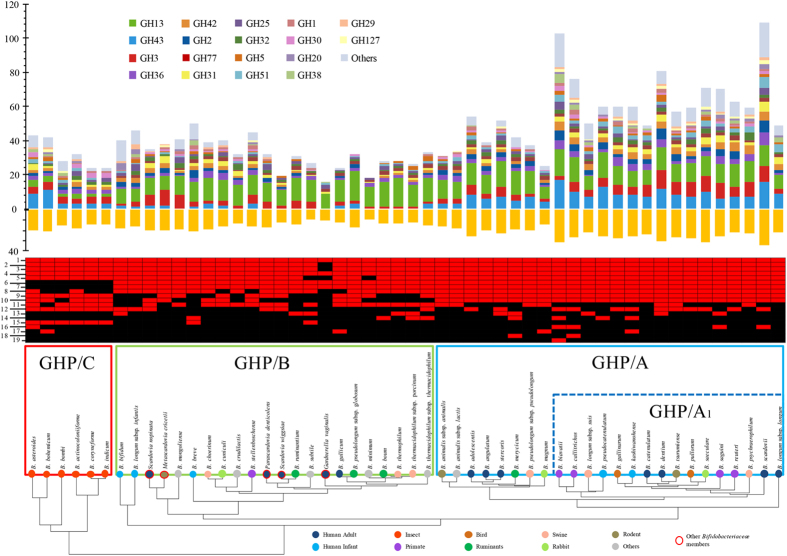
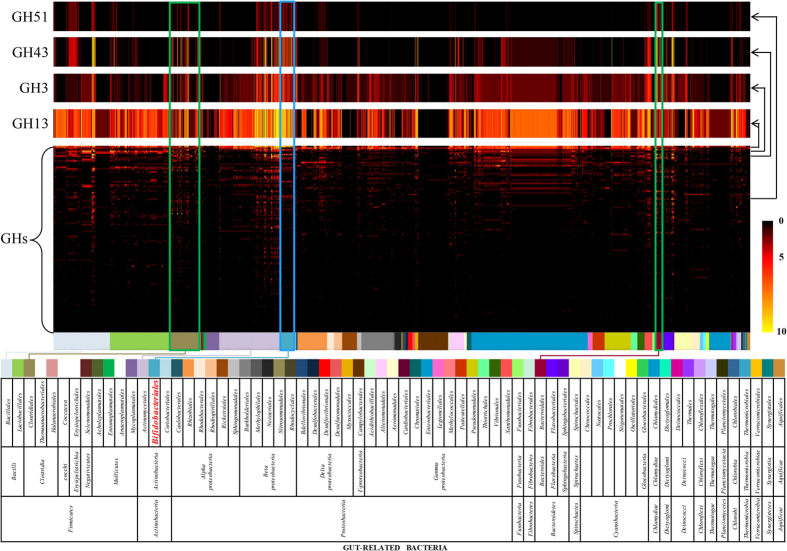
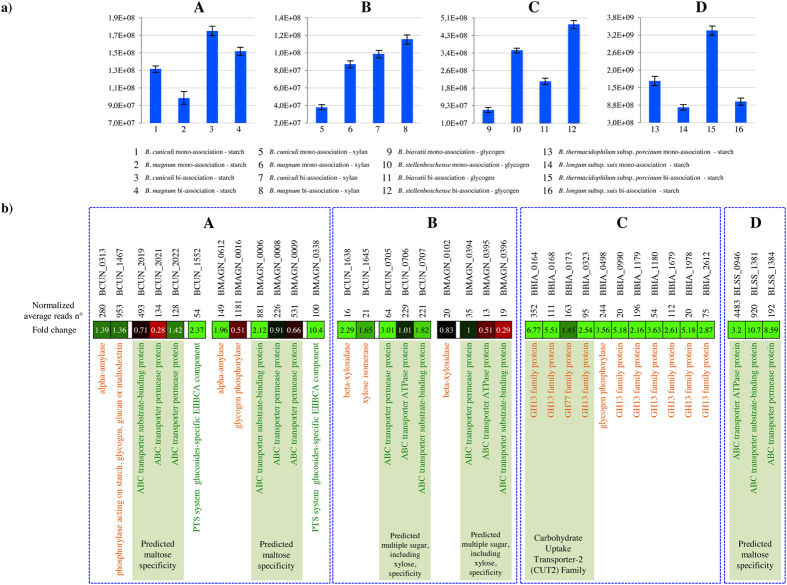
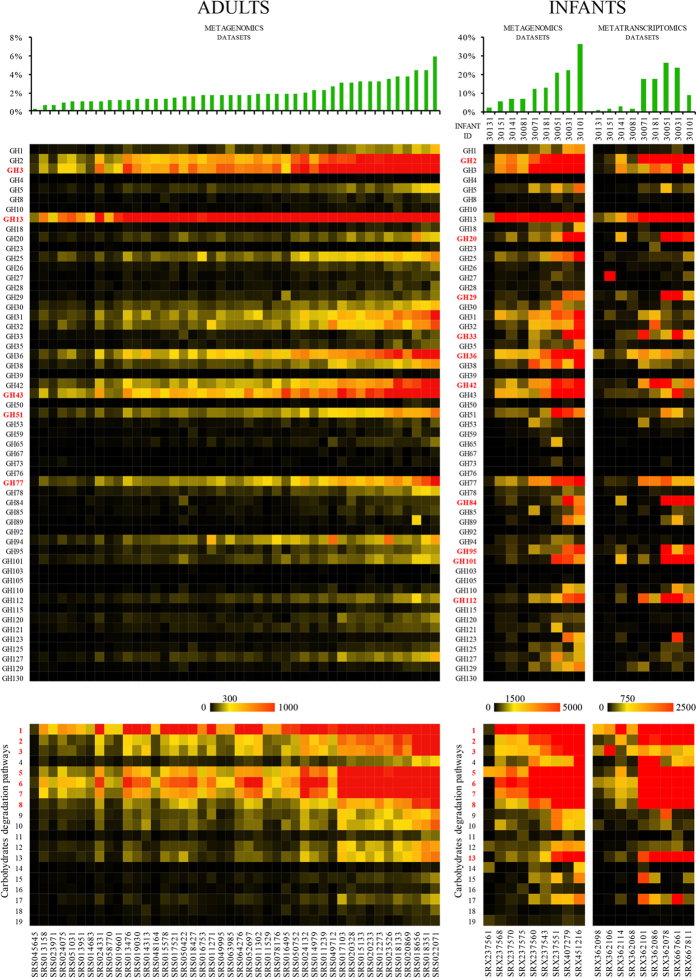
Verification
Claims the paper makes
The claims and statistics of this paper haven’t been checked yet.
Run the check — free, no account needed. It reads the open-access text and checks the sources it cites.
Claims other papers make about this one
Each is checked against this paper’s own text: does it say what the citing paper says it does?
In the citing paper
“as gut commensals work together to fully degrade food within the intestine [125, 126].”
From Role of the gut microbiota in nutrient competition and protection against intestinal pathogen colonization (2023) · cites this paper as [126]
Self-check
Percentages, sums and reported differences re-computed from the paper’s own numbers.
The self-check needs the paper’s full text.
Citations
Cites
Bradford, M. M. (1976) · Analytical Biochemistry · doi:10.1016/0003-2697(76)90527-3 · Cited by 255,302
Molecular Cloning: A Laboratory Manual
Sambrook, J., Fritsch, E., & Maniatis, T. (1989) · UCLA - Biblioteca de Ciencias de la Salud · Cited by 133,589
Moderated estimation of fold change and dispersion for RNA-seq data with DESeq2
Love, M. I., Huber, W., & Anders, S. (2014) · Genome Biology · doi:10.1186/s13059-014-0550-8 · Cited by 95,106
The Sequence Alignment/Map format and SAMtools
Li, H., Handsaker, B., Wysoker, A., Fennell, T., Ruan, J., Homer, N., Marth, G., Abecasis, G., Durbin, R., & 1000 Genome Project Data Processing Subgroup (2009) · Bioinformatics · doi:10.1093/bioinformatics/btp352 · Cited by 62,041
Fast and accurate short read alignment with Burrows-Wheeler transform
Li, H., & Durbin, R. (2009) · Bioinformatics · doi:10.1093/bioinformatics/btp324 · Cited by 58,607
Fast gapped-read alignment with Bowtie 2
Langmead, B., & Salzberg, S. L. (2012) · Nature Methods · doi:10.1038/nmeth.1923 · Cited by 56,400
BEDTools: a flexible suite of utilities for comparing genomic features
Quinlan, A. R., & Hall, I. M. (2010) · Bioinformatics · doi:10.1093/bioinformatics/btq033 · Cited by 27,437
Structure, function and diversity of the healthy human microbiome
The Human Microbiome Project Consortium (2012) · Nature · doi:10.1038/nature11234 · Cited by 11,726
Ashburner, M. (1989) · Cold Spring Harbor Laboratory eBooks · Cited by 6,756
The carbohydrate-active enzymes database (CAZy) in 2013
Lombard, V., Ramulu, H. G., Drula, É., Coutinho, P. M., & Henrissat, B. (2013) · Nucleic Acids Research · doi:10.1093/nar/gkt1178 · Cited by 6,452
Cited by
Sorted by citations
Milani, C., Duranti, S., Bottacini, F., Casey, E., Turroni, F., Mahony, J., Belzer, C., Delgado Palacio, S., Arboleya Montes, S., Mancabelli, L., et al. (2017) · Microbiology and Molecular Biology Reviews · doi:10.1128/mmbr.00036-17 · Cited by 1,950
Self-citationBifidobacteria and Their Role as Members of the Human Gut Microbiota
O’Callaghan, A. A., & van Sinderen, D. (2016) · Frontiers in Microbiology · doi:10.3389/fmicb.2016.00925 · Cited by 1,160
Actinobacteria: A relevant minority for the maintenance of gut homeostasis
Binda, C., Lopetuso, L. R., Rizzatti, G., Gibiino, G., Cennamo, V., & Gasbarrini, A. (2018) · Digestive and Liver Disease · doi:10.1016/j.dld.2018.02.012 · Cited by 828
Fassarella, M., Blaak, E. E., Penders, J., Nauta, A., Smidt, H., & Zoetendal, E. G. (2020) · Gut · doi:10.1136/gutjnl-2020-321747 · Cited by 818
Ormerod, K. L., Wood, D., Lachner, N., Gellatly, S. L., Daly, J. N., Parsons, J. D., Dal’Molin, C. G. D. O., Palfreyman, R. W., Nielsen, L. K., Cooper, M. A., et al. (2016) · Microbiome · doi:10.1186/s40168-016-0181-2 · Cited by 691
Metadata
- Authors
- Milani, C., Lugli, G. A., Duranti, S., Turroni, F., Mancabelli, L., Ferrario, C., Mangifesta, M., Hevia, A., Viappiani, A., Scholz, M., Arioli, S., Sanchez, B., Lane, J., Ward, D. V., Hickey, R., Mora, D., Segata, N., Margolles, A., van Sinderen, D., & Ventura, M.
- Affiliations
- University of Parma (IT)
- National University of Ireland (IE)
- Consejo Superior de Investigaciones Científicas (ES)
- University of Trento (IT)
- Teagasc - The Irish Agriculture and Food Development Authority (IE)
- Broad Institute (US)
- University of Milan (IT)
- Corresponding author
- Ventura, Marco
- ORCID
- Venue
- Scientific Reports
- Published
- 2015-10-28
- Volume
- 5
- Issue
- 1
- Pages
- 15782-15782
- ISSN
- 2045-2322 (ISSN-L)
- PMC
- PMC4623478
- OpenAlex
- W2302783498
- Cited by
- 284
- References
- 44
- Citations by year
- 2026: 8 · 2025: 19 · 2024: 20 · 2023: 25 · 2022: 33 · 2021: 25 · 2020: 49 · 2019: 39 · 2018: 22 · 2017: 27 · 2016: 15 · 2015: 1
- FWCI
- 9.40
- Type
- journal article
- Language
- en
- Open access
- gold
- doi.org
- Locations
- Scientific Reports (publishedVersion, cc-by)
- Europe PMC (PubMed Central) (publishedVersion, cc-by)
- PubMed Central (publishedVersion, cc-by)
- PubMed (publishedVersion)
- Archivio Istituzionale della Ricerca (Universita Degli Studi Di Milano) (submittedVersion, other-oa)
- DIGITAL.CSIC (Spanish National Research Council (CSIC)) (submittedVersion, cc-by)
- Institutional Research Information System (Università degli Studi di Trento) (submittedVersion)
- Funders
- U.S. Department of Health and Human Services (HHSN272200900018C)
- European Commission (618833)
- Science Foundation Ireland (SFI/12/RC/, 12/RC/2273, 12/RC/, SFI/12/RC/2273., 08/SRC/B1393)
- Ministero dell’Istruzione, dell’Università e della Ricerca
- Fondazione Cassa Di Risparmio Di Trento E Rovereto
- Alimentary Glycoscience Research Cluster (08/SRC/B1393)
- National Institutes of Health (HHSN272200900018C)
- APC Microbiome Institute (SFI/12/RC/2273)
- National Institute of Allergy and Infectious Diseases (HHSN272200900018C)
- Topics
- Life Sciences › Biochemistry, Genetics and Molecular Biology › Molecular Biology › Gut microbiota and health
- Health Sciences › Nursing › Nutrition and Dietetics › Infant Nutrition and Health
- Life Sciences › Agricultural and Biological Sciences › Food Science › Probiotics and Fermented Foods
- Keywords
- Bifidobacterium, gut microbiota, carbohydrate utilization, glycan degradation, cross-feeding, resource sharing, gene expression profiling, human faecal microbiota, insect gut microbiota, metabolic specialization
- MeSH terms
- Adult, Bifidobacterium, Carbohydrates, Feces, Humans, Infant, Gastrointestinal Tract, Carbohydrate Metabolism
About these checks
Registry, retraction, Cites and statistics results are computed, not judged, with one exception: a printed reference that no index lists is read once by a model before it counts as a citation error. Claims are extracted by a model and kept only when their quote appears verbatim in the text; each cited source is then checked, with a model’s help, for whether it says what the claim relies on. Those verdicts can be wrong — read the claim’s quote and the cited source before relying on one.
Statistics and arithmetic are recomputed, not judged.
Confidence bands are shown only for fields calibrated on our annotated test set. None is calibrated yet, so no band is shown.
What counts as a claim ›How we measure confidence ›How we check this ›
Are you an author, or do you see a problem with this page? Request a review
