

The DOI matches its Crossref record; 143 of the 143 references it cites were found in a registry or an index.
Sniffing around oxytocin: review and meta-analyses of trials in healthy and clinical groups with implications for pharmacotherapy
Open accessAbstract
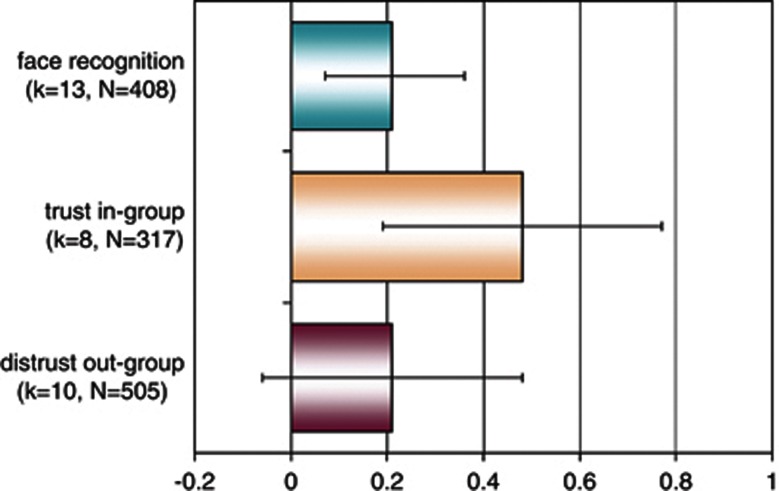
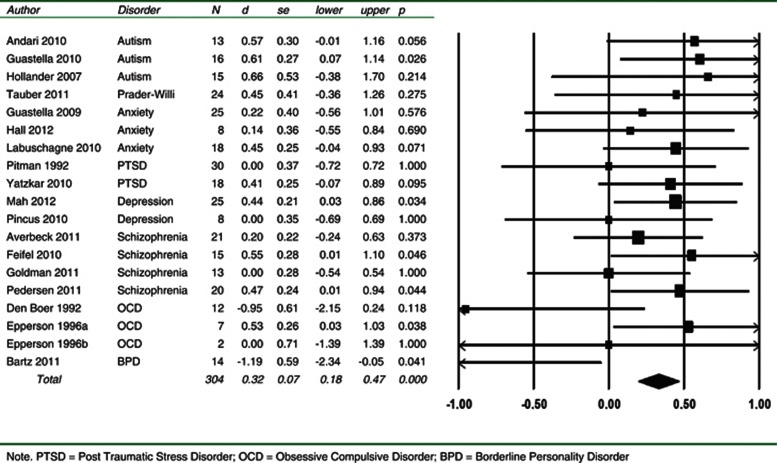
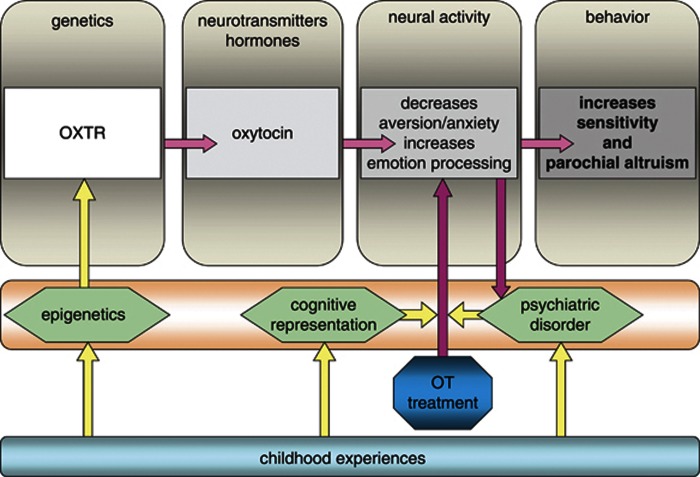
The popularity of oxytocin (OT) has grown exponentially during the past decade, and so has the number of OT trials in healthy and clinical groups. We take stock of the evidence from these studies to explore potentials and limitations of pharmacotherapeutic applications. In healthy participants, intranasally administered OT leads to better emotion recognition and more trust in conspecifics, but the effects appear to be moderated by context (perceived threat of the 'out-group'), personality and childhood experiences. In individuals with untoward childhood experiences, positive behavioral or neurobiological effects seem lowered or absent. In 19 clinical trials, covering autism, social anxiety, postnatal depression, obsessive-compulsive problems, schizophrenia, borderline personality disorder and post-traumatic stress, the effects of OT administration were tested, with doses ranging from 15 IU to more than 7000 IU. The combined effect size was d=0.32 (N=304; 95% confidence interval (CI): 0.18-0.47; P<0.01). However, of all disorders, only studies on autism spectrum disorder showed a significant combined effect size (d=0.57; N=68; 95% CI: 0.15-0.99; P<0.01). We hypothesize that for some of the other disorders, etiological factors rooted in negative childhood experiences may also have a role in the diminished effectiveness of treatment with OT.
Overview
The claims and statistics of this paper haven’t been checked yet.
Run the check — free, no account needed. It reads the open-access text and checks the sources it cites.
Integrity signals
Registry
Cites
Statistics
Figures
Verification
Claims the paper makes
The claims and statistics of this paper haven’t been checked yet.
Run the check — free, no account needed. It reads the open-access text and checks the sources it cites.
Claims other papers make about this one
Each is checked against this paper’s own text: does it say what the citing paper says it does?
The cited source doesn’t support the claim as written.
In the citing paper
“These studies yielded summarized effect sizes ranging from d=0.21 to d=0.48.”
From Statistical and Methodological Considerations for the Interpretation of Intranasal Oxytocin Studies (2016) · cites this paper as [11]
Checked by a reasoning model — may be wrong.
Experimental — accuracy not yet measuredThe source backs part of the claim, not all of it — or backs it for a different population, condition or comparison.
In the citing paper
“The meta-analyses mentioned in this paper all tested for evidence of publication bias in the IN-OT literature, with mixed results (9–11).”
From Statistical and Methodological Considerations for the Interpretation of Intranasal Oxytocin Studies (2016) · cites this paper as [11]
Experimental — accuracy not yet measuredThe source backs part of the claim, not all of it — or backs it for a different population, condition or comparison.
In the citing paper
“Finally, in the meta-analysis by Bakermans-Kranenburg and Van IJzendoorn (11) IN-OT seems to have the largest effect size in individuals with autism. Only four studies of autism were included in the analysis and should therefore be interpreted cautiously. However, the larger effect size for autism (d=0.57) compared to all clinical studies (d=0.32)”
From Statistical and Methodological Considerations for the Interpretation of Intranasal Oxytocin Studies (2016) · cites this paper as [11]
Experimental — accuracy not yet measuredThe cited source says what the claim attributes to it.
In the citing paper
“Bakermans-Kranenburg and Van IJzendoorn studied the effect of IN-OT in clinical trials (19 effect sizes, total N=304)(11).”
From Statistical and Methodological Considerations for the Interpretation of Intranasal Oxytocin Studies (2016) · cites this paper as [11]
The cited source says what the claim attributes to it.
In the citing paper
“To date three meta-analyses of the effects of IN-OT on human behavior have been published.”
From Statistical and Methodological Considerations for the Interpretation of Intranasal Oxytocin Studies (2016) · cites this paper as [11]
The cited source says what the claim attributes to it.
In the citing paper
“Only four studies of autism were included in the analysis and should therefore be interpreted cautiously.”
From Statistical and Methodological Considerations for the Interpretation of Intranasal Oxytocin Studies (2016) · cites this paper as [11]
In the citing paper
“Several clinical studies have also investigated the potential of intranasal oxytocin as a treatment for socio-cognitive, behavioral, and socio-affective symptoms of ASD. So far, these studies cannot provide a certain conclusion about oxytocin’s therapeutic potential43–47.”
From Randomized clinical trial shows no substantial modulation of empathy-related neural activation by intranasal oxytocin in autism (2021) · cites this paper as [46]
In the citing paper
“In typically developing individuals, OT has been linked to interpersonal bonding, parental care, and the ability to establish trust and form social attachments [2, 3].”
From Behavioral effects of multiple-dose oxytocin treatment in autism: a randomized, placebo-controlled trial with long-term follow-up (2020) · cites this paper as [2]
In the citing paper
“the genetic background of oxytocin system might influence efficacy of oxytocin administration.19, 20”
From Oxytocin efficacy is modulated by dosage and oxytocin receptor genotype in young adults with high-functioning autism: a 24-week randomized clinical trial (2016) · cites this paper as [19]
In the citing paper
“oxytocin is emerging as a pharmacological target for social dysfunction in clinical trials (29, 30).”
From Placebo treatment facilitates social trust and approach behavior (2018) · cites this paper as [30]
Self-check
Percentages, sums and reported differences re-computed from the paper’s own numbers.
The self-check needs the paper’s full text.
Citations
Cites
Statistical Power Analysis for the Behavioral Sciences
Muller, K. E., & Cohen, J. (1989) · Technometrics · doi:10.2307/1270020 · Cited by 99,603
Statistical power analysis for the behavioral sciences
Cohen, J. (1990) · Computers Environment and Urban Systems · doi:10.1016/0198-9715(90)90050-4 · Cited by 65,417
(1969) · Cited by 18,340
Duval, S., & Tweedie, R. (2000) · Biometrics · doi:10.1111/j.0006-341x.2000.00455.x · Cited by 14,099
(2000) · Cited by 9,198
LeDoux, J. E. (2000) · Annual Review of Neuroscience · doi:10.1146/annurev.neuro.23.1.155 · Cited by 8,444
Baron-Cohen, S., Wheelwright, S., Skinner, R., Martin, J., & Clubley, E. (2001) · Journal of Autism and Developmental Disorders · doi:10.1023/a:1005653411471 · Cited by 6,450
Kirschbaum, C., Pirke, K.-M., & Hellhammer, D. H. (2008) · Neuropsychobiology · doi:10.1159/000119004 · Cited by 6,093
The precuneus: a review of its functional anatomy and behavioural correlates
Cavanna, A. E., & Trimble, M. R. (2006) · Brain · doi:10.1093/brain/awl004 · Cited by 5,128
Meta-Analytic Procedures for Social Research
Rosenthal, R. (1991) · doi:10.4135/9781412984997 · Cited by 4,635
Research works printed but not linked: 1
- Borenstein M, Hedges LV, Higgins JPT, Rothstein HR . Comprehensive Meta-Analysis, Version 2. Biostat: Englewood, NJ, USA, 2005.
Cited by
Sorted by citations
Assessing human mirror activity with EEG mu rhythm: A meta-analysis.
Fox, N. A., Bakermans‐Kranenburg, M. J., Yoo, K. H., Bowman, L. C., Cannon, E. N., Vanderwert, R. E., Ferrari, P. F., & van IJzendoorn, M. H. (2015) · Psychological Bulletin · doi:10.1037/bul0000031 · Cited by 466
The adaptive human parental brain: implications for children's social development
Feldman, R. (2015) · Trends in Neurosciences · doi:10.1016/j.tins.2015.04.004 · Cited by 419
Statistical and Methodological Considerations for the Interpretation of Intranasal Oxytocin Studies
Walum, H., Waldman, I. D., & Young, L. J. (2016) · Biological Psychiatry · doi:10.1016/j.biopsych.2015.06.016 · Cited by 347
“Finally, in the meta-analysis by BakermansKranenburg and Van IJzendoorn (11) IN-OT seems to have the largest effect size in individuals with autism.”
BackgroundMethodInfluentialRole of neuropeptides in anxiety, stress, and depression: From animals to humans
Kormos, V., & Gaszner, B. (2013) · Neuropeptides · doi:10.1016/j.npep.2013.10.014 · Cited by 333
Does Oxytocin Increase Trust in Humans? A Critical Review of Research
Nave, G., Camerer, C., & McCullough, M. (2015) · Perspectives on Psychological Science · doi:10.1177/1745691615600138 · Cited by 316
Metadata
- Authors
- Bakermans-Kranenburg, M. J., & van IJzendoorn, M. H.
- Venue
- Translational Psychiatry
- Published
- 2013-05-21
- Volume
- 3
- Issue
- 5
- Pages
- e258-e258
- ISSN
- 2158-3188 (ISSN-L)
- PMC
- PMC3669921
- OpenAlex
- W1966317054
- Cited by
- 383
- References
- 142
- Citations by year
- 2026: 7 · 2025: 13 · 2024: 12 · 2023: 18 · 2022: 11 · 2021: 24 · 2020: 22 · 2019: 29 · 2018: 41 · 2017: 55 · 2016: 43 · 2015: 59 · 2014: 40 · 2013: 9
- FWCI
- 6.67
- Type
- journal article
- Language
- en
- Open access
- gold
- doi.org
- Licence
- cc-by-nc-nd
- www.springer.com/tdm (unspecified)
- Locations
- Translational Psychiatry (publishedVersion, cc-by-nc-nd)
- Europe PMC (PubMed Central) (publishedVersion, cc-by-nc-nd)
- PubMed Central (publishedVersion, cc-by-nc-nd)
- PubMed (publishedVersion)
- Funders
- Nederlandse Organisatie voor Wetenschappelijk Onderzoek
- Topics
- Life Sciences › Neuroscience › Endocrine and Autonomic Systems › Neuroendocrine regulation and behavior
- Life Sciences › Neuroscience › Sensory Systems › Olfactory and Sensory Function Studies
- Life Sciences › Neuroscience › Behavioral Neuroscience › Stress Responses and Cortisol
- Keywords
- oxytocin, intranasal administration, pharmacotherapy, autism spectrum disorder, social anxiety, postpartum depression, obsessive-compulsive disorder, schizophrenia, borderline personality disorder, post-traumatic stress disorder, emotion recognition, trust, child abuse, personality moderators, treatment effect size
- MeSH terms
- Administration, Intranasal, Anxiety, Mental Disorders, Child, Child Development Disorders, Pervasive, Depression, Humans, Oxytocin, Personality Disorders, Phobic Disorders, Schizophrenia, Stress Disorders, Post-Traumatic, Anti-Anxiety Agents, Trust
About these checks
Registry, retraction, Cites and statistics results are computed, not judged, with one exception: a printed reference that no index lists is read once by a model before it counts as a citation error. Claims are extracted by a model and kept only when their quote appears verbatim in the text; each cited source is then checked, with a model’s help, for whether it says what the claim relies on. Those verdicts can be wrong — read the claim’s quote and the cited source before relying on one.
Statistics and arithmetic are recomputed, not judged.
Confidence bands are shown only for fields calibrated on our annotated test set. None is calibrated yet, so no band is shown.
What counts as a claim ›How we measure confidence ›How we check this ›
Are you an author, or do you see a problem with this page? Request a review
