

PFAS free chemically amplified resists enabled by low activation energy hydrocarbon cage monomers
Open accessThe DOI matches its Crossref record; 45 of the 45 references it cites were found in a registry or an index; none of the 9 sources its claims cite is checked for support yet.
Abstract
Larger cage hydrocarbon induced hyperconjugation lowers the energy barrier for resist deprotection ( i.e. , solubility switching), eliminating the need for PFAS-containing PAGs for photoresist design.
Overview
CoChat Summary
TL;DR
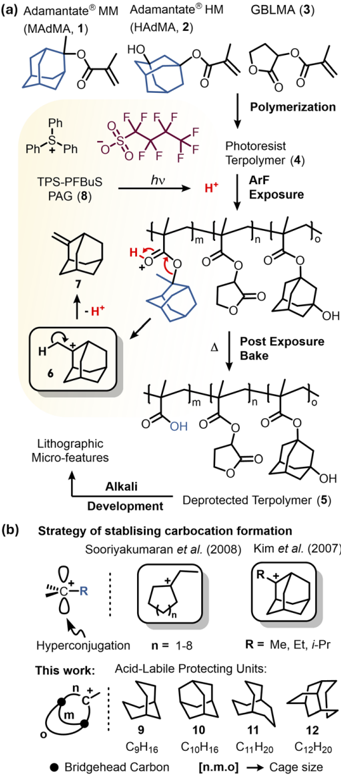
The paper synthesizes and evaluates photoresist terpolymers using cage hydrocarbon methacrylate monomers—bicyclo[3.3.1], bicyclo[3.3.3], and tricyclo[6.3.1.0³,⁹]dodecane—as replacements for adamantyl methacrylate. Larger cage systems lower the activation barrier for carbocation formation, enabling deprotection with weaker non-PFAS photoacid generators while maintaining key thermal and etch-resistance properties.
Key findings
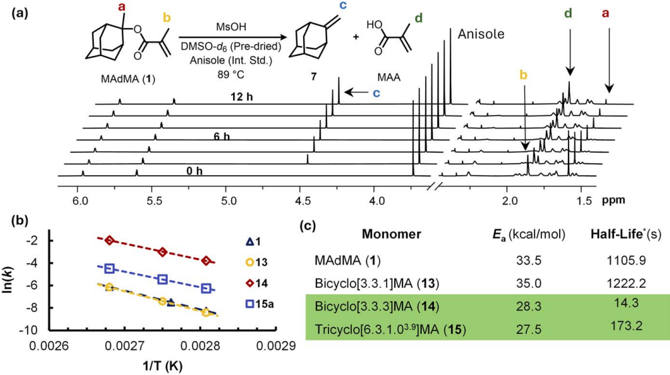
- Monomer deprotection kinetics showed that the larger cages had lower activation energies and shorter half-lives: 28a bicyclo[3.3.3] had Ea 28.3 kcal mol⁻¹ and t₁/₂ 14.3 s; 29a tricyclo[6.3.1.0³,⁹] had Ea 27.5 kcal mol⁻¹ and t₁/₂ 173 s; 27a and 4a had similar values, with Ea 35.0 and 33.5 kcal mol⁻¹ and t₁/₂ 1122 and 1106 s, respectively. DFT calculations indicated carbocation formation from 14, 15a, and 15b was preferred by 3–5 kcal mol⁻¹ relative to 1 or 13.
- With the PFAS PAG TPS-PFBuS (8), 4a had E₀ values of 25 and 110 mJ cm⁻² at PEB 100 and 90 °C; 27a had E₀ 19 mJ cm⁻² at 100 °C; 29a had E₀ 6 mJ cm⁻² at 90 °C; 28a was too sensitive for accurate open-frame E₀ but showed E₀ ≤10 µC cm⁻² by wide-area EBL versus 190 µC cm⁻² for the benchmark. With non-PFAS TPS-Ms (30), 4a and 27a did not fully dissolve above 500 mJ cm⁻² at 120 °C, while 28a achieved E₀ 57 mJ cm⁻² at 100 °C and 29a achieved E₀ 59 mJ cm⁻² at 110 °C; with DTBPI-CampS (31), 28a and 29a had E₀ 138 and 147 mJ cm⁻² at 100 and 120 °C, respectively.
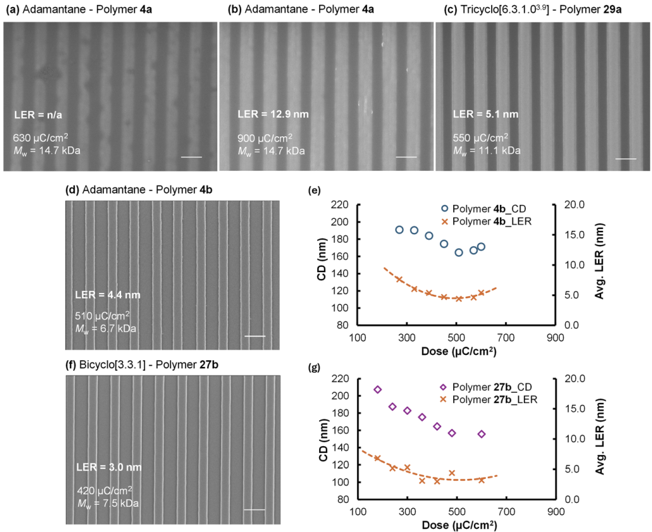
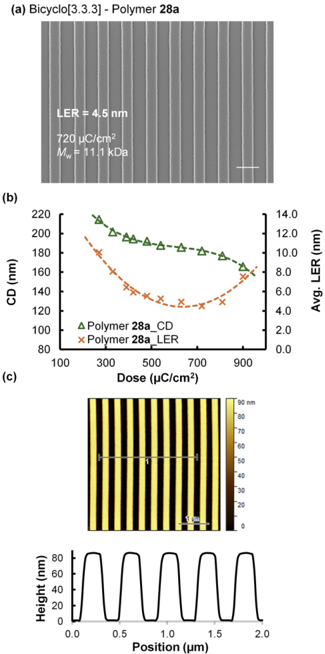
- EBL patterning with PFAS PAG showed 29a had LER 5.1 nm at 550 µC cm⁻² versus 4a LER 12.9 nm at 900 µC cm⁻²; lower-Mw 27b had minimum LER 3.0 nm at 420 µC cm⁻², a 32% reduction versus 4b (4.4 nm at ~510 µC cm⁻²). With non-PFAS PAG 31, 28a achieved minimum LER 4.5 nm at EOP 720 µC cm⁻², comparable to 4b with PFAS PAG.
- Larger cages lowered thermal decomposition onset: 28a Td 164 °C and 29a Td 173 °C versus 4a 225 °C and 27a 221 °C; 29b Td was 133 °C. Tg was 151 °C for 4b and 166 °C for 27b, while 28b and 29b had no Tg detected before Td. O₂ plasma etch rates were 1.31 ± 0.06 nm s⁻¹ for 4a, 1.49 ± 0.06 for 27a, 1.40 ± 0.05 for 28a, and 1.40 ± 0.06 for 29a, with overlapping error bars for 4a, 28a, and 29a.
Methods
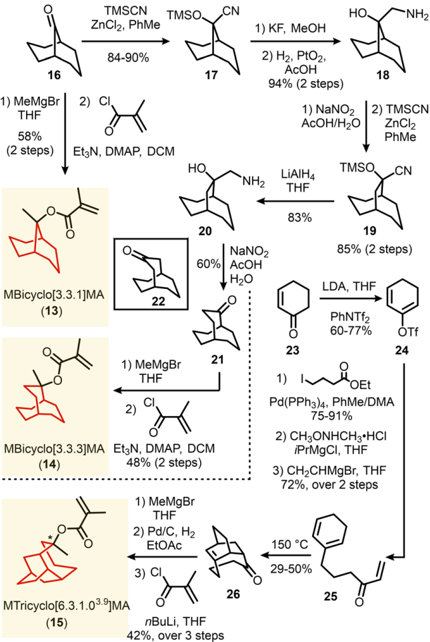
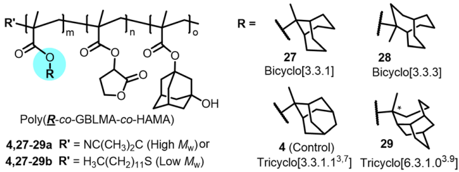
- Monomers 13–15 were synthesized and independently copolymerized with GBLMA (3) and HAdMA (2) by free-radical polymerization using AIBN, with or without n-dodecanethiol as a chain transfer agent, to produce terpolymers 27–29 and reference terpolymer 4; polymers were characterized by NMR, SEC, TGA, and DSC.
- Acid-catalyzed deprotection kinetics were measured by pseudo-first-order experiments using methanesulfonic acid in DMSO-d₆, with Arrhenius analysis; DFT calculations assessed carbocation formation energies.
- Resists were formulated with PAGs TPS-PFBuS (8), TPS-Ms (30), or DTBPI-CampS (31) and TOA quencher, then evaluated by open-frame 265 nm LED exposures, EBL patterning, SEM/AFM, and oxygen plasma etch testing.
Limitations
- The paper states that information on comparative low-Ea CAR photoresist performance from cage hydrocarbons other than adamantane is scarce, motivating this side-by-side study.
- The paper reports that 28a was too sensitive under the same PEB conditions to determine an accurate E₀ via open-frame 265 nm exposures, and that 28b and 29b patterning was highly sensitive to development conditions with early-stage EBL results placed in the SI; Tg for 28b and 29b could not be determined because no Tg was detected before Td.
- Evident from the text: reported resist formulations used a single PAG loading (10 wt%) and quencher loading (10 mol% TOA relative to PAG), so broader formulation optimization is not shown.
Model-written summary. Check it against the paper before relying on it.
Integrity signals
Registry
Cites
Statistics
Figures

Verification
Claims the paper makes
0 Valid · 0 Not valid · 6 Not checked · 35 Own results and interpretations
A result the paper reports from its own data — it cites no other source for it, so there is none to check. The quote shows it is in the paper.
In the paper
“Terpolymer 28a was too sensitive under the same PEB conditions to determine an accurate E0via open frame exposures using the 265 nm open frame setup.”
§ PFAS free chemically amplified resists enabled by low activation energy hydrocarbon cage monomers > Results and discussion > Resist formulation and photosensitivity
plainstates a causeSingle case- Asserted: passes — The authors put it forward as true.
- Checkable: passes — It can be checked against evidence.
- Load-bearing: unclear — It is unclear whether the paper’s conclusions depend on it.
- Based: passes — The paper gives a reason why it holds.
A result the paper states — it cites no source for it, so there is none to check. The quote shows it is in the paper.
In the paper
“When 4a and 27a formulated with TPS-Ms (30) were exposed to over 500 mJ cm−2 and a PEB of 120 °C was performed, the films did not undergo full dissolution.”
§ PFAS free chemically amplified resists enabled by low activation energy hydrocarbon cage monomers > Results and discussion > Resist formulation and photosensitivity
plain- Asserted: passes — The authors put it forward as true.
- Checkable: passes — It can be checked against evidence.
- Load-bearing: passes — The paper’s conclusions depend on it.
- Based: passes — The paper gives a reason why it holds.
A result the paper reports from its own data — it cites no other source for it, so there is none to check. The quote shows it is in the paper.
In the paper
“density functional theory calculations (see Fig. S4–S6 in SI) showed that the formation of carbocations from 14, 15a and 15b are energetically preferred by 3–5 kcal mol−1 relative to carbocation formation derived from 1 or 13”
§ PFAS free chemically amplified resists enabled by low activation energy hydrocarbon cage monomers > Results and discussion > Monomer deprotection kinetics
plainstates a cause- Asserted: passes — The authors put it forward as true.
- Checkable: passes — It can be checked against evidence.
- Load-bearing: passes — The paper’s conclusions depend on it.
- Based: passes — The paper gives a reason why it holds.
A result the paper reports from its own data — it cites no other source for it, so there is none to check. The quote shows it is in the paper.
In the paper
“At a PEB temperature of 100 °C for 27a the E0 was found to be 19 mJ cm−2”
§ PFAS free chemically amplified resists enabled by low activation energy hydrocarbon cage monomers > Results and discussion > Resist formulation and photosensitivity
plain- Asserted: passes — The authors put it forward as true.
- Checkable: passes — It can be checked against evidence.
- Load-bearing: passes — The paper’s conclusions depend on it.
- Based: passes — The paper gives a reason why it holds.
A result the paper reports from its own data — it cites no other source for it, so there is none to check. The quote shows it is in the paper.
In the paper
“terpolymers that incorporated the larger cage hydrocarbon ring systems, i.e., bicyclo[3.3.3] terpolymer 28a and tricyclo[6.3.1.03.9] terpolymer 29a, showed a decreased temperature for the onset of thermal decomposition at 164 °C and 172 °C, respectively, compared to the adamantane and bicyclo[3.3.1] derived terpolymers 4a and 27a, which had thermal decomposition temperatures (Td) over 220 °C.”
§ PFAS free chemically amplified resists enabled by low activation energy hydrocarbon cage monomers > Results and discussion > Resist polymers
plainstates a cause- Asserted: passes — The authors put it forward as true.
- Checkable: passes — It can be checked against evidence.
- Load-bearing: passes — The paper’s conclusions depend on it.
- Based: passes — The paper gives a reason why it holds.
17 more claims
Create a free account to see all 41 claims and every source verdict.
- The quote only partly states this claim. 1
- It may state two separate claims as one. 17
- Probably not a substantial claim. 2
Self-check
Percentages, sums and reported differences re-computed from the paper’s own numbers.
Each contradiction between two passages listed here was confirmed by an independent check.
Rated minor: it would not touch a result — a value no result rests on, a p-value that stays on the same side of the significance level, or a conflict that is clerical, resolved elsewhere in the paper, or outside its own findings.
In the paper
“| 28a | 100 : 0 : 30 | 95/99/99 | 39/40/21 | 64% | 5.1 | 11.3 | 2.10 | 164 | — |”
§ PFAS free chemically amplified resists enabled by low activation energy hydrocarbon cage monomers > Results and discussion > Resist polymers
Reported 2.1 · recomputed 2.215686
Rated minor: it would not touch a result — a value no result rests on, a p-value that stays on the same side of the significance level, or a conflict that is clerical, resolved elsewhere in the paper, or outside its own findings.
In the paper
§ PFAS free chemically amplified resists enabled by low activation energy hydrocarbon cage monomers > Results and discussion > Resist polymers
“bicyclo[3.3.3] terpolymer 28a and tricyclo[6.3.1.03.9] terpolymer 29a, showed a decreased temperature for the onset of thermal decomposition at 164 °C and 172 °C, respectively”
§ PFAS free chemically amplified resists enabled by low activation energy hydrocarbon cage monomers > Results and discussion > Resist polymers
“| 29a | 100 : 0 : 35 | 92/98/98 | 38/41/21 | 52% | 5.5 | 11.1 | 2.02 | 173 | — |”
Citations
Cites
Design of ion-implanted MOSFET's with very small physical dimensions
Dennard, R. H., Gaensslen, F. H., Yu, H.-N., Rideout, V. L., Bassous, E., & LeBlanc, A. R. (1974) · IEEE Journal of Solid-State Circuits · doi:10.1109/jssc.1974.1050511 · Cited by 3,548
An overview of the uses of per- and polyfluoroalkyl substances (PFAS)
Glüge, J., Scheringer, M., Cousins, I. T., DeWitt, J. C., Goldenman, G., Herzke, D., Lohmann, R., Ng, C. A., Trier, X., & Wang, Z. (2020) · Environmental Science: Processes & Impacts · doi:10.1039/d0em00291g · Cited by 2,466
The chips are down for Moore’s law
Waldrop, M. M. (2016) · Nature · doi:10.1038/530144a · Cited by 2,397
New Approaches to Nanofabrication: Molding, Printing, and Other Techniques
Gates, B. D., Xu, Q., Stewart, M., Ryan, D., Willson, C. G., & Whitesides, G. M. (2005) · Chemical Reviews · doi:10.1021/cr030076o · Cited by 2,020
Moore, G. E. (2006) · IEEE Solid-State Circuits Society Newsletter · doi:10.1109/n-ssc.2006.4785860 · Cited by 854
Reymond, J.-L. (2015) · Accounts of Chemical Research · doi:10.1021/ar500432k · Cited by 720
Lithographic Imaging Techniques for the Formation of Nanoscopic Features
Wallraff, G. M., & Hinsberg, W. D. (1999) · Chemical Reviews · doi:10.1021/cr980003i · Cited by 501
Chemical Amplification Resists for Microlithography
Ito, H. (2005) · Advances in Polymer Science · doi:10.1007/b97574 · Cited by 428
Lithography and Other Patterning Techniques for Future Electronics
Pease, R. F., & Chou, S. Y. (2008) · Proceedings of the IEEE · doi:10.1109/jproc.2007.911853 · Cited by 399
Extreme ultraviolet resist materials for sub-7 nm patterning
Li, L., Liu, X., Pal, S., Wang, S., Ober, C. K., & Giannelis, E. P. (2017) · Chemical Society Reviews · doi:10.1039/c7cs00080d · Cited by 345
Research works printed but not linked: 14
- Hennessy J. L. and Patterson D. A., Computer architecture: a quantitative approach, Elsevier Science & Technology, Amsterdam, 2012
- Landis S., Lithography: main techniques, John Wiley & Sons, Inc., Hoboken, 2013
- Ober C. Kafer F. Deng J. J. Micro/Nanopatterning, Mater., Metrol. 2022 21 010901
- Dammel R. Speed D. PFAS in semiconductor photolithography: a mass balance model Proc. SPIE 2024 12957 129570F
- Semiconductor PFAS Consortium, The impact of a potential pfas restriction on the semiconductor sector, Semiconductor Industry Association (SIA), 2023
- Semiconductor PFAS Consortium , Background on semiconductor manufacturing and pfas , Semiconductor Industry Association (SIA) , 2023
- (a) Semiconductor PFAS Consortium, Background on semiconductor manufacturing and pfas, Semiconductor Industry Association (SIA), 2023 (b) De Simone D. Gallagher E. Patterning performance of perfluoroalkyl substances (PFAS) free EUV chemically amplified resists: a step towards environmentally friendly lithographic chemicals Proc. SPIE 2025 13428 1342811
- Sooriyakumaran R. DiPietro R. Truong H. Brock P. Allen R. Bozano L. Popova I. Huang W.-S. Chen R. Khojasteh M. Varanasi P. R. A new class of low bake resists for 193-nm immersion lithography Proc. SPIE 2008 6923 69230C
- Wallraff G. M. Medeiros D. R. Sanchez M. Petrillo K. Huang W.-S. Rettner C. Davis B. Larson C. E. Sundberg L. Brock P. J. Hinsberg W. D. Houle F. A. Hoffnagle J. A. Goldfarb D. Temple K. Wind S. Bucchignano J. J. Vac. Sci. Technol., B:Nanotechnol. Microelectron.:Mater., Process., Meas., Phenom. 2004 22 3479
- Williams J. M. Jobson R. B. Yasuda N. Marchesini G. Dolling U.-H. Grabowski E. J. J. Tetrahedron Lett. 1995 36 5461
- Greul M. Shoshi A. Klikovits J. Martens S. Hofmann U. Barahona O. Shnirman B. Starz L. Wintrich P. Sailer H. J. Micro/Nanopatterning, Mater., Metrol. 2024 23 024601
- Gallatin G. Resist blur and line edge roughness Proc. SPIE 2005 5754 4
- Kunz R. Palmateer S. Forte A. Allen R. Wallraff G. Di Pietro R. Hofer D. Limits to etch resistance for 193-nm single-layer resists Proc. SPIE 1996 3678 241835
- Gogolides E. Argitis P. Couladouros E. A. Vidali V. P. Vasilopoulou M. Cordoyiannis G. Diakoumakos C. D. Tserepi A. J. Vac. Sci. Technol., B:Nanotechnol. Microelectron.:Mater., Process., Meas., Phenom. 2003 21 141
Metadata
- Authors
- Liu, Y., Summersgill, M. D., Cheng, H.-H., Chow, S., Im, E., Du, Y., Xing, H., Houston, S. D., Nielsen, B., Whittaker, A. K., Krenske, E. H., Blakey, I., & Williams, C. M.
- Affiliations
- The University of Queensland (AU)
- Corresponding author
- Blakey, Idriss
- Williams, Craig M.
- ORCID
- Venue
- Chemical Science
- Publisher
- Royal Society of Chemistry (RSC)
- Published
- 2026
- Volume
- 17
- Issue
- 32
- Pages
- 15458-15466
- ISSN
- 2041-6520 (ISSN-L)
- 2041-6539
- PMC
- PMC13321811
- OpenAlex
- W7166867285
- Cited by
- 0
- References
- 44
- FWCI
- 0.00
- Type
- journal article
- Language
- en
- Open access
- diamond
- doi.org
- Licence
- Locations
- Chemical Science (publishedVersion, cc-by-nc)
- PubMed (publishedVersion)
- Funders
- Semiconductor Research Corporation (3317.001)
- Australian Research Council (DP180103004)
- Topics
- Physical Sciences › Engineering › Electrical and Electronic Engineering › Advancements in Photolithography Techniques
- Physical Sciences › Materials Science › Materials Chemistry › Photochromic and Fluorescence Chemistry
- Physical Sciences › Chemistry › Organic Chemistry › Advanced Polymer Synthesis and Characterization
- Keywords
- chemically amplified resists, photoacid generator, low activation energy
About these checks
Registry, retraction, Cites and statistics results are computed, not judged, with one exception: a printed reference that no index lists is read once by a model before it counts as a citation error. Claims are extracted by a model and kept only when their quote appears verbatim in the text; each cited source is then checked, with a model’s help, for whether it says what the claim relies on. Those verdicts can be wrong — read the claim’s quote and the cited source before relying on one.
A language model drew the claims from the paper on 2026-10-10, under version 3 of the claim definition (model deepseek-v4.1-flash, prompt extract-v3).
A second model labelled each claim on 2026-10-10 (model jev-1.13-20260917, definition revision gold-guideline-v0.2).
Statistics and arithmetic are recomputed, not judged.
Confidence bands are shown only for fields calibrated on our annotated test set. None is calibrated yet, so no band is shown.
What counts as a claim ›How we measure confidence ›How we check this ›
Are you an author, or do you see a problem with this page? Request a review
How to cite
Cite CoChat for the checks on this page, and the paper for its own findings.
- This page
- CoChat. (2026). Citation check: PFAS free chemically amplified resists enabled by low activation energy hydrocarbon cage monomers. https://app.cochat.ai/papers/10.1039/d6sc03643k
- The paper
- Liu, Y., Summersgill, M. D., Cheng, H.-H., Chow, S., Im, E., Du, Y., Xing, H., Houston, S. D., Nielsen, B., Whittaker, A. K., Krenske, E. H., Blakey, I., & Williams, C. M. (2026). PFAS free chemically amplified resists enabled by low activation energy hydrocarbon cage monomers. Chemical Science. https://doi.org/10.1039/d6sc03643k
Data sources
Bibliographic data: Semantic Scholar, OpenAlex, Crossref.
Contains information from the Semantic Scholar Academic Graph Datasets, made available under the ODC Attribution License (ODC-BY 1.0).
Semantic Scholar’s data is described in: Kinney, R., et al. (2023). The Semantic Scholar Open Data Platform. arXiv:2301.10140.
