

Galaxy morphology classification based on Convolutional vision Transformer (CvT)
Open accessThe DOI matches its Crossref record; 28 of the 28 references it cites were found in a registry or an index.
Abstract
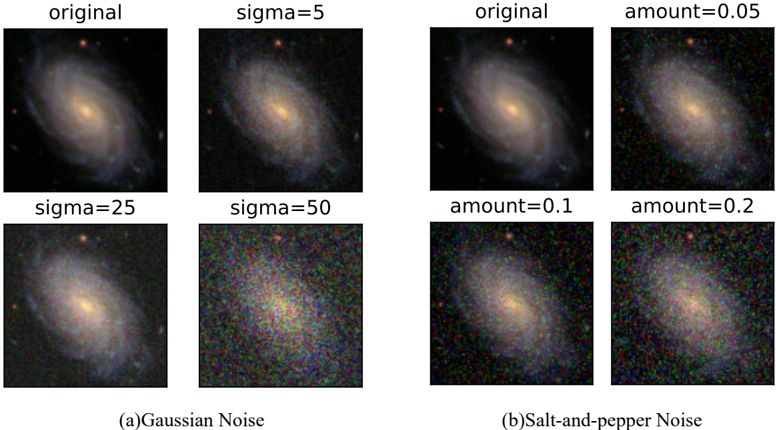
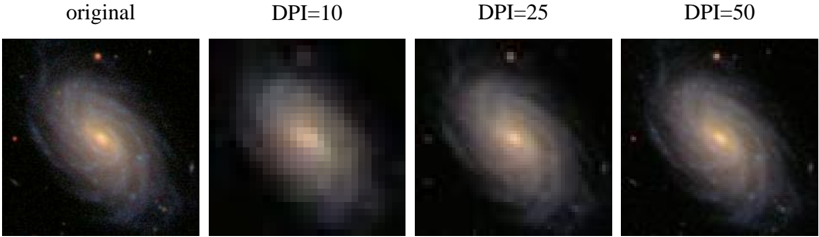
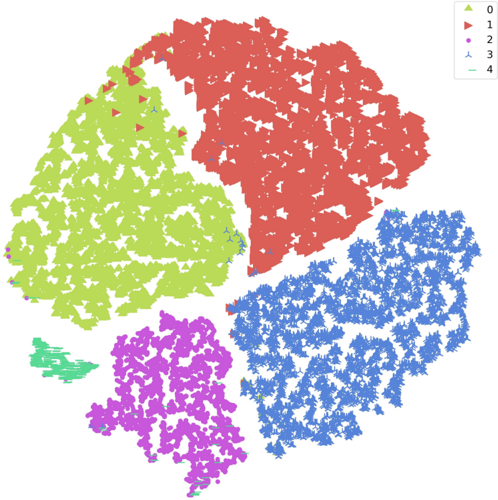
Context.The classification of galaxy morphology is among the most active fields in astronomical research today. With the development of artificial intelligence technology, deep learning is a useful tool in the classification of the morphology of galaxies and significant progress has been made in this domain. However, there is still some room for improvement in terms of classification accuracy, automation, and related issues. Aims.Convolutional vision Transformer (CvT) is an improved version of the Vision Transformer (ViT) model. It improves the performance of the ViT model by introducing a convolutional neural network (CNN). This study explores the performance of the CvT model in the area of galaxy morphology classification. Methods.In this work, the CvT model was applied, for the first time, in a five-class classification task of galaxy morphology. We added different types and degrees of noise to the original galaxy images to verify that the CvT model achieves good classification performance, even in galaxy images with low signal-to-noise ratios (S/Ns). Then, we also validated the classification performance of the CvT model for galaxy images at different redshifts based on the low-redshift dataset GZ2 and the high-redshift dataset Galaxy Zoo CANDELS. In addition, we visualized and analyzed the classification results of the CvT model based on the t-distributed stochastic neighborhood -embedding (t-SNE) algorithm. Results.We find that (1) compared with other five-class classification models of galaxy morphology based on CNN models, the average accuracy, precision, recall, and F1_score evaluation metrics of the CvT classification model are all higher than 98%, which is an improvement of at least 1% compared with those based on CNNs; (2) the classification visualization results show that different categories of galaxies are separated from each other in multi-dimensional space. Conclusions.The application of the CvT model to the classification study of galaxy morphology is a novel undertaking that carries important implications for future studies.
Overview
The claims and statistics of this paper haven’t been checked yet.
Free: it reads the open-access text and checks the first 5 claims that cite a source we can check. Create a free account to check every claim.
Integrity signals
Registry
Cites
Statistics
Figures
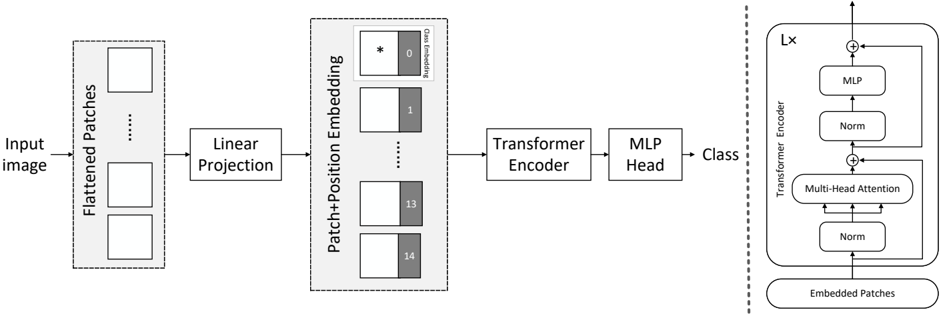
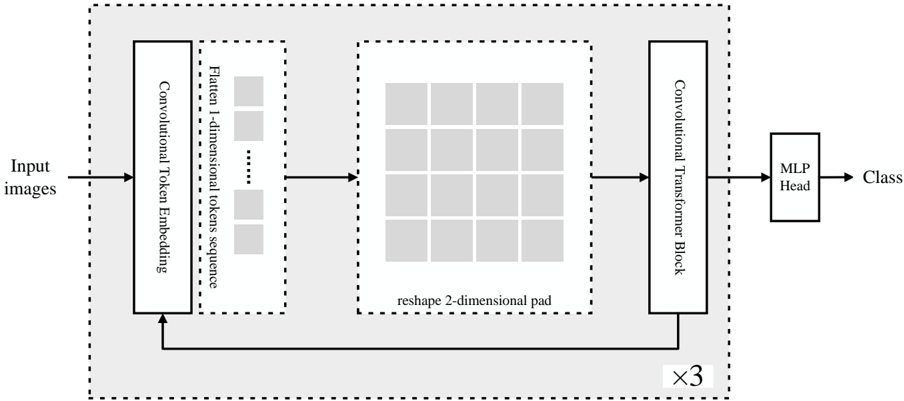
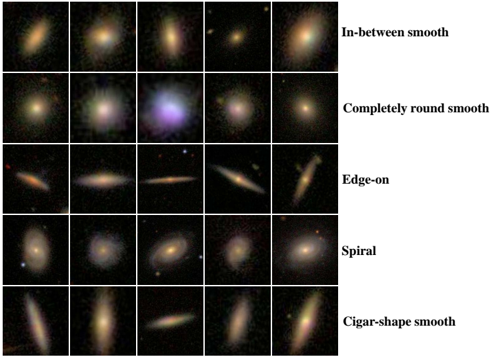
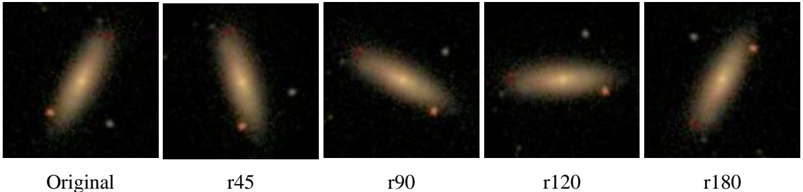
Verification
Claims the paper makes
The claims and statistics of this paper haven’t been checked yet.
Free: it reads the open-access text and checks the first 5 claims that cite a source we can check. Create a free account to check every claim.
Self-check
Percentages, sums and reported differences re-computed from the paper’s own numbers.
The self-check needs the paper’s full text.
Citations
Cites
The Sloan Digital Sky Survey: Technical Summary
York, D. G., Adelman, J., Anderson, Jr., Anderson, S. F., Annis, J., Bahcall, N. A., Bakken, J. A., Barkhouser, R., Bastian, S., Berman, E., et al. (2000) · The Astronomical Journal · doi:10.1086/301513 · Cited by 10,366
scikit-image: image processing in Python
van der Walt, S., Schönberger, J. L., Nunez-Iglesias, J., Boulogne, F., Warner, J. D., Yager, N., Gouillart, E., & Yu, T. (2014) · PeerJ · doi:10.7717/peerj.453 · Cited by 6,794
THE SEVENTH DATA RELEASE OF THE SLOAN DIGITAL SKY SURVEY
Abazajian, K. N., Adelman-McCarthy, J. K., Agüeros, M. A., Allam, S. S., Prieto, C. A., An, D., Anderson, K. S. J., Anderson, S. F., Annis, J., Bahcall, N. A., et al. (2009) · The Astrophysical Journal Supplement Series · doi:10.1088/0067-0049/182/2/543 · Cited by 5,341
HuggingFace's Transformers: State-of-the-art Natural Language Processing
Wolf, T., Debut, L., Sanh, V., Chaumond, J., Delangue, C., Moi, A., Cistac, P., Rault, T., Louf, R., Funtowicz, M., et al. (2019) · arXiv · doi:10.48550/arxiv.1910.03771 · Cited by 3,347
CvT: Introducing Convolutions to Vision Transformers
Wu, H., Xiao, B., Codella, N., Liu, M., Dai, X., Yuan, L., & Zhang, L. (2021) · 2021 IEEE/CVF International Conference on Computer Vision (ICCV) · doi:10.1109/iccv48922.2021.00009 · Cited by 2,444
The 2dF Galaxy Redshift Survey: spectra and redshifts
Colless, M., Dalton, G., Maddox, S., Sutherland, W., Norberg, P., Cole, S., Bland-Hawthorn, J., Bridges, T., Cannon, R., Collins, C., et al. (2001) · Monthly Notices of the Royal Astronomical Society · doi:10.1046/j.1365-8711.2001.04902.x · Cited by 2,367
The Large Sky Area Multi-Object Fiber Spectroscopic Telescope (LAMOST)
Cui, X.-Q., Zhao, Y.-H., Chu, Y.-Q., Li, G.-P., Li, Q., Zhang, L.-P., Su, H.-J., Yao, Z.-Q., Wang, Y.-N., Xing, X.-Z., et al. (2012) · Research in Astronomy and Astrophysics · doi:10.1088/1674-4527/12/9/003 · Cited by 1,720
Self-citationLintott, C. J., Schawinski, K., Slosar, A., Land, K., Bamford, S., Thomas, D., Raddick, M. J., Nichol, R. C., Szalay, A., Andreescu, D., et al. (2008) · Monthly Notices of the Royal Astronomical Society · doi:10.1111/j.1365-2966.2008.13689.x · Cited by 1,488
2021 IEEE/CVF International Conference on Computer Vision (ICCV)
(2021) · doi:10.1109/iccv48922.2021 · Cited by 985
Willett, K. W., Lintott, C. J., Bamford, S. P., Masters, K. L., Simmons, B. D., Casteels, K. R. V., Edmondson, E. M., Fortson, L. F., Kaviraj, S., Keel, W. C., et al. (2013) · Monthly Notices of the Royal Astronomical Society · doi:10.1093/mnras/stt1458 · Cited by 659
The James Webb Space Telescope Mission
Gardner, J. P., Mather, J. C., Abbott, R., Abell, J. S., Abernathy, M., Abney, F. E., Abraham, J. G., Abraham, R., Abul-Huda, Y. M., Acton, S., et al. (2023) · Publications of the Astronomical Society of the Pacific · doi:10.1088/1538-3873/acd1b5 · Cited by 503
Improving galaxy morphologies for SDSS with Deep Learning
Domínguez Sánchez, H., Huertas-Company, M., Bernardi, M., Tuccillo, D., & Fischer, J. L. (2018) · Monthly Notices of the Royal Astronomical Society · doi:10.1093/mnras/sty338 · Cited by 382
Vision Transformers for Classification of Breast Ultrasound Images
Gheflati, B., & Rivaz, H. (2022) · 2022 44th Annual International Conference of the IEEE Engineering in Medicine & Biology Society (EMBC) · doi:10.1109/embc48229.2022.9871809 · Cited by 225
Dimensionality reduction and visualisation of hyperspectral ink data using t-SNE
Melit Devassy, B., & George, S. (2020) · Forensic Science International · doi:10.1016/j.forsciint.2020.110194 · Cited by 166
Galaxy Zoo: probabilistic morphology through Bayesian CNNs and active learning
Walmsley, M., Smith, L., Lintott, C., Gal, Y., Bamford, S., Dickinson, H., Fortson, L., Kruk, S., Masters, K., Scarlata, C., et al. (2020) · Monthly Notices of the Royal Astronomical Society · doi:10.1093/mnras/stz2816 · Cited by 160
Galaxy morphology classification with deep convolutional neural networks
Zhu, X.-P., Dai, J.-M., Bian, C.-J., Chen, Y., Chen, S., & Hu, C. (2019) · Astrophysics and Space Science · doi:10.1007/s10509-019-3540-1 · Cited by 129
Vision Transformer for femur fracture classification
Tanzi, L., Audisio, A., Cirrincione, G., Aprato, A., & Vezzetti, E. (2022) · Injury · doi:10.1016/j.injury.2022.04.013 · Cited by 120
Cheng, T.-Y., Conselice, C. J., Aragón-Salamanca, A., Li, N., Bluck, A. F. L., Hartley, W. G., Annis, J., Brooks, D., Doel, P., García-Bellido, J., et al. (2020) · Monthly Notices of the Royal Astronomical Society · doi:10.1093/mnras/staa501 · Cited by 119
Galaxy Zoo: quantitative visual morphological classifications for 48 000 galaxies from CANDELS
Simmons, B. D., Lintott, C., Willett, K. W., Masters, K. L., Kartaltepe, J. S., Häußler, B., Kaviraj, S., Krawczyk, C., Kruk, S. J., McIntosh, D. H., et al. (2017) · Monthly Notices of the Royal Astronomical Society · doi:10.1093/mnras/stw2587 · Cited by 110
An automatic taxonomy of galaxy morphology using unsupervised machine learning
Hocking, A., Geach, J. E., Sun, Y., & Davey, N. (2018) · Monthly Notices of the Royal Astronomical Society · doi:10.1093/mnras/stx2351 · Cited by 90
COVID-VIT: Classification of COVID-19 from CT chest images based on vision transformer modelsPreprint
Gao, X. W., Yu, Q., & Gao, A. (2021) · arXiv (Cornell University) · doi:10.48550/arxiv.2107.01682 · Cited by 51
Galaxy morphology classification using neural ordinary differential equations
Gupta, R., Srijith, P. K., & Desai, S. (2022) · Astronomy and Computing · doi:10.1016/j.ascom.2021.100543 · Cited by 41
Galaxy Morphological Classification with Efficient Vision TransformerPreprint
Lin, J. Y.-Y., Liao, S.-M., Huang, H.-J., Kuo, W., & Ou, O. H.-M. (2021) · arXiv (Cornell University) · doi:10.48550/arxiv.2110.01024 · Cited by 40
Unsupervised Galaxy Morphological Visual Representation with Deep Contrastive Learning
Wei, S., Li, Y., Lu, W., Li, N., Liang, B., Dai, W., & Zhang, Z. (2022) · Publications of the Astronomical Society of the Pacific · doi:10.1088/1538-3873/aca04e · Cited by 28
PROBING ASYMMETRIC STRUCTURES IN THE OUTSKIRTS OF GALAXIES
Wen, Z. Z., Zheng, X., & An, F. X. (2014) · The Astrophysical Journal · doi:10.1088/0004-637x/787/2/130 · Cited by 27
Galaxy morphology classification using multiscale convolution capsule network
Li, G., Xu, T., Li, L., Gao, X., Liu, Z., Cao, J., Yang, M., & Zhou, W. (2023) · Monthly Notices of the Royal Astronomical Society · doi:10.1093/mnras/stad854 · Cited by 17
Self-citationGalaxy Morphology Classification with DenseNet
Hui, W., Jia, Z. R., Li, H., & Wang, Z. (2022) · Journal of Physics Conference Series · doi:10.1088/1742-6596/2402/1/012009 · Cited by 12
Classification of Galaxy Morphology Based on Multi-Channel Deep Residual Networks
He, Y., Zhang, Y., Chen, S., & Hu, Y. (2023) · IEEE Information Technology, Networking, Electronic and Automation Control Conference (ITNEC) · doi:10.1109/itnec56291.2023.10082415 · Cited by 3
Research works printed but not linked: 8
- 2. Ai, L. P., Xu, Q. F., Du, L. T., et al. 2022, Acta Astron. Sin., 63, 42
- 4. Chu, X., Tian, Z., Zhang, B., Wang, X., & Shen, C. 2023, in The Eleventh International Conference on Learning Representations
- 14. Han, K., Xiao, A., Wu, E., et al. 2021, in Advances in Neural Information Pro- cessing Systems, 34, eds. M. Ranzato, A. Beygelzimer, Y. Dauphin, P. Liang, & J. W. Vaughan (Curran Associates, Inc.), 15908
- 18. Karpoor, P. 2022, in Am. Astron. Soc. Meeting Abstracts, 54, 201.
- 21. Paszke, A., Gross, S., Massa, F., et al. 2019, Advances in Neural Information Processing Systems, eds. H. Wallach, H. Larochelle, A. Beygelzimer, et al. (Curran Associates, Inc.), 32
- 22. Pedregosa, F., Varoquaux, G., Gramfort, A., et al. 2011, J. Mach. Learn. Res., 12, 2825
- 26. Vaswani, A., Shazeer, N., Parmar, N., et al. 2017, in Advances in Neural Information Processing Systems (Curran Associates, Inc.)
- 28. Wang, W., Xie, E., Li, X., et al. 2021, in 2021 IEEE/CVF International Confer- ence on Computer Vision (ICCV), 548
Cited by
Examining vision foundation models for classification and detection in optical and radio astronomy
Lastufka, E., Bait, O., Drozdova, M., Kinakh, V., Piras, D., Audard, M., Dessauges-Zavadsky, M., Holotyak, T., Schaerer, D., & Voloshynovskiy, S. (2025) · Astronomy and Astrophysics · doi:10.1051/0004-6361/202553691 · Cited by 21
Stellar Classification with Vision Transformer and SDSS Photometric Images
Yang, Y., & Li, X. (2024) · Universe · doi:10.3390/universe10050214 · Cited by 14
Galaxy Morphological Classification with Zernike Moments and Machine Learning Approaches
Ghaderi, H., Alipour, N., & Safari, H. (2025) · The Astrophysical Journal Supplement Series · doi:10.3847/1538-4365/ada8ab · Cited by 8
Thavasimuthu, R., Vidhya, P. M., Sridhar, S., Sasirekha, S. P., & Sherubha, P. (2024) · Polymers for Advanced Technologies · doi:10.1002/pat.6506 · Cited by 7
Miao, J., Tu, L., Liu, H., & Zhao, J. N. (2025) · The Astrophysical Journal Supplement Series · doi:10.3847/1538-4365/adca34 · Cited by 7
“…fi cant progress has been made in galaxy image classi fi cation thanks to deep learning techniques ( S. Dieleman et al. 2015; G. Martin et al. 2020; J. Li et al. 2022; S. Wei et al. 2022; J. Cao et al. 2024 ) , which reduce the time and human resources required during the visual inspection process.”
Metadata
- Authors
- Cao, J., Xu, T., Deng, Y., Deng, L., Yang, M., Liu, Z., & Zhou, W.
- Affiliations
- Chinese Academy of Sciences (CN)
- Venue
- Astronomy & Astrophysics
- Publisher
- EDP Sciences
- Published
- 2024-03
- Volume
- 683
- Pages
- A42
- ISSN
- 0004-6361 (ISSN-L)
- 1432-0746
- OpenAlex
- W4391493884
- Cited by
- 32
- References
- 26
- Citations by year
- 2026: 12 · 2025: 14 · 2024: 6
- FWCI
- 6.04
- Type
- journal article
- Language
- en
- Open access
- gold
- doi.org
- Licence
- Locations
- Astronomy and Astrophysics (publishedVersion, cc-by)
- Springer Link (Chiba Institute of Technology) (submittedVersion)
- Funders
- National Nature Science Foundation of China
- Scientific Research Foundation Project of Yunnan Education Department
- Yunnan Fundamental Research Projects
- Yunnan Revitalization Talent Support Program
- Topics
- Physical Sciences › Physics and Astronomy › Astronomy and Astrophysics › Galaxies: Formation, Evolution, Phenomena
- Physical Sciences › Computer Science › Computer Vision and Pattern Recognition › Advanced Neural Network Applications
- Physical Sciences › Computer Science › Computer Vision and Pattern Recognition › Remote-Sensing Image Classification
- Keywords
- galaxy morphology classification, convolutional vision transformer, galaxy images, low signal-to-noise ratio, noise robustness, galaxy redshifts, t-SNE visualization, classification accuracy
About these checks
Registry, retraction, Cites and statistics results are computed, not judged, with one exception: a printed reference that no index lists is read once by a model before it counts as a citation error. Claims are extracted by a model and kept only when their quote appears verbatim in the text; each cited source is then checked, with a model’s help, for whether it says what the claim relies on. Those verdicts can be wrong — read the claim’s quote and the cited source before relying on one.
Statistics and arithmetic are recomputed, not judged.
Confidence bands are shown only for fields calibrated on our annotated test set. None is calibrated yet, so no band is shown.
What counts as a claim ›How we measure confidence ›How we check this ›
Are you an author, or do you see a problem with this page? Request a review
Data sources
Bibliographic data: Semantic Scholar, OpenAlex, Crossref.
Contains information from the Semantic Scholar Academic Graph Datasets, made available under the ODC Attribution License (ODC-BY 1.0).
Semantic Scholar’s data is described in: Kinney, R., et al. (2023). The Semantic Scholar Open Data Platform. arXiv:2301.10140.
