

Situating the default-mode network along a principal gradient of macroscale cortical organization
Open accessThe DOI matches its Crossref record; 100 of the 100 references it cites were found in a registry or an index; 26 of the 58 sources its claims cite were checked for support.
Abstract
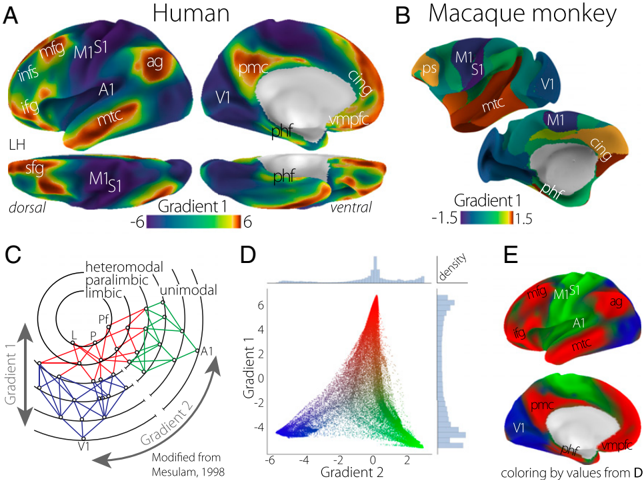
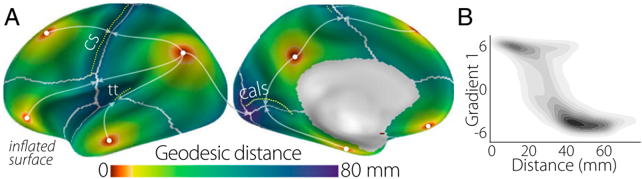
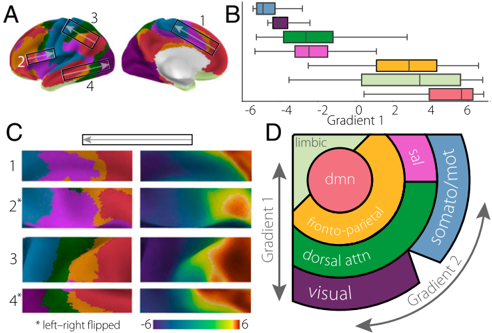
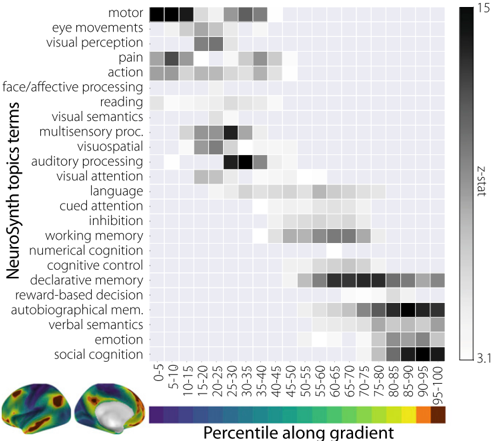
Understanding how the structure of cognition arises from the topographical organization of the cortex is a primary goal in neuroscience. Previous work has described local functional gradients extending from perceptual and motor regions to cortical areas representing more abstract functions, but an overarching framework for the association between structure and function is still lacking. Here, we show that the principal gradient revealed by the decomposition of connectivity data in humans and the macaque monkey is anchored by, at one end, regions serving primary sensory/motor functions and at the other end, transmodal regions that, in humans, are known as the default-mode network (DMN). These DMN regions exhibit the greatest geodesic distance along the cortical surface-and are precisely equidistant-from primary sensory/motor morphological landmarks. The principal gradient also provides an organizing spatial framework for multiple large-scale networks and characterizes a spectrum from unimodal to heteromodal activity in a functional metaanalysis. Together, these observations provide a characterization of the topographical organization of cortex and indicate that the role of the DMN in cognition might arise from its position at one extreme of a hierarchy, allowing it to process transmodal information that is unrelated to immediate sensory input.
Overview
CoChat Summary
TL;DR
The paper identifies a principal connectivity gradient in human and macaque cortex that runs from primary/unimodal sensory-motor regions to transmodal default-mode network (DMN) regions. It argues that the DMN’s position at one extreme, maximally distant from primary areas, helps explain its role in abstract, stimulus-independent cognition.
Key findings
- A principal gradient of functional connectivity, derived from 91,282 cortical/subcortical grayordinates at 2 mm resolution in 820 healthy adults (1 hour resting-state fMRI per participant, HCP S900), is anchored by primary/unimodal visual, somatosensory/motor, and auditory regions at one end and DMN regions at the other.
- Seven peak DMN nodes are maximally distant along the cortical surface from primary sensory/motor landmarks; four are equidistant from the central sulcus, and geodesic distance from DMN peaks relates to the principal gradient with \(R^2 = 0.55\). Beyond 40 mm from DMN peaks, cortex exclusively consists of unimodal regions.
- The principal gradient orders the 7-network Yeo parcellation, with DMN at one extreme and visual/motor networks at the other; the limbic network is an exception, spanning a wide range of values.
- A NeuroSynth meta-analysis using 24 topic terms shows a functional shift along the gradient: motor, visual perception, multisensory, and auditory terms at the unimodal end; cued attention, inhibition, and working memory in the middle; and social cognition, verbal semantics, and autobiographical memory at the DMN end.
Methods
- Human data were from the Human Connectome Project dense connectome S900 release: 91,282 grayordinates at 2 mm resolution, based on 1 hour of resting-state fMRI from 820 healthy adults, with no further processing beyond HCP minimal preprocessing including 2 mm FWHM smoothing.
- The main analysis used diffusion embedding, a nonlinear dimensionality reduction method, to extract connectivity gradients (“connectopies”) rather than discrete network parcellations; the same embedding was applied to a publicly available macaque tract-tracing database.
- Additional analyses calculated minimum geodesic distance from 7 DMN peak nodes, related gradient values to the 7-network Yeo parcellation, and performed a NeuroSynth meta-analysis with 24 topic terms across 5-percentile bins of the principal gradient.
Limitations
- Stated: the limbic network captures an extensive range of gradient values, which the authors suggest may be due to low signal-to-noise in the original parcellation data and may not accurately reflect its constituent regions’ connectivity.
- Stated: future studies are needed to better characterize transitions between large-scale connectivity patterns and to identify where processing occurs stepwise versus gradientially.
- Evident from the text: the macaque cross-species correspondence is described as “initial evidence” that the axis may be phylogenetically conserved, and the analyses are descriptive/spatial rather than causal tests of the proposed hierarchy.
Model-written summary. Check it against the paper before relying on it.
Integrity signals
Registry
Cites
Statistics
Figures

Verification
Claims the paper makes
14 Valid · 2 Not valid · 11 Not checked · 50 Own results and interpretations
The cited sources support only part of this claim — read each source’s verdict below.
In the paper
“Second, the location of the DMN as equidistant from all sensory/motor systems is aligned with its broad range of functions that require integration between multiple sensory systems, including episodic [51] and semantic memory [52-54], social cognition [55, 56], goal-directed working memory tasks [26, 32, 33, 35] and reward-guided decision making [57, 58].”
What the sources say
- Supportedcites [51] Schacter DL, Addis DR (2007) The cognitive neuroscience of constructive memory: remembering the past and imagining the future. Philos Trans R Soc Lond B Biol Sci 362(1481):773786. 661 662 663 source
Split into 2 atoms — 2 confirmed, 0 partially supported, 0 disputed, 0 misattributed, 0 unverifiable. Expand the claim to see per-atom verdicts.
- Supportedcites [52] Binder JR, Desai RH, Graves WW, Conant LL (2009) Where is the semantic system? a critical review and meta-analysis of 120 functional neuroimaging studies. Cereb Cortex 19(12):27672796. 664 665 source
The citation to this paper is attached to the semantic-memory part of the sentence, not the other listed functions. “Semantic Processing and the ‘Default Network’” says the semantic system closely resembles the default network, while “The Semantic System of the Human Brain” describes its regions as receiving multimodal input and supporting integrative processes. Page numbers are unavailable in our copy. (LLM, conf=0.91)
- Not checked — no full text of the sourcecites [53] Jefferies E (2013) The neural basis of semantic cognition: converging evidence from neuropsychology, neuroimaging and TMS. Cortex 49(3):611-625. 666 source
- Partly supportedcites [54] Constantinescu AO, O'Reilly JX, Behrens TEJ (2016) Organizing conceptual knowledge in humans with a gridlike code. Science 352(6292):1464-8. sourceExperimental — accuracy not yet measured
Split into 2 atoms — 1 confirmed, 1 partially supported, 0 disputed, 0 misattributed, 0 unverifiable. Expand the claim to see per-atom verdicts.
- Not checked — no full text of the sourcecites [55] Amodio DM, Frith CD (2006) Meeting of minds: the medial frontal cortex and social cognition. Nat Rev Neurosci 7(4):268-277. source
- Supportedcites [56] Amft M et al. (2015) Definition and characterization of an extended social-affective default network. Brain Struct Funct 220(2):1031-49. source
Split into 2 atoms — 2 confirmed, 0 partially supported, 0 disputed, 0 misattributed, 0 unverifiable. Expand the claim to see per-atom verdicts.
plainstates an association- Asserted: passes — The authors put it forward as true.
- Checkable: passes — It can be checked against evidence.
- Load-bearing: passes — The paper’s conclusions depend on it.
- Based: passes — The paper gives a reason why it holds.
- Supported
The cited sources support only part of this claim — read each source’s verdict below.
In the paper
“The DMN is at a maximal distance from systems involved in perception and action in both functional connectivity and anatomical space, indicating that the neural activity in these regions is likely to be comparably insulated from direct environmental input [49, 50].”
What the sources say
- Partly supportedcites [49] Kiebel SJ, Daunizeau J, Friston KJ (2008) A hierarchy of time-scales and the brain. PLoS Comput Biol 4(11):e1000209. 659 660 sourceExperimental — accuracy not yet measured
The Introduction and Discussion > Neuroscience Account describe higher cortical levels as farther from sensory input and as representing slower-changing context. But the paper does not identify the DMN as such a level or establish that activity in DMN regions is insulated from direct environmental input; its Conclusion says representations at different levels interact. (LLM, conf=0.78)
- Partly supportedcites [50] Friston K (2013) Life as we know it. J R Soc Interface 10(86):20130475. sourceExperimental — accuracy not yet measured
The Heuristic proof (page unavailable) says a Markov blanket insulates internal states from direct access to external states, and the Proof of principle > The Markov blanket section reports no direct connections between those states in a simulation. The paper does not identify DMN regions as those internal states or establish that DMN activity is insulated from environmental input. (LLM, conf=0.84)
hedged- Asserted: passes — The authors put it forward as true.
- Checkable: passes — It can be checked against evidence.
- Load-bearing: passes — The paper’s conclusions depend on it.
- Based: passes — The paper gives a reason why it holds.
- Partly supported
Every source the paper cites for this claim was checked and supports it.
In the paper
“The principal gradient illustrates a broader topographic organization of large-scale connectivity [38] that accounts for the spatial arrangement of local processing streams throughout the cerebral cortex.”
What the sources say
- Supportedcites [38] Jbabdi S, Sotiropoulos SN, Behrens TE (2013) The topographic connectome. Curr Opin Neurobiol 23(2):207-15. 643 644 source
The Introduction (page unavailable) describes topographic, spatial patterns in large-scale connections between grey-matter regions. The citation is attached to that broader organization of connectivity; the sentence’s interpretation of the principal gradient is the citing authors’ framing. (LLM, conf=0.87)
plainstates a cause- Asserted: passes — The authors put it forward as true.
- Checkable: passes — It can be checked against evidence.
- Load-bearing: passes — The paper’s conclusions depend on it.
- Based: passes — The paper gives a reason why it holds.
- Supported
The sources with a verdict support this claim; the rest weren’t checked yet, have no full text we could read, or their verdicts aren’t rated yet.
In the paper
“Notably, our results are consistent with a recent modification of the rostral-caudal processing gradient described within lateral frontal cortex [59, 60].”
What the sources say
- Supportedcites [59] Goulas A, Uylings HBM, Stiers P (2014) Mapping the hierarchical layout of the structural network of the macaque prefrontal cortex. Cereb Cortex 24(5):1178-94. 684 source
In the ABH Optimization section (page unavailable), the paper reports that the strict anterior–posterior gradient was not observed even when the analysis was limited to lateral prefrontal regions. In the Relation Between Asymmetry-Based Hierarchy and Laminar-Based Hierarchy section (page unavailable), it proposes a laminar-based hierarchy as a more plausible basis for models of that gradient. This supports the citation's identification of a modification; the citing authors' statement that their own results are consistent with it is their interpretation. (LLM, conf=0.86)
- Not checked — no full text of the sourcecites [60] Nee DE, D'Esposito M (2016) The hierarchical organization of the lateral prefrontal cortex. eLife 5. source
plainstates an association- Asserted: passes — The authors put it forward as true.
- Checkable: passes — It can be checked against evidence.
- Load-bearing: unclear — It is unclear whether the paper’s conclusions depend on it.
- Based: passes — The paper gives a reason why it holds.
- Supported
A result the paper reports from its own data — it cites no other source for it, so there is none to check. The quote shows it is in the paper.
In the paper
“Here we show that the principal gradient revealed by the decomposition of connectivity data in humans and the macaque monkey is anchored, at one end, by regions serving primary sensory/motor functions and, at the other, by transmodal regions that, in humans, are known as the default-mode network (DMN).”
- Also stated in: § Situating the default-mode network in a principal gradient of macroscale cortical organization · p. 2 · plain
“We describe an overarching organization of large-scale connectivity that situates the default-mode network at the opposite end of a spectrum from primary sensory and motor regions.”
- Also stated in: § Results · p. 3 · plain
“The principal gradient (Figure 1A), which accounts for the greatest variance in connectivity in the human brain (see Figure S1), is anchored at one end by the primary and unimodal visual, somatosensory/motor, and auditory regions. At the other end are regions including the angular gyrus, rostral anterior cingulate, posteromedial cortex, middle temporal gyrus, and middle and superior frontal gyri -”
boostedstates an association- Asserted: passes — The authors put it forward as true.
- Checkable: passes — It can be checked against evidence.
- Load-bearing: passes — The paper’s conclusions depend on it.
- Based: passes — The paper gives a reason why it holds.
- Also stated in: § Situating the default-mode network in a principal gradient of macroscale cortical organization · p. 2 · plain
33 more claims
Create a free account to see all 77 claims and every source verdict.
- The quote only partly states this claim. 1
- It may state two separate claims as one. 24
- Probably not a substantial claim. 21
Claims other papers make about this one
Each is checked against this paper’s own text: does it say what the citing paper says it does?
The cited source says what the claim attributes to it.
In the citing paper
“Because the DMN integrates information from multiple pathways (Binder and Desai 2011; Margulies et al. 2016), we propose that, as stimulus information travels up the cortical hierarchy of timescales during encoding, from low-level sensory areas up to high-level areas, a form of compression takes place (Hasson et al. 2015).”
From How We Transmit Memories to Other Brains: Constructing Shared Neural Representations Via Communication (2017) · cites this paper as Margulies et al. 2016
Citations
Cites
A Global Geometric Framework for Nonlinear Dimensionality Reduction
Tenenbaum, J. B., Silva, V. D., & Langford, J. C. (2000) · Science · doi:10.1126/science.290.5500.2319 · Cited by 13,585
Jenkinson, M., Bannister, P., Brady, M., & Smith, S. (2002) · NeuroImage · doi:10.1006/nimg.2002.1132 · Cited by 11,888
Jenkinson, M., Beckmann, C. F., Behrens, T. E. J., Woolrich, M. W., & Smith, S. M. (2012) · NeuroImage · doi:10.1016/j.neuroimage.2011.09.015 · Cited by 11,314
A tutorial on spectral clustering
von Luxburg, U. (2007) · Statistics and Computing · doi:10.1007/s11222-007-9033-z · Cited by 10,349
Fischl, B. (2012) · NeuroImage · doi:10.1016/j.neuroimage.2012.01.021 · Cited by 9,526
The organization of the human cerebral cortex estimated by intrinsic functional connectivity
Thomas Yeo, B. T., Krienen, F. M., Sepulcre, J., Sabuncu, M. R., Lashkari, D., Hollinshead, M., Roffman, J. L., Smoller, J. W., Zöllei, L., Polimeni, J. R., et al. (2011) · Journal of Neurophysiology · doi:10.1152/jn.00338.2011 · Cited by 9,182
The organization of the human cerebellum estimated by intrinsic functional connectivity
Buckner, R. L., Krienen, F. M., Castellanos, A., Diaz, J. C., & Yeo, B. T. T. (2011) · Journal of Neurophysiology · doi:10.1152/jn.00339.2011 · Cited by 7,304
Separate visual pathways for perception and action
Goodale, M. A., & Milner, A. D. (1992) · Trends in Neurosciences · doi:10.1016/0166-2236(92)90344-8 · Cited by 6,519
Functional connectivity in the resting brain: a network analysis of the default mode hypothesis
Greicius, M. D., Krasnow, B., Reiss, A. L., & Menon, V. (2003) · Proceedings of the National Academy of Sciences · doi:10.1073/pnas.0135058100 · Cited by 6,358
The WU-Minn Human Connectome Project: An overview
Van Essen, D. C., Smith, S. M., Barch, D. M., Behrens, T. E. J., Yacoub, E., & Ugurbil, K. (2013) · NeuroImage · doi:10.1016/j.neuroimage.2013.05.041 · Cited by 5,651
Research works printed but not linked: 2
- Von Bonin G, Bailey P (1947)
- Langs G, Golland P , Tie Y, Rigolo L, Golby AJ (2010) Functional geometry alignment and localization of brain areas. Adv. Neural Inf. Process. Syst. 1:1225-1233.
Cited by
Items 1,001–1,100 of 2,372
Bortolin, K., Delavari, F., Preti, M. G., Sandini, C., Mancini, V., Mullier, E., Ville, D. V. D., & Eliez, S. (2022) · NeuroImage Clinical · doi:10.1016/j.nicl.2022.103075 · Cited by 14
“…multiple studies have already reported a comparable gradient that spans from strongly aligned ‘unimodal ’ sensory cortices to weakly aligned ‘trans-modal ’ cortices using different measures (Margulies et al., 2016; V ´ azquez-Rodríguez et al., 2019; Baum et al., 2020; Paquola et al., 2019).”
The gradient model of brain organization in decisions involving “empathy for pain”
Labek, K., Sittenberger, E., Kienhöfer, V., Rabl, L., Messina, I., Schurz, M., Stingl, J., & Viviani, R. (2022) · Cerebral Cortex · doi:10.1093/cercor/bhac464 · Cited by 9
31st Annual Computational Neuroscience Meeting: CNS*2022
Corsi, M., Sorrentino, P., Schwartz, D., George, N., Hugueville, L., Kahn, A. E., Dupont, S., Bassett, D. S., Jirsa, V., & Fallani, F. D. V. (2023) · Journal of Computational Neuroscience · doi:10.1007/s10827-022-00841-9 · Cited by 13
Gradients of striatal function in antipsychotic-free first-episode psychosis and schizotypy
Oldehinkel, M., Tiego, J., Sabaroedin, K., Chopra, S., Francey, S. M., O'Donoghue, B. N., Cropley, V., Nelson, B., Graham, J. R., Baldwin, L., et al. (2023) · Translational Psychiatry · doi:10.1038/s41398-023-02417-2 · Cited by 10
The Relationship Between Personality Traits and Well-Being via Brain Functional Connectivity
Li, L., Li, L. M. W., Ma, J., Lu, A., & Dai, Z. (2023) · Journal of Happiness Studies · doi:10.1007/s10902-023-00674-y · Cited by 14
“…transmit and integrate internal and external signals received by primary sensory networks to the high-order cognitive network that includes DMN, and ultimately aids individuals in generating adaptive responses (Huntenburg et al., 2018; Margulies et al., 2016; Smallwood et al., 2021).”
BackgroundLin, S., Zhang, C., Zhang, Y., Chen, S., Lin, X., Peng, B., Xu, Z., Hou, G., & Qiu, Y. (2023) · Journal of Affective Disorders · doi:10.1016/j.jad.2023.08.139 · Cited by 10
Zheng, C., Zhao, W. D., Yang, Z., Guo, S., & Initiative, A. D. N. (2023) · Journal of Neuroscience Research · doi:10.1002/jnr.25280 · Cited by 10
“This gra - dient-based approach rendered relative variance in functional brain networks alongside a continual spectrum (Huntenburg et al., 2018; Margulies et al., 2016).”
InfluentialWang, Y., Wang, Y., Wang, H., Ma, L., Eickhoff, S. B., Madsen, K. H., Chu, C., & Fan, L. (2024) · Cell Reports · doi:10.1016/j.celrep.2024.113770 · Cited by 10
Self-citationSpatial-Temporal Analysis of Neural Desynchronization in Sleeplike States Reveals Critical Dynamics
Curic, D., Singh, S., Nazari, M., Mohajerani, M. H., & Davidsen, J. (2024) · Physical Review Letters · doi:10.1103/physrevlett.132.218403 · Cited by 12
A Biased Perspective on Brain Imaging of ADHD
Castellanos, F. X. (2021) · American Journal of Psychiatry · doi:10.1176/appi.ajp.2021.21060609 · Cited by 11
Self-citationSpontaneous perception: a framework for task-free, self-paced perception
Baror, S., & He, B. J. (2021) · Neuroscience of Consciousness · doi:10.1093/nc/niab016 · Cited by 11
Traveling and standing waves in the brain
González-Castillo, J. (2022) · Nature Neuroscience · doi:10.1038/s41593-022-01119-0 · Cited by 11
The Perspective from Cognitive Neuroscience
Kemmerer, D. L. (2019) · Oxford University Press eBooks · doi:10.1093/oso/9780190682620.003.0002 · Cited by 9
Horikawa, T., Cowen, A., Keltner, D. J., & Kamitani, Y. (2019) · bioRxiv (Cold Spring Harbor Laboratory) · doi:10.1101/872192 · Cited by 10
Murphy, C., Ranganath, C., & Gruber, M. J. (2021) · bioRxiv (Cold Spring Harbor Laboratory) · doi:10.1101/2021.07.26.453739 · Cited by 7
Wang, Y., Royer, J., Park, B., de Wael, R. V., Larivière, S., Tavakol, S., Rodríguez‐Cruces, R., Paquola, C., Hong, S., Margulies, D. S., et al. (2021) · bioRxiv (Cold Spring Harbor Laboratory) · doi:10.1101/2021.10.25.465692 · Cited by 10
Self-citationLuppi, A. I., Singleton, S. P., Hansen, J. Y., Bzdok, D., Kuceyeski, A. F., Betzel, R. F., & Mišić, B. (2023) · bioRxiv (Cold Spring Harbor Laboratory) · doi:10.1101/2023.03.16.532981 · Cited by 10
“Additionally, we also computed the correlation between each NeuroSynth map, and the principal gradient of variation in functional connectivity [85], believed to reflect the hierarchical organisation of cortical information-processing.”
BackgroundMethodLuppi, A. I., Uhrig, L., Tasserie, J., Signorelli, C. M., Stamatakis, E. A., Alain Destexhe, A., Jarraya, B., & Cofré, R. (2023) · bioRxiv (Cold Spring Harbor Laboratory) · doi:10.1101/2023.06.30.547281 · Cited by 10
A Human Brain Map of Mitochondrial Respiratory Capacity and DiversityPreprint
Mosharov, E. V., Rosenberg, A. M., Monzel, A. S., Osto, C. A., Stiles, L., Rosoklija, G. B., Dwork, A. J., Bindra, S., Zhang, Y., Fujita, M., et al. (2024) · bioRxiv (Cold Spring Harbor Laboratory) · doi:10.1101/2024.03.05.583623 · Cited by 15
Plasticity and language in the anaesthetized human hippocampus
Katlowitz, K. A., Cole, E. R., Mickiewicz, E. A., Shah, S., Franch, M. C., Adkinson, J. A., Belanger, J. L., Mathura, R. K., Meszéna, D., McGinley, M. J., et al. (2026) · Nature · doi:10.1038/s41586-026-10448-0 · Cited by 34
“A good deal of past research has emphasized the central positioning of the hippocampus within the anatomical hierarchy of brain areas; indeed, it may be among the regions most distant from both input and output ends of brain processing 45 .”
A neural circuit for spatial orientation derived from brain lesions
Roseman-Shalem, M., Elias, U., Kletenik, I., Ferguson, M. A., Fox, M., Horowitz, Z., Marshall, G. A., Spiers, H. J., & Arzy, S. (2023) · Cerebral Cortex · doi:10.1093/cercor/bhad486 · Cited by 12
Navigating Pubertal Goldilocks: The Optimal Pace for Hierarchical Brain Organization
Szakács, H., Mutlu, M. C., Balestrieri, G., Gombos, F., Braun, J., Kringelbach, M. L., Deco, G., & Kovács, I. (2024) · Advanced Science · doi:10.1002/advs.202308364 · Cited by 9
“The evolutionarily expanded heteromodal association cortices, mentioned in the introduction, hosting a range of higher order functions 11,65,67,68,80 may have a potential to compensate when confronted with divergent maturational paces.”
BackgroundXie, Y., Li, C., Guan, M., Zhang, T., Ma, C., Wang, Z., Ma, Z., Wang, H., & Fang, P. (2024) · Heliyon · doi:10.1016/j.heliyon.2024.e30194 · Cited by 9
Noh, E., Namgung, J. Y., Park, Y., Jang, Y., Lee, M. J., & Park, B. (2024) · The Journal of Headache and Pain · doi:10.1186/s10194-024-01806-2 · Cited by 9
“…method lies in dimensionality reduction, which reduces high-dimensional connectome data to multiple low-dimensional eigenvectors (i.e., gradients) [8, 10], allowing for an effective explanation of the entire dataset using a small set of gradients, while retaining sufficient information [11–13].”
BackgroundMethodMa, X., Li, J., Yang, Y., Qiu, X., Sheng, J., Han, N., Wu, C., Xu, G., Jiang, G., Tian, J., et al. (2024) · NeuroImage · doi:10.1016/j.neuroimage.2024.120762 · Cited by 10
“Further analysis revealed that the CCA mode related to ICN-level CBF similarities was significantly correlated with CBF similarities within the SMN ( r = 0.906, P 0.001), between the SMN and VAN ( r = 0.655, P 0.001), between the SMN and FPN ( r = 0.720, P 0.001) and between the SMN and DMN ( r = 0.830, P 0.001) (Fig.”
BackgroundInfluentialPrognostic model for predicting Alzheimer’s disease conversion using functional connectome manifolds
Kim, S., Kim, M., Lee, J., Park, B., & Park, H. (2024) · Alzheimer s Research & Therapy · doi:10.1186/s13195-024-01589-3 · Cited by 12
“This approach offers a robust and biologically interpretable perspective of the cortical axes, emphasizing the core components and facilitating analysis with essential information [27].”
BackgroundMethodProcessing of social closeness in the human brain
Roseman-Shalem, M., Dunbar, R., & Arzy, S. (2024) · Communications Biology · doi:10.1038/s42003-024-06934-8 · Cited by 18
“Asimilargradientwasdiscoveredinan analysisofglobalconnectivitybasedonalargedatasetofbrainactivityat rest 95,96 .”
Tuominen, L. J., Armio, R.-L., Hansen, J. Y., Walta, M., Koutsouleris, N., Laurikainen, H., Salokangas, R. K. R., Mišić, B., & Hietala, J. A. (2025) · Translational Psychiatry · doi:10.1038/s41398-025-03336-0 · Cited by 13
Demir, U., Yang, W. F. Z., & Sacchet, M. D. (2025) · Cerebral Cortex · doi:10.1093/cercor/bhaf079 · Cited by 19
“The proximity of gradient values reflects greater similarity in connectivity patterns, whereas greater distance indicates increased functional differentiation of connectivity patterns between networks (Margulies et al. 2016; Bernhardt et al. 2022).”
InfluentialPourmajidian, M., Hansen, J. Y., Shafiei, G., Mišić, B., & Dagher, A. (2026) · PLoS Biology · doi:10.1371/journal.pbio.3003619 · Cited by 16
“To investigate how the energy maps align with the broader cortical hierarchy and functional organization, we further estimated their enrichment across the Mesulam sensory-fugal hierarchy [56] and the first two principal gradients of resting state functional connectivity (FC) [54].”
InfluentialToward a Theory of Infra-Low Frequency Neurofeedback
Othmer, S., & Othmer, S. (2020) · Routledge eBooks · doi:10.4324/9780429275760-3 · Cited by 10
Descriptive multiscale modeling in data-driven neuroscience
Haueis, P. (2022) · Synthese · doi:10.1007/s11229-022-03551-y · Cited by 11
“( Margulies et al. 2016).”
BackgroundMethodInfluentialEvaluate the efficacy and reliability of functional gradients in within‐subject designs
Zhang, X., & Zang, Z. (2023) · Human Brain Mapping · doi:10.1002/hbm.26213 · Cited by 9
“These gradients depict a functional hierarchy of cortical organization with primary motor/sensory regions at one end and transmodal regions such as default mode network (DMN) at the other end (Margulies et al., 2016).”
BackgroundMethodResultInfluentialGim, S., Hong, S., Losin, E. A. R., & Woo, C. (2024) · PLoS Biology · doi:10.1371/journal.pbio.3002910 · Cited by 11
“This averaged connectivity matrix was then submitted to the BrainSpace toolbox [46] with the same parameters as the original study [33] (i.e., dimension reduction technique: diffusion embedding, kernel: normalized angle, sparsity: 0.9; see S13 Fig ).”
InfluentialAssessing quantitative MRI techniques using multimodal comparisons
Carter, F., Anwander, A., Johnson, M., Goucha, T., Adamson, H., Friederici, A. D., Lutti, A., Gauthier, C. J., Weiskopf, N., Bazin, P., et al. (2025) · PLoS ONE · doi:10.1371/journal.pone.0327828 · Cited by 10
Bassett, D. S., & Stiso, J. (2018) · Comptes Rendus Physique · doi:10.1016/j.crhy.2018.09.006 · Cited by 10
The neural substrate of self- and other-concerned wellbeing: An fMRI study
Jo, H., Ou, Y., & Kung, C. (2019) · PLoS ONE · doi:10.1371/journal.pone.0203974 · Cited by 9
Neuroanthropological Perspectives on Culture, Mind, and Brain
Lende, D. H., & Downey, G. (2020) · Cambridge University Press eBooks · doi:10.1017/9781108695374.014 · Cited by 10
Resting-State Functional Connectivity and Psychopathology in Klinefelter Syndrome (47, XXY)
Whitman, E. T., Liu, S., Torres, E. N., Warling, A., Wilson, K. E., Nadig, A., McDermott, C. L., CLASEN, L. S., Blumenthal, J. D., Lalonde, F. M., et al. (2021) · Cerebral Cortex · doi:10.1093/cercor/bhab077 · Cited by 12
Du, J., & Buckner, R. L. (2021) · Current Opinion in Behavioral Sciences · doi:10.1016/j.cobeha.2021.04.010 · Cited by 11
“The work by Margulies and colleagues [7 ,10] and our own work within individuals [8] provides evidence that the networks form a macroscale gradient.”
Lumaca, M., Vuust, P., & Baggio, G. (2021) · Cerebral Cortex · doi:10.1093/cercor/bhab307 · Cited by 9
Zhang, M., McNab, F., Smallwood, J., & Jefferies, E. (2022) · Cerebral Cortex · doi:10.1093/cercor/bhab459 · Cited by 8
“representations (Spreng et al. 2009; Andrews-Hanna et al. 2010; Margulies et al. 2016), and 2) FPN, which plays a central role in cognitive control (Cole et al.”
BackgroundMethodSelf-citationCytoarchitectonic Maps of the Human Metathalamus in 3D Space
Kiwitz, K., Brandstetter, A., Schiffer, C., Bludau, S., Mohlberg, H., Omidyeganeh, M., Massicotte, P., & Amunts, K. (2022) · Frontiers in Neuroanatomy · doi:10.3389/fnana.2022.837485 · Cited by 9
Functional Parcellation of Human Brain Using Localized Topo-Connectivity Mapping
Zhao, Y., Gao, Y., Li, M., Anderson, A. W., Ding, Z., & Gore, J. C. (2022) · IEEE Transactions on Medical Imaging · doi:10.1109/tmi.2022.3168888 · Cited by 9
“, the connectivity gradient) [11], [12], [16] and structure guided spatial smoothing (e.”
BackgroundMethodActivity flow mapping over probabilistic functional connectivity
Zhu, H., Huang, Z., Yang, Y., Su, K., Fan, M., Zou, Y., Li, T., & Yin, D. (2022) · Human Brain Mapping · doi:10.1002/hbm.26044 · Cited by 8
“Convergent evidence implies that unbalanced local and distributed processing across functional systems is associated with the brain hierarchy or gradient organization (Huntenburg et al., 2018; Margulies et al., 2016).”
BackgroundNetwork Controllability in Transmodal Cortex Predicts Psychosis Spectrum Symptoms
Parkes, L., Moore, T. M., Calkins, M. E., Cieslak, M., Roalf, D. R., Wolf, D. H., Gur, R. C., Gur, R. E., Satterthwaite, T. D., & Bassett, D. S. (2021) · Biological Psychiatry · doi:10.1016/j.biopsych.2021.02.922 · Cited by 8
Spatiotemporal functional interactivity among large-scale brain networks
Xu, N., Doerschuk, P. C., Keilholz, S. D., & Spreng, R. N. (2020) · NeuroImage · doi:10.1016/j.neuroimage.2020.117628 · Cited by 11
Standardizing Human Brain ParcellationsPreprint
Lawrence, R. M., Bridgeford, E., Myers, P. E., et al. (2019) · bioRxiv (Cold Spring Harbor Laboratory) · doi:10.1101/845065 · Cited by 9
A cortical wiring space links cellular architecture, functional dynamics and hierarchies in humansPreprint
Paquola, C., Seidlitz, J., Benkarim, O., Royer, J., Klimes, P., Bethlehem, R. A. I., Larivière, S., de Wael, R. V., Hall, J. A., Frauscher, B., et al. (2020) · bioRxiv (Cold Spring Harbor Laboratory) · doi:10.1101/2020.01.08.899583 · Cited by 12
Self-citationPark, B.-Y., Bethlehem, R. A. I., Paquola, C., Larivière, S., Cruces, R. R., de Wael, R. V., Bullmore, E. T., & Bernhardt, B. C. (2020) · bioRxiv (Cold Spring Harbor Laboratory) · doi:10.1101/2020.06.22.165621 · Cited by 12
“Similar approaches have previously been harnessed to decompose microstructural (Paquola et al., 2019b, 2019a) and functional MRI (Bethlehem et al., 2020; Hong et al., 2019; Margulies et al., 2016; Murphy et al., 2019; Vos de Wael et al., 2020).”
BackgroundMethodInfluentialSymmetry breaking organizes the brain's resting state manifoldPreprint
Fousek, J., Rabuffo, G., Gudibanda, K., et al. (2022) · bioRxiv (Cold Spring Harbor Laboratory) · doi:10.1101/2022.01.03.474841 · Cited by 9
Large-scale cortical networks are organised in structured cyclesPreprint
van Es, M. W. J., Higgins, C., Gohil, C., Quinn, A. J., Vidaurre, D., & Woolrich, M. W. (2023) · bioRxiv (Cold Spring Harbor Laboratory) · doi:10.1101/2023.07.25.550338 · Cited by 9
Release the Krakencoder: A unified brain connectome translation and fusion toolPreprint
Jamison, K. W., Gu, Z., Wang, Q., Tozlu, C., Sabuncu, M. R., & Kuceyeski, A. F. (2024) · bioRxiv (Cold Spring Harbor Laboratory) · doi:10.1101/2024.04.12.589274 · Cited by 8
“S5a , we further quantify this relationship by correlating regional prediction accuracy with an estimate of the cortical hierarchy gradient derived from functional connectivity 43 , and find a significant positive correlation (Spearman r =0.249, p spin =0.019, 10000 rotations 44 ).”
InfluentialBrain Charts for the Rhesus Macaque LifespanPreprint
Alldritt, S., Ramirez, J. S. B., de Wael, R. V., Bethlehem, R. A. I., Seidlitz, J., Wang, Z., Nenning, K., Esper, N. B., Smallwood, J., Franco, A. R., et al. (2024) · bioRxiv (Cold Spring Harbor Laboratory) · doi:10.1101/2024.08.28.610193 · Cited by 21
“Sorting the decoded topics (i.e. the rows in Fig 4c) based on the age at which their associated cognitive function peaks in humans reveals a hierarchical sensory-association axis, a pattern that has been observed previously 34 .”
BackgroundMethodSelf-citationThe Role of Extra-motor Networks in Upper Limb Motor Performance Post-stroke
Mattos, D. J. D. S., Rutlin, J. R., Hong, X., Zinn, K., Shimony, J. S., & Carter, A. R. (2023) · Neuroscience · doi:10.1016/j.neuroscience.2023.01.033 · Cited by 8
Wojciechowski, J., Jurewicz, K., Dzianok, P., Antonova, I., Paluch, K., Wolak, T. P., & Kublik, E. (2024) · Human Brain Mapping · doi:10.1002/hbm.26549 · Cited by 11
“…a hierarchy of the networks that form the extrinsic and intrinsic systems: the former related to taking action in the environment (encompassing the DAN), and the latter related to processes disengaged from external stimulation (encompassing the DMN; Golland et al., 2008; Margulies et al., 2016).”
BackgroundHu, J., Chen, G., Zeng, Z., Ran, H., Zhang, R., Yu, Q., Xie, Y., He, Y., Wang, F., Li, X., et al. (2024) · NeuroImage Clinical · doi:10.1016/j.nicl.2024.103628 · Cited by 10
“The gradient method finds the principal axis of variance in the data through decomposition or embedding techniques, such as diffusion graph embedding [17, 18] and the original dimension of the data is replaced by a set of new dimensions.”
BackgroundMethodInfluentialCytoarchitectonic gradients of laminar degeneration in behavioural variant frontotemporal dementia
Ohm, D. T., Xie, S. X., Capp, N., Arezoumandan, S., Cousins, K. A. Q., Rascovsky, K., Wolk, D. A., Deerlin, V. M. V., Lee, E. B., McMillan, C. T., et al. (2024) · Brain · doi:10.1093/brain/awae263 · Cited by 11
Integrative, segregative, and degenerate harmonics of the structural connectome
Sipes, B. S., Nagarajan, S. S., & Raj, A. (2024) · Communications Biology · doi:10.1038/s42003-024-06669-6 · Cited by 12
“Wethenusedthe NiMARE toolboxin Python to compute the correlation between the eigenvectors and Neuro-synth task activation maps for 146 Latent Dirichlet Allocation (LDA) topics drawn from the LDA-400 set (Neurosynth version-7).”
BackgroundMethodInfluentialAgathos, J. A., Putica, A., Steward, T., Felmingham, K. L., O'Donnell, M. L., Davey, C. G., & Harrison, B. J. (2024) · Psychiatry Research Neuroimaging · doi:10.1016/j.pscychresns.2024.111888 · Cited by 12
Personality traits vary in their association with brain activity across situations
Hardikar, S., Mckeown, B., Turnbull, A. G., Xu, T., Valk, S. L., Bernhardt, B. C., Margulies, D. S., Milham, M. P., Jefferies, E., Leech, R., et al. (2024) · Communications Biology · doi:10.1038/s42003-024-07061-0 · Cited by 11
“To create a neural state space, which describes maximal functional covariation of different neural systems, we used previously established low-dimensional summaries of the group-level whole-brain functional connectivity matrix 14 .”
InfluentialSelf-citationLiu, Z., Xie, T., & Ma, N. (2024) · Nature and Science of Sleep · doi:10.2147/nss.s485412 · Cited by 12
Stepwise pathways from the olfactory cortex to central hub regions in the human brain
Menelaou, G., Diez, I. P., Zelano, C., Zhou, G., Persson, J., Sepulcre, J., & Olofsson, J. (2024) · Human Brain Mapping · doi:10.1002/hbm.26760 · Cited by 10
“A canonical view is that information flows from early unimodal regions to multi-modal and cortical hub regions hierarchically (Buckner & Di Nicola, 2019; Margulies et al., 2016; Sepulcre et al., 2012).”
Ponce‐Alvarez, A. (2025) · Journal of Neuroscience · doi:10.1523/jneurosci.1699-24.2024 · Cited by 12
“Previous studies have shown that the T1w/T2w map is correlated with the intracortical myelin content (Glasser and Van Essen, 2011; Glasser et al., 2014), which varies along a sensory-association gradient (Margulies et al., 2016; Huntenburg et al., 2017).”
Towards an expanded neurocognitive account of ketamine’s rapid antidepressant effects
Dai, Y., Harrison, B. J., Davey, C. G., & Steward, T. (2025) · The International Journal of Neuropsychopharmacology · doi:10.1093/ijnp/pyaf010 · Cited by 11
“93,103 Beyond the DMN, lateral PFC (lPFC), as part of the central executive network (CEN) and frontostriatal circuits, is also associated with rigid negative self-schemas.”
Xiang, J., Ma, C., Chen, X., & Cheng, C. (2025) · Brain Sciences · doi:10.3390/brainsci15020179 · Cited by 11
“The increased scores within the limbic network support the existing evidence of hyperactivity in these regions, which is associated with emotional dysregulation and impaired reward processing [40,41].”
Alberti, F., Menardi, A., Margulies, D. S., & Vallesi, A. (2025) · Human Brain Mapping · doi:10.1002/hbm.70149 · Cited by 9
“The principal functional gradient itself shows a clear spatial organization as sensory regions are located furthest from DMN (Margulies et al. 2016; Smallwood et al. 2021).”
InfluentialSelf-citationKrakencoder: a unified brain connectome translation and fusion tool
Jamison, K. W., Gu, Z., Wang, Q., Tozlu, C., Sabuncu, M. R., & Kuceyeski, A. F. (2025) · Nature Methods · doi:10.1038/s41592-025-02706-2 · Cited by 23
“To quantify the relationship between SC–FC predictions and cortical hierarchy, we first correlate regional prediction accuracy with an estimate of the cortical hierarchy gradient derived from functional connectivity 75 .”
The spatial layout of antagonistic brain regions is explicable based on geometric principles
Leech, R., Braga, R. M., Haydock, D., Vowles, N., Jefferies, E., Bernhardt, B. C., Turkheimer, F., Alberti, F., Margulies, D. S., Sherwood, O., et al. (2025) · Communications Biology · doi:10.1038/s42003-025-08295-2 · Cited by 13
“Moreover, they are also predicted by approaches that emphasise how topographic features in fl uence the function of speci fi c brain networks (for example,thedefaultmodenetwork 11 ,orthegeneraltopographyofobserved brain activity based on descriptions of its structure 12 .”
Self-citationThe splendour of unthresholded brain maps
Mišić, B. (2025) · Aperture Neuro · doi:10.52294/001c.140681 · Cited by 13
Genetic contributions to brain criticality and its relationship with human cognitive functions
Xin, Y., Cui, Y. J., Yu, S., & Liu, N. (2025) · Proceedings of the National Academy of Sciences · doi:10.1073/pnas.2417010122 · Cited by 13
“Previous studies focusing on the hierarchical structure of brain networks have demonstrated distinct structural and functional properties of the PS and AS cortices ( 48 , 49 ).”
Brain dynamics shape cognition–Spatiotemporal Neuroscience
Northoff, G., Wolman, A., & Zhang, J. (2025) · Physics of Life Reviews · doi:10.1016/j.plrev.2025.07.009 · Cited by 16
Ao, Y., Klar, P., Çatal, Y., Wang, Y., & Northoff, G. (2025) · Communications Biology · doi:10.1038/s42003-025-08448-3 · Cited by 14
“We primarily hypothesizedthatallthreemeasuresshowtask-relatedmodulationinvisual and somatomotor networks, the unimodal cortex, which are thought to primarily process visual-motor inputs as required in our task 28,80 .”
Zhou, F., & Becker, B. (2025) · Current Opinion in Behavioral Sciences · doi:10.1016/j.cobeha.2025.101613 · Cited by 16
Zhang, Z., Li, H., Huang, Y., He, Y., Xu, W., Wu, J., Yi, Y., Feng, S., Liu, C., Lin, S., et al. (2026) · Journal of Affective Disorders · doi:10.1016/j.jad.2026.121373 · Cited by 9
Augmenting Human Selves Through Artificial Agents – Lessons From the Brain
Northoff, G., Fraser, M., Griffiths, J. D., Pinotsis, D. A., Panangaden, P., Moran, R., & Friston, K. J. (2022) · Frontiers in Computational Neuroscience · doi:10.3389/fncom.2022.892354 · Cited by 9
“Such core-periphery has been shown to also apply to the brain (Margulies et al., 2016; Huntenburg et al., 2017, 2018; Gu et al., 2019) and akin to other models like “rich club” (van den Heuvel and Sporns, 2013), “dynamic core” (Tononi and Edelman, 1998; de Pasquale et al., 2012, 2016, 2018), and…”
BackgroundMethodInfluentialA simultaneous EEG-fMRI study of thalamic load-dependent working memory delay period activity
Gomes, B. A., Plaska, C. R., Ortega, J., & Ellmore, T. M. (2023) · Frontiers in Behavioral Neuroscience · doi:10.3389/fnbeh.2023.1132061 · Cited by 11
“DMN has also been implicated strongly in cortical integration that allows transmodal information processing that is not related to the immediate sensory input (Alves et al., 2019; Margulies et al., 2016).”
BackgroundSpatiotemporal neural dynamics of object recognition under uncertainty in humans
Wu, Y., Podvalny, E., & He, B. J. (2023) · eLife · doi:10.7554/elife.84797 · Cited by 11
Uncovering the distinct macro-scale anatomy of dysexecutive and behavioural degenerative diseases
Corriveau‐Lecavalier, N., Barnard, L. R., Botha, H., Graff‐Radford, J., Ramanan, V. K., Lee, J., Dicks, E., Rademakers, R., Boeve, B. F., Machulda, M. M., et al. (2023) · Brain · doi:10.1093/brain/awad356 · Cited by 11
“These patterns have been reported in other populations and with different imaging techniques (e.g. typical Alzheimer’s disease spectrum, normal ageing, young adults), 28,60,62 which further supports their reproducibility.”
Dai, R., Huang, Z., Larkin, T. E., Tarnal, V., Picton, P., Vlisides, P. E., Janke, E., McKinney, A., Hudetz, A. G., Harris, R. E., et al. (2023) · Communications Biology · doi:10.1038/s42003-023-05678-1 · Cited by 11
“Following recommendations of previous studies 28,41,54 – 56 , we fi xed global relations between data points in the embedded space by setting α to 0.5 and t to 0, which indicated that the estimation of diffusion time is automated and derived through a damped regularization process 28,54 .”
InfluentialFunctional connectome hierarchy of thalamus impacts fatigue in acute stroke patients
Wang, J., Zhang, H., Fang, Y., Dong, Y., Chao, X., Xiao, L., Jiang, S., Yin, D., Wang, P., Sun, W., et al. (2024) · Cerebral Cortex · doi:10.1093/cercor/bhad534 · Cited by 8
Eisenhauer, S., Alam, T. R. G., Cornelissen, P. L., Smallwood, J., & Jefferies, E. (2024) · Human Brain Mapping · doi:10.1002/hbm.26607 · Cited by 8
Self-citationModulate the impact of the drowsiness on the resting state functional connectivity
Joliot, M., Cremona, S., Tzourio, C., & Etard, O. (2024) · Scientific Reports · doi:10.1038/s41598-024-59476-8 · Cited by 11
“This partition is similar to the gradient-based decomposition proposed by Margulies et al. 52 .”
MethodChanges on Cognition and Brain Network Temporal Variability After Pediatric Neurosurgery
Guan, X., Hu, B., Zheng, W., Chen, N., Li, X., Hu, C., Han, X., Yan, Z., Lü, Z., Ou, Y., et al. (2024) · Neurosurgery · doi:10.1227/neu.0000000000003124 · Cited by 9
Valencia, N., Seeger, F. R., Seitz, K. I., Carius, L., Nkrumah, R. O., Schmitz, M., Bertsch, K., & Herpertz, S. C. (2024) · Journal of Psychiatric Research · doi:10.1016/j.jpsychires.2024.07.022 · Cited by 10
The environmental model of mindfulness
Meaden, J. (2024) · Frontiers in Social Psychology · doi:10.3389/frsps.2024.1385819 · Cited by 19
Uncovering a Timescale Hierarchy by Studying the Brain in a Natural Context
Hasson, U. (2025) · Journal of Neuroscience · doi:10.1523/jneurosci.2368-24.2025 · Cited by 13
Apathy is not associated with reduced ventral striatal volume in patients with schizophrenia
Burrer, A., Caravaggio, F., Manoliu, A., Plitman, E., Guetter, K., Habermeyer, B., Stämpfli, P., Abivardi, A., Schmidt, A., Borgwardt, S., et al. (2020) · Schizophrenia Research · doi:10.1016/j.schres.2020.08.018 · Cited by 12
Mandonnet, E. (2021) · Frontiers in Neurology · doi:10.3389/fneur.2021.721038 · Cited by 8
Higher-order brain regions show shifts in structural covariance in adolescent marmosets
Quah, S. K. L., McIver, L. B., Bullmore, E. T., Roberts, A., & Sawiak, S. J. (2022) · Cerebral Cortex · doi:10.1093/cercor/bhab470 · Cited by 7
“…regions peaked within the frontal pole and lateral and inferotemporal cortices; higher-order transmodal association areas corresponding to regions of the default mode network (Margulies et al. 2016; Buckner and Margulies 2019) and implicated in a social network circuit (Sallet et al. 2011).”
BackgroundYe, C., Huang, J., Li, L., Yan, Z., Qi, Z., Kang, X., Liu, Z., Dong, H., Lv, H., Ma, T., et al. (2022) · Journal of Neuroscience Research · doi:10.1002/jnr.25028 · Cited by 10
Beesley, S., Sullenberger, T., Lee, C., & Kumar, S. S. (2022) · Journal of Neurophysiology · doi:10.1152/jn.00070.2022 · Cited by 13
Lin, J., Pan, L., Kang, X., Zhang, D., Bian, X., Lu, H., Hu, J., Hu, J., Zhang, D., Zhou, X., et al. (2023) · Neurotherapeutics · doi:10.1007/s13311-023-01442-9 · Cited by 8
“Neurodynamic science has been emphasizing that functional organization of human brain strictly follows hierarchical principles for developmental requirements and spatial tissue arrangement, providing the basic gradient framework for information exchange and processing across modalities [4].”
BackgroundMutual Constitution of Culture and the Mind: Insights from Cultural Neuroscience
Kitayama, S., & Yu, Q. (2020) · Cambridge University Press eBooks · doi:10.1017/9781108695374.006 · Cited by 10
Evolving Concepts of “Hierarchy” in Systems Neuroscience
Burnston, D. C., & Haueis, P. (2020) · Studies in brain and mind · doi:10.1007/978-3-030-54092-0_6 · Cited by 13
Dark Control: Towards a Unified Account of Default Mode Function by Markov Decision ProcessesPreprint
Dohmatob, E., Dumas, G., & Bzdok, D. (2017) · bioRxiv (Cold Spring Harbor Laboratory) · doi:10.1101/148890 · Cited by 13
“Further, the principal connectivity gradient in the cortex appears to be greatly expanded in humans compared to monkeys, suggesting a phylogenetically conserved axis of cortical expansion with the DMN emerging at the extreme end in humans (Margulies et al., 2016a).”
BackgroundNeural dynamics at rest associated with patterns of ongoing thoughtPreprint
Karapanagiotidis, T., Vidaurre, D., Quinn, A. J., Vatansever, D., Poerio, G. L., Jefferies, E., Margulies, D. S., Nichols, T. E., Woolrich, M. W., & Smallwood, J. (2018) · bioRxiv (Cold Spring Harbor Laboratory) · doi:10.1101/454371 · Cited by 8
“More 199 generally, understanding how state transitions are constrained by cortical architecture 200 (Margulies et al., 2016) and influenced by the distributed activity of neuromodulators 201 (Harris-Warrick, 2011) are important questions for future research to address.”
BackgroundSelf-citationSubcortical Anatomy of the Default Mode Network: a functional and structural connectivity studyPreprint
Alves, P. N., Foulon, C., Karolis, V. R., Bzdok, D., Margulies, D. S., Emmanuelle Volle, C., & de Schotten, M. T. (2019) · bioRxiv (Cold Spring Harbor Laboratory) · doi:10.1101/528679 · Cited by 8
“…surface and found that DMN areas were at the opposite end of primary motor/sensory areas in a spectrum of connectivity differentiation and that DMN areas exhibit the most considerable geodesic distance at the cortical level, being equidistant to the unimodal cortical areas (Margulies et al., 2016).”
BackgroundSelf-citationAltered Sensorimotor-to-Transmodal Hierarchical Organization in SchizophreniaPreprint
Dong, D., Yao, D., Wang, Y., Hong, S., Genon, S., Xin, F., Jung, K., He, H., Chang, X., Duan, M., et al. (2020) · bioRxiv (Cold Spring Harbor Laboratory) · doi:10.1101/2020.03.06.980607 · Cited by 8
“We applied a novel combination of connectome gradient mapping (Margulies et al., 2016) and stepwise functional connectivity (SFC) analyses (Sepulcre et al., 2012), which offer a complementary characterization of hierarchical abnormalities in schizophrenia.”
BackgroundMethodInfluentialSelf-citationOverlapping connectivity gradients in the anterior temporal lobe underlie semantic cognitionPreprint
Faber, M., Przeździk, I., Fernández, G., Haak, K. V., & Beckmann, C. F. (2020) · bioRxiv (Cold Spring Harbor Laboratory) · doi:10.1101/2020.05.28.121137 · Cited by 9
Metadata
- Authors
- Margulies, D. S., Ghosh, S. S., Goulas, A., Falkiewicz, M., Huntenburg, J. M., Langs, G., Bezgin, G., Eickhoff, S. B., Castellanos, F. X., Petrides, M., Jefferies, E., & Smallwood, J.
- Affiliations
- Max Planck Institute for Human Cognitive and Brain Sciences (DE)
- Harvard University (US)
- University Medical Center Hamburg-Eppendorf (DE)
- MIT Computer Science and Artificial Intelligence Laboratory (US)
- Montreal Neurological Institute and Hospital (CA)
- Forschungszentrum Jülich (DE)
- Nathan Kline Institute for Psychiatric Research (US)
- University of York (GB)
- ORCID
- Venue
- Proceedings of the National Academy of Sciences
- Publisher
- National Academy of Sciences
- Published
- 2016-10-18
- Volume
- 113
- Issue
- 44
- Pages
- 12574-12579
- ISSN
- 0027-8424 (ISSN-L)
- 1091-6490
- PMC
- PMC5098630
- OpenAlex
- W2536956629
- Cited by
- 2,321
- References
- 96
- Citations by year
- 2026: 365 · 2025: 381 · 2024: 388 · 2023: 292 · 2022: 233 · 2021: 218 · 2020: 215 · 2019: 109 · 2018: 65 · 2017: 50 · 2016: 4
- FWCI
- 48.22
- Type
- journal article
- Language
- en
- Open access
- bronze
- doi.org
- Locations
- Proceedings of the National Academy of Sciences (publishedVersion)
- PubMed Central (publishedVersion)
- PubMed (publishedVersion)
- White Rose Research Online (University of Leeds, The University of Sheffield, University of York) (submittedVersion)
- DSpace@MIT (Massachusetts Institute of Technology) (submittedVersion, cc-by-nc)
- Funders
- EC | European Research Council (283530-SEMBIND, WANDERINGMINDS - 646927)
- John Templeton Foundation (Prospective Psychology Stage 2: A Research Competition)
- Gouvernement du Canada | Canadian Institutes of Health Research (FDN-143212)
- NIH (1R01EB020740-01A1, 1P41EB019936-01A1, 3R01MH092380-04S2, 1U01MH108168-01)
- Topics
- Life Sciences › Neuroscience › Cognitive Neuroscience › Functional Brain Connectivity Studies
- Health Sciences › Medicine › Radiology, Nuclear Medicine and Imaging › Advanced Neuroimaging Techniques and Applications
- Life Sciences › Neuroscience › Cognitive Neuroscience › Neural dynamics and brain function
- Keywords
- default mode network, cortical topography, geodesic distance, cortical connectivity, large-scale brain networks, structure-function relationship, macaque cortex, human cortex
- MeSH terms
- Animals, Brain, Brain Mapping, Humans, Macaca, Magnetic Resonance Imaging, Models, Neurological, Nerve Net, Sensation, Sensorimotor Cortex
About these checks
Registry, retraction, Cites and statistics results are computed, not judged, with one exception: a printed reference that no index lists is read once by a model before it counts as a citation error. Claims are extracted by a model and kept only when their quote appears verbatim in the text; each cited source is then checked, with a model’s help, for whether it says what the claim relies on. Those verdicts can be wrong — read the claim’s quote and the cited source before relying on one.
The claim verdicts this report counts are experimental: their accuracy is not yet measured.
A language model drew the claims from the paper on 2026-09-30, under version 3 of the claim definition (model deepseek-v4.1-flash, prompt extract-v3).
A second model labelled each claim on 2026-09-30 (model jev-1.13-20260917, definition revision gold-guideline-v0.2).
Cited sources are checked with a language model’s help (gpt-6-sol).
Statistics and arithmetic are recomputed, not judged.
Confidence bands are shown only for fields calibrated on our annotated test set. None is calibrated yet, so no band is shown.
What counts as a claim ›How we measure confidence ›How we check this ›
Are you an author, or do you see a problem with this page? Request a review
Data sources
Bibliographic data: Semantic Scholar, OpenAlex, Crossref.
Contains information from the Semantic Scholar Academic Graph Datasets, made available under the ODC Attribution License (ODC-BY 1.0).
Semantic Scholar’s data is described in: Kinney, R., et al. (2023). The Semantic Scholar Open Data Platform. arXiv:2301.10140.
